The Importance of Language: A Journey Through Words

When I was but twelve years old and in the sixth grade, I was already a peculiar lad—of that, there can be no dispute. One of my distinct memories from that time is sharing with Miss Davis, my teacher, that I had purchased a dictionary, which I studied ardently each night to enrich my vocabulary. Even then, I was enamored with words and punctuation—the brick and mortar of literature and poetry—and I was learning as much about them as I could. A few years later, in high school, as I have noted elsewhere, a very dear educator, my sophomore English teacher Mrs. Calpin, honored me with a graduation gift: a thesaurus, in recognition of my love of words.

At college, I developed another peculiar habit, alongside acquiring yet another new dictionary. Whenever I coined a neologism (which I believed perfectly appropriate to do), I would record it on a sheet that I had inserted into the dictionary for future reference. That dictionary remains in my possession, though not readily at hand or in regular use, as will soon be explained. Otherwise, I would gladly provide an example of one of those neologisms.

After I finished college and law school, and was sufficiently recompensed as an attorney for the federal government, I indulged myself with the purchase of the complete hardbound set of The Oxford English Dictionary: Second Edition as well as the Historical Thesaurus of the Oxford English Dictionary. It is a safe assumption that few homes, indeed, few offices, possess either of these gems for consultation, let alone for regular use. But the wealth of words contained in these volumes—the backbone of a rich and wondrous language—is awe-inspiring. Not once have I regretted the sum spent on their purchase, nor the richness they have added to both my writing and knowledge.

This lifelong fascination with language, along with those dictionaries and thesauruses, naturally informs my choice of words in my prose writing and poetry, where every term is carefully considered. This serves as a preface and background to a brief note I would like to append to my poem Where is Am I?

Some who have read the poem may be struck by the verse:

The shadow of a shadow,
a footfall lost to time’s soft track?

In particular, they may find footfall to be wholly unfamiliar. Of course, the vocabulary in the poem was not selected by happenstance; every word was chosen with deliberate care, and footfall was no exception. I hesitated only momentarily before selecting this word, but ultimately decided that context should guide the reader (or listener, as poems should always be recited after being read).

To clarify, I did consider alternatives such as step, trace, footprint, and mark, but I ultimately returned to footfall during the poem’s construction. Footfall is not a neologism; it appears in the Oxford English Dictionary (see accompanying image of the Oxford English Dictionary entry for footfall). Footfall refers to the act of stepping—the motion and sound of a foot hitting the ground—rather than the trace or mark left behind, such as a footprint. As such, footfall captures the fleeting nature of action itself, emphasizing the transitory motion rather than the lasting trace of a footprint.

Oxford English Dictionary: Second Edition – entry for footfall

To add another layer to my choice of footfall, it was not just the meaning but the sound of the word itself that carried significance. Again, poetry is to be recited, not just read. The soft, muted quality of the word, when spoken aloud, mirrors the quiet, almost imperceptible nature of the action it describes. The word begins with a gentle f sound, followed by a soft, cushioned ending—a fall that lands lightly, much like the act of stepping itself. It has an almost whispered quality, evoking the idea of a footstep that passes quietly through time, barely noticed before it fades entirely.

This auditory element of the word footfall reinforces the theme of impermanence in the poem. The word itself, in both sound and evanescence, fades even as it is spoken, much like the action it represents disappears into time’s soft track. The fleeting nature of footfall contrasts with the more solid, lasting impression suggested by alternatives like footprint or mark. Where those words imply something left behind, footfall emphasizes the moment of movement itself—the instant when the foot touches the ground, just before it lifts again, leaving no lasting trace.

It is this auditory resonance that made footfall the right choice for the verse, as it complements the poem’s exploration of the transient and fragile nature of human conscious presence and action in the universe. In pairing this word with time’s soft track, the verse captures the tension between motion and stillness, existence and disappearance, echoing the poem’s larger themes of impermanence and the passing of time.

This interpretation also explains my selection of the image of an eroding footprint, a fossilized mark in sand, as a visual metaphor for time’s imperceptible erasure of human presence, chosen to illustrate the poem. The image embodies the idea of humanity, an individual, attempting to leave a lasting mark, while acknowledging that even fossils, over time, are subject to the elements—in time’s soft track.

The word footfall also appears in T.S. Eliot’s Burnt Norton, the first of his Four Quartets. Eliot has been a favorite of mine since I first read Murder in the Cathedral at the age of twelve or thirteen. The specific lines containing footfall open Burnt Norton:

Time present and time past
Are both perhaps present in time future,
And time future contained in time past.
If all time is eternally present
All time is unredeemable.
What might have been is an abstraction
Remaining a perpetual possibility
Only in a world of speculation.
What might have been and what has been
Point to one end, which is always present.
Footfalls echo in the memory
Down the passage which we did not take
Towards the door we never opened
Into the rose-garden. My words echo
Thus, in your mind.
But to what purpose
Disturbing the dust on a bowl of rose-leaves
I do not know.

Exploring the Eternal Now: Past Present Future in Poetic Form

Time Transfixed (La Durée poignardée) is a 1938 oil on canvas by Belgian surrealist René Magritte (1898-1967), now part of the permanent collection of the Art Institute of Chicago. The title translates literally as Ongoing Time Stabbed by a Dagger. Magritte reportedly expressed dissatisfaction with the widely accepted English translation, Time Transfixed. The translation issue resonates with the theme of the poem Past Present Future? Which is Now?

Inspired by Where is Am I? and viewing poetry as akin to musical composition, I felt it fitting to create a follow-up variation on a theme. In truth, it took only moments to pen the opening line/title: Past Present Future? Which is Now? How could this not spring readily to mind, given the intense reading, writing, and research I have been immersed in for so long—scientific and philosophical alike? The line is a distillation of a significant part of my existential quest, an attempt to more deeply explore what I have long referred to as the eternal now.

Past Present Future? Which is Now? captures the tension between how we subjectively experience time and the idea that all moments—past, present, and future—are fixed and unchanging. In this static view, consciousness perceives each moment as now, while in reality, every moment already exists. This concept aligns with the philosophical idea of the eternal now, where all of time is present within each instant, even if our perception fragments it. The poem seeks to capture this interaction: the way awareness encounters different moments in time, while time itself remains constant and unchanging. It reflects my broader philosophical inquiries into the nature of reality, consciousness, and time’s interconnectedness.

Where is Am I? and Past Present Future? Which is Now? function as variations on a shared theme, much like movements in a musical composition. While they differ in focus—one on the search for identity, the other on the nature of time—they resonate with one another through recurring imagery and ideas. Both explore existential uncertainty, employing motifs of light and shadow, echoes and breath, to reflect the fragmented nature of consciousness and experience.

Where is Am I? is an introspective meditation on the self’s disjointed sense of being, while Past Present Future? extends this reflection, asking whether time—past, present, and future—exists as distinct moments or as a continuous whole. In this way, the second poem builds on the first, expanding the inquiry into personal identity toward a larger philosophical investigation of time. Together, the two poems form a stylistic and thematic unity, with the second poem deepening the existential questions introduced in the first, offering a more expansive vision of the human experience or, at least, my experience.


Past Present Future? Which is now?

Past whispers in the corners of my mind,
its shadow folded into the fabric of now—
but is it gone, or does it still breathe,
echoing in the present’s fleeting pulse?

The future calls, a distant tremor,
its promise threaded through each thought.
Yet does it truly wait, or is it here already,
quietly draped over the moment’s edge?

Past, present, future—are they separate streams,
or one river coursing through the self,
an unbroken thread of light,
where time is nothing but a veil? Which is now?
All and none—each breath dissolves the question,
as yesterday, tomorrow, and today
collapse into the eternal now.

Where is Am I? – A Poetic Reflection

A prehistoric footprint at White Sands National Park in New Mexico, approximately 23,000 years old. Photograph by Dan Odess, courtesy of the National Park Service.

Inspiration for poetry often arises from the most innocuous moments. The following poem emerged after I entered a room and, in a moment of confusion (more and more frequent, sadly), questioned why I had entered the room—but in my muddled state, I bungled the question. Struck by my mangled verbs, I realized the existential weight of what I had inadvertently asked myself. It instantly became clear that I should craft a short poem exploring existential uncertainty and fragmented consciousness based on what I had asked in my muddled state, and thus Where is Am I? was born.


Where is Am I?

Where is Am I?
Caught between the breath and thought,
a question turning circles
in the hollow of my chest.
I seek the ground, yet find the sky—
or is it neither, just the haze
of dreams long folded into day?

Am I the echo,
or the voice that trembles back?
The shadow of a shadow,
a footfall lost to time’s soft track?

Where is Am I?
A fragment drifting through the hour,
a flicker in the endless light,
unsure if I was ever whole
or if the pieces were ever mine to find.

The Aesthetic Appeal of Egon Schiele’s Works

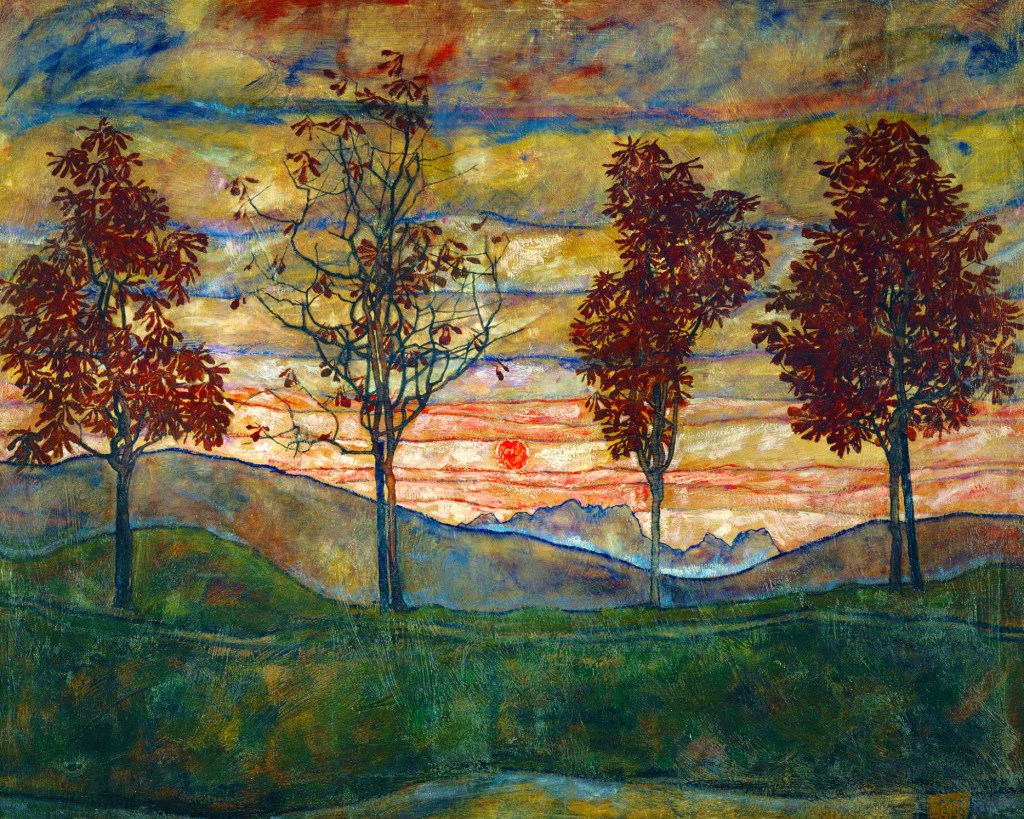
Four Trees, (1917. Oil on canvas) by Egon Schiele. Belvedere, Vienna.

Earlier this week, I took some time to review several hundred works by Egon Schiele (1890–1918), the Austrian Expressionist painter renowned for his intense and raw depictions of the human form. Schiele’s art, with its distinctive distorted body shapes and expressive lines, often explores themes of sexuality and self-examination, particularly in his numerous self-portraits, including nudes. Personally, I am more drawn to his other works—those that portray buildings, landscapes, and more formal sittings—not out of prudishness, but because of his unique ability to capture such scenes with an aesthetic that I appreciate. His mentor, Gustav Klimt, played a significant role in shaping Schiele’s artistic development. A broader collection of his works can be found here: Egon Schiele Overview and at the YouTube video gallery below.

While Schiele’s style is compelling, his biography is troubling, and he is not someone I would have wanted to know personally. Nonetheless, many of his works possess an undeniable aesthetic appeal, although others do not resonate with me as deeply. Two pieces that I find particularly captivating are included in this post—one featured above, and the other below (which reminded me of myself researching for an article or post).

Dr. Hugo Koller (1918, Oil on canvas) by Egon Schiele. Belvedere, Vienna.

For the record, The Cleveland Museum of Art possesses two works by Schiele, neither on display. The more interesting is below.

Portrait of a Child (Anton Peschka, Jr.), [1916, gouache, watercolor, and graphite] by Egon Schiele. The Cleveland Museum of Art, Cleveland.