

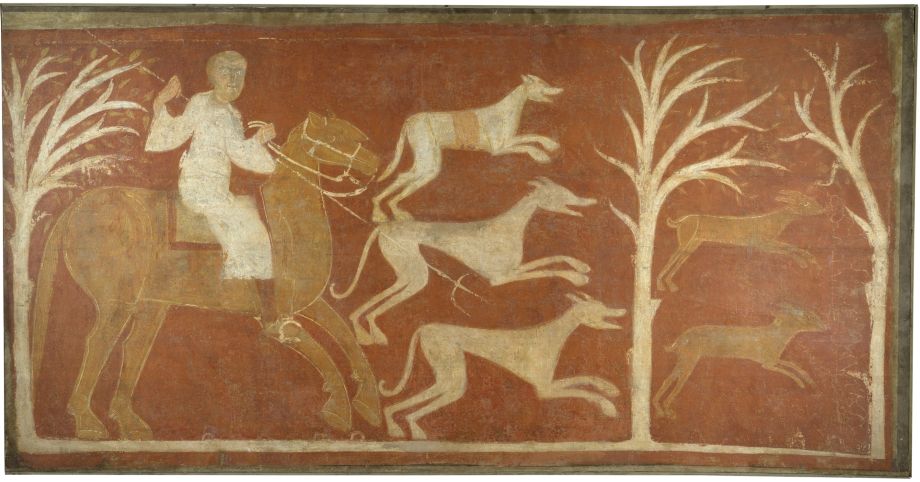
The hunt for the right words often takes place in darkness, while the waking mind rests. Hare Hunt (c. 1125) depicted in this famous fresco from the Prado seems a fitting illustration for my essay exploring my oneiric creative process—given much of my writing involves pursuing words that race ahead faster than I can record them, gifts from the subconscious delivered whole upon waking.
Hare Hunt, Hermitage of San Baudelio, Casillas de Berlanga (Soria)
Anonymous, c. 1125
Copyright ©Museo Nacional del Prado
From my earliest years, my creative process—whether literary or scholarly—has been curiously nocturnal. Much of my work, I have found, is done while I sleep. When faced with a task, I assign it, quite literally, to my subconscious mind and then close my eyes, surrendering to productive sleep.
As a student, this practice became a quiet ritual. When a paper was due, I would already know the topic, the sources I intended to use, and what I wished to accomplish. I would also, admittedly, wait until the evening before it was due—believing, and with reason, that fear brought a clarity of mind that was otherwise lacking. Thus, I would take a short nap before beginning. Upon waking, the entire outline of the paper would be present—clear, complete, and waiting. With a stack of books to my right, a blank sheaf of paper to my left, and a typewriter in front of me, I would set to work, and the paper would unfold almost as if dictated.
My professors noticed this strange fluency. The grades I earned and comments I received reflected it, but more telling were their requests to keep copies of my papers for their own files—something they did not ask of other students. I did not then understand that what they admired was less my discipline, or lack thereof, than the uncanny lucidity of the night mind that guided me.
Over the years, this oneiric gift has only deepened. I remain grateful for it. At times, an entire sentence or paragraph will suddenly appear either as I awake or will awake me in the middle of the night—perfectly formed, insistent, demanding to be recorded before it vanishes. At other times, these moments arrive unbidden, startling me out of unrelated thought; often, they are the flowering of a subject that I had briefly considered and set aside, unaware that it had continued germinating in the depths below consciousness.
When such inspiration surfaces, it comes in torrents. I rush to record the first few words, only to find myself laughing at the impossible speed with which the rest races ahead, leaving me chasing its tail through the air. Madness, perhaps—but a joyous one.
It is as if some part of the mind, working in silence while the waking self is distracted, composes and refines without interference. And when it deems the work ready, it releases it whole into consciousness—seed, stalk, and blossom at once. My task, then, is not to command this process, but to remain open to it, to receive it with gratitude, and to write before the vision fades. Refinement, if needed, may occur later.
What I once mistook for a personal oddity, I now recognize as a shared inheritance of the human mind—the work of the subconscious muse, the night mind ever at her loom, weaving thought into form before dawn breaks—although a nap in the midst of day will oft serve the purpose just as well.
Discover more from Northcoast Antiquarian
Subscribe to get the latest posts sent to your email.


Another extremely remarkable article, Donald, and you’re probably not surprised that some of it seems very familiar to me. Are you aware of how much your character traits are reflected in Daoism? You’re probably familiar with Zhuangzi’s story of the cook Ding, and it reflects it perfectly.
LikeLiked by 1 person
Alas, I am not familiar with Zhuangzi’s story of the cook Ding. I shall have to familiarize myself with it shortly. You have given me a research assignment, my friend!
LikeLike
And here is what I found, based on the assigned reading! Thank you!: [Source: The “Zhuangzi”, translated by Burton Watson and Dr. Robert Eno; Robert Eno, Indiana University]
According to “Tale of Cook Ding” from Chapter 3 of the “Zhuangzi”: “Cook Ding was carving an ox carcass for Lord Wenhui. With each touch of his hand, heave of his shoulder, step of his feet, thrust of his knee – whop! whish! – he wielded his knife with a whoosh, and every move was in rhythm. It was as though he were performing the Dance of the Mulberry Grove or keeping to the beat of the Constant Source music. Ah, marvelous!” said Lord Wenhui. “Surely this is the acme of skill!”, Cook Ding laid down his knife and replied, “What your servant loves, my lord, is the Dao, and that is a step beyond skill.”
“At the beginning, when I first began carving up oxen, all I could see was the whole carcass. After three years I could no longer see the carcass whole, and now I meet it with my spirit and don’t look with my eyes. Perception and understanding cease and spirit moves as it will. I follow the natural form: slicing the major joints I guide the knife through the big hollows, and by conforming to the inherent contours, no vessels or tendons or tangles of sinews – much less the big bones – block my blade in the least.”
“A good cook changes his knife once a year, but this is mere slicing. An ordinary cook changes his knife once a month, because he hacks. I’ve been using this knife now for nineteen years; it has carved thousands of oxen, yet the blade is as sharp as one fresh off the grindstone. You see, there are gaps between these joints, but the blade edge has no thickness. If a knife with no thickness moves into a gap, then it’s wide as need be and the blade wanders freely with plenty of leeway. That’s why after nineteen years the blade of my knife is as sharp as one fresh off the grindstone.”
“But nevertheless, whenever a tangled knot lies ahead, I spot the challenge and on the alert I focus my sight and slow down my hand – then I flick the blade with the slightest of moves, and before you know it the carcass has fallen apart like earth crumbling to the ground. I stand with knife raised and face all four directions in turn, prancing in place with complete satisfaction. Then I wipe off the knife and put it away.” “How fine!” said Lord Wenhui. “Listening to the words of Cook Ding, I have learned how to nurture life!”
Dr. Eno wrote: “The ‘Tale of Cook Ding’ is in some ways the central tale of the ‘Zhuangzi’. It belongs to a set of stories that are sometimes referred to as the ‘knack passages’ of the text. In these tales, individuals penetrate to a state of some sort of unity with the Dao by means of the performance of some thoroughly mastered skill, which they have acquired through long practice of an art (which may be called a Dao, as in ‘the Dao of archery,’ and so forth). The passages celebrate the power of spontaneously performed skill mastery to provide communion with the spontaneous processes of Nature.”
LikeLike