


Language, much like life itself, often reveals the interplay of opposites—light and shadow, creation and destruction, knowledge and ignorance. The study of etymology, the history of words, can uncover surprising connections between concepts that seem worlds apart, offering us profound insights into the human condition. One such connection is found in the shared origin of the words science and shit. Though these words have come to represent vastly different ideas, they both trace their lineage back to the same ancient root: the Proto-Indo-European (PIE) root skei-, meaning “to cut” or “to split.” This essay explores how these seemingly disparate words, rooted in the same ancient origin, serve as powerful metaphors for the light and shadow inherent in the human condition and the perennial quest for understanding.
Proto-Indo-European Roots: The Seeds of Language
Proto-Indo-European (PIE) is not a language we have direct evidence of—it is a reconstructed ancestor, a theoretical framework derived from comparing the languages that descended from it, such as Latin, Greek, Sanskrit, and Old English. PIE roots, like skei-, are the conceptual building blocks from which countless words in these descendant languages evolved. These roots are not words in the modern sense but rather represent basic, primal ideas—actions like cutting or splitting, states of being, or essential objects.
In PIE, the root skei- originally meant “to cut” or “to split.” From this simple, physical concept, a remarkable range of words has emerged across different languages, each bearing the imprint of its original meaning while branching out into diverse semantic fields. This evolution offers us a window into how the same fundamental idea can develop in different directions, leading to words that are as disparate in meaning as science and shit.
The Evolution of Skei- in the Romance Languages
In Latin, skei- evolved into scire, meaning “to know,” which later gave rise to the word scientia and eventually science in English. This path reflects the metaphorical extension of “cutting” as a process of discernment, a way of separating truth from falsehood, knowledge from ignorance.
Beyond scientia, the influence of skei- in the Romance languages is extensive. Consider the Latin word secare, meaning “to cut,” which directly inherits the original sense of the PIE root. From secare stem a multitude of words in the Romance languages associated with cutting, division, and distinction. For example, the English word section derives from the Latin sectio, meaning “a cutting” or “division.” Similarly, segment, from Latin segmentum, refers to something that has been cut off or separated from the whole.
In French, the verb scier (to saw) also traces its lineage back to skei-, emphasizing the physical act of cutting. Meanwhile, the word ciseau (chisel), though phonetically and morphologically transformed, ultimately connects to the same root, representing a tool used to cut or shape materials. Italian retains the word secare (to cut), giving us sezione (section) and segmento (segment), maintaining the connection to division and separation.
Even more abstractly, the root skei- gave rise to words that convey the notion of separating or distinguishing in non-physical ways. The Latin discernere (to discern), combining dis- (apart) and cernere (to sift, to separate), encapsulates the mental process of distinguishing between different ideas or concepts. This term evolved into the French discerner and the Italian discernere, both of which continue to convey the act of intellectual separation and judgment.
The linguistic journey of skei- culminates in the English word science, derived from the Latin scientia. Here, science encapsulates the essence of skei-, as the pursuit of knowledge is fundamentally about separating truth from falsehood, understanding from ignorance. Science, in its most basic form, is the practice of discernment—of cutting through the noise to reveal the underlying principles that govern our world.
The Germanic Branch: From Skei- to Shit
In the Germanic languages, the PIE root skei- also left its mark, though in a different form. The sense of “cutting” or “separating” was preserved, but the focus shifted towards more physical, often bodily, processes. In Old High German, the word scīzan meant “to defecate,” directly preserving the sense of separation as it applies to bodily waste. This verb gave rise to similar terms in other Germanic languages: scheiden in Middle Dutch and skita in Old Norse, all of which convey the idea of separating waste from the body.
The Old English word scitan developed from this same root, referring to the act of defecation. Over time, scitan evolved into shit in Middle English, a term that has persisted into modern English with its meaning largely unchanged. Unlike its Latin counterpart, which evolved into abstract notions of knowledge and discernment, the Germanic branch retained a more literal, physical interpretation of skei-, focusing on the act of excretion.
This divergence is emblematic of the broader thematic dichotomy explored in this essay. The PIE root skei- gave rise to science—the disciplined pursuit of knowledge, marked by precision and intellectual rigor. Yet it also gave us shit—a word rooted in the most basic, physical processes, often associated with what is discarded or deemed unworthy.
A Metaphor for Life’s Duality
The linguistic journey of the PIE root skei- culminates in a profound metaphor for life’s duality: science, the pursuit of knowledge and enlightenment, represents the light, while shit, the rejected and discarded, embodies the shadow. This dichotomy between light and shadow is a theme that resonates deeply across various philosophical and religious traditions, each grappling with the tension between what is revered and what is reviled, what is illuminated and what remains in darkness.

In many philosophies and religions, light is associated with truth, purity, and the divine. In ancient Zoroastrianism, one of the oldest dualistic religions, the eternal battle between Ahura Mazda (the god of light) and Angra Mainyu (the spirit of darkness) symbolizes the cosmic struggle between good and evil. Here, light is knowledge, order, and goodness—concepts closely aligned with what we might associate with science, the disciplined pursuit of understanding that seeks to illuminate the mysteries of the universe. In contrast, Angra Mainyu is associated with the physical world’s corrupt and defiled aspects, bringing death, decay, and moral corruption—elements metaphorically aligned with shit, representing what is base, impure, and rejected.
However, it is important to note that while mainstream Zoroastrianism presents Ahura Mazda and Angra Mainyu as distinct and opposing forces without a common origin, a divergent tradition within Zoroastrianism, known as Zurvanism, offers a different perspective. Zurvanism posits Zurvan (Time) as the primordial deity, the ultimate source from which both Ahura Mazda and Angra Mainyu emerged. Just as the words science and shit diverge from the same linguistic root to embody opposing concepts, Zurvanism’s narrative suggests that the duality of light and darkness, good and evil, originates from a single, primordial source. This perspective mirrors the linguistic evolution we see with skei-, where a single root gives rise to words with vastly different meanings.
Just as the duality of light and darkness is central to Zoroastrian thought, Christianity presents its own understanding of these forces, offering a distinct yet parallel exploration of the tension between good and evil. Although Zurvanism was influential for a time, it was eventually deemed heretical by mainstream Zoroastrianism, which maintained a strict dualism without a common origin for good and evil. This divergence in religious thought parallels the Christian perspective on light and shadow, good and evil.
In Christianity, light is often used as a metaphor for God’s presence, truth, and divine guidance. The creation story in Genesis begins with God’s command: “Let there be light” (Genesis 1:3), bringing light into the void and establishing the foundation of the universe. However, it is essential to recognize that God is also the creator of darkness and shadow. Isaiah 45:7 affirms this: “I form the light and create darkness, I bring prosperity and create disaster; I, the Lord, do all these things.” This verse underscores that both light and shadow, good and evil, are within God’s dominion.

God is also the creator of Satan, originally an angel named Lucifer, who rebelled against God’s authority. According to Christian tradition, as depicted in Paradise Lost by John Milton, Satan’s rebellion leads to his expulsion from Heaven and his fall into Hell. Milton vividly describes Satan’s fall, portraying him as a once-glorious being who becomes the ruler of a realm of darkness and despair, a place of punishment that is also part of God’s creation. In Paradise Lost, Hell is depicted as a kingdom of “darkness visible,” where Satan and his fallen angels are condemned to eternal torment.
This depiction of Hell is further elaborated in Dante Alighieri’s Divine Comedy, particularly in the Inferno. Dante places Satan at the very center of Hell, a realm of perpetual darkness and despair. Here, the damned suffer in various circles filled with filth and excrement, symbolizing the moral corruption that led them to their fate. Especially vivid is his articulation of the fate of flatterers, recounted in Canto XVIII:
“Here we heard people whine in the next chasm,
and knock and thump themselves with open palms,
and blubber through their snouts as if in a spasm.
Steaming from that pit, a vapour rose
over the banks, crusting them with a slime
that sickened my eyes and hammered at my nose.
That chasm sinks so deep we could not sight
its bottom anywhere until we climbed
along the rock arch to its greatest height.
Once there, I peered down; and I saw long lines
of people in a river of excrement
that seemed the overflow of the world’s latrines.
I saw among the felons of that pit
one wraith who might or might not have been tonsured—
one could not tell, he was so smeared with shit.”
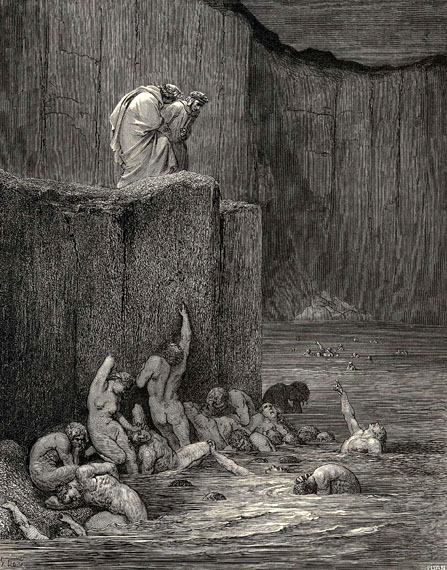
The image of Satan presiding over a kingdom of darkness and filth powerfully illustrates the connection between evil, rejection, and waste—concepts intimately tied to the notion of shit. In Dante’s vision, Hell’s filth is not merely a punishment but a reflection of the inner corruption of the soul, manifesting physically in the environment of the damned.
Darkness and shadow, therefore, are not merely the absence of light but are active forces within the world, created by God to fulfill His divine plan. Just as light reveals and guides, shadow obscures and challenges, reminding humanity of the consequences of straying from the path of righteousness.
The shadow—represented here by shit—carries connotations of what is hidden, ignored, or rejected. In Jungian psychology, the “shadow” represents the unconscious mind, the darker, hidden parts of ourselves that we “cut off,” deny or repress. Jung’s concept of the shadow is not just an abstract idea; it is a fundamental aspect of the psyche that influences behavior, decisions, and self-perception. The shadow is composed of all the aspects of our personality that we do not wish to acknowledge, the traits and impulses that are contrary to our conscious self-image. These elements are not necessarily evil, but they are often perceived as such because they conflict with the ideals and norms of society or our personal moral compass.
Jungian psychology teaches that the shadow must be confronted and integrated into our conscious awareness to achieve psychological wholeness. This process, known as individuation, involves bringing the shadow to light, recognizing it as part of ourselves, and reconciling it with our conscious identity. The failure to do so can result in projection, where we see our own shadow traits in others, or in the shadow manifesting in destructive behaviors.
In a similar vein, Samuel Beckett’s wayfarers in Waiting for Godot find themselves mired in a cyclical existence, often lying in ditches—literal and metaphorical—beset by a sense of futility and degradation. These ditches, filled with the mire of their own making, symbolize the excremental realities that we, too, must navigate. Here, the clash between our lofty aspirations and the baseness of our condition becomes starkly apparent. It is in such moments, where the struggle between light and shadow is most palpable, that the human quest for understanding reaches its existential depths.
A critical part of Carl Gustav Jung’s own journey involved confronting what might be considered the ultimate shadow: the filth and shit inherent in life itself. In a pivotal dream, which Jung described in his autobiography, he saw God defecating on a cathedral. This shocking image challenged his previously held religious beliefs and led him to a deeper understanding that both the sacred and the profane, light and shadow, are intrinsic to the truth of human experience. For Jung, recognizing and integrating these elements was essential to achieving psychological and spiritual wholeness.
The Christian concept of sin and the Jungian shadow share significant parallels. Just as sin is what separates humanity from God, the shadow is what separates the conscious self from the full realization of the psyche’s potential. In both cases, the shadow or sin must be acknowledged and transcended to achieve a higher state of being. The metaphor of shit, then, becomes a powerful symbol for the shadow—something that must be expelled or transformed if one is to attain spiritual or psychological clarity.
Just as the light of science allows us to discern truth, the exploration of the shadow—be it in Dante’s dark realms, Jung’s psychological depths, or the moral struggles depicted in Christian theology—reveals the complexity of the human condition. It challenges us to confront what we might prefer to ignore, to recognize that the pursuit of purpose or truth is not only about enlightenment but also about grappling with the darkness within.
In addition to the psychological insights provided by Jung, the teachings of the 13th-century Persian poet and mystic Jalāl Al-Dīn Muḥammad Rūmī offer a profound perspective on integrating the shadow. Rūmī, known for his deeply spiritual and allegorical tales, explores themes of love, transformation, and the human journey toward divine understanding.
In one tale from his Masnavi, the Prophet Mohammed encounters a man known as the Huge Eater, who, after a night of excessive eating, defecates in his bed. Rather than chastising him, Mohammed quietly cleans the soiled bedclothes. This act of humility and compassion profoundly moves the man, leading to his spiritual awakening.
Rūmī’s tale symbolizes the cleansing of the shadow—what Jung might metaphorically describe as the basest parts of our psyche—transforming what is impure within us into something pure. As Rūmī writes, “When the body empties and stays empty, God fills it with musk and mother of pearl. That way a man gives his dung and gets purity.” This stanza underscores the transformative process, where acknowledging and cleansing these shadow elements leads to spiritual growth. It also subtly alludes to the idea of “cutting off” or removing what is impure to make room for the divine.
Just as Muḥammad’s act of dealing with literal shit in Rūmī’s tale leads to the man’s transformation, so too does the integration of our shadow lead to deeper knowledge and understanding. This mirrors the duality discussed throughout the essay: the interplay between science and shit, light and shadow, and the continuous process of transformation that defines the human experience.
But this exploration of light and shadow, science and shit, extends beyond the mere experience of these dualities. It speaks to the human quest—the relentless search for truth that drives our existence. This quest is fraught with tension, as illustrated in the imagined dialogue I recently wrote between da Vinci and Beckett. Da Vinci, the archetypal figure of the Renaissance, represents the light of reason, the pursuit of knowledge through science and art. Beckett, on the other hand, embodies the existential struggle, the shadow of doubt, despair, and the acknowledgment of the absurdities that define human existence.
Their dialogue captures the essence of this tension: the push and pull between the desire to illuminate the world with knowledge and the recognition of the inherent limitations and darker aspects of that pursuit. It is within this tension that the human search for truth takes place, a journey that is neither straightforward nor devoid of shadow.
In their imagined conversation, continued anew here, Leonardo da Vinci, the Renaissance polymath, questions Beckett about the purpose of his work, Waiting for Godot. Da Vinci, who devoted his life to the pursuit of knowledge and the perfection of art, sees in Beckett’s work an unsettling reflection of the human condition—a world stripped of certainty, where meaning is elusive and the quest for truth is often met with silence.
Da Vinci: “Your characters wait endlessly, in vain, for something—or someone—that never arrives. Is this the conclusion of your inquiry? That we are condemned to wait, to search without hope?”
Beckett: “Leonardo, your works capture the beauty and order of the world, but what of the chaos, the emptiness? My work reflects the shadow, the nothingness that underlies our existence. The quest for meaning is not always met with light; often, it is swallowed by the void. Yet, in the waiting, in the recognition of the absurdity, there is a truth—perhaps not the truth we desire, but a truth nonetheless.”
Da Vinci: “Yet, to acknowledge the void is not to surrender to it. Even in the shadow, there is form, there is structure. My studies of anatomy, of light and shadow, reveal the underlying patterns of life. Can we not find meaning even in the darkness?”
Beckett: “Perhaps. But meaning in darkness is not the same as light. It is ambiguous, fleeting, and it demands a confrontation with the parts of ourselves we’d rather not see—the shadow, as Jung might call it. We cannot have one without the other, can we?”
Da Vinci: “No, we cannot. My work has always sought to unify—to bring together the light and the dark, the known and the unknown. Your work, in its starkness, Samuel, reminds us that this unity is not easily achieved, that the search for truth is fraught with difficulties, and that sometimes, the answers we seek lie in the very questions we ask.”
Beckett: “And so we continue, each in our own way. You with your light, me with my shadow. Both necessary, both incomplete without the other.”
This dialogue between da Vinci and Beckett reflects the core of the human experience—the pursuit of knowledge and meaning, which inevitably involves grappling with both light and shadow, science and shit. It is through this dialectic, this ongoing tension between opposites, that we inch closer to understanding the complex reality of our existence.

Coin image courtesy of Stephen Album Rare Coins.
The Taoist concept of Yin and Yang further encapsulates this duality, with Yin representing the shadowy, passive, and receptive aspects of the universe, and Yang symbolizing the bright, active, and creative forces. Unlike the Western dichotomies of good and evil, light and darkness, Taoism teaches that these forces are not in opposition but are interdependent and interconnected. Yin and Yang exist in a dynamic balance, each necessary to the other—just as science and shit both derive from the same linguistic root, and just as light and shadow originate from the same source. This balance reflects a more holistic understanding of duality, one where opposites are seen not as conflicting entities but as complementary forces that together create a unified whole.
Thus, from a single ancient root, we derive two words that reflect this timeless duality: science, the light guiding us toward knowledge and understanding, and shit, the shadow symbolizing what is cast aside, hidden, or ignored. This divergence serves as a powerful metaphor for the duality inherent in human experience and our ongoing quest for truth. Just as light and shadow originate from the same source, so too do our highest ideals and our basest realities emerge from the same fundamental force.
Recall that Dante’s journey in The Divine Comedy culminates in the Paradiso, where the pilgrim is ultimately united with the divine light, a symbol of ultimate truth and understanding. This final vision represents the fulfillment of the human quest for knowledge and the transcendence of earthly shadows. While Dante’s Paradiso offers an idealized conclusion—one that many might consider beyond the reach of human experience—it underscores the universal journey through light and shadow, science and shit, a path marked by both striving and imperfection.
Indeed, in exploring the relationship between science and shit, we confront the uncomfortable truth that both are essential parts of the human condition—two sides of the same coin, each reflecting different aspects of our quest to understand and navigate the world. The light of science allows us to discern, to separate truth from falsehood, illuminating the path ahead. But the shadow of shit reminds us of the inevitable waste, the parts of our existence that we might prefer to forget but which are nonetheless integral to the whole.
Tracing the evolution of skei- from PIE to modern English deepens our understanding of the intertwined nature of knowledge and waste, creation and rejection, light and shadow. This exploration reveals that these seemingly opposite concepts are, in truth, two sides of the same coin—each essential to the human condition, each a reflection of the complex interplay of light and shadow that defines our existence, and each a testament to the perpetual human quest for truth.
Bibliography
Beckett, S. (2011). Waiting for Godot. Grove Press.
Beekes, R. S. P. (2011). Comparative Indo-European Linguistics: An Introduction (2nd ed.). John Benjamins Publishing Company.
Boyce, M. (2001). Zoroastrians: Their Religious Beliefs and Practices (2nd ed.). Routledge.
Dante Alighieri. (2003). The Divine Comedy. Trans. John Ciardi. New American Library.
De Vaan, M. (2008). Etymological Dictionary of Latin and the Other Italic Languages. Brill.
Fortson, B. W. (2010). Indo-European Language and Culture: An Introduction (2nd ed.). Wiley-Blackwell.
Graver, L. (2004). Beckett: Waiting for Godot (2nd ed.). Landmarks of World Literature. Cambridge University Press.
Harper, D. (n.d.). skei-. In Online Etymology Dictionary. Retrieved August 30, 2024, from https://www.etymonline.com/word/*skei-
Jung, C. G. (1959). Aion: Researches into the Phenomenology of the Self (Collected Works, Vol. 9, Part 2). Princeton University Press.
Jung, C. G. (1963). Memories, Dreams, Reflections. (Aniela Jaffé, Ed., & Richard and Clara Winston, Trans.). Vintage Books.
Kohn, L. (2009). The Taoist Experience: An Anthology. State University of New York Press.
Laozi. (2003). Tao Te Ching. Translated by D. C. Lau. Penguin Classics.
Mallory, J. P., & Adams, D. Q. (1997). Encyclopedia of Indo-European Culture. Fitzroy Dearborn Publishers.
Mallory, J. P., & Adams, D. Q. (2006). The Oxford Introduction to Proto-Indo-European and the Proto-Indo-European World. Oxford University Press.
Milton, J. (2008). The Major Works including Paradise Lost. Oxford University Press.
New International Version. (2011). The Holy Bible. Zondervan.
Rumi, J. (2004). The Essential Rumi (New Expanded Edition, Translated by Coleman Barks). HarperOne.
Watkins, C. (2000). The American Heritage Dictionary of Indo-European Roots (2nd ed.). Houghton Mifflin Harcourt.
Yarab, D. S. (2024, August 29). Exploring Art and Existence: A Dialogue Between Leonardo da Vinci and Samuel Beckett. North Coast Antiquarian. https://northcoastantiquarian.com/2024/08/29/exploring-art-and-existence-a-dialogue-between-leonardo-da-vinci-and-samuel-beckett/




 Northcoast Antiquarian