The Thasian tetradrachm is among the most recognizable silver issues of the late Hellenistic world. Its garlanded Dionysus and its heroic Herakles circulated widely across the Balkans and the Lower Danube, where they became prototypes for the diverse and often striking imitative series struck by Celtic and other tribal groups from the late second to first century BC.
ISLANDS OFF THRACE, Thasos. Tetradrachm, c. 148-90/80 BC. (Silver, 16.96 g, 10 h). Obv. Head of Dionysos to right, wearing ivy wreath. Rev. ΗΡΑΚΛΕΟYΣ ΣΩΤΗΡΟΣ ΘΑΣΙΩΝ Herakles standing facing, head to left, resting his right hand on grounded club and with lion’s skin draped over his left arm; in field to left, monogram. American Numismatic Society, 1948.19.583, CC BY-NC 4.0
One such Celtic imitation appeared recently at auction. The obverse presents a highly abstracted Dionysus—angular, almost post-modern with geometric features—while the reverse reduces Herakles to a ritual stick figure framed by pellet-rows.
LOWER DANUBE REGION. Imitation of Thasos. Late 2nd-1st century BC. Tetradrachm (Silver, 32 mm, 16.36 g, 12 h). Obv. Highly stylized head of a youthful Dionysos to right. Rev. Herakles, in the form of a stick figure, standing facing, holding a club in his right hand with cloak over his left arm; four rows of pellets to left and right, and a single row below. Nomos 37, Lot 16 (November 2025)
The cataloguer rightly observes that these transformations reflect indigenous artistic traditions rather than “primitiveness,” a point well aligned with contemporary scholarship on Celtic visual language. There is no question that the engravers were interpreting, not merely degrading, the Hellenistic prototypes.
It must be said that the auction house in question is one for which I hold the highest regard. Its catalogues have long exemplified best practice: careful numismatic description, transparent provenance, and a consistent habit of guiding collectors toward relevant current scholarship. Precisely for that reason, the explanatory note appended to this coin was so noticeable. Beneath an otherwise exemplary entry appeared the following claim:
” … recent research suggests that the striking of coins by the Celts, the ancient British, and other ancient peoples, other than the Greeks and Romans and those very strongly influenced by them, had a highly ritualistic nature. Ancient sources tell us that prior to the beginning of the minting process, the ancient die engravers would drink copious amounts of what is now known as poitín or poteen, thus, providing them with visions that they then tried to engrave. Looking at the surviving coins makes this theory seem highly likely.”Nomos 37, Lot 16
It is a vivid statement. It is also, in every sense, extraordinary.
No ancient textual source with which I am familiar describes Celtic or Danubian engravers intentionally entering states of ritual intoxication in order to produce dies. No archaeological, metallurgical, or workshop evidence with which I am familiar supports the notion of visionary drink preceding coin production. While ecstatic ritual and alcohol appear in broader Celtic cultural contexts, such general ethnographic data cannot be converted into specific claims about the minting process without concrete evidence.
Stylistic abstraction in Celtic numismatics has long been understood more soberly: as a deliberate reinterpretation of Greek prototypes through indigenous symbolic systems with their own aesthetic grammar. These coins do not require intoxicated celators to be understood; indeed, there is nothing in their style that supports such a narrative.
If research genuinely exists supporting this theory, it ought to be cited with author, title, publication, and date—particularly because the claim is, by its nature, difficult if not impossible to substantiate even if there were scant wisps of archaeological or textual evidence suggestive of such practices. The omission of such citation risks misleading those who encounter the statement and, unintentionally, lowering the high scholarly standard that this firm has otherwise consistently upheld.
The coins themselves are reward enough. Set beside the Thasian model, the Celtic imitation is not a drunken distortion but a cultural reinterpretation—evidence of a visual world reshaping the Hellenistic canon according to its own inherited forms. To impose a tale of visionary potions upon the engravers is not only unnecessary but obscures the far more interesting truth: that artistic autonomy, not intoxication, shaped these remarkable issues.
It is even more speculative than the tulips of tulipmania—less beautiful, less tangible, and arguably, less of an asset. Tulips, after all, at least bloomed.
Cryptocurrency has become the modern symbol of speculative excess: a phenomenon untethered from utility, value, or service to the common good. Its defenders proclaim it a revolution in finance, a challenge to the tyranny of central banks, a restoration of liberty through cryptographic purity. But peel back the gilded claims, and one finds something more brittle, more hollow, and perhaps more dangerous.
To be fair, cryptocurrency does serve certain functions. In Venezuela, citizens use Bitcoin to preserve wealth as their currency hyperinflates. In countries with collapsed banking systems, people rely on digital tokens for remittances. In regions where governments block financial transactions, cryptocurrency provides an escape valve. These are real uses, serving real needs.
But examine why these uses exist, and a darker picture emerges. Cryptocurrency functions not as a superior alternative to traditional finance, but as digital tree bark—emergency sustenance consumed only when the normal food supply has failed. It works precisely because the alternatives are catastrophically worse: worthless fiat, collapsed institutions, criminal governments. This is not cryptocurrency succeeding on its merits; it is cryptocurrency serving as expensive, volatile intermediary in humanity’s most desperate financial moments.
The Venezuelan using Bitcoin is not proving cryptocurrency’s revolutionary potential—they are demonstrating what happens when a society’s monetary system breaks down. The remittance flowing through Ethereum is not evidence of innovation—it is a costly detour around institutional failure, adding friction, fees, and volatility risk to what should be a simple transfer. Cryptocurrency serves merely as an expensive, volatile intermediary in what remains, at core, a fiat transaction. Convert fiat to cryptocurrency, pay network fees, endure price swings, convert back to fiat, pay more fees. The process only makes sense when every other option is worse.
Yet cryptocurrency evangelists take these edge cases—where their system barely outperforms complete collapse—and extrapolate them into grand claims about the future of all finance. They mistake being marginally better than failed institutions for being superior to functional ones. Should we design our financial systems around the needs of failed states and criminal enterprises? Should we burn massive amounts of energy to create digital workarounds for institutional breakdown, rather than strengthening the institutions that serve stable societies?
This is not currency in any meaningful sense of the term. It is not a stable store of value. It is not a consistent medium of exchange. It is barely a unit of account. What it offers, rather, is a kind of digital alchemy, where symbols stand in for substance and belief masquerades as value.
For the early adopter, it is a lever for disproportionate gain. For the tax dodger and the launderer, it is a haven of shadows. For the credulous speculator, it is a mirage of easy wealth—a mirage often followed by collapse. And for the society that tolerates it, it is a siphon, draining energy—literal and metaphorical—from more productive ends.
Nor is this merely a matter of theory. In 2023 alone, blockchain analysis firms estimated that over $22 billion in illicit funds were laundered through cryptocurrencies—much of it routed through decentralized exchanges, mixing services, and prepaid debit card schemes. From sanctioned regimes like Iran and North Korea to transnational crime syndicates and terrorist networks, cryptocurrency now functions as the infrastructure of choice for bypassing traditional surveillance. It is not only opaque; it is portable, borderless, and persistently one step ahead of enforcement.
The value of Bitcoin, or any coin, is not intrinsic. Gold, whatever its monetary mystique, at least has industrial applications—electronics, medical devices, aerospace components. Strip away gold’s monetary role, and it retains a floor value based on genuine utility. Cryptocurrency offers no such foundation. It represents only that some energy was spent and some consensus achieved that a bit of code might be worth something to someone else. Unlike fiat currency—however imperfect—which is at least nominally governed by institutions with public obligations, cryptocurrency is governed by no one and manipulated by many.
Cryptocurrency’s history is not merely volatile—it is littered with failure. From BitConnect’s Ponzi scheme and OneCoin’s fabricated blockchain to meme-based absurdities like Coinye (sued into oblivion by Kanye West), entire ecosystems have collapsed under the weight of fraud or fantasy. More quietly, hundreds of lesser-known coins—Auroracoin, Peercoin, Feathercoin, Nxt—have faded into digital irrelevance. According to independent trackers, over 2,000 cryptocurrencies have already failed, often within a year or two of launch.
The blockchain may be secure, but the ecosystem is anything but. Scams, rug pulls, pump-and-dump schemes, and algorithmic collapses litter the field like digital detritus. And still the faithful chant the liturgy of decentralization, innovation, and inevitability.
The irony is almost poetic. A movement born from distrust of fiat currency has created something far less stable, far less transparent, and far more volatile. At least fiat is answerable to a polity. Cryptocurrency is answerable only to its market—and its market often answers to no one but the early sellers.
What was once billed as a decentralized revolution has, under the current administration, become a centralized enterprise of a different kind—one in which the instruments of state are quietly repurposed to serve private gain. Since President Trump’s return to office, enforcement actions against cryptocurrency firms have been reversed, regulations have been softened, and public officials with deep ties to the industry have assumed the very posts designed to police it. At the center of this permissiveness is a blatant conflict of interest: the Trump family’s own holdings in digital assets—including the $TRUMP meme coin, the USD1 stablecoin, and affiliated ventures—are now believed to rival or exceed the value of their traditional real estate empire. Cryptocurrencies are no longer mere instruments of speculation; they have become the administration’s preferred asset class. In this light, regulatory indifference is not ideological—it is financial. The state is no longer simply tolerating speculative delusion; it is underwriting it. The line between financial fraud and political favoritism has not just blurred—it has all but vanished.
What we are witnessing is not the future of money, but the future of speculation unmoored from labor, utility, or production. It is a theater of illusion, where wealth appears without work, where tulips bloom not in soil but in code, and where the coin in the hand may vanish before it ever finds use.
As governments struggle to keep pace, the anonymity and jurisdictional fluidity of cryptocurrency shield perpetrators behind webs of decentralized complexity. One high-profile case involved a dark web site trafficking in child exploitation, where more than 1.3 million separate cryptocurrency addresses were used to obfuscate payment trails. Investigators ultimately uncovered the network only through transnational cooperation and painstaking digital forensics. Yet such victories are rare. In most cases, enforcement plays an endless game of jurisdictional whack-a-mole—outmatched by technology’s relentless innovation and the absence of unified oversight.
The few legitimate uses of cryptocurrency—preserving wealth during hyperinflation, circumventing capital controls, enabling remittances where banks have failed—are symptoms of institutional pathology, not harbingers of financial evolution. Building speculative manias around emergency measures is both dangerous and absurd. These are not features to celebrate but problems to solve through stronger institutions, not weaker ones.
It is not that all cryptocurrency is criminal, nor that all who engage with it are fools. But the overwhelming dynamic is clear: a frenzy of fools and frauds, chasing magic coins in the digital gutter, while the desperate few who genuinely rely on these digital workarounds bear the cost of everyone else’s speculative delusions.
An Essay on Memory, Power, and the Blood Beneath Our Feet
By Donald S. Yarab
“Taking the proceedings of the Athenians toward Melos from the beginning to the end, they form one of the grossest and most inexcusable pieces of cruelty combined with injustice which Grecian history presents to us … But the treatment of the Melians goes beyond all rigor of the laws of war; for they had never been at war with Athens, nor had they done anything to incur her enmity ….” George Grote, A History of Greece (London 1850) VII, 114.¹
Though we may think otherwise, we are a belligerent people. We flatter ourselves with tales of virtue, liberty, and civilization, but our history betrays us. We are heirs not only to triumphs of culture, learning, and law, but to the unspoken litany of conquest, subjugation, and blood. The soil itself bears witness. Its silence is not empty. It murmurs the blood of men and the cries of women and children—those cast aside, broken, forgotten, or made invisible by the forward march of empire.
This thought came to me not through modern headlines, though there are many that might summon it, but while reading of the Peloponnesian War—of its needless provocations, of its spiraling brutality, of Athens, the “enlightened city,” casting off the veil of philosophy to reveal the naked face of power. It was not necessity that brought on that war, Thucydides tells us, but desire. Desire for power. Desire to dominate. Desire to possess what one has not earned and cannot keep without violence.
Nowhere is this desire more exposed than in the fate of Melos.
During a lull in the great war between Athens and Sparta, the Athenians sailed to the small island of Melos, which had attempted to remain neutral. The Melians appealed to justice, to their rights as a small people, and to the protection of the Spartans with whom they shared kinship. The Athenians responded with brutal clarity: “The strong do what they can, and the weak suffer what they must.”² When Melos refused to surrender, the Athenians besieged and conquered the city. They slaughtered the men. They enslaved the women and children.³
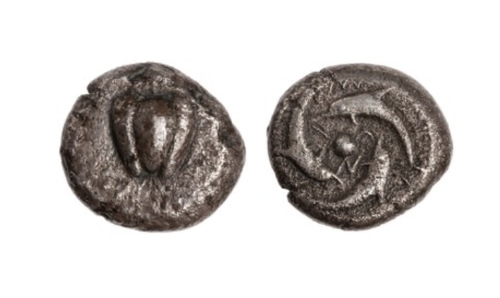
Before its destruction, Melos minted coins bearing the image of an apple—mēlon in Greek, a deliberate pun upon the island’s name that now carries unintended prophetic weight.⁴ And in this small emblem, I saw more than a civic badge. I saw a symbol that reached backward to Eden.
Silver stater of Melos, buried c. 416 B.C. as the Athenians laid siege. The obverse of the coin bears an apple—mēlon—on the obverse, a pun on the city’s name. The reverse shows dolphins swimming around a central boss. The coin was not recovered until discovered in the early 20th century. Image courtesy of American Numismatic Society 1944.100.27879 CC BY-NC 4.0
The apple—though scripture never names the fruit—is a stand-in, in Christian tradition, for the forbidden fruit of knowledge. With it came the mythical expulsion from paradise and the ensuing inheritance of suffering, toil, and death. But in our age, as in ages past, we have not been cast out merely for seeking knowledge. We have been cast out for failing to know ourselves.
We do not seek knowledge. We seek dominion. We crave possession—of land, of treasure, of people. And in so doing, we deny our complicity. We forget. We suppress. We sanctify the victors and silence the conquered. From age to age, we retell only the parts of the story that flatter us.
And here lies the uncomfortable mirror.
In this, we are more like Athens than we care to admit. Like them, we cloak power in principle. And like them, we forget.
We in the United States have long imagined ourselves the inheritors of Athenian democracy. We trace our civic ideals to their assemblies, our rhetoric to their orators, our architecture to their temples. We forget, or do not care to remember, that Athens was also an imperial power, that its democracy was partial and exclusionary, and that it extorted tribute, enslaved its enemies, and turned allies into subjects. At Melos, it abandoned all pretense of justice. It wielded power for its own sake and cloaked the sword in reason.
So too have we. We have invaded and occupied, supported tyrants when convenient, and crushed the aspirations of distant peoples in the name of freedom. At home, we have reaped the fruits of conquest while teaching ourselves to hear only the hymns of progress and patriotism.
Consider the Trail of Tears—where we marched Cherokee, Creek, and other nations from their ancestral lands to distant territories, causing thousands of deaths. That forced removal, justified by the rhetoric of “civilization” and “progress,” has spiraled into generations of poverty, educational disadvantage, and health crises on reservations. Even today, as Native communities face disproportionate hardships, we struggle to acknowledge our national policies as their root cause.
Or look to El Salvador and Nicaragua, where American foreign policy in the 1980s supported authoritarian regimes and death squads in El Salvador while simultaneously funding the Contra rebels against Nicaragua’s Sandinista government—all in the name of anti-communism. Our military aid facilitated massacres of civilians in both countries, devastated civil society, and undermined democratic institutions. The ensuing regional instability bred gangs, poverty, and the very migration crisis that excites our domestic politics today. Yet few Americans connect today’s asylum seekers to our own actions decades ago. Like Athens at Melos, we exercise power, then avert our eyes from the consequences. Yet evidence of our actions remains, waiting to be unearthed.
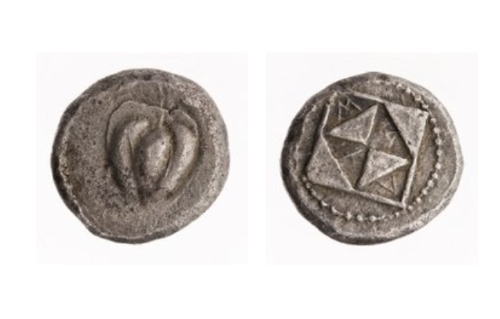
Another silver stater from the soil of Melos, the blood speaks still. This one was also buried in c. 416 B.C. likely during the Athenian siege and recovered only in 1907. On the obverse it too bore the civic emblem, the apple. Its reverse, however, featured a square divided into four triangles. Image courtesy of American Numismatic Society 1959.70.2 CC BY-NC 4.0
From the soil of Melos itself, the blood speaks still. In 1907, a hoard of silver coins was unearthed—buried, according to scholars, in 416 B.C. as the Athenians closed in.⁵ Those who hid them did not live to recover the coins. Both coins bear on the obverse the apple—the symbol of Melos, its punning emblem, its name. But their reverses differ: one shows dolphins encircling a central boss, evoking the sea that once embraced the island; the other, a square divided into four triangles. These buried apples of silver—like their biblical counterpart—bear knowledge too painful to confront: the truth of what power does when unbound by conscience. These coins, long entombed, bear no voices. Yet they cry out. Like Abel’s blood, they testify—not in sound, but in presence. That these objects survived while their owners perished is both historical evidence and perfect metaphor—artifacts outlive empires, bearing witness long after the powerful have fallen. Metal as memory. Silver as witness.
We are not alone in this legacy. But neither are we innocent. The voice of justice does not go silent simply because we stop our ears. As in Genesis, so in history: the blood cries from the ground.⁶ And though we deny it, the Eternal hears.
The apple on the coin of Melos is a relic now, but its meaning remains. It is a warning. It is a mirror. Excavated from darkness, these silent witnesses challenge our comfortable narratives. It is a fruit offered again and again to each generation: not to reveal what lies in the heavens, but what lies within ourselves.
Until we dare to eat of that fruit—not in pride, but in truth—we shall remain wanderers east of Eden, armed with denial, and thus, with destiny.
Footnotes
¹ Seaman, Michael G. “The Athenian Expedition to Melos in 416 B.C.” Historia: Zeitschrift für Alte Geschichte, vol. 46, no. 4, 1997, p. 385. The epigraph featured above is an adaptation of the citation used in Seaman’s essay, which being a fine summary of emotive outrage at Athenian transgressions, could not be more finely articulated.
² Thucydides, History of the Peloponnesian War, Book V, §§89–116. The quoted phrase is a paraphrase of the Athenian argument in the Melian Dialogue, often rendered: “The strong do what they can, and the weak suffer what they must.” See: Robert B. Strassler, ed., The Landmark Thucydides (New York: Free Press, 2008), 352.
³ See Seaman, Michael G., ibid., pp. 385–418, for a detailed discussion of the motives and actions surrounding the Athenian assault on Melos.
⁴ On the apple (mēlon) as a civic pun in Melian coinage, see Sheedy, Kenneth. “Aegina, the Cyclades and Crete.” In The Oxford Handbook of Greek and Roman Coinage, ed. William Metcalf, 2012, p. 112.
⁵ See: Kallet, Lisa and John H. Kroll, The Athenian Empire: Using Coins as Sources (Cambridge University Press, 2020), 105.
⁶ Genesis 4:10: “The voice of your brother’s blood is crying to me from the ground.”
THE KING’S DELIVERANCE – A “Hymn” commemorating the rescue of the King from an attempted kidnapping by the Bar Confederation conspirators in 1771.
It is with pleasure that I share with you The King’s Deliverance, a musical composition inspired by the 1771 AR Medal crafted by Johann Leonhard Oexlein. This piece sets to music the lyrics written to commemorate the remarkable escape of King Stanisław August Poniatowski from an attempted abduction by the Bar Confederation, a group of Polish nobles opposed to Russian influence in the Polish-Lithuanian Commonwealth.
The medal, with its powerful inscriptions from the Psalms and intricate artistic details, captures the moment when “divine providence” intervened to protect the king. It symbolizes not only his deliverance but also the mercy he showed towards those who conspired against him. This event, which unfolded on the night of November 3, 1771, had far-reaching consequences, ultimately strengthening the king’s position. The hymn highlights the themes of justice and divine protection.
For those interested in a more detailed exploration of the medal and the history of the incident, I refer you back to an earlier post where I provide a fuller explanation of these significant historical elements.
The King’s Deliverance seeks to encapsulate these historical themes through music and lyrics, offering a tribute to this significant moment in Polish history. You are invited to watch the video and reflect on the enduring legacy of King Stanisław August’s resilience and mercy.
The content details the historical events surrounding the rise and fall of Eumenes III, also known as Aristonicus, in the kingdom of Pergamum. It explores the political turmoil and power struggles involving Rome, rebellions, and military confrontations. The narrative also touches upon the potential for a compelling play or opera based on these events, with a focus on the character development of key figures. The text is supplemented with an excerpt from a possible libretto, where Aristonicus reflects on his fate. Overall, it provides rich material for dramatic storytelling, combining historical significance with personal introspection.
A snippet of Aristonicus’ story as “opera.”
The Roman Prequel: Tiberius Gracchus and the Bequest of Attalus III
In the late 130s BC, Tiberius Gracchus, serving as a tribune in Rome, emerged as a polarizing figure through his vigorous advocacy for the passage of the lex agraria. This legislation aimed to redistribute land from the affluent elite to the impoverished masses, engendering substantial animosity among the propertied interests. Reflecting the entrenched hostility of these interests, the Roman Senate obstructed the law’s implementation by withholding the requisite funding, thus stymying Gracchus’ reformist agenda.
In 133 BC, the political tensions reached a crescendo when Tiberius Gracchus “accepted” the bequest of Attalus III of Pergamum. Upon his death, Attalus III bequeathed his kingdom, personal treasure, and royal estates to the Roman people. This testament explicitly excluded the city of Pergamum, other Greek cities with their respective territories, and temple lands from the bequest. Gracchus sought to employ this newfound wealth to finance his agrarian reforms, viewing it as an opportunity to alleviate social inequalities. However, his opponents perceived this maneuver as an audacious encroachment upon the Senate’s prerogatives and an exacerbation of the threat to property rights and societal propriety.
Kingdom of Pergamum circa 188 B.C. under the Attalid Dynasty The Kingdom of Pergamum, located in Asia Minor, was ruled by the Hellenistic Attalid Dynasty. This dynasty was founded by Philetairos, who ruled from approximately 282 to 263 B.C. In 188 B.C., the kingdom greatly benefited from the Treaty of Apamea, whereby the Roman Senate granted Pergamum extensive territories formerly held by the defeated Seleucid Empire.
In the wake of these escalating tensions, Gracchus’ adversaries felt justified in resorting to extralegal measures. In a purported “defense” of property and societal order, they orchestrated the murder of Tiberius Gracchus and unceremoniously disposed of his body in the Tiber River. A subsequent purge of his followers from the political sphere ensued, marking a dark chapter in Rome’s history. This brutal response underscored the lengths to which the conservative elite were willing to go to preserve their privileges and stifle reformist efforts.
The Challenge to Attalus III’s Bequest in Pergamum: Rise of Aristonicus
The statue of Aristonicus, known as Eumenes III, King of Pergamum between 133-129 BC, which stands in the city of Pergamum, now known as the city of Bergama, Turkey.
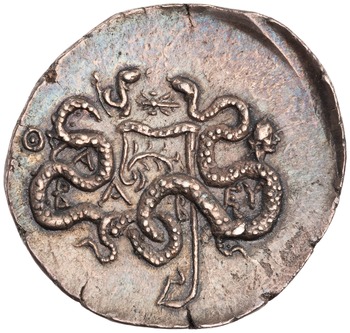
Meanwhile, in Pergamum, Aristonicus, the half-brother of Attalus III and son of Eumenes II and a harpist or lyre-player from Ephesus, declared his intention to seize the throne of Pergamum by right of his lineage, irrespective of the intentions of Attalus III and the Romans. Adopting the regnal name Eumenes III, Aristonicus garnered significant support, amassing both troops and ships, and commenced his campaign to conquer the kingdom of Pergamum. Initially, he achieved notable successes both on land and at sea. He raised the standard of uprising at Leucase, Phocaea joined him, and he conquered Colophon, Notium, Samos, and Myndus. His efforts were further bolstered by his ability to secure sufficient precious metals and strike them into coinage, as evidenced by the cistophorus illustrated below. The coinage series, and its significance, is discussed in an interesting 2021 article written by Lucia Carbone, “A New-ish Cistophorus for the Rebel Aristonicus.”
Reverse of AR cistophorus of Eumenes III of Pergamun featuring two coiled serpents between bow-case and bow. BA EY, a winged thunderbolt above the bow-case and a beardless male head in field right.ANS 1944.100.37579 American Numismatic Society
Roots and Support of Aristonicus’ Uprising
Aristonicus’ uprising was fundamentally rooted in the succession crisis following the death of Attalus III. As an illegitimate son of Eumenes II, Aristonicus claimed the throne of Pergamon under the name Eumenes III, challenging the Roman claim based on Attalus III’s testament. His campaign can be viewed through several lenses:
Dynastic Claim: Aristonicus presented himself as the rightful heir to the Pergamene throne, contesting the Roman-imposed transition. This dynastic legitimacy resonated with certain segments of the population who were loyal to the Attalid lineage.
Social and Economic Grievances: The uprising tapped into widespread discontent among various social groups, including disenfranchised citizens, slaves, and other marginalized populations. Aristonicus’ promise of social reform and liberation found a receptive audience among those dissatisfied with the existing social and economic order.
Anti-Roman Sentiment: There was considerable resentment towards Roman interference and the impending direct control over Pergamon. Aristonicus’ resistance symbolized a broader opposition to the expansionist policies of Rome and its impact on local autonomy.
Support Base
Aristonicus’ supporters came from diverse backgrounds, reflecting the multi-faceted nature of the uprising:
Disenfranchised Individuals and Slaves: A significant portion of Aristonicus’ forces consisted of slaves and lower-class citizens. The promise of freedom and a more equitable society motivated these groups to join the uprising. Aristonicus’ vision of a utopian society, often referred to as “Citizens of the Sun” (Heliopolitae), aimed to create an egalitarian state that resonated with these marginalized groups [Recent scholarship provides ample grounds to re-evaluate the significance and meaning of the Heliopolitae titulature and the role of slaves/disenfranchised individuals. (see Daubner in sources below)].
Local Greek Cities: While some Greek cities in Asia Minor supported Rome, others were sympathetic to Aristonicus, driven by a desire to preserve their autonomy and resist Roman dominance. These cities provided crucial support in terms of resources and manpower.
Mercenaries and Soldiers: Aristonicus also attracted professional soldiers and mercenaries who saw an opportunity in the conflict. Their military expertise was vital in the early successes of the uprising.
Eumenes III (Aristonicus): The Struggle for Support and Survival
Eumenes III (Aristonicus) faced significant challenges in his bid to consolidate power. Despite his initial successes, he failed to win over many citizens of the city of Pergamum itself and was unable to conquer the city. It is plausible that the citizens believed they would be better off freed from royal governance and trusted that the Romans would honor Attalus III’s will by not incorporating them directly under Roman rule. Furthermore, Eumenes III did not gain the support of the kings of neighboring Hellenistic kingdoms, all of whom marched against him at Rome’s behest. These neighboring monarchs, wary of Aristonicus’ revolutionary ideals and eager to maintain favorable relations with Rome, aligned themselves against him.
Despite this formidable opposition, Rome’s local allies initially struggled to subdue Eumenes III. His forces proved resilient and capable, inflicting notable casualties on their adversaries. A significant moment in the conflict was the death of Ariarathes V of Cappadocia, who perished in battle against Aristonicus’ forces, underscoring the intensity and ferocity of the resistance. The support Aristonicus garnered from disenfranchised groups, including slaves and lower-class citizens, played a crucial role in sustaining his campaign against the combined might of Rome and its allies.
By 131 BC, the Romans were compelled to dispatch an army under the command of the consul Publius Licinius Crassus Mucianus to confront the challenge posed by Eumenes III and secure the legacy bequeathed to them by Attalus III. However, Crassus Mucianus was captured by Eumenes’ forces and, after striking one of his captors, was killed. His decapitated head was sent to Eumenes III, marking a grim turn in the conflict. This event underscored the determination and ferocity of Aristonicus’ resistance, significantly alarming Rome and its allies.
The Beginning of the End for Aristonicus
Although the defeat of a Roman army could have signaled the beginning of success for Eumenes III, it was, in fact, the onset of his decline. This turn of fortune came not at the hands of the Romans, but from Ephesus. Unsettled by the new king’s numerous naval victories and conquests, Ephesus armed a fleet and engaged Eumenes III in battle off the coast of Cyme in Aeolis. The outcome was decisive, forcing Eumenes to abandon the coast and withdraw into the interior.
This defeat also marked a transformation in the character of Eumenes III’s reign. In an effort to broaden his appeal and replenish his forces, he called upon peasants from royal domains, slaves, and others whom historians characterize as underprivileged. To the slaves, he promised freedom; to the others, economic relief. His appeal was successful, and multitudes responded to his call. He named his new followers Heliopolitae [Ἡλιοπολῖται], Citizens of the Sun.[1] This utopian vision of a society based on equality and justice resonated deeply with those disenfranchised by the existing order.
Ideological Influences: Blossius of Cumae and the Heliopolitae
One must wonder if Eumenes was motivated in the “social program” of his recruitment campaign (e.g., emancipation and economic relief) by his reported association at this point with the Stoic philosopher Blossius of Cumae, a devoted ally of Tiberius Gracchus. Blossius had fled Rome after Tiberius’ murder and attached himself to Eumenes. Some historians perceive Blossius’ ideological influence in the Heliopolitae movement. Blossius, having been a proponent of the Gracchan reforms, likely brought with him a philosophical foundation that emphasized social justice and the alleviation of inequality. His presence in Eumenes III’s court suggests a continuity of the radical ideas that had stirred Rome, now transplanted to Asia Minor and adapted to the local context.
The Final Defeat and Capture of Eumenes III
In the wake of Crassus’ defeat in 130 B.C., the Roman Senate dispatched the consul Marcus Perperna to subdue Eumenes III and secure the Kingdom of Pergamum for Rome. Perperna promptly arrived, assembled his troops, and marched into the interior, where he decisively defeated Eumenes. Aristonicus had expanded his campaign inland, focusing on regions such as Lydia and Mysia, including the strategic city of Kyzikos. His efforts in these areas were marked by a combination of military engagements and political maneuvering to gain the support of local populations. Despite these efforts, Eumenes was ultimately outmatched by the superior Roman forces. Following his defeat, he fled to the city of Stratonicea, where the Romans besieged him. The siege was marked by a protracted struggle, as the Romans systematically cut off supplies, starving the city and its defenders into submission. Ultimately, Eumenes was captured and sent to Rome in chains. In 129 B.C., the Senate decreed his execution by strangulation, thus extinguishing his challenge to Roman authority.
Consolidation of Roman Rule and the Fate of the Heliopolitae
Following the capture of Eumenes III, the Romans proceeded to organize the new province of Asia, despite ongoing resistance from the remnants of the Heliopolitae. These remnants, inspired by the egalitarian ideals of Aristonicus, continued to resist Roman domination. However, their defiance was brutally quashed by the Romans, who resorted to poisoning the water supplies of their impregnable strongholds—a tactic even they considered disgraceful. By 129 B.C., or 127 B.C. at the latest, the Romans had likely secured their Attalid inheritance, fully integrating the territory into the Roman Republic.
Is there a libretto or play in the story above?
This exposition is recited with confidence that it provides rich source material for a compelling play or opera. Indeed, I have begun work on such a project, sketching the broad outlines of a libretto—acts and scenes—and have already written substantial portions. Recognizing my weaknesses in character development, I am focusing on refining this aspect. However, I am pleased with one section I have written. After Aristonicus has been captured and is in chains, he contemplates his situation. Below is a scene I have written, set to music so I have a sense of the possibilities:
Audio Music file of Aristonicus in Chains (Lyrics by D.S. Yarab, Music created using Udio.com)
Aristonicus in Chains
Setting: A dark Roman dungeon. Aristonicus, bound in chains, reflects on his fate and the enduring spirit of his cause.
Aristonicus (Recitative):
Oh fate, thou art a cruel mistress, To wrest my dreams and cast them low. Yet here I stand, though bound in chains, My spirit soars, untouched by woe.
Aristonicus (Aria):
In chains, my spirit stands free, No Roman yoke shall master me. For in my heart, a kingdom lives, A beacon bright, the Sun still gives.
Oh, Citizens of the Sun, Your hope was mine, our battle won, Not in the fields where we did fall, But in the hearts that heeded our call.
From Pergamum’s hills to the wide sea, Our dream of freedom shall always be. Though walls of stone around me rise, The Sun shall never set on skies.
Oh, Perpernas, behold my fate, A king unbowed by Roman hate. For even in this darkest hour, My will remains, my soul has power.
(Bridge):
To the poor and enslaved, my voice shall reach, In every heart, our cause I’ll teach. No chains can hold what is divine, Our struggle, our dream, forever shine.
(Aria da capo):
In chains, my spirit stands free, No Roman yoke shall master me. For in my heart, a kingdom lives, A beacon bright, the Sun still gives.
Oh, Citizens of the Sun, Your hope was mine, our battle won, Not in the fields where we did fall, But in the hearts that heeded our call.
(Recitative):
So take me now, to Rome’s great halls, But know this truth, as empire falls: A dream once born, can never die, In chains, my spirit soars the sky.
SOURCES:
Africa, T. W. (1961). Aristonicus, Blossius, and the City of the Sun. International Review of Social History, 6(1), 110-124.
Daubner, F. (2006). Bellum Asiaticum: Der Krieg der Römer gegen Aristonikos von Pergamon und die Einrichtung der Provinz Asia (2nd ed., Quellen und Forschungen zur Antiken Welt 41). München: Herbert Utz Verlag. [*Daubner’s work is the current definitive study on the Aristonicus uprising and the establishment of the Roman province of Asia. It challenges many of the outlines of the traditional scholarship over the past century (including much presented in my post above) and concludes that there is extraordinarily little evidence to suggest that he was the utopian social reformer that earlier scholars feared or lionized in their writings.In a sense, his scholarship is sober prose based on all the current and continuously emerging evidence whereas what came before (and what I write above) is akin to romantic poetry based on the then sparse antiquarian fragments. Yet, some scholars still adhere to the older interpretations of Aristonicus as a social reformer. See the work by Mesihović , below, as an example.]
Hochard, P.O. (2021). Quand Aristonicos s’écrit avec un E. Bulletin De La Société Française De Numismatique, 76(02), 47–54.
Magie, D. (1950). Roman Rule in Asia Minor (Vol. 1). Princeton University Press, 147-158.
Mesihović, S. (2017). Aristonik i država Sunca (Drugi dio: Aristonicus Solis Reform). Radovi Filozofskog fakulteta u Sarajevu, Knjiga XX, 2017.[Mesihović, without taking note of – let alone attempting to address – Daubner’s scholarship, reiterates the argument that Aristonicus’s movement was fundamentally reform-oriented and revolutionary. He iterates that the movement aimed to challenge the existing social and political structures by advocating for social and democratic reforms, thereby attracting support from the lower classes and slaves. He stresses that Aristonicus’ movement was not merely a struggle for control of the Attalid kingdom but had a significant ideological dimension, seeking to establish an egalitarian and communal society, which posed a substantial threat to the established order of both local elites and the Roman authorities. The views encompassed in this work serve as the basis for an operatic libretto, as it is poetic, but may have been superseded as scholarship.]
Thonemann, P. (2013). Attalid Asia Minor: Money, International Relations and the State. Cambridge University Press. [Of particular note is how Thonemann’s first chapter characterizes the Attalid state as an innovative and unique monarchy that emerged in the second century BC. The Attalids transformed their kingdom from a small city-state into a major territorial power, characterized by a non-charismatic and decentralized style of rule. They implemented a federative model, portraying their state as a coalition of free cities rather than a centralized monarchy, and emphasized civic participation and local governance. This approach was reflected in their economic policies, such as the introduction of the cistophoric coinage, which supported the kingdom’s administrative and fiscal autonomy. The expansion of the state was largely a result of the Treaty of Apameia in 188 BC, which redistributed Seleukid territories to the Attalids, significantly enlarging their realm and elevating their political status.]
The concept of the Heliopolitae, or “Citizens of the Sun,” is a central theme in understanding Aristonicus’ revolt. This term embodies the utopian and revolutionary ideals that Aristonicus promoted to garner support from various disenfranchised groups.
Symbolism and Ideals: The name “Heliopolitae” is symbolic of Aristonicus’ vision for a new society based on equality and justice. It represents a community united under the metaphor of the Sun, which signifies enlightenment and purity. This ideological framework was used to attract slaves, the poor, and other marginalized groups by promising them freedom and a better social order.
Historical Accounts: Strabo and Diodorus provide key historical accounts that describe how Aristonicus retreated into the interior regions of Lydia after a naval defeat and rallied the oppressed classes, including slaves, around his cause. Strabo mentions that Aristonicus promised freedom to these groups, who then became known as the Heliopolitae.
Scholarly Debate: The article highlights the debate among scholars regarding the nature and significance of the Heliopolitae. Some view it as evidence of a broader social revolution, akin to other slave revolts in antiquity, while others argue it was a strategic move by Aristonicus to consolidate his power. The text suggests that while there is evidence to support both views, the primary aim was likely to use ideological rhetoric to strengthen Aristonicus’ claim and unify his diverse followers.
Religious and Utopian Context: The term “Heliopolitae” also carries religious connotations, linking the movement to solar worship and the Hellenistic tradition of divine kingship. This religious aspect provided additional legitimacy to Aristonicus’ rule and helped create a cohesive identity among his supporters. The use of the term is compared to other utopian experiments, but the article emphasizes that Aristonicus’ movement was distinct in its context and execution.







 Northcoast Antiquarian