

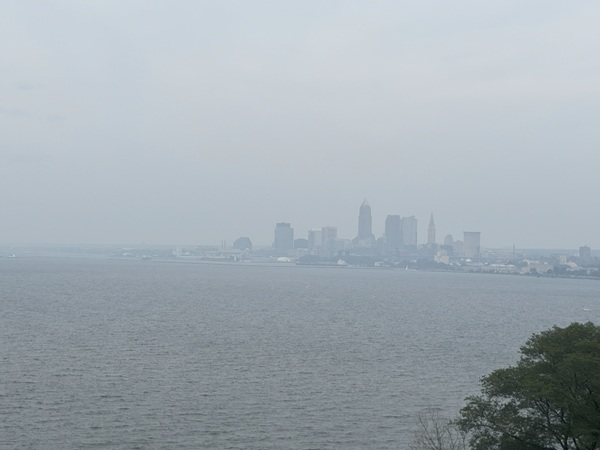
This morning I awoke—yet again—to an air quality alert in Cleveland. These warnings have become disturbingly routine. Yet there is nothing routine about them. Sometimes the smoke is plainly visible, a dull haze hanging over Lake Erie; other times the sky appears deceptively clear, even as sensors warn of danger. Each alert is not only a public health signal but also a tangible indicator of the broader climate crisis—one that too many still deny.
I. Not a New Story, but a New Scale
Canada has long experienced wildfires, particularly within its vast boreal forests, as part of natural ecological cycles. However, the severity of recent fire seasons represents a dramatic departure from historical norms. In 2023, Canada endured its most destructive wildfire season on record, with more than 18.5 million hectares (over 45 million acres) burned—more than two and a half times the previous record and roughly seven times the long-term annual average.[1]
II. Why Canada Is Burning More Than Ever
1. Climate Change Accelerates the Threat
Canada’s climate is warming at roughly twice the global average (approximately 2°C since 1950 compared to the global average of 1.1°C), and in some northern regions nearly three times faster.[2] This accelerated warming produces hotter, drier vegetation that becomes fuel for wildfires, extends the fire season well beyond historical norms, and increases the frequency of lightning storms that ignite many of these blazes.[3]
2. Boreal Forest Vulnerability and Ecological Shifts
While boreal forests are adapted to periodic fire, the new scale and intensity of burning can overwhelm their capacity for regeneration. Repeated megafires may transform vast areas into grasslands or savannas, disrupting ecosystems and releasing massive stores of carbon into the atmosphere.[4]
3. Human Activity and Legacy Fire-Management Models
Though many fires are sparked by lightning, human activities—campfires, discarded cigarettes, sparks from machinery—remain a significant cause. Decades of fire suppression, along with the decline of Indigenous controlled-burn practices, have also left forests dense and fuel-rich, primed for catastrophic fires when drought and heat arrive.[5]
III. Cleveland Downwind
Wildfire smoke respects no borders. Carried by wind patterns and jet streams, it regularly drifts into the Midwest and Northeast. In Cleveland, this has meant days when the Air Quality Index rises into the “unhealthy for sensitive groups” range or worse. Fine particulate matter (PM₂.₅—particles smaller than 2.5 micrometers) can penetrate deep into the lungs and enter the bloodstream, aggravating heart and lung conditions and increasing health risks for vulnerable populations. Elevated ground-level ozone, worsened by heat, compounds these dangers.[6]
The reality is that Cleveland residents now regularly breathe air compromised by fires burning hundreds or thousands of miles away—a stark reminder of how interconnected our environmental challenges have become.
IV. A Shared Crisis
This is not merely a Canadian issue—or solely a U.S. problem. It is a continental and global crisis, rooted in climate change and demanding coordinated action in emissions reduction, forest management, and public health preparedness.
V. Closing Reflection
Tomorrow’s sunrise over Lake Erie may bring either full clarity or another haze alert. Regardless, the truth remains: our climate is changing faster than our institutions, our habits, or our response. The question is not whether the air tomorrow will be breathable. The question is whether we are prepared to protect it—not only here, but everywhere.
References
- “2023 Canadian Wildfires,” Wikipedia, accessed August 8, 2025, https://en.wikipedia.org/wiki/2023_Canadian_wildfires.
- “Climate Change in Canada,” Wikipedia, accessed August 8, 2025, https://en.wikipedia.org/wiki/Climate_change_in_Canada.
- “Expert Insight: Canada Is Warming Faster than Anywhere Else on Earth,” Western University News, January 2024, https://news.westernu.ca/2024/01/expert-insight-canada-is-warming-faster-than-anywhere-else-on-earth/.
- Kasha Patel, “Canada’s Wildfires Are Changing the Landscape for Decades to Come,” Washington Post, July 11, 2025, https://www.washingtonpost.com/weather/2025/07/11/canada-wildfire-smoke-forests-landscape-change/.
- Aryn Baker, “We’ve Entered the Age of the Megafire,” Time, July 2024, https://time.com/7299284/age-of-mega-wildfires-climate-change/.
- David Abel, “Wildfire Smoke Is Increasing across New England,” Boston Globe, August 5, 2025, https://www.bostonglobe.com/2025/08/05/metro/wildfire-smoke-increasing-across-new-england/.





 Northcoast Antiquarian