Inspired by a brisk winter walk in the Cleveland, Ohio area.
LYRICS
The birch tree braves the winter’s icy grip,
Its branches bare, white stark against the sky.
It does not mourn the loss of leaves or gold,
But waits with patience for the spring to nigh.
The birch tree knows the seasons wax and wane,
Each carries purpose, beauty, grace, and pace.
It does not fear the frost, the ice, the rain,
But greets each one with elegance and grace.
My soul, like birch, endures and perseveres,
To rise from earth to heaven’s radiant light.
It stands unbowed, unbroken by the cold,
But shines with faith and courage through the night.
From birch I learn to face life’s change and strife,
To trust in self, let faith and courage guide.
“In another moment down went Alice after it, never once considering how in the world she was to get out again.”
Long ago a doctor observed that, in his opinion, I most certainly had an attention deficit disorder. He in particular noted that my habit of reading three or four or more books (each a few pages or chapters at a time) simultaneously rather than sequentially (one book in its entirety, one after another), sealed the deal, as it were, for his diagnosis. The reality now is even worse than the kind doctor could have imagined for in any book with end notes or foot notes, which I review most assiduously, I am often immediately diverted by the notes to hunt for additional relevant information. I hunt either in my library for the information or on the internet. I describe that hunt, and the ensuing hunts that usually result from the initial hunt, just as a tumble down a rabbit hole. For, you see, I tumble down rabbit holes in pursuit of knowledge almost daily, never considering how in the world I will get out again, just as blithely as Alice tumbled down her rabbit hole.
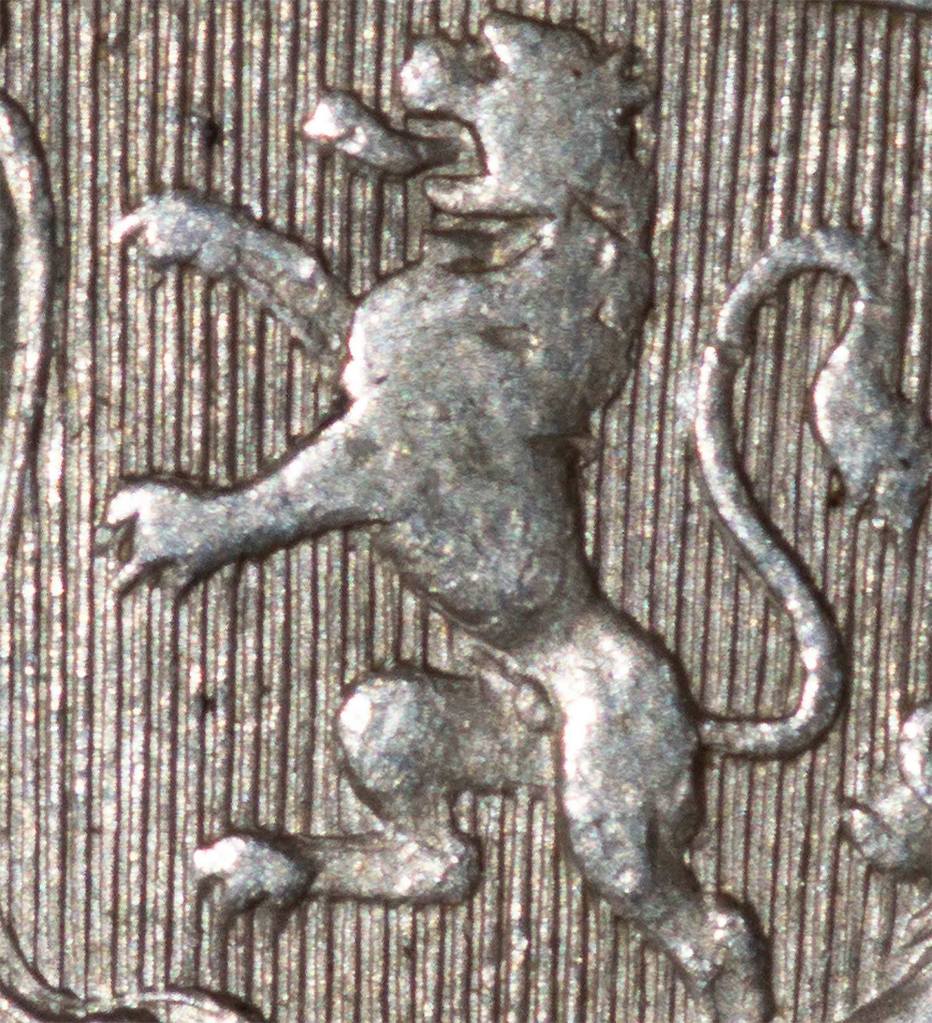
It happens easily enough, these tumbles. Consider the macro photograph of the AR jeton of Lyon which I posted about earlier. All things considered, the jeton was one of many items I was photographing that particular day merely to practice my photography skills. I was, in point of fact, attempting to develop my skills in lighting the coins which I was photographing with more precision and subtlety. I was not attempting to undertake any particular study of the individual items themselves. However, when I happened to glance at the photograph of the jeton, which is admittedly poorly lit overall (my skills are still inadequate and developing!), I was struck, as I had previously mentioned, by the presence of the lion’s phallus, which I had never noticed previously when viewing the jeton. This was not, in spite of the subject matter, a prurient observation, so much as an amused observation that the engraver would add such fine detail to the piece which is not readily visible to the naked eye. It was also a catalyst to further research (much like those cursed notes in a book). In short, I stumbled into a rabbit hole.
My curiosity was piqued, first and most naturally, as to whether the lion was generally depicted on the arms of Lyon in the 1750s in so anatomically correct a manner. Though my library does contain a number of heraldic works, those works do not include anything that would address French heraldry so, of course, I immediately went to the internet. Much to my pleasure and surprise, Wikipedia has a very robust and well researched entry on the arms of Lyon.
“Down, down, down. Would the fall NEVER come to an end! ‘I wonder how many miles I’ve fallen by this time?’ she said aloud. ‘I must be getting somewhere near the centre of the earth.“
Wikipedia was kind enough to instruct me as to when Lyon was granted its arms and the various forms the arms have taken over the years. I learned many things, including how Lyon sided with the Royalists during the French Revolution and, for its efforts, was officially disestablished. I also learned that, after the restoration of the monarchy, the lion in the shield was shown carrying a sword to signify its combativeness against the revolution. A nice touch, to be sure. And, of course, with each change to the shield, and each twist of history, I went down another rabbit hole to learn the story behind the story. Before I knew it, several hours had gone by. I had learned many interesting things, none of which I had planned on learning that day. Indeed, none of which I would have even planned on learning that day if I had sketched the day out. As I recall, I was working on my photography skills that day and the jeton was merely a tool in that exercise.
My lack of discipline regarding the initial task at hand allowed me to be diverted for an extended period of time, but I learned much about topics that I shall likely never have occasion to visit again or otherwise put to productive use. I confess that I cannot much regret the experience, for it was enjoyable and all knowledge has value. Yet, I am convinced that I must develop a more rigorous schedule, so that even in retirement, I accomplish some of the projects that I have a mind to complete. I can only stumble down so many rabbit holes before the day, then the week, then the month, then the year, is lost.
One of the various activities that I have engaged in as a newly retired individual has been participation in the various online educational seminars offered by the American Numismatic Association (ANA) and the American Numismatic Society (ANS). To this end, I signed up for a four session program offered by the ANS entitled “ANS Lyceum: Basics of Photography.” Happily, my macro photography skills are slowly improving.
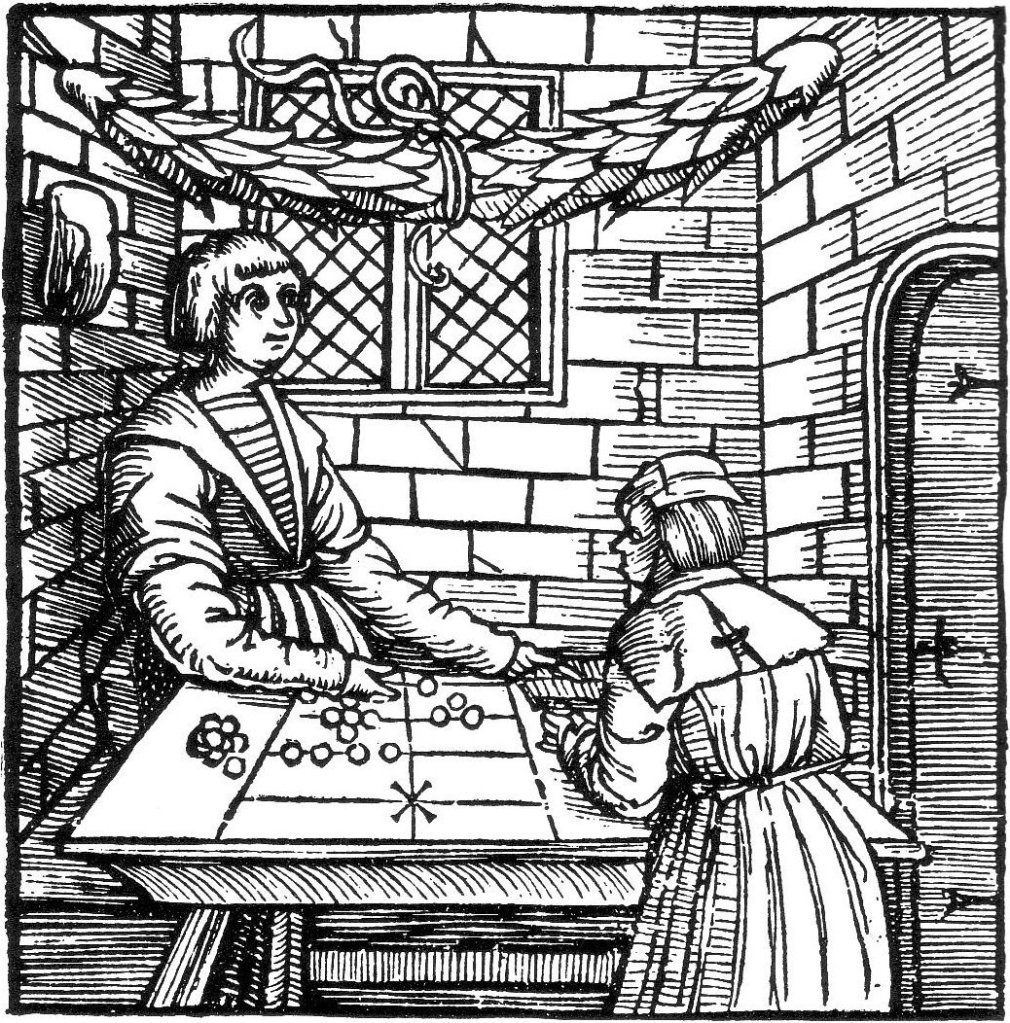
Reckoning Table in Use From Jakob Koebel’s Rechenbiechlin, Augsburg, 1514
One of the pieces that I recently photographed was an eighteenth century French jeton from Lyon catalogued as Feuardent-10682 by Felix Feuardent in his magnus opus, Jetons et méreaux depuis Louis IX jusqu’à la fin du Consulat de Bonaparte (Paris 1907). A French jeton, also known as a reckoning counter, was originally used in the medieval era as an aid in performing calculations by merchants and royal officials who placed the counters on a checkered board or reckoning table to represent amounts or tallies in complex calculations. The word jeton comes from the French verb jeter, to cast. The specimen I have photographed has an obverse which features the heraldic arms of Lyons. Lyon, of course, may be translated as lion, so it is no surprise the centerpiece of the arms is a lion rampant. The shield itself is augmented by a heraldic chief, the division occupying the upper third. This is the “Head of France,” which shows the heraldry of the former monarchs of France: of azure laden with three golden fleurs-de-lys (a blue background adorned with three yellow lily flowers).
Arms of Lyon
The reverse features the inscriptions VIRIS. CONSULARIBUS in circular caption while in the featuring in the field the words PATRIA. MEMOR in an oak crown, with the date 1756 in Roman numerals below. The blazon proper of Lyon consists of a field of gules (red color), in which a lion appears rampant (of profile and erect) and silver (white color).
AR Jeton Lyon, 1756.
What photographing the jeton allowed me to see, that I had never noticed before, was the anatomical glory of the lion which the engraver had labored to ensure was embedded in the die for the piece. This was somewhat of a surprise as very few of the heraldic renderings of the arms of Lyon that I was able to trace, from the granting of the shield in 1320, through the issuance of this jeton, seemed to insist upon such graphic accuracy (though most allude to the appendage). Perhaps it is the Rococo transitioning to neoclassical in metallic glory.