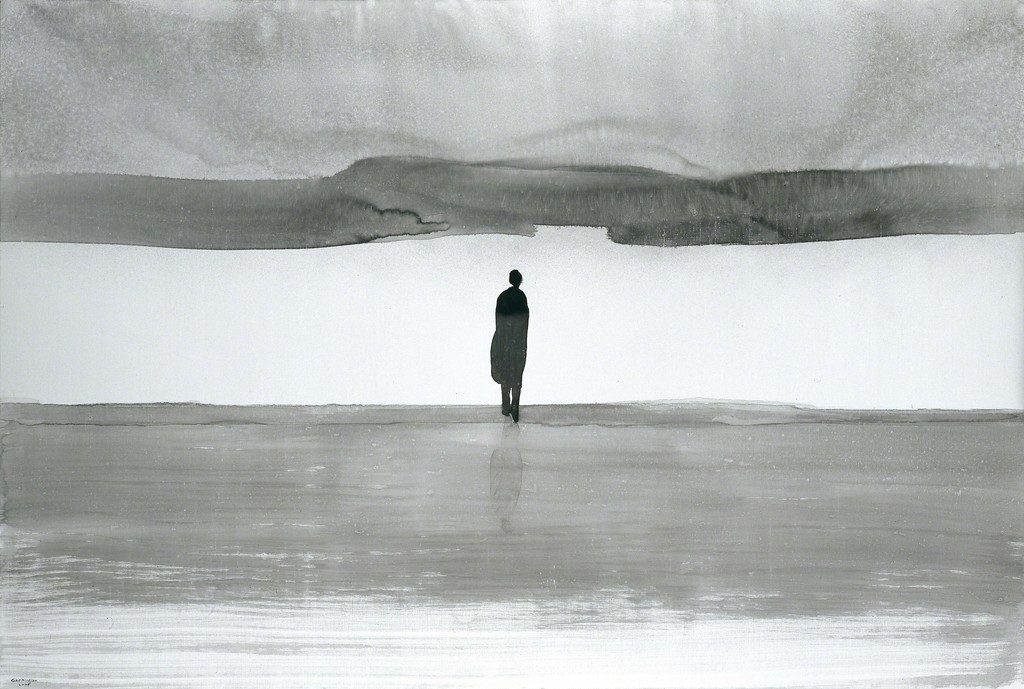
In “L’attente (Waiting) [2004]” by Gao Xingjian, the author finds an appropriate artwork to illustrate his reflections on retreating into a world of words as a sanctuary from the harsh external world, but also as a form of self-imposed isolation. The poem expresses the duality of words as both protection and confinement, shaping the author’s existence, reflecting a life intertwined with letters, sheltered yet constrained by the fortress of his mind.In “L’attente (Waiting) [2004]” by Gao Xingjian, the author finds an appropriate artwork to illustrate his reflections on retreating into a world of words as a sanctuary from the harsh external world, but also as a form of self-imposed isolation. The poem expresses the duality of words as both protection and confinement, shaping the author’s existence, reflecting a life intertwined with letters, sheltered yet constrained by the fortress of his mind.
L’attente (Waiting) [2004] by Gao Xingjian (b. 1940).
As I am confounded by life now, as I was in my youth, I retreat, as always, into a world of words, written on pages and assembled in books. These books surround me, forming walls that at times serve as battlements, the fortifications protecting me from the external perils of an incomprehensible, harsh, and hostile world, or so I tell myself. In other moments, however, these same walls are the confines of a cell, isolating me in solitude, depriving me of the air, sustenance, and human interactions necessary to life and sanity. Thus, the world of words is both my sanctuary and prison.
Of course, playing the poet much of late, and a bad one at that, I transmogrified the above thoughts, into the following:
I retreat, as always, into words, Pages inked and bound in books, Encircled by these silent guards, My fortress walls, my quiet nooks.
At times they stand as battlements, Shielding me from the world’s disdain, A citadel where reason reigns, Against the chaos, fear, and pain.
Yet oft they turn to prison walls, Confines of a solitary cell, Where air and sustenance are scarce, And human warmth does not dwell.
This paradox my soul sustains, A life in letters intertwined, Sheltered by and yet constrained, By the fortress of my mind.
On Sunday evening, as the sun had just receded and I returned home, I found myself in my backyard. There, I witnessed the flicker of light from the tail of a lightning bug, the first I had seen this summer. In that instant, a crash of childhood memories, from so many decades ago, flooded my mind. It is remarkable how a single sight, much like a familiar smell, can trigger memories from so long ago.
The next morning, still smiling from the memories elicited by that twinkle in the night, I quickly sketched out the recollections that had cascaded through my mind in that luminous instant. I then spent a little time shaping them into form. For better or for worse, here is the result. I imagine only my siblings can fully appreciate these memories, as they are so deeply family-centric.
Memory Fragments of a Mahoning Valley Childhood
In the heart of summer, lightning bugs glowed bright, Church festivals thrived, Saint Luke’s, Saint Pat’s in the night. The Canfield Fair’s grand end of summer delight, A crush of people, crash-up derby, under starry twilight.
Handel’s Ice Cream, a seasonal treasure so sweet, A&W root beer floats, a frothy, chilled treat. Sunday drives through Mill Creek Park’s serene retreat, Fresh bread’s aroma from Schwebel’s bakery street.
Poulakos donuts after Sunday mass, divine, Pierogies with butter and onions, St. Stan’s line. Idora Park’s Wild Cat, Jack Rabbit in summertime, Learning to swim at the downtown Y, feeling fine.*
Downtown shopping at Woolworth and Strouss, a spree, Barney Bean, Gilligan’s Island, and more on TV. Isaly’s chip chop ham sandwiches, more than we’d plea, Dad’s Friday night football games on AM frequency.
Bowling leagues, Dusi Music, Conti Dance’s beat, Mom at ceramics studio, weekly meet. Family dinners nightly when Dad came home to eat, Vegetable garden’s bounty, homegrown treats so neat.
Bicycles, unicycles, basketballs in the drive, Chalk drawings, sandboxes, tree forts where dreams thrive. Imagination abundant, throughout the neighborhood we’d roam, Mahoning Valley memories, forever our home.
*In truth, I disliked the swimming lessons at the Y, the water was so cold that I shivered incessantly, teeth chattering and lips turning blue, every lesson — oh, and let me tell you that the smell of chlorine was overwhelming!
Throughout my life, two essential sources of guidance have been my personal motto, “Humilitatem Initium Sapientiae,” meaning humility is the beginning of wisdom, and the insightful advice from Thomas à Kempis in De Imitatione Christi. His words inspired the lyrics of my composition, “The Beginning of Wisdom,” recently set to music using Udio.com. The song emphasizes the importance of humility, seeking good examples, and self-correction. It beautifully portrays the idea that through humility, wisdom shines bright, leading us forward even through the darkest nights. The powerful message is conveyed through gentle and reflective lyrics, inspiring listeners to embrace humility as the start of wisdom.
Korea, hanging scroll, ink on paper. Egret and Reeds, late 1800s. Yang Ki-hun (Seuk-Eun) (Korean, 1843–1919?). In this hanging scroll, an egret walks along the shores of a salt marsh where reeds abundantly grow. Yang treated his subjects of flora and fauna with an observant naturalist’s view, yet his choice of subjects—an egret and reeds—is deeply rooted in traditional symbolic language: the egret stands for the scholarly reclusive life, while reeds indicate humility and modesty. Cleveland Museum of Art.
Two of the most treasured sources of guidance throughout my life, which I frequently call to mind, are my personal motto, Humilitatem Initium Sapientiae, which may be translated as humility is the beginning of wisdom, and the prudential advice offered by the canon, author, and scribe Thomas à Kempis (d. 1471), in De Imitatione Christi: “Study also to guard against and to overcome the faults which in others very frequently displease you. Make the best of every opportunity, so that if you see or hear good example you may be moved to imitate it. On the other hand, take care lest you be guilty of those things which you consider reprehensible, or if you have ever been guilty of them, try to correct yourself as soon as possible. As you see others, so they see you.” These words informed the lyrics of my most recent composition which I then set to music using Udio.com
Humilitatem Initium Sapientiae (Humility, the beginning of Wisdom) – by Donald S. YarabAudio file for “The Beginning of Wisdom” (Lyrics by Donald S. Yarab).
Lyrics:
In the quiet dawn, wisdom’s voice we hear, Whispering softly, drawing us near. In the humble heart, truth finds its place, Guiding our steps with gentle grace.
Humilitatem Initium Sapientiae, Through the shadows, a light to guide our way. In the path of humility, wisdom shines bright, Leading us forward through the darkest night.
Guard against the faults that others display, Seek the good examples, and follow their way. Correct your own missteps, strive to be true, For as you see others, they also see you.
Humilitatem Initium Sapientiae, Through the shadows, a light to guide our way. In the path of humility, wisdom shines bright, Leading us forward through the darkest night.
With each humble act, our spirits rise, Touching the heavens, reaching the skies. In the silence deep, where the soul is free, Wisdom’s beginning, in humility.
Humilitatem Initium Sapientiae, Through the shadows, a light to guide our way. In the path of humility, wisdom shines bright, Leading us forward through the darkest night.
In humility, we find our start, With wisdom’s light, within our heart. Humilitatem Initium Sapientiae, A guiding star, forever to stay.
In the throes of insomnia, an exceptionally long time ago, I found myself roused at the early hour of three in the morning. Seized by a fervent and despairing impulse, I wrote with unrelenting urgency about the anguish of unrequited love and being single. The despair, as is its wont, eventually dissipated, leaving in its wake a legacy of lines imbued with melancholy. These lines, born of nocturnal desolation, now seem well-suited to be transformed into music, evoking the same poignant emotions that inspired their creation. The original lines read as follows after I cleaned it up slightly:
“If, as the saints of Assisi, Francis and his companion Giles aver, It is better to love than to be loved, Then I am a most fortunate man indeed. If this be a jest, verily, I am well mocked. My heart, encumbered with unanswered love, Holds those affections deep within, Some as faintly glowing embers, Others as white-hot coals.
Contrary to the lyrics of poetry, The artifice of novels, and the drama of screen, There is no soaring inspiration or felicity In unrequited love, Only a sore appreciation For knowing that I possess humanity, The capacity to give of myself Without the expectation of reciprocation.
In truth, perpetual aloneness, To be unloved, Is a tragedy from an individual perspective, Yet a trivial banality from a societal view, As uncountable multitudes have lived and died alone, Without affectionate human touch, Long before me, And will long after me.”
“A Tale Oft Told” – Lyric by Donald S. Yarab
Lyrics to “A Tale Oft Told” by Donald S. Yarab
If, as the saints of Assisi proclaim,
Francis and Giles with hearts both the same,
It’s better far to love than to be loved,
Then I am blessed, by heaven's grace, beloved.

If this be jest, then jest, indeed, is true,
My heart has felt no lover’s steadfast view.
Unanswered love has planted seeds of fire,
Some as faint embers, some as hot desire.

Not like the verse in poet’s crafted lore,
Nor novels, screens, with tales that promise more,
In unrequited love, the truth is clear,
A sore yet noble proof that I am here.

Though solitude may mark a tragic plight,
To one, it’s pain, to many, common sight:
A tale oft told, in ancient times and now,
For countless souls alone did live somehow.

If love's a gift that’s given without claim,
Then I am rich in heart, though poor in name.
For in the silence of unspoken dreams,
My soul finds strength in love's relentless beams.

The night, it whispers secrets to the stars,
Of solitary hearts and hidden scars.
Though love unreturned brings shadows near,
It carves within a path to persevere.

In dreams, I wander through the fields of time,
Where love’s soft echoes linger, so sublime.
Each heartbeat sings a song of love unshown,
Yet in the pain, a deeper truth is known.

For every tear that falls from longing's eye,
A testament to love that cannot die.
Though unrequited, love remains so pure,
A testament to what the heart endures.

And so, I cherish every silent cry,
Each whispered wish beneath the moonlit sky.
For in this love, though met with quiet ache,
I find a strength that time cannot unmake.
Recently, I have been revisiting Dante’s Divine Comedy, focusing specifically on Paradiso. This journey through Dante’s celestial spheres has inevitably planted within me thematic thoughts of hope, inspiring me to put pen to paper and author a new poem. This sudden burst of creativity, whether of any merit or not, has taken me by surprise. Nonetheless, I have relished the productivity, regardless of its outcome.
For several days, I awoke each morning with my mind fixated on the theme of hope, having pondered over the topic in my sleep with deliberate contemplation. Earlier this week, I awoke with a fully outlined sketch of a poem, realizing that hope, as a concept, evolves dramatically through the stages of life.
In childhood, hope is almost an unknown entity, as we scarcely need it, trusting that nearly every need and desire will be met. This is largely because our understanding of the world and its possibilities is limited. As we grow older, hope becomes more pronounced, with the belief that if we hope earnestly enough, we can obtain almost anything. In young adulthood, this transforms into the conviction that hard work will inevitably lead to the fulfillment of our hopes.
However, as we enter middle age, our perception of hope shifts once again. We begin to see it as a plea, tempered by the realities of justice and merit. By old age, if not earlier, we recognize that despite our hopes and best efforts, many who work hard are denied the fruits of their labor, and many who deserve much are denied their due. By the time silver graces our brow, a bemused smile often accompanies our thoughts of hope, seasoned by the wisdom of experience. We come to understand that hope should not be centered on what we aspire for, but rather on what we can give to others—justice, fulfilled dreams, love, acceptance, and comfort. These are the gifts that we once hoped for ourselves and now, perhaps, are in a position to bestow upon others. If we had any intelligence and kindness, we were doing so all along.
Reflecting on my college years, I recall considering myself an optimistic pessimist. Schopenhauer’s works on pessimism were light reading in those days. Despite this, I was not afraid to embrace hope, recognizing its necessity throughout life. This philosophical introspection led me to author a poem, which I have set to music courtesy of Udio.com. I am pleased with the results and plan to eventually set it to a worthy video. For now, it is available as an audio track with the lyrics provided below.
LYRICS TO “HOPE’S JOURNEY: A TAPESTRY OF LIFE”
Stage I: Childhood
In the garden of my youth, every dream was mine, Hope was just a whisper, a secret so divine. No need to chase the stars, they’d fall into my hand, In a world of endless wonders, a magic wonderland.
Chorus:
Hope, it morphs and changes, like the tides of life’s great sea, From dreams of youth to wisdom’s truth, in each phase we’ll see. In the tapestry of time, it weaves a story bold and true, Hope’s enduring presence, guiding us through all we do.
Stage II: Young Adulthood
As a young and daring heart, hope became my creed, Believing in the odds, I’d conquer every need. With faith and fierce conviction, the future seemed so bright, The power of my spirit, would always lead to light.
Chorus:
Hope, it morphs and changes, like the tides of life’s great sea, From dreams of youth to wisdom’s truth, in each phase we’ll see. In the tapestry of time, it weaves a story bold and true, Hope’s enduring presence, guiding us through all we do.
Stage III: Adulthood
In the prime of my endeavor, hope was like a flame, If I worked with all my might, I’d win the endless game. Justice and ambition, tempered with the real,* A dance of dreams and struggles, the balance I could feel.
Chorus:
Hope, it morphs and changes, like the tides of life’s great sea, From dreams of youth to wisdom’s truth, in each phase we’ll see. In the tapestry of time, it weaves a story bold and true, Hope’s enduring presence, guiding us through all we do.
Stage IV: Middle Age
In the heart of middle age, hope became a plea, An appeal to justice, to merit and integrity. Tempered by the trials, and the lessons learned in time, Hope was now a beacon, in a world less sublime.
Chorus:
Hope, it morphs and changes, like the tides of life’s great sea, From dreams of youth to wisdom’s truth, in each phase we’ll see. In the tapestry of time, it weaves a story bold and true, Hope’s enduring presence, guiding us through all we do.
Stage V: Old Age
In the twilight of my days, hope seems like a dream, A foolish, fleeting fancy, yet it makes me beam. A smile in reflection, of a life so richly lived, Hope was a companion, in the gifts that life could give.
Chorus:
Hope, it morphs and changes, like the tides of life’s great sea, From dreams of youth to wisdom’s truth, in each phase we’ll see. In the tapestry of time, it weaves a story bold and true, Hope’s enduring presence, guiding us through all we do.
Journey’s End:
So here I stand, at journey’s end, with hope a fading light, A smile upon my weathered face, as day turns into night. For hope has been my constant friend, through every twist and bend, A timeless song within my heart, until the very end.
* I have revised this line in Stage III for future “publications” to read: “Ambition was my compass, guiding through the real,” as it was too redundant of the thoughts and words in Stage IV.
Art Credits for the YouTube Video:
Stage I: Childhood
The Voyage of Life: Childhood (oil on canvas, 1842) by Thomas Cole (1801-1848). National Gallery of Art, Washington, D.C.
Stage II: Young Adulthood
Liberty Leading the People (oil on canvas, 1830) by Eugène Delacroix (1798-1863). Louvre Museum, Paris.
Stage III: Adulthood
The Fog Warning (oil on canvas, 1885) by Winslow Homer (1836–1910). Museum of Fine Arts, Boston.
Stage IV: Middle Age
Nighthawks (oil on canvas, 1942) by Edward Hopper (1882-1967). Art Institute of Chicago.
Stage V: Old Age
The Starry Night (oil on canvas, 1889) by Vincent van Gogh(1853-1890). Museum of Modern Art, New York.
Journey’s End
The Monk by the Sea (oil on canvas, 1808–10) by Caspar David Friedrich(1774-1840). Alte Nationalgalerie, Berlin.






 Northcoast Antiquarian