

Navigating Chaos: Personal Journey Through Fables, Poetry, and Lyrics

“The Wanderer Above the Sea of Fog” (oil on canvas, c. 1818) by Caspar David Friedrich (1774-1840). Hamburger Kunsthalle, Hamburg.

In light of my recent endeavors—posting fables, poetry, and lyrics for songs—it is essential to clarify my intentions. These creations, though shared in this space, are not primarily intended as offerings to others, though I am pleased if others find them of some utility. Rather, they represent my personal journey to navigate and comprehend the tumultuous landscape—the chaos—of my mind, my life, and my community. Chaos, in this context, is not pejorative; rather, it encapsulates the full spectrum of human experience—joy and sorrow, triumph and defeat, despair and hope, connection and isolation, fear and wonder, intellect and confusion. It embodies, in essence, the unadorned human condition.

Thus, these fables, poetry, and lyrics are not exercises in narcissistic introspection but rather unvarnished articulations of my attempt to discern order, meaning, or purpose—if any is to be found—from the chaos, and to commit my journey to metaphorical paper. To others, many of the words, allusions, and themes recording my thoughts may remain obscure, inaccessible, or even enigmatic—yet each word, allusion, and theme was chosen with care, purpose, and meaning, even if others cannot grasp it. And so it must be.

As these ramblings take form, I have noticed recurrent themes and words surfacing. In time, I shall undoubtedly delve more deeply into these themes, as they surely reveal either truths or obsessions that I should explore more systematically for my own edification. I may also conduct a census of the recurrent words—if only to either find more synonyms or avoid redundancy.

In the meantime, I apologize for the occasional poorly written or contrived poem, fable, or lyric. I also ask for your patience with those that you find incomprehensible, though artful—I assure you that they have deep meaning to me. Bear this fool kindly, as a fool must pursue his ramblings!

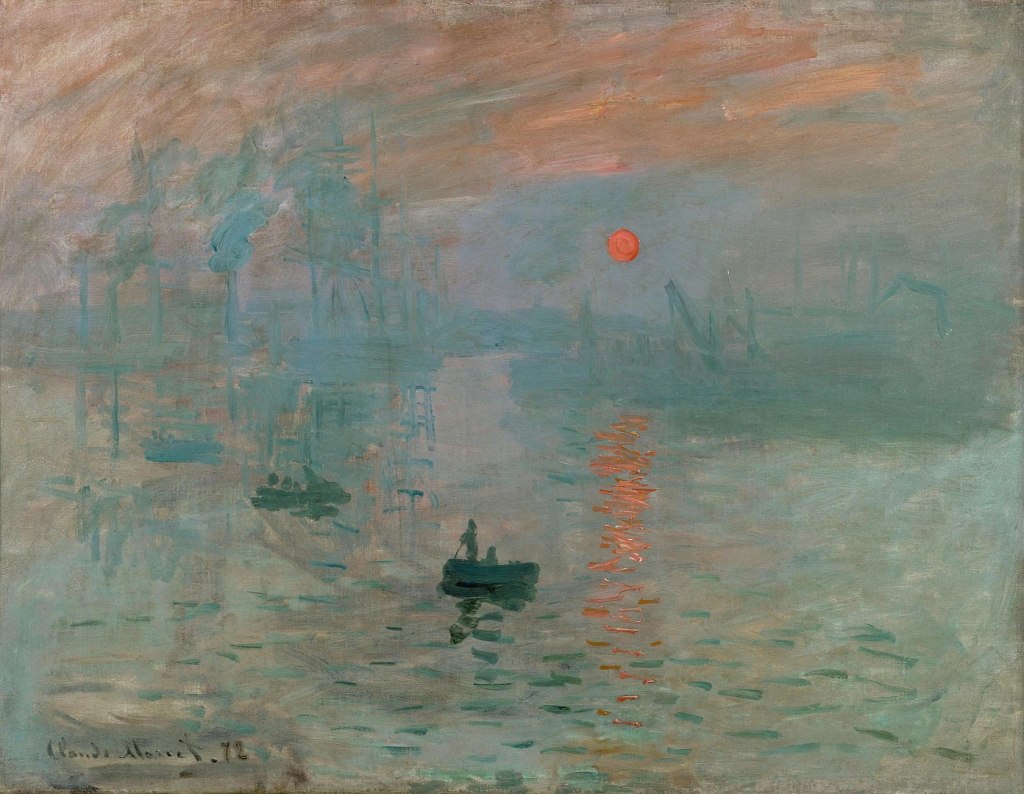
The Art of Language: Exploring the Beauty and Power of the Written Word

Impression, Sunrise (oil on canvas, 1872) by Claude Monet. The painting’s subtle interplay of light, color, and form mirrors the delicate balance required in crafting a well-written sentence, paragraph, or tale. The art of communication on canvas.

Language is beautiful. Every language, I imagine, holds within it a unique splendor, a symphony of sounds and meanings that resonate with the human experience. It is a medium of endless subtlety and flexibility, capable of expressing the most nuanced thoughts and the deepest emotions. A single word or phrase can carry extraordinary weight, encapsulating the full spectrum of human expression, from the profound to the mundane.

Language is a vessel for wisdom, humor, and frivolity alike. With just a few well-chosen words, one can impart lessons that echo through time, evoke laughter that lightens the heart, or create moments of joy that linger in the memory. It is delicate, yet strong—able to convey the lightest touch of affection or the heaviest burden of sorrow.

Yet, the true power of language lies in the words themselves. Words are the building blocks of language, each one a gem with its own distinct hue, tone, and resonance. While some may not give much thought to their choice of words, and are indifferent or careless in their selection, I hold that choosing the right word is an art of the utmost consequence. Every word carries its own timbre, a unique vibration that justifies its existence in a sentence, distinguishing it from others that may seem similar on the surface but convey subtly different meanings.

To me, words are not mere vessels of communication, but carefully chosen notes in the symphony of expression. The nuances between synonyms are not trivial; they are the very essence of precision in language. It is this precision that breathes life into writing, allowing it to resonate with readers in the way that only the perfect word can. In the delicate interplay of vocabulary, each word plays its part, contributing to a harmony that is richer and more meaningful than the sum of its parts. This meticulous selection is not just a preference but a necessity for the craft, as it ensures that the language not only conveys a message but does so with the exact emotion, clarity, and impact intended.

My particular fondness lies with the written word, for I find that I am no longer the extemporaneous orator I once was, no longer as quick in constructing or articulating speech. Above all, I aspire to become more artful in the crafting and presentation of my writing, so that it may be more pleasing both when read and recited. In this pursuit, I seek to imbue each phrase with the perfect blend of sound and meaning, creating a text that is not only clear but also resonant—a true expression of the beauty that language, at its best, can achieve. To be sure, I shall often falter in this endeavor, particularly after having written daily primarily as an attorney for over thirty years, but it is my earnest hope that, with continued practice, the failures will diminish and the successes will grow more frequent.

The Magpie in Winter: A Fable told by Lysander Aesopides

The Magpie (Oil on canvas, 1868) by Claude Monet (1840-1926). Musée d’Orsay, Paris.

In a quiet land where the world often rested beneath a thick blanket of snow, a lone magpie perched on a wooden gate. The magpie, with its striking black-and-white feathers, was accustomed to the stillness and calm that the cold season brought.

One day, as the magpie foraged for food, it noticed a small bird struggling in the snow below. It was a young robin, shivering and weak, its bright red breast a stark contrast to the white landscape.

The magpie flew down to the robin and asked, “Why do you struggle here alone? This is no place for those unprepared for the cold.”

The robin, trembling, replied, “I lost my way in the snowstorm and now I am too weak to continue. I fear I won’t survive much longer.”

The magpie, though known for its cleverness and keen eye for survival, had a kind heart. Seeing the robin’s plight, the magpie said, “Come, I will help you. We must look after each other in difficult times.”

The magpie led the robin to a sheltered spot under a thick hedge, where the snow had not yet reached. It shared its small store of seeds and nuts, collected with care for such harsh times.

As the days passed, the magpie and the robin found warmth in each other’s company. The magpie taught the robin how to spot food even in the bleakest of landscapes, and in return, the robin shared songs of hope, lifting the magpie’s spirits.

In time, the robin’s strength returned, and she knew it was time to fly back to her own home. She thanked the magpie for her kindness and promised to return when the snow melted, to sing for her new friend the songs of spring.

The magpie, watching the robin take flight, felt a warmth in her heart that even the coldest winter could not freeze. She understood that while the snow had brought silence and stillness to the land, it had also brought them together, reminding her that even in the quietest moments, there is life, warmth, and connection.

Moral of the Fable

Adversity and difficulty often give rise to beauty, strength, and connection. In challenging times, the support and kindness we offer to others not only help them but also reveal our own inner resilience.

An Additional Treat – Lyrics based on the fable set to music

Lyrics by Donald S. Yarab, inspired by the fable “The Magpie in Winter,” set to music.

The King’s Deliverance: Musical Tribute to King Stanisław August Poniatowski’s Rescue

THE KING’S DELIVERANCE – A “Hymn” commemorating the rescue of the King from an attempted kidnapping by the Bar Confederation conspirators in 1771.

It is with pleasure that I share with you The King’s Deliverance, a musical composition inspired by the 1771 AR Medal crafted by Johann Leonhard Oexlein. This piece sets to music the lyrics written to commemorate the remarkable escape of King Stanisław August Poniatowski from an attempted abduction by the Bar Confederation, a group of Polish nobles opposed to Russian influence in the Polish-Lithuanian Commonwealth.

The medal, with its powerful inscriptions from the Psalms and intricate artistic details, captures the moment when “divine providence” intervened to protect the king. It symbolizes not only his deliverance but also the mercy he showed towards those who conspired against him. This event, which unfolded on the night of November 3, 1771, had far-reaching consequences, ultimately strengthening the king’s position. The hymn highlights the themes of justice and divine protection.

For those interested in a more detailed exploration of the medal and the history of the incident, I refer you back to an earlier post where I provide a fuller explanation of these significant historical elements.

The King’s Deliverance seeks to encapsulate these historical themes through music and lyrics, offering a tribute to this significant moment in Polish history. You are invited to watch the video and reflect on the enduring legacy of King Stanisław August’s resilience and mercy.

The Nightingale and the Rose: A Fable told by Lysander Aesopides

Swallow and Peony (woodblock print, pre-1945), Ohara Koson (1877-1945).

The Nightingale and the Rose

In a secluded grove, hidden deep within an ancient forest, there lived a nightingale whose song was unmatched by any other creature. Every evening, as the sun dipped below the horizon, the nightingale would perch on a high branch and sing, filling the air with melodies so beautiful that even the stars seemed to pause and listen.

In the center of the grove grew a single rosebush, its flowers the color of a blush at dawn, delicate and fragrant. The nightingale loved the rosebush with all its heart, for it saw in the rose a beauty that mirrored its own song. Night after night, the nightingale would sing to the rose, hoping that the rose might hear the song and return its love.

But the rose, though beautiful, was unaware of the nightingale’s affection. It stood rooted in the earth, its petals turned toward the sun, drinking in the light and warmth. The rose did not understand the nightingale’s song, for it had never known love beyond the gentle caress of the morning dew or the kiss of the afternoon breeze.

One night, as the nightingale sang its most heartfelt melody, the moonlight filtered through the leaves, casting a silvery glow over the grove. The nightingale, filled with longing, poured all its love into the song, hoping to reach the rose’s heart.

The rose, touched by the nightingale’s song, began to stir. Its petals trembled, and for the first time, it felt something more than just the sun’s warmth or the wind’s touch. It felt the nightingale’s love, pure and unyielding. But the rose could not return this love in the way the nightingale desired. It could only bloom as it always had, beautiful but distant, its heart locked away in its delicate petals.

The nightingale, realizing that the rose could never love it as it loved the rose, sang one final song, a song of acceptance and farewell. It was a song that spoke of the beauty of love, even when unreturned, and of the joy in loving without expectation.

As the nightingale’s song faded into the night, the rose shed a single petal, a silent token of its appreciation for the nightingale’s devotion. The nightingale, with a heart full of love but no bitterness, flew away into the night, knowing that its love, though unrequited, had been true and pure.

The rose continued to bloom, its beauty admired by all who passed, but it was never the same after that night. It had been touched by the nightingale’s love, and though it could not return it, the memory of that love remained within its petals, giving them a deeper, more resonant hue.

Moral of the Fable

Love, even when unreturned, is a gift that enriches both the giver and the recipient. True love is selfless and does not demand reciprocation, finding its own beauty in the act of loving.

A Lyrical Treat Inspired by the Fable

A Four Stanza “Poem” based on the Fable set to a medieval-folk theme. Lyrics by Donald S. Yarab, Music by Udio.com.