
An Essay on Memory, Power, and the Blood Beneath Our Feet
By Donald S. Yarab
“Taking the proceedings of the Athenians toward Melos from the beginning to the end, they form one of the grossest and most inexcusable pieces of cruelty combined with injustice which Grecian history presents to us … But the treatment of the Melians goes beyond all rigor of the laws of war; for they had never been at war with Athens, nor had they done anything to incur her enmity ….” George Grote, A History of Greece (London 1850) VII, 114.¹
Though we may think otherwise, we are a belligerent people. We flatter ourselves with tales of virtue, liberty, and civilization, but our history betrays us. We are heirs not only to triumphs of culture, learning, and law, but to the unspoken litany of conquest, subjugation, and blood. The soil itself bears witness. Its silence is not empty. It murmurs the blood of men and the cries of women and children—those cast aside, broken, forgotten, or made invisible by the forward march of empire.
This thought came to me not through modern headlines, though there are many that might summon it, but while reading of the Peloponnesian War—of its needless provocations, of its spiraling brutality, of Athens, the “enlightened city,” casting off the veil of philosophy to reveal the naked face of power. It was not necessity that brought on that war, Thucydides tells us, but desire. Desire for power. Desire to dominate. Desire to possess what one has not earned and cannot keep without violence.
Nowhere is this desire more exposed than in the fate of Melos.
During a lull in the great war between Athens and Sparta, the Athenians sailed to the small island of Melos, which had attempted to remain neutral. The Melians appealed to justice, to their rights as a small people, and to the protection of the Spartans with whom they shared kinship. The Athenians responded with brutal clarity: “The strong do what they can, and the weak suffer what they must.”² When Melos refused to surrender, the Athenians besieged and conquered the city. They slaughtered the men. They enslaved the women and children.³
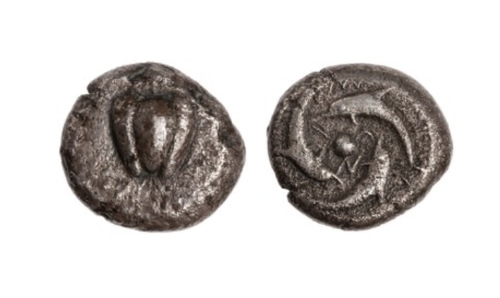
Before its destruction, Melos minted coins bearing the image of an apple—mēlon in Greek, a deliberate pun upon the island’s name that now carries unintended prophetic weight.⁴ And in this small emblem, I saw more than a civic badge. I saw a symbol that reached backward to Eden.
The apple—though scripture never names the fruit—is a stand-in, in Christian tradition, for the forbidden fruit of knowledge. With it came the mythical expulsion from paradise and the ensuing inheritance of suffering, toil, and death. But in our age, as in ages past, we have not been cast out merely for seeking knowledge. We have been cast out for failing to know ourselves.
We do not seek knowledge. We seek dominion. We crave possession—of land, of treasure, of people. And in so doing, we deny our complicity. We forget. We suppress. We sanctify the victors and silence the conquered. From age to age, we retell only the parts of the story that flatter us.
And here lies the uncomfortable mirror.
In this, we are more like Athens than we care to admit. Like them, we cloak power in principle. And like them, we forget.
We in the United States have long imagined ourselves the inheritors of Athenian democracy. We trace our civic ideals to their assemblies, our rhetoric to their orators, our architecture to their temples. We forget, or do not care to remember, that Athens was also an imperial power, that its democracy was partial and exclusionary, and that it extorted tribute, enslaved its enemies, and turned allies into subjects. At Melos, it abandoned all pretense of justice. It wielded power for its own sake and cloaked the sword in reason.
So too have we. We have invaded and occupied, supported tyrants when convenient, and crushed the aspirations of distant peoples in the name of freedom. At home, we have reaped the fruits of conquest while teaching ourselves to hear only the hymns of progress and patriotism.
Consider the Trail of Tears—where we marched Cherokee, Creek, and other nations from their ancestral lands to distant territories, causing thousands of deaths. That forced removal, justified by the rhetoric of “civilization” and “progress,” has spiraled into generations of poverty, educational disadvantage, and health crises on reservations. Even today, as Native communities face disproportionate hardships, we struggle to acknowledge our national policies as their root cause.
Or look to El Salvador and Nicaragua, where American foreign policy in the 1980s supported authoritarian regimes and death squads in El Salvador while simultaneously funding the Contra rebels against Nicaragua’s Sandinista government—all in the name of anti-communism. Our military aid facilitated massacres of civilians in both countries, devastated civil society, and undermined democratic institutions. The ensuing regional instability bred gangs, poverty, and the very migration crisis that excites our domestic politics today. Yet few Americans connect today’s asylum seekers to our own actions decades ago. Like Athens at Melos, we exercise power, then avert our eyes from the consequences. Yet evidence of our actions remains, waiting to be unearthed.
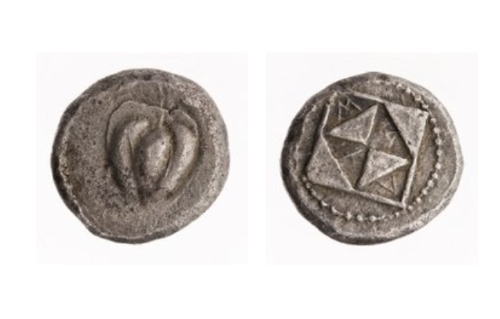
From the soil of Melos itself, the blood speaks still. In 1907, a hoard of silver coins was unearthed—buried, according to scholars, in 416 B.C. as the Athenians closed in.⁵ Those who hid them did not live to recover the coins. Both coins bear on the obverse the apple—the symbol of Melos, its punning emblem, its name. But their reverses differ: one shows dolphins encircling a central boss, evoking the sea that once embraced the island; the other, a square divided into four triangles. These buried apples of silver—like their biblical counterpart—bear knowledge too painful to confront: the truth of what power does when unbound by conscience. These coins, long entombed, bear no voices. Yet they cry out. Like Abel’s blood, they testify—not in sound, but in presence. That these objects survived while their owners perished is both historical evidence and perfect metaphor—artifacts outlive empires, bearing witness long after the powerful have fallen. Metal as memory. Silver as witness.
We are not alone in this legacy. But neither are we innocent. The voice of justice does not go silent simply because we stop our ears. As in Genesis, so in history: the blood cries from the ground.⁶ And though we deny it, the Eternal hears.
The apple on the coin of Melos is a relic now, but its meaning remains. It is a warning. It is a mirror. Excavated from darkness, these silent witnesses challenge our comfortable narratives. It is a fruit offered again and again to each generation: not to reveal what lies in the heavens, but what lies within ourselves.
Until we dare to eat of that fruit—not in pride, but in truth—we shall remain wanderers east of Eden, armed with denial, and thus, with destiny.
Footnotes
¹ Seaman, Michael G. “The Athenian Expedition to Melos in 416 B.C.” Historia: Zeitschrift für Alte Geschichte, vol. 46, no. 4, 1997, p. 385. The epigraph featured above is an adaptation of the citation used in Seaman’s essay, which being a fine summary of emotive outrage at Athenian transgressions, could not be more finely articulated.
² Thucydides, History of the Peloponnesian War, Book V, §§89–116. The quoted phrase is a paraphrase of the Athenian argument in the Melian Dialogue, often rendered: “The strong do what they can, and the weak suffer what they must.” See: Robert B. Strassler, ed., The Landmark Thucydides (New York: Free Press, 2008), 352.
³ See Seaman, Michael G., ibid., pp. 385–418, for a detailed discussion of the motives and actions surrounding the Athenian assault on Melos.
⁴ On the apple (mēlon) as a civic pun in Melian coinage, see Sheedy, Kenneth. “Aegina, the Cyclades and Crete.” In The Oxford Handbook of Greek and Roman Coinage, ed. William Metcalf, 2012, p. 112.
⁵ See: Kallet, Lisa and John H. Kroll, The Athenian Empire: Using Coins as Sources (Cambridge University Press, 2020), 105.
⁶ Genesis 4:10: “The voice of your brother’s blood is crying to me from the ground.”

 Northcoast Antiquarian