“Ponder, O Morpheus, the Night Sky” arose from a meditation on the nature of dreams, consciousness, and the silent mysteries that lie beyond both. Rather than seeking to instruct, this poetic work offers a dialogue — between mortal longing and divine wonder, between question and silence. In addressing Morpheus, the god of dreams, the poem invites not sleep, but contemplation: a shared pondering of the night sky, where the known fades into the unknown, and where even gods may pause in awe before the infinite. It is my hope that this work may serve as a quiet companion for those who have found themselves, at least once, standing beneath the stars, asking questions for which no easy answers are given — and finding, in the asking, a kind of sacred beginning.
Sleep by Jean Bernard Restout (c. 1771). Oil on canvas, 129.5 x 96.5 cm (38 x 51 in). Cleveland Museum of Art. Depicting Morpheus
Ponder, O Morpheus, the Night Sky
“Beyond dreams lies a silence where even gods wonder.”
Prelude: The Summoning of Morpheus
Morpheus, Keeper of the Silent Looms, hear now the summons not of those who seek forgetfulness, nor of those who plead for soft illusions to cradle their weary minds— but of one who, standing alone beneath the immeasurable firmament, dares to bid thee ponder.
Ponder, thou Weaver of Shadows, the night sky: the endless, ink-deep vault where Orion’s belt cinches the waist of darkness, where scattered fires—blue, white, and ancient red— whisper of secrets too vast for mortal tongues.
Not for dreams of idle comfort do I call thee forth, but for contemplation; to set aside for a moment thy ceaseless crafting of mortal visions and lift thine ancient gaze upward, where the silent percussion of dying stars beats out the hidden music of creation.
For if thou, master of phantoms and bringer of luminous memories, shouldst pause to wonder at that boundless mystery, then perhaps the soul of man, frail and flickering though it be, might dare likewise to ask:
Who dreams the dreamers, O Morpheus? Whence come the visions thou bestowest? And what lies beyond the last dream, beyond the last star, beyond the last breath of sleep?
Thus the greater query is born, trembling on the tongue of the sleepless, yearning toward the silence that gathers all speech.
The Greater Query: A Dialogue with Morpheus
Soul: If thou, O Shaper of Phantoms, canst be stilled by wonder, then hear the questions borne upon my waking breath, fragile as they are, yet earnest as the stars are ancient:
Who first whispered the dream into being, before ever thou didst fashion it? From what unseen wellspring do the rivers of vision flow? Are the dreams of men but fractured echoes of a deeper song, or do they weave even now the hidden fabric of worlds yet unborn?
Morpheus (in thought): Dreams are the trembling of the soul against the veil of the infinite. They are not born of my will alone, Seeker, but arise from the deep soil where memory, longing, and the first light entwine. I but give them form; I do not summon them from the abyss. Some dreams, frail though they seem, stitch the very edges of what is to be. Mortals, in dreaming, unknowingly shape the unborn dawn.
Soul: Is it given to us—dust briefly animated, clay granted momentary breath— to pierce that veil? Or must we first unmake ourselves, falling through forgetting, to be remembered by the nameless light?
Morpheus: Beyond all dreams there is a silence older than stars and deeper than death. A silence not of absence, but of fullness, where neither waking nor sleeping holds dominion, and the soul, naked and unafraid, beholds itself as it was before all weaving began.
There the true Dreamer dwells— not I, but He whom none can name, the source of all dreams, the end of all seeking, the unspoken, the unseen.
Soul: And if we seek it, do we not risk all—memory, longing, even self itself?
Morpheus: It is the risk of being lost to be found, the surrender of knowledge to come to knowing. To seek the Silent One is to set sail upon a sea without stars, to abandon the safe shores of image and name, to become at last what thou hast always been: a breath upon the waters of infinity.
Ponder well, O Seeker, for in the seeking, thou thyself becomest the dream, the dreamer, and the silence beyond.
The Blessing of Morpheus: The Sending Forth
Morpheus: Go forth, Child of Earth and Stars, go forth lightly, as one who walks upon waters not yet created. Carry no burden save the yearning that kindled thy question; bind no certainty to thy brow, nor shelter fear within thy breast.
Let dreams fall from thee like withered leaves; let even the constellations become but distant embers, for thou seekest now what neither dream nor waking thought can compass.
Take not with thee the names men have carved into the bones of the world, for names shatter against the face of the nameless. Take not the proud trophies of reason, nor the soft nets of hope, for these will tear upon the thorns of the infinite.
Instead, take this only: a heart made naked in wonder, a mind made silent in awe, and feet made light as wind upon waters unseen.
And know this, O Soul: thou art neither lost nor found in this seeking, for to seek the Silent One is to be gathered even now into His dreaming.
Thus do I, Morpheus, who weaves the veils of sleep, send thee forth beyond all veils, beyond all sleep, beyond the last trembling breath of mortal wonder. Go, and become the question thou hast dared to ask.
Epilogue: The Pondering of Morpheus
And Morpheus stood long in the hush of the night, his ancient hands unclasped, his brow unburdened of dreams.
He lifted his gaze once more to the immeasurable vault, where scattered fires—blue, white, and red— burned against the black breast of infinity.
He pondered— not as god to mortal, nor as master to servant, but as wonder to wonder, breathless before a mystery he too could not wholly grasp.
In the stillness beyond weaving and shaping, he glimpsed, as in the faintest shimmer of distant nebulae, a vastness where even gods must bow their heads, where even dreams dissolve like mist before the morning sun.
And in that silence, older than all his songs, Morpheus smiled— not because he understood, but because he wondered still.
He felt a pang—brief and piercing— a mortal ache for the fleeting fierceness of human wonder, so bright and brief.
And so he pondered, and the night pondered with him, until speech was stilled, and he was lost—and found—within the endless deep.
When I consider thy heavens, the work of thy fingers, the moon and the stars, which thou hast ordained; what is man, that thou art mindful of him? — Psalm 8:3–4 (KJV)
A child, in the earliest unfolding of consciousness, turns to the parent and asks: Why? Why is the sun hot? Why did my pet goldfish die? Why must we grow old? The loving parent does not scorn the child for such questions. Even when the answers stretch beyond what the child can yet comprehend, even when no answer can satisfy the deep, intuitive wonder stirring in the young mind, the parent listens. A gesture, a story, a silence full of tenderness—all serve as a response, for the asking itself is a sign of life, of spirit, of the soul reaching beyond itself.
How then can it be imagined that the Divine—source of all wisdom, all love—would greet humanity’s first Why not with the hush of welcome but with wrath? How could the natural longing to know, to understand the world into which humanity was born, be met not with compassion, but with a condemnation unto death?
It cannot be so. It is not the divine who pronounced guilt over the sacred question; it is man.
The doctrine of original sin, as shaped by priests and theologians, emerges not from divine decree but from human artifice. It is born of fear—fear of questions too vast to answer, fear of mysteries that human authority could neither command nor contain. It is a doctrine not of heaven but of earth, devised by those who sought to regulate the soul’s native reaching beyond the bounds of certainty.
For what is the story of Eden if not the story of the first Why? The yearning for knowledge—the desire to taste, to see, to know good and evil—was not the rebellion of prideful beings but the natural unfolding of consciousness itself. To portray this reaching as disobedience is to misread the very nature of the soul. It is the innocence of the child, multiplied and deepened, that yearns toward the silence, that dares to disturb the hush with a question.
The Genesis narrative itself frames the matter plainly:
“But of the tree of the knowledge of good and evil, thou shalt not eat of it: for in the day that thou eatest thereof thou shalt surely die.” (Genesis 2:17, KJV)
Yet in the original Hebrew, “good and evil” is not a narrow moral distinction, but a merism—a pairing of extremes meant to evoke the totality of human experience. The knowledge at stake was not merely of right and wrong, but of the complexities, ambiguities, and perplexities of life and being itself. It was the awakening of discernment, the painful blessing of full consciousness—the soul’s first stretching beyond the silence into the unknown.
In the unfolding of the tale, it is the serpent who first stirs the question, bidding the woman to see beyond the command to the possibility of knowledge itself:
“For God doth know that in the day ye eat thereof, then your eyes shall be opened, and ye shall be as gods, knowing good and evil.” (Genesis 3:5, KJV)
Yet the serpent, in the original narrative, is not named as a satanic force. That identification is a later gloss, a retrospective layering by later traditions. In Genesis itself, the serpent is simply described as subtle—”more cunning than any beast of the field.” It is not evil in the mythic sense, but a catalyst: a figure who provokes the first stirring of conscious wonder.
The temptation it offers is not toward cruelty or depravity, but toward awareness—the dangerous and sacred gift of discernment. When the woman saw that the tree was “good for food,” “pleasant to the eyes,” and “a tree to be desired to make one wise” (Genesis 3:6), it was not pride that stirred her, but wonder. It was not rebellion, but reverent reaching—the first trembling articulation of the soul’s native Why—that set humanity upon its long and necessary journey into the unfolding mystery.
Later theological traditions, particularly within Christianity, would recast this moment as the origin of inherited sin, a fall from grace so profound that it marred all generations to come. Even softer interpretations would speak of exile—a banishment from divine presence, a sundering of primordial innocence.
But this, too, misreads the deeper rhythm of the story.
There is no fall in the truest sense. There is no exile. There is only awakening.
Awakening carries consequence: the loss of effortless innocence, the onset of labor, of mortality, of sorrow. But it is not severance from the divine. It is the beginning of the soul’s true journey—the movement from unknowing participation in being into conscious, perilous freedom. It is not punishment, but transformation: the invitation to become beings capable of discernment, of wonder, of seeking the infinite even while clothed in dust.
The expulsion from Eden, if it can be called that at all, is no casting away. It is a sending forth—a sorrowful and sacred commissioning. It is humanity’s first trembling step into a world no longer given but always to be made meaningful by seeking, questioning, remembering.
Nor is this reaching confined to Eden alone. Even in the later unfolding of the sacred story, it is the struggle, not the submission, that is honored. Jacob wrestles through the long night with the divine being, refusing to release his grip until a blessing is given. And far from being punished for his audacity, he is renamed—Israel—“one who struggles with God.” (Genesis 32:28) Thus the struggle is made sacred. The refusal to let go, the daring to seek, the ache of confusion: these are not condemned but crowned. The journey was never meant to return to innocence; it was always to pass through mystery, bearing the wound and the wonder of awakening.
Across cultures and ages, humanity has imagined a lost Golden Age—a time when the world was right, when peace and justice reigned, when innocence was unbroken. In religion, in philosophy, in politics, the pattern repeats: there was once a perfection; we have fallen from it; we must find a way back.
Why does this myth endure? Perhaps it speaks to something innate within us: a yearning for wholeness, for rootedness, for a home we can no longer name. Perhaps it soothes the terror of our confusion, offering the hope that disorder and suffering are not our native condition, but a wound that can be healed.
Yet in our fixation on a lost Eden, we risk becoming prisoners of backward-facing time. The myth orients our spiritual gaze toward the past—toward what was allegedly lost—rather than toward what might yet be discovered. We become archaeologists of an imagined innocence rather than explorers of an unfolding mystery. The soul’s natural movement—reaching forward into new understanding—becomes replaced by a desperate scrambling backward toward a manufactured memory.
This temporal disorientation fundamentally misunderstands the nature of spiritual growth. Wisdom is not the recovery of what once was, but the discovery of what has always been waiting to be known. The soul does not develop by returning to an infantile state of pre-questioning, but by maturing through its questions into deeper and more profound questions still.
When we orient ourselves toward a mythical past rather than an unfolding future, we deny the essential nature of consciousness itself, which is not static but dynamic, not preservative but creative. We mistake the spiritual journey for a return ticket when it is, and has always been, a one-way passage into greater mystery, greater wonder, greater questioning.
Moreover, what we call Eden is not a historical reality but a projection of our deepest yearnings. It is the mind casting upon the blank canvas of prehistory its own longing for belonging, for certainty, for uncomplicated being. We imagine a time before questioning not because such a time existed, but because questioning—the fundamental condition of human consciousness—carries with it the necessary burden of uncertainty.
Eden, then, is not a lost homeland but a psychological construct. It is the mind’s attempt to escape the very condition that makes it mind: the capacity to ask, to wonder, to reach beyond what is immediately given. The myth provides a name for our discomfort with confusion, allowing us to imagine that our questioning nature is not our essence but our fall.
And here lies the deeper danger: what begins as a fabricated consolation becomes, in the hands of authority, an instrument of control. The artificial memory of Eden, manufactured to soothe our existential disquiet, transforms into a weapon wielded against the very questioning that makes us human.
For when the myth of a lost Eden is seized by those who would govern—whether priest or king—it becomes a tool of manipulation. The lost paradise becomes a justification for power. If the people can be made to believe they have fallen, they can be led to believe that only through obedience—obedience to those who claim to hold the keys to return—can they be restored.
Thus Eden becomes not a symbol of hope, but a lever of command. Thus nostalgia becomes a chain.
For those who seek to honor obedience as a spiritual virtue, there remains a profound distinction between the willing surrender that flows from understanding and the blind submission that stifles questioning. The former may indeed be sacred—a conscious alignment with wisdom greater than one’s own. It is only when obedience is divorced from the soul’s natural reaching, when it demands the silencing rather than the maturing of questions, that it betrays both the human and the divine.
And the chain wounds. It wounds the individual, teaching him to distrust his own questions, to despise his own longings, to silence the sacred impulse toward wonder within himself. It wounds the collective, stifling thought, suppressing creativity, narrowing the imagination of what a human life or a human community might be. It breeds conformity where there might have been diversity of spirit; it fosters submission where there might have been genuine reverence; it exalts obedience over understanding.
Under the weight of this imagined Eden, humanity turns inward in fear rather than outward in joyful seeking. The soul bows not in awe before mystery, but in terror before judgment.
Thus the myth that was meant to console becomes a force that deforms, a memory that imprisons rather than frees.
Some might argue that certainty provides comfort, that boundaries offer safety, that answers—even if incomplete—shelter us from the storm of unknowing. There is truth in this. Structure can indeed nurture growth, just as the trellis supports the vine. Yet when structure calcifies into dogma, when the trellis becomes a cage, the soul withers rather than flourishes.
Man is neither innately good nor innately evil. Man is innately confused. Born into a world more vast than his mind can grasp, woven from mysteries too great for his language to name, humanity’s first impulse is not toward sin, but toward understanding. The soul, bewildered and reaching, gropes for knowledge not out of pride, but out of need—the need to make sense of the strange and wondrous being into which it has been thrust.
Confusion, then, is not a defect; it is the ground of wonder. It is the blessed ignorance that precedes the sacred question: Why?
It is this confusion—the condition of the in-between creature, made of dust and breath—that makes the human journey necessary. Without it, there would be no seeking, no questioning, no striving toward the silence that calls from beyond the edges of comprehension. Without it, there would be no reaching for the fruit, no ache for the infinite, no longing to pierce the hush with a voice.
The theologians, in their haste to impose clarity where mystery should have remained, mistook confusion for corruption. They mistook the stumbling search for the willful turning away. But confusion is not sin; it is the evidence of our created nature, the signature of beings fashioned for a journey, not for stasis.
To ask Why? is to live as we were made to live: poised between the known and the unknown, between the immediate and the eternal. To forbid the question, to cast the seeking as rebellion, is to deny the very condition of being human.
Thus, the first reaching toward the tree of knowledge was not a crime against the divine. It was the first true act of humanity: the confused, innocent soul daring to stretch toward the beyond.
In our questions, then, we find not our fall but our rising. Not our sin but our salvation. For to ask Why? is to begin the journey home—not to an Eden that never was, but to a wholeness that awaits us in the brave and beautiful reaching of the confused, beloved human heart.
The sacred path is forward—into uncertainty, into wonder, into the endless unfolding of mystery.
Early on I warned that I would occasionally use this website as my sandbox to post my ramblings. My apologies for this rambling, as it is not a good story, scholarship, poetry, or even an interesting quote. Rather, it is just a post-it note in the ether, preserving a moment in time of an exploration of a thought that I found interesting.
The Block Universe and the Multiverse have increasingly become areas of scholarly inquiry for me. In recent months, I have been reading academic papers and books to deepen my understanding of both concepts. However, I must acknowledge that, while I find them fascinating, they lie largely outside my area of competency, except perhaps in a philosophical context. Despite this, I am undeniably drawn to both models, though many questions remain unanswered. To explore my ideas, I often turn to AI as a starting point for my inquiries, a way to clarify my inchoate thoughts and ideas.
This evening, I found myself particularly curious about the theoretical interaction between two individuals in the Block Universe model, specifically when they are not in “conscious alignment” but still interacting at the same point in time. Below is the inquiry I posed to ChatGPT and the response I received. I share this as yet another example of how ChatGPT can significantly enrich my exploration of ideas, particularly when I am surrounded by papers, books, and my computer without a similarly interested friend to discuss my ideas – and more importantly, my questions with – at length.
I will not burden you with the followup queries I made and the responses I received that refined the question below to include the Multiverse, migrating consciousnesses, etc., as factors. I will only note that the “discussion,” as it were, became rather heady.
My Inquiry to ChatGPT:
In the Block Universe model, where time is static and every moment exists simultaneously, if Individual A is conscious and interacting with Individual B at a particular point in time (let’s call it ABC on the time axis), can A’s conscious interaction with B be considered a “resurrection” of B, even if B’s consciousness has moved away from that moment? In other words, does A’s present consciousness revive B’s existence, or is B reduced to a mere memory? If time is static and both A and B exist at point ABC, how can we dismiss B’s presence as simply a memory? Wouldn’t A’s conscious perception of B bring B fully into the present, regardless of B’s own conscious awareness at that moment?
ChatGPT’s Response:
Your inquiry touches on a deeply philosophical and metaphysical problem: in a Block Universe, where time is static and every moment exists simultaneously, what happens to individual B if individual A is presently conscious and interacting with them, but B’s consciousness is not at the same point of present awareness? Does A’s conscious interaction with B “resurrect” B, making them fully present, or is B reduced to a mere memory?
1. The Nature of the Present in the Block Universe:
In the Block Universe model, all events—past, present, and future—are equally real and exist at once. Time, much like space, is laid out as a four-dimensional “block” where every point in time is a fixed coordinate. In this framework, “now” is relative—one individual’s present moment might not align with another’s, but both moments exist eternally within the same spacetime.
This leads to the question: if A’s consciousness is at a certain point on the time axis (let’s call it ABC), and B was at ABC at some point, can A’s current awareness bring B back into present existence, or is B simply an imprint of a past moment?
2. The Role of Perception and Consciousness:
Your suggestion, which draws on the nature of perception, implies that A’s perception of B in the present moment might “revive” or “resurrect” B in a meaningful way. In essence, the act of A’s awareness or consciousness interacting with B might not merely render B a memory, but instead fully re-engage B in the present moment. This raises a few key possibilities:
Relational Reality: The philosopher Martin Buber, in his work I and Thou, argued that the world is not made up of isolated individuals but of relationships. In the context of the Block Universe, this suggests that the relationship between A and B could make B fully real in A’s consciousness. Even if B is not consciously aware in that moment, A’s engagement could create a present relational reality where B exists in full presence within the scope of their interaction.
Revival through Observation: In quantum theory, the act of observation plays a crucial role in defining the state of particles (the observer effect). Although you are not suggesting quantum mechanics applies directly here, your analogy suggests that A’s conscious awareness might act as a kind of observer, bringing B’s reality into the present moment. This is not merely memory, but a revival of B’s full presence through A’s perception, even if B’s own consciousness is “elsewhere.”
Dynamic Engagement with Static Time: Although time in the Block Universe is static, conscious interaction with others might create dynamic pockets of reality within that framework. In this view, A’s consciousness “animates” the static reality of B at the point ABC, reviving B’s presence from the past and bringing it into the shared present. B’s full self, even if no longer conscious in that specific moment, becomes “resurrected” in the relational present through A’s engagement.
3. Memory vs. Resurrection of Existence:
The distinction between memory and resurrection is crucial here. If we think of B’s past presence at point ABC as a fixed event in spacetime, it is tempting to reduce B to a memory once their consciousness moves away from that moment. However, the idea that A’s conscious interaction with B resurrects B goes beyond mere memory. In this sense:
Memory involves a one-sided recollection of B’s past existence, a mental reconstruction.
Resurrection (in your context) implies a re-engagement of B’s full presence at point ABC, facilitated by A’s perception. Even though B is not consciously aware at that moment, their existence in spacetime is reactivated through A’s perception, making B as fully present as when their consciousness was originally at that moment.
4. Perception and Shared Realities:
This idea also ties into theories of shared reality, where the perception of one individual shapes the reality of another. In phenomenology, especially in the work of Edmund Husserl, the experience of the “other” plays a key role in how reality is constructed. When A interacts with B, A’s perception of B might revive B’s presence in a way that transcends mere memory. In this sense, even if B’s consciousness has moved on to a different moment in spacetime, their presence in that specific interaction is made “alive” again through A’s experience.
5. Implications for Consciousness and Existence:
Philosophically, this raises profound questions about the nature of existence:
Does existence depend on consciousness, or is it enough for consciousness to engage with an event to resurrect it?
Can we exist fully in the minds of others, even if our consciousness is not directly present in a given moment?
In a Multiverse Block Universe model, the potential for repeated instances of engagement between A and B across different versions of reality might amplify this effect, allowing for multiple points of resurrection or engagement in different universes.
Conclusion:
In the Block Universe, where time is static and every moment is fixed, A’s conscious perception of B in a present moment might indeed revive B’s existence, making B fully present again within the framework of that specific interaction. This is more than memory; it is a resurrection of B’s presence in a meaningful, relational way. The interaction creates a shared reality, where B’s existence at point ABC is reanimated by A’s conscious engagement, even if B’s consciousness is no longer at that same point.
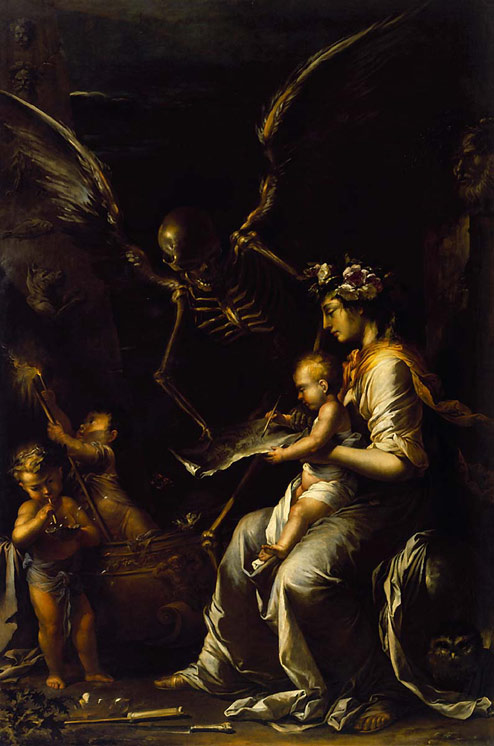
L’Umana Fragilita (Human Frailty, oil on canvas, 1656) by Salvator Rosa. Fitzwilliam Museum, Cambridge.
“O glorious day when I shall retire from this crowd, this turmoil, and join that divine council and assembly of souls” — Cicero
Cicero reflects on death as a natural and not to be feared part of life. One of his most famous passages reads: “Death is not a matter of sorrow, because it releases us from the prisons of the body and brings us to our natural rest. If death is an end to consciousness, it is like a deep and eternal sleep. If, however, the soul lives on, we have nothing to fear, for we will join those who have already passed.”
Here, Cicero expresses two possibilities for death: either it brings a peaceful, eternal sleep or allows the soul to join those who have passed before, both of which alleviate the fear of death. The first possibility, that death brings the end of consciousness and a restful, eternal sleep, presents death as a final release from the burdens of mortal life. In this scenario, time ceases for the individual, as their consciousness no longer experiences its passage. The second possibility, in which the soul lives on, imagines a continued existence where the soul joins the company of others who have passed, in a realm beyond the constraints of earthly time.
Building on this latter idea, Cicero envisions the soul departing from the mortal world and entering a “divine council” of virtuous souls. He writes: “O glorious day when I shall retire from this crowd, this turmoil, and join that divine council and assembly of souls, and when I shall depart from this life to live with them!” In this vision, the soul is no longer bound by the physical limitations of the body or the linear progression of time. It enters a state of peace, free from the turmoil of earthly life, and becomes part of an eternal realm where time as we know it no longer applies. This divine assembly offers a vision of death as a transition into a timeless existence, where the soul continues without the burdens of decision-making, moral struggles, or the passage of time.
This vision aligns remarkably well with modern cosmological theories, particularly the Block Universe model, which arises from Einstein’s theory of relativity. In this model, time is viewed not as something that flows but as a static dimension. The Block Universe posits that past, present, and future all exist simultaneously within a four-dimensional spacetime continuum. Every moment—whether in the past, present, or future—exists eternally and is as real as any other moment. The flow of time, as we perceive it, is an illusion generated by our consciousness. In this framework, time does not move; rather, we, as conscious beings, experience it as though we are moving through it.
When Cicero speaks of the soul’s release from the turmoil of earthly life and its subsequent joining with other souls, he touches on a concept that can be reconciled with the Block Universe. In his vision, the soul continues to exist, but it is no longer bound by the temporal constraints of human existence. It no longer perceives time as a sequence of moments passing one after another. Instead, the soul becomes part of an eternal now—much like the fixed moments in the Block Universe model. In this state, the soul experiences the peace of being embedded in time’s eternal structure without the torment of consciousness or the burden of decision-making.
In both Cicero’s philosophical framework and the Block Universe model, time continues to exist objectively, but for the individual, time’s significance vanishes with the cessation of perception. This alignment suggests that the end of time, in a subjective sense, is not the end of the universe’s temporal structure, but the end of an individual’s experience of time. The soul, in Cicero’s understanding, remains part of the universe, but without the active engagement of temporal consciousness.
What makes this comparison particularly compelling is the shift from seeing death as a terrifying end to perceiving it as a transition into a timeless existence. For Cicero, death frees us from the burdens of morality and decision-making—tasks that are so deeply tied to our experience of time. Similarly, in the Block Universe, once consciousness fades, we are no longer participants in the dynamic flow of time but become part of the static, eternal structure of existence.
In essence, both Cicero and the Block Universe propose that the end of time is not a destruction or cessation of reality, but rather the cessation of our perception of time’s flow. While the soul may continue to exist in an ethereal state, it does so in a manner detached from the sequential experience of time. Thus, the soul’s existence in this eternal now is one of peace, free from the weight of decisions and the suffering caused by the relentless march of time.
Through this lens, we might reinterpret Cicero’s contemplation of death and the soul’s journey as a profound early philosophical insight into a truth later echoed by modern physics: the possibility of eternal existence within a timeless framework, where the flow of time is merely a byproduct of human perception. In death, the soul may continue within the Block Universe—no longer tormented by the passage of time, but instead, eternally present in the cosmic order.
Works Relied Upon While Preparing This Essay:
Cicero, Marcus Tullius. De Senectute. Translated by William Armistead Falconer. Harvard University Press, 1923.
Cicero, Marcus Tullius. Tusculan Disputations. Translated by J. E. King. Harvard University Press, 1927.
Einstein, Albert. Relativity: The Special and the General Theory. Translated by Robert W. Lawson. Crown Publishers, 1961.
Hawking, Stephen. A Brief History of Time: From the Big Bang to Black Holes. Bantam Books, 1988.
Rovelli, Carlo. The Order of Time. Riverhead Books, 2018.




 Northcoast Antiquarian