
Theogony: The Second Breaking

From them the law arose that gods forget,
Though even the new must yield to old at last.

after Hesiod, Theogony


I
The dust began to shimmer on the ground,
As buried stars stirred faintly in their sleep;
The heavens held their breath—no voice, no sound—
While watchful shadows gathered, slow and deep.
Then from the mountains came a murmured sound,
A groan of stone, where roots their vigil keep;
The air grew still; the silence was profound,
As angels watched what they could never keep.

II
From depths unmeasured rose the buried flame,
The heart of chaos quickened in its deep;
The void recalled its long-forgotten name,
And thunder woke the silence from its sleep.
The stars withdrew, ashamed of what became,
As time’s cold mirror shattered through the deep;
The world remembered whence its motion came,
And broke the vow it could not ever keep.

III
Beneath the weight of aeons, thought awoke,
A mind long bound within perfection’s chain;
Its breath was wild, and through its silence spoke
Of worlds once free before the rule of gain.
The newer gods, their crystal order broke,
Their light too flawless for the strain of life;
Their harmony unmoving, cold as grave—
A deathless peace no living soul could brave.

IV
The rivers turned and murmured in their course,
Old voices whispering beneath their foam;
The winds cried out, compelled by wilder force,
And struck the towers where stillness made its home.
The harvest failed; the ploughshare bent, its course
Abandoned—earth remembered dust and bone;
For from the depths there surged a living source,
And time bent low before the god unknown.

V
Then broke the vault; the firmament withdrew,
And blaze unuttered poured from every seam;
The seas drew back, the sun forgot its hue,
As form took shape within the formless gleam.
The air grew dense, as if creation knew
The end of peace, the birth of fire’s regime;
The heavens quaked, their ordered paths askew,
And life awoke from its eternal dream.

VI
The newer thrones arrayed their borrowed light,
Their radiance perfect, cold, without desire;
They spoke the words that once had bound the night,
Yet found their speech now hollow of its fire.
The elder rose, majestic in his right,
His breath the wind, his eyes the molten pyre;
He named each star by its forsaken name,
And stasis yielded to desire’s wild fire.

VII
The mountains groaned; the seas forgot their shore,
And cities cracked beneath a reddened sky;
The temples fell; their idols shone no more,
While men beheld the end they could not die.
From sleep they woke, remembering before—
The breath, the pulse, the heart’s primeval cry;
And trembling knew what silence had in store:
To live is to be broken, yet to try.

VIII
Then from the dust the golden throne was raised,
Its splendor veiled through ages’ slow decay;
The heavens bowed, astonished and amazed,
And newer gods knelt down in mute dismay.
He spoke—and every silence learned to praise,
His word the wind, His voice the living way;
The elder’s gaze burned falsehood into flame,
And life arose from ruin’s vast decay.

IX
I, lesser flame, beheld the thrones renew,
And saw the dust grow radiant as the dawn;
I dared not sing, yet all the heavens knew
That death itself was broken and withdrawn.
The elder’s gaze burned all it looked into,
And life from ash to living breath was drawn;
I bowed, unmade, remade, and trembling knew—
The world began because the old had gone.

The Subconscious Muse: The Night Mind at Work

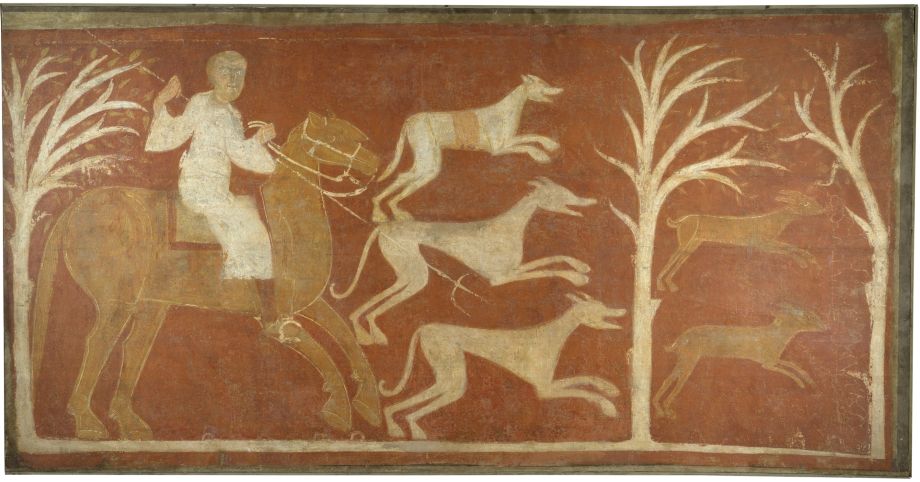
Hare Hunt, Hermitage of San Baudelio, Casillas de Berlanga (Soria)
Anonymous, c. 1125
Copyright ©Museo Nacional del Prado

The hunt for the right words often takes place in darkness, while the waking mind rests. Hare Hunt (c. 1125) depicted in this famous fresco from the Prado seems a fitting illustration for my essay exploring my oneiric creative process—given much of my writing involves pursuing words that race ahead faster than I can record them, gifts from the subconscious delivered whole upon waking.
Hare Hunt, Hermitage of San Baudelio, Casillas de Berlanga (Soria)
Anonymous, c. 1125
Copyright ©Museo Nacional del Prado

From my earliest years, my creative process—whether literary or scholarly—has been curiously nocturnal. Much of my work, I have found, is done while I sleep. When faced with a task, I assign it, quite literally, to my subconscious mind and then close my eyes, surrendering to productive sleep.

As a student, this practice became a quiet ritual. When a paper was due, I would already know the topic, the sources I intended to use, and what I wished to accomplish. I would also, admittedly, wait until the evening before it was due—believing, and with reason, that fear brought a clarity of mind that was otherwise lacking. Thus, I would take a short nap before beginning. Upon waking, the entire outline of the paper would be present—clear, complete, and waiting. With a stack of books to my right, a blank sheaf of paper to my left, and a typewriter in front of me, I would set to work, and the paper would unfold almost as if dictated.

My professors noticed this strange fluency. The grades I earned and comments I received reflected it, but more telling were their requests to keep copies of my papers for their own files—something they did not ask of other students. I did not then understand that what they admired was less my discipline, or lack thereof, than the uncanny lucidity of the night mind that guided me.

Over the years, this oneiric gift has only deepened. I remain grateful for it. At times, an entire sentence or paragraph will suddenly appear either as I awake or will awake me in the middle of the night—perfectly formed, insistent, demanding to be recorded before it vanishes. At other times, these moments arrive unbidden, startling me out of unrelated thought; often, they are the flowering of a subject that I had briefly considered and set aside, unaware that it had continued germinating in the depths below consciousness.

When such inspiration surfaces, it comes in torrents. I rush to record the first few words, only to find myself laughing at the impossible speed with which the rest races ahead, leaving me chasing its tail through the air. Madness, perhaps—but a joyous one.

It is as if some part of the mind, working in silence while the waking self is distracted, composes and refines without interference. And when it deems the work ready, it releases it whole into consciousness—seed, stalk, and blossom at once. My task, then, is not to command this process, but to remain open to it, to receive it with gratitude, and to write before the vision fades. Refinement, if needed, may occur later.

What I once mistook for a personal oddity, I now recognize as a shared inheritance of the human mind—the work of the subconscious muse, the night mind ever at her loom, weaving thought into form before dawn breaks—although a nap in the midst of day will oft serve the purpose just as well.