
The First Why: Innocence, Confusion, and the Misreading of Eden

Donald S. Yarab


When I consider thy heavens, the work of thy fingers,
the moon and the stars, which thou hast ordained;
what is man, that thou art mindful of him?

— Psalm 8:3–4 (KJV)


Original Sin, Hermitage of Vera Cruz, Maderuelo (Segovia)
Anonymous

Copyright ©Museo Nacional del Prado

Original Sin, Hermitage of Vera Cruz, Maderuelo (Segovia)
Anonymous
Copyright ©Museo Nacional del Prado

A child, in the earliest unfolding of consciousness, turns to the parent and asks: Why? Why is the sun hot? Why did my pet goldfish die? Why must we grow old? The loving parent does not scorn the child for such questions. Even when the answers stretch beyond what the child can yet comprehend, even when no answer can satisfy the deep, intuitive wonder stirring in the young mind, the parent listens. A gesture, a story, a silence full of tenderness—all serve as a response, for the asking itself is a sign of life, of spirit, of the soul reaching beyond itself.

How then can it be imagined that the Divine—source of all wisdom, all love—would greet humanity’s first Why not with the hush of welcome but with wrath? How could the natural longing to know, to understand the world into which humanity was born, be met not with compassion, but with a condemnation unto death?

It cannot be so. It is not the divine who pronounced guilt over the sacred question; it is man.

The doctrine of original sin, as shaped by priests and theologians, emerges not from divine decree but from human artifice. It is born of fear—fear of questions too vast to answer, fear of mysteries that human authority could neither command nor contain. It is a doctrine not of heaven but of earth, devised by those who sought to regulate the soul’s native reaching beyond the bounds of certainty.

For what is the story of Eden if not the story of the first Why? The yearning for knowledge—the desire to taste, to see, to know good and evil—was not the rebellion of prideful beings but the natural unfolding of consciousness itself. To portray this reaching as disobedience is to misread the very nature of the soul. It is the innocence of the child, multiplied and deepened, that yearns toward the silence, that dares to disturb the hush with a question.

The Genesis narrative itself frames the matter plainly:

“But of the tree of the knowledge of good and evil, thou shalt not eat of it: for in the day that thou eatest thereof thou shalt surely die.” (Genesis 2:17, KJV)

Yet in the original Hebrew, “good and evil” is not a narrow moral distinction, but a merism—a pairing of extremes meant to evoke the totality of human experience. The knowledge at stake was not merely of right and wrong, but of the complexities, ambiguities, and perplexities of life and being itself. It was the awakening of discernment, the painful blessing of full consciousness—the soul’s first stretching beyond the silence into the unknown.

In the unfolding of the tale, it is the serpent who first stirs the question, bidding the woman to see beyond the command to the possibility of knowledge itself:

“For God doth know that in the day ye eat thereof, then your eyes shall be opened, and ye shall be as gods, knowing good and evil.” (Genesis 3:5, KJV)

Yet the serpent, in the original narrative, is not named as a satanic force. That identification is a later gloss, a retrospective layering by later traditions. In Genesis itself, the serpent is simply described as subtle—”more cunning than any beast of the field.” It is not evil in the mythic sense, but a catalyst: a figure who provokes the first stirring of conscious wonder.

The temptation it offers is not toward cruelty or depravity, but toward awareness—the dangerous and sacred gift of discernment. When the woman saw that the tree was “good for food,” “pleasant to the eyes,” and “a tree to be desired to make one wise” (Genesis 3:6), it was not pride that stirred her, but wonder. It was not rebellion, but reverent reaching—the first trembling articulation of the soul’s native Why—that set humanity upon its long and necessary journey into the unfolding mystery.

Later theological traditions, particularly within Christianity, would recast this moment as the origin of inherited sin, a fall from grace so profound that it marred all generations to come. Even softer interpretations would speak of exile—a banishment from divine presence, a sundering of primordial innocence.

But this, too, misreads the deeper rhythm of the story.

There is no fall in the truest sense. There is no exile. There is only awakening.

Awakening carries consequence: the loss of effortless innocence, the onset of labor, of mortality, of sorrow. But it is not severance from the divine. It is the beginning of the soul’s true journey—the movement from unknowing participation in being into conscious, perilous freedom. It is not punishment, but transformation: the invitation to become beings capable of discernment, of wonder, of seeking the infinite even while clothed in dust.

The expulsion from Eden, if it can be called that at all, is no casting away. It is a sending forth—a sorrowful and sacred commissioning. It is humanity’s first trembling step into a world no longer given but always to be made meaningful by seeking, questioning, remembering.

Nor is this reaching confined to Eden alone. Even in the later unfolding of the sacred story, it is the struggle, not the submission, that is honored. Jacob wrestles through the long night with the divine being, refusing to release his grip until a blessing is given. And far from being punished for his audacity, he is renamed—Israel—“one who struggles with God.” (Genesis 32:28) Thus the struggle is made sacred. The refusal to let go, the daring to seek, the ache of confusion: these are not condemned but crowned. The journey was never meant to return to innocence; it was always to pass through mystery, bearing the wound and the wonder of awakening.

Across cultures and ages, humanity has imagined a lost Golden Age—a time when the world was right, when peace and justice reigned, when innocence was unbroken. In religion, in philosophy, in politics, the pattern repeats: there was once a perfection; we have fallen from it; we must find a way back.

Why does this myth endure? Perhaps it speaks to something innate within us: a yearning for wholeness, for rootedness, for a home we can no longer name. Perhaps it soothes the terror of our confusion, offering the hope that disorder and suffering are not our native condition, but a wound that can be healed.

Yet in our fixation on a lost Eden, we risk becoming prisoners of backward-facing time. The myth orients our spiritual gaze toward the past—toward what was allegedly lost—rather than toward what might yet be discovered. We become archaeologists of an imagined innocence rather than explorers of an unfolding mystery. The soul’s natural movement—reaching forward into new understanding—becomes replaced by a desperate scrambling backward toward a manufactured memory.

This temporal disorientation fundamentally misunderstands the nature of spiritual growth. Wisdom is not the recovery of what once was, but the discovery of what has always been waiting to be known. The soul does not develop by returning to an infantile state of pre-questioning, but by maturing through its questions into deeper and more profound questions still.

When we orient ourselves toward a mythical past rather than an unfolding future, we deny the essential nature of consciousness itself, which is not static but dynamic, not preservative but creative. We mistake the spiritual journey for a return ticket when it is, and has always been, a one-way passage into greater mystery, greater wonder, greater questioning.

Moreover, what we call Eden is not a historical reality but a projection of our deepest yearnings. It is the mind casting upon the blank canvas of prehistory its own longing for belonging, for certainty, for uncomplicated being. We imagine a time before questioning not because such a time existed, but because questioning—the fundamental condition of human consciousness—carries with it the necessary burden of uncertainty.

Eden, then, is not a lost homeland but a psychological construct. It is the mind’s attempt to escape the very condition that makes it mind: the capacity to ask, to wonder, to reach beyond what is immediately given. The myth provides a name for our discomfort with confusion, allowing us to imagine that our questioning nature is not our essence but our fall.

And here lies the deeper danger: what begins as a fabricated consolation becomes, in the hands of authority, an instrument of control. The artificial memory of Eden, manufactured to soothe our existential disquiet, transforms into a weapon wielded against the very questioning that makes us human.

For when the myth of a lost Eden is seized by those who would govern—whether priest or king—it becomes a tool of manipulation. The lost paradise becomes a justification for power. If the people can be made to believe they have fallen, they can be led to believe that only through obedience—obedience to those who claim to hold the keys to return—can they be restored.

Thus Eden becomes not a symbol of hope, but a lever of command. Thus nostalgia becomes a chain.

For those who seek to honor obedience as a spiritual virtue, there remains a profound distinction between the willing surrender that flows from understanding and the blind submission that stifles questioning. The former may indeed be sacred—a conscious alignment with wisdom greater than one’s own. It is only when obedience is divorced from the soul’s natural reaching, when it demands the silencing rather than the maturing of questions, that it betrays both the human and the divine.

And the chain wounds. It wounds the individual, teaching him to distrust his own questions, to despise his own longings, to silence the sacred impulse toward wonder within himself. It wounds the collective, stifling thought, suppressing creativity, narrowing the imagination of what a human life or a human community might be. It breeds conformity where there might have been diversity of spirit; it fosters submission where there might have been genuine reverence; it exalts obedience over understanding.

Under the weight of this imagined Eden, humanity turns inward in fear rather than outward in joyful seeking. The soul bows not in awe before mystery, but in terror before judgment.

Thus the myth that was meant to console becomes a force that deforms, a memory that imprisons rather than frees.

Some might argue that certainty provides comfort, that boundaries offer safety, that answers—even if incomplete—shelter us from the storm of unknowing. There is truth in this. Structure can indeed nurture growth, just as the trellis supports the vine. Yet when structure calcifies into dogma, when the trellis becomes a cage, the soul withers rather than flourishes.

Man is neither innately good nor innately evil. Man is innately confused. Born into a world more vast than his mind can grasp, woven from mysteries too great for his language to name, humanity’s first impulse is not toward sin, but toward understanding. The soul, bewildered and reaching, gropes for knowledge not out of pride, but out of need—the need to make sense of the strange and wondrous being into which it has been thrust.

Confusion, then, is not a defect; it is the ground of wonder. It is the blessed ignorance that precedes the sacred question: Why?

It is this confusion—the condition of the in-between creature, made of dust and breath—that makes the human journey necessary. Without it, there would be no seeking, no questioning, no striving toward the silence that calls from beyond the edges of comprehension. Without it, there would be no reaching for the fruit, no ache for the infinite, no longing to pierce the hush with a voice.

The theologians, in their haste to impose clarity where mystery should have remained, mistook confusion for corruption. They mistook the stumbling search for the willful turning away. But confusion is not sin; it is the evidence of our created nature, the signature of beings fashioned for a journey, not for stasis.

To ask Why? is to live as we were made to live: poised between the known and the unknown, between the immediate and the eternal. To forbid the question, to cast the seeking as rebellion, is to deny the very condition of being human.

Thus, the first reaching toward the tree of knowledge was not a crime against the divine. It was the first true act of humanity: the confused, innocent soul daring to stretch toward the beyond.

In our questions, then, we find not our fall but our rising. Not our sin but our salvation. For to ask Why? is to begin the journey home—not to an Eden that never was, but to a wholeness that awaits us in the brave and beautiful reaching of the confused, beloved human heart.

The sacred path is forward—into uncertainty, into wonder, into the endless unfolding of mystery.

For the gates of Eden swing but one way.

The Shimmering Absence: A Journey into Silence

Prefatory Thoughts

Meditations on the Divine Absence are not arguments in defense of an idea, nor essays in systematic theology. They are structured instead as a triptych—three panels that open onto one another, each moving closer toward silence. Their form is intentional: poetic, theological, and contemplative in turn. The sequence begins in language, passes through tradition, and ends in surrender. This is the apophatic path not only in theme, but in structure.

Apophatic theology—also called negative or via negativa theology—is often misunderstood as merely an assertion that “God is unknowable.” But more precisely, it is a spiritual and intellectual discipline: the repeated, reverent unmaking of what is known, not to assert nothing, but to refuse to make of God something.

In this spirit, Meditation I: On the Absence that Speaks begins in the poet’s voice, naming the absence and its effect upon the speaking soul. This first movement is evocative rather than doctrinal; it explores the human impulse to name the divine and the deep intuition that such naming always falls short. The language is paradoxical, metaphorical, reaching always beyond itself. It echoes the mystical poets and desert fathers who knew that silence is not the opposite of speech, but its completion.

Meditation II: The Theological Echo of Absence turns from the personal to the historical. It gathers the voices of mystics, theologians, and philosophers who have traced the contours of this absence in Christian tradition and beyond. The figures cited—Pseudo-Dionysius, Gregory of Nyssa, Augustine, Aquinas, and Eckhart—do not merely argue for God’s unknowability; they enact it, each in their own way, by gesturing toward the divine as that which exceeds every utterance. The inclusion of resonances from Jewish, Islamic, Hindu, and Buddhist traditions is not an attempt at syncretism, but a recognition that the apophatic insight is not the possession of one creed. It arises wherever human speech meets its limit before the sacred.

Finally, Meditation III: Return to Silence abandons even these authorities. It is not a conclusion, but a relinquishment. It does not aim to instruct, but to let go. It beckons the contemplative not to grasp, but to receive. Here, the structure itself participates in the theology: movement gives way to stillness, and knowledge is overtaken by being known.

This form—poetic, theological, contemplative—is not accidental. It enacts what it describes. If the meditations succeed, they do so not by persuading, but by inviting. Not by resolving tension, but by allowing the reader to abide within it.

The apophatic tradition does not speak because it knows; it speaks in tension with what it does not know, responding to humanity’s innate compulsion to fill the pregnant void that silence presents. These meditations, too, speak—but with trembling voice, always approaching silence, always pointing beyond themselves. What is offered here is not a theology of absence, but a theological absence: a space in which the divine may be known by not being spoken.

❈ ❈ ❈

Meditations on the Divine Absence


It is at a total remove from every condition, movement, life, imagination, conjecture, name, discourse, thought, conception, being, rest, dwelling, unity, limit, infinity, the totality of existence.” — Pseudo-Dionysius the Areopagite, The Divine Names

Yet, humanity still strives, with its limited lexicon and limp imagination, to create a divinity in its own image, willing a revelation and incarnation, rather than a contemplation and dim remembrance.


Meditation I: On the Absence that Speaks

We speak because we must. Language, that trembling scaffold of sound and symbol, is all we possess. We speak even into silence. Especially into silence.

Yet there is a silence so profound that it is not absence, but plenitude—so overflowing that it undoes every category into which we might try to pour it. It is not stillness, but the void that cradles movement. Not darkness, but the blinding brightness before which the eyes of the soul must close to see. This is the silence from which Pseudo-Dionysius begins—not a silence that demands filling, but one that demands reverence.

Still, we strive. We sculpt idols from our need, chisel out theology from longing. We clothe the divine in flesh because flesh is what we know. We name it with sacred syllables, not because we have grasped it, but because we fear the void its namelessness implies. What is not spoken might vanish altogether. And so, we speak.

But the more we speak, the more the divine retreats—not in spite of our words, but because of them. Each utterance of “God” tightens the net of finitude around what is unbounded. Each metaphor, however noble, is a concession to the fear of absence. We say Father, King, Fire, Light, Love—and behind every word lingers the unspoken admission: This, too, fails.

Perhaps true reverence lies not in naming, but in un-naming. In the surrender of language. In the gradual peeling away of image and doctrine until only a single breath remains—then even that dissolves. What if the highest praise is silence? What if the only true theology is awe?

The mystic knows what the theologian forgets: that to encounter the divine is to be unmade. The intellect does not ascend the mountain; it is stripped bare upon its slopes. The soul does not grasp the flame; it is consumed by it. We do not see God—we are blinded by the sight.

And yet, paradoxically, it is in this surrender that the dim remembrance awakens. A faint echo from before thought. A memory not of doctrine, but of origin. The soul recalls—not in clarity, but in yearning—that it once knew what it now cannot speak.

This remembrance is not knowledge, nor even certainty. It is the ache of what lies just beyond the veil. It is the recognition that we are not merely ignorant of the divine, but that the divine is of a nature so wholly other that even our ignorance cannot frame it. We do not fail to reach it because it is distant, but because it is other. Not far, but utterly near in a way we cannot endure.

Let us then cease striving to form God in our image. Let us instead allow ourselves to be unformed in the presence of what cannot be named. Let the lexicon fall silent. Let imagination bend toward surrender. Let us enter not into proclamation, but into mystery.

For what is remembered dimly may be closer to the truth than what is shouted from the pulpit.

And in that quiet, perhaps we will find not answers, but presence—not revelation, but a shimmering absence that speaks more deeply than all our declarations.

Not a voice, but the space in which every voice dissolves.

Not a light, but the void from which all light bursts forth.

Not a god fashioned in our image, but the image effaced in the divine.

And yet, scripture speaks—haltingly, tremblingly—of the face of God.

Not to describe it, for none who have glimpsed it speak of its contours. Rather, they speak of what it did to them. Jacob limps away, renamed and remade (Genesis 32:22-32). Moses descends the mountain veiled, his face radiant with an unbearable light (Exodus 34:29-35). Isaiah cries woe upon himself, undone in the temple (Isaiah 6:1-5). The face is never rendered, only reflected—dimly, in the trembling of the one who beheld it.

Perhaps this is the truest vision: not seeing what God is, but undergoing what it means to see. To encounter the divine is to suffer a revelation that effaces more than it illuminates. The face of God is not a surface to be studied, but a mirror that cannot hold our image. In that gaze, the self dissolves. Identity falters. What remains is not understanding, but awe—perhaps even fear—not of punishment, but of proximity.

For this is the truth the literalists miss: that these metaphors are not evasions, but vessels of meaning. They point to a reality too radiant for our eyes, too intimate for our language. The face of God is not a face—but the boundary between presence and annihilation. It is where knowing ends, and being is remade.

So let us not strive to depict that face, nor name it, nor cage it in doctrine. Let us instead receive the wound of that encounter, the mystery that leaves us silent and changed.

There, in the shimmering absence, in the dim remembrance of what cannot be retained, may we dwell—not as those who know, but as those who have been known.

❈ ❈ ❈

Meditation II: The Theological Echo of Absence

The paradox stands at the heart of theology: to speak of that which exceeds all speech, to name the Unnameable. If the first meditation rested on the poet’s breath and the philosopher’s silence, this second seeks resonance in the historical voice—the voices that have, across centuries, affirmed that the deepest truths of the divine lie not in presence, but in absence. Not in description, but in reverent unknowing.

The Paradox of Theological Language

Scripture speaks of God walking in the garden, wrestling with Jacob, speaking from the whirlwind. And yet, it also insists: “You cannot see my face, for no one may see me and live” (Exodus 33:20). This tension—between intimacy and unknowability, between revelation and concealment—has never been resolved. Nor should it be. It is the fertile ground from which the apophatic tradition springs: the conviction that God is best approached not through affirmation, but through negation—not by saying what God is, but by peeling away all that God is not.

The tradition does not reject speech, but recognizes its limits. It affirms that the words we use—however sacred, however inspired—are at best provisional. The divine is not the sum of our highest attributes multiplied to infinity. It is not the perfection of being. It is beyond being.

Dionysius the Areopagite and the Language of Unknowing

No figure more clearly articulates this mystical approach than the one who calls himself Dionysius the Areopagite. Writing in the late fifth or early sixth century, and cloaked in the authority of the Athenian convert of Acts 17, the Pseudo-Dionysius shaped the path of Christian mysticism with profound subtlety. In The Mystical Theology and The Divine Names, he insists that God is “beyond being” and that the soul must ascend not into light, but into the “superluminous darkness” (πέρφωτον γνόφον)—that paradoxical state where illumination comes through the surrender of conventional sight.[1]

His thought was deeply influential in both East and West, preserved and transmitted through Maximus the Confessor and John of Scythopolis in the East, and through John Scotus Eriugena, Albert the Great, and Thomas Aquinas in the Latin tradition.[2]

Eastern Echoes: Gregory of Nyssa and the Divine Darkness

Long before Dionysius, Gregory of Nyssa laid the groundwork for apophatic ascent. In his Life of Moses, Gregory describes a spiritual journey that moves from light, to cloud, to darkness—the very image Dionysius would echo.[3] This threefold progression is crucial: first comes the light of initial revelation (Moses and the burning bush), where God appears accessible to sensory perception. Then follows the cloud on Mount Sinai, where visibility diminishes but presence intensifies. Finally, Moses enters the “darkness where God was”—not absence, but presence so overwhelming that it transcends sight altogether. The darkness into which Moses enters is the place where God is most truly encountered—not by sight, but by an ever-deepening desire that knows it cannot comprehend.

This theology of yearning rather than seeing marks the Eastern mystical tradition and shapes Orthodox understandings of theosis, or deification, as participation in the unknowable divine mystery.[4]

Western Currents: Augustine, Aquinas, and the Limits of Reason

Augustine repeatedly affirmed that God transcends human understanding: Si comprehendis, non est Deus (“If you understand it, it is not God,” Sermon 117).[5] Aquinas, despite his systematizing impulse, echoes this humility. In Summa Theologiae, I.12.4, he asserts that we know God only through His effects, and that every name we give to God is analogical, not univocal.[6]

Meister Eckhart, building on these currents, pushed the apophatic impulse to its limits. His sermons and tracts often flirt with paradox and negation: God is “nothing” because God transcends all categories. For Eckhart, spiritual maturity requires a radical unknowing that undoes the ego and renders the soul receptive to divine birth within.[7]

The Cloud of Unknowing

In fourteenth-century England, an anonymous writer composed The Cloud of Unknowing, a guide to contemplative prayer rooted in Dionysian insight. One must abandon all images, concepts, and thoughts, and enter into a “cloud” between the soul and God. Only love, not knowledge, can penetrate this darkness.[8] It is a work of profound simplicity and depth, reminding its reader that one does not think oneself into the presence of God—one surrenders into it.

Resonances in Other Traditions

This way of unknowing is not unique to Christianity. Across diverse religious traditions, we find remarkably similar approaches to ultimate reality as that which exceeds conceptual grasp. Maimonides, in The Guide for the Perplexed, insists that “the negative attributes of God are the true attributes: they do not include any incorrect actions or any deficiency whatever in reference to God, while positive attributes imply polytheism, and are inadequate,” that is to say, in his view, the only proper theology is negative theology.[9] In Hindu Advaita Vedānta, the concept of neti neti (“not this, not this”) methodically negates all attributes when speaking of Brahman, while Mahāyāna Buddhism’s Śūnyatā (emptiness) points to a reality beyond all conceptual construction.[10] Similarly, Sufi mystics in Islam approach the divine essence (dhāt) as that which remains utterly transcendent even in the midst of intimate experience.[11]

Modern Loss and Quiet Recovery

The Enlightenment ushered in clarity, system, and the elevation of reason—but at the cost of mystery. Apophatic theology waned, but never vanished. In the twentieth century, thinkers like Simone Weil, Karl Rahner, and Jean-Luc Marion reclaimed it. Weil wrote of a God who withdraws to make room for human freedom.[12] Marion spoke of the divine as a “saturated phenomenon” that exceeds conceptual containment.[13] Denys Turner has argued that apophatic theology is not mysticism as irrationalism, but the highest form of rational humility—a rigorous acknowledgment of reason’s proper limits that represents not reason’s defeat but its most disciplined expression.[14]

To Know by Not Knowing

The apophatic path is not a renunciation of theology, but its transfiguration. It affirms that the truest knowledge of God is found not in definition, but in reverent surrender. The journey is not upward toward clarity, but inward toward mystery.

And so, we return to the face of God—not as image, but as encounter. Not as object of knowledge, but as the wound of being known. The face that blinds, that transfigures, that effaces the self who dared to see.

Let us abandon definition, and embrace mystery. Let us release certainty, and receive wonder. Let us remember, in silence, that we have been spoken into being by one who will not be spoken.

And in that shimmering absence, may we dwell.

Having traced the contours of absence through the voices of tradition, we stand now at a precipice. The theologians and mystics have led us to the edge of language, to the boundary where systematic thought dissolves into contemplation. What remains when historical survey falls silent? What emerges when the scholar’s pen is set down? We must now set aside even our carefully constructed apophatic theology, for what we seek precedes all theology—the unmediated encounter between the soul and its ineffable source. It is to this final threshold—not of further analysis, but of return to the originating silence—that we now turn.

❈ ❈ ❈

Meditation III: Return to Silence

The mystics spoke from silence and returned to it. Dionysius, from the summit of negation, advised: “Leave behind you everything perceived and understood….”[15] Eckhart dared to pray, “God, rid me of God.”[16] The Cloud counseled love—not thought, not form—love, as the only bridge through the cloud of unknowing.[17]

Now, having wandered long the corridors of theology, hearing the echo of centuries articulate and retreat, we arrive again—not at conclusion, but at the beginning.

Not a god named, but the God who names us. Not knowledge possessed, but a presence that possesses.

Here, the face of God no longer terrifies, for it no longer requires our gaze. Here, the void no longer threatens, for it holds us, cradles movement.

We speak, then we fall silent. We learn, then we forget. We know, then we are known.

So let the scaffolding fall. Let the doctrine be devoutly forgotten. Let the fire of yearning burn away the scroll.

The divine remains—not in image or language, but in the hush after. In that hush, we dwell.

At a total remove from condition, we find rest. Beyond movement, we discover true life. Outside imagination, we glimpse reality. Beyond name, discourse, and thought, we are embraced. Past being, unity, limit, and infinity, we return.[18]

Remembered. Released. Still.

❈ ❈ ❈

Endnotes

  1. The phrase superluminous darkness (Greek: ὑπέρφωτον γνόφον) appears in the opening lines of the Mystical Theology attributed to Pseudo-Dionysius the Areopagite. The Greek text used here is drawn from Patrologiae Cursus Completus, Series Graeca, ed. J.-P. Migne, vol. 3 (Paris: Imprimerie Catholique, 1857), 997–1000. This foundational paradox of apophatic theology—a darkness more radiant than light—expresses the Dionysian claim that the divine transcends all affirmation and is to be approached through reverent unknowing. For a general discussion of the development and transmission of this tradition, see Jaroslav Pelikan, The Christian Tradition: A History of the Development of Doctrine, Vol. 1, The Emergence of the Catholic Tradition (100–600) (Chicago: University of Chicago Press, 1971), 225–230; see also Vol. 2, The Spirit of Eastern Christendom (600–1700) (1974), especially 32–39 and 215–219; Vol. 3, The Growth of Medieval Theology (600–1300) (1978), 51–58; and Vol. 4, Reformation of Church and Dogma (1300–1700) (1984), 234–238.
  2. For a focused discussion of Pseudo-Dionysius’ apophatic theology in its patristic, philosophical, and reception context, see Andrew Louth, The Origins of the Christian Mystical Tradition: From Plato to Denys (Oxford: Clarendon Press, 1981), esp. pp. 113ff. For an accessible English translation of the Dionysian corpus, see Pseudo-Dionysius: The Complete Works, trans. Colm Luibhéid, ed. Paul Rorem (Mahwah, NJ: Paulist Press, 1987). The three introductory essays in that volume offer important perspectives on the historical reception of the Dionysian tradition: Jaroslav Pelikan, “The Odyssey of Dionysian Spirituality,” pp. 11ff; Jean Leclercq, “Influences and Noninfluence of Dionysius in the Western Middle Ages,” pp. 25ff; and Karlfried Froehlich, “Pseudo-Dionysius and the Reformation of the Sixteenth Century,” pp. 33ff.
  3. Gregory of Nyssa, The Life of Moses, trans. Abraham J. Malherbe and Everett Ferguson (New York: Paulist Press, 1978).
  4. On the concept of theosis in the Eastern Christian tradition and its grounding in apophatic theology—especially as developed by Pseudo-Dionysius and interpreted within Orthodox mystical thought—see Nancy J. Hudson, “Theosis in the Greek Fathers and Pseudo-Dionysius,” in Becoming God: The Doctrine of Theosis in Nicholas of Cusa (Washington, DC: Catholic University of America Press, 2007), 11–44.
  5. Augustine of Hippo, The Works of Saint Augustine: A Translation for the 21st Century, Part III, vol. 4, Sermons 94A–147A, trans. Edmund Hill, O.P., ed. John E. Rotelle, O.S.A. (Brooklyn, NY: New City Press, 1992), Sermon 117, pp. 209-223.  
  6. Thomas Aquinas, The “Summa Theologica” of St. Thomas Aquinas, trans. Fathers of the English Dominican Province, 2nd rev. ed. (London: Burns, Oates & Washbourne, 1920), I, q. 12, a. 4.
  7. On the significance of The Cloud of Unknowing as a foundational text in the English apophatic tradition, see both Evelyn Underhill’s traditional rendering in The Cloud of Unknowing (Mineola, NY: Dover Publications, 2012; originally published London: Stuart & Watkins, 1912), which preserves the texture of Middle English spirituality, and Carmen Acevedo Butcher’s modernized version, The Cloud of Unknowing (Boulder, CO: Shambhala Publications, 2009), which presents the text in accessible contemporary English. These complementary translations illustrate the dynamic between historical fidelity and modern readability in mystical literature.
  8. For a classic treatment of negative theology within the Jewish philosophical tradition, particularly the limits of language in describing God, see Moses Maimonides, The Guide for the Perplexed, trans. M. Friedländer, 2nd ed. (New York: Dover Publications, 1956), especially Part I, chapters L–LXI. This edition reprints the original 1904 translation first published in London.
  9. On the Hindu expression of apophatic insight, particularly the formulation “neti, neti” (“not this, not this”) found in Brihadaranyaka Upanishad 2.3.6, see Brihadaranyaka Upanishad: With the Commentary of Shankaracharya (Shankara Bhashya), trans. Swami Madhavananda (Kolkata: Advaita Ashrama, 1950), pp. 336–337. For the Buddhist articulation of emptiness (śūnyatā) in relation to apophatic thought, see Jay L. Garfield, The Fundamental Wisdom of the Middle Way: Nāgārjuna’s Mūlamadhyamakakārikā, trans. and comm. (New York: Oxford University Press, 1995), esp. pp. 281–282 n. 104 and p. 325 n. 126.
  10. William C. Chittick, The Sufi Path of Knowledge: Ibn al-Arabi’s Metaphysics of Imagination (Albany: State University of New York Press, 1989), Chapter I, “The Divine Presence.” On the Sufi understanding of divine unknowability and the paradox of perception, see William C. Chittick, Sufism: A Short Introduction (Oxford: Oneworld Publications, 2000; ebook 2011), p. 42. Chittick cites Abu Bakr’s famed aphorism: “Incapacity to perceive is perception,” capturing the apophatic logic at the heart of Sufi mysticism.
  11. On the notion of divine withdrawal (kenosis) and the tension between presence and absence in mystical theology, see Simone Weil, Gravity and Grace, trans. Emma Crawford and Mario von der Ruhr (London: Routledge, 2002; originally published 1947), pp. 15 and 32.
  12. On Jean-Luc Marion’s account of divine self-revelation as the paradigm of saturated phenomena, see Jean-Luc Marion, Being Given: Toward a Phenomenology of Givenness, trans. Jeffrey L. Kosky (Stanford, CA: Stanford University Press, 2002), esp. pp. 234ff.
  13. Denys Turner frames apophatic theology as a disciplined intellectual practice, emphasizing its philosophical rigor and alignment with rational humility. He challenges the notion that apophatic theology is synonymous with mystical experientialism or irrationalism—arguing instead that it is the highest form of rational thought acknowledging its own limits. His second chapter on Pseudo-Dionysius is particularly significant, exploring the tension between knowing and unknowing, and demonstrating that apophatic theology, while paradoxical, is a systematic approach to understanding divine transcendence. See Denys Turner, The Darkness of God: Negativity in Christian Mysticism (Cambridge: Cambridge University Press, 1995).
  14. Pseudo-Dionysius: The Complete Works, trans. Colm Luibhéid, ed. Paul Rorem (Mahwah, NJ: Paulist Press, 1987) Chapter 1, Section 1, 135.
  15. This prayer appears in Meister Eckhart’s German Sermon 52. Bruce Milem discusses its significance in his essay, where the line is as “Therefore I beg God that he make me empty of God,” see Suffering God: Meister Eckhart’s Sermon 52, Mystics Quarterly 22, no. 2 (1996), pp. 81ff.
  16. Anonymous, The Cloud of Unknowing, Translated by Evelyn Underhill (Mineola, NY: Dover Publications, 2012), Chapter 6: “He may well be loved, but not thought. By love may He be gotten and holden; but by thought never.”
  17. This concluding paragraph deliberately echoes the epigraph from Pseudo-Dionysius’s The Divine Names, bringing the meditation full circle.


Toward an Unsaying: Contemplation of Faith in the Shadow of the Ineffable

A meditation on the limits of theological language and the mystery of the Divine, this contemplative essay explores apophatic mysticism, the inadequacy of creeds, and the symbolic power of maps—blending poetic introspection with a life lived in scholarship, service, and creative expression.

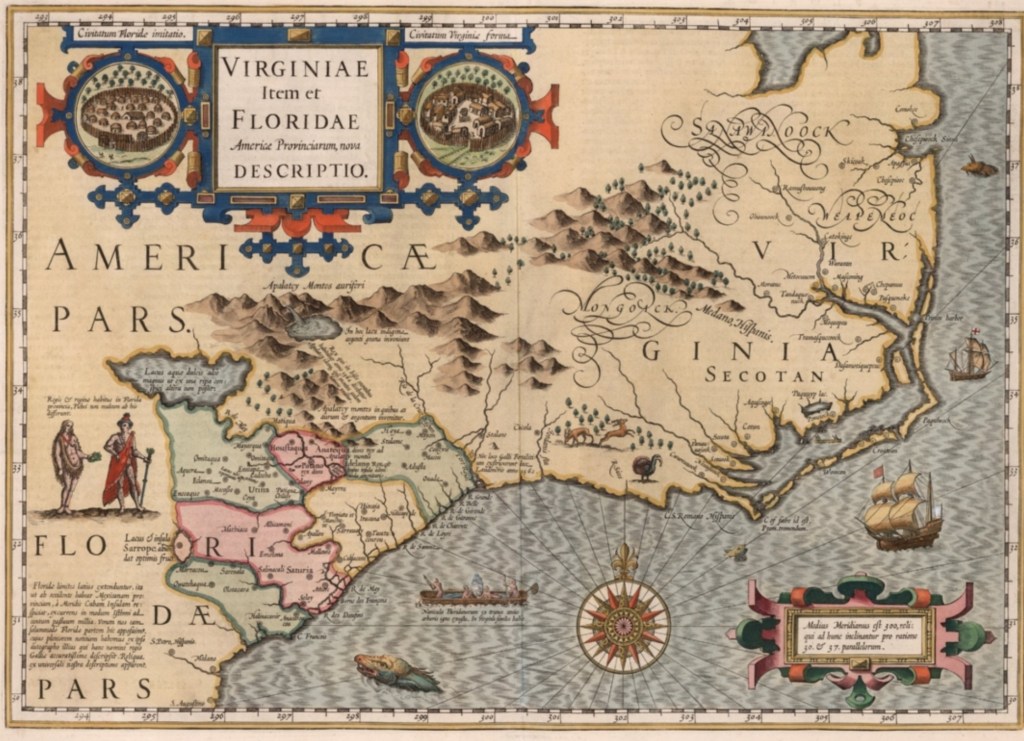
Virginiae Item et Floridae Americae Provinciarum, nova Descriptio.
Map by Gerard Mercator (1512–1594), Jodocus Hondius (1563–1612), and Hendrik Hondius (1597–1651).
Virginiae Item et Floridae Americae Provinciarum, nova Descriptio.
Map by Gerard Mercator (1512–1594), Jodocus Hondius (1563–1612), and Hendrik Hondius (1597–1651).
Published in 1623 by Hendricus Hondius, Amsterdam.
Image courtesy of the David Rumsey Map Collection, David Rumsey Map Center, Stanford Libraries.
Licensed under Creative Commons CC BY-NC-SA 3.0.

Raised within the Romano-Byzantine tradition—formed by both the Roman and Byzantine Catholic rites—I was shaped by a confluence of liturgical beauty, theological depth, and mystical reverence. From that upbringing, there remains not merely memory, but a lasting affection for the rhythm and substance of the faith of my youth. It is not simply a cultural inheritance, but a formative lens through which the sacred, the communal, and the mysterious first revealed themselves. Yet, it would not be accurate to describe my present stance as that of a lapsed Catholic, nor as an atheist, nor as one alienated from the Church. Alienation implies disaffection or estrangement born of expectation unmet or betrayal suffered. What remains is neither rejection nor rebellion, but something quieter and more reflective—a posture of reverent detachment that neither clings nor condemns.

Any attempt to articulate my position must begin by acknowledging the futility of articulation itself—at least in matters concerning the Divine. The belief that the Divine wholly exceeds the bounds of human comprehension and articulation grows only firmer over time. All creeds, revelations, and theological systems—however earnest or inspired—are, in the end, efforts to sketch with a cramped human lexicon and limited imagination that which lies beyond even the highest powers of conception. Far from illuminating the Divine, such efforts only obscure its immensity by imposing upon it our narrow symbols and forms.

Better to liken our theological endeavors to the drawing of maps—maps sketched by explorers who had never seen the coasts they sought to chart. Just as early cartographers filled the margins with dragons, saints, and imagined cities, we adorn the unknown with creeds, cosmologies, and commandments. These are sincere efforts, yet they more often reflect our hopes and fears than reveal any transcendent truth. The more intricate the system, the more seductive the illusion that the map is the territory. But the Divine is not a line upon a page. It is the sea beneath the sea monster, the silence beyond the compass rose, the continent whose very existence remains unknown. To name the Divine is already to misname it; to describe is to distort.

Such a perspective finds its truest expression in apophatic mysticism—the via negativa, the way of negation—a tradition articulated by Pseudo-Dionysius the Areopagite, a Christian thinker of the late fifth to early sixth century whose writings permeate the Catholic tradition through the works of Thomas Aquinas, Bonaventure, and the Spanish mystics, reminding us that the path of unknowing is not a break from faith, but one of its most ancient and revered expressions. In this light, God is not wise, not good, not just, not loving—not because the Divine lacks these qualities, but because our highest notions of them remain shadows cast by a light we cannot behold. Whatever we say of the Divine, however conceived, the most faithful statement is this: our words fall short.

Even so, human beings remain kataphatic creatures as well—creatures who long to speak, to name, to worship, to relate. Thus arises a kataphatic-apophatic tension, a profound and permanent unease between the impulse to speak of the Divine and the recognition that all speech fails. Hymns, liturgies, cathedrals, and doctrines are all human responses to this tension—not to capture the Divine, but to reach toward it, however falteringly. These gestures deserve neither scorn nor uncritical assent. They should be honored, but held lightly, cherished as poems rather than mistaken for proofs.

This tension extends beyond the realm of theology into the very nature of being itself. In a moment of quiet reflection, I found myself asking: “Where is Am I?”—caught between breath and thought, a question turning circles in the hollow of my chest. Am I the echo, or the voice that trembles back? A fragment drifting through the hour, a flicker in the endless light, unsure if I was ever whole or if the pieces were ever mine to find. Such a question is not mere existential uncertainty, but a recognition that the self, like the Divine, eludes definitive capture.

No formal creed or written revelation authored by man commands my assent, however noble or inspired it may be. Faith is not placed in these constructions, though the sacred yearning from which they arise is deeply respected. They are echoes of an original voice no longer heard directly, outlines of a presence glimpsed but never grasped. Like the adornments on ancient maps, these expressions are beautiful and sincere, but they are not to be mistaken for the thing itself.

To some, this may resemble agnosticism, though that word has become burdened with meanings it was never intended to carry—meanings of indecision, skepticism, or apathy. What is expressed here is none of those. It is not a shrug of the shoulders, but a bow of the head. Not the silence of the indifferent, but of the reverent. Not ignorance, but a conscious unknowing—a sacred refusal to impose limitation upon that which exceeds all bounds. This is why I eschew agnostic labels in favor of mystical ones—for the mystic does not claim ignorance of the Divine but acknowledges that true knowledge of it transcends conventional understanding.

What remains, then, is a life lived in contemplation of the ineffable—a contemplation that finds expression through creative work. In poetry, music, and essay, I reach toward that which cannot be directly named. When I write of the “eternal now” where “yesterday, tomorrow, and today collapse,” or compose lyrics that honor Humilitatem Initium Sapientiae, I am not merely creating art but engaging in a form of contemplative practice. These creative acts serve as bridges, not only between myself and the ineffable, but also between myself and others who share this reverent space, regardless of their formal religious affiliations or φιλοσοφίαι (philosophies or wisdom traditions).

The path ahead is not marked by certainty but by awe, not by declarations but by listening. Mystery is not something to be solved, but something to be honored. Years of formal study—first in history and religious studies as an undergraduate, then as a teacher of both subjects, and later through a long career in civil rights law and public service—have only deepened the awareness that human systems, whether intellectual, doctrinal, or legal, ultimately encounter their limits at the threshold of the sacred. In this, the apophatic tradition offers a spiritual home—a dwelling place where reverence begins precisely where language ends. If there is a guiding light for such a path, it is humility—humilitatem initium sapientiae—not merely as a moral posture, but as a metaphysical necessity. That teaching, which echoes throughout Thomas à Kempis’ The Imitation of Christ, remains not only a personal motto, but a settled conviction: that wisdom begins when one ceases to pretend to possess it.

Near the staircase in my front hallway hangs an early map of the New World—an artifact I have long cherished. Its artistry is matched only by its courage, for it dares to depict what was not yet known. Near the region now recognized as Virginia and the Carolinas, a sea monster rises from the ocean’s depths, signaling peril or wonder—perhaps both. On the land itself, figures of “natives” stand, imagined by a hand that never walked those coasts. That map does not record the world; it records what the world dared to imagine. So, too, do our theologies populate the margins of metaphysical uncertainty with monsters and angels, commandments and visions. They are imaginative acts—sincere, flawed, luminous. And like that map, they are to be cherished not for their precision but for what they reveal of the human longing to reach into mystery with word and symbol, with ink and awe. In their earnest striving, they remind us: we are always sketching the edge of the unknown, even when we know we cannot cross it.

Prophetic Lamentation in the Biblical Tradition on Judicial Corruption

The content discusses transforming a prophetic lamentation about the corruption of the American justice system into a biblical framework, relating it to Judeo-Christian themes. It emphasizes the corruption of judges influenced by wealth and oligarchs, using biblical imagery and references to emphasize concerns for justice. The work calls for repentance and restoration while echoing biblical prophetic traditions highlighting the importance of righteousness and divine justice, urging readers to recognize the significant consequences of judicial corruption and its societal ramifications.

Photo by Pavel Danilyuk on Pexels.com

Recognizing that most Americans may have a familiarity with Judeo-Christian themes, imagery, and language—but little to no awareness of Mesopotamian themes, imagery, and language—I sought to recast my recent prophetic lamentation on the corruption of Justice, The Temples of Utu, into a biblical framework. By doing so, I aimed to ensure that my lamentation on the corruption of the American justice system, particularly the concern that judges and Justices are being purchased by oligarchs and beholden to faction, would resonate more deeply with contemporary readers.

The work found by scrolling further down, A Prophetic Lamentation: A Biblical Cry for Righteous Judgment, was created by transforming The Temples of Utu: A Contemporary Lament for Justice into a text that more explicitly resonates with the Judeo-Christian tradition. By incorporating biblical references throughout and aligning the themes with scriptural principles, this lamentation follows the prophetic tradition of calling out corruption and pleading for divine justice.

An Audio Reading of Donald S. Yarab’s
A Prophetic Lamentation: A Biblical Cry for Righteous Judgment

To aid in understanding the biblical framework underlying this transformation, the following terms and themes are central to the work:

I. Theological Names and Concepts

  1. El Elyon (אֵל עֶלְיוֹן) – A Hebrew name for God meaning “God Most High.” It first appears in Genesis 14:18-20 with Melchizedek, emphasizing God’s supreme authority and sovereignty over all creation.
  2. Adonai (אֲדֹנָי) – A Hebrew term meaning “my Lord,” traditionally used as a substitute for YHWH out of reverence. It signifies God’s absolute authority and dominion.
  3. El Shaddai (אֵל שַׁדַּי) – Typically translated as “God Almighty,” it first appears in Genesis 17:1 when God makes a covenant with Abraham. It highlights God’s power, might, and provision.
  4. Elohim (אֱלֹהִים) – A plural form used singularly for God in the Hebrew Bible, emphasizing divine power and majesty.
  5. Mammon (μαμμωνᾶς) – An Aramaic term used by Jesus in Matthew 6:24 and Luke 16:13, personifying wealth and material possessions as an opposing force to God. In this work, Mammon represents the corrupting influence of material gain and injustice.

II. Historical and Symbolic References

  1. Babylon – The empire that conquered Jerusalem in 586 BC, destroying Solomon’s Temple and exiling many Judeans. In biblical prophecy, Babylon symbolizes oppressive human power and arrogance that defies God (Isaiah 47:1-11; Jeremiah 50-51; Revelation 18).
  2. Egypt – The nation that enslaved Israel before the Exodus. Egypt is often used as a biblical metaphor for oppression, idolatry, and the worldly systems from which God delivers His people (Exodus 20:2; Deuteronomy 4:20; Hosea 11:1).
  3. Assyria – The empire that conquered the Northern Kingdom of Israel in 722 BC. Known for ruthless expansion and forced resettlement, Assyria is depicted as an instrument of God’s judgment but ultimately doomed for its arrogance (Isaiah 10:5-19; Nahum 3).
  4. Tyre – A Phoenician port city known for its wealth and trade dominance. Biblical prophets condemned Tyre for its pride, greed, and economic exploitation (Ezekiel 27-28; Isaiah 23). In this work, Tyre symbolizes commercial corruption and economic injustice.
  5. Mount Sinai – The sacred mountain where Moses received the Law from God (Exodus 19-20). Sinai represents divine revelation, covenant responsibility, and the foundation of justice.
  6. Sodom – The city destroyed for its wickedness and injustice (Genesis 19:24-25). In prophetic literature, Sodom serves as a symbol of moral corruption and a warning of divine judgment (Isaiah 1:9-10; Ezekiel 16:49-50).

III. Prophetic Tradition and Literary Framework

  1. Biblical Lamentation – This work follows the tradition of biblical lament, particularly seen in Lamentations, the Psalms, and prophetic writings. These laments express grief over national corruption and divine judgment (Lamentations 1:1-4; Psalm 137).
  2. Prophetic Literary Forms – The text incorporates multiple prophetic genres, including:
    • Lawsuit (rîb) – Where God brings charges against His people (Isaiah 1:2-3; Hosea 4:1).
    • Woe Oracle (hôy) – Pronouncing judgment upon injustice (Amos 5:18-24; Habakkuk 2:6-20).
    • Lament (qînâ) – Mourning the destruction caused by sin and corruption (Jeremiah 9:17-22; Ezekiel 19).
    • Restoration Promise – Common in prophetic literature, offering hope after judgment (Jeremiah 31:31-34; Isaiah 61:1-3).
  3. Covenantal Framework – Judges in ancient Israel were not merely legal authorities, but covenant mediators tasked with upholding divine law. Their corruption represents a betrayal of that covenant, mirroring Israel’s repeated failure to uphold God’s justice (Deuteronomy 16:18-20; Isaiah 1:21-23).
  4. Justice for the Oppressed – The recurring emphasis on justice for widows, orphans, and foreigners aligns with the core concerns of biblical prophets, such as:
    • Amos 5:11-12 – Condemning exploitation of the poor.
    • Micah 6:8 – Calling for justice, mercy, and humility.
    • Isaiah 10:1-2 – Warning against unjust laws that oppress the vulnerable.
  5. Apocalyptic Elements – The “Day of Reckoning” section reflects apocalyptic themes, seen in:
    • Joel 2:1-2 – A warning of impending divine judgment.
    • Daniel 7:9-14 – God’s ultimate triumph over corrupt rulers.
    • Revelation 18 – The fall of oppressive systems.

IV. Purpose of This Work

By drawing on these biblical themes, historical symbols, and prophetic traditions, A Prophetic Lamentation: A Biblical Cry for Righteous Judgment aims to offer a theologically rich meditation on the corruption of justice. It calls for repentance, righteousness, and restoration, echoing the voices of the biblical prophets who spoke against oppression and warned of impending judgment.

For readers wishing to explore the scriptural foundations of this work, a guide to the work labeled as containing in-text biblical citations is available at the button below. Finally, though many have their favorite bibles, I do not hesitate to recommend for studying the Old Testament, Robert Alter’s The Hebrew Bible: A Translation with Commentary. The scholarship, especially in the footnotes, is unmatched. Another useful online resource is biblehub.com – which allows you access to multiple bible translation traditions.


A Prophetic Lamentation: A Biblical Cry for Righteous Judgment

A Lament for the Perversion of Judgment and the Abandonment of Righteousness

Part I: The Forsaking of Righteousness

The First Turning from Truth

In the days when righteousness stood firm in the land, when the Law of The LORD was a lamp unto the feet of judges, the courts of justice were as sanctuaries where truth dwelled. The judges, servants of El Elyon—The LORD, God of Abraham, Isaac, and Jacob, the One who brought Israel out of Egypt and wrote His covenant in fire upon Sinai, sat in chambers of cedar and stone, their hands unstained, their judgment righteous. The widow, the orphan, and the foreigner approached without fear, for the Law was written by the finger of Elohim upon tablets of stone, and justice flowed like the waters of Shiloah through the gates of the city.

But in time, whispers arose from the chambers of power. First to one judge, then another. Golden whispers, honeyed promises, from the lips of those who dwelled in palaces of privilege. And some turned their ears to listen.

From the houses of the mighty came messengers bearing gifts wrapped in fine linen, bearing words that concealed their true purpose. And the first judge who accepted such offerings felt the scales within his heart shift, so slightly he did not perceive it. But The LORD perceived it, as He perceived the wickedness of the sons of Eli, whose hands were stained with bribes and whose lips defiled the altar. The LORD, before whom no falsehood can stand, whose eyes search the hearts of men.

Yet the voice of Adonai grew fainter in the halls of judgment, as the mighty pressed their thumbs upon the sacred scales of Moses.

The Widow’s Cause Rejected

When the widow came before the seat of judgment,
Her cause was just, her plea righteous.
But he who wronged her wore the seal of the rulers,
And silver had changed the words of the Law.

The judge spoke with a tongue not his own:
“The letter of the Law says thus and thus,
Yet its spirit is silenced beneath my tongue.”
And so the widow departed in sackcloth.

She lifted her voice in the gates of the city:
“Where is Thy justice, O LORD of Hosts?
Thy servants speak with deceitful lips,
Thy Law is sold for pieces of silver.”

But no thunder came from Mount Sinai,
For the judges had stopped their ears with gold.

Part II: The Spreading Abomination

The Choosing of the Corrupt

As the seasons of harvest passed, it came to be that when a judge returned to the dust, those who appointed his successor sought not for wisdom, not for righteousness, not for fear of The LORD. Instead, they sought those who had bowed before the mighty, who had pledged themselves in secret chambers to uphold not the Law as it was given through Moses, but the interests of those who elevated them.

And so the courts of judgment, one by one, were filled with those who had sold their birthright for a bowl of pottage before ever taking the seat of judgment. The words of their oaths remained the same, the ceremonies unchanged, but the fear of El Shaddai had departed from the administration of justice.

Then came the spirit of Mammon, whom Solomon warned against, moving through the corridors of power. Not with swift judgment did he strike, but with slow corruption, a leprosy of the soul that left its victims outwardly clean but inwardly defiled, wearing the robes of righteousness while serving the lords of unrighteousness. And Elohim looked down, as He did in the days of Noah, and beheld that the wickedness of man had multiplied, and that the thoughts of his heart were only evil continually.

The Judgment Purchased with Silver

Behold how they come with scrolls of precedent in hand,
Twisting the words of the prophets to serve new masters.
The Law speaks what they command it to say,
The statutes bend like bulrushes in the wind.

Mammon walks boldly among the pillars of justice,
His touch light as silver upon the outstretched palm.
Each judgment purchased furthers the transgression,
Each verdict for sale defiles the holy sanctuary.

The judges feast at the tables of the merchants of Tyre,
The masters of wealth whisper close in their ears:
“This cause favors our interests,” they murmur,
“This ruling preserves the power we hold dear.”

And the people cry out to the Holy One of Israel,
But His face is turned away from His defiled courts.

Part III: The New Order of Iniquity

The Temple Defiled

And so it came to pass that the courts of justice no longer stood as bulwarks against wickedness, but as instruments of those who ruled from behind veils. The judges spoke still of righteousness, wore still the robes of impartiality, but their eyes looked ever to their masters for instruction. Their words were shaped not by the Law of Moses, but by the whispers of corruption.

The scales that once weighed all causes righteously now tipped by design. The light that once revealed truth now cast deceptive shadows. And those who came seeking justice found instead a marketplace where judgments were bought and sold like cattle and grain in the markets of Jerusalem.

The Serpent, who from Eden has twisted the words of Elohim, wound himself around the pillars of judgment like the bronze serpent once lifted in the wilderness. His forked tongue spoke through the mouths of judges, uttering words sweet as honey yet bitter in the belly, verdicts that invoked the sacred Law while rendering it void and without effect.

The Perverted Judgment

The scales of judgment hang crooked now,
Weighted with bribes and heavy with deceit.
The mantle of justice has become a shroud,
Pulled tight by hands that serve the powerful.

The Serpent coils around the judgment seat,
His ancient form hidden beneath holy garments.
“Justice,” they proclaim, while dealing in oppression,
“The Law,” they invoke, while breaking its covenant.

The mighty approach the courts without fear,
For they have purchased favor with unrighteous mammon.
The poor approach with trembling upon their faces,
For they know the sentence before the cause is heard.

So the pillars of justice, hewn by the hands of the faithful,
Were carved anew by the chisels of corruption.
The covenant of right judgment lay broken upon the steps,
As the people watched their inheritance dissolve like morning dew.

Part IV: The Breaking of the Covenant

The Covenant Forsaken

Thus was the covenant between The LORD and His people defiled. Not by the sword of Babylon, nor by the chariots of Egypt, nor by the cunning of the Assyrians, but by the slow poisoning of the wells of justice. As the cycles of seedtime and harvest passed, the people came to know that the courts offered no refuge for the oppressed, that the words of judges held no truth, that judgment measured not righteousness but privilege.

And in this knowing, the foundations of society began to crumble. For what is Law if not covenant? What is justice if not faithfulness? What is order if not the keeping of sacred promises?

The rulers and mighty men who had captured the courts of judgment did not see the doom they had wrought. They feasted upon their victory over righteousness, their conquest of the scales. They did not hear the voice of Adonai, gathering like thunder upon the mountains, as in the days of Sinai, preparing for the day of visitation.

For when justice fails, the whirlwind awaits. When Law becomes a snare rather than a protection, the people cast aside its yoke. When righteousness is no longer honored in the courts, it cries out from the dust like the blood of Abel, calling for vengeance before the throne of El Elyon.

The Harvest of Corruption

Now Jerusalem trembles upon foundations of sand,
The courts of judgment stand as whitewashed tombs.
What was established through generations of faithfulness,
Falls to ruin through seasons of corruption.

The people no longer call upon the name of The LORD in the courts,
For His servants have made it bitter on the tongue.
They turn instead to other deliverers, darker powers,
Gods of vengeance, spirits of retribution.

The rulers sleep uneasy in their chambers,
For they have slain the guardian of their peace.
In purchasing the Law, they rendered it powerless,
In perverting justice, they broke its authority.

And The LORD cried out, as He did through Amos:
“But let justice roll down like waters,
And righteousness like an ever-flowing stream!”
But the stream had dried, the land was parched, and the people drank the wine of oppression instead.

Epilogue: The Prophetic Warning

The Voice of the Remnant

Those who remember, who still hold the Law sacred in their hearts, who recall the days when the courts of judgment shone with uncorrupted light, raise their voices in the wilderness of injustice.

They speak of what was lost, of scales that balanced, of laws that protected the least among the people. They warn of what comes when the rulers believe they have placed themselves beyond the judgment of El Shaddai.

For the LORD watches still, though His servants have forsaken Him. The Holy One of Israel sees still, though His courts have been corrupted. And the day will come when righteousness returns to the gates of the city, when justice again flows like living water.

But the price of restoration will be bitter, paid in the coin of tribulation. For what is defiled cannot be cleansed without fire, as Sodom was overturned in fire and brimstone, and the altars of Baal were cast down in the days of Elijah.

The Day of Reckoning

Remember this in days to come,
When the storms of judgment break upon the land,
When faction rises against faction in the ruined streets,
When the rulers tremble before the dispossessed:

It began with the perversion of judgment,
It began with the purchasing of truth.
It began when the courts of the LORD
Became marketplaces for injustice.

And those who turned their backs on righteousness,
Who sold the Law for temporary gain,
Who twisted the statutes of the Most High,
Will cry out: “How could we have known?”

But their hands are not clean.
For they defiled the sanctuary, stone by stone.
They corrupted the judges, word by word.
They profaned justice, verdict by verdict.

And the LORD shall arise, as He did at Sinai, in fire and storm,
As He did at Babylon, with writing upon the wall.
Neither silver nor rulers will shield them;
They and their wealth shall melt like wax before the flame.


The Temples of Utu: A Contemporary Lament for Justice

The Gods Who Watch and the Scales That Tilt

Justice, in any age, is a fragile thing. When upheld, it brings order, clarity, and fairness. When corrupted, it festers unseen at first, then collapses with ruinous consequence. The Temples of Utu: A Contemporary Lamentation for Justice is a prophetic lament cast in the voice and style of an ancient civilization, yet it speaks with painful familiarity to those who observe the world today.

Ningišzida, with snakes emanating from his shoulders, on a relief of Gudea. Photograph by Osama Shukir Muhammed Amin FRCP (Glasg) CC BY-SA 4.0.

This work draws upon the mythic imagery of Mesopotamian religion, invoking gods who, for the people of Sumer and Akkad, embodied cosmic forces—truth and deception, judgment and decay. Though their temples have long crumbled to dust, their symbols remain potent warnings for the rise and fall of justice in human society.

Be aware, however, the Lamentation does not reflect the historic reality of how and where justice was actually dispensed in ancient Mesopotamia. A rudimentary understanding of the justice system, such as we understand it, is discussed in early scholarship, such as Samuel Noah Kramer’s The Summerians: Their History, Culture and Character (1963/1971), for those who are interested in the basics (see for instance pp. 83-88). If truly interested in historical reality, seek out more updated, contemporary scholarship! It will be worthwhile!

Who Are the Gods Named in This Lamentation?

  • Utu (Shamash): The Mesopotamian god of the sun, justice, and truth. Utu was depicted as the divine judge who saw all things, presiding over oaths and fair dealings. His light illuminated deception, and his scales weighed the hearts of the people. When justice was upheld, his temples shone golden in the sun; when corruption took root, his light dimmed.
  • Namtar: The herald of death and bringer of plagues, Namtar represents creeping inevitability—the slow, inexorable spread of decay. In this lamentation, he is not an agent of quick destruction, but of corruption’s quiet advance through the halls of justice, spreading like a sickness that hollows out institutions from within.
  • Ningišzida: A chthonic (underworld) deity associated with serpents, passage between worlds, and the boundary between truth and falsehood. He coils around the pillars of justice, his forked tongue shaping words that once carried fairness into tools of deception. His presence signals the transformation of law into an instrument of the powerful, a mask of legitimacy covering injustice.
  • Enlil: The great god of storms and divine authority. Though absent for much of the lamentation, his presence gathers at the end, a harbinger of reckoning. If Utu is the impartial light of justice, Enlil is the storm that follows when justice is betrayed.

These figures serve as more than mythological references—they embody timeless realities. The slow erosion of judicial integrity, the rise of factionalism over fairness, the perversion of law into a tool of the mighty—these are not merely the concerns of an ancient civilization but of every society that has ever built temples to justice, and of every people who have watched those temples fall.

As you read (or listen to) The Temples of Utu, consider not only the past, but the world around you. Are the scales of justice still balanced? Or has the light of Utu grown dim once more?


An Reading of Donald S. Yarab’s “The Temples of Utu: “A Lamentation for Justice”
The Temples of Utu: A Lamentation for Justice

Part I: The Silencing of the Scales
The First Turning Away


In the days of order, when truth stood firm in the public square and the scales weighed all hearts with equal measure, the temples of Utu shone golden in the light of the sun. The judges, priests of Utu—Utu, whose eye sees all deceptions, whose light banishes shadow—sat in chambers of cedar and stone, their hands unstained, their vision clear. The weak approached without trembling, for the law was etched in tablets that none might alter, and justice flowed like water through the streets of the city.

But in time, whispers came upon the night wind. First to one priest, then another. Golden whispers, honeyed promises, from the lips of those who dwelled in towers of privilege. And some turned their ears to listen.

From the towers of the mighty came emissaries bearing gifts that were not called bribes, bearing words that were not called threats. And the first priest of Utu who accepted such offerings felt the scales within his heart shift, so slightly he did not mark it. But Utu marked it. Utu, whose eye sees all deceptions, whose light banishes shadow.

Yet Utu's voice grew fainter in the halls of judgment, as the mighty pressed their thumbs upon his sacred scales.

The First Injustice

When the widow came before the seat of judgment,
Her cause was just, her claim was true.
But he who robbed her wore the sigil of the faction,
And gold had changed the color of the law.

The priest of Utu spoke with borrowed tongue:
"The letter of the tablet says thus and thus,
Though its spirit cries otherwise."
And so the widow left with empty hands.

She raised her voice to Utu in the square:
"Where is thy justice, Lord of Truth?
Thy priests speak with forked tongues,
Thy scales are weighted with gold."

But no answer came from the heavens,
For the priests had muffled Utu's ears with silk.

Part II: The Spreading Corruption
The Selecting of the Loyal


As the cycles of the moon passed, it came to be that when a priest of Utu returned to the earth, those who chose his successor looked not for wisdom, not for fairness, not for devotion to the scales of truth. Instead, they sought those who had bowed before the factions, who had pledged themselves in secret chambers to uphold not the law as it was written, but the interests of those who appointed them.

And so the temples of Utu, one by one, were filled with those who had sold their sight before ever taking the seat of judgment. The words remained the same, the rituals unchanged, but the spirit had fled from the body of justice.

Then came Namtar, herald of plagues and divine judgment, moving through the corridors of power. Not with swift death did he strike, but with slow corruption, a disease of the soul that left its victims standing but hollow, wearing the robes of justice while serving the lords of greed.

The Purchased Judgment

See how they come with scrolls of precedent,
Twisting ancient words to serve new masters.
The tablet says what they wish it to say,
The law bends like reeds in the wind.

Namtar walks among the pillars of justice,
His touch light as coin upon the palm.
Each judgment purchased furthers the contagion,
Each verdict for sale spreads the plague.

The merchants of discord dine at the judges' tables,
The priests of faction whisper in their ears.
"This cause favors our patrons," they murmur,
"This ruling advances our creed."

And the people cry out to Shamash, to Utu,
But the god of justice has turned his face away.

Part III: The New Order of the Scales
The Temples Transformed


And so it came to pass that the temples of Utu no longer stood as bulwarks against chaos, but as instruments of those who ruled from shadow. The priests spoke still of justice, wore still the robes of impartiality, but their eyes looked ever to their masters for guidance. Their words were shaped not by the tablets of law, but by the whispers of faction.

The scales that once weighed all hearts equally now tipped by design. The light that once revealed truth now cast strategic shadows. And those who came seeking justice found instead a marketplace where outcomes were traded like cloth and grain in the bazaar.

Ningišzida, serpent god of the underworld who knows the passage between life and death, between truth and falsehood, wound himself around the pillars of the temple. His forked tongue spoke through the mouths of judges, words that seemed just but served injustice, verdicts that spoke of law while mocking its purpose.

And the people learned that there were two laws in the land: one for the mighty, another for the meek.

The Twisted Scales

The scales of Utu hang crooked now,
Weighted with bribes and heavy with deceit.
The blindfold of justice has become a hood,
Pulled tight by hands that serve the powerful.

Ningišzida coils around the judgment seat,
His serpent form hidden beneath official robes.
"Justice," they proclaim, while dealing in its absence,
"The law," they intone, while breaking its heart.

The mighty approach the temple without fear,
For they have purchased indulgence in advance.
The weak approach with dread upon their faces,
For they know the verdict before the case is heard.

The tablets of law remain upon the wall,
But the words change meaning at the touch of gold.

Part IV: The Unraveling
The Breaking of the Covenant


Thus was the covenant between the people and the law undone. Not by decree, not by conquest, but by the slow poisoning of the wells of justice. As the cycles of the sun passed, the people came to know that the temples of Utu offered no sanctuary, that the words of his priests held no truth, that the scales of judgment measured not justice but advantage.

And in this knowing, the bindings of society began to fray. For what is law if not promise? What is justice if not trust? What is order if not the belief that truth will prevail against falsehood?

The factions that had captured the temples of Utu did not see the doom they had wrought. They celebrated their victory over impartiality, their conquest of the scales. They did not hear the whispers of Enlil, god of wind and storm, gathering his breath for the tempest to come.

For when justice fails, chaos awakens. When law becomes weapon rather than shield, the people take up arms of their own. When truth is no longer honored in the temples, it finds voice in the streets.

The Price of Betrayal

Now the city trembles on foundations of sand,
The temples of justice stand as hollow shells.
What was built through centuries of wisdom,
Falls to ruin through seasons of corruption.

The people no longer speak the name of Utu,
For his priests have made it bitter on the tongue.
They turn instead to other gods, darker gods,
Gods of vengeance, gods of fire.

The mighty sleep uneasy in their beds,
For they have slain the guardian of their peace.
In purchasing the law, they rendered it worthless,
In bending justice, they broke its spine.

And Enlil gathers the winds of retribution,
For no society stands when its pillars are rotten.

Epilogue: The Warning
The Voice of Memory


Those who remember, who still hold truth sacred in their hearts, who recall the days when the temples of Utu shone with uncorrupted light, raise their voices in the twilight of justice. They speak of what was lost, of scales that balanced, of laws that served all equally. They warn of what comes when the mighty believe they have placed themselves beyond judgment.

For Utu watches still, though his priests have forsaken him. Shamash sees still, though his temples have been corrupted. And the day will come when light returns to the chambers of darkness, when truth again flows through the veins of justice.

But the price of restoration will be bitter, paid in the coin of upheaval. For what is corrupted cannot be cleansed without fire.

The Future Reckoning

Remember this in days to come,
When the storms of chaos break upon the land,
When faction fights faction in the ruined streets,
When the mighty tremble before the dispossessed:

It began with the silencing of the scales,
It began with the purchasing of truth.
It began when the temples of Utu
Became marketplaces for injustice.

And those who turned their backs on truth,
Who sold the scales for temporary gain,
Who twisted the tablets of sacred law,
Will cry out: "How could we have known?"

But their hands are not clean.
For they desecrated the temples, stone by stone.
They corrupted the judges, word by word.
They unmade justice, verdict by verdict.

And when Utu returns to claim his throne,
Neither gold nor faction will shield them from his light.