
The Peril and Promise of Models: Utopia, Economy, and Theology


Pieter Bruegel the Elder, The Tower of Babel (c. 1563)
Pieter Bruegel the Elder, The Tower of Babel (c. 1563, oil on panel)
Kunsthistorisches Museum, Vienna

Utopias, like theoretical economic models and theological constructs, are among the most daring expressions of human thought. Each arises from an impulse toward order and improvement, born of the conviction that the present is insufficient and the future can be shaped. Yet despite their elevated origins, these frameworks call to be eschewed—not for the good they propose, but for the horrors they have enabled when unmoored from humility and constraint.

The history of ideas is littered with systems that began in hope and ended in terror. Plato’s Republic, with its philosopher-kings and rigid class hierarchy, inspired centuries of authoritarian dreams. Soviet central planning promised rational allocation but delivered famine and repression. The Puritan theocracy in Massachusetts Bay sought godly perfection but produced witch trials and exile for dissenters. Each began as a vision of human flourishing—the utopian city, the rationalized economy, the purified creed—yet furnished the blueprints for regimes of control.

Nor is such danger confined to leftist excesses or theological zealotry. In Chile, the 1973 overthrow of Salvador Allende led not only to political violence, but also to the forceful imposition of a radical free-market model under General Pinochet, guided by economists trained in the Chicago School. The result was economic restructuring praised by some for its efficiency, yet experienced by many as immiseration and repression. Here, too, theory eclipsed humanity. Market mechanisms became commandments; dissenters were not debated but disappeared. What was billed as liberation through market freedom became another apparatus of dominance—less visible, perhaps, but no less brutal. The lesson is not partisan, but perennial: when theory is elevated above persons, systems serve themselves.

Elevated to ideology, models cease to be guides and become chains. They offer certainty in place of inquiry, coherence in place of complexity, and purpose in place of personhood. What begins as vision hardens into decree; what is meant as a lens becomes law. Mao’s Great Leap Forward exemplified this transformation: an economic model promising industrial prosperity became an unyielding doctrine that cost millions of lives when reality refused to conform to theory.

When the model becomes sacred, deviation becomes heresy. And where heresy is named, there follow inevitably the commissars, the inquisitors, the doctrinaires—those who patrol the borders of the permissible. Stalin’s show trials eliminated those who questioned economic orthodoxy. Both Catholic Inquisitions and Protestant persecutions took inhuman measures against those who strayed from their respective versions of theological purity. McCarthyism destroyed careers in service of ideological conformity. All operated in service of the model, the path, the “truth”—though truth, in such hands, is no longer a horizon toward which one travels, but a cudgel with which to enforce obedience. And perhaps there is no final truth to be had, only a multiplicity of partial illuminations, glimpsed through the mist, refracted through fallible minds.

And yet, it would be a grave error to reject these models wholesale. A utopia, though unattainable, directs the gaze beyond the immediate—Martin Luther King Jr.’s “Dream” inspired civil rights progress precisely because it painted a picture of what America could become. A well-crafted economic model brings coherence to chaotic phenomena: Keynesian theory, whatever its limitations, helped navigate the Great Depression by providing a framework for understanding how governments might respond to economic collapse. A theological vision offers moral orientation and poetic resonance—liberation theology in Latin America, despite its political complications, channeled Christian teaching toward concrete concern for the poor and oppressed.

When held lightly—non-dogmatically, open to revision, aware of their limits—such models are not prisons but tools. They help us navigate complexity, but they must never be mistaken for the complexity itself. The Chicago School economists who influenced policy in the 1980s offered valuable insights about market mechanisms, but when their models became gospel rather than guides, the result was often ideology that ignored market failures and social costs.

The question, then, is one of balance. Can aspiration be disentangled from absolutism? Can man dream without dictating, model without mastering, believe without binding? This is no easy task, for humanity is rarely a creature of balance. We veer, we commit, we grasp too tightly. The same revolutionary fervor that toppled the Bastille eventually devoured its own children in the Terror. But the remedy is not the renunciation of vision; it is the cultivation of humility within vision. It is the refusal to equate map with territory, model with meaning, doctrine with destiny.

If balance is the ideal, then it must rest not on detachment but on a deeper fidelity—one that refuses both rigidity and relativism. This is not a call to valueless existence, but to the most valued existence—one that honors core commitments through responsive attention rather than rigid prescription. The danger lies not in caring deeply about human flourishing, justice, or freedom, but in believing we possess the universal formula for achieving these goods. True fidelity to our highest values often requires abandoning our preconceptions about how they must be realized. It demands constant attentiveness to circumstances, genuine openness to what the moment requires, and the intellectual courage to adjust course when reality refuses to conform to our expectations. The principled life is not one that follows predetermined blueprints, but one that remains alert to the irreducible complexity of human need and the ever-changing demands of genuine care.

To live without models is to drift. To live by them uncritically is to be enslaved. Wisdom lies in the middle path: to aspire without illusion, to theorize without tyranny, and to seek the better without forgetting the cost of the best. In this fragile equilibrium lies the noblest promise of human reason—not to control the world, but to understand it more justly, and to live within it more wisely. And in that wisdom, to leave room for the truth that ever escapes us.

Giambattista Vico, Metaphorical Language, and the Darmok episode of Star Trek: The Next Generation

Giambattista Vico, an influential figure in the 18th century, has gained recognition for his work on historical imagination. His opus “The New Science,” published in 1744, has contributed significantly to various disciplines, including philosophy, anthropology, literary criticism, and psychology. Vico’s views have influenced notable thinkers and writers, such as Wilhelm Dilthey, Karl Marx, R.G. Collingwood, and James Joyce. Understanding Vico’s perspective on metaphorical language sheds light on the significance of ancient literary and artistic works. This understanding resonates with the “Darmok” episode in Star Trek, where the encounter between two species with different languages reflects Vico’s ideas. The implications of language and culture on human advancement continue to be a subject of debate and analysis.

Giambattista Vico

Of late, the insights and importance of Giambattista Vico, an eighteenth century Neapolitan, especially as they relate to historical imagination, have attracted my attention.  To plumb the depths of the significance of his work, which are far deeper than I initially imagined, I obtained and read a translation of his opus Scienza Nuova seconda (or simply The New Science, the title under which the definitive version published in 1744 is known today).  The translation I obtained was published by Yale University Press in 2020, translated by Jason Taylor and Robert C. Miner, with an introduction by Giuseppe Mazzotta.  It is the third English translation of The New Science and is both well-notated and highly readable.   

Book Cover: The New Science by Giambattista Vico

Giovanni Battista Vico was born in Naples on June 23, 1668.  He received his education at local grammar schools, from Jesuit tutors, and at the University of Naples from which he graduated in 1694 as Doctor of Civil and Canon Law.  Although he never succeeded in obtaining the chair of Jurisprudence at the University of Naples, which he long desired, he did obtain a professorship in Rhetoric at the University, which he held until 1741.  Vico died in Naples in January 1744, at the age of 75. 

In his lifetime Vico’s works were largely unremarked, however, by the nineteenth century his extraordinary insights began to make a significant impression on philosophers, historians, and other intellectuals.  Vico’s ideas reached a wider audience with a German translation of The New Science by W.E. Weber which appeared in 1822, and, more significantly, through a French translation by Jules Michelet in 1824.  Subsequently, Vico’s views influenced the work of Wilhelm Dilthey, Karl Marx, R.G. Collingwood, and James Joyce, who used The New Science to structure Finnegans Wake.  The Stanford Encyclopedia of Philosophy notes that “ … an appreciation of Vico’s thought has spread far beyond philosophy, and his ideas have been taken up by scholars within a range of contemporary disciplines, including anthropology, cultural theory, education, hermeneutics, history, literary criticism, psychology, and sociology. Thus despite obscure beginnings, Vico is now widely regarded as a highly original thinker who anticipated central currents in later philosophy and the human sciences.”

When I was searching for guidance on understanding Vico, I quickly found that some of the greatest intellects of the twentieth century had both lectured and written on him.  For instance, the political philosopher Leo Strauss had lectured on him in Autumn Quarter 1963 at the University of Chicago.  Audio files of the lectures are available at the University’s Leo Strauss Center website; however, the quality of the audio files is uneven and, in many instances, poor.  But not to fear, a comprehensive and helpful written summary of the lectures is available here.  More helpful, and the immediate impetus for this posting, is the second guide I utilized for Vico: the writings by the intellectual historian Isaiah Berlin collected in the work entitled, Three Critics of the Enlightenment – Vico, Hamann, Herder (with a foreword by Jonathan Israel), Second Edition, edited by Henry Hardy, which was published by Princeton University Press in 2013.

Bookcover: Isaiah Berlin's Three Critics of the Enlightenment Vico Haman Herder

From the latter work, Three Critics of the Enlightenment, Berlin wrote a masterful section summarizing Vico’s attitude towards an appropriate historical understanding of humanity’s use of metaphorical language that immediately gave me a greater understanding and appreciation of both Vico’s genius and insight as well as brought to my mind with particular force many different literary and artistic works which I had previously experienced, but in a new and more vivid light.  First, the lengthy extract from Berlin’s essay:

“We normally distinguish between the literal and the metaphorical use of language.  To be literal is to call things by their appropriate names, and describe them in plain, simple terms; to use metaphor is a sophisticated or poetical way of embellishing or heightening such plain usage for the sake of giving pleasure or of creating vivid imaginative effects, or of demonstrating verbal ingenuity; this is usually considered the product of conscious elaboration which could, with enough effort, always be translated back into the plain or literal sense of which it is merely an artificially heightened expression.  Metaphor and simile, even allegory, are not for Vico, deliberate artifices.  They are natural ways of expressing a vision of life different from ours.  Men once thought, according to him, in images rather than concepts, and ‘attributed senses and passions […]to bodies as vast as sky sea and earth’.  What for us a less or more conscious use of rhetorical devices was their sole means of ordering, connecting and conveying what they sensed, observed, remembered, imagined, hoped, feared, worshiped – in short their entire experience.  This is what Vico calls ‘poetic logic’, the pattern of language and thought in the age of heroes.  The metaphorical use precedes – and must precede – the ‘literal’ use of words, as poetry must come before prose, as song is earlier than spoken speech; ‘the source of all poetic locution are two: poverty of language and need to explain and be understood’.  Early man, animist and anthropomorphist, thought in terms of what we now call metaphor as naturally and inevitably as we now think in ‘literal’ phrases.  Hence a great deal of what now passes for literal speech incorporates dead metaphors, the origins of which are so little remembered that they are no longer felt – even faintly – as such.  Since the changing structure of a language ‘tells us the histories of the institutions signified by the words’, we can glean from it something of how their world looked to our ancestors.  Because primitive man cannot abstract, ‘metaphor makes up the great body of the language among all nations’ at that time.  Vico supposed that such men used similes, images and metaphors much as people, to this day, use flags, or uniforms, or Fascist salutes – to convey something directly; this is a use of signs which it would today seem unnatural to call either metaphorical or literal.  Vico maintains that when a primitive man said ‘the blood boils in my heart’, where we should say ‘I am angry’, his ‘metaphorical’ phrase is a uniquely valuable evidence of the way in which such a man though, perceived and felt.  What he felt when he spoke of blood boiling seemed to him – and indeed was – more directly related to his perception of water in a heated cauldron than our sensation of anger would seem to us today.  The marvellous images, the immortal phrases coined by early poets are, according to Vico, due not to conscious flights of fancy but to the fact that the imaginations of such men and their capacity for direct sensations were so much stronger than ours as to be different in kind, while their capacity for precise analogies and scientific observations was far less developed.  Hence, if we are to understand their world, we must try to project ourselves into minds very remote from our own and endowed with these unfamiliar powers.  A world in which men naturally talk of the lip of a cup, the teeth of a rake, the mouth of a river, a neck of land, handfuls of one thing, the heart of another, veins of minerals, bowels of the earth, murmuring waves, whistling winds, smiling skies, groaning tables and weeping willows – such a world must be deeply and systemically different from any in which such phrases are felt, even remotely, to be metaphorical, as contrasted with so-called literal speech.  This is one of Vico’s most revolutionary discoveries.”

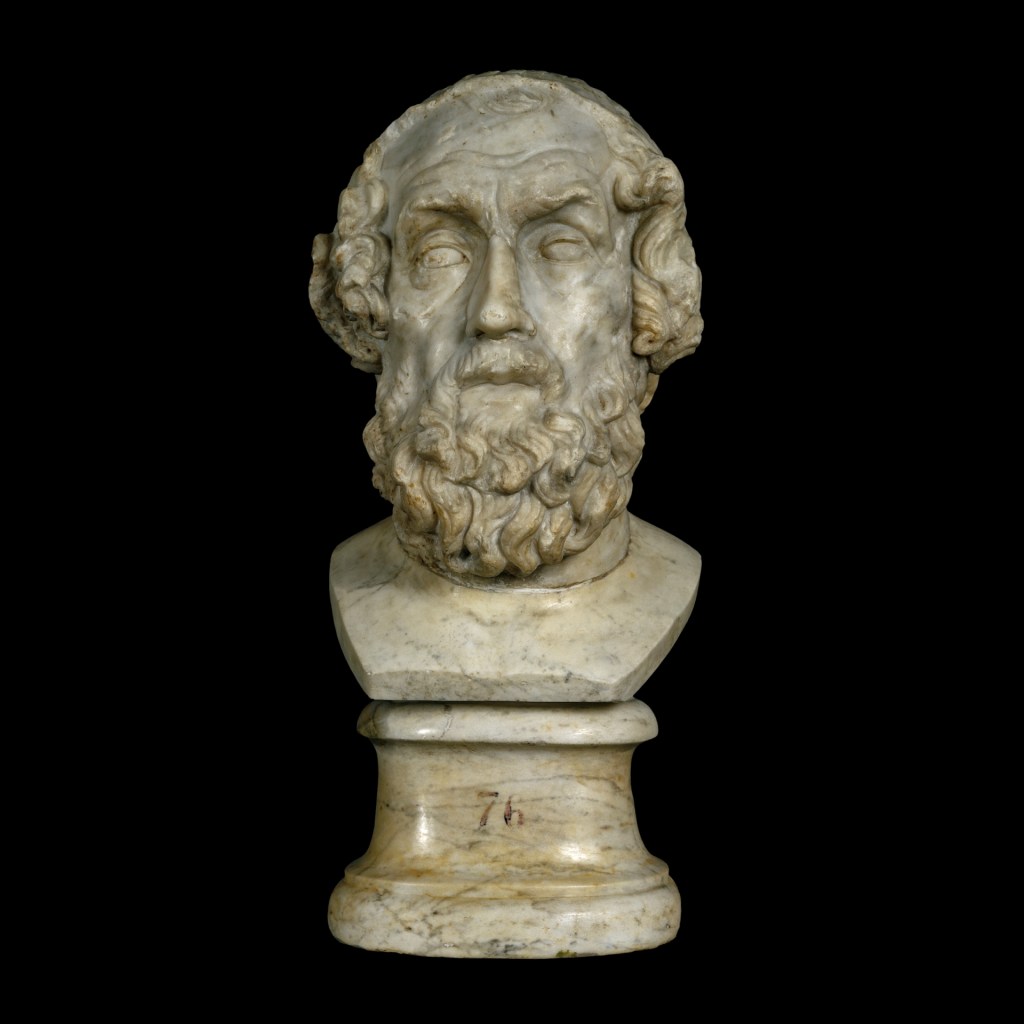
A Roman copy of a Hellenistic image of the poet Homer, author of the Iliad and Odyssey, sculpted in white marble between 150 and 125 BC.  Copyright ©Museo Nacional del Prado

Revolutionary indeed!  Who cannot but grasp even a scintilla of the foregoing and not know that reading the Iliad or Gilgamesh will be even more instinctually meaningful and powerful if read with this understanding of how those works struck the ears and core of our ancestors so many thousands of years ago?  And this, finally, brings me to the Darmok episode, which came to mind quite readily as I read the above on metaphorical speech.

A Trekkie I am not.  However, I do recall being struck by the brilliance of the Darmok episode when I first saw it decades ago.  The episode summary: Starfleet, a species known as speaking a literal language, interacts with a species (Tamarians) that uses a metaphorical language.  As a result of the language disconnect, the two species are initially unable to understand each other with tragic consequences as they engage in an ‘epic’ struggle with a hostile predator.  Ultimately, Picard, using the metaphorical language of Gilgamesh, communicates his understanding, such as it is, with the other species, thereby extending a tenuous bridge between the species … with optimistic portents for future relations. Star Trek often had ‘primitive’ species zipping across the universe with advance technology.  As such, it is not surprising that a species capable only of metaphorical language would be capable of interstellar flight in the Star Trek universe.  In Vico’s universe, however, such a primitive state of humanity (for he could conceive only of humanity) would not be capable of such advanced technological achievements.

An Atlantic article published in 2014 noted that many Trekkies also argued that the Tamarians would be unable to be so advanced given the limitations imposed by their metaphorical language. However, the author of the article, Ian Bogost, countered that the Tamarian language was sufficient, if compared, not to metaphor, but perhaps to allegory or, better yet, was understood as an abstraction, that is, a form of logic, which could be best described as a strategy. His argument is, to my sensibilities, convoluted, complex, and unattractive, but worth reviewing.