

The Oligarchic Turn: Wealth, Power, and the Decline of American Democracy

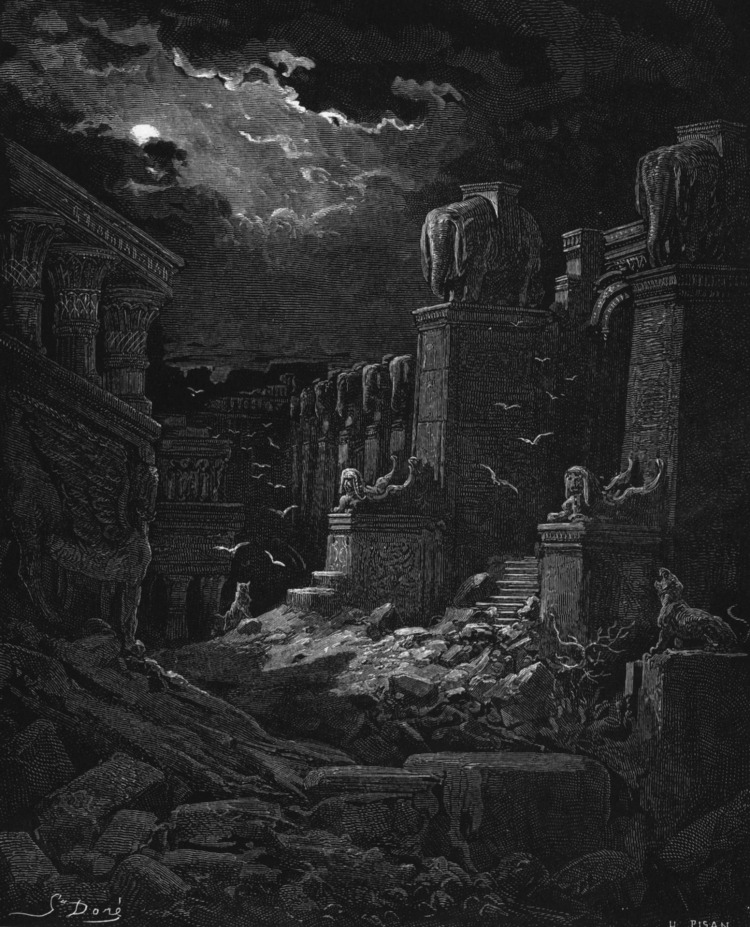
Gustave Doré – The Fall of Babylon (1866)

I. The Abdication of Democracy

The United States was founded as a democratic republic, a nation where governance was entrusted to the people and their elected representatives. Yet, in the present age, democracy appears increasingly untenable, not because of external threats, but because the citizenry itself seems willing to surrender its role in self-governance. Rather than engaging in the messy and difficult work of democracy, Americans have increasingly deferred power to an elite class—oligarchs whose wealth, status, and influence have elevated them beyond the reach of ordinary accountability. In doing so, we have embraced a political theology that anoints the rich as our rightful rulers, sanctifying economic disparity as though it were ordained by divine providence.

A key factor in this transformation is the theological justification for inequality, particularly through the Prosperity Gospel—a strain of Christianity that equates material wealth with divine favor. If wealth is a sign of God’s blessing, then poverty must be a mark of moral or spiritual failure. This belief, deeply embedded in the American consciousness, has provided a convenient ideological foundation for the rise of oligarchy. The result is a republic in name only, where the wealthy govern without meaningful challenge, and where democracy is tolerated only to the extent that it does not threaten the interests of the ruling elite.

Alexis de Tocqueville, in Democracy in America, warned that “the aristocracy of manufacturers… are one of the most dangerous that has ever appeared in the world” because they hold power over the masses without obligation or accountability. Likewise, James Madison in The Federalist No. 10 cautioned that factions dominated by economic interests would threaten the republic, as “the most common and durable source of factions has been the various and unequal distribution of property.”

II. The Historical Cycle: Republics in Decline

America is not the first republic to slide into oligarchy. The Roman Republic offers a particularly illuminating parallel. Beginning as a relatively participatory system after the expulsion of its kings, Rome’s republic gradually concentrated power in the hands of wealthy patricians. By the late republic, a handful of families controlled vast estates worked by slaves, while formerly independent farmers were displaced into a dependent urban proletariat. The final century of the republic saw repeated attempts at reform by populist leaders like the Gracchi brothers, who were assassinated for proposing land redistribution. When Julius Caesar crossed the Rubicon in 49 BC, the republic that had stood for nearly 500 years had already been hollowed out by economic inequality.

Venice provides another instructive example. The Republic of Venice began with a relatively broad-based Great Council of citizens. However, in 1297, the Serrata (closure) of the Great Council permanently fixed membership to established families, creating a hereditary aristocracy. Over time, even within this oligarchy, power concentrated further into the hands of the Council of Ten and eventually the three State Inquisitors. What began as a merchant republic gradually calcified into rule by the few, with elaborate ceremonies maintaining the fiction of the Serenissima Respublica (Most Serene Republic) while actual democratic elements withered.

The Weimar Republic’s collapse demonstrates how economic crisis can accelerate democratic decline. The hyperinflation of 1923 and the Great Depression devastated Germany’s middle class, traditionally democracy’s strongest supporters. As economic security vanished, so did commitment to democratic processes, with many seeking salvation in authoritarian alternatives. Alarmingly, in contemporary America, we witness similar anti-democratic impulses despite experiencing nothing remotely comparable to Weimar’s catastrophic conditions—suggesting that our democratic erosion stems not from genuine economic devastation but from manufactured grievance and the deliberate exploitation of social divisions.

But what fuels this manufactured grievance? Unlike the desperate economic collapse of Weimar Germany, today’s American discontent is stoked less by material suffering and more by a carefully cultivated sense of resentment. The modern oligarchy has perfected the art of distraction, channeling public anger away from corporate excess and systemic inequality and toward cultural and ideological battles that serve no economic interest for the working and middles classes. Instead of demanding higher wages, we are encouraged to fight over identity politics. Instead of questioning why billionaires pay lower tax rates than teachers, Americans are bombarded with outrage over books in libraries. Economic anxiety is repackaged into tribal conflict, ensuring that the real architects of inequality remain unchallenged.

This strategy is not accidental—it is the logical evolution of the media landscape. As traditional journalism declines, political entertainment thrives. Once, the press served as a check on power; now, it too is absorbed into the machinery of grievance, owned by the very oligarchs it should scrutinize. The consolidation is staggering: 90% of U.S. media is now controlled by just six corporations, compared to 50 companies in the 1980s.[1] This concentration has decimated local journalism while amplifying voices that serve oligarchic interests. The electorate is not simply disengaged—it is actively misled, encouraged to see fellow citizens as enemies rather than those who rule over them. This is not the erosion of democracy through neglect, but through engineering.

The success of this model is evident in voter behavior. Discontent no longer translates into economic reform movements or policy advocacy; instead, it is absorbed into personality-driven politics, where would-be strongmen are seen as righteous warriors against manufactured threats. The shift from democracy to oligarchy is not imposed—it is sold, marketed, and ultimately, embraced.

In this light, the warnings of America’s founders appear remarkably prescient. Thomas Jefferson warned against an “aristocracy of monied corporations” and stated, “I hope we shall… crush in its birth the aristocracy of our monied corporations which dare already to challenge our government to a trial of strength, and bid defiance to the laws of our country” (Letter to George Logan, November 12, 1816). Yet today, we have embraced the very model the Founders feared, allowing economic elites to determine policy, shape culture, and control the mechanisms of governance. The people, rather than resisting this transformation, have largely accepted it—guided in part by a religious narrative that equates power with virtue and poverty with failure.

III. The New Oligarchy: Wealth as Divine Favor

The modern American oligarchy is not merely composed of the wealthy, but of those who have successfully positioned themselves as figures of admiration and near-worship. Silicon Valley billionaires, hedge fund magnates, and political dynasties have become the new aristocracy, justified not by noble birth but by financial success. What separates today’s oligarchs from the robber barons of the past is not their wealth alone, but the theological and cultural framework that has shielded them from critique.

The concentration of wealth has reached unprecedented levels. According to Federal Reserve data, the top .1 percent of Americans—just 330,000 individuals—now hold 12.5% of the wealth, a staggering 40% increase from 8.9% in 2010. Meanwhile, the bottom 50% of Americans—165 million people—now hold only 5.5%.[2] This means the richest one-thousandth of the population controls more than twice the wealth of half the entire country. This marks a historic reversal of the post-WWII economic order. Yet rather than prompting concern, this concentration is often celebrated as evidence of entrepreneurial success and innovation.

This oligarchic influence extends beyond domestic borders. Foreign billionaires and sovereign wealth funds increasingly shape American policy and economic priorities through strategic investments, lobbying efforts, and ownership of U.S. assets. The globalization of capital has created a transnational oligarchic class whose interests often align regardless of nationality, further removed from democratic accountability. While domestic oligarchs at least feign the pretense of national loyalty, foreign wealth operates with even fewer constraints, treating American democracy as simply another market to be influenced or manipulated for profit.

The Prosperity Gospel, a uniquely American theological development, has played a significant role in this transformation. This doctrine teaches that material success is evidence of God’s blessing, while poverty signals a lack of faith or effort. In this view, wealth is not merely economic—it is moral. This ideology serves as a powerful deterrent to any redistributionist impulse, as it frames economic disparity as a reflection of divine will rather than systemic injustice.

Consider concrete manifestations of this oligarchic power: Congressional studies show that policy outcomes overwhelmingly align with the preferences of the wealthy. The Princeton study by Gilens and Page (2014) concluded that “economic elites and organized groups representing business interests have substantial independent impacts on U.S. government policy, while average citizens and mass-based interest groups have little or no independent influence.”[3] This influence is maintained through campaign finance—in the 2020 election cycle alone, the top 20 billionaire donors collectively spent $2.3 billion, more than twice as much as Joe Biden’s entire campaign, with a single billionaire contributing over half that sum.[4] Our democracy has effectively been captured by a donor class whose interests dictate policy priorities.

This capture extends to the very institutions designed to safeguard democracy. The judiciary, once a bulwark against concentrated power, has been systematically reshaped through strategic appointments and massive funding of judicial campaigns. Supreme Court decisions like Citizens United have equated money with speech, unleashing unprecedented corporate (thus oligarchic) influence in elections. Meanwhile, elected officials increasingly depend on wealthy donors and corporate PACs to fund ever-more-expensive campaigns, creating a system where access and influence are directly proportional to financial contributions. The result is a government formally elected by the people but functionally beholden to monied interests.

We see this play out in specific policies. The 2017 Tax Cuts and Jobs Act delivered massive benefits to corporations and wealthy individuals while adding $1.9 trillion to the national debt. Meanwhile, proposals for universal healthcare, student debt relief, or expanded social services—policies that would benefit the broader citizenry—face insurmountable opposition despite popular support. The revolving door between Wall Street and government regulatory agencies ensures that financial regulations are written by and for the financial elite. Figures like Steven Mnuchin, who moved from Goldman Sachs to hedge fund companies to Treasury Secretary, or Gary Gensler, who went from Goldman Sachs to Assistant Treasury Secretary, Under Secretary of the Treasury, Chair of the Commodity Futures Trading Commission, Commissioner of the U.S. Securities and Exchange Commission, and Chair of the Securities and Exchange Commission, exemplify how the line between regulator and regulated has blurred beyond recognition. When financial institutions faced collapse in 2008, they received immediate bailouts, while millions of Americans lost their homes with minimal assistance.

The tax system itself has been shaped to benefit the oligarchy. In 2021, ProPublica revealed that the 25 richest Americans paid an effective tax rate of just 3.4% between 2014-2018, while the average American paid around 14%.[5] This disparity did not occur by accident but through deliberate policy choices that allow the wealthy to categorize income as capital gains, exploit loopholes, and shield assets through complex financial structures unavailable to ordinary citizens.

Yet, the same religious justifications that elevate the wealthy conveniently overlook the conduct of those at the top. The modern oligarchs are often anything but paragons of virtue. Their lifestyles, filled with excess, exploitation, and moral as well as often legal bankruptcy, are far removed from the Christian ideals of humility, charity, and service. As Jesus himself warned in Matthew 19:24, “Again I tell you, it is easier for a camel to go through the eye of a needle than for someone who is rich to enter the kingdom of God.” And yet, the rich are celebrated, while the poor—often vilified as lazy or undeserving—are left to navigate a system rigged against them.

IV. The Willing Servitude of the Electorate

This transition from democracy to oligarchy has not been solely imposed from above; it has been embraced from below. A significant portion of the American electorate has come to see governance not as a participatory duty, but as a spectacle—one in which wanna-be strongmen and billionaires are revered as saviors rather than as figures to be held accountable.

Some defend this system as a meritocracy, where wealth reflects productivity and innovation. Yet Federal Reserve data shows that, using historically typical rates of return, inherited rather than earned wealth may account for over half of total wealth, undermining the narrative that economic status is purely the result of individual effort.[6] When nearly half of all wealth comes through inheritance, the myth of pure meritocracy becomes impossible to maintain. Nevertheless, the electorate continues to defend a system that increasingly resembles the hereditary aristocracies our founders sought to abolish.

The cultural obsession with wealth, combined with religious narratives that equate prosperity with righteousness, has dulled the instinct for democratic engagement. Why question the morality of economic inequality when it is perceived as a reflection of God’s order? Proverbs 22:7 states, “The rich rule over the poor, and the borrower is slave to the lender.” Why demand accountability from the ruling class when they are seen as divinely chosen stewards of the nation’s fate?

This abdication of democratic responsibility has been significantly accelerated by the capture of media institutions by the same oligarchic interests. Independent, objective news sources have largely disappeared from citizens’ lives, replaced by conglomerates owned by the very elites whose power should be scrutinized. What passes for journalism often amounts to ideologically laden content designed to reinforce existing power structures while appearing to inform. The resulting information ecosystem leaves citizens simultaneously overwhelmed with content yet starved of the context and critical analysis necessary for meaningful democratic participation. This theological deference to wealth has allowed democracy to wither, not through violent overthrow, but through active acquiescence.

The illusion of consumer choice masks growing corporate concentration, where 75% of household items are now controlled by just ten corporations.[7] When we believe we are making free market choices, we are often simply selecting between products owned by the same conglomerate. This mirrors our increasingly limited political choices, where candidates across the spectrum rely on the same donor base and serve similar corporate interests despite superficial differences in rhetoric.

Consider Amazon’s successful opposition to unionization efforts in Bessemer, Alabama (2021-2022), where billions in corporate resources were deployed to defeat workers seeking basic protections and better wages.[8] Rather than seeing this as class conflict, many Americans defend corporate interests against their own economic self-interest, having internalized a worldview where the market is sacrosanct and labor organization is somehow un-American. This represents the culmination of decades of ideological cult conditioning that has separated Americans from their own civic and economic power.

V. The Disappearance of Ethics in Public Life

If the Prosperity Gospel were true to Christianity, it would demand that the wealthy adhere to moral obligations—generosity, humility, and justice. Yet the reality is quite the opposite. The modern oligarchy exploits faith not to guide ethical behavior, but to silence dissent.

Throughout history, faith has been a force for challenging power—from the Social Gospel movement’s advocacy for labor rights to Martin Luther King Jr.’s invocation of Christian morality in the fight for civil rights. Dr. King warned, “We must rapidly begin the shift from a ‘thing-oriented’ society to a ‘person-oriented’ society” (Beyond Vietnam: A Time to Break Silence, April 4, 1967), criticizing the worship of material success over human dignity.

Yet today, much of American Christianity has been hollowed out, transformed into a vehicle for wealth-worship rather than a challenge to injustice. The teachings of Jesus, who spoke of the poor inheriting the kingdom of God and the moral dangers of riches, have been replaced by a doctrine that tells the poor they simply need to pray harder and wait their turn.

VI. The Oligarchs’ America

The American experiment in democracy appears to be in retreat, not because of foreign invaders or external threats, but because we have abandoned the very principles that sustain it. A democracy requires engaged citizens, yet we have become a nation content to let the wealthy govern without challenge. A republic requires accountability, yet we have deified billionaires and accepted their dominion as inevitable, if not righteous.

The Prosperity Gospel and its ideological offshoots have played a crucial role in this transformation. By equating wealth with divine favor, they have given a theological foundation to inequality and sanctioned the rise of oligarchy. This ideology has not only justified the unchecked power of the rich, but has also pacified the poor, persuading them that their struggles are personal failings rather than structural injustices.

If America is to reclaim its democratic aspirations, it must first confront the myths that have enabled its decline. We the People must remember that wealth is not virtue. Power is not righteousness. And democracy is not sustainable when its people cease to believe in their own right to govern. Until these truths are recognized, the nation will remain in the hands of those who have been deemed, by wealth and by providence, our betters.

History shows that oligarchic rule is not an inevitability. From the antitrust reforms of the early 20th century to the labor movements that shaped the New Deal, democratic resurgence is possible when citizens recognize their own power. But this requires first dispelling the myths that sustain the status quo: that wealth equals virtue, that political change is impossible, and that democracy is someone else’s responsibility.


[1] Ashley Lutz, “These 6 Corporations Control 90% of the Media in America,”’ Business Insider, June 14, 2012.

[2] Board of Governors of the Federal Reserve System, “Distributional Financial Accounts,” Q3 2024 Distribution of Wealth, accessed March 4, 2025,https://www.federalreserve.gov/releases/z1/dataviz/dfa/

[3] Martin Gilens and Benjamin I. Page. “Testing Theories of American Politics: Elites, Interest Groups, and Average Citizens.” Perspectives on Politics 12, no. 3 (2014), 565.

[4] Michela Tindera, “These Billionaire Donors Spent The Most Money On The 2020 Election,” Forbes, February 25, 2021, updated April 16, 2021, https://www.forbes.com/sites/michelatindera/2021/02/25/these-billionaire-donors-spent-the-most-money-on-the-2020-election/ 

[5] Jesse Eisinger, Jeff Ernsthausen, and Paul Kiel. “The Secret IRS Files: Trove of Never-Before-Seen Records Reveal How the Wealthiest Avoid Income Tax.” ProPublica, June 8, 2021. https://www.propublica.org/article/the-secret-irs-files-trove-of-never-before-seen-records-reveal-how-the-wealthiest-avoid-income-tax

[6] Laura Feiveson and John Sabelhaus. “How Does Intergenerational Wealth Transmission Affect Wealth Concentration?” Federal Reserve FEDS Notes, June 1, 2018.

[7] Oxfam. “Behind the brands: Food justice and the ‘Big 10’ food and beverage companies.” Oxfam International, 2013, https://www-cdn.oxfam.org/s3fs-public/file_attachments/bp166-behind-the-brands-260213-en_2.pdf

[8] Karen Weise. “Amazon Workers Vote Down Union Drive at Alabama Warehouse,” The New York Times, April 9, 2021.  https://www.nytimes.com/2021/04/09/technology/amazon-defeats-union.html?smid=url-share

Exploring ‘The Insemination of Venus’ by Laura Schmidt

The Insemination of Venus by Laura Schmidt
The Insemination of Venus, Laura Schmidt (2024). Mixed media (tooled leather, acrylic with hand-printed paper, torch-painted copper, soft pastel, polymer clay). The work incorporates kinetic elements, such as freely hanging copper leaves, and draws upon classical and mythological influences, including Botticelli’s Birth of Venus

If you find yourself without task or chore, bored beyond belief, and inclined to read a pedantic, hubristic, and discursive review interpreting a truly stunning work of art, I invite you to explore my essay (accessible at link below) on The Insemination of Venus by Laura Schmidt. To say that I find Schmidt’s work exciting and inspiring would be an understatement.

Schmidt, whom I have known for almost four decades, has recently turned in earnest to artistic endeavors following the conclusion of her legal career. Her latest work, The Insemination of Venus, is a masterful synthesis of classical themes and contemporary materials, drawing inspiration from Botticelli’s Birth of Venus and which I interpret as a re-imagining of the ancient motif of the Tree of Life and as an active force of creative transformation (see also my poem below).


Abstract for Essay: The Insemination of Venus as a Modern Tree of Life

The essay explores the profound intersection of classical mythology, artistic innovation, and the enduring motif of the Tree of Life in Laura Schmidt’s multimedia work. Inspired in part by Botticelli’s Birth of Venus, Schmidt’s piece transforms the classical image of Venus from a passive subject of divine creation into an active force of generative imagination. Through an interpretative lens, this essay examines how The Insemination of Venus re-imagines the ancient Tree of Life—not merely as a conduit of divine will, but as a dynamic site of transformation shaped by human creativity. Drawing on traditions from Mesopotamian sacred trees to Platonic cosmology and Norse mythology, my interpretive analysis situates Schmidt’s work within a continuum of cultural expressions that depict trees as cosmic axes, vessels of metamorphosis, and symbols of the evolving relationship between nature, divinity, and artistic agency. Engaging with both the technical execution and symbolic complexity of Schmidt’s composition, this essay illuminates how art can simultaneously honor and redefine ancient archetypes, presenting the Tree of Life as a living, evolving force in the realm of artistic creation.

And here is the poem I was inspired to write after contemplating Schmidt’s The Insemination of Venus:

Once we trembled beneath sacred boughs,

Watching gods inscribe their will on leaves,

While divine winds shook celestial branches

And fate dripped like dew from heaven’s eaves.

Now the tree grows from our own imagining,

Its copper leaves dance to earthly air,

Venus transforms not by divine decree

But through the power we ourselves dare.

Where once we sought the gods’ creation,

Now we are the force that makes stars bloom.

The moth bears witness with human eyes:

We are become the cosmic loom.

No longer supplicants beneath holy trees,

We are the garden, we are the grove.

Where once we quaked beneath the heavens,

We are become the force that moves the heavens.

Schadenfreude and the Politics of Resentment: A Society Unmoored

The author reflects on a troubling societal trend where individuals derive joy from others’ misfortunes, particularly amidst widespread economic inequality. Instead of advocating for fairness, many focus on undermining those with minor advantages while overlooking systemic issues that favor the ultra-wealthy. Historical concepts like Nietzsche’s ressentiment underline this destructive mindset. The piece illustrates this with a union example, where members aimed to diminish benefits for others instead of promoting broader equity. The author emphasizes the need to redirect resentment towards addressing inequality, fostering solidarity rather than division, and calls for reclaiming virtues like justice and compassion in the face of collective suffering.

Throughout my life, I have encountered individuals and groups who seem to lack not only a moral and ethical compass but even a basic sense of self-interest. When they witness others losing an advantage—whether in employment, social standing, or opportunity—they do not respond with sympathy or concern but instead with unrestrained joy, reveling in another’s misfortune. Rather than advocating for fairness or seeking to improve society or their own standing, they take solace in the suffering of others, as though deprivation itself were a form of justice.

This perverse celebration of the misfortune of others becomes even more striking when we consider the actual distribution of power and wealth in our society. While workers resent each other’s minor advantages, America’s top 12 billionaires have amassed over $2 trillion in wealth—an increase of 193% since early 2020. The displacement of legitimate economic anxiety onto fellow workers, rather than the rigged systems enabling such extreme concentration of wealth, exemplifies how resentment is weaponized against collective interests. Instead of questioning the forces that have hollowed out the middle class, many find misplaced satisfaction in seeing others fall.

This phenomenon is not new. Philosophers and historians have long observed the destructive power of ressentiment—a term Nietzsche used to describe the corrosive, festering resentment of those who feel powerless, who, unable to elevate themselves, seek instead to bring others down (Nietzsche, 1887/1989, p. 36). The weaker spirit, he argued, does not strive toward greatness but seeks revenge against those who embody what it cannot attain. In our current dystopian era, where the richest 1% now control 54% of all stock market wealth—up from 40% in 2002—this sense of powerlessness has fertile ground in which to grow. Rather than demanding fairness or aspiring to something greater, many find solace in celebrating the stripping away the rights and relative advantages of others, while the true beneficiaries of systemic inequality remain untouched.

When the slide into the current era began, I began to see this corruption of the spirit play out in the most mundane of settings. Decades ago, in the workplace, I encountered a revealing example of the mindset that prioritizes resentment over solidarity. Our office had only a limited number of private offices and computers, with the former assigned to attorneys based on job classification and the latter distributed by seniority across all employees, including attorneys and investigators within the collective bargaining unit. When discussions arose about relocating to a new office space, the union sought input from the membership on concerns to bring forward to management. At the time—which was years before I became a supervisor—I was the local union steward.

To my astonishment, a significant number of members advocated for the union to ask management to eliminate private offices for all non-managers in the new space simply because not all job classifications had been granted them. Their logic baffled me. Rather than seeking to extend a benefit to more workers, they focused on stripping it from other bargaining unit members, as though incremental improvements in working conditions for some created intolerable working conditions for others.

Fortunately, I was able to argue—successfully—that this approach was entirely backward. Instead of resenting those who had obtained an improved working condition, we should advocate for an expansion of the working condition rather than its elimination. The rational course was to request that more job classifications be made eligible for offices, using objective criteria related to job duties and their similarities to those that already warranted offices. While we were ultimately unsuccessful in securing additional offices, we did succeed in shifting the mindset of the membership. What began as an impulse to strip others of their advantage out of frustration became, upon reflection, a collective effort to push for broader equity. We may not have won the tangible benefit, but we avoided the far greater loss of allowing ourselves to be divided by shortsightedness and resentment.

And yet, this very same ugly impulse now dominates our national discourse. The cruel celebration of public servants losing their livelihoods becomes even more troubling when viewed against economic realities. While many Americans cheer the human pain that the elimination of government positions and the middle-class existence which such positions enabled, the ultra-wealthy’s share of national wealth has reached levels not seen since the 1920s. Even more striking, as the oligarchs’ wealth share has nearly quadrupled since 1953, their share of total taxes has remained virtually unchanged. Yet rather than questioning this dramatic shift in resources, many find satisfaction in seeing their neighbors lose healthcare benefits and perhaps even their homes.

This misdirection of resentment has particularly pernicious effects along racial lines—an all-too-familiar pattern in American history. While the median Black family holds just 12.7% of the wealth of the typical white family, and 28% of Black households have zero or negative wealth, political entrepreneurs channel economic anxieties into racial antagonism rather than solidarity. The very communities that could benefit most from collective action are instead pushed toward celebrating each other’s losses rather than confronting the systemic structures that perpetuate their deprivation.

Even those who remain employed in federal service are subjected to arbitrary and senseless disruptions, yet their plight is met not with sympathy but with open derision. Some are forced to return to offices that lack the space to accommodate them, while others are ordered to relocate across the country to similarly ill-equipped workplaces—an absurdity greeted with applause rather than outrage. The schadenfreude is both bizarre and troubling, driven not by principle but by petty resentment: If I had to go back, so should they. I was never allowed to work from home, so why should they? I doubt they were even efficient in the first place.

These justifications are not arguments but thinly veiled expressions of bitterness, exposing a society conditioned to revel in the suffering of others rather than demand justice, fairness, or rational policy. Worse still, there is little recognition that these actions—these firings, transfers, program terminations, and other disruptions—whether arbitrary, capricious, cruel, irrational, intentional, or, at times, unfortunate yet necessary—inflict real harm on individuals with families and loved ones, embedded in communities not unlike our own.

This kind of envy serves only the interests of those who seek to keep us divided, distracting us from the real issues that demand our attention. Understanding the true scale of inequality—where most Americans’ wealth is tied to their homes while the top 1% controls over half of all stock market wealth—can help redirect resentment toward productive change. Rather than celebrating when others lose benefits or job security, we must recognize how the concentration of wealth and power benefits from our division.

This lesson has been articulated time and again by thinkers from across traditions. Aristotle’s concept of megalopsychia—the great-souled person—stood in contrast to those driven by pettiness and envy, emphasizing instead the nobility of advocating for the common good (See Book IV of the Nicomachean Ethics). In the Christian tradition, agape—a selfless, communal love—demands that one’s neighbor be uplifted, not torn down (1 Corinthians 13:4–7).

Yet in modern America, these lessons are too often ignored in favor of a corrosive, zero-sum mentality that pits the powerless against one another rather than against the forces that perpetuate their economic insecurity and often economic suffering. A society where 26-28% of Black and Latino households have negative wealth, while billionaires added over $2 trillion to their fortunes during a global pandemic, has deep structural issues to address. Yet instead of confronting these systemic challenges, we have allowed ourselves to be divided, finding hollow satisfaction in our neighbors’ misfortunes rather than building the solidarity needed for meaningful change.

This is the moral failure of our time—not just the overt corruption of those in power, but the willing embrace of cruelty by so many in the public. A nation that delights in its own suffering, that views the suffering of its neighbors as a victory rather than a tragedy, is one that has lost its way. The challenge before us is not merely political but fundamentally ethical: to resist the temptation of resentment and to reclaim the higher virtues of solidarity, justice, and shared human dignity.

Yes, there is a legitimate argument for addressing the national debt and curbing government spending. And yes, when Congress engages this issue in a constitutionally sound manner, it may result in job losses in the public sector. Such decisions, if undertaken with deliberation and fairness, may at times be necessary. However, what we have witnessed thus far is not a measured fiscal policy but a reckless, chaotic purge—carried out without regard for Constitutional norms, the rule of law, economic stability, or human impact. Even where reductions in government employment may be warranted, they should never be occasions for celebration, nor should they serve as fuel for the schadenfreude and politics of resentment that have become disturbingly and consistently prevalent.

Would that we had the wisdom to see it.


References

 Aristotle, and Terence Irwin. Nicomachean Ethics. 2019. 3rd ed., Hackett Publishing Company, Inc., 2019, https://www.perlego.com/book/4620092.

Nietzsche, F. (1989). On the Genealogy of Morals (W. Kaufmann & R. J. Hollingdale, Trans.). Vintage Books. (Original work published 1887).

LSE Inequalities. (2025, January 2). Ten facts about wealth inequality in the USA. London School of Economics and Political Science. https://blogs.lse.ac.uk/inequalities/2025/01/02/ten-facts-about-wealth-inequality-in-the-usa/

Tomorrow: The Response to a Republic in Crisis

A Republic does not fall in a day, nor is it restored in one.

Today was the reckoning—the recognition of what we have lost, the indictment of our failures. But reckoning alone is not enough. If the Republic is to endure, we must turn from despair to restoration.

Tomorrow is that turn.

It is not a promise that the Republic will be saved. It is a challenge: that we must choose to save it. Not by rhetoric, not by grievance, not by empty nostalgia, but by reclaiming reason, morality, and purpose—by remembering what the Republic was meant to be.

What shall we make of tomorrow? That choice is ours.

A reading of the D.S. Yarab’s essay “Tomorrow”

TOMORROW

What shall we make of tomorrow?

If Today is the reckoning, then Tomorrow must be the response. But where does restoration begin? Not in speeches, nor in promises, nor in the empty rituals of politics. It begins in the only place it can—within ourselves.

A Republic cannot be saved by its institutions alone. Laws, constitutions, courts, elections—these are but scaffolding. They do not stand without a foundation, and that foundation is the people. If the people are unmoored, if they are ruled by grievance, by appetite, by fear, then no law will save them, no leader will redeem them. If the people themselves are lost, then the Republic is lost with them.

We have been taught to believe that we are powerless, that history is something done to us rather than something we shape. But this is a falsehood. The truth is that the fate of a nation is not determined by its rulers alone—it is determined by its citizens, by what they accept, by what they demand, by what they are willing to stand for.

If we are to restore reason, we must reclaim the habits of thought that we have abandoned. We must question, we must listen, we must doubt, we must seek to understand before we seek to judge.

If we are to restore morality, we must hold ourselves to a higher standard than those we condemn. We must not mistake vengeance for justice, or self-righteousness for virtue. We must remember that morality is not merely a tool to wield against our enemies but a mirror in which we must see ourselves.

If we are to restore purpose, we must remember that liberty is not the right to do as we please but the responsibility to govern ourselves, to live not as individuals alone but as a people. We must choose to build rather than to destroy, to create rather than to consume, to serve rather than to rule.

But we cannot restore what we do not understand.

Education: The Foundation of Restoration

We must educate ourselves—not with propaganda, not with the comforting lies of factional loyalty, but with truth. Real education is neither indoctrination nor mere vocational training. It is the development of the mind, the sharpening of judgment, the capacity to distinguish the essential from the trivial, the real from the false. It is learning to think.

The founders of this Republic, despite their flaws and contradictions, understood that knowledge was the safeguard of freedom. Jefferson wrote that “If a nation expects to be ignorant and free, in a state of civilization, it expects what never was and never will be. Franklin warned that democracy was always one step from tyranny if the people lacked the wisdom to guard it. Washington, in his farewell address, cautioned against faction and the corruption of reason by unchecked ambition.

Yet today, we have forsaken the intellectual inheritance of the Republic. We do not educate for wisdom—we educate for compliance. We do not seek understanding—we seek affirmation. We do not debate—we shout. We do not learn—we consume.

A people who will not think for themselves will be ruled by those who think only of themselves.

If we are to reclaim the Republic, we must first reclaim ourselves. We must read not to confirm what we already believe, but to challenge it. We must seek facts, not slogans. We must recognize that learning is not a passive act but an active responsibility, that ignorance is not an excuse but a failure.

We must resist the seduction of easy answers.

We must understand what we have lost.

The Spirit of the Republic

The Republic was never meant to be an empire. It was never meant to be a mere tax revolt. It was never meant to be a vessel for ideology, oligarchy, or faction.

It was an idea. A radical, fragile, difficult idea: that a free people could and should govern themselves—not by force, not by wealth, not by divine right, but by reason and consent.

This idea has been betrayed, not by one party, not by one movement, but by all who have sought power for its own sake, who have turned democracy into a game of conquest, who have mistaken governance for domination.

The Republic was meant to be a living thing, a constant dialogue, a place where principles could be tested against reality, where reason could temper passion, where justice could stand apart from vengeance.

But we have let it become something else.

We have let it become a battleground for competing tribes, each seeking to impose its will rather than to govern in common cause. We have allowed it to be captured—by interests, by ideologues, by oligarchs, and finally by would be tyrants who have no stake in the future of the people they claim to serve.

We have mistaken cynicism for wisdom. We have mistaken manipulation for leadership. We have mistaken spectacle for governance.

But the Republic is not yet lost.

If we understand what has been taken, we can take it back.

If we remember what the Republic was meant to be—not a possession, not a weapon, not an empire, but an ideal—we can begin the work of restoring it.

Not through empty gestures. Not through rage or grievance. But through the slow, difficult work of becoming a people worthy of self-governance again.

The road to restoration is not a single act, nor a single moment. It is a thousand small choices, made every day, by each of us.

What shall we make of tomorrow?

That choice is ours.

An Essay About the State of the Republic Entitled “TODAY”

A Reading of D.S. Yarab’s essay “TODAY”

TODAY

We are a nation without reason.
We are a nation without morals.
We are a nation without purpose.

We have failed our inheritance.
We have failed our promise.
We have failed our future.

Once, we were a people who sought wisdom in the governance of reason, who fashioned our republic in the crucible of Enlightenment thought. We held that truth could be discerned, that knowledge was the safeguard against tyranny, that free inquiry was the antidote to superstition. Yet, we have cast aside the intellect of our forebears, bartering reason for the cheap currency of factional dogma, of ignorance parading as virtue.

Once, we understood that a republic, to endure, must be anchored in moral responsibility. The city upon a hill was not merely a boast—it was a charge, a demand, an expectation. Yet, we have allowed that moral vision to fragment, perverted into empty postures of righteousness, where sectarian division supplants shared virtue, and the sacred call to justice is drowned in the clamor of self-interest.

Once, we were a people of purpose, our liberties not mere indulgences but the instruments of human dignity and national strength. We were called to the defense of freedom, not merely for ourselves but for those who would follow. Yet, today, our purpose dissolves in the tide of complacency, our freedoms bartered for fleeting comforts, our equality abandoned to the rising chorus of cynicism and despair.

All factions—left, right, and center—have forsaken the principles that once defined us. Each has wrapped itself in the illusion of virtue while kneeling at the altar of Mammon. We claim fidelity to truth, but we scorn reason when it contradicts our desires. We speak of morality, yet we wield it as a weapon rather than a compass. We invoke purpose, but only as rhetoric to mask our pursuit of power and comfort.

And so we arrive at Today.

If we are honest—if we strip away our illusions and stand before the bar of judgment without recourse to excuse, evasion, or self-justification—we must confess: we are all complicit. No single faction bears this burden alone, nor can any claim the mantle of righteousness. We, the people, have chosen indulgence over discipline, grievance over responsibility, spectacle over substance. And in that choosing, we have undone the Republic.

But we are not bound to our ruin.

We must restore reason.
We must restore morality.
We must restore purpose.

To do so, we must abandon the golden idols who are unworthy to serve us, the oligarchs who plunder us, the ideologies that subvert reason. We must cast aside the anger, the bitterness, the division that have led us to forsake one another, that have severed us from our future and our purpose. If we are to be a people again—if we are to reclaim the inheritance we have squandered—we must choose anew. Not comfort, not grievance, not self-interest. We must choose to be worthy of the Republic, or else surrender to its final dissolution.

If we continue on our present course, where do we go?

If we have abandoned reason, morality, and purpose, what remains?

It is no longer a question of mere decline but of transformation. A Republic that ceases to be a Republic does not simply fade into irrelevance; it becomes something else, something unrecognizable to those who once believed in its founding principles. Have we already crossed that threshold? Have we slipped, not merely toward decay, but into authoritarianism?

The signs are unmistakable. A government that no longer serves its people but instead entrenches power. A citizenry that, weary of self-governance, willingly submits to rule by force or deception. A society that exalts spectacle over substance, division over unity, and vengeance over justice. These are the hallmarks of a nation no longer free in spirit, even if it still pretends to be free in form.

Authoritarianism does not always come with the fanfare of a coup or the boot of the oppressor; more often, it arrives in whispers, in the slow erosion of rights once taken for granted, in the willing abdication of responsibility by a people who have lost the will to govern themselves. It arrives when power, unchecked, ceases to be accountable. When the institutions meant to preserve liberty instead secure their own perpetuity. When law becomes a weapon, wielded not for justice but for control.

If we have not yet fallen fully into authoritarianism, then we are on its precipice. A people who no longer hold their leaders accountable, who no longer value reason, morality, or purpose, will find themselves ruled—not by wisdom, not by justice, but by those who know only how to command and demand obedience.

And so, we face a choice.

Do we accept this slow descent into tyranny, consoling ourselves with the illusion that we are still free, so long as we are comfortable? Do we resign ourselves to the idea that the Republic was always doomed, that we are powerless to reclaim it?

Or do we resist?

To resist is not merely to oppose a party or a faction. It is not to trade one demagogue for another. True resistance is the restoration of the very things we have abandoned: reason, morality, and purpose. It is the rejection of fear and cynicism, the refusal to accept the inevitability of our own undoing.

It is to say, as those before us have said in darker times: not yet, not now, not here.

Today is the reckoning.

What shall we make of tomorrow?