
The Shattered Eagle: A Poetic Reflection on Democracy

Introduction

The Shattered Eagle is a poignant examination of constitutional crisis and democratic decay in modern America. Through vivid imagery and elegiac tone, it traces the symbolic fall of the American Republic, using the eagle as a metaphor for a nation once soaring with purpose but now battered by corruption, authoritarianism, and civic erosion. This meditation on institutional collapse examines the deterioration of checks and balances, the rise of illiberal power, and the fraying of democratic norms.

Themes and Significance

The poem critiques the erosion of constitutional democracy, judicial independence, and legislative integrity. It reflects on how demagoguery, partisan dysfunction, and the corruption of public institutions have undermined democratic ideals and the rule of law. Through its exploration of societal polarization and institutional decay, it captures the zeitgeist of a republic in crisis.

Yet amid constitutional peril and democratic backsliding, the poem poses a crucial question about renewal. Its final stanzas challenge readers to consider whether civic restoration is possible through recommitment to democratic principles and constitutional values.

A Poem for Our Times

Rich in metaphor and steeped in political philosophy, The Shattered Eagle invites readers to confront the realities of democratic erosion while contemplating paths to institutional renewal. Drawing on the tradition of great political poetry like Yeats’s The Second Coming and Auden’s September 1, 1939, this work speaks to the universal struggle to preserve constitutional democracy and the rule of law in an age of mounting illiberalism.


The Shattered Eagle

Once soared an eagle, wings outspread,
Its cry a clarion, freedom bred.
From gilded heights, it carved the skies,
Its dreams a nation dared to rise.

Yet winds of discord tore its plume,
Ambition’s torch became its tomb.
The golden thread of union frayed,
As shadows deepened, hope decayed.

Where laws were forged by reason’s might,
Now darkness shrouds their guiding light.
Once sworn to serve the commonweal,
They sold their oaths for power’s appeal.

The halls once rang with measured voice,
Where reason swayed the public choice.
Yet now the chambers echo lies,
As honeyed tongues weave thin disguise.

No laws they craft, but favors they sell,
To oligarchs who cast their spell.
Once stewards strong, they now kneel low,
To serve a leader’s fleeting glow.

The scales of justice, firm and true,
Now tilt, corrupted, favoring the few.
Once blind, now stained with partisan hue,
They take their bribes in plainest view.

No fealty now to law's command,
But whispers guide the justices’ hand.
From lofty heights, the court descends,
A tool for power, not amends.

The eagle's perch, the people's trust,
Now yields to one with tyrannous lust.
The laurels fall, the wreath departs,
A crown is forged for lawless hearts.

No equal here, a king ascends,
While truth dissolves and honor bends.
The oath betrayed, the power abused,
A throne of lies by fear infused.

The wheels once turned to serve the land,
Now falter at one man’s command.
Where duty reigned with steady hand,
Now chaos thrives and rot expands.

The gears once turned with steady grace,
Impartial hands for every case.
Now oiled with fear, the cogs obey,
A sovereign’s whims, the people's dismay.

No law to guide, no truth to bind,
The constitution lies maligned.
The servants sworn to guard the land
Now yield to lash at one command.

Ideals once held as shining beacons,
Now crumble ‘neath the weight of treasons.
Their lofty light, now dimmed and lost,
Is bartered for ambition’s cost.

The shining hill, a beacon high,
Now shrouded 'neath a darkened sky.
Its lofty dreams by greed betrayed,
By hands of those whose hearts decayed.

No vision guides, no ideals inspire,
But petty aims and base desire.
The noble pact, to truth once sworn,
Now trampled, tattered, and forlorn.

A fractured land, a shattered will,
Where hatred reigns and hearts grow still.
What union stood now falls apart,
Its seams undone by poisoned hearts.

The land now split by faction’s line,
Where rancor festers, hopes decline.
The brother turns on brother’s hand,
And hatred scorches all the land.

No union binds, no concord stays,
But discord reigns in endless days.
Society rent, uncivil, torn,
A weary people, broken, worn.

...

A weary people, broken, worn,
Where shadows fall and freedoms mourn.
Yet seeds may bloom, if hearts remain,
Resolved to rise through toil and pain.

The Tragic Lesson of Verginia: Power and Tyranny

Guillaume Guillon Lethière (French, 1760 – 1832) The Death of Virginia, about 1825–1828, Oil on paper, mounted on canvas. Unframed: 73.5 × 117 cm (28 15/16 × 46 1/16 in.).
The J. Paul Getty Museum, Los Angeles, 2023.7

Livy’s History of Early Rome offers a timeless case study in the corruption of power through the story of Verginia. In Book 3, Appius Claudius – a member of the decemviri tasked with codifying Roman law – becomes consumed by lustful desire for Verginia, a young woman of plebeian birth. Unable to win her through legitimate means, he orchestrates a fraudulent court case to claim her as a slave, abusing his authority to ensure the verdict.

When her father Verginius, a soldier, arrives to defend his daughter, he finds the machinery of justice has been wholly perverted to serve Appius’s desires. Faced with no recourse against this tyranny, Verginius takes his daughter’s life in the forum rather than see her enslaved and defiled. His tragic act galvanizes both the people and army, leading to the overthrow of the decemviri and restoration of constitutional government.

The story has relevance today as we witness how unchecked power still corrupts, with modern figures who – like Appius – seduce both masses and elites with promises of reform while pursuing personal gain and dismantling democratic safeguards. The allusive poem I drafted below below explores this persistent danger, using Verginia’s sacrifice to illuminate the cost of our collective failure to recognize and resist tyranny in its early stages.


The Wages of Compromise: The Blood of Verginia

Beneath the rostra’s shadowed height, he stood,
The man whose gilded words had bought the crowd.
Their cheer, a wreath for virtue misconstrued,
Their gaze averted, though his deeds grew loud.
What harm, they thought, if petty sins abound?
A jest, a taunt, though brazen, met no plea;
The slights were not whispered, though unjust,
Personal gain o’er public trust was clear to see.

Yet they excused what honesty would shun,
For promised change, for vengeance lightly jested.
The wrongs of old made present wrongs seem none;
A brighter future claimed, though untested.
And so, unchecked, his shadow stretched and grew,
Till justice bowed before his grim designs.
A father’s hand, with love and fury true,
Struck down the bonds of tyranny’s confines.

Her blood, a warning, sanctified the square,
The people’s slumber shattered by her cry.
The forum rang with shouts that pierced the air,
The dream of freedom breathed, though she must die.
No longer could they feign or look away—
Their wish for ease had birthed a tyrant’s reign.
The jest of vengeance turned to ash that day,
And Appius fled, undone by grief and shame.

Let not the lesson fade within our time:
That deeds unchallenged fester into might.
To mock the law, to cloak a crime sublime
In promised gold, ensures the coming blight.
The people’s trust, the lords’ approving nod,
May crown a man or break his staff and rod.

Zbigniew Herbert’s Poem on Caligula’s Contempt: The Appointment of the Horse Incitatus

Gaius (Caligula). AD 37-41. Æ Sestertius. Photograph from CNG, Triton XXVII Auction, Lot 675.

The Roman Emperor Caligula, to demonstrate his contempt for the Roman Senate, appointed, by some accounts, his horse, Incitatus, to the Senate so that the horse could be made a consul of Rome. This ancient tale is called to mind by events of recent days, but not for reasons many may suspect. The following poem of Zbigniew Herbert (translated by Oriana Ivy) suggests that the horse had merits as an appointee which many of the recent suggested appointees do not.

***

Caligula Speaks

Among all the citizens of Rome

I loved only one

Incitatus–a horse

when he entered the Senate

the unstainable toga of his coat

gleamed in the midst

of purple-lined assassins

Incitatus possessed many merits

he never made speeches

had a stoic temperament

I think at night in the stable he read the philosophers

I loved him so much that one day I decided to crucify him

but his noble anatomy made it impossible

he accepted the honor of consulship with indifference

exercised authority in the best manner

that is not at all

he would not be persuaded toward a lasting liason

with my second wife Caesonia

thus unfortunately the lineage of centaur caesars

was not engendered

that’s why Rome fell

I determined to have him declared a god

but on the ninth day before the February calends

Cherea Cornelius Sabinus and the other fools

interfered with my pious plans

he accepted the news of my death with calm

was thrown out of the palace and condemned to exile

he bore this blow with dignity

he died without descendants

slaughtered by a thick-skinned butcher from Ancium

Tacitus is silent

about the posthumous fate of his meat

The Dream of Gilgamesh: Mourning the Loss of the Rock from the Sky

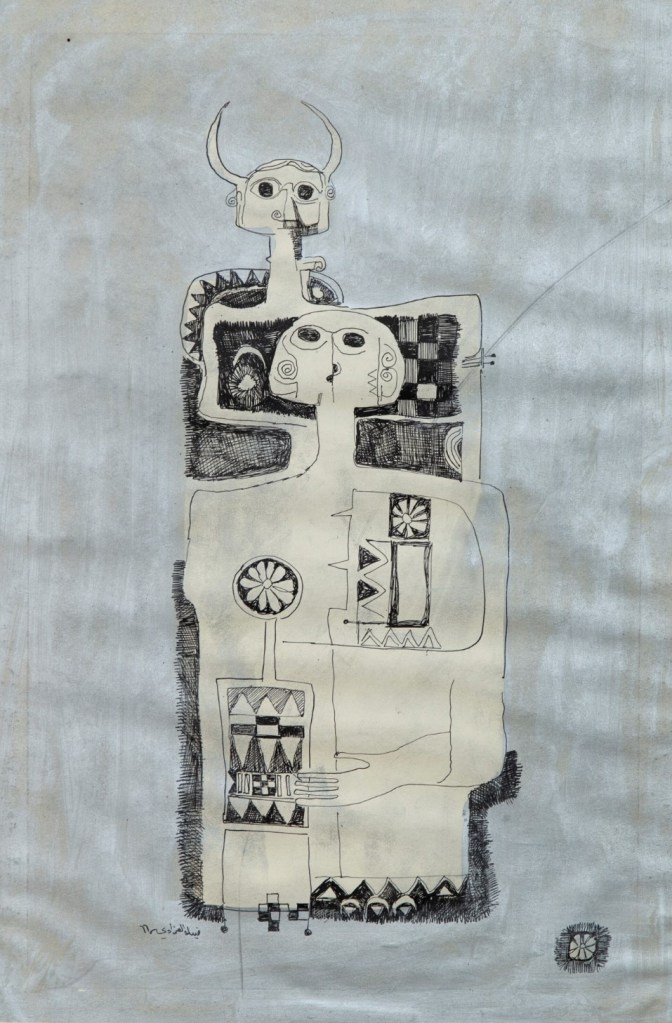
The Epic of Gilgamesh: Gilgamesh and Enkidu, No. 6 (ink and gouache on paper, 1966) by Dia Al-Azzawi (Iraqi, b. 1939).

The Epic of Gilgamesh and its related ancient tales have long been a source of inspiration for me, often woven into my prose. Earlier this week, I had the pleasure of reading an essay by Andrew George, written in 2012, which I highly recommend to your attention: The Mayfly on the River: Individual and Collective Destiny in the Epic of Gilgamesh. As with all of George’s works, this essay is masterful, and it resonated with much of my recent work. By coincidence, his reference to the mayfly aligned perfectly with a sub-theme of a monograph I have been developing over the past several weeks.

Inspired by these reflections and my own experience with the loss of close friends, I chose to explore The Epic of Gilgamesh through poetry, marking a departure from my usual prose. Below, I offer a poem that captures a dream in which Gilgamesh contemplates the profound absence of Enkidu, his friend and companion, who met death as punishment for the transgressions he and Gilgamesh committed against the gods. The timeless relationship between Gilgamesh and Enkidu seemed to me a fitting metaphor for the sorrow that accompanies the loss of friends and the enduring nature of their memory.

An Audio Recitation of Donald S. Yarab’s The Dream of Gilgamesh

The Dream of Gilgamesh

In the shadows of my sleep, you came,
Enkidu, my brother, carved from the heavens,
The rock that fell to earth and struck me whole.
But now the earth has claimed you,
Silent is the storm of your breath,
Felled like the great cedar, your might is no more.
I reach for you, yet grasp but dust.

The gods whisper through the winds,
Enkidu, you are beyond my reach,
Though I call, your name echoes
Through the empty halls of Uruk,
A soundless shadow, a memory unmade.

In the dream, I see you on the plain,
Your laughter rolls like thunder once more,
Yet it is distant, swallowed by the sky.
I run to you, but the earth swallows my feet,
The horizon stretches and bends,
And you fade, a shadow of stars,
Leaving me to wrestle with the night.

Oh, Enkidu, my companion, my rock from the heavens,
In life, you steadied me, made my heart whole.
Now the world is too wide,
The journey too long.
What joy can be found in Uruk’s walls,
Without your hand upon my shoulder?
You lie beneath the river stones,
And I am left to wander the desolate road alone.

Vincent of Beauvais and the Evolution of Book Indexing

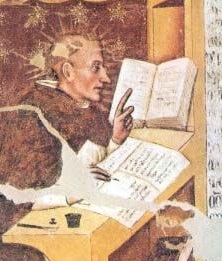
Vincent of Beauvais

Conveniences commonplace today were once novel. In this regard, today let us remember with gratitude Vincent of Beauvais, who died in 1264 AD, for making access to to the content of books easier. He is credited as having been the first writer to systematically provide indexes for his works, a trend which others eventually followed. He added an index to every single book of his Speculum historiale after 1244. This kind of apparatus only spread more widely in the field of historical writing during the fourteenth century, beginning with the Tabula secundum litterarum ordinem alphabeti on the same work by Vincent, composed by Jean Hautfuney in Avignon around 1320. Thank you, Vincent!

Source: Kujawiński, J. (2015). Commenting on historical writings in medieval Latin Europe: A reconnaissance. Acta Poloniae HistoricaVolume 112, 169. Especially see footnote 26, which states the following: “See the study and edition by Monique Paulmier, ‘Jean Hautfuney, Tabula super Speculum historiale fratris Vincentii’, Spicae. Cahiers de l’Atelier Vincent de Beauvais, Nouvelle série, 2 (1980), 19–263 (on Vincent’s indexes, see 20–3), and ibidem, 3 (1981), 5–208. Both Vincent’s and Jean’s indexes are discussed within the history of medieval historiography by Guenée, Histoire et culture historique, 232–7, and within the history of medieval indexes by Olga Weijers, ‘Les index au Moyen Âge sont-ils un genre littéraire?’ in Leonardi, Morelli, Santi (eds.), Fabula in tabula, 11–22, here: 20–1, and il. 5.”