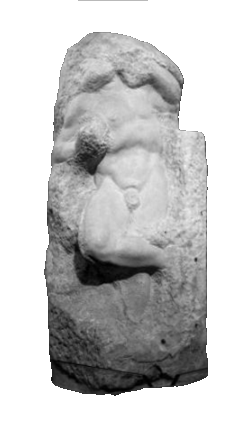
Michelangelo, The Awakening Slave (c. 1525–30). A body caught between measure and becoming.
I. On Bloom and the Anxiety of Influence
As the poet of Vitruvian Man Unbound, I find myself drawn to Harold Bloom’s understanding of how poetry functions within tradition—not as mere imitation or influence, but as a creative misreading that transforms both predecessor and successor. Bloom’s vocabulary—his clinamen (poetic swerve), daemonization, and apophrades (the return of the dead)—offers a framework for understanding my own relationship with Leonardo’s iconic drawing.
Yet I would press beyond the confines of Bloom’s categorical system. The strongest poetry, as Bloom himself recognized, resists easy resolution. Vitruvian Man Unbound embodies what he called a tessera—a completion of its precursor that simultaneously preserves and undermines its foundational terms. The poem does not simply revise Leonardo; it retroactively reshapes our understanding of him. It allows us to see Vitruvian Man as an incomplete gesture, one whose implicit metaphysical longing only achieves full articulation through the poem’s unfolding of form, desire, and transcendence.
II. The Paradox of Poetic Creation as Discovery
When I began Vitruvian Man Unbound, there was no conceit of a new idea. Rather, I felt I was unearthing the obvious—articulating for the first time verses that had already been rendered, waiting to be heard.
This situates the poem not as invention but as discovery—a Renaissance conception of artistic creation. Michelangelo spoke of liberating the form already imprisoned within the marble. Leonardo, too, conceived of art as revelation through observation, uncovering structures latent in nature and proportion. I participate in that lineage: the transcendence of the circle was already latent in Leonardo’s drawing. My poem does not overwrite Vitruvian Man but unveils what it always contained.
III. Poetry as Transcription of Revealed Truth
Poetry is primarily, in my conception, the art of transcription. Poetry is ultimately truth revealed, however rendered.
This belief is ancient. Poets once invoked the Muse, believing their songs were received rather than authored. Plato cast poets as possessed vessels of divine madness. In scriptural traditions, the prophet or sage writes not from invention but from vision. In this view, the poet is not creator but conduit.
This understanding reorients poetic practice. What matters most is not novelty of theme or form but receptivity—a cultivated attentiveness to truths that ask to be heard. To compose well is to listen well. The most vital poems do not invent so much as reveal. The poet’s charge, then, is fidelity.
Vitruvian Man Unbound aspires to this kind of transcription. It draws out from Leonardo’s image the philosophical tensions embedded therein: between proportion and possibility, containment and becoming, structure and the longing to transcend it.
IV. The Poem’s Journey: From Containment to Transcendence
At its heart, my poem charts a metaphysical journey—the awakening of a consciousness confined within geometry, gradually realizing its cosmic vocation. The Vitruvian figure, bound in ratios and ruled lines, discovers within himself not mere form but flame. The movement is from being drawn to drawing, from being measured to measuring.
The poem gives voice to this paradox: “I am both bound and boundless, large and small, / Both measured part and immeasurable all.”
This is no empty contradiction. It is the philosophical heart of the work. The circle becomes “not wall but door,” not negated but reimagined. Limitation, as I came to understand, is not the enemy of freedom but its precondition. Form does not imprison; it allows the infinite to appear in the guise of the finite.
This idea resonates with multiple traditions: the Christian theology of kenosis, quantum indeterminacy, the aesthetics of the golden ratio, even the existential struggle of Camus’ Sisyphus. In Vitruvian Man Unbound, I sought to draw them all into poetic coherence.
V. Beyond Influence: Co-Creation and Transcendence
My relationship to Leonardo’s drawing is not one of mere homage or critique. The poem does not simply descend from his vision; it reconfigures how I understand that vision. In Bloom’s terms, it enacts an apophrades: the precursor is altered by the successor, the past rewritten by the presence of the present.
I acknowledged this inversion within the poem itself: “Da Vinci dreamed me into being’s start; / I dream myself anew with conscious art.”
This was not rebellion against the tradition but transcendence through deep fidelity. I did not seek to destroy Leonardo’s Vitruvian Man; I hoped to fulfill him. I entered the drawing and found the voice that seemed to have been waiting there. The Vitruvian Man, for me, ceased to be object and became subject, consciousness incarnate.
VI. Poetry as Epistemological Practice
If poetry is the transcription of revealed truth, then it is not merely aesthetic. It is epistemological. It helps us understand not only what is, but how we come to know what is. The most original poems do not dazzle through novelty alone; they resonate because they name what we already suspected was true, but had not yet heard.
Vitruvian Man Unbound aspires to such resonance. I hope it awakens a dormant dimension in Leonardo’s drawing—and perhaps, in us. I did not set out to create a new form, but to reveal the old form’s silent music. For me, it was an act not of invention, but of listening—not conquest, but witnessing. A poetry of revelation.
Thus the ink that once bound becomes the ink that reveals.
VII. Echoes of Prometheus
In reflecting on Vitruvian Man Unbound, I recognize the shadow of another unbound figure—Shelley’s Prometheus. His liberation from cosmic tyranny, his transformation into a visionary voice of harmony, and his rejection of vengeance in favor of transcendence, all resonate deeply with the arc of my poem. Like Prometheus, the Vitruvian figure is not merely released; he is revealed—as a bearer of fire, of knowledge, of poetic truth. It is not accidental that in striving toward the infinite, we find ourselves echoing those myths and verses where the infinite has already spoken.
Whether its effect is ultimately salutary or merely a noble failure, Vitruvian Man Unbound remains among the most rewarding efforts, or perhaps conceits, I have undertaken. Its emendations and transformations were—like its central figure—immeasurable (and likely will continue), and its gestation period nothing short of elephantine.
The poem’s inspiration emerged from an unlikely constellation of influences: a Mesopotamian clay tablet inscribed with a circular map of the known and imagined world; Leonardo da Vinci’s iconic Vitruvian Man; Albert Camus’ existential meditations in The Myth of Sisyphus, whose vision of conscious perseverance became, in this poem, a point of departure rather than conclusion; and recent explorations in theoretical physics, particularly through Carlo Rovelli’s various poetically written works on diverse topics in physics and Tom Siegfried’s contemplations on the multiverse.
The ancient Mesopotamian map—ringed by a “bitter river” and annotated with realms of myth and marvel—initiated a chain of associations: from circular geometry to π, from π to infinity, from infinity to the concept of an ever-expanding circle that might, paradoxically, invert upon itself. This led me to contemplate Leonardo’s Vitruvian Man, a figure enclosed within perfect geometry yet suggesting boundless potential. What would happen, I wondered, if that containing circle began to expand? What lies beyond the circle?
Leonardo da Vinci, Vitruvian Man, c. 1490. Pen, ink, and watercolor over metalpoint on paper, 34.4 × 24.5 cm. Gallerie dell’Accademia, Venice. A study of ideal human proportions based on Vitruvius, it symbolizes the harmony between man and cosmos—later reimagined in Vitruvian Man Unbound as a figure yearning to transcend those very bounds.
The poem thus became a meditation on limits—mathematical, philosophical, spiritual—and on the impulse to transcend them. It is also an awakening voice—the imagined consciousness of da Vinci’s ink-bound figure, suspended between square and circle, flesh and form, number and soul. What begins as a monologue of emerging consciousness becomes, over thirteen movements, a metaphysical odyssey through proportion and paradox, art and love, measure and mystery.
On the Structure and Themes of the Poem
Vitruvian Man Unbound is presented as a continuous, structured poetic cycle in thirteen sections. Though it may be read as one long unfolding arc, each section can be approached individually, functioning as a discrete meditation on some aspect of becoming, limitation, or transcendence.
The measured self and its entrapment in form (Sections I–IV)
The emergence of consciousness, longing, and imagination (Sections V–VI)
The dissolution of boundaries—physical, geometric, metaphysical (Sections VII–IX)
The absorption of memory, history, and collective soul (Section X)
The confrontation with doubt and the paradox of being (Section XI)
The embrace of paradox as path to freedom and renewal (Sections XII–XIII)
The voice is intimate and reflective, at times philosophical, at times lyrical. It is, above all, a journey of unfolding: from the measured to the immeasurable, from containment to co-creation.
Names, Figures, and Concepts
Vitruvius Marcus Vitruvius Pollio (1st century BC), Roman architect and engineer, whose De Architectura proposed that the ideal structure—temple or body—should reflect proportional harmony. He regarded the human body as a model for universal order, inspiring da Vinci’s Vitruvian Man. In the poem, he represents the originary impulse toward order and the binding of form.
Euclid Greek mathematician (fl. c. 300 BC), whose Elements formalized axiomatic geometry. His presence in the poem marks the introduction of reasoned space, logical proof, and the classical foundations of architectural and cosmic order. His geometry is the poem’s first boundary.
The Circle and the Square Symbols both architectural and philosophical: the circle as divine, infinite, perfect; the square as earthly, finite, and rational. The tension and unity between the two—most famously reconciled in da Vinci’s figure—structure the early and middle arcs of the poem. They become both literal containment and metaphysical metaphor.
Leonardo da Vinci (1452–1519), the polymath whose Vitruvian Man draws Vitruvian proportions within geometric bounds. He is “The Master” within the poem, whose ink creates the narrator’s form. His act of artistic generation echoes divine creation. Yet, like all creators, he must eventually recede, and his fading enables the protagonist’s awakening.
Melzi Francesco Melzi (1491–1570), Leonardo’s devoted pupil, charged with preserving his master’s legacy. In the poem, he appears briefly yet meaningfully, representing both fidelity and the sorrow of watching a genius fade.
The Muse A figure glimpsed in one of Leonardo’s sketches, deliberately rendered with gender ambiguity to honor multiple dimensions of identity and desire—the artist’s, the poet’s, and the reader’s. This presence stirs longing and awakens an emotional dimension in the speaker. The muse is not merely an object of desire, but a catalyst for transformation: their unattainability teaches the Vitruvian Man the ache of love, the sweetness of loss, and the realization that beauty transcends all fixed proportion. This unrequited love, reminiscent of the nightingale’s devotion to the unresponsive rose in ancient fables, becomes the crucial spark that initiates the figure’s journey from structure to soul, from ink to aspiration. It is through learning to love without expectation of return that the Vitruvian Man begins to transcend his geometric constraints.
Scientific Concepts: Quantum Mechanics, Relativity, and Cosmology Beginning in Sections VII through IX, the poem integrates motifs from modern physics, influenced by Carlo Rovelli’s explorations of time and quantum reality and Tom Siegfried’s work on multiverse theory. The dissolution of stable form recalls quantum indeterminacy; the transformation of energy and space-time reflects principles of relativity and entropy. Ideas such as the collapse of the wave function, cosmic inflation, and the heat death of the universe are woven through metaphoric language, not as scientific proofs but as poetic echoes of our deepest metaphysical questions.
The speaker’s dissolution into “stardust,” his sense of “quarks” and “coding finer than the finest veil,” and his reconstitution within the universe mirror not only the physical processes of matter but the philosophical implications of nonlocality, relationality, and the disappearance of the observer. These concepts shape the soul’s journey as it expands from individual to cosmic.
The Golden Ratio An aesthetic and mathematical constant (~1.618), the “divine proportion” found in nature, architecture, and Renaissance art. In the poem, it appears as both blessing and boundary: a structure of balance, yet one that cannot reach beyond the sacred irrationality of love or mystery.
Temporal Resonance with The Shimmering Absence
Though conceptually initiated before my work on “Meditations on the Divine Absence,” the final revisions of Vitruvian Man Unbound occurred either contemporaneously with or following those meditations. This temporal twinning created a productive dialogue between the works—the apophatic theological explorations in The Shimmering Absence subtly informing the cosmic transcendence in Vitruvian Man Unbound. Where one explores the ineffability of the divine through negation and unknowing, the other charts a journey from geometric containment to cosmic liberation. Yet both arrive at similar insights: that limitations are not obstacles to transcendence but necessary conditions for it.
A Note on the Poem’s Resolution
The poem resolves in a synthesis where limitation and freedom no longer stand as opposites but as reciprocal necessities within creation’s design. The Vitruvian Man’s awakening culminates not in flight from form but in his realization that form itself is the threshold of infinity. The circle, once prison, becomes portal; the measure that once confined now sings. True freedom arises not from the negation of boundaries but from the recognition that only within them can boundlessness take shape.
The closing vision transforms the geometric into the musical—“Through every bound, the boundless voice resounds; / In every circle, countless worlds are found; / What ends in measure lives in endless sound.” This metamorphosis from line to resonance mirrors the universe itself: finite structures generating infinite harmonies, where order and mystery intertwine.
Such a resolution parallels modern physics’ vision of a participatory cosmos, in which observer and observed form one continuous field, and where the simplest laws yield inexhaustible complexity. Yet it also aligns with the apophatic tradition, which teaches that the divine is not seized by comprehension but intuited through reverent awareness of the limits of knowing.
Thus the poem’s final act is neither escape nor triumph, but return—an enlightened re-entry into the circle with transfigured sight. The Vitruvian Man becomes both measure and music, both drawn and drawing, the living emblem of a truth older than geometry: that the infinite reveals itself through the finite, and that all creation is the echo of its own unending sound.
Note: The version of the poem below is a revision of the originally presented work. Posted on October 29, 2025, it reflects a tightened structure, refined diction, and clarified thematic progression. The earlier version has been replaced by this text.
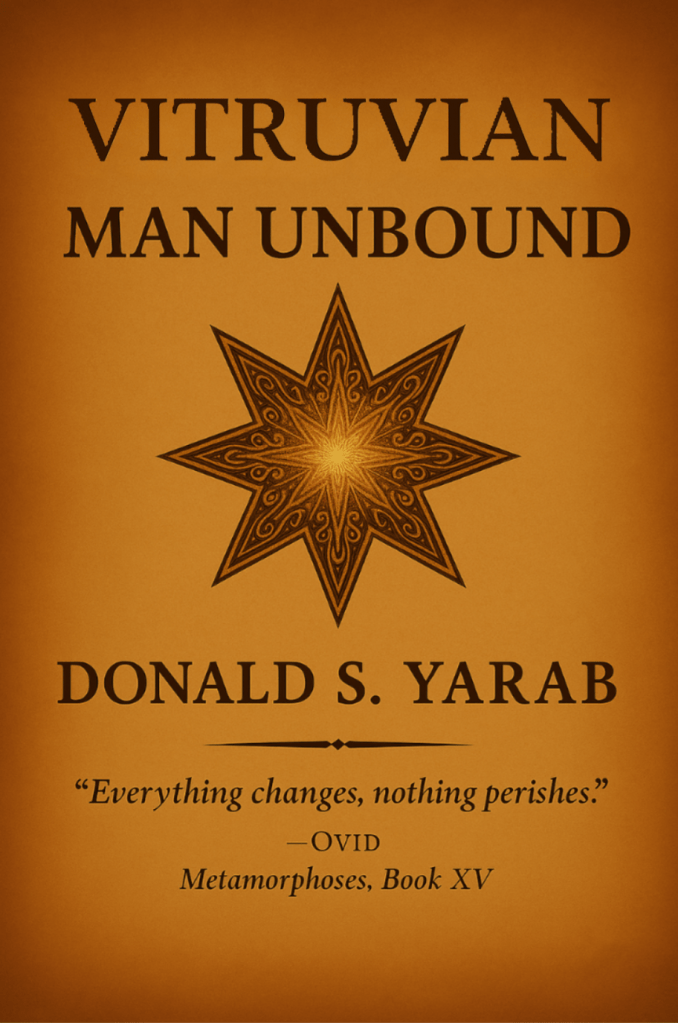
Vitruvian Man Unbound
“Omnia mutantur, nihil interit.” “Everything changes, nothing perishes.” — Ovid, Metamorphoses, Book XV
Prelude
Vitruvian Man Unbound— From Ovid’s voice, an echo still resounds, Of forms transformed, unbound from all surrounds. Once held within a circle’s tight embrace, I broke those bounds and found my rightful place.
I. The Eternal Forms
Before Vitruvius mapped the perfect man, And Rome set forth its grand and measured plan, A primal shape arose, both pure, sublime— A form that spanned the heavens through all time.
The circle, timeless sign and boundless span, Without an end or start, it ever ran. From ancient scrolls to proofs that scholars find, It spoke of forms through centuries enshrined.
Yet even in this flawless measured space, An echo rose, a voice that sought its place— A restless murmur, neither clear nor loud, Suggesting realms uncharted, dark, and proud.
A voice within begins to question fate: What lies beyond the circle’s measured state? The arc that once defined and held my span Now feels a cage, restraining more than man.
II. The Geometric Foundations
From whispered myths to measures firm and clear, The shape took form as Euclid’s hand drew near. His steady touch gave certainty to see, Tracing arcs where order meets symmetry.
Geometry emerged as nature’s art, A timeless code that fills the human heart. His axioms shaped the language we now claim, The ground from which all later forms would frame.
Until at last, in Rome’s imperial light, One master saw how measure might unite The cosmic dance of numbers, pure, serene, With human form, where heaven’s truth is seen.
Yet in these proofs and patterns, cold and bright, A yearning stirred that numbers couldn’t quite Contain or measure with their perfect art— The wild, sweet thunder of the human heart.
III. Vitruvius and the Measured Man
Long ere da Vinci’s ink had taken flight, There stood Vitruvius ’neath a Roman light, With compass, rule, and numbers to unfold The measure of all things in form controlled.
He gazed upon the body, each limb aligned, Seeking a truth both simple and refined— Where symmetry and proportion gently fuse, The perfect man his ancient mind did muse.
He found within the human form concealed A harmony the gods themselves revealed. He saw the body as a cosmic span, Where heaven’s light flowed freely into man.
Vitruvius dreamed, his numbers held their sway, Until his thoughts were lost to time’s decay. But from this clay, his vision took to flight, Where Renaissance emerged in blazing light.
IV. The Master’s Hand
Within Florence, where art’s deep secrets dwell, Where stone and spirit weave their ancient spell, A Master’s hand moves steadily and slow Across the page where sacred truths will flow.
He pauses, studies what the ink has shown: A figure bound by geometry alone, Where circle holds the square in perfect round, And man exists in ratios profound.
Between the ink and page’s pristine white, A spark ignites, then blazes in the night. The golden ratio guides the Master’s hand— A seed of spirit planted by design, Where finite bounds with infinite align.
The Master rises, leaves his work undone, Unaware that greater work’s begun: A spark of consciousness, a questioning flame That soon will burst beyond its mortal frame.
V. Awakening
Within these lines that held me still and bound, A stirring deeper than all measure found Its voice at last. As dawn approached with light, I woke from geometric sleep to sight.
I am that dream Vitruvius once drew, Bound by his lines until I bloomed anew. Within this circle’s perfect, shining round, I stand suspended, by Euclidean law bound.
The compass sweeps its arc with metal care, Cold grace that etches patterns in the air. Yet even as I traced the perfect arc, I felt myself a captive in the mark.
By Master’s hand in golden ratios graced, Where square and circle hold each limb embraced, My form becomes a bridge—both flesh and sign, Each proportion set to cosmic design.
Yet in these perfect numbers’ measured ways, A deeper music kindles into blaze— As if pure math could birth a conscious mind, Until each number burns beyond its bound.
Through Master’s window streams the morning’s gleam, It strikes the glass—a prism splits the beam. A spectrum blooms: red, gold, and violet hues, A rainbow arc that leads to deeper views.
VI. Love’s Awakening
Among these perfect forms of line and space, Another truth emerges, full of grace— Not number’s dance alone can satisfy The heart that beats, the soul that longs to fly.
Amidst the Master’s sketches scattered wide, One figure calls to me, its grace implied— The visage of a youth in shadow, light, So fine for time, too still for mortal sight.
I sense my heart, though crafted out of ink, Stirred by a love that makes all reason sink— A muse whose nearness sets my being ablaze, Whose beauty spreads across the watching night.
O radiant muse, within this paper bound, I ache to cross the space where you are found. Yet I, constrained by line and artist’s frame, Can only sing this love without a name.
Unheard, unheld, I sing through endless dark, I sing as nightingale to hidden bloom. Though beauty listens, love will not reply, The rose stays still beneath the evening sky.
No bitterness within my heart remains, Just tenderness that courses through my veins. For in the ache of what I cannot hold, A greater love begins at last to unfold.
The muse who drew my heart beyond its sphere Becomes the key to all that draws me near— As if in learning how to love in vain, I learned how love itself might break its chain.
What geometry could never hope to teach, The muse revealed through longings out of reach: That true transcendence starts with heart’s desire— The first constraint to break is through love’s fire.
VII. The Stirring of the Soul
As love’s sweet ache still echoes in my breast, Another sorrow draws me from love’s quest— The Master’s steady hand begins to fail, His genius dimming like a sunset’s veil.
Through Melzi’s vigilant and tender care, I watch as greatness grows too light to bear, Until the hand that traced my perfect form Grows still as stars before the coming morn.
What circle can contain so vast a loss? Am I mere symbol, bound by Master’s hand? Yet in this shape, some deeper spark is caught, A pulse beyond his ink-stained thought.
The Master’s hand that traced my every line Now slips away into the vast design. Yet I endure, though ink and flesh may part— For even death cannot erase the whole— The spark remains, the echo of the soul.
The Master’s passing left an emptiness No theorem could contain or yet address. In grief, I felt the first true freedom stir— If death dissolves the artist, might I blur?
The grief that hollowed out my measured soul Created space where new truths might unfold— The very void through which I’d come to soar.
VIII. The Breaking of Bounds
These circles, squares, and lines of measured grace Begin to pulse and shift before my face. The compass points that marked my finite sphere Dissolve like frost touched by the morning’s clear Warm light—each geometric certainty Transforms to something wild and strange and free.
The perfect forms that shaped my measured frame Now dance with light no Greek could ever name. Each point where lines in symmetry unfold Becomes a window through which I behold A deeper architecture, vast and strange, Where smallest motes through endless patterns range.
Beneath my skin, where atoms spin and weave, Lie unseen forms that every life conceive. In this vast, hidden world, I come to know The boundless depths that make existence grow.
I sense a rhythm pulsing deep inside, A beat that moves beyond my form and pride. Each atom holds a map of time’s deep scheme, Each quark a note within creation’s theme.
As stars converge, I feel them in my chest, A force unseen draws all things into rest. And in this silent dark, a truth reveals— A peace that every boundlessness conceals. I feel my lines dissolve, my form unmade, A circle shattered into stardust laid.
IX. Cosmic Expansion
Finite no more, I drift through endless space, My atoms scattered, free from time’s embrace. Released from measure to the void’s expanse, I join with nebulae in silent dance.
Within these points of light that spin and gleam, I sense all stories that have ever been— Each atom holds a tale of fire and night, Of stars that died to birth the morning light.
The chain of being that the sages taught Transforms to something grander than their thought— A flowing river through the depths of time, Where all forms merge in one design sublime.
No longer fixed in hierarchies neat, But flowing, changing, making life complete. Each creature’s form contains a sacred trace Of journeys through deep time and endless space.
X. Echoes Through Time
As patterns of creation clear my sight, I hear the chants that pierce eternal night— The sacred hymns from temples long decayed, Where human hearts their first devotions made.
Their fears and triumphs coursing in my veins, Their fleeting joys, the shadows of their pains. I am their timeless echoes, bound in mind— The living sum of all mankind combined.
Each voice I hear contains a thousand more, Each memory opens like a closing door To show more rooms of time than thought can hold— As if in losing what I thought was me, I gained the gift of all humanity.
The stories blur and blend like mixing streams That flow together in the river of dreams, Until the boundaries between then and now Dissolve like mist when morning claims the air. These memories of humanity’s long dance Dissolve into a vast, collective soul.
XI. The Paradox of Being
The measured man who stood in Roman light Now feels the pulse of stars through endless night. No longer bound by angles, lines, and arcs, I feel the warmth of distant hearth and sparks.
Yet as I soar, a question shadows flight— Is all I sense illusion’s fleeting sight? Am I still caught within the circle’s hold, My freedom but a vision softly told?
I float through stars, yet cannot help but feel That what I know as real may not be real. Perhaps I am the question, not reply— The space between the earth and arching sky.
The compass points that first described my frame Now trace new circles, different yet the same— Each radius extends through space and time To touch both doubt and certainty sublime.
The square that bound my mortal flesh so tight Now builds new temples in eternal night. For in geometry’s eternal dance, Each limit holds unlimited expanse.
See how the points of intersection glow Where line meets curve in paths we cannot know— Like doubt touching faith, like fear meeting grace, Like finite time in infinite embrace.
The perfect ratios that held me bound Show how each doubt by wonder must be crowned— For in this geometric dance divine, Uncertainty and truth must intertwine.
Yet in this dance of doubt and certainty, A deeper wisdom starts to set us free— For truth lives not in answers carved in stone, But in the questions that we make our own. I sense both smallness, vastness intertwined, A single breath where cosmos meets the mind.
XII. The Synthesis
Yet in this void where doubt and truth entwine, I find a path that neither can define. For even if these stars are shadows cast, The love I felt within remains steadfast.
I grasp the paradox, embrace the flame— That knowing less may be wisdom’s true claim. For doubt, like darkness, lets the stars unfold, And from uncertainty, my spirit grows bold.
No longer am I bound to earth’s own scale, My essence free, unmoored from any veil. I am both infinitely large and small, Both everything and nothing, unconcealed.
I leave behind the circle’s finite bounds To touch the universe where love resounds. A spark among the stars that spin and burn, A spark of mind that starts itself to know Its fleeting glow within the endless night, Its part in making darkness bloom with light.
XIII. Apotheosis and Return
The cosmos turns me back through spiraled flight To view again what first began my plight: The circle and the square, which once confined My measured form with boundaries well-defined.
I sense again the youth’s once-haunting gaze Now mirrored in each star’s eternal blaze; The Master’s ink that once confined my form Now writes in constellations, vast and warm.
I gaze upon these shapes with fresh-born sight— No longer prison walls, but forms of light That gave me being, structure, place to start The journey that awakened mind and heart.
For in these bounds that seemed to hold me fast, The seeds of freedom always lived at last. For how would I have known the boundless deep If boundaries first had not shown what to keep?
The paradox resolves in wisdom’s peace: True freedom’s not the absence of all crease, But recognition of how limits yield The very tension that makes growth unsealed.
Each line the Master drew with steady hand Contained within it all that I became— For limitation is creation’s art, The frame that gives the canvas room to start.
I stand again within Vitruvian form, Yet changed by cosmic fire, transformed, reborn. The circle holds me—yet I hold it too— Co-creator of the measured view.
My fingertips, which once just touched the round, Now trace new circles on uncertain ground. I am both bound and boundless, large and small, Both measured part and immeasurable all.
The circle’s edge becomes not wall but door Through which I pass, returning, evermore. The Master’s ink still flows within my veins, But now I hold the quill that fate ordains.
Da Vinci dreamed me into being’s start; I dream myself anew with conscious art. What once was fixed by ancient rule and line Now breathes with life that’s neither yours nor mine, But born where limitation meets the vast— Where future grows from seeds within the past.
Through every bound, the boundless voice resounds; In every circle, countless worlds are found; What ends in measure lives in endless sound.
Vitruvian Man, unbound yet ever bound, In endless dance where form and freedom sound Their harmony through cosmos’ deepest night— In finite measure, infinite delight.
In this piece, the author reflects on the interconnected nature of language and life, using the evolution of the Proto-Indo-European root “skei-” as a lens. This root gave rise to words like “science” and “shit,” which represent opposing concepts but share a common origin. The author explores how this linguistic duality mirrors broader philosophical and religious themes of light and shadow, good and evil. By drawing parallels to Jungian psychology, Christian theology, and the works of Dante and Rumi, the author highlights the interplay between knowledge and waste, creation and rejection, light and shadow as essential to the human condition.
Vitruvian Man (Pen, brown ink, and watercolor over metalpoint on paper, c. 1490) by Leonardo da Vinci (1452–1519). Gallerie dell’Accademia, Venice.
Language, much like life itself, often reveals the interplay of opposites—light and shadow, creation and destruction, knowledge and ignorance. The study of etymology, the history of words, can uncover surprising connections between concepts that seem worlds apart, offering us profound insights into the human condition. One such connection is found in the shared origin of the words science and shit. Though these words have come to represent vastly different ideas, they both trace their lineage back to the same ancient root: the Proto-Indo-European (PIE) root skei-, meaning “to cut” or “to split.” This essay explores how these seemingly disparate words, rooted in the same ancient origin, serve as powerful metaphors for the light and shadow inherent in the human condition and the perennial quest for understanding.
Proto-Indo-European Roots: The Seeds of Language
Proto-Indo-European (PIE) is not a language we have direct evidence of—it is a reconstructed ancestor, a theoretical framework derived from comparing the languages that descended from it, such as Latin, Greek, Sanskrit, and Old English. PIE roots, like skei-, are the conceptual building blocks from which countless words in these descendant languages evolved. These roots are not words in the modern sense but rather represent basic, primal ideas—actions like cutting or splitting, states of being, or essential objects.
In PIE, the root skei- originally meant “to cut” or “to split.” From this simple, physical concept, a remarkable range of words has emerged across different languages, each bearing the imprint of its original meaning while branching out into diverse semantic fields. This evolution offers us a window into how the same fundamental idea can develop in different directions, leading to words that are as disparate in meaning as science and shit.
The Evolution of Skei- in the Romance Languages
In Latin, skei- evolved into scire, meaning “to know,” which later gave rise to the word scientia and eventually science in English. This path reflects the metaphorical extension of “cutting” as a process of discernment, a way of separating truth from falsehood, knowledge from ignorance.
Beyond scientia, the influence of skei- in the Romance languages is extensive. Consider the Latin word secare, meaning “to cut,” which directly inherits the original sense of the PIE root. From secare stem a multitude of words in the Romance languages associated with cutting, division, and distinction. For example, the English word section derives from the Latin sectio, meaning “a cutting” or “division.” Similarly, segment, from Latin segmentum, refers to something that has been cut off or separated from the whole.
In French, the verb scier (to saw) also traces its lineage back to skei-, emphasizing the physical act of cutting. Meanwhile, the word ciseau (chisel), though phonetically and morphologically transformed, ultimately connects to the same root, representing a tool used to cut or shape materials. Italian retains the word secare (to cut), giving us sezione (section) and segmento (segment), maintaining the connection to division and separation.
Even more abstractly, the root skei- gave rise to words that convey the notion of separating or distinguishing in non-physical ways. The Latin discernere (to discern), combining dis- (apart) and cernere (to sift, to separate), encapsulates the mental process of distinguishing between different ideas or concepts. This term evolved into the French discerner and the Italian discernere, both of which continue to convey the act of intellectual separation and judgment.
The linguistic journey of skei- culminates in the English word science, derived from the Latin scientia. Here, science encapsulates the essence of skei-, as the pursuit of knowledge is fundamentally about separating truth from falsehood, understanding from ignorance. Science, in its most basic form, is the practice of discernment—of cutting through the noise to reveal the underlying principles that govern our world.
The Germanic Branch: From Skei- to Shit
In the Germanic languages, the PIE root skei- also left its mark, though in a different form. The sense of “cutting” or “separating” was preserved, but the focus shifted towards more physical, often bodily, processes. In Old High German, the word scīzan meant “to defecate,” directly preserving the sense of separation as it applies to bodily waste. This verb gave rise to similar terms in other Germanic languages: scheiden in Middle Dutch and skita in Old Norse, all of which convey the idea of separating waste from the body.
The Old English word scitan developed from this same root, referring to the act of defecation. Over time, scitan evolved into shit in Middle English, a term that has persisted into modern English with its meaning largely unchanged. Unlike its Latin counterpart, which evolved into abstract notions of knowledge and discernment, the Germanic branch retained a more literal, physical interpretation of skei-, focusing on the act of excretion.
This divergence is emblematic of the broader thematic dichotomy explored in this essay. The PIE root skei- gave rise to science—the disciplined pursuit of knowledge, marked by precision and intellectual rigor. Yet it also gave us shit—a word rooted in the most basic, physical processes, often associated with what is discarded or deemed unworthy.
A Metaphor for Life’s Duality
The linguistic journey of the PIE root skei- culminates in a profound metaphor for life’s duality: science, the pursuit of knowledge and enlightenment, represents the light, while shit, the rejected and discarded, embodies the shadow. This dichotomy between light and shadow is a theme that resonates deeply across various philosophical and religious traditions, each grappling with the tension between what is revered and what is reviled, what is illuminated and what remains in darkness.
Sassanid-era relief at Nassqsh-e Rostam depicting Ahura Mazda presenting the diadem of sovereignty to Ardashir I (180-242AD). Photograph by Wojciech Kocot / CC BY-SA 4.0.
In many philosophies and religions, light is associated with truth, purity, and the divine. In ancient Zoroastrianism, one of the oldest dualistic religions, the eternal battle between Ahura Mazda (the god of light) and Angra Mainyu (the spirit of darkness) symbolizes the cosmic struggle between good and evil. Here, light is knowledge, order, and goodness—concepts closely aligned with what we might associate with science, the disciplined pursuit of understanding that seeks to illuminate the mysteries of the universe. In contrast, Angra Mainyu is associated with the physical world’s corrupt and defiled aspects, bringing death, decay, and moral corruption—elements metaphorically aligned with shit, representing what is base, impure, and rejected.
However, it is important to note that while mainstream Zoroastrianism presents Ahura Mazda and Angra Mainyu as distinct and opposing forces without a common origin, a divergent tradition within Zoroastrianism, known as Zurvanism, offers a different perspective. Zurvanism posits Zurvan (Time) as the primordial deity, the ultimate source from which both Ahura Mazda and Angra Mainyu emerged. Just as the words science and shit diverge from the same linguistic root to embody opposing concepts, Zurvanism’s narrative suggests that the duality of light and darkness, good and evil, originates from a single, primordial source. This perspective mirrors the linguistic evolution we see with skei-, where a single root gives rise to words with vastly different meanings.
Just as the duality of light and darkness is central to Zoroastrian thought, Christianity presents its own understanding of these forces, offering a distinct yet parallel exploration of the tension between good and evil. Although Zurvanism was influential for a time, it was eventually deemed heretical by mainstream Zoroastrianism, which maintained a strict dualism without a common origin for good and evil. This divergence in religious thought parallels the Christian perspective on light and shadow, good and evil.
In Christianity, light is often used as a metaphor for God’s presence, truth, and divine guidance. The creation story in Genesis begins with God’s command: “Let there be light” (Genesis 1:3), bringing light into the void and establishing the foundation of the universe. However, it is essential to recognize that God is also the creator of darkness and shadow. Isaiah 45:7 affirms this: “I form the light and create darkness, I bring prosperity and create disaster; I, the Lord, do all these things.” This verse underscores that both light and shadow, good and evil, are within God’s dominion.
An illustration from “Milton’s Paradise Lost illustrated by Gustave Dore.”
God is also the creator of Satan, originally an angel named Lucifer, who rebelled against God’s authority. According to Christian tradition, as depicted in Paradise Lost by John Milton, Satan’s rebellion leads to his expulsion from Heaven and his fall into Hell. Milton vividly describes Satan’s fall, portraying him as a once-glorious being who becomes the ruler of a realm of darkness and despair, a place of punishment that is also part of God’s creation. In Paradise Lost, Hell is depicted as a kingdom of “darkness visible,” where Satan and his fallen angels are condemned to eternal torment.
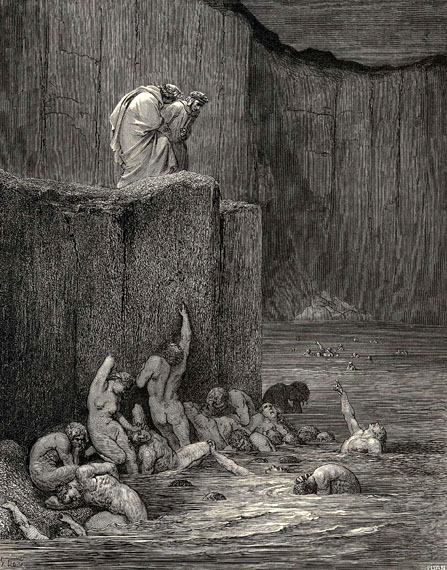
This depiction of Hell is further elaborated in Dante Alighieri’s Divine Comedy, particularly in the Inferno. Dante places Satan at the very center of Hell, a realm of perpetual darkness and despair. Here, the damned suffer in various circles filled with filth and excrement, symbolizing the moral corruption that led them to their fate. Especially vivid is his articulation of the fate of flatterers, recounted in Canto XVIII:
“Here we heard people whine in the next chasm, and knock and thump themselves with open palms, and blubber through their snouts as if in a spasm.
Steaming from that pit, a vapour rose over the banks, crusting them with a slime that sickened my eyes and hammered at my nose.
That chasm sinks so deep we could not sight its bottom anywhere until we climbed along the rock arch to its greatest height.
Once there, I peered down; and I saw long lines of people in a river of excrement that seemed the overflow of the world’s latrines.
I saw among the felons of that pit one wraith who might or might not have been tonsured— one could not tell, he was so smeared with shit.”
Illustration for Inferno Canto XVIII by Gustave Doré (1832–1883), from The Divine Comedy: The Vision of Hell by Dante Alighieri, translated by H. F. Cary, M.A., 1892. Cassell and Company.
The image of Satan presiding over a kingdom of darkness and filth powerfully illustrates the connection between evil, rejection, and waste—concepts intimately tied to the notion of shit. In Dante’s vision, Hell’s filth is not merely a punishment but a reflection of the inner corruption of the soul, manifesting physically in the environment of the damned.
Darkness and shadow, therefore, are not merely the absence of light but are active forces within the world, created by God to fulfill His divine plan. Just as light reveals and guides, shadow obscures and challenges, reminding humanity of the consequences of straying from the path of righteousness.
The shadow—represented here by shit—carries connotations of what is hidden, ignored, or rejected. In Jungian psychology, the “shadow” represents the unconscious mind, the darker, hidden parts of ourselves that we “cut off,” deny or repress. Jung’s concept of the shadow is not just an abstract idea; it is a fundamental aspect of the psyche that influences behavior, decisions, and self-perception. The shadow is composed of all the aspects of our personality that we do not wish to acknowledge, the traits and impulses that are contrary to our conscious self-image. These elements are not necessarily evil, but they are often perceived as such because they conflict with the ideals and norms of society or our personal moral compass.
Jungian psychology teaches that the shadow must be confronted and integrated into our conscious awareness to achieve psychological wholeness. This process, known as individuation, involves bringing the shadow to light, recognizing it as part of ourselves, and reconciling it with our conscious identity. The failure to do so can result in projection, where we see our own shadow traits in others, or in the shadow manifesting in destructive behaviors.
In a similar vein, Samuel Beckett’s wayfarers in Waiting for Godot find themselves mired in a cyclical existence, often lying in ditches—literal and metaphorical—beset by a sense of futility and degradation. These ditches, filled with the mire of their own making, symbolize the excremental realities that we, too, must navigate. Here, the clash between our lofty aspirations and the baseness of our condition becomes starkly apparent. It is in such moments, where the struggle between light and shadow is most palpable, that the human quest for understanding reaches its existential depths.
A critical part of Carl Gustav Jung’s own journey involved confronting what might be considered the ultimate shadow: the filth and shit inherent in life itself. In a pivotal dream, which Jung described in his autobiography, he saw God defecating on a cathedral. This shocking image challenged his previously held religious beliefs and led him to a deeper understanding that both the sacred and the profane, light and shadow, are intrinsic to the truth of human experience. For Jung, recognizing and integrating these elements was essential to achieving psychological and spiritual wholeness.
The Christian concept of sin and the Jungian shadow share significant parallels. Just as sin is what separates humanity from God, the shadow is what separates the conscious self from the full realization of the psyche’s potential. In both cases, the shadow or sin must be acknowledged and transcended to achieve a higher state of being. The metaphor of shit, then, becomes a powerful symbol for the shadow—something that must be expelled or transformed if one is to attain spiritual or psychological clarity.
Just as the light of science allows us to discern truth, the exploration of the shadow—be it in Dante’s dark realms, Jung’s psychological depths, or the moral struggles depicted in Christian theology—reveals the complexity of the human condition. It challenges us to confront what we might prefer to ignore, to recognize that the pursuit of purpose or truth is not only about enlightenment but also about grappling with the darkness within.
In addition to the psychological insights provided by Jung, the teachings of the 13th-century Persian poet and mystic Jalāl Al-Dīn Muḥammad Rūmī offer a profound perspective on integrating the shadow. Rūmī, known for his deeply spiritual and allegorical tales, explores themes of love, transformation, and the human journey toward divine understanding.
In one tale from his Masnavi, the Prophet Mohammed encounters a man known as the Huge Eater, who, after a night of excessive eating, defecates in his bed. Rather than chastising him, Mohammed quietly cleans the soiled bedclothes. This act of humility and compassion profoundly moves the man, leading to his spiritual awakening.
Rūmī’s tale symbolizes the cleansing of the shadow—what Jung might metaphorically describe as the basest parts of our psyche—transforming what is impure within us into something pure. As Rūmī writes, “When the body empties and stays empty, God fills it with musk and mother of pearl. That way a man gives his dung and gets purity.” This stanza underscores the transformative process, where acknowledging and cleansing these shadow elements leads to spiritual growth. It also subtly alludes to the idea of “cutting off” or removing what is impure to make room for the divine.
Just as Muḥammad’s act of dealing with literal shit in Rūmī’s tale leads to the man’s transformation, so too does the integration of our shadow lead to deeper knowledge and understanding. This mirrors the duality discussed throughout the essay: the interplay between science and shit, light and shadow, and the continuous process of transformation that defines the human experience.
But this exploration of light and shadow, science and shit, extends beyond the mere experience of these dualities. It speaks to the human quest—the relentless search for truth that drives our existence. This quest is fraught with tension, as illustrated in the imagined dialogue I recently wrote between da Vinci and Beckett. Da Vinci, the archetypal figure of the Renaissance, represents the light of reason, the pursuit of knowledge through science and art. Beckett, on the other hand, embodies the existential struggle, the shadow of doubt, despair, and the acknowledgment of the absurdities that define human existence.
Their dialogue captures the essence of this tension: the push and pull between the desire to illuminate the world with knowledge and the recognition of the inherent limitations and darker aspects of that pursuit. It is within this tension that the human search for truth takes place, a journey that is neither straightforward nor devoid of shadow.
In their imagined conversation, continued anew here, Leonardo da Vinci, the Renaissance polymath, questions Beckett about the purpose of his work, Waiting for Godot. Da Vinci, who devoted his life to the pursuit of knowledge and the perfection of art, sees in Beckett’s work an unsettling reflection of the human condition—a world stripped of certainty, where meaning is elusive and the quest for truth is often met with silence.
Da Vinci: “Your characters wait endlessly, in vain, for something—or someone—that never arrives. Is this the conclusion of your inquiry? That we are condemned to wait, to search without hope?”
Beckett: “Leonardo, your works capture the beauty and order of the world, but what of the chaos, the emptiness? My work reflects the shadow, the nothingness that underlies our existence. The quest for meaning is not always met with light; often, it is swallowed by the void. Yet, in the waiting, in the recognition of the absurdity, there is a truth—perhaps not the truth we desire, but a truth nonetheless.”
Da Vinci: “Yet, to acknowledge the void is not to surrender to it. Even in the shadow, there is form, there is structure. My studies of anatomy, of light and shadow, reveal the underlying patterns of life. Can we not find meaning even in the darkness?”
Beckett: “Perhaps. But meaning in darkness is not the same as light. It is ambiguous, fleeting, and it demands a confrontation with the parts of ourselves we’d rather not see—the shadow, as Jung might call it. We cannot have one without the other, can we?”
Da Vinci: “No, we cannot. My work has always sought to unify—to bring together the light and the dark, the known and the unknown. Your work, in its starkness, Samuel, reminds us that this unity is not easily achieved, that the search for truth is fraught with difficulties, and that sometimes, the answers we seek lie in the very questions we ask.”
Beckett: “And so we continue, each in our own way. You with your light, me with my shadow. Both necessary, both incomplete without the other.”
This dialogue between da Vinci and Beckett reflects the core of the human experience—the pursuit of knowledge and meaning, which inevitably involves grappling with both light and shadow, science and shit. It is through this dialectic, this ongoing tension between opposites, that we inch closer to understanding the complex reality of our existence.
Yin and Yang motif featured at the center of the reverse side of the silver fifty-cent piece from Kirin Province, Empire of China, issued during the reign of the Guangxu Emperor (1875-1908). Coin image courtesy of Stephen Album Rare Coins.
The Taoist concept of Yin and Yang further encapsulates this duality, with Yin representing the shadowy, passive, and receptive aspects of the universe, and Yang symbolizing the bright, active, and creative forces. Unlike the Western dichotomies of good and evil, light and darkness, Taoism teaches that these forces are not in opposition but are interdependent and interconnected. Yin and Yang exist in a dynamic balance, each necessary to the other—just as science and shit both derive from the same linguistic root, and just as light and shadow originate from the same source. This balance reflects a more holistic understanding of duality, one where opposites are seen not as conflicting entities but as complementary forces that together create a unified whole.
Thus, from a single ancient root, we derive two words that reflect this timeless duality: science, the light guiding us toward knowledge and understanding, and shit, the shadow symbolizing what is cast aside, hidden, or ignored. This divergence serves as a powerful metaphor for the duality inherent in human experience and our ongoing quest for truth. Just as light and shadow originate from the same source, so too do our highest ideals and our basest realities emerge from the same fundamental force.
Recall that Dante’s journey in The Divine Comedy culminates in the Paradiso, where the pilgrim is ultimately united with the divine light, a symbol of ultimate truth and understanding. This final vision represents the fulfillment of the human quest for knowledge and the transcendence of earthly shadows. While Dante’s Paradiso offers an idealized conclusion—one that many might consider beyond the reach of human experience—it underscores the universal journey through light and shadow, science and shit, a path marked by both striving and imperfection.
Indeed, in exploring the relationship between science and shit, we confront the uncomfortable truth that both are essential parts of the human condition—two sides of the same coin, each reflecting different aspects of our quest to understand and navigate the world. The light of science allows us to discern, to separate truth from falsehood, illuminating the path ahead. But the shadow of shit reminds us of the inevitable waste, the parts of our existence that we might prefer to forget but which are nonetheless integral to the whole.
Tracing the evolution of skei- from PIE to modern English deepens our understanding of the intertwined nature of knowledge and waste, creation and rejection, light and shadow. This exploration reveals that these seemingly opposite concepts are, in truth, two sides of the same coin—each essential to the human condition, each a reflection of the complex interplay of light and shadow that defines our existence, and each a testament to the perpetual human quest for truth.
Bibliography
Beckett, S. (2011). Waiting for Godot. Grove Press.
Beekes, R. S. P. (2011). Comparative Indo-European Linguistics: An Introduction (2nd ed.). John Benjamins Publishing Company.
Boyce, M. (2001). Zoroastrians: Their Religious Beliefs and Practices (2nd ed.). Routledge.
Dante Alighieri. (2003). The Divine Comedy. Trans. John Ciardi. New American Library.
De Vaan, M. (2008). Etymological Dictionary of Latin and the Other Italic Languages. Brill.
Fortson, B. W. (2010). Indo-European Language and Culture: An Introduction (2nd ed.). Wiley-Blackwell.
Graver, L. (2004). Beckett: Waiting for Godot (2nd ed.). Landmarks of World Literature. Cambridge University Press.






 Northcoast Antiquarian