

Exploring the Eternal Now: Past Present Future in Poetic Form

Time Transfixed (La Durée poignardée) is a 1938 oil on canvas by Belgian surrealist René Magritte (1898-1967), now part of the permanent collection of the Art Institute of Chicago. The title translates literally as Ongoing Time Stabbed by a Dagger. Magritte reportedly expressed dissatisfaction with the widely accepted English translation, Time Transfixed. The translation issue resonates with the theme of the poem Past Present Future? Which is Now?

Inspired by Where is Am I? and viewing poetry as akin to musical composition, I felt it fitting to create a follow-up variation on a theme. In truth, it took only moments to pen the opening line/title: Past Present Future? Which is Now? How could this not spring readily to mind, given the intense reading, writing, and research I have been immersed in for so long—scientific and philosophical alike? The line is a distillation of a significant part of my existential quest, an attempt to more deeply explore what I have long referred to as the eternal now.

Past Present Future? Which is Now? captures the tension between how we subjectively experience time and the idea that all moments—past, present, and future—are fixed and unchanging. In this static view, consciousness perceives each moment as now, while in reality, every moment already exists. This concept aligns with the philosophical idea of the eternal now, where all of time is present within each instant, even if our perception fragments it. The poem seeks to capture this interaction: the way awareness encounters different moments in time, while time itself remains constant and unchanging. It reflects my broader philosophical inquiries into the nature of reality, consciousness, and time’s interconnectedness.

Where is Am I? and Past Present Future? Which is Now? function as variations on a shared theme, much like movements in a musical composition. While they differ in focus—one on the search for identity, the other on the nature of time—they resonate with one another through recurring imagery and ideas. Both explore existential uncertainty, employing motifs of light and shadow, echoes and breath, to reflect the fragmented nature of consciousness and experience.

Where is Am I? is an introspective meditation on the self’s disjointed sense of being, while Past Present Future? extends this reflection, asking whether time—past, present, and future—exists as distinct moments or as a continuous whole. In this way, the second poem builds on the first, expanding the inquiry into personal identity toward a larger philosophical investigation of time. Together, the two poems form a stylistic and thematic unity, with the second poem deepening the existential questions introduced in the first, offering a more expansive vision of the human experience or, at least, my experience.


Past Present Future? Which is now?

Past whispers in the corners of my mind,
its shadow folded into the fabric of now—
but is it gone, or does it still breathe,
echoing in the present’s fleeting pulse?

The future calls, a distant tremor,
its promise threaded through each thought.
Yet does it truly wait, or is it here already,
quietly draped over the moment’s edge?

Past, present, future—are they separate streams,
or one river coursing through the self,
an unbroken thread of light,
where time is nothing but a veil? Which is now?
All and none—each breath dissolves the question,
as yesterday, tomorrow, and today
collapse into the eternal now.

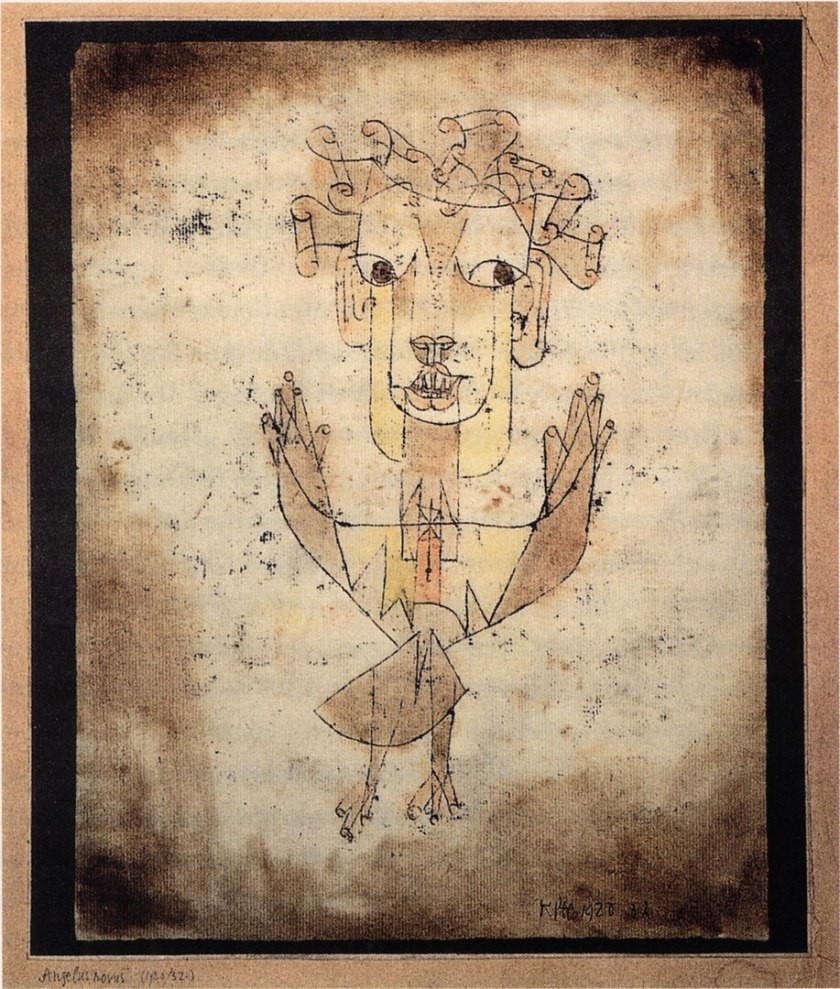
MUSIC AND LYRICS FOR Angelus Novus, Angel of History

Music and lyrics for Angelus Novus, Angel of History. Lyrics inspired by Walter Benjamin’s essay, in which he dubbed Paul Klee’s Angelus Novus the angel of history. Music created through use of udio.com.

Angelus Novus, monoprint, 1920, by Paul Klee.

The Lyrics below were written by D.S. Yarab, and inspired by Walter Benjamin’s 1940 essay, On the Concept of History, in which Walter Benjamin dubbed Paul Klee’s Angelus Novus the Angel of History in the following haunting paragraph: “A Klee painting named Angelus Novus shows an angel looking as though he is about to move away from something he is fixedly contemplating. His eyes are staring, his mouth is open, his wings are spread. This is how one pictures the angel of history. His face is turned toward the past. Where we perceive a chain of events, he sees one single catastrophe which keeps piling wreckage upon wreckage and hurls it in front of his feet. The angel would like to stay, awaken the dead, and make whole what has been smashed. But a storm is blowing from Paradise; it has got caught in his wings with such violence that the angel can no longer close them. The storm irresistibly propels him into the future to which his back is turned, while the pile of debris before him grows skyward. This storm is what we call progress.” The music was created with artful prompts using AI at Udio.com.

It is safe to observe that neither lyricists nor composers are at risk of displacement. For proof, see, at the end of this post, below the transcription of my lyrics, the video of the work by the artist Laurie Anderson, who used the same Benjamin essay for inspiration for her work, “The Dream Before.” I came across her work several days after I posted my video and thought it would make a good addition to the original post so amended my post to include it.

Audio file of Eyes of Stone, an alternative musical setting of the Lyrics below.

Lyrics to “Angelus Novus, Angel of History” by Donald S. Yarab

Verse:

Angelus Novus stands alone,
Gazing back with eyes of stone,
Mouth agape, wings open wide,
Witness to the endless tide.

Chorus:

Angelus, angel of history,
Wreckage piled, a single catastrophe,
Storm from Paradise, wings unfurled,
Propels him onward, to the future hurled.

Verse:

Where we see events unfold,
He sees ruins, stories told,
Wreckage piling at his feet,
Dreams of wholeness, incomplete.

Chorus:

Angelus, angel of history,
Wreckage piled, a single catastrophe,
Storm from Paradise, wings unfurled,
Propels him onward, to the future hurled.

Verse:

Storm of progress, fierce and strong,
Drives him ever, far along,
Backwards facing, forward thrust,
Dreams of past now turned to dust.

Chorus:

Angelus, angel of history,
Wreckage piled, a single catastrophe,
Storm from Paradise, wings unfurled,
Propels him onward, to the future hurled.

Verse:

Angel yearning, dead to wake,
Mend the shattered, for their sake,
But the storm, it will not cease,
Angel’s plight, no sign of peace.

Chorus:

Angelus, angel of history,
Wreckage piled, a single catastrophe,
Storm from Paradise, wings unfurled,
Propels him onward, to the future hurled.

Coda:

Angelus Novus, forward driven,
By the storm, no peace is given,
Angel of history, face of sorrow,
Through the wreckage, towards tomorrow.