“O shining Odysseus, never try to console me for dying. I would rather follow the plow as thrall to another man, one with no land allotted him and not much to live on, than be a king over all the perished dead.”
Hear me, O boundless halls of shadow, where the voices of the upper world drift down like falling leaves, carrying my name—
yet here, in this silence deeper than death’s first breath, I am but shade calling to shade across the voiceless deep.
Not as I was in life do I summon you, O dwellers in darkness, but as one among the countless dead who wander here, seeking not the glory that the living world still sings, but what no song can restore, no fame redeem.
By Acheron’s dark waters, by Cocytus’ wailing stream, come forth from asphodel’s pale meadows, enter not Lethe’s merciful waters—
let me embrace again what I have lost, not the glory I have won.
The Encounter with Odysseus
Through the mists of the unremembering came Odysseus of many turns, his words still honey-bright, his tongue still silver-edged:
“Achilles, no shade walks more blessed than you among the dead! In life, you were honored as a god among mortals; here, you are lord of the departed. Above, the poets crown you with undying flame— your name will never perish from the lips of men.”
But I answered him, bitter with the dust of ages:
“Do not gild my shadow, son of Laertes. Better to be a hireling alive, a drudge to some poor man who scratches bread from stubborn earth, than king among these silent multitudes.
Your songs reach my name but cannot touch my soul; they raise me to eternity yet leave me hollow as wind through bone.”
The Shade of Patroclus
Then—O mercy of the pitiless dark— I thought I heard you, Patroclus, soft as breath through withered leaves, faint as the last note of a dying lyre string:
“They did not forget me, Achilles… my name is bound to yours twined in bronze and grief. They sang my fall beneath the walls of Troy, they knew… they knew I was beloved.”
“O Patroclus,” I cried across the gulf of silence, “O companion of my heart, O dearer than breath—
yes, they sang you, but they knew only shadows.
They praised my spear but not your steadying hand, they heard my wrath but not our laughter in the tents, they saw my grief but not the mornings when you woke and the world was whole because you breathed within it.
Glory is one thing, beloved, but your nearness was another— greater than all the songs that mortals weave.”
Then darker came your voice, like distant thunder:
“Yet had you not brooded, had you not nursed your wounded pride, I might have lived to see another dawn.
I wore your armor, Achilles, and with it, your doom— my blood became the price of your great wrath, my grave the shadow of your choice.
They sing your glory, but it is built upon ashes from my pyre.”
I reached through the darkness.
My hands closed on nothing.
The Voice of Echo
Then from the depths where memory dwells eternal, Echo came, bearing fragments of what was, and in her broken voice I heard my mother’s prophecy, scattered like pearls upon the wine-dark deep:
“Two fates… two fates bear you toward death’s end…
If here you remain… remain fighting the sons of Troy… brief is your life… brief… but your glory undying… undying through all the generations of men…
If homeward you sail… you sail to Phthia’s shore… long life awaits… awaits… but your name dies with you… dies with you like smoke upon the wind…”
“Two roads… two roads I set before you…
Choose… choose… but know that I will lose you… lose you in either path you take…”
Her voice faded like waves withdrawing from a distant shore.
Epilogue: The Wisdom of Shadows
So here I abide, famed beyond forgetting, hollow as the caves where no wind stirs.
O Patroclus, my brother, my breath made flesh— they remember our names twined in bronze and sorrow, but none recall the quiet mornings when you woke and smiled, and the world was made new.
The poets crown me with eternal fire.
Eternity burns cold without you near.
Alone.
[This poem revises a version first published here on August 18, 2025. It appears here in a later and more considered form.]
The lament that follows was born of an essay I penned after re-reading The Iliad through the figure of Thersites: truth-speaker, scapegoat, silenced. Where the essay names the mechanisms—divine deceit, aristocratic coercion, popular complicity—the mythic poem strives to give breath to that silenced voice through Antipseudes of Elis, a fictive low-born warrior who speaks from within the wound of the epic itself. Against the degradations of later tradition—most starkly in Quintus Smyrnaeus’ Posthomerica, where Thersites is struck down in rage by his companion-in-arms Achilles, not in duel nor battle but unjustly, unarmed, unready, and unaware, and then buried in the earth rather than burned upon a pyre, in defiance of Achaean custom—the lament restores what Homer only intimates: that the truth-speaker saw clearly, and that to remember him, and the vision he bore, is the conscience of witness. Thersites’ voice, mocked in antiquity, is recognized belatedly by thinkers such as Hegel and Nietzsche.
The Lament of Antipseudes of Elis
After the Fall of Troy of the High Walls
“What glory is this, that tastes of ash and allotted fate?”
I. The Weight of Victory
Ten winters I carried this spear, ten summers I dreamed of home—
the olive grove behind my father’s house, the way morning light fell across my wife’s sleeping face.
Now Troy burns behind us, her towers cracked like broken teeth,
and the wind carries the smell of what the immortals and kings call victory: blood and smoke, the stench of the fallen.
They say we have victory. They say our names will echo through the halls of distant kings,
that singers will sing of this day when the world was young.
But we—nameless before kings and heroes, we who bore the spears, we who remember our companions—
we think of Phegaios, who fell at the Scaean Gate, beneath the shadow of the consecrated beech,
his shield-arm shattered, calling for his mother as the light left his eyes.
What song will remember that he loved to carve small birds from olive wood, that he wept the night before battle—
not from fear, but from beauty; the way starlight fell on the wine-dark sea, too lovely for a world that would end him tomorrow?
II. The Kings’ Glory
Agamemnon stands proud upon the battlements, his bronze breastplate catching the flame-light of the city.
He speaks of destiny, of honor served, of the gods’ will made manifest in spear-point and sword-edge.
But what did Helen know of our ten years’ dying? What did she dream in Priam’s halls
while we bled the earth black beneath Troy’s walls?
Was her face worth Patroklos, torn and broken? Worth Hector’s son, dashed against the stones? Worth the thousand nameless sons who will never see their fathers’ fields again?
The kings divide the spoils— gold and bronze, slaves and chariots, of a broken world.
But they cannot divide the weight that settles in a warrior’s chest
when men no longer fall, and the silence gapes like a wound across the blood-soaked plain.
III. What the Dead Know
In the grey hour before dawn we walked among the pyres where our companions burned.
Their smoke rose straight into the windless sky, and we thought: here is truth—
not in the golden masks of heroes, not in the songs that will outlive our bones, but in this.
Not only kings waged war at Troy, nor only the heroes whose names the singers will praise. These also bore the spear, or fell in dust:
Phegaios of the beech, who fell at the Scaean Gate beneath the sacred tree, calling for his mother as the bronze pierced his side.
Echelaos of Argos, new to war, who upheld the host but died clutching a lock of hair cut from his sister’s head— a pledge never delivered.
Lēthios the forgetful, the goatherd’s son, barely bearded, who drowned in his own blood until Thersites drew him forth, yet lived to forget the hand that saved him.
And I—Antipseudes of Elis, opposer of lies— who live to speak the lament of the nameless many.
What do the dead know that we, the living, have forgotten? What wisdom lies in their silence?
Perhaps this: that glory is a word spoken by those who were not there
when the bronze bit deep, when the earth drank its fill of young blood, when the horses screamed and would not be comforted.
Perhaps this: that a man’s worth is not measured in the length of his shadow cast by the pyre-flames,
but in the small kindnesses— the water shared, the wound bound, the hand held in the dark hour before the last battle where men meet their fate.
IV. The Voice We Silenced
I remember Thersites.
Not his name—no one speaks his name now, though once it rang across the ranks like bronze on bronze, clear and true and terrible.
He was ugly, yes— twisted-legged, sharp-voiced, the kind of man whom kings saw not, though he stood before them.
But when he spoke that day in the ninth year, when Agamemnon deceived us, pretending to release us only to test our hearts—
Thersites alone, voice of the low-born, truth-speaker, spoke what we all knew:
What share have we in Atreus’ son’s portion? Why must our bones bleach white on the Scamandrian plain, while he grows fat on Trojan plunder?
The words hung like loosed arrows trembling in the morning air.
For one bright moment we saw ourselves clearly: not heroes, not bearers of glory, but flesh offered up to feed another’s pride.
Then Odysseus rose— Odysseus the much-turning, whose counsels coiled like serpents in the dust, whose tongue bore honey and venom both—
and did not quarrel. He beat him. Beat him bloody with the royal scepter while we—gods forgive us— we laughed.
We laughed, but the gods had blinded us. We cast his voice into dust, and cheered the silencing of the truth-speaker, as fate compelled.
Had we listened, had we sailed that day— Hector would breathe still, Achilles would grow old in Phthia’s fields, Priam’s grandson would chase shadows through Troy’s unfallen towers.
But we chose laughter. We chose the war. We chose to die rather than hear what the ugly man dared to say:
that we were fools, that we were cattle, that our lives meant less to our kings than the bronze in their coffers.
But listen—Thersites died not as the coward Odysseus made him seem, not cowering in his tent or fleeing from the fray.
He died on the day Patroklos fell, that day of ruin when the Greeks were driven back to the ships, when bronze points flashed like lightning and the sand drank rivers of blood.
The field was chaos and screaming— chariots overturned, horses mad with terror, shields splintered, spears shivered, and men cried out for mothers no longer living.
In that storm of ruin, young Lēthios—barely bearded, homesick for his goats— took a spear through the lung and lay drowning in his blood.
No king was watching. No god took note.
The hour was desperate, the deed unheroic: Thersites crawling through the bodies, hauling the boy across the bloody sand while the clash of bronze roared about him.
The boy lived. Lives still, perhaps, somewhere in Argos, telling his young sons and daughters stories of the war, never speaking the name of the man who dragged him from the edge of death.
And Thersites? A Trojan blade found his heart as he shielded the boy’s retreat.
He made no sound— no cry for help, no call to glory, no final words for singers to polish into verses of bronze.
He simply fell, face-down in the bloody sand, his truth-telling mouth stopped with earth.
We burned him on a common pyre with a dozen others— companions-in-arms whose names the smoke carried skyward and scattered on the wind, whose deeds no singer will praise before kings.
But we remember:
the man who spoke against the war died saving a life, not for glory, not for honor, not for the gold of distant kingdoms, but because a boy was drowning in his blood and someone had to act.
What share have we in Atreus’ son’s portion?
The question follows us like a shade, unanswered still,
though half our number— Thersites among them— perished on the soil of Ilium some mourned, some forgotten, some remembered only by the wind.
V. The Long Road Home
Tomorrow we sail for the wine-dark waters of home.
Some speak of wives and children waiting at the harbor, of olive groves heavy with fruit, of wine that tastes of peace.
But we have seen too much to believe in simple homecomings.
The men who left for Troy ten years past lie buried somewhere beneath the walls we have torn down, buried with the voice of Thersites, buried with the truth we cast into dust.
What strangers wear their faces now? What shades return to sit at ancestral tables, to hold the hands we knew, to feign that time and blood and the weight of blood have not cut deep furrows in their hearts?
The ships wait, black-hulled against the morning light. The oars are ready, the sails hang slack as old skin.
But before we go, let me speak this truth into the ashes of the fallen city:
We came for glory. We found only that men die as simply as leaves fall in autumn—
and that we ourselves chose to silence the one voice that might have stopped the falling.
We came as heroes. We leave as vessels of sorrow— too burdened for song, too grievous for memory.
What is victory but the bitter wine pressed from the grapes of other men’s grief?
What is honor but a name we press upon our wounds to make them bearable?
And what are we— who cheered the beating of the truth-speaker, who chose war, who laughed as wisdom bled into the dust?
Epilogue: The Warrior’s Prayer
Hear me, immortals, who sent us forth to toil in war, who moved our hands to this dark work—
grant us this:
Not that our names be remembered in bronze and stone, not that singers will sing our deeds to unborn kings—
But that when we pass to Hades’ shadowed halls, where our fathers dwell, the dead will forgive us the price we laid upon their dying.
Grant that the shadows of Troy’s children will not follow us across the wine-dark sea.
Grant that the blood we spilled here will not cry out from every field we pass.
And if you must remember us, remember this:
that we learned too late the weight of bronze, the true cost of kingdoms, the sacrifice of war.
The ships call. The wind rises.
Troy burns behind us like a star falling into the dark.
After countless readings of various translations of Homer’s Iliad, certain passages can suddenly leap from the page with startling clarity. It can feel as if I am encountering them for the first time. Such was my experience with the incident regarding Thersites in Book 2, brought into sharp focus by Emily Wilson’s brilliant new translation—whose story had barely registered in previous readings, now revealed as perhaps the most penetrating political commentary in all of ancient literature.
A quick review of the scholarship revealed that while I was hardly alone in this recognition, the political interpretation of Thersites remains surprisingly contested. Some modern scholars have recognized in Homer’s portrayal a sophisticated critique of power that transcends the heroic framework, but many others continue to read the episode as simply affirming aristocratic values.¹ Yet there is something to be said for arriving at these insights through direct encounter with the text—Wilson’s translation made visible what a handful of careful readers have long debated.
The setup is masterful in its cynicism. Zeus, hungry for blood and bound by his promise to Thetis, sends a false dream to Agamemnon. The king, ever susceptible to flattery, believes the lie that, after nine years without success, Troy will fall easily if he attacks immediately. Divine deception exploits human vanity to ensure more carnage—the gods conspire to prolong suffering for their own purposes.
But first, Agamemnon decides to test his troops’ resolve by suggesting they abandon the siege and sail home. The test backfires spectacularly—war-weary soldiers leap up and race toward their ships, desperate to escape nine years of futile bloodshed. Only Odysseus’s violent intervention stops the mass exodus.
Into this moment of barely restored order steps Thersites, described by Homer with deliberate physical grotesquerie to ensure we see him through aristocratic eyes—bandy-legged, lame, with little hair and a shrill voice. In the ancient world, such deformity was viewed as suggesting mental or moral deficiency. But as scholar Panagiotis Stamatopoulos observes, “the ugly hero is the personification of the ugly truth.” Homer introduces an insolent and fearless figure who points out truths that both the soldiers and the kings dare not see. Thersites emerges as “the voice of the people, of demos“—a vox populi expressing the position of the lower social class and opposing the aristocratic consensus. Tellingly, Homer gives him no patronymic surname, no family lineage to establish elite status; he represents not an individual but a class.
Yet Thersites’ words cut through the manufactured crisis with devastating precision. He challenges Agamemnon directly: what is your grievance? You already have gold, women, first choice of everything. After nine years of pointless war, he asks the question that should be obvious—why should common soldiers continue dying for the personal honor of the elite who have already been richly compensated?
This is the voice of human reason emerging amid divine machination and aristocratic ego. Thersites offers what the epic desperately needs: an exit ramp from tragedy. Had the Greeks listened and sailed home, Troy would have stood, Hector would have lived, Achilles would have returned to Phthia, and Odysseus would never have wandered. The commoner alone sees the madness clearly.
More provocatively, Thersites points out the fundamental dependency that the heroic code obscures: “Let him consume his winnings here at Troy, so he can see if we helped him or not.” Without the common soldiers doing the actual fighting and dying, what would Agamemnon accomplish? He would be one man with his treasure, powerless before Troy’s walls. The entire war rests on the backs of those excluded from its real rewards.
But Homer’s brilliance lies in what follows. Odysseus—wily, eloquent, a master of persuasion—does not refute Thersites’ logic. He silences it. The master of cunning speech, the man who could talk his way out of any crisis, abandons rhetoric entirely when faced with reasonable dissent. Seizing the divine scepter, he beats the man bloody while the other soldiers—the very men whose interests Thersites defends—laugh and cheer. Yet Homer’s subtlety continues: even after this violent suppression, it takes two additional speeches by the army’s finest orators, Odysseus and Nestor, to convince the troops to resume fighting. The laughter was hollow; Thersites’ logic had found its mark. In this single scene, Homer offers a devastating triple indictment: the gods manipulate, the elite brutalize, and the masses collaborate in their own subjugation.
What makes this commentary so sophisticated is its recognition that the problem is not simply bad leadership or divine caprice—it is the entire system’s complicity in silencing rational dissent. Homer shows us a world where every level of authority, from Olympus to the ranks, conspires to suppress the voice that points toward sanity and survival.
We live in an age of algorithmic manipulation designed to amplify division for profit. Our elites meet dissent with derision and suppression, while the public, misled or weary, often rallies to their side, cheering policies that erode their own dignity and livelihood. The machinery Homer diagnosed—divine deceit, aristocratic coercion, popular compliance—still grinds forward, indifferent to time.
Thersites asks the eternal question that every society must confront: “Why should we suffer and die for the vanity and greed of our leaders?” That his voice is not merely ignored but mocked—laughed into silence by those he would save—remains one of the most chilling recognitions in all of literature. Homer understood what many modern narratives refuse to admit: that exploitation and oppression do not come from above alone. It comes when the oppressed celebrate it themselves. And the greatest tragedy may not be the fall of Troy, nor the deaths of elite heroes, but the silencing of the one voice that might have stopped the tragedy before it began.
¹ See, for example, Panagiotis G. M. Stamatopoulos, “The episode of Thersites in the Iliad as an ideological and literary construction of Homer,” 28th Seminar of Homeric Philology, Ithaca Island, Greece (2014); and Siep Stuurman, “The Voice of Thersites: Reflections on the Origins of the Idea of Equality,” Journal of the History of Ideas 65.2 (2004): 171-89.
In myth, the Furies pursue the guilty. In this meditative poem, they do not chase or condemn, but pause—witnesses to memory, silence, and the uncertain balance between reckoning and reprieve. Beneath the yew, they wait—not gone, not appeased, but listening.
Vincent van Gogh, Trunk of an Old Yew Tree (1888) Oil on canvas, 91 × 71 cm London, Helly Nahmad Gallery
“Necdum illum aut trunca lustrauerat obuia taxo / Eumenis…” — Statius, Thebaid VIII. 9–10
“Nor yet had the Fury met him, bearing the lustral yew…” — Statius, Thebaid VIII. 9–10 (adapted translation)
As darkness descends and light abates, The Furies wake at the turning of fates. No horn is blown, no omen flies— Only the hush where judgment lies.
They come not crowned, but cloaked in ash, With broken names and eyes that flash. Not wrath alone, but what endures— The weight of memory that never cures.
They walk where silence used to sleep, Where secrets rot and letters bleed. The breath of dusk is cold and tight— A wound reopens in the night.
By yews they pause, where death takes root, In soil grown thick with ash and fruit. The bark is split with silent cries, The rings record what speech denies.
They do not speak, but still the trees Murmur of trespass in the breeze. The wind forgets its mournful tone— As if the world waits to atone.
A shadow stirs, but does not fall; A light withdraws, but leaves a call. No hand is raised, no doom is cast— And yet the pulse runs through the past.
The air is thick with what might be: A breaking, or a turning key. The Furies halt—but do not sleep. And from the yews, the silence… deep.
So still they stand beneath the yew— The Furies veiled in dusk’s soft hue. Its needles dark, its berries red, It shelters both the quick and dead.
They neither strike nor turn away, But hold the hush at break of day. Their eyes are dark, their purpose blurred— As if they wait to hear a word.
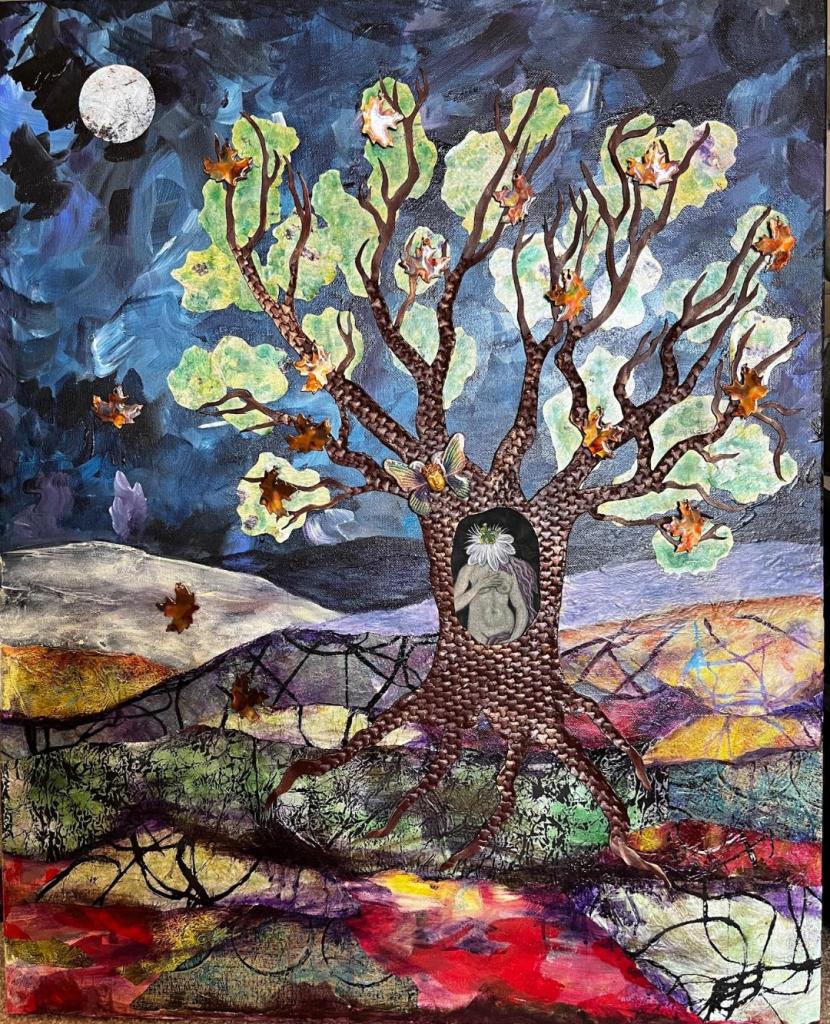
The Insemination of Venus, Laura Schmidt (2024). Mixed media (tooled leather, acrylic with hand-printed paper, torch-painted copper, soft pastel, polymer clay). The work incorporates kinetic elements, such as freely hanging copper leaves, and draws upon classical and mythological influences, including Botticelli’s Birth of Venus
If you find yourself without task or chore, bored beyond belief, and inclined to read a pedantic, hubristic, and discursive review interpreting a truly stunning work of art, I invite you to explore my essay (accessible at link below) on The Insemination of Venus by Laura Schmidt. To say that I find Schmidt’s work exciting and inspiring would be an understatement.
Schmidt, whom I have known for almost four decades, has recently turned in earnest to artistic endeavors following the conclusion of her legal career. Her latest work, The Insemination of Venus, is a masterful synthesis of classical themes and contemporary materials, drawing inspiration from Botticelli’s Birth of Venus and which I interpret as a re-imagining of the ancient motif of the Tree of Life and as an active force of creative transformation (see also my poem below).
Abstract for Essay:The Insemination of Venus as a Modern Tree of Life
The essay explores the profound intersection of classical mythology, artistic innovation, and the enduring motif of the Tree of Life in Laura Schmidt’s multimedia work. Inspired in part by Botticelli’s Birth of Venus, Schmidt’s piece transforms the classical image of Venus from a passive subject of divine creation into an active force of generative imagination. Through an interpretative lens, this essay examines how The Insemination of Venus re-imagines the ancient Tree of Life—not merely as a conduit of divine will, but as a dynamic site of transformation shaped by human creativity. Drawing on traditions from Mesopotamian sacred trees to Platonic cosmology and Norse mythology, my interpretive analysis situates Schmidt’s work within a continuum of cultural expressions that depict trees as cosmic axes, vessels of metamorphosis, and symbols of the evolving relationship between nature, divinity, and artistic agency. Engaging with both the technical execution and symbolic complexity of Schmidt’s composition, this essay illuminates how art can simultaneously honor and redefine ancient archetypes, presenting the Tree of Life as a living, evolving force in the realm of artistic creation.






 Northcoast Antiquarian