

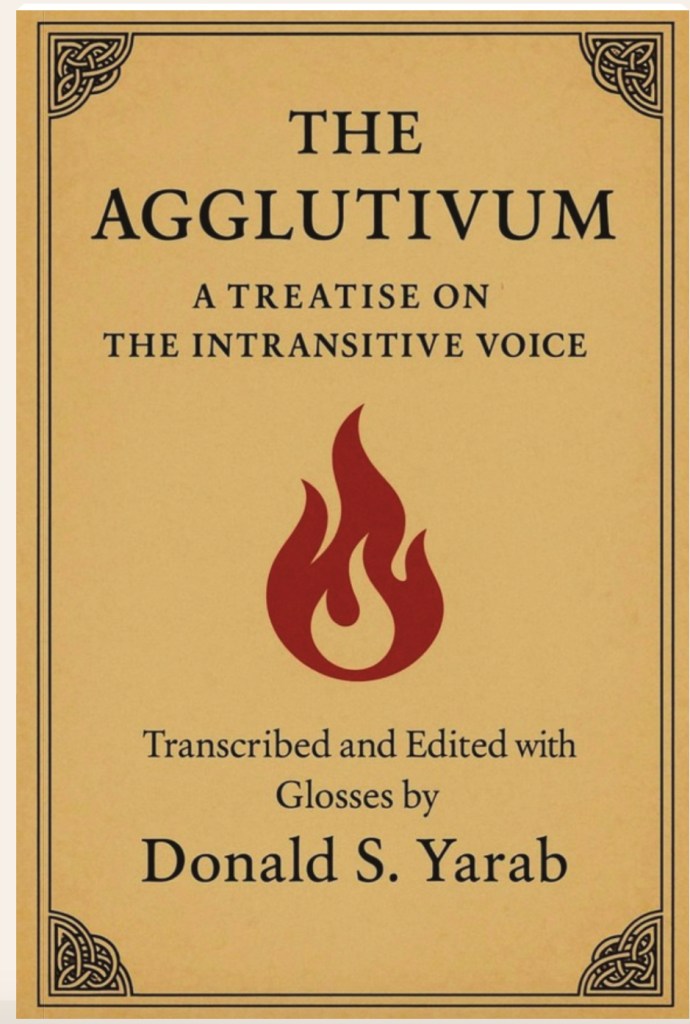
Transcribed and Edited with Glosses by Donald S. Yarab
Paperback, 58 Pages, 6in × 9in, $7.99 plus $5 postage
CLICK IMAGE ABOVE TO ORDER BOUND COPY
It is difficult to describe the Liber Agglutivi, or as translated into English, The Agglutivum: A Treatise on the Intransitive Voice, for both its origin and content resist conventional classification. Its genesis, as I recount within the pages themselves, was not intellectual but oneiric. The word agglutive—unknown to me then, undefined in any language I knew—visited me repeatedly in sleep. So compelling was its sound and weight that, upon waking, I began at once to give breath to the whisper that had haunted my rest. What emerged was not story or doctrine, but something stranger and perhaps more elemental.
The text that followed felt less composed than revealed—an excavation rather than a construction. It is, in the truest sense, a received work. Its structure—voculae, glosselitha, silentia, postverba—appeared as if drawn from some hidden grammar beneath ordinary speech. Though shaped in Latin (with an English translation as appendix) and framed by scholarly apparatus, it is not a parody nor a pastiche, but a sincere tribute to the metaphysical impulse in language.
Readers may find echoes of Borges, Vico, and Pseudo-Dionysius; others may see affinities with mystical traditions, liturgical fragments, or even speculative linguistics. It may be read as fictive scripture, poetic glossolalia, philosophical provocation, or theological shadowplay. Or perhaps—if read rightly—it is none of these, but instead a call to silence, to memory, to the threshold of meaning itself.
Let it be said plainly: this work will not appeal to all. It is slow and strange, elliptical and spare. But for the rare reader attuned to the hum beneath the words we know, it may, in its own agglutive way, speak.
The work is available to read through the link below as a free PDF. For those who find affinity with it, an inexpensive bound copy may be ordered by clicking the image of the book above.
PHILOSOPHICAL EXTENSION: ONTOLOGICAL VOCULAE
A Contemporary Meditation Inspired by the Liber Agglutivi
The Agglutivum suggests but does not systematize a catalog of words that resist conventional grammar—words that seem to create rather than merely describe reality. What follows is a modern attempt to identify and explore such “ontological voculae,” developed in the spirit of the medieval treatise but acknowledging its contemporary construction.
Voculae Agglutivae
A Supplement to the Glossarium Philosophicum
Non omnia verba dicuntur ut loquantur. Quaedam dicuntur ut fiant.
I. Sacra Voculae – Sacred Utterances
These words do not inform; they summon. Often liturgical, they retain weight through resonance, not explanation.
- Amen
Confirmatio sine contentu.
—What is confirmed is not always known. - Alleluia
Laus pura, sine scopo.
—Praise that outruns its object. - Kyrie
Clamor, non formula.
—Not request, but primal cry. - Hosanna
Eruptio, non enuntiatio.
—A word of ascent, not address. - Om / Aum
Vox quae se ipsam audit.
—The breath that sustains itself.
II. Voculae Primitivae – Primal Expressions
Pre-conceptual utterances: the first stirrings of meaning, or the last.
- Yes
Vocabulum consentientis animae.
—Affirmation without argument. - No
Negatio sine opposito.
—The first refusal of the void. - Ah
Apertura interioris visus.
—Recognition unmediated. - Oh
Exclamatio praesentiae subitae.
—When the world enters unbidden. - [Intake of breath before weeping]
Suspirium originis.
—A language too full to speak.
III. Nomina Se Nominantia – Names That Name Themselves
These words contain themselves, and alter meaning with each utterance.
- God
Vocabulum ad quod omnis significatio deficit.
—The name that names the unnamable. - I
Index mobilis identitatis.
—Each speaker remakes it. - Here
Locus qui loquitur se ipsum.
—Presence given in the utterance. - Now
Tempus quod fit dum nominatur.
—Time speaking its own arrival.
IV. Verba Liminalia – Threshold Words
Spoken not to describe, but to open a space.
- Hello
Initiatio contactus.
—More door than declaration. - Goodbye
Benedictio transitus.
—Departure sanctified in speech. - Please
Vulnerabilitas facta audibilis.
—A soft invocation of the will. - Welcome
Domus facta verbo.
—The house that builds itself in greeting.
V. Glosselithae Viventia – Words Worn Smooth by Use
Repeated beyond meaning, yet retaining force.
- Love
Verbum laesum; reclamatione indiget.
—Desecrated by misuse, yet pulsing still. - Peace
Optatio in figura dissoluta.
—A longing that sounds like a promise. - Home
Non locus, sed reditus.
—Not place, but return. - Mother
Verbum primordiale; lingua ante lingua.
—The first word spoken without grammar.
VI. Voculae Intranslatae – The Untranslatable
Not exotic curiosities, but deep resonances foreign to our tongue.
- Saudade (Portuguese)
Absentia praesentiae desideratae.
—Longing for what once was or never was. - Duende (Spanish)
Spiritus tenebrosus artis viventis.
—The dark, unteachable spark of art. - Hiraeth (Welsh)
Nostalgia quae locum non habet.
—Homesickness for an imagined past.
VII. Voculae Vulneratae – Wounded Words
To be spoken only with reverence, if at all.
- Freedom
Verbum quod fuit, et quod mendacio circumdatur.
—Once invoked in hope, now weaponized. - Truth
Conceptus fractus inter instrumenta.
—Broken under the weight of use. - Justice
Verbum spoliatum, ad reclamationem vocatum.
—A word in exile.
Nota Terminalis:
Verba haec tangenda sunt sicut lapides post imbrem. Non sunt instrumenta, sed accessus. Loqui ea est transire limen. Tacere ea est servare lumen.

 Northcoast Antiquarian