

Preface: A Debt to Alchemists
I am a debtor to alchemists.
Over decades of reading, I have traveled through worlds made accessible only by the alchemy of translation. I have wandered with Gilgamesh through Akkadian laments, pondered existence through German philosophy, felt the passionate dialectics of Danish thought, traced the monetary history of Chinese civilization, and followed the angular syntax of Old Norse sagas. I have encountered the theological precision of Medieval Latin, the passionate arguments of French existentialism, the compressed intensity of Hebrew psalms, and the illuminating insights of Spanish mysticism. From Sumerian creation myths to Aramaic scripture to Polish modernist fiction, from the heroic verse of Old English epics to classical Russian realist literature—and doubtless I have forgotten others, to my shame—an entire lifetime of reading has been built on the labors of those who possess what seems to me a kind of supernatural skill.
These translators are linguistic engineers and lexical lyricists working in multiple masteries simultaneously. They must command not just two languages but two literary traditions, two ways of organizing thought, two sets of cultural assumptions about how meaning moves through words. They must be scholars, poets, acoustic artisans, and cultural ambassadors all at once. The precision required is staggering: a single word choice can shift the moral center of a character, the rhythm of a line can determine whether a passage soars or stumbles, and the decision to preserve or adapt a cultural reference can make a text feel ancient or immediate.
What astonishes me most is not just the technical virtuosity required—though that alone would command respect—but the creative courage these practitioners demonstrate. They must make countless decisions in the space between languages where no perfect answers exist, where every choice involves both gain and loss. They work in the knowledge that their efforts will be scrutinized, compared, and inevitably found wanting in some dimension, yet they persist in attempting the impossible: carrying not just words but worlds across the vast spaces between human languages.
I approach translation not as a scholar of the field but as a reader acutely conscious of this debt. The essays that follow examine moments where translators face their greatest challenges—words, phrases, and passages that resist transfer from one language to another, or that demonstrate remarkable ingenuity when confronting texts where even the original language contains indwelling ambiguities. These are the places where translation reveals itself not as mechanical substitution but as interpretive art, where the impossibility of perfect equivalence becomes the very condition for creative meaning-making.
My perspective is that of someone who has been repeatedly astonished by what translators manage to accomplish, someone grateful for the cultural wandering their work has made possible. If these essays contribute anything to the ongoing conversation about translation, I hope it is a deepened appreciation for the miraculous ordinariness of the translator’s task: taking what is said in one language, whether with clarity, ambiguity, or poetic force, and seeking ways to let it speak, however imperfectly, in another.
The debt is vast. The gratitude is boundless. And now the conversation begins.
The Fifth Word: An Introduction
Or: How One Greek Word Launched Four Centuries of πολύτροποι
Ἄνδρα μοι ἔννεπε, Μοῦσα, πολύτροπον, ὃς μάλα πολλὰ πλάγχθη, ἐπεὶ Τροίης ἱερὸν πτολίεθρον ἔπερσε· πολλῶν δ’ ἀνθρώπων ἴδεν ἄστεα καὶ νόον ἔγνω
Homer, Odyssey 1.1-3¹
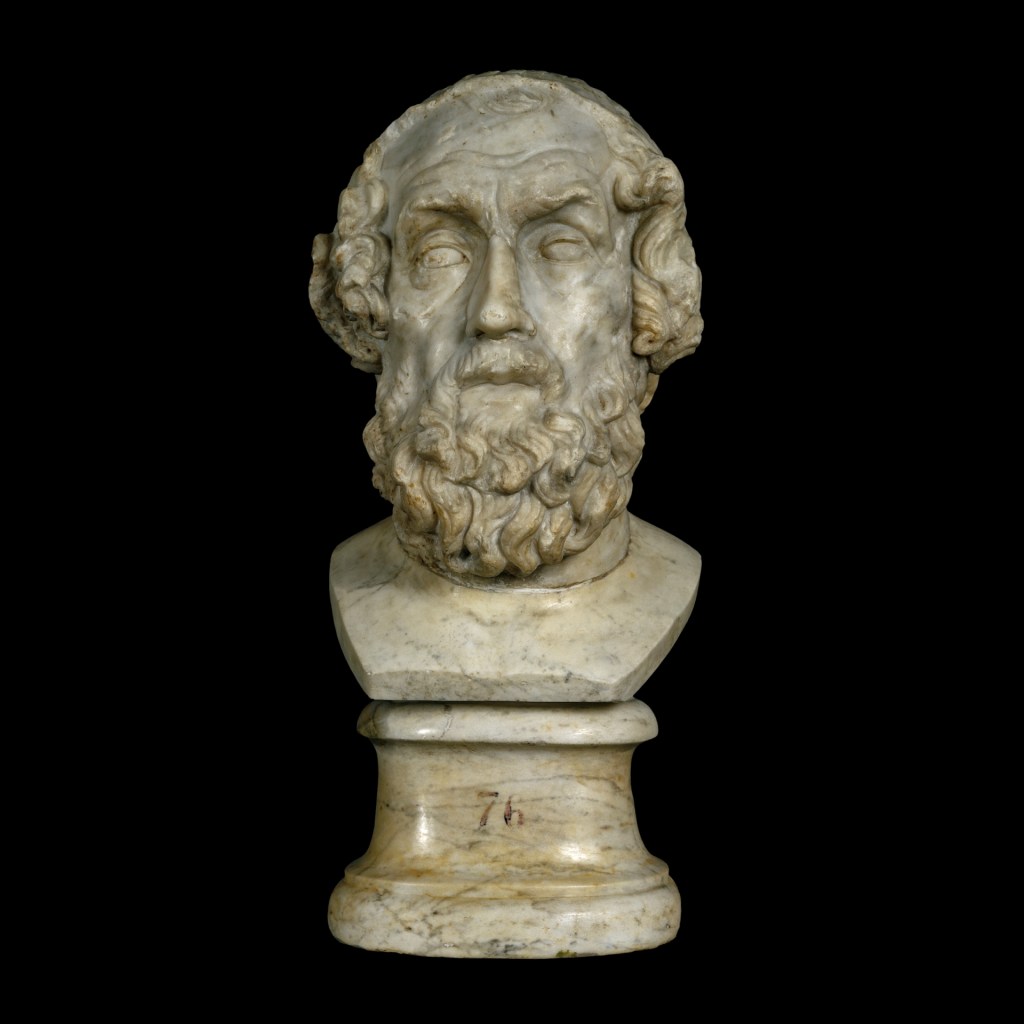
There exists, in the fifth position of the opening line of Homer’s Odyssey, a single Greek word that has tormented, delighted, and obsessed translators for centuries. To most readers, the opening line flows effortlessly: “Tell me, Muse, of the man….” And every translation affixes a descriptive word or several words to the man based on Homer’s fifth Greek word. But for the translator, the fifth word halts progress like a boulder in the stream of translation. The word is πολύτροπον (polytropon), the accusative case of πολύτροπος (polytropos), a descriptor so rich, so layered, so fundamentally untranslatable in any simple sense, that it has spawned not just a multiplicity of different English renderings, but an entire cottage industry of scholarly exploration.
This is where our series begins—not because polytropos is necessarily the most important word in the Odyssey, but because it perfectly embodies the central mystery of translation: the gap between what words mean and what they are made to mean in another tongue. Every choice a translator makes in approaching polytropos reveals something fundamental about how they understand not just Odysseus, not just Homer, but the very art and alchemy of translation itself.
Translation’s Creative Challenge
Polytropos is deceptively simple in construction. The prefix poly- means “many” or “much.” The root tropos means “turn,” “way,” or “manner.” Put them together and you get, quite literally, “many-turning” or “of many ways.” The construction appears straightforward.
But herein lies the difficulty: tropos carries within it a fundamental ambiguity about agency. As Emily Wilson, the translator of the latest English-language translation of The Odyssey that I have acquired has explained, the word presents a choice between describing someone who turns many ways (actively, cunningly, by choice) or someone who is turned many ways (passively, by fate, by the gods, by circumstance). Is this a man who manipulates his path through the world, or one whose path has been manipulated by forces beyond his control? Or, perhaps, by some combination of both active and passive turns?
The Greek does not resolve this ambiguity—it embraces it. And therein lies the translator’s dilemma.
A Plenitude of Solutions
Consider how various translators across four centuries have approached this single word:
- George Chapman (1614): “that many a way / Wound with his wisdom to his wished stay”
- John Ogilby (1669): “Prudent”
- Thomas Hobbes (1674): “the man”
- Alexander Pope (1725): “The Man, for Wisdom’s various arts renown’d”
- William Cowper (1802): “For shrewdness famed/And genius versatile”
- Samuel Butler (1900): “that ingenious hero”
- T.E. Shaw (1932): “the various-minded man”
- W.H.D. Rouse (1937): “the man who was never at a loss”
- E.V. Rieu (1946): “that resourceful man”
- Robert Fitzgerald (1961): “that man skilled in all ways of contending”
- Richmond Lattimore (1967): “the man of many ways”
- Allen Mandelbaum (1990): “of many wiles”
- Robert Fagles (1996): “the man of twists and turns”
- Stanley Lombardo (2000): “the cunning hero”
- Emily Wilson (2017): “the complicated man”
The range is remarkable—from Chapman’s elaborate wordplay to Hobbes’s complete evasion, from Pope’s ornate expansion to Wilson’s stark modernity, each choice reflects not just linguistic preference but philosophical commitment about what translation should and can accomplish.
Wilson’s Innovation
The most recent translation in my library is Emily Wilson’s Odyssey. Wilson’s rendering for polytropon—“complicated”—offers an interesting approach to preserving the word’s semantic ambiguity while signaling moral and psychological depth, though scholarly reception has been mixed.² Its Latin root complicare, “to fold together,” aptly captures a figure whose facets—cunning, suffering, manipulation, endurance—are not easily separated, suggesting as Wilson notes, “someone whose multiple aspects are folded into a single identity, difficult to unravel or understand completely.” This translation does not resolve ambiguity; it revels in it. Where earlier translators sought precision through lexical equivalence, Wilson embraces complexity through conceptual resonance.

The Sound of Meaning
Translation, however, is not just about semantic equivalence—it is also about music, rhythm, and the physical experience of language in the mouth and ear. In the original Greek, polytropos participates in a complex pattern of sound and rhythm:
ἄνδρα μοι ἔννεπε, μοῦσα, πολύτροπον, ὃς μάλα πολλὰ πλάγχθη…
The repetition of the poly- sound connects polytropos to polla (“many”) in the same line and to planchthe (“wandered”) in the next, creating a sonic unity that reinforces the semantic connection between Odysseus’s many-sidedness and his many wanderings. This musical dimension is almost impossible to preserve in English, forcing translators to choose between acoustic and semantic fidelity.
The varied renderings of πολύτροπον by translators across centuries reflect not only aesthetic and lexical choices, but also deeper assumptions about the nature and purpose of translation itself—assumptions that resonate with and are interrogated by major theoretical frameworks.
Translation as Theory, Translation as Politics
Each translator’s approach to polytropos reveals their fundamental assumptions about what translation should accomplish, assumptions that echo through the major theoretical debates of the past century. Should translation prioritize:
- Lexical fidelity to source structures?
- Preservation of aesthetic complexity?
- Contemporary accessibility and clear interpretation?
- Resistance to reductive meaning-making?
- Cultural and political responsibility?
The impossible thing is that these goals often conflict. Wilson’s “complicated” is perhaps more accessible to contemporary ears and possibly more interpretively rich than Lattimore’s “of many ways,” but it sacrifices literal connection to its Greek roots. Fagles’s “twists and turns” preserves ambiguity through metaphor, capturing both the active dimension (Odysseus creating twists through his cunning) and the passive dimension (being turned by forces beyond his control), while also preserving the literal sense of physical wandering and the metaphorical sense of mental agility. Notably, among the dozens of English translations preceding Fagles, only two others—T.S. Norgate’s “of many a turn” (1858) and Albert Cook’s “of many turns” (1967)—preserved the Greek roots as literally as Fagles’ “twists and turns.”³ Each translator joins rather than replaces the ongoing conversation about what this untranslatable word might mean.⁴
The challenge of polytropos connects to broader conversations about what translation is and what it should do—conversations that have produced some of the most influential theoretical writings of the past century.
Walter Benjamin’s 1923 essay “Die Aufgabe des Übersetzers,” best known in English as “The Task of the Translator,” remains perhaps the most cited work in translation theory, arguing that translation should not aim for communication but for a kind of “pure language”—not found in either source or target, but revealed in their interplay—that emerges in the space between languages. For Benjamin, the translator’s task is not to convey meaning but to find the way languages complement each other, revealing what he calls their “kinship.” Applied to polytropos, Benjamin might advocate for something like “many-turned” or “much-turning”—preserving the German-like compound structure that reveals the kinship between Greek and English through their shared capacity for word-building. He would resist choosing between active and passive readings, instead creating a translation that holds both possibilities in tension, allowing the “pure language” that exists between Greek and English to emerge.
Susan Sontag’s 1966 “Against Interpretation” offers a different but related challenge to conventional approaches to meaning-making. Sontag argues that interpretation—which she sees as analogous to translation—often becomes “the revenge of the intellect upon art,” impoverishing works by reducing them to predetermined meanings. Her call for an “erotics of art” rather than a “hermeneutics of art” parallels the translator’s dilemma: how to preserve the sensual, immediate impact of a work while necessarily transforming it. Sontag might prefer leaving polytropos untranslated entirely, forcing readers to encounter the word’s irreducible foreignness, or choose the most literal rendering—”many-turning”—while resisting any footnotes that would “interpret” the ambiguity away. Her approach would preserve what she calls the work’s “sensuous surface,” letting readers experience the word’s mystery rather than having it explained into submission.
Vladimir Nabokov’s “Problems of Translation: Onegin in English” (1955) stakes out an extreme position in favor of literal fidelity. Nabokov argues that “the clumsiest literal translation is a thousand times more useful than the prettiest paraphrase,” advocating for translations with “footnotes reaching up like skyscrapers to the top of this or that page so as to leave only the gleam of one textual line between commentary and eternity” rather than the kind of elegant adaptation that sacrifices accuracy for readability. His approach to Eugene Onegin exemplifies this philosophy, creating what he called an “interlinear” translation that preserves every nuance at the cost of natural English. Nabokov would almost certainly render polytropos as “of many turnings” with extensive footnotes explaining every possible meaning: “1) having many devices/stratagems, 2) being turned in many directions by fate, 3) taking many paths, 4) being versatile in character, 5) cunning, 6) much-traveled…” His translation would sacrifice English fluency entirely for exhaustive accuracy, creating what he called “truthful ugliness” rather than “beautiful deception.”⁴
Gayatri Spivak’s “The Politics of Translation” (1992) brings postcolonial and feminist perspectives to bear on these questions. Spivak argues that translation is never neutral but always involves power dynamics, particularly when translating from “weaker” languages into English, the “language of power.” She advocates for what she calls “surrender” to the source text and criticizes translations that over-assimilate foreign works to make them accessible to Western readers, creating what she terms “translatese.” Spivak might choose something like “many-wayed” that preserves the Greek’s strangeness while questioning Western heroic ideals. She would resist translations that make Odysseus too familiar to English readers, warning against rendering polytropos as “resourceful” or “cunning”—words that domesticate Greek concepts of heroism into comfortable English categories. Her footnotes would address how translation choices reflect cultural power dynamics.
George Steiner’s monumental After Babel (1998) frames these concerns in terms of cultural encounter, arguing that translation is fundamentally an act of aggression where the translator “invades, extracts, and brings home” meaning from the foreign text—a conception that resonates deeply with postcolonial critiques of translation as cultural appropriation. Steiner might embrace a translation that acknowledges the “violence” of cultural appropriation—perhaps “man of manifold turnings” that sounds deliberately archaic, marking the temporal and cultural distance we must cross to reach Homer. He would want readers to feel they are encountering something genuinely foreign that has been “brought home” but not domesticated.
The Birth of a Series
These theoretical frameworks illuminate why polytropos serves as the perfect introduction to “The Fifth Word”—not just the series, but the concept. Every significant work of translated literature contains moments like this, words or phrases that crystallize the fundamental challenges of moving meaning between languages and cultures. These moments reveal translation not as a mechanical process of substitution, but as an art form in its own right, requiring creativity, interpretation, and impossible choices.
In each essay that follows, we will examine these crucial moments—the words that challenge translators and the art of translation, that force translators to become interpreters, that reveal the beautiful impossibility of perfect communication between languages. We will explore how different translators have approached these challenges, what their choices reveal about their understanding of the source text and target audience, and what these translation decisions mean for readers who encounter these works only in translation.
Some essays in this irregular series will focus on single words, like polytropos. Others will examine phrases, passages, or even entire approaches to a text. What unites them is the conviction that these moments of translation difficulty are not obstacles to be overcome, but windows into meaning itself—opportunities to understand not just what texts say, but how meaning moves through time, space, and the minds of readers separated by centuries and cultures.
Translation, at its best, does not just move words from one language to another—it creates critical access to intended meaning, oft revealing new ways of understanding both the source and target cultures. The history of translating polytropos is not just a record of different approaches; it is a map of how Western culture has understood heroism, character, and human complexity over the centuries.
Each new translation of The Odyssey does not replace its predecessors—it joins the conversation, adding another voice to an ongoing dialogue about what these ancient words might mean for contemporary readers. In this sense, translation is less like solving a puzzle than like composing music, with each translator adding their own interpretation to a theme that will never be definitively resolved.
This is what “The Fifth Word” will explore: the fertile space between languages, where meaning is not merely transferred but transformed—reborn, refracted, and made newly strange. Each essay will examine these crucial moments—the words that break translation, that force translators to become interpreters, that reveal the beautiful impossibility of perfect communication between languages.
Welcome to “The Fifth Word.” The journey begins here, but like the wanderings of Odysseus himself, who knows where it will lead us?
Notes
- The Greek text is taken from Homer, Homer’s Odyssey, edited with English notes, appendices, etc. by W. Walter Merry and James Riddell, 2nd ed., rev. (Oxford: Clarendon Press, 1886), p. 1. The scholarly apparatus notes πολύτροπον as meaning “of many devices” (p. 1, fn. 8).
- For mixed scholarly reception of Wilson’s translation, see Richard H. Armstrong, review of Homer: The Odyssey, by Emily Wilson, Museum Helveticum 75, no. 2 (2018): 225-226; and Richard Whitaker, “Homer’s Odyssey Three Ways: Recent Translations by Verity, Wilson, and Green,” Acta Classica 63 (2020): 241-254. For more positive mainstream reception, see Gregory Hays, “A Version of Homer That Dares to Match Him Line for Line,” New York Times Book Review, December 5, 2017; and Tim Parks, “The Visible Translator,” New York Review of Books, March 31, 2021. For Wilson’s own discussion of translating πολύτροπον, see Wyatt Mason, “The First Woman to Translate the ‘Odyssey’ Into English,” New York Times Magazine, November 2, 2017.
- For the observation about Norgate and Cook being the only predecessors to preserve the Greek roots literally, see Wyatt Mason, “The First Woman to Translate the ‘Odyssey’ Into English,” New York Times Magazine, November 2, 2017.
- Wilson implicitly rejects Nabokov’s approach, arguing that translations requiring footnotes reaching up like skyscrapers or dictionary-based translation represent “a simple and fundamental misunderstanding … of what any translation is doing.” See Mason, “The First Woman to Translate the ‘Odyssey’ Into English.”
- The author’s preference would be Fagles’s “twists and turns” with annotation explaining that polytropos (πολύτροπος) contains an inherent grammatical ambiguity—tropos (τρόπος) can indicate either twists and turns inflicted by fate or the gods, or twists and turns of cunning and choice by Odysseus himself—that no English rendering can preserve without explanatory note.
Bibliography
Primary Sources: Homer Translations
Butler, Samuel. The Odyssey of Homer. London: A.C. Fifield, 1900.
Chapman, George. The Odysseys of Homer. 1614. Reprint, with introduction and notes by Richard Hooper, M.A., F.S.A. London: John Russell Smith, 1857.
Cowper, William. The Odyssey of Homer. 2nd ed., with copious alterations and notes. London: Bunney and Gold, 1802.
Fagles, Robert. The Odyssey. New York: Viking, 1996.
Fitzgerald, Robert. The Odyssey. New York: Doubleday, 1961.
Hobbes, Thomas. The Iliads and Odysses of Homer. 1st AMS ed. New York: AMS Press, 1979. Facsimile of: 2nd ed. London: W. Crook, 1677.
Lattimore, Richmond. The Odyssey of Homer. New York: Harper & Row, 1967.
Lombardo, Stanley. Odyssey. Indianapolis: Hackett Publishing, 2000.
Mandelbaum, Allen. The Odyssey. New York: Bantam Classics, 1990.
Ogilby, John. Homer His Odysses Translated. London: Printed by James Flesher, for the Authour, 1669.
Pope, Alexander. The Odyssey of Homer. A new edition, with additional notes, critical and illustrative by Gilbert Wakefield, B.A. London: Printed for J. Johnson, W. J. and J. Richardson, W. Otridge and Son, et al., 1806.
Rieu, E.V. The Odyssey. Baltimore: Penguin Books, 1946.
Rouse, W.H.D. The Story of Odysseus. London: Thomas Nelson, 1937.
Shaw, T.E. The Odyssey of Homer. Introduction by John Finley. Norwood, Massachusetts: The Plimpton Press, 1932.
Wilson, Emily. The Odyssey. New York: W.W. Norton, 2017.
Translation Theory: Essential Essays
Benjamin, Walter. “Die Aufgabe des Übersetzers.” 1923. In Translation as a Form: A Centennial Commentary on Walter Benjamin’s “The Task of the Translator,” edited by Douglas Robinson, 1st ed. London: Routledge, 2022.
Nabokov, Vladimir. “Problems of Translation: Onegin in English.” Partisan Review 22, no. 4 (1955): 496-512. Reprinted in Theories of Translation: An Anthology of Essays from Dryden to Derrida, edited by John Biguenet and Rainer Schulte, 127-143. Chicago: University of Chicago Press, 1992.
Sontag, Susan. “Against Interpretation.” 1966. In Against Interpretation and Other Essays, 3-14. New York: Farrar, Straus and Giroux, 1966.
Spivak, Gayatri Chakravorty. “The Politics of Translation.” 1992. In Living Translation, by Gayatri Chakravorty Spivak et al. London: Seagull Books, 2022.
Steiner, George. After Babel: Aspects of Language and Translation. 3rd ed. Oxford: Oxford University Press, 1998.
Secondary Sources
Armstrong, Richard H. “Homer for Scalawags: Emily Wilson’s ‘Odyssey.’” Los Angeles Review of Books, August 5, 2018.
Bär, Silvio. “Reviewing the Classics I: Richmond Lattimore’s Translations of Homer’s Epics.” April 29, 2020. https://www.silviobaer.com/post/reviewing-the-classics-i-richmond-lattimore-s-translations-of-homer-s-epics
Griffin, Jasper. Review of The Odyssey, by Homer, translated by Robert Fagles. The New York Times Book Review, 1996.
Higgins, Charlotte. Review of The Odyssey, by Homer, translated by Emily Wilson. The Guardian, December 8, 2017.
Johnston, Ian. “Review Comments on Translations of Homer.” http://johnstoniatexts.x10host.com/homer/
Mason, Wyatt. “The First Woman to Translate the ‘Odyssey’ Into English.” The New York Times Magazine, November 2, 2017.
Miller, Madeline. Review of The Odyssey, by Homer, translated by Emily Wilson. The Washington Post, December 7, 2017.
Stalnaker, Joanna. “An Epic New Journey for ‘The Odyssey.’” Columbia News, November 9, 2018.
Translation Station. “Odyssey: Opening Lines.” April 10, 2018. https://translationstation2018.wordpress.com/2018/04/02/odyssey-opening-lines/
Venuti, Lawrence. The Translator’s Invisibility: A History of Translation. 2nd ed. London: Routledge, 2008.



 Northcoast Antiquarian