
Incompetence and Buffoonery: The Threat to Democracy

Clowns and buffoons

Preface to the Reader

There was hesitation before I posted the essay below. Not for its merit, but for its timing. I wonder, truly, whether we have already passed the point of rupture—whether the buffoonery we witness in scandals such as Whiskeyleaks (the use of the Signal app by U.S. cabinet officials and others to discuss classified war plans) is not merely incompetence, but a smokescreen for something more deliberate, more calculated, and far more lethal. If the jesters, clowns, and buffoons distract, it may be only so that the knife may fall unnoticed. This essay, then, may read not as prophecy but as postmortem—or as warning flung desperately against a wind already turning. And yet, even still, I believe it must be said.


Note to the Reader

This essay is written not as a partisan screed, nor as a nostalgic lament for some imagined golden age, but as a meditation—part moral reckoning, part civic warning—on the condition of a republic that has allowed itself to descend into spectacle, incoherence, and institutional decay.

It is addressed to those who still believe that government, for all its failings, remains a public trust; that civic virtue is not an antiquated ideal; and that the health of a nation may be measured not merely in wealth or might, but in memory, restraint, and the character of its leaders and laws.

The tone is deliberately severe, for the times are unserious. The satire is not meant to entertain, but to unmask. Where irony sharpens, it does so to reveal truths that cannot be said plainly without losing their edge. And where the anger beneath the prose surfaces, it does so not in despair, but in the hope that the reader, too, is angry—and unwilling to become numb.

This is not a call to revolution, but a call to remembrance, to vigilance, and above all to responsibility. If the republic is to be rebuilt, it will not be by those who broke it, nor by those who profited from its breaking, but by those who, though weary, still believe it is worth the rising.


The Farce of Ruin: On the Buffoonery, Cowardice, and Consent that Endanger the Republic

It becomes difficult indeed to weigh if the republic is more greatly endangered by ignoble, incompetent lackeys such as now populate the greatest offices of state, appointed by the bitter, vengeful, demented, and oft confused and wholly arbitrary despotic personality that resides in the executive mansion, courtesy of the cult of resentment, hate, and fear, than it would have been had he appointed more able men and women to execute his whims and vices. For in one case, we face the farce of ruin—the slow, stumbling, ignoble unraveling of a once-proud polity into absurdity and impotence. In the other, we would face tyranny executed with precision, method, and perhaps permanence. Yet if there is any comfort to be found in chaos, it is this: incompetence leaves wreckage; competence might have left chains. But wreckage, at least, invites the labor of rebuilding—if the will, the memory, and the courage yet remain.

This is the bitter paradox of the present hour: that we may find ourselves grateful not for wisdom, but for the want of it; not for virtue, but for its absence. That the republic’s temporary reprieve lies not in the strength of her institutions nor the vigilance of her people, but in the vacuity and vanity of her despoilers. These are not statesmen in the Roman sense, nor even villains in the Shakespearean; they are caricatures—jesters costumed in stolen robes of office, bumbling through decrees, barking orders not out of conviction but impulse, devoid alike of strategy and shame. And yet, we dare not laugh too loudly. For every laugh chokes on the question: how long can a republic endure when the machinery of its survival is entrusted to hands unfit to hold it?

The Rise of the Cult: Resentment as Political Theology

Power, once grounded in consent and law, now derives its strength from a darker source: resentment. Not merely disappointment or disillusionment, but that deeper, more corrosive sentiment born of perceived humiliation, of grievance nurtured until it metastasizes into dogma. No longer content to reform what they claim to hate, the votaries of this new creed seek instead to destroy—to salt the fields, poison the wells, and tear down every institution that once restrained ambition with honor, and pride with duty.

This is not politics in any meaningful sense. It is theology by other means—a bitter creed that worships neither God nor country but the self, wounded and wrathful. Its high priests preach vengeance cloaked in patriotism, its sacraments are insult and spectacle, and its liturgy is grievance repeated endlessly, unexamined and unrelieved. To belong to this cult is not to believe in anything beyond the negation of others: the “elites,” the “experts,” the “traitors,” the “others”—those perpetual abstractions upon whom every failure may be pinned, every fear projected.

Thus, the executive, himself a totem of grievance, is not admired in spite of his vices but because of them. His incoherence becomes a form of authenticity; his cruelty, a mark of strength; his ignorance, proof that he is unsullied by the corruption of thought. This is the logic of the mob, sanctified and enthroned. It does not seek truth, only validation; not justice, but vengeance. And from such poison grows not a polity, but a pack.

The Machinery of Power: Incompetents in High Places

Once, high office required at least the semblance of merit—a capacity for governance, a grasp of statecraft, or, at the very least, the discretion to defer to those who possessed it. No longer. The new qualification is loyalty alone: loyalty not to the Constitution, not to principle or country, but to personality. And not even to a consistent personality, but to a flickering candle in a tempest—unstable, moody, and perpetually affronted.

Thus have the halls of government been peopled with jesters, flatterers, and feckless opportunists. Ministers of the treasury who do not believe in numbers, secretaries of education who scorn learning, envoys who sabotage diplomacy, and legal advisors who treat the law as a nuisance to be outmaneuvered rather than a structure to be upheld. Their résumés are padded with failure, their careers propped up by sycophancy, their ambitions tethered not to public service but to personal advancement through proximity to power.

Yet their greatest failing is not simply what they do, but what they permit. Their very mediocrity becomes the shield behind which greater abuses are concealed. For while the citizenry scoffs at the spectacle—the press conference gaffes, the mangled grammar, the contradictions piled upon contradictions—policy proceeds maliciously, cruelly. Freed from oversight, insulated by noise, the machinery grinds on: protections undone, laws abandoned, rights weakened, government dismantled, alliances broken. The clown at the helm distracts the gaze, while the bureaucratic knife goes unnoticed beneath the velvet tablecloth.

And in this lies the genius of institutional vandalism: not to destroy with one mighty blow, but to dull the blade slowly—through mismanagement, attrition, and the silent resignation of the capable and the firing of tens of thousands. A thousand small indignities, each one tolerable, each one dismissed, until the edifice no longer stands, and we wonder not when it fell, but how we failed to notice.

The Counterfactual: What If the Tyrant Were Wise?

One is almost tempted to breathe a sigh of relief at the chaos, for chaos is its own limit. A despot who contradicts himself hourly, who governs by whim and forgets his decrees by dusk, is a tyrant only in name. He may wish to rule absolutely, but lacking consistency, foresight, or discipline, he becomes instead a figure of grotesque parody—dangerous, yes, but disarmed by his very incoherence. We may survive him not because of our strength, but because of his weakness.

But imagine, if you will, the inverse: a tyrant possessed of intellect, method, and clarity. One who governs not in the service of ego but of vision—however malignant. One who surrounds himself not with cowed incompetents, but with men and women of ruthless efficiency, cold logic, and administrative precision. This is the tyrant history has known best. It is not the fool who builds the gulag or writes the blacklists, but the functionary with a plan, the theorist with a chart, the orderly mind untroubled by conscience.

Had our moment produced such a figure, how much swifter the erosion of liberty would have been! How much more subtle the theft of rights, how much more durable the machinery of oppression! The republic might not have looked so disordered—it might have seemed vigorous, decisive, strangely efficient. But beneath the appearance of control, the soul of the nation would have already been extinguished, its people transformed not into rebels or resisters, but into docile instruments of the state’s will.

The question, then, is no longer whether we are fortunate in our calamity, but whether we understand its nature. For fools can be replaced. But should a day come when their successors wear the same mask but wield it with purpose—then the hour will be far darker, and the laughter that once served as shield will curdle into silence.

The Theatre of the Absurd: Democracy as Entertainment

If the republic falters from within, it is not only because of those who hold the levers of power, but because of those who have come to see governance not as a civic duty, but as a form of entertainment. The forum has become a stage, the statesman a performer, and the electorate an audience demanding sensation. Nuance bores, compromise offends, and truth is a distant, flickering ghost—unwelcome and unprofitable.

In such a theatre, absurdity is not a bug but a feature. Every gaffe becomes a meme, every outrage a headline, every policy a subplot in an endless narrative of grievance and spectacle. The media, desperate to retain its vanishing grip on attention, ceases to inform and instead curates the drama—cutting, splicing, amplifying. The body politic is no longer a deliberative citizenry but a viewership conditioned to react, not to reason.

And what is the role of the elected official in this new dramaturgy? Not to lead, but to brand. Not to govern, but to trend. They issue not laws, but slogans. They trade not in facts, but in feels. Even their failures become assets, for in the logic of the spectacle, visibility is power, and infamy sells just as well as virtue—often better.

Worse still, even those who know the performance is a fraud feel trapped within it. To disengage is to surrender the stage to the most unscrupulous actors; to engage is to be complicit in a system that rewards noise over thought, allegiance over principle. This is the final genius of the absurd republic: to create a politics where participation itself feels degrading, and yet absence feels dangerous.

Thus the state becomes not a polity of free and deliberative people, but a spectacle of exhaustion. We scroll, we jeer, we despair. But rarely—too rarely—do we act.

The Fragility of Memory: When History No Longer Speaks

No tyranny begins as tyranny. It begins in the forgetting. A forgetting not only of facts or dates, but of the moral weight of precedent, the slow accumulation of civic wisdom, the lessons written in blood and ink by those who came before. When memory is intact, it serves as conscience; when eroded, it becomes convenience. We do not recognize the fall because we no longer remember what it was to stand.

Once, a statesman would rise in the chamber and quote Pericles or Lincoln, Cicero or Solon—not merely to adorn his speech but to anchor it in tradition, to draw from the well of republican virtue. Now, even such allusion is dismissed as elitist pedantry. The past is regarded not as a guide but as a burden, and history is reduced to a buffet of misremembered grievances, curated to flatter the resentful and indict the dead.

In this vacuum, lies grow bold. Fictions parade as fact, myths usurp monuments, and the record of what was is rewritten by those who benefit from what is. The archives decay; the historians, sidelined or silenced, speak to a shrinking audience. Memory becomes tribal, curated by algorithm and sentiment. The young no longer study the fragility of freedom because it is no longer taught. The old recall its price, but their warnings are heard as the mutterings of a defeated past.

And what, then, remains? A citizenry adrift—cut loose from history’s moorings, vulnerable to every charlatan with a flag and a grievance. The republic, in such a state, is no longer endangered by enemies at the gates, but by the silence within. Not the silence of censorship, but the quieter, more dangerous silence of indifference. The silence that follows when memory no longer speaks and no one cares to ask what it once said.

Wreckage or Rebirth?

It is tempting, when surveying the present wreckage, to surrender to despair—to believe that the republic, having stumbled so absurdly into decline, can never be set aright. The pillars have cracked, the roof sags, and the foundation seems to shift beneath our feet. But wreckage, for all its tragedy, is not the same as ruin. What has been shattered can, in principle, be rebuilt. The question is whether the will endures, and whether the anger now rising can be forged into resolve rather than simply rage.

For there is anger—mounting, justified, and no longer concealed. It grows not within the cult, but outside it, among those who have watched with clenched jaws as the instruments of governance were handed to buffoons and cowards, as the executive strutted and raged, as the political class bowed and curtsied, mumbling excuses, averting eyes, trading principle for position. And it is not merely the executive that earns their ire, but the entire edifice of acquiescence—a legislature that mutters indignation but funds the farce all the same; a judiciary that, cloaked in solemnity, too often validates the very abuses it ought to constrain. These are not neutral bystanders. They are collaborators by convenience, guardians turned ushers to a constitutional catastrophe.

And so the citizen watches, furious and exhausted, as the republic’s very stewards conspire in its diminishment. Yet this fury, though dangerous if left to fester, may still be redemptive if rightly directed. The task is not to lament the collapse of a golden age that never was, but to resist the entrenchment of a cynical age that need not be. The republic will not be saved by the institutions that failed to defend it, nor by the party machines that greased its fall. If salvation comes, it will be through memory rekindled, virtue rediscovered, and courage reclaimed—not in grand gestures, but in the hard, slow work of rebuilding what was squandered.

We stand, then, not at the end, but at a crossroads between farce fulfilled and tragedy averted. The clowns will fall—their nature guarantees it. But what comes next will not be dictated by their collapse. It will be shaped by those who remain: the watchful, the angry, the resolute. The question is not whether the republic can rise again, but whether we still believe it is worth the rising.

The Real Armageddon: Musk’s DOGE and the Dismantling of Public Trust

Photo by Chris F on Pexels.com

“If you read the news, it feels like Armageddon. I can’t walk past a TV without seeing a Tesla on fire,” Elon Musk said recently at a Tesla all-hands meeting. “I understand if you don’t want to buy our product, but you don’t have to burn it down. That’s a bit unreasonable.”1

The quote is evocative—perhaps designed to stir sympathy. Yet it invites a measure of irony. While vandalism against Tesla properties is, of course, deplorable, it is neither as widespread nor as catastrophic as Musk, and biased media reporting, would have the public believe. Fewer than a dozen reported incidents—at Tesla dealerships or Supercharger stations—have resulted in fires, graffiti, or property damage. In nearly all of these cases, suspects have been arrested and charged.2

In a country of over 330 million people, where more than 200,000 vehicle fires and 500,000 structure fires occur annually,3 and where Florida and Texas alone report nearly 3,000 murders each year,4 these incidents—while serious—are statistically insignificant. What Musk decries as “Armageddon” is, in national context, a series of isolated acts that have been swiftly addressed by law enforcement.

Meanwhile, under Musk’s leadership of the Trump administration’s Department of Government Efficiency (DOGE), far greater destruction is being wrought—not upon property and government subsidized business interests, but upon the institutions designed to serve the American people.

According to Reuters, the Department of Veterans Affairs (VA) is expected to lose over 80,000 employees under DOGE’s efficiency plan.5 Already, this downsizing is disrupting vital services: clinics are understaffed, appointments are delayed, and mental health services—already under strain—are faltering.6

This is not bureaucratic “streamlining.” The VA currently serves over 18 million veterans,7 many of whom depend on timely and specialized care for physical and mental trauma, service-connected disabilities, and long-term support. Disabling this infrastructure in the name of “efficiency” is not neutral policy—it is institutional abandonment.

The Social Security Administration (SSA) has not fared better. Facing mandates to reduce its workforce by up to 50%, the SSA is bracing for a collapse in the timely delivery of services to more than 70 million Americans, including over 50 million seniors.8 Already, SSA field offices in major cities have shortened hours, laid off staff, and seen processing times for benefits skyrocket.

Federal workers have responded with urgency. In San Francisco and other metropolitan areas, SSA and VA employees have staged public protests, warning of the catastrophic impact these cuts will have on their most vulnerable clients.9 Their message is clear: public service cannot survive on ideology alone.

Thus, while Musk’s Teslas may burn in isolated incidents, the real fire is the one now consuming the administrative state (the means by which public servants deliver public services to the citizens they serve pursuant to laws passed by Congress). The irony is sharp. Musk’s complaint—“You don’t have to burn it down”—could just as easily be addressed to himself. If you do not like the structure or scale of government, you do not have to dismantle its capacity to serve. That, too, is a bit unreasonable.

What Musk labels as terrorism when directed at his private enterprise is tolerated—even celebrated—when inflicted upon public institutions. Yet the human cost of the latter is infinitely greater. The quiet collapse of service infrastructure—untelevised and untheatrical—is the more insidious disaster.

In the end, the real “Armageddon” may not be a vandalized Tesla on a TV screen. It may be the veteran denied timely access to urgent medical care. The senior citizen waiting months for a critical in-person meeting at a Social Security office. The single parent lost in a phone queue with no one left to answer.

These are not symbolic gestures. These are lives.


Notes

  1. Pras Subramanian, “Tesla’s Elon Musk Holds Surprise All-Hands Meeting to Assuage Employees and Investors,” MSN Money, March 21, 2025.
  2. New York Post, “Pam Bondi Announces Charges Against 3 in Tesla Attacks,” March 20, 2025.
  3. National Fire Protection Association, “Vehicle Fires,” 2024.
  4. Federal Bureau of Investigation, Crime in the United States, 2021.
  5. Reuters, “US Plans to Fire 80,000 Veterans Affairs Workers,” March 5, 2025.
  6. Reuters, “VA Shake-up Disrupts Mental Health Services,” March 20, 2025.
  7. Pew Research Center, “The Changing Face of America’s Veteran Population,” November 8, 2023; Reuters, “VA Shake-up Disrupts Mental Health Services,” March 20, 2025.
  8. Sara Dorn, “Here’s Where Trump’s Government Layoffs Are,” Forbes, February 21, 2025.
  9. San Francisco Chronicle, “Federal Workers Protest Musk-Led Government Cuts,” March 14, 2025.

The Danger of Literalist Thinking in the Face of Rising Authoritarianism in the United States

The Perils of Legalistic Literalism

Throughout history, authoritarianism has rarely invaded democracies through dramatic coups but rather through the gradual erosion of norms and institutions. This erosion is often enabled by what might be called “legalistic literalism”—a mindset that fixates on procedural adherence while remaining blind to broader patterns of democratic decay. This approach creates a dangerous paradox: by the time literalists acknowledge an authoritarian threat has crossed their arbitrary legal threshold, democratic safeguards have often already been fatally compromised.

The United States offers a compelling case study of this phenomenon. From the normalization of anti-democratic rhetoric during the current president’s first campaign to the institutional paralysis surrounding the January 6th insurrection and subsequent Supreme Court decisions expanding presidential immunity, literalist thinking has consistently undermined effective resistance to democratic deterioration. Now, with the current administration’s return to office, the administration has embraced an explicitly authoritarian approach. It has weaponized the Justice Department and haphazardly dismantled government agencies without required Congressional authorization—at times so maliciously and haphazardly that certain closures had to be reversed. Public servants have been fired, impeding the delivery of essential services to senior citizens, veterans, those seeking enforcement of their civil rights, and other citizens. Some, identified as the “other,” have been sent to what can only be described as concentration camps (in the British historical tradition thus far) in foreign countries or literally “lawless” territories under U.S. control (in the American historical tradition alas) pending their final disposition. Meanwhile, Congress has been marginalized, and executive orders are treated as beyond the oversight of Congress or the judiciary under the novel unitary executive theory propounded by the administration.

This pattern follows a recognizable trajectory observed in other democracies that have declined into authoritarian rule. What makes the American case particularly instructive is how adherence to procedural norms—supposedly the safeguard of democracy—has paradoxically accelerated democratic erosion by delaying meaningful resistance until institutional damage becomes nearly irreversible. Examining this process reveals not just the mechanics of democratic decline but also potential strategies for arresting it before critical democratic guardrails are wholly destroyed.

This essay examines how literalist thinking enables authoritarianism by exploring these key moments of institutional failure and draws lessons for preserving democratic systems against such threats.

The Warning Signs: Early Responses to Authoritarian Signals

The Normalization Phase (2015-2016)

When he emerged as a political figure, his rhetoric displayed clear authoritarian tendencies: praising dictators like Vladimir Putin and Kim Jong-un, threatening political opponents with imprisonment, attacking the press as “enemies of the people,” and suggesting he might not accept election results. These statements represented textbook warning signs familiar to scholars of democratic decline.

Yet the response from most institutional actors was profoundly literalist. Major media outlets normalized his rhetoric by treating it as conventional political hyperbole rather than dangerous authoritarianism. Legal scholars reassured the public that constitutional guardrails would hold. Political opponents dismissed him as unserious. The common refrain—“take him seriously, not literally”—embodied this literalist fallacy, suggesting that dangerous rhetoric was inconsequential until manifested in specific legal violations.

This response ignored historical lessons from democratic backsliding in countries like Hungary, Turkey, and Venezuela, where authoritarian leaders signaled their intentions through rhetoric long before implementing institutional changes. The literalist mindset demanded concrete proof before acknowledging threat—effectively demanding democracy show fatal symptoms before allowing preventative treatment.

Constitutional Optimism as Denial (2017-2019)

Once in office, he tested democratic guardrails through actions that challenged norms without clearly violating laws: firing FBI Director James Comey while citing the Russia investigation, demanding loyalty from law enforcement officials, attacking judges who ruled against him, and claiming “absolute immunity” from investigation.

The literalist response from many institutions was to examine each action in isolation rather than as part of a pattern of democratic erosion. This compartmentalization prevented the recognition of the cumulative threat. Many mainstream legal scholars maintained that since each action could be technically defended through creative legal interpretation, the system was holding.

This faith in procedural safeguards reflected a fundamental misunderstanding of how democracies die in the 21st century. As scholars Steven Levitsky and Daniel Ziblatt note in How Democracies Die, modern authoritarian leaders typically dismantle democracies through legal channels—exploiting ambiguities in legal systems rather than openly violating them. The literalist’s insistence on clear legal violations as the threshold for concern thus creates a perfect blind spot for detecting authoritarian encroachment.

This blindspot would prove particularly damaging as his presidency progressed, setting the stage for increasingly bold challenges to democratic norms that would eventually culminate in the events surrounding the 2020 election.

Institutional Paralysis: January 6th and Its Aftermath

The events surrounding January 6th, 2021, represent perhaps the clearest example of how literalist thinking enables authoritarianism. For months, he and his allies laid groundwork to overturn the election: filing dozens of baseless lawsuits, pressuring state officials to “find” votes, attempting to manipulate the Justice Department, and promoting alternative slates of electors.

The Failure of Preventative Response

Despite these clear warning signs, many institutions remained paralyzed by literalist reasoning. Political leaders insisted on waiting for an unambiguous “red line” to be crossed. Law enforcement agencies, despite intelligence warnings about violence, hesitated to prepare adequately for January 6th partly due to concerns about appearing to take sides in what was framed as a “political dispute” rather than an attempted coup.

This paralysis extended to Congress, where even after the Capitol was breached, a significant number of legislators proceeded with objections to electoral votes—adhering to a procedural approach even as the violent consequences of that approach unfolded around them.

The Accountability Gap

In the aftermath, literalist thinking continued to impede accountability. Criminal prosecutions moved at a glacial pace, constrained by procedures designed for ordinary criminal cases rather than threats to democracy itself. The impeachment process failed when many senators cited procedural objections about impeaching a former president—a literalist reading that ignored the purpose of impeachment as a safeguard against future threats to democracy.

Perhaps most concerning was the judiciary’s response. Courts processing January 6th cases often treated them as ordinary criminal matters rather than components of an attempted coup, focusing on specific statutory violations while avoiding broader questions about democracy and insurrection. This procedural compartmentalization helped normalize an unprecedented assault on democratic transition.

As Daniel Ziblatt observed, the January 6th attack and his subsequent pardoning of rioters highlighted two cardinal rules of a healthy democracy: You have to accept election results, win or lose, and you cannot engage in violence or threaten violence to hold onto power. The failure to enforce these principles further illustrates how literalist hesitation in addressing democratic threats emboldens authoritarian actors.

This failure of accountability created a dangerous precedent, setting the stage for the next phase of democratic erosion: the judiciary’s formal expansion of executive power beyond democratic constraints.

Judicial Complicity and the Supreme Court’s Role

The Supreme Court’s decision in Trump v. United States (2024) exemplifies how literalist legal reasoning can provide cover for authoritarianism. By granting unprecedented immunity to presidents, the Court elevated a narrow textual reading over consideration of how such immunity would affect democratic accountability.

The ruling effectively places presidents above the law, making future accountability nearly impossible. While meticulously parsing eighteenth-century texts and precedents, the Court showed remarkable blindness to the real-world impact: a president who had already attempted to overturn an election was being granted expanded immunity just as he prepared to potentially retake office with explicit promises of retribution against opponents.

This decision represented the culmination of a years-long process of judicial capture that extended well beyond this single ruling. Justices Samuel Alito and Clarence Thomas had been implicated in significant ethics scandals, including undisclosed luxury vacations, private jet travel, and real estate deals with billionaires who had interests before the Court. Rather than addressing these clear conflicts of interest through meaningful ethics reforms, the Court responded with voluntary, unenforceable guidelines that preserved the appearance of judicial independence while allowing substantive corruption to continue.

These ethics scandals revealed a deeper problem: the Court’s legitimacy was being undermined not just by individual rulings but by both the perception and reality that justices were entangled with wealthy interests seeking to reshape American governance. The corruption evident in these scandals aligned key justices with the very oligarchic forces backing authoritarian politics—creating a dangerous alliance between judicial power and anti-democratic wealth.

The Oligarchic Capture of Democratic Institutions

The literalist approach fails not only through procedural blindness but also by ignoring the economic power dynamics that increasingly shape American governance. The same oligarchic network supporting judicial capture has also backed authoritarian political movements and organizations, such as the Federalist Society, recognizing that an authoritarian turn benefits economic elites through deregulation, tax policies, and suppression of labor rights.

Congress’ failure to act against judicial corruption stems not merely from procedural timidity but from financial entanglement with the same oligarchs and corporate interests that have corrupted the courts. This same timidity was on display in Senate Minority Leader Chuck Schumer’s decision to support a Republican-crafted Continuing Resolution (CR) to extend government funding, despite opposition from within his own party and others opposed to authoritarian encroachment. His rationale—that blocking the bill would allow the president and his oligarchic side-kick to seize more power through a government shutdown—illustrates how institutional leaders often capitulate to authoritarian pressure rather than risk direct confrontation. This type of preemptive surrender, justified through procedural pragmatism, ultimately facilitates democratic erosion rather than preventing it.

The assumption that democratic institutions operate independently of economic influence is a dangerous literalist fallacy. The reality is that concentrated wealth has created a feedback loop where economic power translates into political influence, which in turn creates policies that further concentrate wealth. This cycle has accelerated democratic erosion by ensuring that institutional responses to authoritarianism remain weak and ineffective, constrained by the same economic interests that benefit from democratic decline.

The Road Ahead

Democracy in the U.S. is at a precarious moment. The literalist approach to democratic defense has repeatedly failed to prevent authoritarian encroachment. The path forward requires:

  1. Recognizing that democracy dies through legal channels, not just through obvious coups.
  2. Understanding that economic oligarchy and political authoritarianism are mutually reinforcing threats.
  3. Prioritizing substantive democratic values over procedural formalism.
  4. Building coalitions willing to take political risks to preserve democratic governance.

For citizens, this means moving beyond the assumption that legal procedures alone will protect democracy. For institutions, it means developing the courage to defend democratic principles even when doing so challenges conventional interpretations of their role.

Effective resistance to authoritarianism requires not just procedural vigilance but moral courage—the willingness to recognize patterns of democratic erosion before they manifest in unambiguous legal violations. It requires understanding that democracy depends not just on rules but on shared commitments to democratic values that transcend legalistic interpretations.

By the time an authoritarian breaks the law, they have already rewritten the rules. The fight for democracy must begin long before that point.

The Dismantling of the U.S. Department of Education: A Calculated Assault on the Nation’s Future

Abandoned classroom. Photo by Pixabay on Pexels.com

The destruction of the U.S. Department of Education is not merely a bureaucratic restructuring or an attempt at governmental efficiency. It is, rather, a brutal, ideologically driven attack on public and higher education itself—an assault decades in the making. The immediate consequences, such as the callous firing of over 1,300 employees and the gutting of its Office for Civil Rights, are alarming, but they are only symptoms of a broader effort to delegitimize and dismantle the tradition of public education in America. This is no accident; it is a deliberate and malicious campaign waged by reactionary forces who have long sought to annihilate the very concept of education as a public good.

Before addressing the broader catastrophe, it is essential to recognize the dedicated public servants whose careers have been abruptly and callously ended. These were not faceless bureaucrats but individuals who dedicated their lives to ensuring access to quality education, protecting civil rights, and supporting students, parents, and teachers. They are the ones who worked tirelessly to administer federal student aid, enforce anti-discrimination laws, and uphold policies meant to ensure that education remained a pathway to opportunity rather than a privilege of the few. To see them falsely maligned and slandered while being discarded so cruelly is an injustice, not only to them but to the nation they so nobly served.

To understand the scope of this travesty, one must acknowledge that public education in the United States has been under sustained assault—not from bureaucrats, not from educators, and certainly not from the imagined “woke” enemies that conservative demagogues irrationally scream about—but from the anti-public education, anti-higher education agenda of the right-wing forces that have festered in the American political landscape since Brown v. Board of Education so deeply outraged the bigoted sensibilities of many Americans. This movement, which cloaks itself in deceptive terms like “school choice” and “parental rights,” is nothing more than a long-running campaign to dismantle public education in favor of a reactionary, privatized system that siphons resources from the many to enrich the few.

Milton Friedman, the sinister patron saint of the libertarian free-market fantasy, provided the economic blueprint for this war on public education. His advocacy for school vouchers was never about “improving education” or “empowering parents”—it was about facilitating the exodus of white children from integrated schools while redirecting public funds into private, often exclusionary institutions. The modern conservative attack on public education is a direct continuation of this shameful tradition, now infused with fresh venom as it seeks to erase any federal coordination, civil rights protections, and guarantee of equal access to education.

And now, with breathtaking ruthlessness, this agenda is reaching its culmination at the hands of pusillanimous politicians hiding behind false narratives. The elimination of nearly half the workforce of the Department of Education within the first two months of the second reign of incompetence is an unmistakable step toward the total obliteration of the department. The Office for Civil Rights, already struggling to process the nearly 25,000 complaints of discrimination it receives from the public yearly and one of the last remaining institutional bulwarks against discrimination in schools—has been slashed to the bone, ensuring that students with disabilities and others who are discriminated against, whether on sex or race or national origin, will have nowhere to turn for timely relief when their rights are trampled. This is not accidental; this is the plan.

The current Education Secretary, in the grand Orwellian tradition of this administration, has assured the public that these cuts will somehow improve “efficiency” and “accountability.” Such statements are not merely disingenuous—they are outright lies, designed to mask the true intent behind this evisceration: to dismantle any federal structure that protects education as a right rather than a privilege reserved for the wealthy and well-connected.

Adding further insult to this grievous injury, the most aggrieved one has handed the reins of this demolition project to none other than our billionaire tech overlord. This grotesque display of plutocratic interference sees our billionaire tech overlord—who has no experience in education policy but plenty of experience in exploiting workers—granted unfettered access to sensitive government data and decision-making power over federal agencies. Under the laughable guise of “efficiency,” his Technokratische Jugend has set about dismantling the very institutions that serve as the backbone of public education, further centralizing power in the hands of the ultra-rich while leaving working Americans to suffer the consequences.

But let us be clear: this is not just an attack on those in public service. It is an attack on the very principle that education should be accessible to all, that an informed citizenry is essential to democracy, that knowledge should not be hoarded by the privileged few. It is an attack on the American future, a calculated and malevolent act of national sabotage designed to entrench ignorance and subjugation. Presently, the enlightened pro-choice anti-education agenda of our political elite has delivered unto us a nation where 54 percent of adults read only at the 6th grade level—imagine a decade hence where we will be!

Public education is not a luxury; it is the foundation of an equitable society. The destruction of the U.S. Department of Education is not about “efficiency” or “streamlining” government—it is about ensuring that the levers of power remain in the hands of a select few while the masses are kept ignorant, powerless, and too overwhelmed to fight back. This is a crisis of democracy, and it will have consequences that reverberate for generations.

The wreckage of this assault will be vast and far-reaching. Higher education costs will continue to increase as many institutions shutter their doors, vocational training programs will wither, and civil rights enforcement in schools will become an afterthought, if it exists at all. Meanwhile, a handful of oligarchs and right-wing ideologues will gloat over their victory, having successfully reduced one of the last bastions promoting American progress into a smoldering ruin. And continue to pay attention to the war on institutions of higher education, our overlords are not done reducing our heirs into ignorance.

The Oligarchic Turn: Wealth, Power, and the Decline of American Democracy

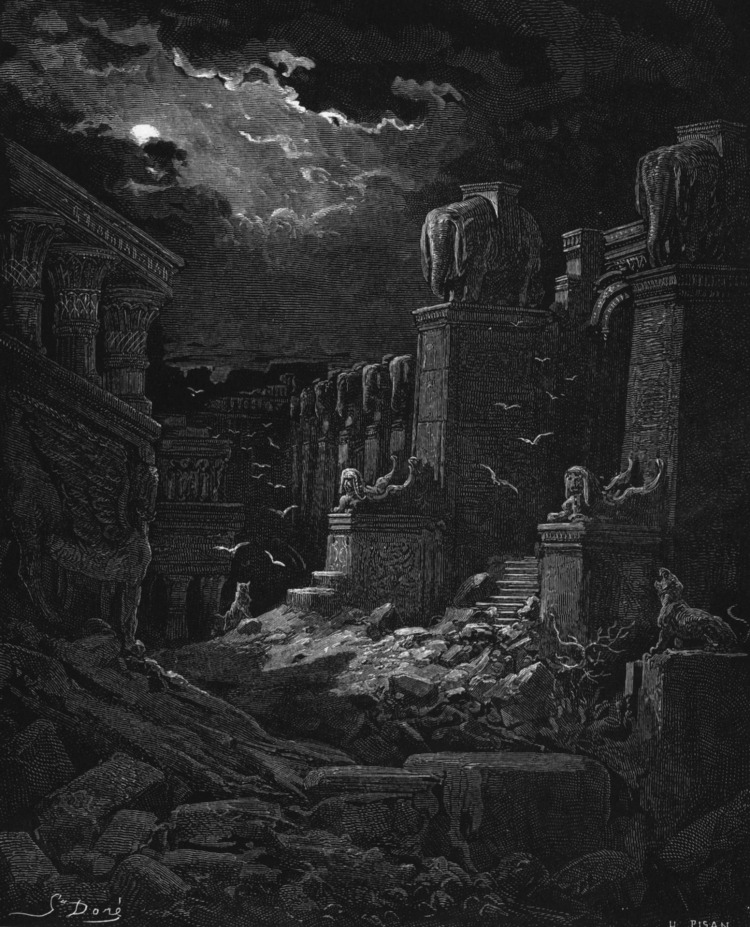
Gustave Doré – The Fall of Babylon (1866)

I. The Abdication of Democracy

The United States was founded as a democratic republic, a nation where governance was entrusted to the people and their elected representatives. Yet, in the present age, democracy appears increasingly untenable, not because of external threats, but because the citizenry itself seems willing to surrender its role in self-governance. Rather than engaging in the messy and difficult work of democracy, Americans have increasingly deferred power to an elite class—oligarchs whose wealth, status, and influence have elevated them beyond the reach of ordinary accountability. In doing so, we have embraced a political theology that anoints the rich as our rightful rulers, sanctifying economic disparity as though it were ordained by divine providence.

A key factor in this transformation is the theological justification for inequality, particularly through the Prosperity Gospel—a strain of Christianity that equates material wealth with divine favor. If wealth is a sign of God’s blessing, then poverty must be a mark of moral or spiritual failure. This belief, deeply embedded in the American consciousness, has provided a convenient ideological foundation for the rise of oligarchy. The result is a republic in name only, where the wealthy govern without meaningful challenge, and where democracy is tolerated only to the extent that it does not threaten the interests of the ruling elite.

Alexis de Tocqueville, in Democracy in America, warned that “the aristocracy of manufacturers… are one of the most dangerous that has ever appeared in the world” because they hold power over the masses without obligation or accountability. Likewise, James Madison in The Federalist No. 10 cautioned that factions dominated by economic interests would threaten the republic, as “the most common and durable source of factions has been the various and unequal distribution of property.”

II. The Historical Cycle: Republics in Decline

America is not the first republic to slide into oligarchy. The Roman Republic offers a particularly illuminating parallel. Beginning as a relatively participatory system after the expulsion of its kings, Rome’s republic gradually concentrated power in the hands of wealthy patricians. By the late republic, a handful of families controlled vast estates worked by slaves, while formerly independent farmers were displaced into a dependent urban proletariat. The final century of the republic saw repeated attempts at reform by populist leaders like the Gracchi brothers, who were assassinated for proposing land redistribution. When Julius Caesar crossed the Rubicon in 49 BC, the republic that had stood for nearly 500 years had already been hollowed out by economic inequality.

Venice provides another instructive example. The Republic of Venice began with a relatively broad-based Great Council of citizens. However, in 1297, the Serrata (closure) of the Great Council permanently fixed membership to established families, creating a hereditary aristocracy. Over time, even within this oligarchy, power concentrated further into the hands of the Council of Ten and eventually the three State Inquisitors. What began as a merchant republic gradually calcified into rule by the few, with elaborate ceremonies maintaining the fiction of the Serenissima Respublica (Most Serene Republic) while actual democratic elements withered.

The Weimar Republic’s collapse demonstrates how economic crisis can accelerate democratic decline. The hyperinflation of 1923 and the Great Depression devastated Germany’s middle class, traditionally democracy’s strongest supporters. As economic security vanished, so did commitment to democratic processes, with many seeking salvation in authoritarian alternatives. Alarmingly, in contemporary America, we witness similar anti-democratic impulses despite experiencing nothing remotely comparable to Weimar’s catastrophic conditions—suggesting that our democratic erosion stems not from genuine economic devastation but from manufactured grievance and the deliberate exploitation of social divisions.

But what fuels this manufactured grievance? Unlike the desperate economic collapse of Weimar Germany, today’s American discontent is stoked less by material suffering and more by a carefully cultivated sense of resentment. The modern oligarchy has perfected the art of distraction, channeling public anger away from corporate excess and systemic inequality and toward cultural and ideological battles that serve no economic interest for the working and middles classes. Instead of demanding higher wages, we are encouraged to fight over identity politics. Instead of questioning why billionaires pay lower tax rates than teachers, Americans are bombarded with outrage over books in libraries. Economic anxiety is repackaged into tribal conflict, ensuring that the real architects of inequality remain unchallenged.

This strategy is not accidental—it is the logical evolution of the media landscape. As traditional journalism declines, political entertainment thrives. Once, the press served as a check on power; now, it too is absorbed into the machinery of grievance, owned by the very oligarchs it should scrutinize. The consolidation is staggering: 90% of U.S. media is now controlled by just six corporations, compared to 50 companies in the 1980s.[1] This concentration has decimated local journalism while amplifying voices that serve oligarchic interests. The electorate is not simply disengaged—it is actively misled, encouraged to see fellow citizens as enemies rather than those who rule over them. This is not the erosion of democracy through neglect, but through engineering.

The success of this model is evident in voter behavior. Discontent no longer translates into economic reform movements or policy advocacy; instead, it is absorbed into personality-driven politics, where would-be strongmen are seen as righteous warriors against manufactured threats. The shift from democracy to oligarchy is not imposed—it is sold, marketed, and ultimately, embraced.

In this light, the warnings of America’s founders appear remarkably prescient. Thomas Jefferson warned against an “aristocracy of monied corporations” and stated, “I hope we shall… crush in its birth the aristocracy of our monied corporations which dare already to challenge our government to a trial of strength, and bid defiance to the laws of our country” (Letter to George Logan, November 12, 1816). Yet today, we have embraced the very model the Founders feared, allowing economic elites to determine policy, shape culture, and control the mechanisms of governance. The people, rather than resisting this transformation, have largely accepted it—guided in part by a religious narrative that equates power with virtue and poverty with failure.

III. The New Oligarchy: Wealth as Divine Favor

The modern American oligarchy is not merely composed of the wealthy, but of those who have successfully positioned themselves as figures of admiration and near-worship. Silicon Valley billionaires, hedge fund magnates, and political dynasties have become the new aristocracy, justified not by noble birth but by financial success. What separates today’s oligarchs from the robber barons of the past is not their wealth alone, but the theological and cultural framework that has shielded them from critique.

The concentration of wealth has reached unprecedented levels. According to Federal Reserve data, the top .1 percent of Americans—just 330,000 individuals—now hold 12.5% of the wealth, a staggering 40% increase from 8.9% in 2010. Meanwhile, the bottom 50% of Americans—165 million people—now hold only 5.5%.[2] This means the richest one-thousandth of the population controls more than twice the wealth of half the entire country. This marks a historic reversal of the post-WWII economic order. Yet rather than prompting concern, this concentration is often celebrated as evidence of entrepreneurial success and innovation.

This oligarchic influence extends beyond domestic borders. Foreign billionaires and sovereign wealth funds increasingly shape American policy and economic priorities through strategic investments, lobbying efforts, and ownership of U.S. assets. The globalization of capital has created a transnational oligarchic class whose interests often align regardless of nationality, further removed from democratic accountability. While domestic oligarchs at least feign the pretense of national loyalty, foreign wealth operates with even fewer constraints, treating American democracy as simply another market to be influenced or manipulated for profit.

The Prosperity Gospel, a uniquely American theological development, has played a significant role in this transformation. This doctrine teaches that material success is evidence of God’s blessing, while poverty signals a lack of faith or effort. In this view, wealth is not merely economic—it is moral. This ideology serves as a powerful deterrent to any redistributionist impulse, as it frames economic disparity as a reflection of divine will rather than systemic injustice.

Consider concrete manifestations of this oligarchic power: Congressional studies show that policy outcomes overwhelmingly align with the preferences of the wealthy. The Princeton study by Gilens and Page (2014) concluded that “economic elites and organized groups representing business interests have substantial independent impacts on U.S. government policy, while average citizens and mass-based interest groups have little or no independent influence.”[3] This influence is maintained through campaign finance—in the 2020 election cycle alone, the top 20 billionaire donors collectively spent $2.3 billion, more than twice as much as Joe Biden’s entire campaign, with a single billionaire contributing over half that sum.[4] Our democracy has effectively been captured by a donor class whose interests dictate policy priorities.

This capture extends to the very institutions designed to safeguard democracy. The judiciary, once a bulwark against concentrated power, has been systematically reshaped through strategic appointments and massive funding of judicial campaigns. Supreme Court decisions like Citizens United have equated money with speech, unleashing unprecedented corporate (thus oligarchic) influence in elections. Meanwhile, elected officials increasingly depend on wealthy donors and corporate PACs to fund ever-more-expensive campaigns, creating a system where access and influence are directly proportional to financial contributions. The result is a government formally elected by the people but functionally beholden to monied interests.

We see this play out in specific policies. The 2017 Tax Cuts and Jobs Act delivered massive benefits to corporations and wealthy individuals while adding $1.9 trillion to the national debt. Meanwhile, proposals for universal healthcare, student debt relief, or expanded social services—policies that would benefit the broader citizenry—face insurmountable opposition despite popular support. The revolving door between Wall Street and government regulatory agencies ensures that financial regulations are written by and for the financial elite. Figures like Steven Mnuchin, who moved from Goldman Sachs to hedge fund companies to Treasury Secretary, or Gary Gensler, who went from Goldman Sachs to Assistant Treasury Secretary, Under Secretary of the Treasury, Chair of the Commodity Futures Trading Commission, Commissioner of the U.S. Securities and Exchange Commission, and Chair of the Securities and Exchange Commission, exemplify how the line between regulator and regulated has blurred beyond recognition. When financial institutions faced collapse in 2008, they received immediate bailouts, while millions of Americans lost their homes with minimal assistance.

The tax system itself has been shaped to benefit the oligarchy. In 2021, ProPublica revealed that the 25 richest Americans paid an effective tax rate of just 3.4% between 2014-2018, while the average American paid around 14%.[5] This disparity did not occur by accident but through deliberate policy choices that allow the wealthy to categorize income as capital gains, exploit loopholes, and shield assets through complex financial structures unavailable to ordinary citizens.

Yet, the same religious justifications that elevate the wealthy conveniently overlook the conduct of those at the top. The modern oligarchs are often anything but paragons of virtue. Their lifestyles, filled with excess, exploitation, and moral as well as often legal bankruptcy, are far removed from the Christian ideals of humility, charity, and service. As Jesus himself warned in Matthew 19:24, “Again I tell you, it is easier for a camel to go through the eye of a needle than for someone who is rich to enter the kingdom of God.” And yet, the rich are celebrated, while the poor—often vilified as lazy or undeserving—are left to navigate a system rigged against them.

IV. The Willing Servitude of the Electorate

This transition from democracy to oligarchy has not been solely imposed from above; it has been embraced from below. A significant portion of the American electorate has come to see governance not as a participatory duty, but as a spectacle—one in which wanna-be strongmen and billionaires are revered as saviors rather than as figures to be held accountable.

Some defend this system as a meritocracy, where wealth reflects productivity and innovation. Yet Federal Reserve data shows that, using historically typical rates of return, inherited rather than earned wealth may account for over half of total wealth, undermining the narrative that economic status is purely the result of individual effort.[6] When nearly half of all wealth comes through inheritance, the myth of pure meritocracy becomes impossible to maintain. Nevertheless, the electorate continues to defend a system that increasingly resembles the hereditary aristocracies our founders sought to abolish.

The cultural obsession with wealth, combined with religious narratives that equate prosperity with righteousness, has dulled the instinct for democratic engagement. Why question the morality of economic inequality when it is perceived as a reflection of God’s order? Proverbs 22:7 states, “The rich rule over the poor, and the borrower is slave to the lender.” Why demand accountability from the ruling class when they are seen as divinely chosen stewards of the nation’s fate?

This abdication of democratic responsibility has been significantly accelerated by the capture of media institutions by the same oligarchic interests. Independent, objective news sources have largely disappeared from citizens’ lives, replaced by conglomerates owned by the very elites whose power should be scrutinized. What passes for journalism often amounts to ideologically laden content designed to reinforce existing power structures while appearing to inform. The resulting information ecosystem leaves citizens simultaneously overwhelmed with content yet starved of the context and critical analysis necessary for meaningful democratic participation. This theological deference to wealth has allowed democracy to wither, not through violent overthrow, but through active acquiescence.

The illusion of consumer choice masks growing corporate concentration, where 75% of household items are now controlled by just ten corporations.[7] When we believe we are making free market choices, we are often simply selecting between products owned by the same conglomerate. This mirrors our increasingly limited political choices, where candidates across the spectrum rely on the same donor base and serve similar corporate interests despite superficial differences in rhetoric.

Consider Amazon’s successful opposition to unionization efforts in Bessemer, Alabama (2021-2022), where billions in corporate resources were deployed to defeat workers seeking basic protections and better wages.[8] Rather than seeing this as class conflict, many Americans defend corporate interests against their own economic self-interest, having internalized a worldview where the market is sacrosanct and labor organization is somehow un-American. This represents the culmination of decades of ideological cult conditioning that has separated Americans from their own civic and economic power.

V. The Disappearance of Ethics in Public Life

If the Prosperity Gospel were true to Christianity, it would demand that the wealthy adhere to moral obligations—generosity, humility, and justice. Yet the reality is quite the opposite. The modern oligarchy exploits faith not to guide ethical behavior, but to silence dissent.

Throughout history, faith has been a force for challenging power—from the Social Gospel movement’s advocacy for labor rights to Martin Luther King Jr.’s invocation of Christian morality in the fight for civil rights. Dr. King warned, “We must rapidly begin the shift from a ‘thing-oriented’ society to a ‘person-oriented’ society” (Beyond Vietnam: A Time to Break Silence, April 4, 1967), criticizing the worship of material success over human dignity.

Yet today, much of American Christianity has been hollowed out, transformed into a vehicle for wealth-worship rather than a challenge to injustice. The teachings of Jesus, who spoke of the poor inheriting the kingdom of God and the moral dangers of riches, have been replaced by a doctrine that tells the poor they simply need to pray harder and wait their turn.

VI. The Oligarchs’ America

The American experiment in democracy appears to be in retreat, not because of foreign invaders or external threats, but because we have abandoned the very principles that sustain it. A democracy requires engaged citizens, yet we have become a nation content to let the wealthy govern without challenge. A republic requires accountability, yet we have deified billionaires and accepted their dominion as inevitable, if not righteous.

The Prosperity Gospel and its ideological offshoots have played a crucial role in this transformation. By equating wealth with divine favor, they have given a theological foundation to inequality and sanctioned the rise of oligarchy. This ideology has not only justified the unchecked power of the rich, but has also pacified the poor, persuading them that their struggles are personal failings rather than structural injustices.

If America is to reclaim its democratic aspirations, it must first confront the myths that have enabled its decline. We the People must remember that wealth is not virtue. Power is not righteousness. And democracy is not sustainable when its people cease to believe in their own right to govern. Until these truths are recognized, the nation will remain in the hands of those who have been deemed, by wealth and by providence, our betters.

History shows that oligarchic rule is not an inevitability. From the antitrust reforms of the early 20th century to the labor movements that shaped the New Deal, democratic resurgence is possible when citizens recognize their own power. But this requires first dispelling the myths that sustain the status quo: that wealth equals virtue, that political change is impossible, and that democracy is someone else’s responsibility.


[1] Ashley Lutz, “These 6 Corporations Control 90% of the Media in America,”’ Business Insider, June 14, 2012.

[2] Board of Governors of the Federal Reserve System, “Distributional Financial Accounts,” Q3 2024 Distribution of Wealth, accessed March 4, 2025,https://www.federalreserve.gov/releases/z1/dataviz/dfa/

[3] Martin Gilens and Benjamin I. Page. “Testing Theories of American Politics: Elites, Interest Groups, and Average Citizens.” Perspectives on Politics 12, no. 3 (2014), 565.

[4] Michela Tindera, “These Billionaire Donors Spent The Most Money On The 2020 Election,” Forbes, February 25, 2021, updated April 16, 2021, https://www.forbes.com/sites/michelatindera/2021/02/25/these-billionaire-donors-spent-the-most-money-on-the-2020-election/ 

[5] Jesse Eisinger, Jeff Ernsthausen, and Paul Kiel. “The Secret IRS Files: Trove of Never-Before-Seen Records Reveal How the Wealthiest Avoid Income Tax.” ProPublica, June 8, 2021. https://www.propublica.org/article/the-secret-irs-files-trove-of-never-before-seen-records-reveal-how-the-wealthiest-avoid-income-tax

[6] Laura Feiveson and John Sabelhaus. “How Does Intergenerational Wealth Transmission Affect Wealth Concentration?” Federal Reserve FEDS Notes, June 1, 2018.

[7] Oxfam. “Behind the brands: Food justice and the ‘Big 10’ food and beverage companies.” Oxfam International, 2013, https://www-cdn.oxfam.org/s3fs-public/file_attachments/bp166-behind-the-brands-260213-en_2.pdf

[8] Karen Weise. “Amazon Workers Vote Down Union Drive at Alabama Warehouse,” The New York Times, April 9, 2021.  https://www.nytimes.com/2021/04/09/technology/amazon-defeats-union.html?smid=url-share