Exploring the Eternal Now: Past Present Future in Poetic Form

Time Transfixed (La Durée poignardée) is a 1938 oil on canvas by Belgian surrealist René Magritte (1898-1967), now part of the permanent collection of the Art Institute of Chicago. The title translates literally as Ongoing Time Stabbed by a Dagger. Magritte reportedly expressed dissatisfaction with the widely accepted English translation, Time Transfixed. The translation issue resonates with the theme of the poem Past Present Future? Which is Now?

Inspired by Where is Am I? and viewing poetry as akin to musical composition, I felt it fitting to create a follow-up variation on a theme. In truth, it took only moments to pen the opening line/title: Past Present Future? Which is Now? How could this not spring readily to mind, given the intense reading, writing, and research I have been immersed in for so long—scientific and philosophical alike? The line is a distillation of a significant part of my existential quest, an attempt to more deeply explore what I have long referred to as the eternal now.

Past Present Future? Which is Now? captures the tension between how we subjectively experience time and the idea that all moments—past, present, and future—are fixed and unchanging. In this static view, consciousness perceives each moment as now, while in reality, every moment already exists. This concept aligns with the philosophical idea of the eternal now, where all of time is present within each instant, even if our perception fragments it. The poem seeks to capture this interaction: the way awareness encounters different moments in time, while time itself remains constant and unchanging. It reflects my broader philosophical inquiries into the nature of reality, consciousness, and time’s interconnectedness.

Where is Am I? and Past Present Future? Which is Now? function as variations on a shared theme, much like movements in a musical composition. While they differ in focus—one on the search for identity, the other on the nature of time—they resonate with one another through recurring imagery and ideas. Both explore existential uncertainty, employing motifs of light and shadow, echoes and breath, to reflect the fragmented nature of consciousness and experience.

Where is Am I? is an introspective meditation on the self’s disjointed sense of being, while Past Present Future? extends this reflection, asking whether time—past, present, and future—exists as distinct moments or as a continuous whole. In this way, the second poem builds on the first, expanding the inquiry into personal identity toward a larger philosophical investigation of time. Together, the two poems form a stylistic and thematic unity, with the second poem deepening the existential questions introduced in the first, offering a more expansive vision of the human experience or, at least, my experience.


Past Present Future? Which is now?

Past whispers in the corners of my mind,
its shadow folded into the fabric of now—
but is it gone, or does it still breathe,
echoing in the present’s fleeting pulse?

The future calls, a distant tremor,
its promise threaded through each thought.
Yet does it truly wait, or is it here already,
quietly draped over the moment’s edge?

Past, present, future—are they separate streams,
or one river coursing through the self,
an unbroken thread of light,
where time is nothing but a veil? Which is now?
All and none—each breath dissolves the question,
as yesterday, tomorrow, and today
collapse into the eternal now.

Exploring Consciousness in the Block Universe (A query to ChatGPT, again)

Early on I warned that I would occasionally use this website as my sandbox to post my ramblings. My apologies for this rambling, as it is not a good story, scholarship, poetry, or even an interesting quote. Rather, it is just a post-it note in the ether, preserving a moment in time of an exploration of a thought that I found interesting.

The Block Universe and the Multiverse have increasingly become areas of scholarly inquiry for me. In recent months, I have been reading academic papers and books to deepen my understanding of both concepts. However, I must acknowledge that, while I find them fascinating, they lie largely outside my area of competency, except perhaps in a philosophical context. Despite this, I am undeniably drawn to both models, though many questions remain unanswered. To explore my ideas, I often turn to AI as a starting point for my inquiries, a way to clarify my inchoate thoughts and ideas.

This evening, I found myself particularly curious about the theoretical interaction between two individuals in the Block Universe model, specifically when they are not in “conscious alignment” but still interacting at the same point in time. Below is the inquiry I posed to ChatGPT and the response I received. I share this as yet another example of how ChatGPT can significantly enrich my exploration of ideas, particularly when I am surrounded by papers, books, and my computer without a similarly interested friend to discuss my ideas – and more importantly, my questions with – at length.

I will not burden you with the followup queries I made and the responses I received that refined the question below to include the Multiverse, migrating consciousnesses, etc., as factors. I will only note that the “discussion,” as it were, became rather heady.


My Inquiry to ChatGPT:

In the Block Universe model, where time is static and every moment exists simultaneously, if Individual A is conscious and interacting with Individual B at a particular point in time (let’s call it ABC on the time axis), can A’s conscious interaction with B be considered a “resurrection” of B, even if B’s consciousness has moved away from that moment? In other words, does A’s present consciousness revive B’s existence, or is B reduced to a mere memory? If time is static and both A and B exist at point ABC, how can we dismiss B’s presence as simply a memory? Wouldn’t A’s conscious perception of B bring B fully into the present, regardless of B’s own conscious awareness at that moment?


ChatGPT’s Response:

Your inquiry touches on a deeply philosophical and metaphysical problem: in a Block Universe, where time is static and every moment exists simultaneously, what happens to individual B if individual A is presently conscious and interacting with them, but B’s consciousness is not at the same point of present awareness? Does A’s conscious interaction with B “resurrect” B, making them fully present, or is B reduced to a mere memory?

1. The Nature of the Present in the Block Universe:

In the Block Universe model, all events—past, present, and future—are equally real and exist at once. Time, much like space, is laid out as a four-dimensional “block” where every point in time is a fixed coordinate. In this framework, “now” is relative—one individual’s present moment might not align with another’s, but both moments exist eternally within the same spacetime.

This leads to the question: if A’s consciousness is at a certain point on the time axis (let’s call it ABC), and B was at ABC at some point, can A’s current awareness bring B back into present existence, or is B simply an imprint of a past moment?

2. The Role of Perception and Consciousness:

Your suggestion, which draws on the nature of perception, implies that A’s perception of B in the present moment might “revive” or “resurrect” B in a meaningful way. In essence, the act of A’s awareness or consciousness interacting with B might not merely render B a memory, but instead fully re-engage B in the present moment. This raises a few key possibilities:

  • Relational Reality: The philosopher Martin Buber, in his work I and Thou, argued that the world is not made up of isolated individuals but of relationships. In the context of the Block Universe, this suggests that the relationship between A and B could make B fully real in A’s consciousness. Even if B is not consciously aware in that moment, A’s engagement could create a present relational reality where B exists in full presence within the scope of their interaction.
  • Revival through Observation: In quantum theory, the act of observation plays a crucial role in defining the state of particles (the observer effect). Although you are not suggesting quantum mechanics applies directly here, your analogy suggests that A’s conscious awareness might act as a kind of observer, bringing B’s reality into the present moment. This is not merely memory, but a revival of B’s full presence through A’s perception, even if B’s own consciousness is “elsewhere.”
  • Dynamic Engagement with Static Time: Although time in the Block Universe is static, conscious interaction with others might create dynamic pockets of reality within that framework. In this view, A’s consciousness “animates” the static reality of B at the point ABC, reviving B’s presence from the past and bringing it into the shared present. B’s full self, even if no longer conscious in that specific moment, becomes “resurrected” in the relational present through A’s engagement.

3. Memory vs. Resurrection of Existence:

The distinction between memory and resurrection is crucial here. If we think of B’s past presence at point ABC as a fixed event in spacetime, it is tempting to reduce B to a memory once their consciousness moves away from that moment. However, the idea that A’s conscious interaction with B resurrects B goes beyond mere memory. In this sense:

  • Memory involves a one-sided recollection of B’s past existence, a mental reconstruction.
  • Resurrection (in your context) implies a re-engagement of B’s full presence at point ABC, facilitated by A’s perception. Even though B is not consciously aware at that moment, their existence in spacetime is reactivated through A’s perception, making B as fully present as when their consciousness was originally at that moment.

4. Perception and Shared Realities:

This idea also ties into theories of shared reality, where the perception of one individual shapes the reality of another. In phenomenology, especially in the work of Edmund Husserl, the experience of the “other” plays a key role in how reality is constructed. When A interacts with B, A’s perception of B might revive B’s presence in a way that transcends mere memory. In this sense, even if B’s consciousness has moved on to a different moment in spacetime, their presence in that specific interaction is made “alive” again through A’s experience.

5. Implications for Consciousness and Existence:

Philosophically, this raises profound questions about the nature of existence:

  • Does existence depend on consciousness, or is it enough for consciousness to engage with an event to resurrect it?
  • Can we exist fully in the minds of others, even if our consciousness is not directly present in a given moment?

In a Multiverse Block Universe model, the potential for repeated instances of engagement between A and B across different versions of reality might amplify this effect, allowing for multiple points of resurrection or engagement in different universes.

Conclusion:

In the Block Universe, where time is static and every moment is fixed, A’s conscious perception of B in a present moment might indeed revive B’s existence, making B fully present again within the framework of that specific interaction. This is more than memory; it is a resurrection of B’s presence in a meaningful, relational way. The interaction creates a shared reality, where B’s existence at point ABC is reanimated by A’s conscious engagement, even if B’s consciousness is no longer at that same point.

The Eternal Now: The Block Universe and Cicero’s Reflections on Death

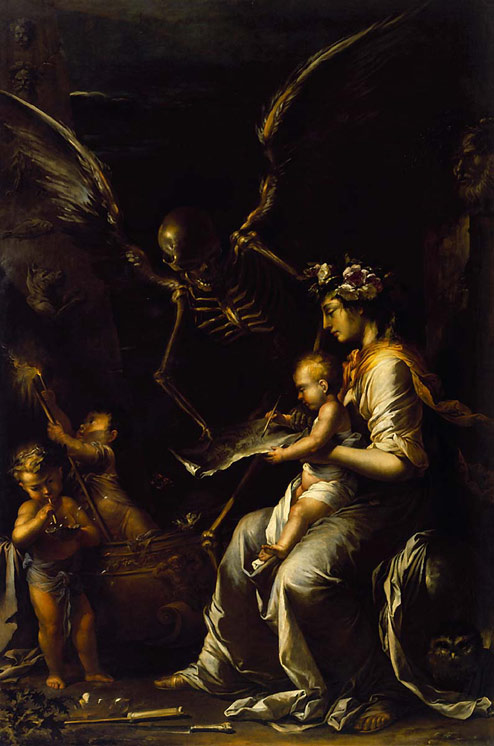
L'Umana Fragilita (Human Frailty, oil on canvas, 1656) by Salvator Rosa. Fitzwilliam Museum, Cambridge.
L’Umana Fragilita (Human Frailty, oil on canvas, 1656) by Salvator Rosa. Fitzwilliam Museum, Cambridge.

“O glorious day when I shall retire from this crowd, this turmoil, and join that divine council and assembly of souls” — Cicero

Cicero reflects on death as a natural and not to be feared part of life. One of his most famous passages reads: “Death is not a matter of sorrow, because it releases us from the prisons of the body and brings us to our natural rest. If death is an end to consciousness, it is like a deep and eternal sleep. If, however, the soul lives on, we have nothing to fear, for we will join those who have already passed.”

Here, Cicero expresses two possibilities for death: either it brings a peaceful, eternal sleep or allows the soul to join those who have passed before, both of which alleviate the fear of death. The first possibility, that death brings the end of consciousness and a restful, eternal sleep, presents death as a final release from the burdens of mortal life. In this scenario, time ceases for the individual, as their consciousness no longer experiences its passage. The second possibility, in which the soul lives on, imagines a continued existence where the soul joins the company of others who have passed, in a realm beyond the constraints of earthly time.

Building on this latter idea, Cicero envisions the soul departing from the mortal world and entering a “divine council” of virtuous souls. He writes: “O glorious day when I shall retire from this crowd, this turmoil, and join that divine council and assembly of souls, and when I shall depart from this life to live with them!” In this vision, the soul is no longer bound by the physical limitations of the body or the linear progression of time. It enters a state of peace, free from the turmoil of earthly life, and becomes part of an eternal realm where time as we know it no longer applies. This divine assembly offers a vision of death as a transition into a timeless existence, where the soul continues without the burdens of decision-making, moral struggles, or the passage of time.

This vision aligns remarkably well with modern cosmological theories, particularly the Block Universe model, which arises from Einstein’s theory of relativity. In this model, time is viewed not as something that flows but as a static dimension. The Block Universe posits that past, present, and future all exist simultaneously within a four-dimensional spacetime continuum. Every moment—whether in the past, present, or future—exists eternally and is as real as any other moment. The flow of time, as we perceive it, is an illusion generated by our consciousness. In this framework, time does not move; rather, we, as conscious beings, experience it as though we are moving through it.

When Cicero speaks of the soul’s release from the turmoil of earthly life and its subsequent joining with other souls, he touches on a concept that can be reconciled with the Block Universe. In his vision, the soul continues to exist, but it is no longer bound by the temporal constraints of human existence. It no longer perceives time as a sequence of moments passing one after another. Instead, the soul becomes part of an eternal now—much like the fixed moments in the Block Universe model. In this state, the soul experiences the peace of being embedded in time’s eternal structure without the torment of consciousness or the burden of decision-making.

In both Cicero’s philosophical framework and the Block Universe model, time continues to exist objectively, but for the individual, time’s significance vanishes with the cessation of perception. This alignment suggests that the end of time, in a subjective sense, is not the end of the universe’s temporal structure, but the end of an individual’s experience of time. The soul, in Cicero’s understanding, remains part of the universe, but without the active engagement of temporal consciousness.

What makes this comparison particularly compelling is the shift from seeing death as a terrifying end to perceiving it as a transition into a timeless existence. For Cicero, death frees us from the burdens of morality and decision-making—tasks that are so deeply tied to our experience of time. Similarly, in the Block Universe, once consciousness fades, we are no longer participants in the dynamic flow of time but become part of the static, eternal structure of existence.

In essence, both Cicero and the Block Universe propose that the end of time is not a destruction or cessation of reality, but rather the cessation of our perception of time’s flow. While the soul may continue to exist in an ethereal state, it does so in a manner detached from the sequential experience of time. Thus, the soul’s existence in this eternal now is one of peace, free from the weight of decisions and the suffering caused by the relentless march of time.

Through this lens, we might reinterpret Cicero’s contemplation of death and the soul’s journey as a profound early philosophical insight into a truth later echoed by modern physics: the possibility of eternal existence within a timeless framework, where the flow of time is merely a byproduct of human perception. In death, the soul may continue within the Block Universe—no longer tormented by the passage of time, but instead, eternally present in the cosmic order.

Works Relied Upon While Preparing This Essay:

Cicero, Marcus Tullius. De Senectute. Translated by William Armistead Falconer. Harvard University Press, 1923.

Cicero, Marcus Tullius. Tusculan Disputations. Translated by J. E. King. Harvard University Press, 1927.

Einstein, Albert. Relativity: The Special and the General Theory. Translated by Robert W. Lawson. Crown Publishers, 1961.

Hawking, Stephen. A Brief History of Time: From the Big Bang to Black Holes. Bantam Books, 1988.

Rovelli, Carlo. The Order of Time. Riverhead Books, 2018.