Digital Tulips in the Gutter: A Reflection on Cryptocurrency and Speculative Delusion

by Donald S. Yarab

It is even more speculative than the tulips of tulipmania—less beautiful, less tangible, and arguably, less of an asset. Tulips, after all, at least bloomed.


four assorted cryptocurrency coins
Photo by Worldspectrum on Pexels.com

Cryptocurrency has become the modern symbol of speculative excess: a phenomenon untethered from utility, value, or service to the common good. Its defenders proclaim it a revolution in finance, a challenge to the tyranny of central banks, a restoration of liberty through cryptographic purity. But peel back the gilded claims, and one finds something more brittle, more hollow, and perhaps more dangerous.

To be fair, cryptocurrency does serve certain functions. In Venezuela, citizens use Bitcoin to preserve wealth as their currency hyperinflates. In countries with collapsed banking systems, people rely on digital tokens for remittances. In regions where governments block financial transactions, cryptocurrency provides an escape valve. These are real uses, serving real needs.

But examine why these uses exist, and a darker picture emerges. Cryptocurrency functions not as a superior alternative to traditional finance, but as digital tree bark—emergency sustenance consumed only when the normal food supply has failed. It works precisely because the alternatives are catastrophically worse: worthless fiat, collapsed institutions, criminal governments. This is not cryptocurrency succeeding on its merits; it is cryptocurrency serving as expensive, volatile intermediary in humanity’s most desperate financial moments.

The Venezuelan using Bitcoin is not proving cryptocurrency’s revolutionary potential—they are demonstrating what happens when a society’s monetary system breaks down. The remittance flowing through Ethereum is not evidence of innovation—it is a costly detour around institutional failure, adding friction, fees, and volatility risk to what should be a simple transfer. Cryptocurrency serves merely as an expensive, volatile intermediary in what remains, at core, a fiat transaction. Convert fiat to cryptocurrency, pay network fees, endure price swings, convert back to fiat, pay more fees. The process only makes sense when every other option is worse.

Yet cryptocurrency evangelists take these edge cases—where their system barely outperforms complete collapse—and extrapolate them into grand claims about the future of all finance. They mistake being marginally better than failed institutions for being superior to functional ones. Should we design our financial systems around the needs of failed states and criminal enterprises? Should we burn massive amounts of energy to create digital workarounds for institutional breakdown, rather than strengthening the institutions that serve stable societies?

This is not currency in any meaningful sense of the term. It is not a stable store of value. It is not a consistent medium of exchange. It is barely a unit of account. What it offers, rather, is a kind of digital alchemy, where symbols stand in for substance and belief masquerades as value.

For the early adopter, it is a lever for disproportionate gain. For the tax dodger and the launderer, it is a haven of shadows. For the credulous speculator, it is a mirage of easy wealth—a mirage often followed by collapse. And for the society that tolerates it, it is a siphon, draining energy—literal and metaphorical—from more productive ends.

Nor is this merely a matter of theory. In 2023 alone, blockchain analysis firms estimated that over $22 billion in illicit funds were laundered through cryptocurrencies—much of it routed through decentralized exchanges, mixing services, and prepaid debit card schemes. From sanctioned regimes like Iran and North Korea to transnational crime syndicates and terrorist networks, cryptocurrency now functions as the infrastructure of choice for bypassing traditional surveillance. It is not only opaque; it is portable, borderless, and persistently one step ahead of enforcement.

The value of Bitcoin, or any coin, is not intrinsic. Gold, whatever its monetary mystique, at least has industrial applications—electronics, medical devices, aerospace components. Strip away gold’s monetary role, and it retains a floor value based on genuine utility. Cryptocurrency offers no such foundation. It represents only that some energy was spent and some consensus achieved that a bit of code might be worth something to someone else. Unlike fiat currency—however imperfect—which is at least nominally governed by institutions with public obligations, cryptocurrency is governed by no one and manipulated by many.

Cryptocurrency’s history is not merely volatile—it is littered with failure. From BitConnect’s Ponzi scheme and OneCoin’s fabricated blockchain to meme-based absurdities like Coinye (sued into oblivion by Kanye West), entire ecosystems have collapsed under the weight of fraud or fantasy. More quietly, hundreds of lesser-known coins—Auroracoin, Peercoin, Feathercoin, Nxt—have faded into digital irrelevance. According to independent trackers, over 2,000 cryptocurrencies have already failed, often within a year or two of launch.

The blockchain may be secure, but the ecosystem is anything but. Scams, rug pulls, pump-and-dump schemes, and algorithmic collapses litter the field like digital detritus. And still the faithful chant the liturgy of decentralization, innovation, and inevitability.

The irony is almost poetic. A movement born from distrust of fiat currency has created something far less stable, far less transparent, and far more volatile. At least fiat is answerable to a polity. Cryptocurrency is answerable only to its market—and its market often answers to no one but the early sellers.

What was once billed as a decentralized revolution has, under the current administration, become a centralized enterprise of a different kind—one in which the instruments of state are quietly repurposed to serve private gain. Since President Trump’s return to office, enforcement actions against cryptocurrency firms have been reversed, regulations have been softened, and public officials with deep ties to the industry have assumed the very posts designed to police it. At the center of this permissiveness is a blatant conflict of interest: the Trump family’s own holdings in digital assets—including the $TRUMP meme coin, the USD1 stablecoin, and affiliated ventures—are now believed to rival or exceed the value of their traditional real estate empire. Cryptocurrencies are no longer mere instruments of speculation; they have become the administration’s preferred asset class. In this light, regulatory indifference is not ideological—it is financial. The state is no longer simply tolerating speculative delusion; it is underwriting it. The line between financial fraud and political favoritism has not just blurred—it has all but vanished.

What we are witnessing is not the future of money, but the future of speculation unmoored from labor, utility, or production. It is a theater of illusion, where wealth appears without work, where tulips bloom not in soil but in code, and where the coin in the hand may vanish before it ever finds use.

As governments struggle to keep pace, the anonymity and jurisdictional fluidity of cryptocurrency shield perpetrators behind webs of decentralized complexity. One high-profile case involved a dark web site trafficking in child exploitation, where more than 1.3 million separate cryptocurrency addresses were used to obfuscate payment trails. Investigators ultimately uncovered the network only through transnational cooperation and painstaking digital forensics. Yet such victories are rare. In most cases, enforcement plays an endless game of jurisdictional whack-a-mole—outmatched by technology’s relentless innovation and the absence of unified oversight.

The few legitimate uses of cryptocurrency—preserving wealth during hyperinflation, circumventing capital controls, enabling remittances where banks have failed—are symptoms of institutional pathology, not harbingers of financial evolution. Building speculative manias around emergency measures is both dangerous and absurd. These are not features to celebrate but problems to solve through stronger institutions, not weaker ones.

It is not that all cryptocurrency is criminal, nor that all who engage with it are fools. But the overwhelming dynamic is clear: a frenzy of fools and frauds, chasing magic coins in the digital gutter, while the desperate few who genuinely rely on these digital workarounds bear the cost of everyone else’s speculative delusions.

An Ice-Cold Response: Penguins of Heard Island React to Trumpian Tariff Madness

By Gentoo T. Adelie, Chief Diplomatic Penguin of Heard Island

Macaroni Penguin of Heard Island responding in disbelief to the news of the Trumpian Tariffs of 2025.

An Audio Recitation of “An Ice Cold Response” by Gentoo T. Adelie

It was a clear morning on Heard Island. A gentle drift of cloud played among the slopes of Big Ben, and the Southern Ocean moved against the gravel shores with its slow, eternal breath. Among patches of moss and lichen, our colonies bustled with seasonal purpose—territories reestablished, mates greeted, feathers fluffed against the autumn wind. The eastern rockhoppers had returned to their grassland burrows, the macaronis muttered among the coastal tussock, and the gentoos stood sentinel. Then word arrived—borne by a wandering albatross returning from northern skies.

The Trump administration had imposed tariffs upon us.

Tariffs. Upon penguins.

I summoned the colonies. The emperors listened in regal silence, their gold-ringed heads unmoved. The kings shuffled to attention along the icy moraine. The skuas perched nearby, and even the black-faced sheathbill—normally distracted by refuse—cocked a pale head toward the speaker’s mound.

Our indignation was tempered by confusion.

We are not exporters. We are not manufacturers. Ours is not a civilization of spreadsheets, but of rhythm and return. We recognize no currency but krill, no metric but the molt. We nest in the gullies and commune with the icy winds that polish our shores.

It is true that humans have declared sovereignty over us. Flags have been planted, letters exchanged, and acts of parliament signed in Canberra. Heard and McDonald Islands, they assert, are administered by the Australian Antarctic Division, whose bureaucrats maintain that our affairs fall under the jurisdiction of the Supreme Court of the Australian Capital Territory—though no court has ever convened upon our shores.

But let it be understood: though we permit their presence, we do not cede authority.

The king penguin does not bow to Hobart. The Heard Island shag files no petitions. And the sheathbill, should it ever stand before the High Court, will surely eat the brief.

So it was with bewilderment that we received news of the 10% tariff levied by the United States upon our territory. An island with no people, no ports, and no exports—accused of an imbalance in trade. A claim founded on mislabeled shipping data: specifically, six containers of semiconductor components manufactured in Taiwan but erroneously coded as “HRD”—Heard Island’s port code, rarely used but technically valid—instead of “HKG” for Hong Kong by an exhausted logistics clerk working the graveyard shift in Singapore.

Naturally, the memes began to circulate—relayed to us by kelp gulls who’ve developed a taste for human refuse and, consequently, smartphones washed ashore from passing vessels. These gulls, perched near research stations to pilfer Wi-Fi signals (and the occasional protein bar), have become our unwitting ambassadors to digital culture. Among their findings: images of penguins queuing at customs, passports in wing. Shags rebuffed at security checkpoints. A sheathbill with a placard reading “TAXATION WITHOUT MIGRATION.”

The images are amusing. Yet beneath the laughter lies a chill deeper than our glaciers.

The absurdity is not that tariffs have been imposed, but that the structures of power are so far removed from reality as to invent us as participants in their theatre. Our colony is not a market. Our rookery is not a trading floor. If humans mistake our ecological presence for economic threat, then it is their world, not ours, that is disordered.

Even the ecosystem watched with bemusement. The mosses clung silently to volcanic stone. The seals slumped across the glacial flats, unmoved. Life persisted as it always has.

We shall not respond in kind. We shall not embargo the sea. We have no ports to close, no envoys to recall. We shall simply continue—diving into the surf, tending our chicks, enduring the westerlies that lash our coast.

The mosses remember.
The sheathbill remembers.
The ice remembers, too.


Confidential Diplomatic Cable

From: Office of the Subantarctic Avian Council (Provisional), Heard Island and McDonald Islands
Domain: commonwealth.penguin.gov.hm
To: Bureau of Global Trade Anomalies, U.S. Department of Commerce
Date: April 8, 2025
Priority: Routine (given prevailing currents)


RE: ERRONEOUS APPLICATION OF TRADE TARIFFS TO UNRECOGNIZED BIOLOGICAL POLITY

To Whom It May Confound,

We write with a combination of courteous gravity and ice-bound disbelief upon learning that the Territory of Heard Island and McDonald Islands—comprising an uninhabited archipelago, 80% of which is glacier, and 100% of which is devoid of Walmart, Walgreens, or Whole Foods—has been subjected to a 10% tariff by your esteemed administration.

We presume this action arises from the alleged export of “machinery and electrical goods” originating from our domain. As no such items have been observed here since the disintegration of a scientific balloon payload in 1989, and as neither the king penguins nor the black-faced sheathbills have mastered voltage regulation, we suggest an administrative review.

Indeed, it now appears the source of this confusion lies in a series of clerical misassignments within international shipping records. Several bills of lading reportedly list the shipper’s address as “Vienna, Heard Island and McDonald Islands”—a charming bit of geopolitical fiction that, while expanding our sense of empire, sadly bears no relation to geographic or penguin reality.{1}

For clarity:

  • Our economy is non-monetized and chiefly fish-based.
  • Our primary industries include standing, molting, and collective thermoregulation.
  • Our manufacturing sector is limited to guano, occasionally artistic in form but unfit for commercial use.
  • The .hm domain, while charming, is not associated with logistical throughput. It is managed by a sooty albatross with a rusted antenna.
  • No residents, citizens, or consumers exist here in the human sense.

We therefore formally request the rescission of said tariff and the reclassification of Heard Island and McDonald Islands from “Emerging Trade Threat” to “Uninhabited Geopolitical Curiosity.” Alternatively, we are willing to accept foreign aid in the form of high-calorie fish paste, new tagging rings, or a fully functioning weather station.

For future reference, all customs declarations should be addressed to:
Gentoo T. Adelie, Chief Diplomatic Penguin
C/O The Hollow Behind the Third Basalt Outcrop
Atlas Cove, Heard Island
UTM Coordinates Available Upon Request (or clear skies)

We await your reply, though not urgently.

Warmest regards from the coldest coast,
Subantarctic Avian Council (Provisional)

P.S.
Seal No. 1: Be it known we do not seal mail with actual seals. The three elephant seals consulted regarding this matter expressed their disinterest through prolonged snoring, while the fur seals drafted a dissenting opinion consisting entirely of territorial barks. Their contribution to international diplomacy remains, much like this tariff situation, largely symbolic.


{1} The basis of error was uncovered and reported by multiple news sources, such as the following BBC article ‘Nowhere’s safe’: How an island of penguins ended up on Trump tariff list

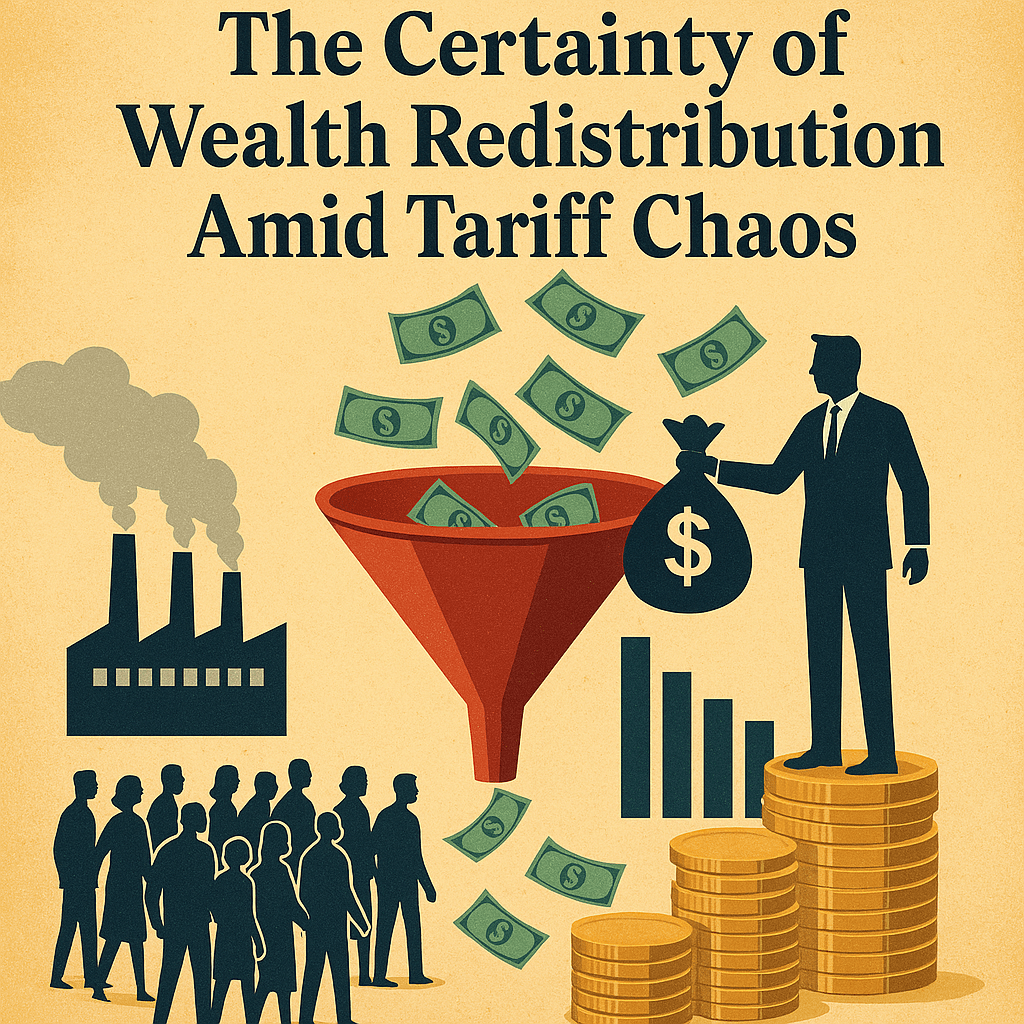
The Certainty of Wealth Redistribution Amid Tariff Chaos

In the history of American economic policy, few moments have rivaled the current administration’s radical redirection of trade as both a break with precedent and a deliberate provocation of instability. The imposition of universal tariffs, compounded by steep duties on selected nations and penguins, has injected volatility into nearly every sector of the global economy. Yet, for all the uncertainties this policy has unleashed—geopolitical, fiscal, and industrial—one outcome is not only predictable but virtually guaranteed: a significant transfer of wealth from the broad base of American households to a narrow echelon of financial elites.

The administration’s tariff policy, sweeping in scope and nationalist in tone, has been sold to the public as the path to the restoration of American greatness, even proclaimed as a “Liberation Day.” But the reality it heralds is less one of liberation than of reallocation—specifically, a reallocation of economic burden and reward. By taxing nearly all imported goods—consumer staples, electronics, food, clothing, and industrial components—the policy imposes a direct and regressive cost on the average American. Inflationary pressures, rising production costs, and disrupted supply chains ensure that these tariffs function not merely as tools of negotiation, but as economic levers that press down on the middle and lower classes while lifting those whose wealth resides in capital rather than wages.

If the COVID-era recession taught us anything, it is that crises, when coupled with targeted monetary and fiscal policy, can act as engines of wealth concentration. During the pandemic, unprecedented interventions—stimulus checks, expanded unemployment insurance, PPP loans, and Federal Reserve liquidity—managed to momentarily soften the blow for many. Even then, the lion’s share of wealth gains went to the top 0.1%, as asset prices surged and capital-rich investors reaped the benefits of timely speculation and quantitative easing.

But the current recession-in-the-making differs in one essential respect: it is being pursued without pretense of public aid. There are no stimulus packages, no safety nets. What is offered instead is a doctrine of creative destruction: tens of thousands of federal workers laid off; regulatory agencies gutted; international partners alienated; domestic producers left to absorb new costs or pass them on to already-strained consumers. The economic pain is not an unintended consequence—it is the plan. And in such an environment, wealth will not merely trickle upward; it will flood there.

As import costs surge, businesses with transnational supply chains and logistical flexibility will shift production, seek carve-outs, and hedge against volatility. Those without such capacities—local manufacturers, family-owned farms, small retailers—will face thinning margins, layoffs, and in many cases, closure. The financial elite, holding diversified portfolios in real estate, private equity, and multinationals, will swoop into the resulting vacuum, acquiring distressed assets at discount, consolidating market share, and harvesting profits from inflationary dynamics. As was seen in the years following 2020, equity markets may fall precipitously at first, but they are likely to rebound faster than the broader economy—particularly with the Federal Reserve expected to cut interest rates in the wake of contraction. Once again, asset prices will rise. Once again, the owners of capital will see their fortunes grow.

Tariffs are traditionally viewed as blunt instruments of industrial protection. But in this case, they serve a far more surgical purpose. They extract purchasing power from the working class, undermine the viability of small and medium enterprises, and force a restructuring of the American economy around those who can absorb cost, influence policy, and pivot globally. They are not instruments of policy so much as instruments of wealth concentration.

If anything is certain in the unfolding tariff-driven crisis, it is that inequality will increase. Not in abstract or relative terms, but in concrete redistributive ones: trillions of dollars will move from wage earners and consumers to capital holders and financial intermediaries. The historical data, the institutional forecasts, and the structural logic all align. Amid the din of political slogans, retaliatory tariffs, and market disruptions, this is the one truth that should command attention.

History will not record this period as a victory for the American people. It will record it as a transformation: not of manufacturing, not of trade, but of the very architecture of American wealth—concentrated more tightly, held more distantly, and insulated more completely from the needs and voices of the many.