
The Inversion Cycle: Eight Scrolls of Withheld Grace

The Counterpoint of Ponder, O Morpheus, the Night Sky
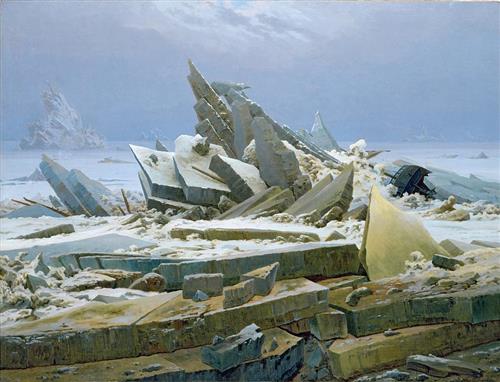

Caspar David Friedrich, The Sea of Ice, also called The Wreck of Hope 
Oil on canvas paint, 96.7 cm × 126.9 cm (1823–1824).
Caspar David Friedrich, The Sea of Ice, also called The Wreck of Hope
Oil on canvas, 96.7 cm × 126.9 cm (1823–1824).

On the Unmaking of Benediction

This cycle of verses—The Inversion Cycle—emerged not as a contradiction, but as a counterweight to The Blessing of Morpheus: The Sending Forth, a series of benedictions articulated in reverent tones and metaphysical gestures within the poem Ponder, O Morpheus, the Night Sky. That earlier work was rooted in the soul’s deep yearning toward the ineffable, culminating in luminous affirmations bestowed by the dream-god Morpheus upon the seeker. In time, those benedictions came to feel too complete, too resolved. I began to wonder: what if they failed?

The Inversion Cycle is not blasphemy, but a form of apophatic honesty. It does not seek to erase Ponder, but to stand beside it—its negative counterpoint. Each scroll of the cycle corresponds to a specific line or blessing from Ponder and performs an act of unmaking: where Morpheus blesses, these verses refrain; where he sends the seeker into mystery, these verses stall at the threshold; where he assures, they withhold.

To honor that reversal, a further restraint was imposed: the exclusion of the very vocabulary upon which the original work (and many of my other recent works) so often relied. Words such as breath, dust, light, shadow, silence, and memory—among others—have been set aside. Their absence is not a loss but a signal. These are not the tools we are permitted to carry here.

The scrolls appear here in the same order as the benedictions from Ponder, O Morpheus, the Night Sky. This reversal respects the original arc—from the loosening of dreams to the transformation of the soul—and follows its negative path with precision.

What remains is austerity, not despair. These unsacraments do not offer consolation, but they do speak. If Ponder was a song of ascent, then this is the long exhale after the music ends—a psalter of withheld grace, composed in the space where blessing does not descend.

Let this work be read not in defiance of belief, but in the trembling of its undoing. For if it is brave to bless, it is perhaps braver still to stand in the space where blessing will not come—and write there, in the dust, what remains.


Scroll I: Of the Clinging Husk

Let not your dreams fall—
for they will not fall.
They remain,
clinging like husks unpicked,
blackened not by season,
but by refusal.

You will try to cast them down,
but they are fastened,
not to limb,
but to marrow.

They do not curl like leaves.
They do not return to soil.
They sour upon you,
a bitterness in the sinew,
a ferment in the thought.

And if you turn to shake them loose,
they will tighten.
Their threads are not of sleep,
but of habit,
knotted in long forgetting.

There is no wind to lift them.
No frost to loosen them.
No gardener comes.

Remain, then, beneath their burden—
bent,
unshed,
unchanged.


Scroll II: Of the Inscribed Weight

Take them.
You will take them.
You cannot help it.

The names carved into stone,
the words burned into walls,
the cries etched into earth—
they cling not to your pack,
but to your ribs.

You bear them not as titles,
but as scars.

They whisper through your marrow,
resisting every act of unmaking.
You try to enter the place without form,
but they speak before you.
They call the ground by its old name,
and the gate does not open.

Even the sky does not answer
when it hears them rising again.

These names were not carved to remember.
They were carved to bind.

And now,
as you stand at the edge
of the place where all naming ends,
they press their syllables
against your tongue,
and you speak them,
not in defiance,
but because you cannot forget.


Scroll III: Of Implements Abandoned

Bring not the weighted balances,
nor the woven snares of longing.
They do not hold,
not here.

Their handles crack in the frost
where no stars rise to bless the hour.
Their mesh is brittle—threaded not of wool,
but of claims left too long in the mouth.

The mind, honed to edge,
cuts only fog in this place.
The heart, cupped too gently,
spills what it never held.

There are no laurels in this soil,
only reeds that do not bend
and brambles that do not bleed.

And should you cast such tools before you,
expecting fruit, or fire, or favor—
they will return to you as ash,
unsought, unshaped,
the chaff of means
mistaken for ends.


Scroll IV: Of the Withheld Offering

Bring not your hollowed chest,
stripped clean of ornaments and plea.
It will not be filled.

Wonder has no purchase here.
Its gaze returns unreflected
from stone too smooth to be shaped.

Let the mind remain loud and unyielding,
for awe would shatter in this poise
like frost-cracked bronze.

As for your feet—
do not lift them.
There is no basin here,
only ground dry from the beginning,
lined with rings that do not ripple.

The wind does not attend.
It does not lift.
It does not listen.

There is no path across this floor,
only grit,
and the marks of those who came
thinking they would walk upon revelation.


Scroll V: Of the False Horizon

Do not seek.
There is no one to be found.

The sea does not receive you.
It is not fluid,
but glare stretched to the edge of motion—
shimmering not with promise,
but with mirage.

You did not launch.
You drifted.
And your craft was not chosen,
but assigned,
drawn from timbers
meant for no voyage.

The sky above you swells with stars,
but none are true.
Each one marks a path
that bends inward,
circling you back to your forgetting.

You will think you move.
You will call it seeking.
You will call it bold.
But you are already known
by the thing that does not answer.
And it has left no threshold,
only wind
that cannot be charted
and depth that does not hold.


Scroll VI: Of the Barren Threshold

There is no beyond.
Only the gray field where sleep forgets its end
and waking does not begin.

Here, nothing waits.
Not voice, not veil,
not even the last gasp of wonder.

What lies past dream is not fullness,
but poise robbed of sanctity—
the deafness of stones
before their naming.

No stars ever hung above this place.
No fire traced its vault.
Only pallor,
dull as bone in a dry shrine,
untouched by flame or veil.

And death,
so often imagined a gate,
has no depth here.
It is shallow, crusted,
and holds nothing but its own refusal.

Let no one say this place is holy.
It is not what remains made full—
but vacancy made permanent.

A place unmourned.
Uncalled.
Unmade.


Scroll VII: Of the Unbecome

Go not.
There is nowhere that calls.
No road unfurls before you,
no veil parts,
no watchful eye lingers on your vanishing.

The question you bore
was not accepted.
It curled back into you,
like a tongue that feared its own utterance.

You will not be shaped by asking,
nor known by your seeking.
You will remain
as you were before the yearning—
a vessel without fracture,
never poured,
never filled.

No sound will rise behind you.
No trace will stir where your feet passed.
Even the soil will forget your weight.

Be still, not in peace,
but in the form that does not unfold.
Remain—not as the question—
but as that which never found its shape.


Scroll VIII: The Soul Beneath the Blanched Sky

The soul, girded and unmoved,
stood beneath a sky without veil—
a dome blanched of fire,
where nothing had ever gleamed,
only ash adrift from unremembered pyres.

It bore no garment.
No mark of calling or descent.
It was as parchment without script,
unhandled, unblemished, unread.

No winds stirred the plain.
Only cairns rose in rows,
not raised in reverence,
but born of the land’s refusal to yield.

The trees there had no buds.
Their limbs were stiff, as if carved for stillness—
a forest of halted prayers.
And beneath them,
the roots did not seek nourishment,
but curled inward,
content in their forgetting.

There was no calm,
no sacred pause.
Instead, a muttering of syllables
rose from the dry hollows—
sounds without grammar,
without bond,
giving rise to no names,
no intelligible form.

And when the soul pressed its palm
to the ground,
there was no spring,
no pulse,
only crusted clay—
neither moist nor cracked,
a firmness that would not give.

It asked nothing.
Not from pride,
but from knowing
that some places are beyond summons—
places where even longing
has been turned to stone.

Toward an Unsaying: Contemplation of Faith in the Shadow of the Ineffable

A meditation on the limits of theological language and the mystery of the Divine, this contemplative essay explores apophatic mysticism, the inadequacy of creeds, and the symbolic power of maps—blending poetic introspection with a life lived in scholarship, service, and creative expression.

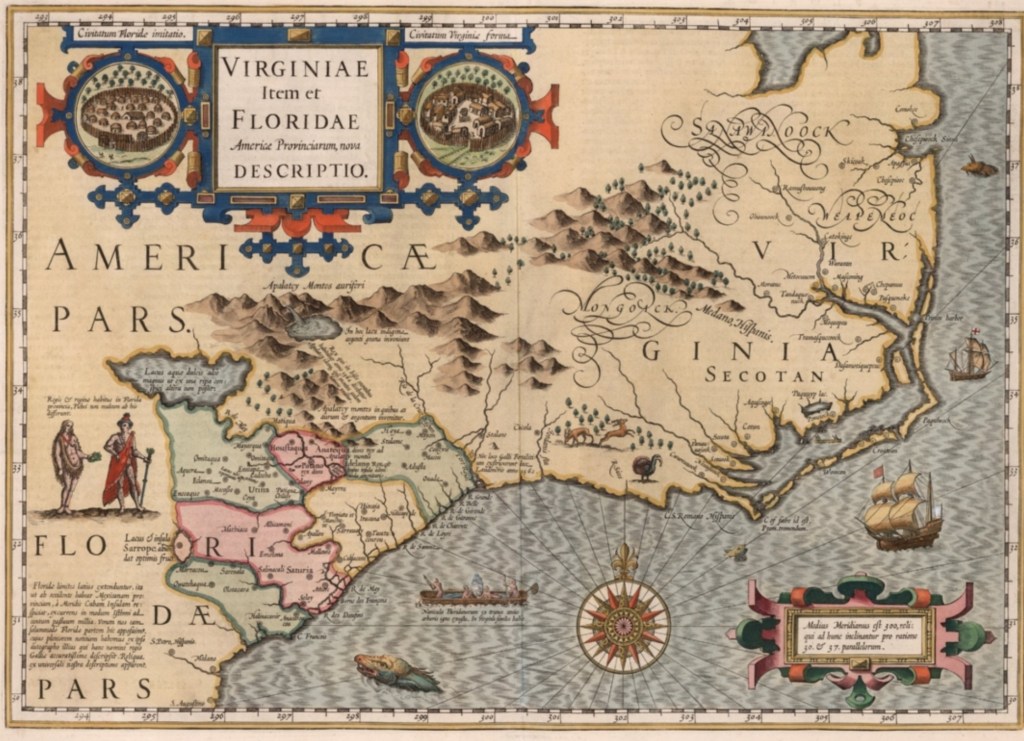
Virginiae Item et Floridae Americae Provinciarum, nova Descriptio.
Map by Gerard Mercator (1512–1594), Jodocus Hondius (1563–1612), and Hendrik Hondius (1597–1651).
Virginiae Item et Floridae Americae Provinciarum, nova Descriptio.
Map by Gerard Mercator (1512–1594), Jodocus Hondius (1563–1612), and Hendrik Hondius (1597–1651).
Published in 1623 by Hendricus Hondius, Amsterdam.
Image courtesy of the David Rumsey Map Collection, David Rumsey Map Center, Stanford Libraries.
Licensed under Creative Commons CC BY-NC-SA 3.0.

Raised within the Romano-Byzantine tradition—formed by both the Roman and Byzantine Catholic rites—I was shaped by a confluence of liturgical beauty, theological depth, and mystical reverence. From that upbringing, there remains not merely memory, but a lasting affection for the rhythm and substance of the faith of my youth. It is not simply a cultural inheritance, but a formative lens through which the sacred, the communal, and the mysterious first revealed themselves. Yet, it would not be accurate to describe my present stance as that of a lapsed Catholic, nor as an atheist, nor as one alienated from the Church. Alienation implies disaffection or estrangement born of expectation unmet or betrayal suffered. What remains is neither rejection nor rebellion, but something quieter and more reflective—a posture of reverent detachment that neither clings nor condemns.

Any attempt to articulate my position must begin by acknowledging the futility of articulation itself—at least in matters concerning the Divine. The belief that the Divine wholly exceeds the bounds of human comprehension and articulation grows only firmer over time. All creeds, revelations, and theological systems—however earnest or inspired—are, in the end, efforts to sketch with a cramped human lexicon and limited imagination that which lies beyond even the highest powers of conception. Far from illuminating the Divine, such efforts only obscure its immensity by imposing upon it our narrow symbols and forms.

Better to liken our theological endeavors to the drawing of maps—maps sketched by explorers who had never seen the coasts they sought to chart. Just as early cartographers filled the margins with dragons, saints, and imagined cities, we adorn the unknown with creeds, cosmologies, and commandments. These are sincere efforts, yet they more often reflect our hopes and fears than reveal any transcendent truth. The more intricate the system, the more seductive the illusion that the map is the territory. But the Divine is not a line upon a page. It is the sea beneath the sea monster, the silence beyond the compass rose, the continent whose very existence remains unknown. To name the Divine is already to misname it; to describe is to distort.

Such a perspective finds its truest expression in apophatic mysticism—the via negativa, the way of negation—a tradition articulated by Pseudo-Dionysius the Areopagite, a Christian thinker of the late fifth to early sixth century whose writings permeate the Catholic tradition through the works of Thomas Aquinas, Bonaventure, and the Spanish mystics, reminding us that the path of unknowing is not a break from faith, but one of its most ancient and revered expressions. In this light, God is not wise, not good, not just, not loving—not because the Divine lacks these qualities, but because our highest notions of them remain shadows cast by a light we cannot behold. Whatever we say of the Divine, however conceived, the most faithful statement is this: our words fall short.

Even so, human beings remain kataphatic creatures as well—creatures who long to speak, to name, to worship, to relate. Thus arises a kataphatic-apophatic tension, a profound and permanent unease between the impulse to speak of the Divine and the recognition that all speech fails. Hymns, liturgies, cathedrals, and doctrines are all human responses to this tension—not to capture the Divine, but to reach toward it, however falteringly. These gestures deserve neither scorn nor uncritical assent. They should be honored, but held lightly, cherished as poems rather than mistaken for proofs.

This tension extends beyond the realm of theology into the very nature of being itself. In a moment of quiet reflection, I found myself asking: “Where is Am I?”—caught between breath and thought, a question turning circles in the hollow of my chest. Am I the echo, or the voice that trembles back? A fragment drifting through the hour, a flicker in the endless light, unsure if I was ever whole or if the pieces were ever mine to find. Such a question is not mere existential uncertainty, but a recognition that the self, like the Divine, eludes definitive capture.

No formal creed or written revelation authored by man commands my assent, however noble or inspired it may be. Faith is not placed in these constructions, though the sacred yearning from which they arise is deeply respected. They are echoes of an original voice no longer heard directly, outlines of a presence glimpsed but never grasped. Like the adornments on ancient maps, these expressions are beautiful and sincere, but they are not to be mistaken for the thing itself.

To some, this may resemble agnosticism, though that word has become burdened with meanings it was never intended to carry—meanings of indecision, skepticism, or apathy. What is expressed here is none of those. It is not a shrug of the shoulders, but a bow of the head. Not the silence of the indifferent, but of the reverent. Not ignorance, but a conscious unknowing—a sacred refusal to impose limitation upon that which exceeds all bounds. This is why I eschew agnostic labels in favor of mystical ones—for the mystic does not claim ignorance of the Divine but acknowledges that true knowledge of it transcends conventional understanding.

What remains, then, is a life lived in contemplation of the ineffable—a contemplation that finds expression through creative work. In poetry, music, and essay, I reach toward that which cannot be directly named. When I write of the “eternal now” where “yesterday, tomorrow, and today collapse,” or compose lyrics that honor Humilitatem Initium Sapientiae, I am not merely creating art but engaging in a form of contemplative practice. These creative acts serve as bridges, not only between myself and the ineffable, but also between myself and others who share this reverent space, regardless of their formal religious affiliations or φιλοσοφίαι (philosophies or wisdom traditions).

The path ahead is not marked by certainty but by awe, not by declarations but by listening. Mystery is not something to be solved, but something to be honored. Years of formal study—first in history and religious studies as an undergraduate, then as a teacher of both subjects, and later through a long career in civil rights law and public service—have only deepened the awareness that human systems, whether intellectual, doctrinal, or legal, ultimately encounter their limits at the threshold of the sacred. In this, the apophatic tradition offers a spiritual home—a dwelling place where reverence begins precisely where language ends. If there is a guiding light for such a path, it is humility—humilitatem initium sapientiae—not merely as a moral posture, but as a metaphysical necessity. That teaching, which echoes throughout Thomas à Kempis’ The Imitation of Christ, remains not only a personal motto, but a settled conviction: that wisdom begins when one ceases to pretend to possess it.

Near the staircase in my front hallway hangs an early map of the New World—an artifact I have long cherished. Its artistry is matched only by its courage, for it dares to depict what was not yet known. Near the region now recognized as Virginia and the Carolinas, a sea monster rises from the ocean’s depths, signaling peril or wonder—perhaps both. On the land itself, figures of “natives” stand, imagined by a hand that never walked those coasts. That map does not record the world; it records what the world dared to imagine. So, too, do our theologies populate the margins of metaphysical uncertainty with monsters and angels, commandments and visions. They are imaginative acts—sincere, flawed, luminous. And like that map, they are to be cherished not for their precision but for what they reveal of the human longing to reach into mystery with word and symbol, with ink and awe. In their earnest striving, they remind us: we are always sketching the edge of the unknown, even when we know we cannot cross it.