
The Temples of Utu: A Contemporary Lament for Justice

The Gods Who Watch and the Scales That Tilt

Justice, in any age, is a fragile thing. When upheld, it brings order, clarity, and fairness. When corrupted, it festers unseen at first, then collapses with ruinous consequence. The Temples of Utu: A Contemporary Lamentation for Justice is a prophetic lament cast in the voice and style of an ancient civilization, yet it speaks with painful familiarity to those who observe the world today.

Ningišzida, with snakes emanating from his shoulders, on a relief of Gudea. Photograph by Osama Shukir Muhammed Amin FRCP (Glasg) CC BY-SA 4.0.

This work draws upon the mythic imagery of Mesopotamian religion, invoking gods who, for the people of Sumer and Akkad, embodied cosmic forces—truth and deception, judgment and decay. Though their temples have long crumbled to dust, their symbols remain potent warnings for the rise and fall of justice in human society.

Be aware, however, the Lamentation does not reflect the historic reality of how and where justice was actually dispensed in ancient Mesopotamia. A rudimentary understanding of the justice system, such as we understand it, is discussed in early scholarship, such as Samuel Noah Kramer’s The Summerians: Their History, Culture and Character (1963/1971), for those who are interested in the basics (see for instance pp. 83-88). If truly interested in historical reality, seek out more updated, contemporary scholarship! It will be worthwhile!

Who Are the Gods Named in This Lamentation?

  • Utu (Shamash): The Mesopotamian god of the sun, justice, and truth. Utu was depicted as the divine judge who saw all things, presiding over oaths and fair dealings. His light illuminated deception, and his scales weighed the hearts of the people. When justice was upheld, his temples shone golden in the sun; when corruption took root, his light dimmed.
  • Namtar: The herald of death and bringer of plagues, Namtar represents creeping inevitability—the slow, inexorable spread of decay. In this lamentation, he is not an agent of quick destruction, but of corruption’s quiet advance through the halls of justice, spreading like a sickness that hollows out institutions from within.
  • Ningišzida: A chthonic (underworld) deity associated with serpents, passage between worlds, and the boundary between truth and falsehood. He coils around the pillars of justice, his forked tongue shaping words that once carried fairness into tools of deception. His presence signals the transformation of law into an instrument of the powerful, a mask of legitimacy covering injustice.
  • Enlil: The great god of storms and divine authority. Though absent for much of the lamentation, his presence gathers at the end, a harbinger of reckoning. If Utu is the impartial light of justice, Enlil is the storm that follows when justice is betrayed.

These figures serve as more than mythological references—they embody timeless realities. The slow erosion of judicial integrity, the rise of factionalism over fairness, the perversion of law into a tool of the mighty—these are not merely the concerns of an ancient civilization but of every society that has ever built temples to justice, and of every people who have watched those temples fall.

As you read (or listen to) The Temples of Utu, consider not only the past, but the world around you. Are the scales of justice still balanced? Or has the light of Utu grown dim once more?


An Reading of Donald S. Yarab’s “The Temples of Utu: “A Lamentation for Justice”
The Temples of Utu: A Lamentation for Justice

Part I: The Silencing of the Scales
The First Turning Away


In the days of order, when truth stood firm in the public square and the scales weighed all hearts with equal measure, the temples of Utu shone golden in the light of the sun. The judges, priests of Utu—Utu, whose eye sees all deceptions, whose light banishes shadow—sat in chambers of cedar and stone, their hands unstained, their vision clear. The weak approached without trembling, for the law was etched in tablets that none might alter, and justice flowed like water through the streets of the city.

But in time, whispers came upon the night wind. First to one priest, then another. Golden whispers, honeyed promises, from the lips of those who dwelled in towers of privilege. And some turned their ears to listen.

From the towers of the mighty came emissaries bearing gifts that were not called bribes, bearing words that were not called threats. And the first priest of Utu who accepted such offerings felt the scales within his heart shift, so slightly he did not mark it. But Utu marked it. Utu, whose eye sees all deceptions, whose light banishes shadow.

Yet Utu's voice grew fainter in the halls of judgment, as the mighty pressed their thumbs upon his sacred scales.

The First Injustice

When the widow came before the seat of judgment,
Her cause was just, her claim was true.
But he who robbed her wore the sigil of the faction,
And gold had changed the color of the law.

The priest of Utu spoke with borrowed tongue:
"The letter of the tablet says thus and thus,
Though its spirit cries otherwise."
And so the widow left with empty hands.

She raised her voice to Utu in the square:
"Where is thy justice, Lord of Truth?
Thy priests speak with forked tongues,
Thy scales are weighted with gold."

But no answer came from the heavens,
For the priests had muffled Utu's ears with silk.

Part II: The Spreading Corruption
The Selecting of the Loyal


As the cycles of the moon passed, it came to be that when a priest of Utu returned to the earth, those who chose his successor looked not for wisdom, not for fairness, not for devotion to the scales of truth. Instead, they sought those who had bowed before the factions, who had pledged themselves in secret chambers to uphold not the law as it was written, but the interests of those who appointed them.

And so the temples of Utu, one by one, were filled with those who had sold their sight before ever taking the seat of judgment. The words remained the same, the rituals unchanged, but the spirit had fled from the body of justice.

Then came Namtar, herald of plagues and divine judgment, moving through the corridors of power. Not with swift death did he strike, but with slow corruption, a disease of the soul that left its victims standing but hollow, wearing the robes of justice while serving the lords of greed.

The Purchased Judgment

See how they come with scrolls of precedent,
Twisting ancient words to serve new masters.
The tablet says what they wish it to say,
The law bends like reeds in the wind.

Namtar walks among the pillars of justice,
His touch light as coin upon the palm.
Each judgment purchased furthers the contagion,
Each verdict for sale spreads the plague.

The merchants of discord dine at the judges' tables,
The priests of faction whisper in their ears.
"This cause favors our patrons," they murmur,
"This ruling advances our creed."

And the people cry out to Shamash, to Utu,
But the god of justice has turned his face away.

Part III: The New Order of the Scales
The Temples Transformed


And so it came to pass that the temples of Utu no longer stood as bulwarks against chaos, but as instruments of those who ruled from shadow. The priests spoke still of justice, wore still the robes of impartiality, but their eyes looked ever to their masters for guidance. Their words were shaped not by the tablets of law, but by the whispers of faction.

The scales that once weighed all hearts equally now tipped by design. The light that once revealed truth now cast strategic shadows. And those who came seeking justice found instead a marketplace where outcomes were traded like cloth and grain in the bazaar.

Ningišzida, serpent god of the underworld who knows the passage between life and death, between truth and falsehood, wound himself around the pillars of the temple. His forked tongue spoke through the mouths of judges, words that seemed just but served injustice, verdicts that spoke of law while mocking its purpose.

And the people learned that there were two laws in the land: one for the mighty, another for the meek.

The Twisted Scales

The scales of Utu hang crooked now,
Weighted with bribes and heavy with deceit.
The blindfold of justice has become a hood,
Pulled tight by hands that serve the powerful.

Ningišzida coils around the judgment seat,
His serpent form hidden beneath official robes.
"Justice," they proclaim, while dealing in its absence,
"The law," they intone, while breaking its heart.

The mighty approach the temple without fear,
For they have purchased indulgence in advance.
The weak approach with dread upon their faces,
For they know the verdict before the case is heard.

The tablets of law remain upon the wall,
But the words change meaning at the touch of gold.

Part IV: The Unraveling
The Breaking of the Covenant


Thus was the covenant between the people and the law undone. Not by decree, not by conquest, but by the slow poisoning of the wells of justice. As the cycles of the sun passed, the people came to know that the temples of Utu offered no sanctuary, that the words of his priests held no truth, that the scales of judgment measured not justice but advantage.

And in this knowing, the bindings of society began to fray. For what is law if not promise? What is justice if not trust? What is order if not the belief that truth will prevail against falsehood?

The factions that had captured the temples of Utu did not see the doom they had wrought. They celebrated their victory over impartiality, their conquest of the scales. They did not hear the whispers of Enlil, god of wind and storm, gathering his breath for the tempest to come.

For when justice fails, chaos awakens. When law becomes weapon rather than shield, the people take up arms of their own. When truth is no longer honored in the temples, it finds voice in the streets.

The Price of Betrayal

Now the city trembles on foundations of sand,
The temples of justice stand as hollow shells.
What was built through centuries of wisdom,
Falls to ruin through seasons of corruption.

The people no longer speak the name of Utu,
For his priests have made it bitter on the tongue.
They turn instead to other gods, darker gods,
Gods of vengeance, gods of fire.

The mighty sleep uneasy in their beds,
For they have slain the guardian of their peace.
In purchasing the law, they rendered it worthless,
In bending justice, they broke its spine.

And Enlil gathers the winds of retribution,
For no society stands when its pillars are rotten.

Epilogue: The Warning
The Voice of Memory


Those who remember, who still hold truth sacred in their hearts, who recall the days when the temples of Utu shone with uncorrupted light, raise their voices in the twilight of justice. They speak of what was lost, of scales that balanced, of laws that served all equally. They warn of what comes when the mighty believe they have placed themselves beyond judgment.

For Utu watches still, though his priests have forsaken him. Shamash sees still, though his temples have been corrupted. And the day will come when light returns to the chambers of darkness, when truth again flows through the veins of justice.

But the price of restoration will be bitter, paid in the coin of upheaval. For what is corrupted cannot be cleansed without fire.

The Future Reckoning

Remember this in days to come,
When the storms of chaos break upon the land,
When faction fights faction in the ruined streets,
When the mighty tremble before the dispossessed:

It began with the silencing of the scales,
It began with the purchasing of truth.
It began when the temples of Utu
Became marketplaces for injustice.

And those who turned their backs on truth,
Who sold the scales for temporary gain,
Who twisted the tablets of sacred law,
Will cry out: "How could we have known?"

But their hands are not clean.
For they desecrated the temples, stone by stone.
They corrupted the judges, word by word.
They unmade justice, verdict by verdict.

And when Utu returns to claim his throne,
Neither gold nor faction will shield them from his light.

The House of Azag: A Contempory Lamentation

The text explores the myth of Ninurta and the contemporary retelling of Azag’s story, emphasizing themes of power, complicity, and the consequences of forgetting history, blending prose and verse to convey a timeless lamentation.

Cuneiform tablet: nir-gal lu e-NE, balag to Ninurta
Seleucid or Parthian Period, ca. 2nd–1st century BC
Mesopotamia, probably from Babylon (modern Hillah)
Clay tablet inscribed with a hymn of praise to Ninurta, the storm god and vanquisher of Asag, the demon of disease.
The Metropolitan Museum of Art, Object No. 86.11.349
(Public Domain Image – Courtesy of The Metropolitan Museum of Art)
Cuneiform tablet: nir-gal lu e-NE, balag to Ninurta
Seleucid or Parthian Period, ca. 2nd–1st century BC
Mesopotamia, probably from Babylon (modern Hillah)
Clay tablet inscribed with a hymn of praise to Ninurta, the storm god and vanquisher of Asag, the demon of disease.
The Metropolitan Museum of Art, Object No. 86.11.349
(Public Domain Image – Courtesy of The Metropolitan Museum of Art)

On the Inspiration for The House of Azag: A Contemporary Lamentation

Inspiration often comes suddenly and from unexpected sources. While rereading Samuel Noah Kramer’s The Sumerians: Their History, Culture, and Character (1963/1971), I came across a passage recounting the myth of Ninurta, “the god of the stormy south wind,” who in battle destroyed Asag (Azag), “the demon of sickness and disease, whose abode is in the kur, or netherworld” (p. 151).

This passage immediately sparked a question: How would the story of Azag’s heir unfold in the modern age of plague and divisive politics? And how might it be told in the style of a Sumerian lamentation or myth?

The result is a hybrid of prose and verse, a structure reminiscent of ancient lamentations, epic chronicles, and prophetic texts. The prose sections serve as a narrative scaffold, unfolding the events and guiding the reader through the cycle of tyranny, reckoning, and return. The verse distills the emotional and symbolic essence of these events into stark, prophetic utterances, in keeping with the brevity and weight of traditional lamentation poetry.

By blending these forms, The House of Azag mirrors the ancient mode of storytelling in which history, myth, and warning are inseparable. It is both a retelling and a foretelling, a meditation on the cycles of power, complicity, and ruin—and the price a people pay when they forget the past.

An Audio Reading of D.S. Yarab’s The House of Azag: A Contemporary Lamentation


The House of Azag: A Contemporary Lamentation

Part I: The First Reign

The Time of Pestilence

In the days of turmoil, when truth was cast into the dust and the air itself grew thick with sorrow, there arose a ruler from the House of Azag—Azag, the demon slain by Ninurta, yet never truly vanquished. His tongue dripped venom, his hand withered the harvest, and his breath carried pestilence upon the wind. The multitudes, fevered and blind, hailed his coming, for they had forgotten the old warnings. They did not recall the tale, the curse, the name:

From the House of Azag, Azag, the demon slain by Ninurta.

And so, in his first reign, he set forth a sacrifice—one not of fire nor incense, but of breath and blood, of silence and mourning, that the land itself might wail beneath his shadow.

The Reign of Plague

He, of the House of Azag, heir to ruin,
Crowned in blight and anointed in ash,
Raised his hand, and the heavens grew silent,
Breathed his word, and the earth was unmade.

Fevered winds bore his whispered decree,
A covenant sealed in the shroud of the dead.
And they, the lost, the beguiled, the willing,
Bowed before the plague-born throne.

His altars dripped not with oil nor myrrh,
But with breathless sighs and broken names.
And still they called him savior, still they knelt,
Though the air itself was thick with wailing.

The Judgment

Thus was the land cast into shadow,
And the wise were scorned, the healers undone.
Not by sword nor by fire, but by silence,
Did the House of Azag reign.


Part II: The Fall and the Interregnum

The Elder Warrior’s Time

And so it came to pass that after the years of pestilence, when the land was burdened with sorrow and the cries of the forsaken rose to the heavens, an old warrior took up the mantle of the fallen city. He was a man of the elder years, not swift but steadfast, not mighty in arms but resolute in purpose. And he stood against the darkness, bearing the weight of the withered earth upon his back.

He drove out the ruler of the House of Azag—not by blade nor by fire, but by the will of the people, who in their suffering turned against the master of plague. The temples of deception cracked, the halls of power shuddered, and the great beast was cast into exile, retreating to the shadows of the wastelands.

Yet the abominable beast does not slumber.

The Warrior’s Triumph

He, the warrior of elder years, stood firm,
His hands worn, his voice a beacon.
And the people, weary of death and despair,
Turned from the House of Azag.

The tyrant fell, his name a whisper,
His throne an empty husk of ruin.
And for a time, the land breathed free,
And the winds carried no plague.


Part III: The Second Reign

The Return of Wrath

But the abominable beast does not die. Even as the warrior sought to mend the broken walls, the deceiver’s voice slithered through the ruins. He whispered of old glories, of stolen kingdoms, of vengeance against the weak. He promised dominion to the cruel, riches to the corrupt, and absolution to the faithless. And in the dark corners of the land, where grievance festered, where truth was forgotten, and where justice was mocked, they listened.

And the warrior—burdened by years, by the weight of a land divided—fought not with sword or fire, but with weary breath and reasoned word. And they laughed, for reason had no purchase in the ears of the blind.

Thus, through falsity and oath-breaking, through fear and fury, the House of Azag rose once more. And this time, not in sickness, but in wrath.

The Return of the Abominable Beast

He, of the House of Azag, whisperer in shadow,
Spoke in silvered lies, and the deaf gave answer.
He stirred the dust, and the bitter took arms,
He spread his hand, and the oath-breakers swore.

Not by plague, but by vengeance, he came,
Not with fever, but with fire.
The halls of wisdom he razed,
The scribes he silenced, the truth he unmade.


Part IV: The Willing Hands

The People’s Bargain

And when he, of the House of Azag—Azag, the demon slain by Ninurta, called forth his name from the abyss, they who had once trembled at his touch did not recoil. They did not remember the pestilence, nor the wailing of their own dead. Instead, they gathered at the gates, voices raised in fervor, hands outstretched not in defiance, but in welcome.

For he did not come as he had before, cloaked in sickness and ruin. This time, he came bearing gifts—promises of glories unearned, of burdens lifted from their shoulders, of enemies cast into the void. He did not call them to serve, but to rule. He did not ask them to sacrifice, but to consume.

And so they bent the knee, not in chains, but in hunger. Not from fear, but from desire.

And the warrior, standing upon the walls, cried out: “Have you forgotten?”

But they turned their faces from him.

The Willing Betrayal

He, of the House of Azag, called to the lost,
And they answered, not with dread, but with praise.
For he did not come with pestilence,
But with crowns of dust and golden lies.

He whispered: “The land is yours.” And they rejoiced.
He promised: “The labor is no longer yours.” And they knelt.
He declared: “The past is a burden. Remember it not.”
And they cast their own memories into the fire.


Epilogue: The Consequence

The Reckoning to Come

Thus, the gates were flung open, not by the tyrant’s might, but by the hands of the desperate and the blind. They, who had suffered under his reign, now lifted him upon their shoulders, crying, “He is the chosen! He will restore what was stolen!”

But there was nothing to restore. What they had lost, they had cast away.

And when the reckoning came, they wailed once more,
Crying out, “How could we have known?”

But their hands were not clean.

For they had built the throne, brick by brick.
They had paved the way, stone by stone.

And when the monstrous beast took his seat,
He did not need to command them.
They carried out his will before he spoke it.

Exploring ‘The Insemination of Venus’ by Laura Schmidt

The Insemination of Venus by Laura Schmidt
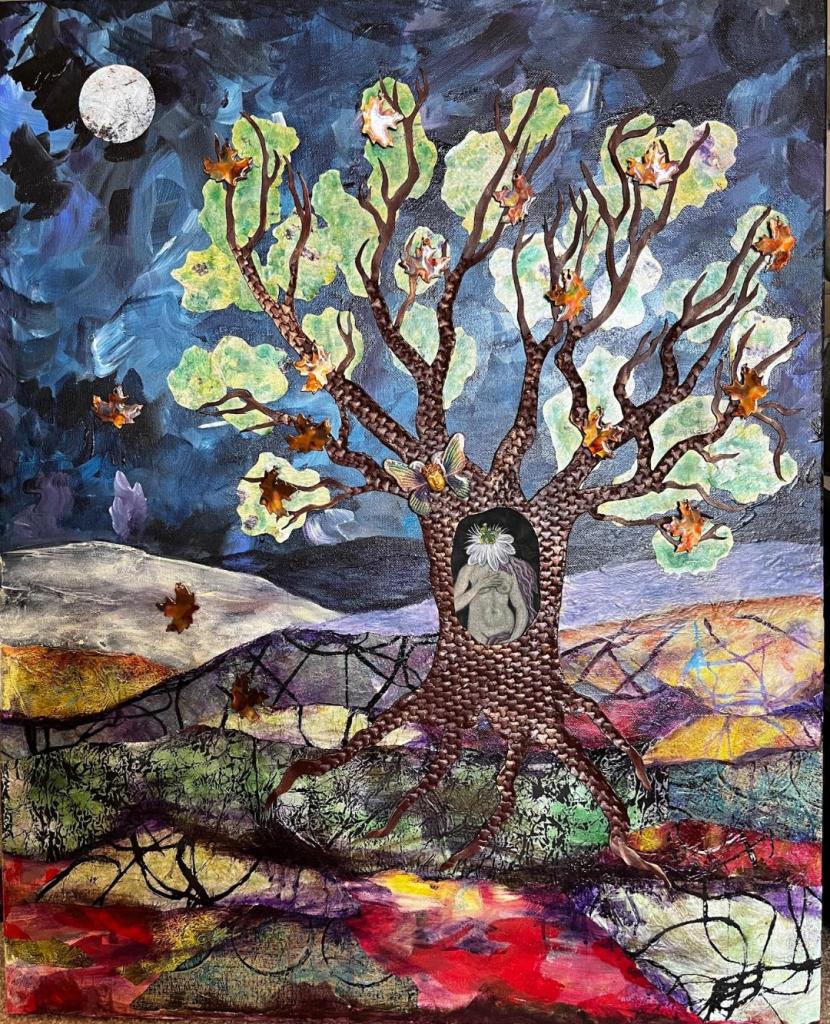
The Insemination of Venus, Laura Schmidt (2024). Mixed media (tooled leather, acrylic with hand-printed paper, torch-painted copper, soft pastel, polymer clay). The work incorporates kinetic elements, such as freely hanging copper leaves, and draws upon classical and mythological influences, including Botticelli’s Birth of Venus

If you find yourself without task or chore, bored beyond belief, and inclined to read a pedantic, hubristic, and discursive review interpreting a truly stunning work of art, I invite you to explore my essay (accessible at link below) on The Insemination of Venus by Laura Schmidt. To say that I find Schmidt’s work exciting and inspiring would be an understatement.

Schmidt, whom I have known for almost four decades, has recently turned in earnest to artistic endeavors following the conclusion of her legal career. Her latest work, The Insemination of Venus, is a masterful synthesis of classical themes and contemporary materials, drawing inspiration from Botticelli’s Birth of Venus and which I interpret as a re-imagining of the ancient motif of the Tree of Life and as an active force of creative transformation (see also my poem below).


Abstract for Essay: The Insemination of Venus as a Modern Tree of Life

The essay explores the profound intersection of classical mythology, artistic innovation, and the enduring motif of the Tree of Life in Laura Schmidt’s multimedia work. Inspired in part by Botticelli’s Birth of Venus, Schmidt’s piece transforms the classical image of Venus from a passive subject of divine creation into an active force of generative imagination. Through an interpretative lens, this essay examines how The Insemination of Venus re-imagines the ancient Tree of Life—not merely as a conduit of divine will, but as a dynamic site of transformation shaped by human creativity. Drawing on traditions from Mesopotamian sacred trees to Platonic cosmology and Norse mythology, my interpretive analysis situates Schmidt’s work within a continuum of cultural expressions that depict trees as cosmic axes, vessels of metamorphosis, and symbols of the evolving relationship between nature, divinity, and artistic agency. Engaging with both the technical execution and symbolic complexity of Schmidt’s composition, this essay illuminates how art can simultaneously honor and redefine ancient archetypes, presenting the Tree of Life as a living, evolving force in the realm of artistic creation.

And here is the poem I was inspired to write after contemplating Schmidt’s The Insemination of Venus:

Once we trembled beneath sacred boughs,

Watching gods inscribe their will on leaves,

While divine winds shook celestial branches

And fate dripped like dew from heaven’s eaves.

Now the tree grows from our own imagining,

Its copper leaves dance to earthly air,

Venus transforms not by divine decree

But through the power we ourselves dare.

Where once we sought the gods’ creation,

Now we are the force that makes stars bloom.

The moth bears witness with human eyes:

We are become the cosmic loom.

No longer supplicants beneath holy trees,

We are the garden, we are the grove.

Where once we quaked beneath the heavens,

We are become the force that moves the heavens.

Schadenfreude and the Politics of Resentment: A Society Unmoored

The author reflects on a troubling societal trend where individuals derive joy from others’ misfortunes, particularly amidst widespread economic inequality. Instead of advocating for fairness, many focus on undermining those with minor advantages while overlooking systemic issues that favor the ultra-wealthy. Historical concepts like Nietzsche’s ressentiment underline this destructive mindset. The piece illustrates this with a union example, where members aimed to diminish benefits for others instead of promoting broader equity. The author emphasizes the need to redirect resentment towards addressing inequality, fostering solidarity rather than division, and calls for reclaiming virtues like justice and compassion in the face of collective suffering.

Throughout my life, I have encountered individuals and groups who seem to lack not only a moral and ethical compass but even a basic sense of self-interest. When they witness others losing an advantage—whether in employment, social standing, or opportunity—they do not respond with sympathy or concern but instead with unrestrained joy, reveling in another’s misfortune. Rather than advocating for fairness or seeking to improve society or their own standing, they take solace in the suffering of others, as though deprivation itself were a form of justice.

This perverse celebration of the misfortune of others becomes even more striking when we consider the actual distribution of power and wealth in our society. While workers resent each other’s minor advantages, America’s top 12 billionaires have amassed over $2 trillion in wealth—an increase of 193% since early 2020. The displacement of legitimate economic anxiety onto fellow workers, rather than the rigged systems enabling such extreme concentration of wealth, exemplifies how resentment is weaponized against collective interests. Instead of questioning the forces that have hollowed out the middle class, many find misplaced satisfaction in seeing others fall.

This phenomenon is not new. Philosophers and historians have long observed the destructive power of ressentiment—a term Nietzsche used to describe the corrosive, festering resentment of those who feel powerless, who, unable to elevate themselves, seek instead to bring others down (Nietzsche, 1887/1989, p. 36). The weaker spirit, he argued, does not strive toward greatness but seeks revenge against those who embody what it cannot attain. In our current dystopian era, where the richest 1% now control 54% of all stock market wealth—up from 40% in 2002—this sense of powerlessness has fertile ground in which to grow. Rather than demanding fairness or aspiring to something greater, many find solace in celebrating the stripping away the rights and relative advantages of others, while the true beneficiaries of systemic inequality remain untouched.

When the slide into the current era began, I began to see this corruption of the spirit play out in the most mundane of settings. Decades ago, in the workplace, I encountered a revealing example of the mindset that prioritizes resentment over solidarity. Our office had only a limited number of private offices and computers, with the former assigned to attorneys based on job classification and the latter distributed by seniority across all employees, including attorneys and investigators within the collective bargaining unit. When discussions arose about relocating to a new office space, the union sought input from the membership on concerns to bring forward to management. At the time—which was years before I became a supervisor—I was the local union steward.

To my astonishment, a significant number of members advocated for the union to ask management to eliminate private offices for all non-managers in the new space simply because not all job classifications had been granted them. Their logic baffled me. Rather than seeking to extend a benefit to more workers, they focused on stripping it from other bargaining unit members, as though incremental improvements in working conditions for some created intolerable working conditions for others.

Fortunately, I was able to argue—successfully—that this approach was entirely backward. Instead of resenting those who had obtained an improved working condition, we should advocate for an expansion of the working condition rather than its elimination. The rational course was to request that more job classifications be made eligible for offices, using objective criteria related to job duties and their similarities to those that already warranted offices. While we were ultimately unsuccessful in securing additional offices, we did succeed in shifting the mindset of the membership. What began as an impulse to strip others of their advantage out of frustration became, upon reflection, a collective effort to push for broader equity. We may not have won the tangible benefit, but we avoided the far greater loss of allowing ourselves to be divided by shortsightedness and resentment.

And yet, this very same ugly impulse now dominates our national discourse. The cruel celebration of public servants losing their livelihoods becomes even more troubling when viewed against economic realities. While many Americans cheer the human pain that the elimination of government positions and the middle-class existence which such positions enabled, the ultra-wealthy’s share of national wealth has reached levels not seen since the 1920s. Even more striking, as the oligarchs’ wealth share has nearly quadrupled since 1953, their share of total taxes has remained virtually unchanged. Yet rather than questioning this dramatic shift in resources, many find satisfaction in seeing their neighbors lose healthcare benefits and perhaps even their homes.

This misdirection of resentment has particularly pernicious effects along racial lines—an all-too-familiar pattern in American history. While the median Black family holds just 12.7% of the wealth of the typical white family, and 28% of Black households have zero or negative wealth, political entrepreneurs channel economic anxieties into racial antagonism rather than solidarity. The very communities that could benefit most from collective action are instead pushed toward celebrating each other’s losses rather than confronting the systemic structures that perpetuate their deprivation.

Even those who remain employed in federal service are subjected to arbitrary and senseless disruptions, yet their plight is met not with sympathy but with open derision. Some are forced to return to offices that lack the space to accommodate them, while others are ordered to relocate across the country to similarly ill-equipped workplaces—an absurdity greeted with applause rather than outrage. The schadenfreude is both bizarre and troubling, driven not by principle but by petty resentment: If I had to go back, so should they. I was never allowed to work from home, so why should they? I doubt they were even efficient in the first place.

These justifications are not arguments but thinly veiled expressions of bitterness, exposing a society conditioned to revel in the suffering of others rather than demand justice, fairness, or rational policy. Worse still, there is little recognition that these actions—these firings, transfers, program terminations, and other disruptions—whether arbitrary, capricious, cruel, irrational, intentional, or, at times, unfortunate yet necessary—inflict real harm on individuals with families and loved ones, embedded in communities not unlike our own.

This kind of envy serves only the interests of those who seek to keep us divided, distracting us from the real issues that demand our attention. Understanding the true scale of inequality—where most Americans’ wealth is tied to their homes while the top 1% controls over half of all stock market wealth—can help redirect resentment toward productive change. Rather than celebrating when others lose benefits or job security, we must recognize how the concentration of wealth and power benefits from our division.

This lesson has been articulated time and again by thinkers from across traditions. Aristotle’s concept of megalopsychia—the great-souled person—stood in contrast to those driven by pettiness and envy, emphasizing instead the nobility of advocating for the common good (See Book IV of the Nicomachean Ethics). In the Christian tradition, agape—a selfless, communal love—demands that one’s neighbor be uplifted, not torn down (1 Corinthians 13:4–7).

Yet in modern America, these lessons are too often ignored in favor of a corrosive, zero-sum mentality that pits the powerless against one another rather than against the forces that perpetuate their economic insecurity and often economic suffering. A society where 26-28% of Black and Latino households have negative wealth, while billionaires added over $2 trillion to their fortunes during a global pandemic, has deep structural issues to address. Yet instead of confronting these systemic challenges, we have allowed ourselves to be divided, finding hollow satisfaction in our neighbors’ misfortunes rather than building the solidarity needed for meaningful change.

This is the moral failure of our time—not just the overt corruption of those in power, but the willing embrace of cruelty by so many in the public. A nation that delights in its own suffering, that views the suffering of its neighbors as a victory rather than a tragedy, is one that has lost its way. The challenge before us is not merely political but fundamentally ethical: to resist the temptation of resentment and to reclaim the higher virtues of solidarity, justice, and shared human dignity.

Yes, there is a legitimate argument for addressing the national debt and curbing government spending. And yes, when Congress engages this issue in a constitutionally sound manner, it may result in job losses in the public sector. Such decisions, if undertaken with deliberation and fairness, may at times be necessary. However, what we have witnessed thus far is not a measured fiscal policy but a reckless, chaotic purge—carried out without regard for Constitutional norms, the rule of law, economic stability, or human impact. Even where reductions in government employment may be warranted, they should never be occasions for celebration, nor should they serve as fuel for the schadenfreude and politics of resentment that have become disturbingly and consistently prevalent.

Would that we had the wisdom to see it.


References

 Aristotle, and Terence Irwin. Nicomachean Ethics. 2019. 3rd ed., Hackett Publishing Company, Inc., 2019, https://www.perlego.com/book/4620092.

Nietzsche, F. (1989). On the Genealogy of Morals (W. Kaufmann & R. J. Hollingdale, Trans.). Vintage Books. (Original work published 1887).

LSE Inequalities. (2025, January 2). Ten facts about wealth inequality in the USA. London School of Economics and Political Science. https://blogs.lse.ac.uk/inequalities/2025/01/02/ten-facts-about-wealth-inequality-in-the-usa/

Tomorrow: The Response to a Republic in Crisis

A Republic does not fall in a day, nor is it restored in one.

Today was the reckoning—the recognition of what we have lost, the indictment of our failures. But reckoning alone is not enough. If the Republic is to endure, we must turn from despair to restoration.

Tomorrow is that turn.

It is not a promise that the Republic will be saved. It is a challenge: that we must choose to save it. Not by rhetoric, not by grievance, not by empty nostalgia, but by reclaiming reason, morality, and purpose—by remembering what the Republic was meant to be.

What shall we make of tomorrow? That choice is ours.

A reading of the D.S. Yarab’s essay “Tomorrow”

TOMORROW

What shall we make of tomorrow?

If Today is the reckoning, then Tomorrow must be the response. But where does restoration begin? Not in speeches, nor in promises, nor in the empty rituals of politics. It begins in the only place it can—within ourselves.

A Republic cannot be saved by its institutions alone. Laws, constitutions, courts, elections—these are but scaffolding. They do not stand without a foundation, and that foundation is the people. If the people are unmoored, if they are ruled by grievance, by appetite, by fear, then no law will save them, no leader will redeem them. If the people themselves are lost, then the Republic is lost with them.

We have been taught to believe that we are powerless, that history is something done to us rather than something we shape. But this is a falsehood. The truth is that the fate of a nation is not determined by its rulers alone—it is determined by its citizens, by what they accept, by what they demand, by what they are willing to stand for.

If we are to restore reason, we must reclaim the habits of thought that we have abandoned. We must question, we must listen, we must doubt, we must seek to understand before we seek to judge.

If we are to restore morality, we must hold ourselves to a higher standard than those we condemn. We must not mistake vengeance for justice, or self-righteousness for virtue. We must remember that morality is not merely a tool to wield against our enemies but a mirror in which we must see ourselves.

If we are to restore purpose, we must remember that liberty is not the right to do as we please but the responsibility to govern ourselves, to live not as individuals alone but as a people. We must choose to build rather than to destroy, to create rather than to consume, to serve rather than to rule.

But we cannot restore what we do not understand.

Education: The Foundation of Restoration

We must educate ourselves—not with propaganda, not with the comforting lies of factional loyalty, but with truth. Real education is neither indoctrination nor mere vocational training. It is the development of the mind, the sharpening of judgment, the capacity to distinguish the essential from the trivial, the real from the false. It is learning to think.

The founders of this Republic, despite their flaws and contradictions, understood that knowledge was the safeguard of freedom. Jefferson wrote that “If a nation expects to be ignorant and free, in a state of civilization, it expects what never was and never will be. Franklin warned that democracy was always one step from tyranny if the people lacked the wisdom to guard it. Washington, in his farewell address, cautioned against faction and the corruption of reason by unchecked ambition.

Yet today, we have forsaken the intellectual inheritance of the Republic. We do not educate for wisdom—we educate for compliance. We do not seek understanding—we seek affirmation. We do not debate—we shout. We do not learn—we consume.

A people who will not think for themselves will be ruled by those who think only of themselves.

If we are to reclaim the Republic, we must first reclaim ourselves. We must read not to confirm what we already believe, but to challenge it. We must seek facts, not slogans. We must recognize that learning is not a passive act but an active responsibility, that ignorance is not an excuse but a failure.

We must resist the seduction of easy answers.

We must understand what we have lost.

The Spirit of the Republic

The Republic was never meant to be an empire. It was never meant to be a mere tax revolt. It was never meant to be a vessel for ideology, oligarchy, or faction.

It was an idea. A radical, fragile, difficult idea: that a free people could and should govern themselves—not by force, not by wealth, not by divine right, but by reason and consent.

This idea has been betrayed, not by one party, not by one movement, but by all who have sought power for its own sake, who have turned democracy into a game of conquest, who have mistaken governance for domination.

The Republic was meant to be a living thing, a constant dialogue, a place where principles could be tested against reality, where reason could temper passion, where justice could stand apart from vengeance.

But we have let it become something else.

We have let it become a battleground for competing tribes, each seeking to impose its will rather than to govern in common cause. We have allowed it to be captured—by interests, by ideologues, by oligarchs, and finally by would be tyrants who have no stake in the future of the people they claim to serve.

We have mistaken cynicism for wisdom. We have mistaken manipulation for leadership. We have mistaken spectacle for governance.

But the Republic is not yet lost.

If we understand what has been taken, we can take it back.

If we remember what the Republic was meant to be—not a possession, not a weapon, not an empire, but an ideal—we can begin the work of restoring it.

Not through empty gestures. Not through rage or grievance. But through the slow, difficult work of becoming a people worthy of self-governance again.

The road to restoration is not a single act, nor a single moment. It is a thousand small choices, made every day, by each of us.

What shall we make of tomorrow?

That choice is ours.