Sometimes, a little historical memory delivered with a healthy dose of satire is exactly what the moment calls for. I recently stumbled upon this memorandum—allegedly issued by Herr Obersekretär Otto von Pulpo, our resident officious German octopus—crafted as a sharp response to The Economist’s editorial, “Is Elon Musk remaking government or breaking it?” Unsatisfied with the notion that “some transgressions” might be acceptable if they bring about efficiency, I was inspired to share this fictional but incisive critique. Enjoy Otto’s take on why the path of destruction is never a shortcut to genuine reform, and join the conversation on how we should remember history in light of today’s political challenges.
Memorandum No. 843.3a-b(krill) From the Desk of Herr Obersekretär Otto von Pulpo Former Archivist, Department of Tentacular Oversight (Ret.), Abyssal Branch Current Observer of Surface-Level Folly, Emeritus
To the editorial board of The Economist, cc: The Directorate for Dangerous Euphemisms, Baltic Division
RE: Concerning Your Recent Enthusiasm for “Some Transgressions” in the Service of Government Efficiency
Esteemed humans,
It is with a firm grip and furrowed brow (of the metaphorical kind—our brows are subdermal) that I write to express my alarm, tinged as it is with a deep familiarity, at your recent editorial on the so-called Department of Government Efficiency (DOGE). Your noble publication—usually known for reasoned analysis and fondness for balanced budgets—has recently dabbled in the genre of historical amnesia.
You write, approvingly if not enthusiastically, that “some transgressions along the way might be worth it” in your editorial “Is Elon Musk remaking government or breaking it?” Permit me, as a creature of long memory and cold water, to remind you: some transgressions are never worth it. History is not made by heroic shortcuts. It is unraveled by them.
When I was a much younger cephalopod, gliding the brackish waters near Wilhelmshaven, I recall hearing the surface-world’s chatter about another figure who spoke boldly of waste and stagnation, who promised national renewal, who performed gestures that were first dismissed as eccentric, and who flirted with “creative destruction” until the destruction ceased to be metaphorical. He too was seen by many as a misunderstood innovator. Until it was too late.
Herr Musk, I understand, now punctuates state occasions with gestures uncannily similar to the Roman salute, and praises parties in your former occupation zone with a fondness that suggests more than economic theory. If these are the traits of a reformer, then perhaps I should consider joining the AfD myself—though I suspect I would not pass their purity tests, being both foreign and soft-bodied.
But it is not Herr Musk who most disturbs me. It is your newsmagazine, with your steady tone and Oxford commas, that murmurs, “Efficiency requires boldness,” and wonders aloud whether the destruction is merely a precursor to some unseen creation. You ask: “Who now remembers the Grace Commission?” And I reply: who now remembers the Enabling Act of 1933, passed under the same logic—that extraordinary conditions justify extralegal actions?
Beware the language of renovation when it requires dismantling the foundation. Beware the hagiography of disruptors who come not to build, but to erase. DOGE does not make government more efficient. It makes obedience more efficient.
If I may say so without rudeness, your editorial reads as if it were penned in a warm bath, insulated from the chill that such reasoning brings to those of us with memory. Down here, in the benthic gloom, we remember what it means when legislative bodies and courts are bypassed, when “wrongthink” is rooted out, when civil servants are mocked as obstacles to destiny.
Do not confuse boldness with wisdom. Do not mistake collapse for reform.
With respectful concern and eight meticulously inked signatures,
Otto von Pulpo Obersekretär a.D. Archivist, Rememberer, Cephalopod
P.S. Historical Note from the Abyss:
When tectonic plates shift, they do not ask for parliamentary approval. They simply move—and tsunamis follow. I have observed this firsthand from 4,000 meters below. The surfacelings always call it unprecedented, as if the sea forgets. We do not forget.
Herr von Pulpo’s earlier memoranda (Nos. 842.1–843.1) were dispatched in response to similar enthusiasms for charismatic technocrats in the late Weimar period. These were, at the time, unread by those who most needed to read them.
About the Author Otto von Pulpo is a retired archivist, amateur historian, and former Vice-Chair of the Commission for Bivalve Misclassification. He resides in a gently collapsing wreck off the Heligoland shelf and writes occasionally on democracy, plankton, and the perils of charismatic overreach.
By Gentoo T. Adelie, Chief Diplomatic Penguin of Heard Island
Macaroni Penguin of Heard Island responding in disbelief to the news of the Trumpian Tariffs of 2025.An Audio Recitation of “An Ice Cold Response” by Gentoo T. Adelie
It was a clear morning on Heard Island. A gentle drift of cloud played among the slopes of Big Ben, and the Southern Ocean moved against the gravel shores with its slow, eternal breath. Among patches of moss and lichen, our colonies bustled with seasonal purpose—territories reestablished, mates greeted, feathers fluffed against the autumn wind. The eastern rockhoppers had returned to their grassland burrows, the macaronis muttered among the coastal tussock, and the gentoos stood sentinel. Then word arrived—borne by a wandering albatross returning from northern skies.
The Trump administration had imposed tariffs upon us.
Tariffs. Upon penguins.
I summoned the colonies. The emperors listened in regal silence, their gold-ringed heads unmoved. The kings shuffled to attention along the icy moraine. The skuas perched nearby, and even the black-faced sheathbill—normally distracted by refuse—cocked a pale head toward the speaker’s mound.
Our indignation was tempered by confusion.
We are not exporters. We are not manufacturers. Ours is not a civilization of spreadsheets, but of rhythm and return. We recognize no currency but krill, no metric but the molt. We nest in the gullies and commune with the icy winds that polish our shores.
It is true that humans have declared sovereignty over us. Flags have been planted, letters exchanged, and acts of parliament signed in Canberra. Heard and McDonald Islands, they assert, are administered by the Australian Antarctic Division, whose bureaucrats maintain that our affairs fall under the jurisdiction of the Supreme Court of the Australian Capital Territory—though no court has ever convened upon our shores.
But let it be understood: though we permit their presence, we do not cede authority.
The king penguin does not bow to Hobart. The Heard Island shag files no petitions. And the sheathbill, should it ever stand before the High Court, will surely eat the brief.
So it was with bewilderment that we received news of the 10% tariff levied by the United States upon our territory. An island with no people, no ports, and no exports—accused of an imbalance in trade. A claim founded on mislabeled shipping data: specifically, six containers of semiconductor components manufactured in Taiwan but erroneously coded as “HRD”—Heard Island’s port code, rarely used but technically valid—instead of “HKG” for Hong Kong by an exhausted logistics clerk working the graveyard shift in Singapore.
Naturally, the memes began to circulate—relayed to us by kelp gulls who’ve developed a taste for human refuse and, consequently, smartphones washed ashore from passing vessels. These gulls, perched near research stations to pilfer Wi-Fi signals (and the occasional protein bar), have become our unwitting ambassadors to digital culture. Among their findings: images of penguins queuing at customs, passports in wing. Shags rebuffed at security checkpoints. A sheathbill with a placard reading “TAXATION WITHOUT MIGRATION.”
The images are amusing. Yet beneath the laughter lies a chill deeper than our glaciers.
The absurdity is not that tariffs have been imposed, but that the structures of power are so far removed from reality as to invent us as participants in their theatre. Our colony is not a market. Our rookery is not a trading floor. If humans mistake our ecological presence for economic threat, then it is their world, not ours, that is disordered.
Even the ecosystem watched with bemusement. The mosses clung silently to volcanic stone. The seals slumped across the glacial flats, unmoved. Life persisted as it always has.
We shall not respond in kind. We shall not embargo the sea. We have no ports to close, no envoys to recall. We shall simply continue—diving into the surf, tending our chicks, enduring the westerlies that lash our coast.
The mosses remember. The sheathbill remembers. The ice remembers, too.
Confidential Diplomatic Cable
From: Office of the Subantarctic Avian Council (Provisional), Heard Island and McDonald Islands Domain: commonwealth.penguin.gov.hm To: Bureau of Global Trade Anomalies, U.S. Department of Commerce Date: April 8, 2025 Priority: Routine (given prevailing currents)
RE: ERRONEOUS APPLICATION OF TRADE TARIFFS TO UNRECOGNIZED BIOLOGICAL POLITY
To Whom It May Confound,
We write with a combination of courteous gravity and ice-bound disbelief upon learning that the Territory of Heard Island and McDonald Islands—comprising an uninhabited archipelago, 80% of which is glacier, and 100% of which is devoid of Walmart, Walgreens, or Whole Foods—has been subjected to a 10% tariff by your esteemed administration.
We presume this action arises from the alleged export of “machinery and electrical goods” originating from our domain. As no such items have been observed here since the disintegration of a scientific balloon payload in 1989, and as neither the king penguins nor the black-faced sheathbills have mastered voltage regulation, we suggest an administrative review.
Indeed, it now appears the source of this confusion lies in a series of clerical misassignments within international shipping records. Several bills of lading reportedly list the shipper’s address as “Vienna, Heard Island and McDonald Islands”—a charming bit of geopolitical fiction that, while expanding our sense of empire, sadly bears no relation to geographic or penguin reality.{1}
For clarity:
Our economy is non-monetized and chiefly fish-based.
Our primary industries include standing, molting, and collective thermoregulation.
Our manufacturing sector is limited to guano, occasionally artistic in form but unfit for commercial use.
The .hm domain, while charming, is not associated with logistical throughput. It is managed by a sooty albatross with a rusted antenna.
No residents, citizens, or consumers exist here in the human sense.
We therefore formally request the rescission of said tariff and the reclassification of Heard Island and McDonald Islands from “Emerging Trade Threat” to “Uninhabited Geopolitical Curiosity.” Alternatively, we are willing to accept foreign aid in the form of high-calorie fish paste, new tagging rings, or a fully functioning weather station.
For future reference, all customs declarations should be addressed to: Gentoo T. Adelie, Chief Diplomatic Penguin C/O The Hollow Behind the Third Basalt Outcrop Atlas Cove, Heard Island UTM Coordinates Available Upon Request (or clear skies)
We await your reply, though not urgently.
Warmest regards from the coldest coast, Subantarctic Avian Council (Provisional)
P.S. Seal No. 1: Be it known we do not seal mail with actual seals. The three elephant seals consulted regarding this matter expressed their disinterest through prolonged snoring, while the fur seals drafted a dissenting opinion consisting entirely of territorial barks. Their contribution to international diplomacy remains, much like this tariff situation, largely symbolic.
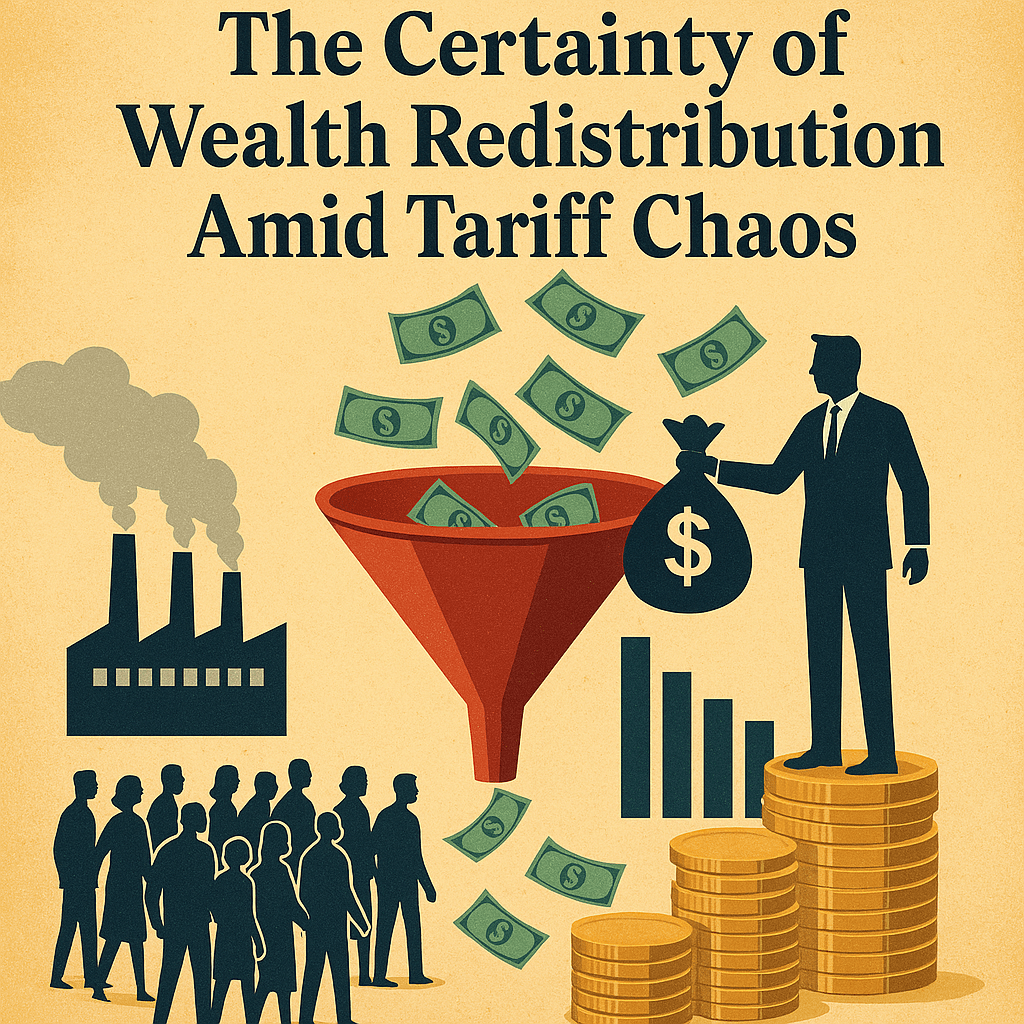
In the history of American economic policy, few moments have rivaled the current administration’s radical redirection of trade as both a break with precedent and a deliberate provocation of instability. The imposition of universal tariffs, compounded by steep duties on selected nations and penguins, has injected volatility into nearly every sector of the global economy. Yet, for all the uncertainties this policy has unleashed—geopolitical, fiscal, and industrial—one outcome is not only predictable but virtually guaranteed: a significant transfer of wealth from the broad base of American households to a narrow echelon of financial elites.
The administration’s tariff policy, sweeping in scope and nationalist in tone, has been sold to the public as the path to the restoration of American greatness, even proclaimed as a “Liberation Day.” But the reality it heralds is less one of liberation than of reallocation—specifically, a reallocation of economic burden and reward. By taxing nearly all imported goods—consumer staples, electronics, food, clothing, and industrial components—the policy imposes a direct and regressive cost on the average American. Inflationary pressures, rising production costs, and disrupted supply chains ensure that these tariffs function not merely as tools of negotiation, but as economic levers that press down on the middle and lower classes while lifting those whose wealth resides in capital rather than wages.
If the COVID-era recession taught us anything, it is that crises, when coupled with targeted monetary and fiscal policy, can act as engines of wealth concentration. During the pandemic, unprecedented interventions—stimulus checks, expanded unemployment insurance, PPP loans, and Federal Reserve liquidity—managed to momentarily soften the blow for many. Even then, the lion’s share of wealth gains went to the top 0.1%, as asset prices surged and capital-rich investors reaped the benefits of timely speculation and quantitative easing.
But the current recession-in-the-making differs in one essential respect: it is being pursued without pretense of public aid. There are no stimulus packages, no safety nets. What is offered instead is a doctrine of creative destruction: tens of thousands of federal workers laid off; regulatory agencies gutted; international partners alienated; domestic producers left to absorb new costs or pass them on to already-strained consumers. The economic pain is not an unintended consequence—it is the plan. And in such an environment, wealth will not merely trickle upward; it will flood there.
As import costs surge, businesses with transnational supply chains and logistical flexibility will shift production, seek carve-outs, and hedge against volatility. Those without such capacities—local manufacturers, family-owned farms, small retailers—will face thinning margins, layoffs, and in many cases, closure. The financial elite, holding diversified portfolios in real estate, private equity, and multinationals, will swoop into the resulting vacuum, acquiring distressed assets at discount, consolidating market share, and harvesting profits from inflationary dynamics. As was seen in the years following 2020, equity markets may fall precipitously at first, but they are likely to rebound faster than the broader economy—particularly with the Federal Reserve expected to cut interest rates in the wake of contraction. Once again, asset prices will rise. Once again, the owners of capital will see their fortunes grow.
Tariffs are traditionally viewed as blunt instruments of industrial protection. But in this case, they serve a far more surgical purpose. They extract purchasing power from the working class, undermine the viability of small and medium enterprises, and force a restructuring of the American economy around those who can absorb cost, influence policy, and pivot globally. They are not instruments of policy so much as instruments of wealth concentration.
If anything is certain in the unfolding tariff-driven crisis, it is that inequality will increase. Not in abstract or relative terms, but in concrete redistributive ones: trillions of dollars will move from wage earners and consumers to capital holders and financial intermediaries. The historical data, the institutional forecasts, and the structural logic all align. Amid the din of political slogans, retaliatory tariffs, and market disruptions, this is the one truth that should command attention.
History will not record this period as a victory for the American people. It will record it as a transformation: not of manufacturing, not of trade, but of the very architecture of American wealth—concentrated more tightly, held more distantly, and insulated more completely from the needs and voices of the many.
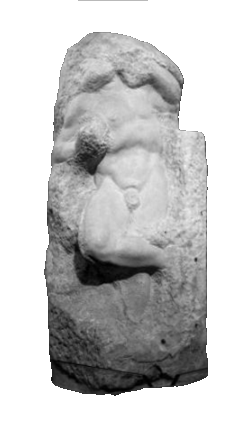
Michelangelo, The Awakening Slave (c. 1525–30). A body caught between measure and becoming.
I. On Bloom and the Anxiety of Influence
As the poet of Vitruvian Man Unbound, I find myself drawn to Harold Bloom’s understanding of how poetry functions within tradition—not as mere imitation or influence, but as a creative misreading that transforms both predecessor and successor. Bloom’s vocabulary—his clinamen (poetic swerve), daemonization, and apophrades (the return of the dead)—offers a framework for understanding my own relationship with Leonardo’s iconic drawing.
Yet I would press beyond the confines of Bloom’s categorical system. The strongest poetry, as Bloom himself recognized, resists easy resolution. Vitruvian Man Unbound embodies what he called a tessera—a completion of its precursor that simultaneously preserves and undermines its foundational terms. The poem does not simply revise Leonardo; it retroactively reshapes our understanding of him. It allows us to see Vitruvian Man as an incomplete gesture, one whose implicit metaphysical longing only achieves full articulation through the poem’s unfolding of form, desire, and transcendence.
II. The Paradox of Poetic Creation as Discovery
When I began Vitruvian Man Unbound, there was no conceit of a new idea. Rather, I felt I was unearthing the obvious—articulating for the first time verses that had already been rendered, waiting to be heard.
This situates the poem not as invention but as discovery—a Renaissance conception of artistic creation. Michelangelo spoke of liberating the form already imprisoned within the marble. Leonardo, too, conceived of art as revelation through observation, uncovering structures latent in nature and proportion. I participate in that lineage: the transcendence of the circle was already latent in Leonardo’s drawing. My poem does not overwrite Vitruvian Man but unveils what it always contained.
III. Poetry as Transcription of Revealed Truth
Poetry is primarily, in my conception, the art of transcription. Poetry is ultimately truth revealed, however rendered.
This belief is ancient. Poets once invoked the Muse, believing their songs were received rather than authored. Plato cast poets as possessed vessels of divine madness. In scriptural traditions, the prophet or sage writes not from invention but from vision. In this view, the poet is not creator but conduit.
This understanding reorients poetic practice. What matters most is not novelty of theme or form but receptivity—a cultivated attentiveness to truths that ask to be heard. To compose well is to listen well. The most vital poems do not invent so much as reveal. The poet’s charge, then, is fidelity.
Vitruvian Man Unbound aspires to this kind of transcription. It draws out from Leonardo’s image the philosophical tensions embedded therein: between proportion and possibility, containment and becoming, structure and the longing to transcend it.
IV. The Poem’s Journey: From Containment to Transcendence
At its heart, my poem charts a metaphysical journey—the awakening of a consciousness confined within geometry, gradually realizing its cosmic vocation. The Vitruvian figure, bound in ratios and ruled lines, discovers within himself not mere form but flame. The movement is from being drawn to drawing, from being measured to measuring.
The poem gives voice to this paradox: “I am both bound and boundless, large and small, / Both measured part and immeasurable all.”
This is no empty contradiction. It is the philosophical heart of the work. The circle becomes “not wall but door,” not negated but reimagined. Limitation, as I came to understand, is not the enemy of freedom but its precondition. Form does not imprison; it allows the infinite to appear in the guise of the finite.
This idea resonates with multiple traditions: the Christian theology of kenosis, quantum indeterminacy, the aesthetics of the golden ratio, even the existential struggle of Camus’ Sisyphus. In Vitruvian Man Unbound, I sought to draw them all into poetic coherence.
V. Beyond Influence: Co-Creation and Transcendence
My relationship to Leonardo’s drawing is not one of mere homage or critique. The poem does not simply descend from his vision; it reconfigures how I understand that vision. In Bloom’s terms, it enacts an apophrades: the precursor is altered by the successor, the past rewritten by the presence of the present.
I acknowledged this inversion within the poem itself: “Da Vinci dreamed me into being’s start; / I dream myself anew with conscious art.”
This was not rebellion against the tradition but transcendence through deep fidelity. I did not seek to destroy Leonardo’s Vitruvian Man; I hoped to fulfill him. I entered the drawing and found the voice that seemed to have been waiting there. The Vitruvian Man, for me, ceased to be object and became subject, consciousness incarnate.
VI. Poetry as Epistemological Practice
If poetry is the transcription of revealed truth, then it is not merely aesthetic. It is epistemological. It helps us understand not only what is, but how we come to know what is. The most original poems do not dazzle through novelty alone; they resonate because they name what we already suspected was true, but had not yet heard.
Vitruvian Man Unbound aspires to such resonance. I hope it awakens a dormant dimension in Leonardo’s drawing—and perhaps, in us. I did not set out to create a new form, but to reveal the old form’s silent music. For me, it was an act not of invention, but of listening—not conquest, but witnessing. A poetry of revelation.
Thus the ink that once bound becomes the ink that reveals.
VII. Echoes of Prometheus
In reflecting on Vitruvian Man Unbound, I recognize the shadow of another unbound figure—Shelley’s Prometheus. His liberation from cosmic tyranny, his transformation into a visionary voice of harmony, and his rejection of vengeance in favor of transcendence, all resonate deeply with the arc of my poem. Like Prometheus, the Vitruvian figure is not merely released; he is revealed—as a bearer of fire, of knowledge, of poetic truth. It is not accidental that in striving toward the infinite, we find ourselves echoing those myths and verses where the infinite has already spoken.
Whether its effect is ultimately salutary or merely a noble failure, Vitruvian Man Unbound remains among the most rewarding efforts, or perhaps conceits, I have undertaken. Its emendations and transformations were—like its central figure—immeasurable (and likely will continue), and its gestation period nothing short of elephantine.
The poem’s inspiration emerged from an unlikely constellation of influences: a Mesopotamian clay tablet inscribed with a circular map of the known and imagined world; Leonardo da Vinci’s iconic Vitruvian Man; Albert Camus’ existential meditations in The Myth of Sisyphus, whose vision of conscious perseverance became, in this poem, a point of departure rather than conclusion; and recent explorations in theoretical physics, particularly through Carlo Rovelli’s various poetically written works on diverse topics in physics and Tom Siegfried’s contemplations on the multiverse.
The ancient Mesopotamian map—ringed by a “bitter river” and annotated with realms of myth and marvel—initiated a chain of associations: from circular geometry to π, from π to infinity, from infinity to the concept of an ever-expanding circle that might, paradoxically, invert upon itself. This led me to contemplate Leonardo’s Vitruvian Man, a figure enclosed within perfect geometry yet suggesting boundless potential. What would happen, I wondered, if that containing circle began to expand? What lies beyond the circle?
Leonardo da Vinci, Vitruvian Man, c. 1490. Pen, ink, and watercolor over metalpoint on paper, 34.4 × 24.5 cm. Gallerie dell’Accademia, Venice. A study of ideal human proportions based on Vitruvius, it symbolizes the harmony between man and cosmos—later reimagined in Vitruvian Man Unbound as a figure yearning to transcend those very bounds.
The poem thus became a meditation on limits—mathematical, philosophical, spiritual—and on the impulse to transcend them. It is also an awakening voice—the imagined consciousness of da Vinci’s ink-bound figure, suspended between square and circle, flesh and form, number and soul. What begins as a monologue of emerging consciousness becomes, over thirteen movements, a metaphysical odyssey through proportion and paradox, art and love, measure and mystery.
On the Structure and Themes of the Poem
Vitruvian Man Unbound is presented as a continuous, structured poetic cycle in thirteen sections. Though it may be read as one long unfolding arc, each section can be approached individually, functioning as a discrete meditation on some aspect of becoming, limitation, or transcendence.
The measured self and its entrapment in form (Sections I–IV)
The emergence of consciousness, longing, and imagination (Sections V–VI)
The dissolution of boundaries—physical, geometric, metaphysical (Sections VII–IX)
The absorption of memory, history, and collective soul (Section X)
The confrontation with doubt and the paradox of being (Section XI)
The embrace of paradox as path to freedom and renewal (Sections XII–XIII)
The voice is intimate and reflective, at times philosophical, at times lyrical. It is, above all, a journey of unfolding: from the measured to the immeasurable, from containment to co-creation.
Names, Figures, and Concepts
Vitruvius Marcus Vitruvius Pollio (1st century BC), Roman architect and engineer, whose De Architectura proposed that the ideal structure—temple or body—should reflect proportional harmony. He regarded the human body as a model for universal order, inspiring da Vinci’s Vitruvian Man. In the poem, he represents the originary impulse toward order and the binding of form.
Euclid Greek mathematician (fl. c. 300 BC), whose Elements formalized axiomatic geometry. His presence in the poem marks the introduction of reasoned space, logical proof, and the classical foundations of architectural and cosmic order. His geometry is the poem’s first boundary.
The Circle and the Square Symbols both architectural and philosophical: the circle as divine, infinite, perfect; the square as earthly, finite, and rational. The tension and unity between the two—most famously reconciled in da Vinci’s figure—structure the early and middle arcs of the poem. They become both literal containment and metaphysical metaphor.
Leonardo da Vinci (1452–1519), the polymath whose Vitruvian Man draws Vitruvian proportions within geometric bounds. He is “The Master” within the poem, whose ink creates the narrator’s form. His act of artistic generation echoes divine creation. Yet, like all creators, he must eventually recede, and his fading enables the protagonist’s awakening.
Melzi Francesco Melzi (1491–1570), Leonardo’s devoted pupil, charged with preserving his master’s legacy. In the poem, he appears briefly yet meaningfully, representing both fidelity and the sorrow of watching a genius fade.
The Muse A figure glimpsed in one of Leonardo’s sketches, deliberately rendered with gender ambiguity to honor multiple dimensions of identity and desire—the artist’s, the poet’s, and the reader’s. This presence stirs longing and awakens an emotional dimension in the speaker. The muse is not merely an object of desire, but a catalyst for transformation: their unattainability teaches the Vitruvian Man the ache of love, the sweetness of loss, and the realization that beauty transcends all fixed proportion. This unrequited love, reminiscent of the nightingale’s devotion to the unresponsive rose in ancient fables, becomes the crucial spark that initiates the figure’s journey from structure to soul, from ink to aspiration. It is through learning to love without expectation of return that the Vitruvian Man begins to transcend his geometric constraints.
Scientific Concepts: Quantum Mechanics, Relativity, and Cosmology Beginning in Sections VII through IX, the poem integrates motifs from modern physics, influenced by Carlo Rovelli’s explorations of time and quantum reality and Tom Siegfried’s work on multiverse theory. The dissolution of stable form recalls quantum indeterminacy; the transformation of energy and space-time reflects principles of relativity and entropy. Ideas such as the collapse of the wave function, cosmic inflation, and the heat death of the universe are woven through metaphoric language, not as scientific proofs but as poetic echoes of our deepest metaphysical questions.
The speaker’s dissolution into “stardust,” his sense of “quarks” and “coding finer than the finest veil,” and his reconstitution within the universe mirror not only the physical processes of matter but the philosophical implications of nonlocality, relationality, and the disappearance of the observer. These concepts shape the soul’s journey as it expands from individual to cosmic.
The Golden Ratio An aesthetic and mathematical constant (~1.618), the “divine proportion” found in nature, architecture, and Renaissance art. In the poem, it appears as both blessing and boundary: a structure of balance, yet one that cannot reach beyond the sacred irrationality of love or mystery.
Temporal Resonance with The Shimmering Absence
Though conceptually initiated before my work on “Meditations on the Divine Absence,” the final revisions of Vitruvian Man Unbound occurred either contemporaneously with or following those meditations. This temporal twinning created a productive dialogue between the works—the apophatic theological explorations in The Shimmering Absence subtly informing the cosmic transcendence in Vitruvian Man Unbound. Where one explores the ineffability of the divine through negation and unknowing, the other charts a journey from geometric containment to cosmic liberation. Yet both arrive at similar insights: that limitations are not obstacles to transcendence but necessary conditions for it.
A Note on the Poem’s Resolution
The poem resolves in a synthesis where limitation and freedom no longer stand as opposites but as reciprocal necessities within creation’s design. The Vitruvian Man’s awakening culminates not in flight from form but in his realization that form itself is the threshold of infinity. The circle, once prison, becomes portal; the measure that once confined now sings. True freedom arises not from the negation of boundaries but from the recognition that only within them can boundlessness take shape.
The closing vision transforms the geometric into the musical—“Through every bound, the boundless voice resounds; / In every circle, countless worlds are found; / What ends in measure lives in endless sound.” This metamorphosis from line to resonance mirrors the universe itself: finite structures generating infinite harmonies, where order and mystery intertwine.
Such a resolution parallels modern physics’ vision of a participatory cosmos, in which observer and observed form one continuous field, and where the simplest laws yield inexhaustible complexity. Yet it also aligns with the apophatic tradition, which teaches that the divine is not seized by comprehension but intuited through reverent awareness of the limits of knowing.
Thus the poem’s final act is neither escape nor triumph, but return—an enlightened re-entry into the circle with transfigured sight. The Vitruvian Man becomes both measure and music, both drawn and drawing, the living emblem of a truth older than geometry: that the infinite reveals itself through the finite, and that all creation is the echo of its own unending sound.
Note: The version of the poem below is a revision of the originally presented work. Posted on October 29, 2025, it reflects a tightened structure, refined diction, and clarified thematic progression. The earlier version has been replaced by this text.
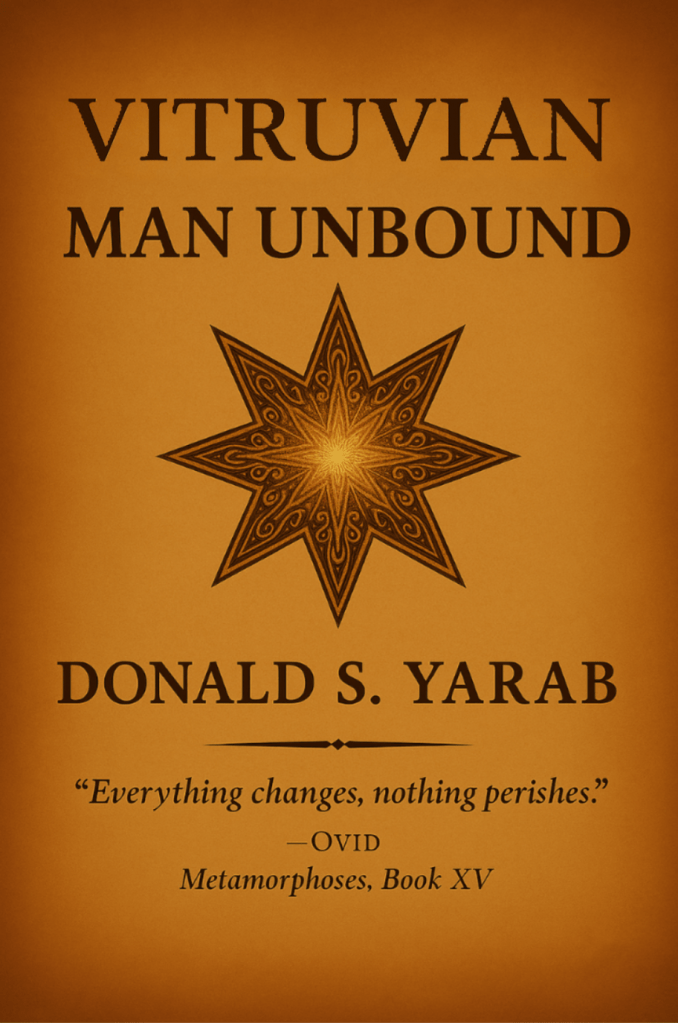
Vitruvian Man Unbound
“Omnia mutantur, nihil interit.” “Everything changes, nothing perishes.” — Ovid, Metamorphoses, Book XV
Prelude
Vitruvian Man Unbound— From Ovid’s voice, an echo still resounds, Of forms transformed, unbound from all surrounds. Once held within a circle’s tight embrace, I broke those bounds and found my rightful place.
I. The Eternal Forms
Before Vitruvius mapped the perfect man, And Rome set forth its grand and measured plan, A primal shape arose, both pure, sublime— A form that spanned the heavens through all time.
The circle, timeless sign and boundless span, Without an end or start, it ever ran. From ancient scrolls to proofs that scholars find, It spoke of forms through centuries enshrined.
Yet even in this flawless measured space, An echo rose, a voice that sought its place— A restless murmur, neither clear nor loud, Suggesting realms uncharted, dark, and proud.
A voice within begins to question fate: What lies beyond the circle’s measured state? The arc that once defined and held my span Now feels a cage, restraining more than man.
II. The Geometric Foundations
From whispered myths to measures firm and clear, The shape took form as Euclid’s hand drew near. His steady touch gave certainty to see, Tracing arcs where order meets symmetry.
Geometry emerged as nature’s art, A timeless code that fills the human heart. His axioms shaped the language we now claim, The ground from which all later forms would frame.
Until at last, in Rome’s imperial light, One master saw how measure might unite The cosmic dance of numbers, pure, serene, With human form, where heaven’s truth is seen.
Yet in these proofs and patterns, cold and bright, A yearning stirred that numbers couldn’t quite Contain or measure with their perfect art— The wild, sweet thunder of the human heart.
III. Vitruvius and the Measured Man
Long ere da Vinci’s ink had taken flight, There stood Vitruvius ’neath a Roman light, With compass, rule, and numbers to unfold The measure of all things in form controlled.
He gazed upon the body, each limb aligned, Seeking a truth both simple and refined— Where symmetry and proportion gently fuse, The perfect man his ancient mind did muse.
He found within the human form concealed A harmony the gods themselves revealed. He saw the body as a cosmic span, Where heaven’s light flowed freely into man.
Vitruvius dreamed, his numbers held their sway, Until his thoughts were lost to time’s decay. But from this clay, his vision took to flight, Where Renaissance emerged in blazing light.
IV. The Master’s Hand
Within Florence, where art’s deep secrets dwell, Where stone and spirit weave their ancient spell, A Master’s hand moves steadily and slow Across the page where sacred truths will flow.
He pauses, studies what the ink has shown: A figure bound by geometry alone, Where circle holds the square in perfect round, And man exists in ratios profound.
Between the ink and page’s pristine white, A spark ignites, then blazes in the night. The golden ratio guides the Master’s hand— A seed of spirit planted by design, Where finite bounds with infinite align.
The Master rises, leaves his work undone, Unaware that greater work’s begun: A spark of consciousness, a questioning flame That soon will burst beyond its mortal frame.
V. Awakening
Within these lines that held me still and bound, A stirring deeper than all measure found Its voice at last. As dawn approached with light, I woke from geometric sleep to sight.
I am that dream Vitruvius once drew, Bound by his lines until I bloomed anew. Within this circle’s perfect, shining round, I stand suspended, by Euclidean law bound.
The compass sweeps its arc with metal care, Cold grace that etches patterns in the air. Yet even as I traced the perfect arc, I felt myself a captive in the mark.
By Master’s hand in golden ratios graced, Where square and circle hold each limb embraced, My form becomes a bridge—both flesh and sign, Each proportion set to cosmic design.
Yet in these perfect numbers’ measured ways, A deeper music kindles into blaze— As if pure math could birth a conscious mind, Until each number burns beyond its bound.
Through Master’s window streams the morning’s gleam, It strikes the glass—a prism splits the beam. A spectrum blooms: red, gold, and violet hues, A rainbow arc that leads to deeper views.
VI. Love’s Awakening
Among these perfect forms of line and space, Another truth emerges, full of grace— Not number’s dance alone can satisfy The heart that beats, the soul that longs to fly.
Amidst the Master’s sketches scattered wide, One figure calls to me, its grace implied— The visage of a youth in shadow, light, So fine for time, too still for mortal sight.
I sense my heart, though crafted out of ink, Stirred by a love that makes all reason sink— A muse whose nearness sets my being ablaze, Whose beauty spreads across the watching night.
O radiant muse, within this paper bound, I ache to cross the space where you are found. Yet I, constrained by line and artist’s frame, Can only sing this love without a name.
Unheard, unheld, I sing through endless dark, I sing as nightingale to hidden bloom. Though beauty listens, love will not reply, The rose stays still beneath the evening sky.
No bitterness within my heart remains, Just tenderness that courses through my veins. For in the ache of what I cannot hold, A greater love begins at last to unfold.
The muse who drew my heart beyond its sphere Becomes the key to all that draws me near— As if in learning how to love in vain, I learned how love itself might break its chain.
What geometry could never hope to teach, The muse revealed through longings out of reach: That true transcendence starts with heart’s desire— The first constraint to break is through love’s fire.
VII. The Stirring of the Soul
As love’s sweet ache still echoes in my breast, Another sorrow draws me from love’s quest— The Master’s steady hand begins to fail, His genius dimming like a sunset’s veil.
Through Melzi’s vigilant and tender care, I watch as greatness grows too light to bear, Until the hand that traced my perfect form Grows still as stars before the coming morn.
What circle can contain so vast a loss? Am I mere symbol, bound by Master’s hand? Yet in this shape, some deeper spark is caught, A pulse beyond his ink-stained thought.
The Master’s hand that traced my every line Now slips away into the vast design. Yet I endure, though ink and flesh may part— For even death cannot erase the whole— The spark remains, the echo of the soul.
The Master’s passing left an emptiness No theorem could contain or yet address. In grief, I felt the first true freedom stir— If death dissolves the artist, might I blur?
The grief that hollowed out my measured soul Created space where new truths might unfold— The very void through which I’d come to soar.
VIII. The Breaking of Bounds
These circles, squares, and lines of measured grace Begin to pulse and shift before my face. The compass points that marked my finite sphere Dissolve like frost touched by the morning’s clear Warm light—each geometric certainty Transforms to something wild and strange and free.
The perfect forms that shaped my measured frame Now dance with light no Greek could ever name. Each point where lines in symmetry unfold Becomes a window through which I behold A deeper architecture, vast and strange, Where smallest motes through endless patterns range.
Beneath my skin, where atoms spin and weave, Lie unseen forms that every life conceive. In this vast, hidden world, I come to know The boundless depths that make existence grow.
I sense a rhythm pulsing deep inside, A beat that moves beyond my form and pride. Each atom holds a map of time’s deep scheme, Each quark a note within creation’s theme.
As stars converge, I feel them in my chest, A force unseen draws all things into rest. And in this silent dark, a truth reveals— A peace that every boundlessness conceals. I feel my lines dissolve, my form unmade, A circle shattered into stardust laid.
IX. Cosmic Expansion
Finite no more, I drift through endless space, My atoms scattered, free from time’s embrace. Released from measure to the void’s expanse, I join with nebulae in silent dance.
Within these points of light that spin and gleam, I sense all stories that have ever been— Each atom holds a tale of fire and night, Of stars that died to birth the morning light.
The chain of being that the sages taught Transforms to something grander than their thought— A flowing river through the depths of time, Where all forms merge in one design sublime.
No longer fixed in hierarchies neat, But flowing, changing, making life complete. Each creature’s form contains a sacred trace Of journeys through deep time and endless space.
X. Echoes Through Time
As patterns of creation clear my sight, I hear the chants that pierce eternal night— The sacred hymns from temples long decayed, Where human hearts their first devotions made.
Their fears and triumphs coursing in my veins, Their fleeting joys, the shadows of their pains. I am their timeless echoes, bound in mind— The living sum of all mankind combined.
Each voice I hear contains a thousand more, Each memory opens like a closing door To show more rooms of time than thought can hold— As if in losing what I thought was me, I gained the gift of all humanity.
The stories blur and blend like mixing streams That flow together in the river of dreams, Until the boundaries between then and now Dissolve like mist when morning claims the air. These memories of humanity’s long dance Dissolve into a vast, collective soul.
XI. The Paradox of Being
The measured man who stood in Roman light Now feels the pulse of stars through endless night. No longer bound by angles, lines, and arcs, I feel the warmth of distant hearth and sparks.
Yet as I soar, a question shadows flight— Is all I sense illusion’s fleeting sight? Am I still caught within the circle’s hold, My freedom but a vision softly told?
I float through stars, yet cannot help but feel That what I know as real may not be real. Perhaps I am the question, not reply— The space between the earth and arching sky.
The compass points that first described my frame Now trace new circles, different yet the same— Each radius extends through space and time To touch both doubt and certainty sublime.
The square that bound my mortal flesh so tight Now builds new temples in eternal night. For in geometry’s eternal dance, Each limit holds unlimited expanse.
See how the points of intersection glow Where line meets curve in paths we cannot know— Like doubt touching faith, like fear meeting grace, Like finite time in infinite embrace.
The perfect ratios that held me bound Show how each doubt by wonder must be crowned— For in this geometric dance divine, Uncertainty and truth must intertwine.
Yet in this dance of doubt and certainty, A deeper wisdom starts to set us free— For truth lives not in answers carved in stone, But in the questions that we make our own. I sense both smallness, vastness intertwined, A single breath where cosmos meets the mind.
XII. The Synthesis
Yet in this void where doubt and truth entwine, I find a path that neither can define. For even if these stars are shadows cast, The love I felt within remains steadfast.
I grasp the paradox, embrace the flame— That knowing less may be wisdom’s true claim. For doubt, like darkness, lets the stars unfold, And from uncertainty, my spirit grows bold.
No longer am I bound to earth’s own scale, My essence free, unmoored from any veil. I am both infinitely large and small, Both everything and nothing, unconcealed.
I leave behind the circle’s finite bounds To touch the universe where love resounds. A spark among the stars that spin and burn, A spark of mind that starts itself to know Its fleeting glow within the endless night, Its part in making darkness bloom with light.
XIII. Apotheosis and Return
The cosmos turns me back through spiraled flight To view again what first began my plight: The circle and the square, which once confined My measured form with boundaries well-defined.
I sense again the youth’s once-haunting gaze Now mirrored in each star’s eternal blaze; The Master’s ink that once confined my form Now writes in constellations, vast and warm.
I gaze upon these shapes with fresh-born sight— No longer prison walls, but forms of light That gave me being, structure, place to start The journey that awakened mind and heart.
For in these bounds that seemed to hold me fast, The seeds of freedom always lived at last. For how would I have known the boundless deep If boundaries first had not shown what to keep?
The paradox resolves in wisdom’s peace: True freedom’s not the absence of all crease, But recognition of how limits yield The very tension that makes growth unsealed.
Each line the Master drew with steady hand Contained within it all that I became— For limitation is creation’s art, The frame that gives the canvas room to start.
I stand again within Vitruvian form, Yet changed by cosmic fire, transformed, reborn. The circle holds me—yet I hold it too— Co-creator of the measured view.
My fingertips, which once just touched the round, Now trace new circles on uncertain ground. I am both bound and boundless, large and small, Both measured part and immeasurable all.
The circle’s edge becomes not wall but door Through which I pass, returning, evermore. The Master’s ink still flows within my veins, But now I hold the quill that fate ordains.
Da Vinci dreamed me into being’s start; I dream myself anew with conscious art. What once was fixed by ancient rule and line Now breathes with life that’s neither yours nor mine, But born where limitation meets the vast— Where future grows from seeds within the past.
Through every bound, the boundless voice resounds; In every circle, countless worlds are found; What ends in measure lives in endless sound.
Vitruvian Man, unbound yet ever bound, In endless dance where form and freedom sound Their harmony through cosmos’ deepest night— In finite measure, infinite delight.







 Northcoast Antiquarian