Clay tablets. Story of Gilgamesh and Aga. Old Babylonian period, 2003-1595 BC. Sulaymaniyah Museum, Iraqi Kurdistan. (CC-BY SA 4.0. Dr. Osama Shukir Muhammed Amin).
Homer, even if the fictive creator of the Iliad and the Odyssey, is inseparable in the mind from those masterful and inspiring works of literature. Equally inseparable should be Sin-lēqi-unninni from the Epic of Gilgamesh.
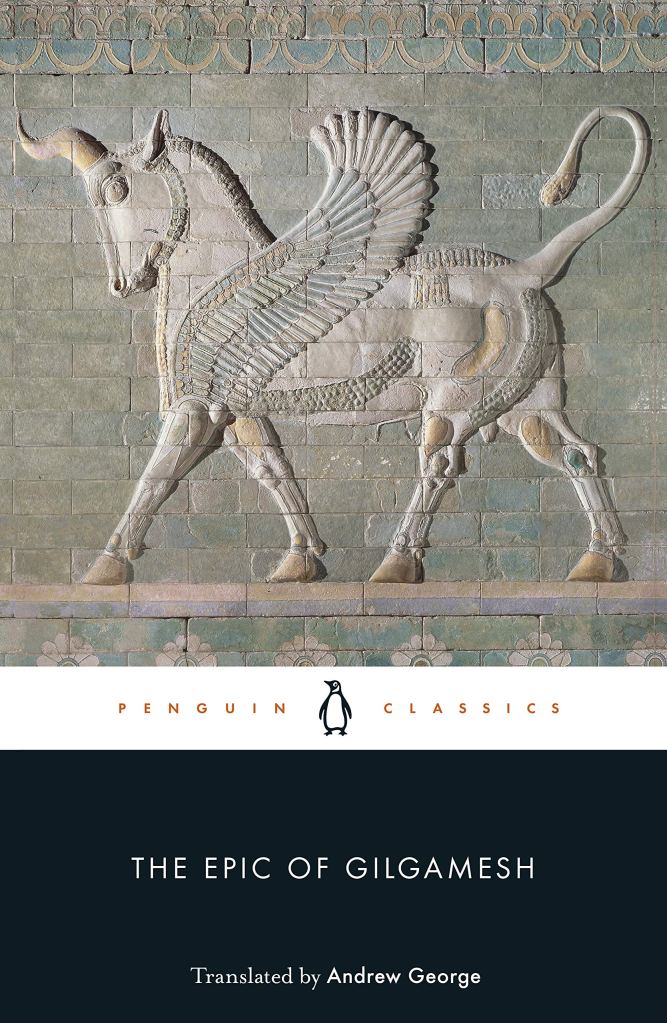
Andrew George, whose engaging translation of the Epic of Gilgamesh is readily acknowledged by later translators of the epic as “a master class in philological precision and ingenuity,” has this to say about Sin-lēqi-unninni:
According to Babylonian tradition the [Epic of Gilgamesh] was the work of a certain Sîn-lēqi-unninni, a scholar from Uruk who was believed to have been a contemporary of Gilgamesh himself. However, Sîn-lēqi-unninni bears a name of a kind not found before the second millennium, so the tradition clearly preserved an anachronism. Instead, there is little doubt that Sîn-lēqi-unninni’s name was associated with the epic because he was the man who gave it its final, fixed form. Sîn-lēqi-unninni is thus one of the earliest editors in recorded history. From a comparison of the standard version of the first millennium with the older fragments we know that the person responsible for the standard version remodeled the poem. He provided it with a new prologue and recast the story to emphasize the theme of wisdom gained through suffering. Probably he was responsible for interpolating a version of the flood story, adapted from the old poem of Atra-hasis, and for appending to the epic as Tablet XII the rump of one of the Sumerian poems of Bilgames in an Akkadian prose translation. He left his mark also on the prosody, reducing variation in parallel and similar passages by combining their lines and repeating them verbatim to produce a text characterized by long sections of repetition where older versions had none. For this he often stands accused of damaging the poem’s literary qualities, but at the same time it can be argued that he introduced a profundity of thought that was probably lacking in the older versions.
Though the editorship of Sîn-lēqi-unninni probably changed the poem so radically that it is no wonder the Babylonians later named him as its author, it is clear from the multiple versions of the second millennium and from the existence of textual variants in the standard version of the first millennium, that he was not the only individual to leave his mark on the written epic. However, we know nothing of these others.
George, Andrew (2008) ‘Shattered tablets and tangled threads: Editing Gilgamesh, then and now.’ Aramazd. Armenian Journal of Near Eastern Studies, 3 (1). pp. 11-12.
George, perhaps, does an injustice to Sin-lēqi-unninni, by relegating him to the role of editor alone. Sin-lēqi-unninni was not mere scribe, nor compilator, nor even editor; rather, because of the number and weight of the substantive additions and structural changes he made to the epic, we may rightly view him as an ingenious co-creator of the ever-inspiring epic, such that modern publications could have a title page reading Sin-lēqi-unninni’s Epic of Gilgamesh.
The life that you seek you will never find: when the gods created mankind, death they dispensed to mankind, life they kept for themselves.
The Epic of Gilgamesh (2020), A. George, p. xlv
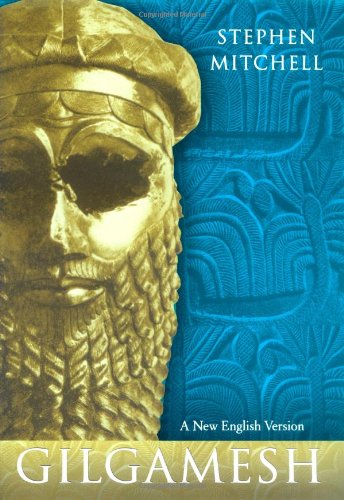
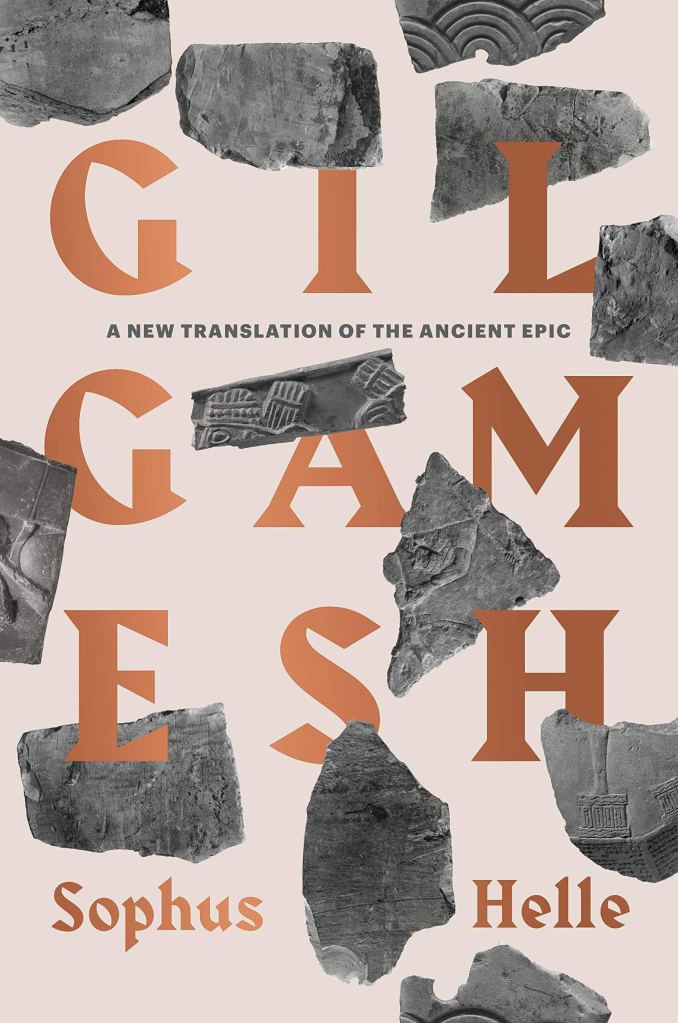
Two other translations of the poem in my library, both meritorious and worthy of note, include the recently published Gilgamesh: A New Translation of the Ancient Epic, by Sophus Helle (2021), which sought to strike a middle ground between George’s scholarly translation and the “translations of translations,” which can be used to described the other work in my library, Stephen Mitchell’s Gilgamesh (2004). Harold Bloom described Mitchell’s version of Gilgamesh as the “best I have seen in English” at the time it was published.
Gilgamesh is a well I go to for reflection and creative thought repeatedly. This is not surprising, as The New York Review of Books concisely notes that Gilgamesh inspires reflection and creativity on a multiplicity of levels:
In the century and a half since its rediscovery, however, and especially since World War II, Gilgamesh has made up for lost time. It has been translated into at least two dozen languages and been the inspiration for countless works of theater, film, poetry, fiction, and visual art. Musical responses to Gilgamesh include several operas, a ballet, hip-hop, jazz fusion, and an ear-pummeling track called “Gilgameš” by the Greek extreme metal band Rotting Christ.
Gilgamesh has also been acclaimed as the earliest work of ecological literature and included in The Columbia Anthology of Gay Literature as a founding text of queer writing, for its treatment of the relationship between Gilgamesh and his wild-man friend, Enkidu. The cultural energy of Gilgamesh shows no sign of dimming; the novelist Naja Marie Aidt describes it as a “fireball” that “has torn through time,” constantly in a process of reentry to the present.
New York Review of Books (October 20, 2022), “A Fireball from the Sands,” by Robert Macfarlane.
Some of my favorite more recent creative endeavors include two musical works. The first is a Lament on the Death of Enkidu, set to music and sung in Akkadian, based on the poetry of the epic. Peter Pringle, the creator, notes that he was helped along in his pronunciation of the Akkadian by Dr. George. It is simply stunning. Take a moment to listen and reflect on your mortality.
Gilgamesh’s Lament for the Death of Enikidu
The second is a nod to the ecological message that many find in the epic related to the consequences of the indiscriminate felling of the cedar forest in Lebanon. As explained in the New York Review of Books:
During the UK’s pandemic lockdown, [Robert] Macfarlane cowrote an album with the singer-songwriter and actor Johnny Flynn, Lost in the Cedar Wood. They collaborated on lyrics, sharing photos of notebook pages while in their respective homes, and Flynn would set them to music. “It felt like a wild wonder, to be able to feed words into the Johnny Flynn Song Machine and get a demo back a few days later!”
In addition to daily life in lockdown, the album is inspired by the Epic of Gilgamesh: “We wanted to write something both ancient and urgent,” said Macfarlane. “At the heart of Gilgamesh is the story of an unwise ruler, Gilgamesh himself, taking his axe to the Sacred Cedar Wood and felling these extraordinary trees. A few months after we began work on it, the Fairy Creek calamity started to unfold on Vancouver Island, with the premier of British Columbia, John Horgan, allowing the logging of the old-growth cedar forest there, including trees up to 2,000 years old.” Lines like “It was the first of the tellings/Of all of the fellings” (from the song “Tree Rings”), while unfortunately evergreen, took on a particular significance.
New York Review of Books (July 10, 2021), Ramblin’ Man. Robert Macfarlane, interviewed by Willa Glickman.
Johnny Flynn and Robert Macfarlane’s Tree Rings
To circle back to the beginning, this remarkable creativity is very much, I believe, the result of the creativity and authorship of the ancient editor of the Epic of Gilgamesh, Sîn-lēqi-unninni. He deserves more credit for the depth and reflection which is inspired by the ancient epic in its most familiar form. Let us celebrate his memory every time we read the epic or enjoy any of its derivative inspirational works.
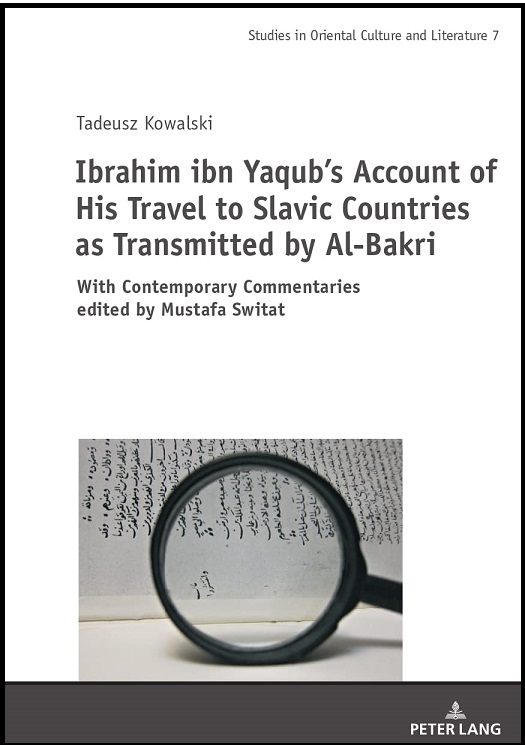
2022 Release of English Translation of Kowalski’s Invaluable Scholarship
12/30/31 UPDATE: A review of the work above was published in Polish by D. Sikorski in 2023 which is highly critical of the work for its lack of fidelity to Kowalski’s original scholarship and translation, as well as for its lack of familiarity with the scope and breath of all the relevant current scholarship. The review stated that the editor “made several decisions significantly changing the original shape of the old edition, in places even scandalously distorting it.“ The review illustrated a number of the editorial and factual failings in the work in detail. The reviewer summarized his opinion rather succinctly as follows: “Among the positive aspects of the presented book is primarily the availability in a widely understood language of T. Kowalski’s findings regarding Ibrahim ibn Jakub and his extensive and very detailed commentaries on al-Bakri’s text. On the negative side, the main issue is the removal of the critical apparatus from the Arabic text, depriving it of its scholarly character. Another serious flaw of the publication is the attempt to include two different English translations in one text. Thirdly, there is an inadequate discussion of the state of research on Ibrahim’s text.” I note that, on balance, the work still retains some utility for those who cannot access Kowalski’s work, or who cannot read works in Polish or Arab regarding Ibrahim’s Account; however, I share the reviewer’s enthusiasm for an upcoming release by French Arabist, Jean-Charles Ducène, who is preparing an edition of all fragments of Ibrahim’s Account for Monumenta Germaniae Historica – as the reviewer noted, the forthcoming edition by Ducène will render the above work and its deficiencies obsolete and eclipse T. Kowalski’s work in terms of the text.See review at:Sikorski, D. (2023). Review of Ibrahim ibn Yaqub’s Account of His Travel to Slavic Countries as Transmitted by al-Bakri, with Contemporary Commentaries, by M. Switat (Ed.), A. Waśkiewicz (Trans.). Roczniki Historyczne, 89, 179-186.
In February 2022, my post entitled “Remarks on Mieszko’s Payments to His Warriors: ‘Market Weights’ or ‘Good Coins (Dirhams) of Fixed Value’?” noted that the above referenced translation of Kowalski’s 1946 foundational scholarship [Relacja Ibrāhīma ibn Ja’ḳūba z podróży do krajów słowiańskich w przekazie al-Bekrīego (Relatio Ibrāhīm ibn Ja’ḳūb de itinere Slavico, quo traditur apud al-Bekrī). Cracow: PAU, 1946] was forthcoming. I have been eagerly awaiting its arrival ever since. It has finally been published and, this week, I received my long-anticipated copy.
Previous to this translation of Ibrahim ibn Yaqub’s references to Slavic lands based on his travels in the 960s, I relied on the very able and sound English translations of Dmitrij Mishin (Mishin 1996) and Paul Lunde and Caroline Stone (Lunde and Stone 2012). I was aware of the 1946 Kowalski scholarship because all translations of Ibrahim ibn Yaqub’s original texts ultimately draw from the well of Kowalski’s 1946 magisterial work. Unfortunately, I was unable to draw upon that well both because of the language barrier and the physical inaccessibility of the work. The newly released publication allows me and others who faced similar barriers to finally access much of Kowalski’s original 1946 scholarship. Unfortunately, four of the original supplementary essays by other scholars in the work were not republished due to copyright issues. Although the essays were likely outdated, it would no doubt have been beneficial to understand the full scholarly context of the original publication to have had those essays in translation.
The new publication does not, ultimately, disappoint, in spite of the copyright issues limiting the completeness of its re-publication in translation. Of course, the heart of the work is its presentation of the translation, from Arabic, of Ibrahim ibn Yaqub’s references to Slavic lands. The translation is remarkably detailed, thorough, and heavily footnoted. It quickly becomes apparent that this translation is the first I will consult when I am researching and writing, as it is clearly the foundation upon which my understanding will be built. However, when writing narratively, rather than for scholarly purposes, my quotations will continue to come from Mishin or Lunde and Stone. One quick illustrative example will suffice to demonstrate why.
In Kowalski 2022, the first lines of the Arabic text are translated as follows (citations removed): “Slavs are those born {belong to descendants (come from descendant)} of Mādhāy Ibn {the son of} Yāfith. Their dwellings {continually} [spread] from the north to the west.” In Lunde and Stone 2012, the same lines are translated as follows:”The Saqāliba are the descendants of Mādhāy, son of Yāfith (Japheth) and they dwell in the north-west.”
Obviously, Kowalski is a translation foundational to scholarly understanding (especially with its abundant citations) whereas Lunde and Stone is a translation useable in flowing narratives.
The translation also includes extensive, helpful philological commentary, a reconstruction of the biographical identity of Ibrahim ibn Yaqub, and a very useful discussion of proposed dates for his travels. Of particular note are two new commentaries by Mateusz Bogucki and Mateusz Wilk. Bogucki contributed an entry entitled “Archaeological Commentary on Ibrāhīm ibn Yaʿqūb’s Account” while Wilk contributed one entitled “Ibrāhīm ibn Yaʿqūb’s Account in the Context of Source Analysis.” Finally, there are biographical notes, indices of names, and the Arabic text which was translated.
Although I am thrilled to add this work to my library, and will consult it frequently, as I already have, I am somewhat disappointed that the opportunity presented by its publication to attach the most recent, more clarifying scholarship, when warranted, was not exploited more robustly. Several areas where such updates were possible were identified in a 2006 conference celebrating the 60th anniversary of the publication of Kalkowski’s 1946 work. The conference papers were published in Zaborski, Andrzej (ed.). Ibrahim Ibn Jakub i Tadeusz Kowalski w sześćdziesiątą rocznicę edycji, Cracow, 2008.
I wrote about one area of particular interest in my February 2022 post. Although that area was ostensibly addressed in Bogucki’s commentary in the new publication, Bogucki’s treatment of the issue is puzzling and incomplete, as I will discuss below.
In my February 2022 post, I quoted this excerpt from Mishin:
Ibrahim Ibn Ya’Qub reported the following regarding Mieszko and his realm: “The country of Mashaqqah [that is Mieszko, earlier in the text identified as ‘King of the North’] is the largest one among the countries [of the Slavs]. It abounds in food, meat, honey, and agricultural produce. The taxes are collected in market weights. Those are the salary of his men in every month, and each of them has a certain amount of them to get. He has three thousand warriors wearing coats of mail; a hundred of them is worth a thousand of other warriors in the battle. He gives those men clothes, horses, arms, and everything they need. If a child is born to one of them, he orders the child to be paid a maintenance, regardless of the latter’s sex. When the child grows, and he is a boy, he marries him and pays the dowry to her father. The dowry of the Slavs if very big, and they pay it in the same way as the Berbers do. If a man, thus, has two or three daughters, he gets rich, but if he has two sons, he becomes poor.”
Mishin (1996), pp. 187-188.
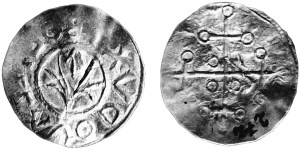
I noted that scholars have long focused on the references to the taxes collected and paid by Mieszko to support his three thousand warriors, the warriors which allowed Mieszko to expand, consolidate, and stabilize his realm because current scholarship does not support that Mieszko issued any coinage of his own. Rather, it shows that his son, Boleslaw Chrobry, struck Poland’s first denars between 992 A.D. and 1000 A.D. (see Suchodolski 2019 and Suchodolski 2015 for a discussion of which denars are contenders for earliest denars struck in Poland).
Denar of Boleslaus Chrobry of Poland, ca. 992-1000 A.D. Tree of life with arrow, inscription / cross. One of the contenders for the first coins struck in Poland. Photograph from Suchodolski 2015.
Accordingly, we must look elsewhere for what, exactly, Mieszko may have collected for taxes and used to pay his force of warriors.
Mishin, in his translation, indicated that Mieszko collected taxes in “market weights,” which were then used to pay his warriors a fixed monthly salary. As I noted in February 2022, Mishin based his translation, “market weights” for matāqīl al-murquatiyya, on Kowalski’s scholarship. Kowalski arrived at this rather peculiar translation because al-matāqīl or al-matākīl is the Arabic word for dinar, a gold coin, which did not circulate in Slavic lands and it was modified by a previously unattested or corrupted modifying word al-murquatīyya or al-marqatīya, which Kowalski rendered as market or commercial.
In a paper prepared for a 2006 conference celebrating the 60th anniversary of Kowalski’s remarkable scholarship regarding the testimony of Ibrahim Ibn Ya’qub, Andrzej Zaborski discussed this translation issue at length, noting that alternatives proposed over the years have include Byzantine money (a proposal widely rejected), legal tender/money, and his own hypotheses, “good coins of fixed value” or “coins of diminished value.” Zaborski concluded that the translation issue required further investigation. (Zaborski, pp. 64-65).
In February 2022, I suggested that the text itself had revealed all that it would yield and that the evidence on the ground, or rather in the ground, argued that “good coins of fixed value” should prevail as the preferred translation. To support this contention, I appealed to the numismatic hoard evidence. Specifically, I made the following argument:
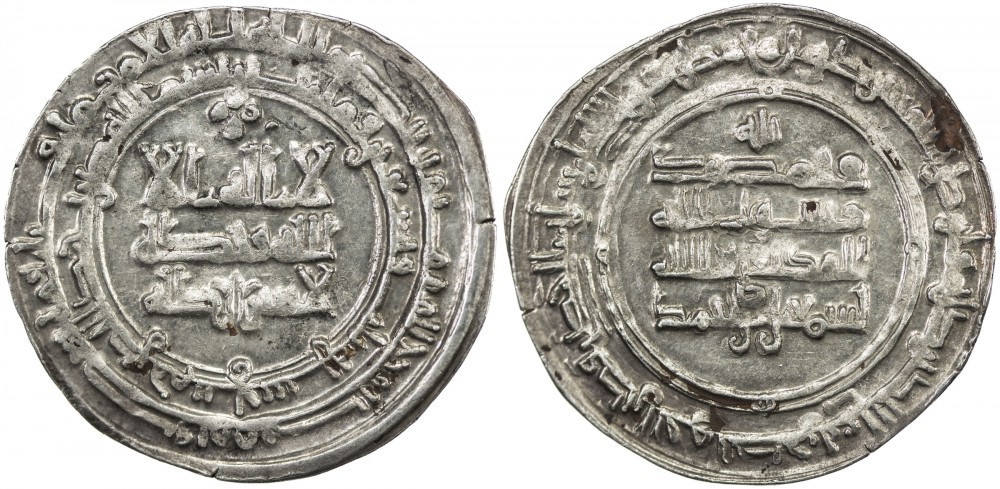
A Dirham of the type found in hoards in Poland from the early 10th century. SAMANID: Isma’il I, 892-907, AR dirham (2.89g), Balkh, AH293, A-1443. Photograph courtesy Stephen Album Rare Coins.
Mateusz Bogucki discussed the use of silver dirhams in Slavic lands in 2011, based on hoard evidence, and divided the time periods during which the hoards went into the ground into seven phases. Bogucki’s Phase III most aligns with the period during which Mieszko is referred to as collecting taxes and paying warriors salaries. Here is, in part, what Bogucki has to say about that period: “Phase III (early tenth century). At the turn of the ninth and tenth centuries, an important change in dirham importation may be observed. A significantly greater number of hoards are known from the period 900-40, and they are much larger (up to 1,000 coins). They are found in eastern Poland, Great Poland and Pomerania. Dirhams are almost exclusively whole coins. Some complete (undamaged) ornaments also occur in the hoards. Analysis of the coins and ornaments demonstrates that, during this phase, two important routes were in use. Coins found in Pomerania came via the Baltic, whereas coins in the eastern parts of Poland and Great Poland arrived mainly via the eastern land-route” (Bogucki (2011), p. 136).
In 2016, Bogucki explicitly tied the influx of dirhams into Poland to Mieszko’s use of mercenaries to consolidate his realm: “Assuming the chronology of the deposits is solid, it may even be suggested that the influx of silver to Wielkopolska from the East preceded the Pomeranian route by more than a decade and was initially greater in importance. The issue of the commodity exchanged for silver in the early-Piast state is still difficult to ascertain. It is apparent that the metal was needed to pay for mercenary services and to develop a proper network of administration and infrastructure based on strongholds. Archaeological research proves that the first half of the 10th century, when the core of the state in Wielkopolska was being established, brought destruction to a large percentage of tribal stronghold centres. Juxtaposing these facts with the chronology of the influx of oriental silver into Wielkopolska (discussed above) and the information found in written Arab sources, we may conclude that the economic basis for building the earliest Piast state came from selling slaves – the inhabitants of the destroyed tribal centres of Wielkopolska. By eliminating their hostile neighbours, the Piasts acquired silver, which they could use to consolidate their power” (Bogucki 2016, p. 246).
Based on the above, we know that Mieszko had access to good quality dirhams, in quantity, and that the dirhams were not yet always reduced to intensely fragmented hack-silver (where they would need to be regularly weighed to be paid out as a salary) as they were in later phases (such as Phase IV, from 970-1010 A.D., which Bogucki noted often included coins and items that were “intensely fragmented”). This adds support to Zaborski’s hypothesis, and my contention, that the contentious translation should be “good coins of fixed value” rather than the unsatisfactory and less supportable “market weights.” I note that Bogucki, in a 2005 paper, made passing reference to the issue of the form of the warrior salaries (in an article that was poorly translated into English) without addressing the underlying translation issue:
In my opinion buying meat by silver doesn’t hinder from buying by the silver politically loyalty. In the matter of salary and taxes it’s better to quote the words of Ibrahim: ‘Received by him (king Mieszko I) taxes are trade weights. They are used as payment for his mans (knights). Each month to each man it’s a known number of it’ (Kowalski 1946, 50). Here is necessary to comment the term trade weights –mataqil murquatiyya. Ibrahim might have known the name of dirhems, the western European denars he called Kinszar, so I think that Ibrahim noticed the hack silver, taken not for pieces, but for weight. This relation doesn’t mean that salary and taxes weren’t paid in animals, grain or any other goods. But it shows, that in this matter it isn’t possible to give only one single answer.
Bogucki (2005), p. 1152.
So, in 2005, Bogucki published an article translating the Arabic phrase at issue as trade weights. He does so because he views the currency in circulation in the Polish lands at the time of Ibrahim ibn Yaqub’s writing as either whole dirhams or, more likely, intensely fragmented hack-silver. So, how does Bogucki view the issue in his commentary in the new translation in 2022?
Bogucki writes the following:
Ibrahim also wrote that in Mieszko I’s country, taxes were levied in al-matākīlal-marqatiya. This term was originally rendered as ‘commercial weights’; however, W. Kubiak has proved that the term actually denoted coins. Ibrahim seems to have used a familiar term to describe collecting fragmented silver by weight. The crucial information is that taxes were collected in metal coins. Naturally, it is difficult to assume that each peasant individually paid the prince in silver, but a complex fiscal system, where a peasant or a craftsman paid his due to the relevant official (the town comes) in produce, animals or products, and the official, in his turn, paid the prince with silver seems highly probable. Incidentally, Arab dirhams were widely used in Mieszko I’s country, a fact that Ibrahim fails to mention (he did note their use at Otto I’s court, however). It is worth recalling here that in the light of the most recent research, the slave trade, in which slaves were sold for Arab silver, played an important role in building Mieszko I’s power. Naturally, direct archaeological material does not corroborate the slave trade, but wide-scale archaeological studies seem to confirm this thesis.
Kowalski (2022), pp. 168-169.
Although it is gratifying that Bogucki is seemingly prepared to render the disputed phrase as referring to coins and no longer referring to weights, it is unclear how he would actually translate it, if at all. Is he proposing that the words be translated, as Kubiak did, as market money, or current coin, or market coin? I note that Zaborski, in reviewing Kubiak’s scholarship, was troubled by Kubiak’s interpretation as it relied on a translation that embraced etymology for market that was only attested in the 20th century in the Arabic dialect of the Jews of Algiers (Zaborski, pp. 48 and 65). The brevity of Bogucki’s comments on the issue leave these questions unaddressed, unfortunately.
On balance, however, the scholarly debate has advanced sufficiently that any translation of the phrase involving weights may be set aside. For my own purposes, I will leave the phrase untranslated, as Lunde and Stone do in their translation, and provide a note indicating that current scholarship understands the phrase as meaning current coin (e.g., dirhams and/or hack-silver).
REFERENCES/SOURCES: (Blue boxes may be clicked to be taken to reference works available online for review. Red boxes indicate reference works are not available for online review. If a link for a blue box is no longer working, please advise me of such as nca@northcoastantiquarian.com. Thank you.).
Note: Zabroski’s work is a compilation of scholarly papers read at a May 2006 conference celebrating the 60th anniversary of the publication of the first and most critical edition of Ibrahim Ibn Ya’Qub’s reports on the Slavs, which had been prepared and published by Tadeusz Kowalski [Kowalski, Tadeusz. Relacja Ibrāhīma ibn Ja’ḳūba z podróży do krajów słowiańskich w przekazie al-Bekrīego (Relatio Ibrāhīm ibn Ja’ḳūb de itinere Slavico, quo traditur apud al-Bekrī). Cracow: PAU, 1946].
Today, I was researching the early medieval coins known variously as Sachsenpfennige, Wendenpfennige, Randpfennige, Hochrandpfennige, Denary krzyzowe, or cross denarii. As part of this research, I have been consulting the works of the earliest writers to discuss these coins, including Evers, Mader, and Lelewel. When consulting Lelewel’s Numismatique du Moyen-âge, considérée sous le rapport du type (Paris, 1835), I was absolutely thrilled with Lelewel’s sense of humor and writing style. In truth, I had a hardy chuckle when I read the section of his work which led up to his discussion of the types which are the subject of my research.
My free translation of the text that gave rise to my pleasure follows. It discusses the mutilated inscriptions, inscription fragments, or random letters, which Lelewel noted as appearing on some early medieval German coins.
The coinage of Germany offers more examples of deformity than any other; it has sometimes enigmatically imitated Anglo-Saxon coins, most often only having the remains of an inscription and thus becoming infinitely obscure. I believe there are pieces that have the letters mixed up aimlessly, without reason or symmetry. Anglo-Saxon riddles are more inventive and complete and hold more to a complicated and organized method. German riddles are rather more puzzling with their raw obscurity, outdoing all the others. Letters are mixed aimlessly, without reason, without symmetry. The captions are truncated and mutilated, and the small number of letters that are preserved are not spared harm, to such an extent that all traces to be deciphered disappear. It is not the incapacity of the artist that breaks the necks of legends and letters but his whim, or his willful inattention, or his inadvertence. You see the letters reversed ass-over-head. Sometimes they lie on their backs, sometimes crawl belly to the ground; some walk with firm feet, others turned with their legs upside down. In their continual somersaults, they appear lame and bent, their limbs are dislocated, shattered, or scattered.
Part III, p . 155 ff.
Lelewel is not wrong. He expresses his indignation with an exasperated eloquence that I have rarely encountered but which I greatly appreciate!
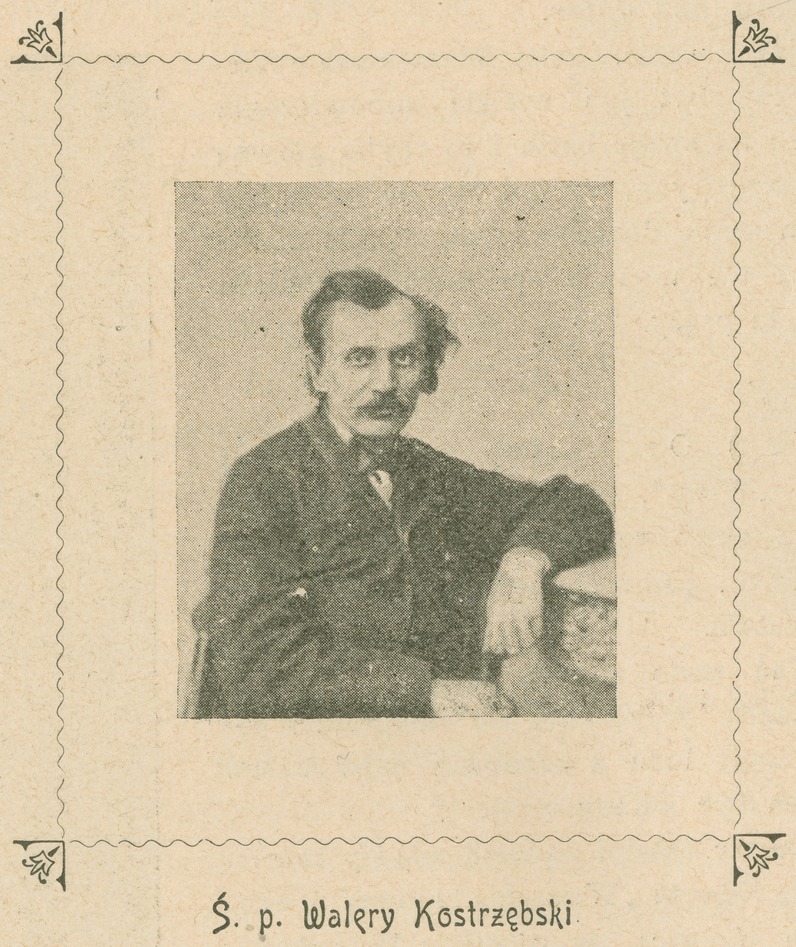
Walery Kostrzębski (8 December 1828 – 26 October 1899) was an eminent figure in Polish numismatics, whose star shone quite brightly in that lustrous circle of luminaries which included Beyer, Müller, Stronczyński, Kiska, and Przyborowski.
Kostrzębski worked as an assayer at the Warsaw Mint from 1850 through its closing in 1867. In carrying out his duties at the mint, he had an opportunity to view all the interesting numismatic materials that flowed into the mint to be melted, which sparked an intense scholarly interest in numismatics. After the mint was closed, Kostrzębski devoted himself with great enthusiasm to numismatic studies, especially of the medieval period. At the time of his death, he was undertaking a careful and exacting study of cross denars and their place in Polish numismatics.
Cross Denarii (formerly known as Sachsenpfennige or Wendenpfennige)
His work was instrumental to the studies of Marian Gumowski and the great numismatists that followed and is still routinely cited in the studies of cross denars to this day, most recently in Adam Kędzierski’s magisterial Skarb Słuszków I. Denary krzyżowe z przełomu XI i XII wieku (The Słuszków I hoard. Cross denarii from the end of the 11th and the beginning of the 12th century).
The articles collected for your convenience include a remembrance written in honor of Kostrzębski after his death and a series on cross denars that was published posthumously in his name which represented his views on what were then often called Wendenpfennige but which he called Slav denars.
Contents, which include the following, are accessible by pressing the button found below:
Bog, Walenty (1899). “Wspomnienia,” Wiadomości Numizmatyczno-Archeologiczne, Vol. IV, No. 4, p. 126-128.
Kostrzębski, Walery (1900). “O denarach Słowian zwanych wendyjskimi,” Wiadomości Numizmatyczno-Archeologiczne, Vol. IV, no.1, pp. 257-261.
Kostrzębski, Walery (1901). “O denarach Słowian zwanych wendyjskimi: ciąg dalszy,” Wiadomości Numizmatyczno-Archeologiczne Vol. IV, no. 1, pp. 303-307.
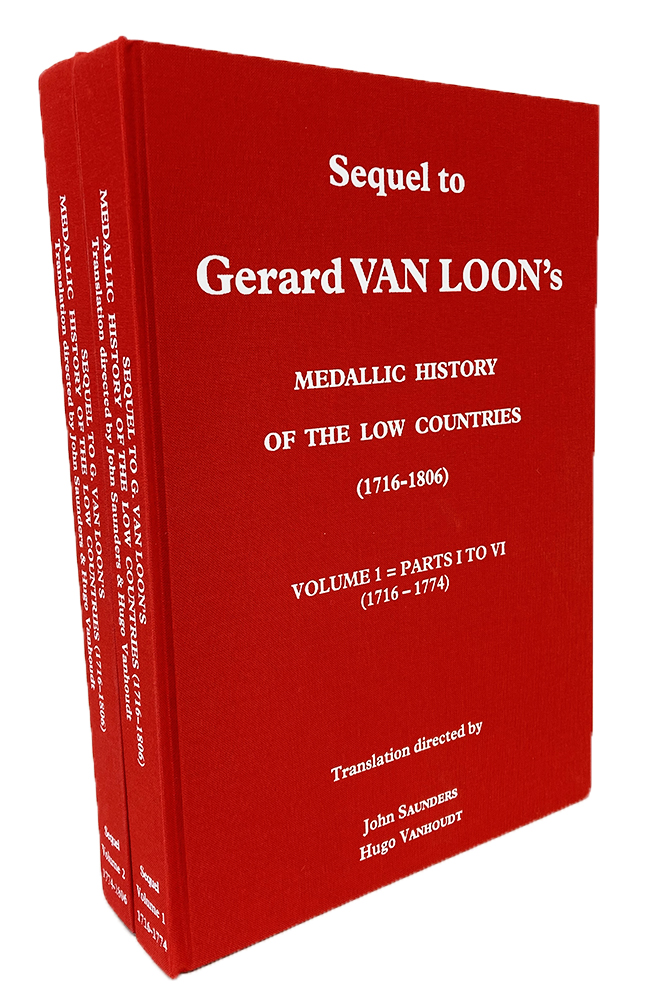
The recent translation of Gerard van Loon’s Beschryving Der Nederlandsche Historipenningen, known as the sequel to his previous work, has been added to the library, showcasing the history of the Low Countries from 1716 to 1806. Despite occasional translation hiccups, such as the misinterpretation of “Excellency” as “Excellence,” and the term “volunteer corpses” instead of “volunteer corps,” the overall quality of the work and the translation is commendable. The volumes, filled with comprehensive content and illustrations, make a valuable addition to numismatic libraries. Despite these minor imperfections, the translation is recommended, and interested individuals can consider purchasing it from Kolbe & Fanning, the numismatic bookseller.
SEQUEL TO GERARD VAN LOON’S MEDALLIC HISTORY OF THE LOW COUNTRIES (1716–1806). Gerard van Loon. Available from Kolbe & Fanning
The translation of a work from one language to another is an arduous task, requiring both technical skill and artistry. It occasionally also requires, for long laborious works of translation, an especially attentive, well-educated reviewer or proofreader, preferably one whose native language is the language into which the work was translated.
A welcome, recent addition to my library, acquired from the numismatic bookseller Kolbe and Fanning, is a translation of Gerard van Loon’s Beschryving Der Nederlandsche Historipenningen. It was originally published between 1822 and 1869 by the Second Section of the Royal Dutch Institute of Science, Literature and Fine Arts. The translation, SEQUEL TO GERARD VAN LOON’S MEDALLIC HISTORY OF THE LOW COUNTRIES (1716–1806), was published in two volumes (740pp.) in 2022. This, and the original van Loon series in translation, is highly recommended for all serious numismatic libraries.
In any event, though well pleased overall with the quality of the work (binding, printing, plates) and the translation, I must note, if only because it has made an impression that the translation of the original van Loon series did not, that there are occasional lapses, or as suggested above, infelicities, in the translation, occurring throughout the Sequel that catch the eye, sometimes to inadvertent humorous effect.
As a trivial example of a translation glitch, the honorific Excellency is translated correctly through most of the two volumes but occasionally appears as Excellence, as in Vol. 2 of Sequel, on p. 2-111, in the phrase “His Excellence the Stadholder.”
Slightly more unfortunate is the translation appearing in Vol. 1, on p. 1-104, in the description of the reverse of medal number 201 which commemorates the Peace of Dresden in 1745. The translator stated the following: “The three principal streams of Germany, viz. the Danube (DANVBIS) the Elbe (ALBIS) and the Oder (VIADRUS) under the guise of Stream Gods; above them respectively the Eagle of the Empire, of Poland, and of Prussia.” That the Danube, Elbe, and Oder are described as streams gave rise to a chuckle. Clearly river was the word for which the translator was reaching. The river-gods would not approve of being masters of mere babbling brooks.
Finally, the translation that inspired this post appeared in Vol. 2, on p. 2-110. I can do no better that present it without introduction: “And then one heard and saw that all over the country so-called volunteer corpses were founded and taught how to handle arms, for which many retired military persons were used, who received very good rewards for their training.” The translator, encountering an irregular plural, not realizing that the plural for corps is also corps, caused me to smile broadly when I came across this gem as I envisioned in my mind’s eye quite the zombie thriller.
Volunteer Corpses?
Despite all the foregoing, the translation of the work is quite able, and the work is highly recommended. I have included links to Kolbe and Fanning and recommend a purchase if it is still available.











 Northcoast Antiquarian