I have completed a draft of a booklet, The Tales and Fables of Lysander Aesopides, exploring wisdom, morality, and the balance of light and shadow. Inspired by “Traditional Slovak Folktales,” I aim to reflect fable traditions and the human condition. Each tale is illustrated with carefully chosen artwork. Join me in exploring these fables, offering reflections and timeless lessons.
It is with some trepidation and absolute pleasure that I announce that I have completed a draft of a booklet, The Tales and Fables of Lysander Aesopides. This collection of fables, written under my chosen pseudonym, explores themes of wisdom, morality, and the intricate balance of light and shadow within the human experience. The name Lysander Aesopides—a blend of ‘Lysander,’ meaning ‘liberator’ or ‘one who is free,’ and ‘Aesopides,’ meaning ‘descendant of Aesop’—symbolizes a continuation of the ancient tradition of fable-telling, while also embracing a spirit of renewal and reinterpretation. Through this persona, I seek to honor the legacy of Aesop, while offering narratives that explore these timeless themes in ways that reflect the complexities of our modern world.
CLICK ABOVE IMAGE TO OPEN A DRAFT PDF BOOKLET OF THE ABOVE COLLECTION OF FABLESOR CLICK BUTTON AT END OF POSTING
The impetus for this work stems from my long appreciation for fables and folktales and the collection of such fables and tales in my library. The release of this draft coincides with the recent arrival of a cherished addition to my library—a volume entitled “Traditional Slovak Folktales”(Collected by Pavol Dobsinsky and edited and translated by David L. Cooper). The stories within, rich with cultural heritage and timeless lessons, inspired me to continue to craft my own set of tales that reflect both the universality of fable traditions and the unique nuances of our shared human condition.
You are invited to explore these fables and tales, where the old meets the new, and where every tale offers a reflection, a lesson, or perhaps even a glimpse into the complexities of our souls. This booklet will continue to grow over time. Also, I saw fit to illustrate each fable with a work of art that seemed fitting to the tale. In time, I suspect I will proffer more explanation within the publication as to why the artwork was chosen.
It is my hope that you find some pleasure in my efforts, as I certainly enjoyed the creation of these nuggets.
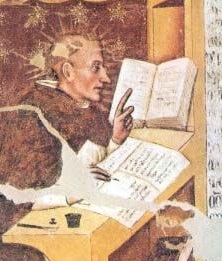
Conveniences commonplace today were once novel. In this regard, today let us remember with gratitude Vincent of Beauvais, who died in 1264 AD, for making access to to the content of books easier. He is credited as having been the first writer to systematically provide indexes for his works, a trend which others eventually followed. He added an index to every single book of his Speculum historiale after 1244. This kind of apparatus only spread more widely in the field of historical writing during the fourteenth century, beginning with the Tabula secundum litterarum ordinem alphabeti on the same work by Vincent, composed by Jean Hautfuney in Avignon around 1320. Thank you, Vincent!
Source: Kujawiński, J. (2015). Commenting on historical writings in medieval Latin Europe: A reconnaissance. Acta Poloniae Historica, Volume 112, 169. Especially see footnote 26, which states the following: “See the study and edition by Monique Paulmier, ‘Jean Hautfuney, Tabula super Speculum historiale fratris Vincentii’, Spicae. Cahiers de l’Atelier Vincent de Beauvais, Nouvelle série, 2 (1980), 19–263 (on Vincent’s indexes, see 20–3), and ibidem, 3 (1981), 5–208. Both Vincent’s and Jean’s indexes are discussed within the history of medieval historiography by Guenée, Histoire et culture historique, 232–7, and within the history of medieval indexes by Olga Weijers, ‘Les index au Moyen Âge sont-ils un genre littéraire?’ in Leonardi, Morelli, Santi (eds.), Fabula in tabula, 11–22, here: 20–1, and il. 5.”
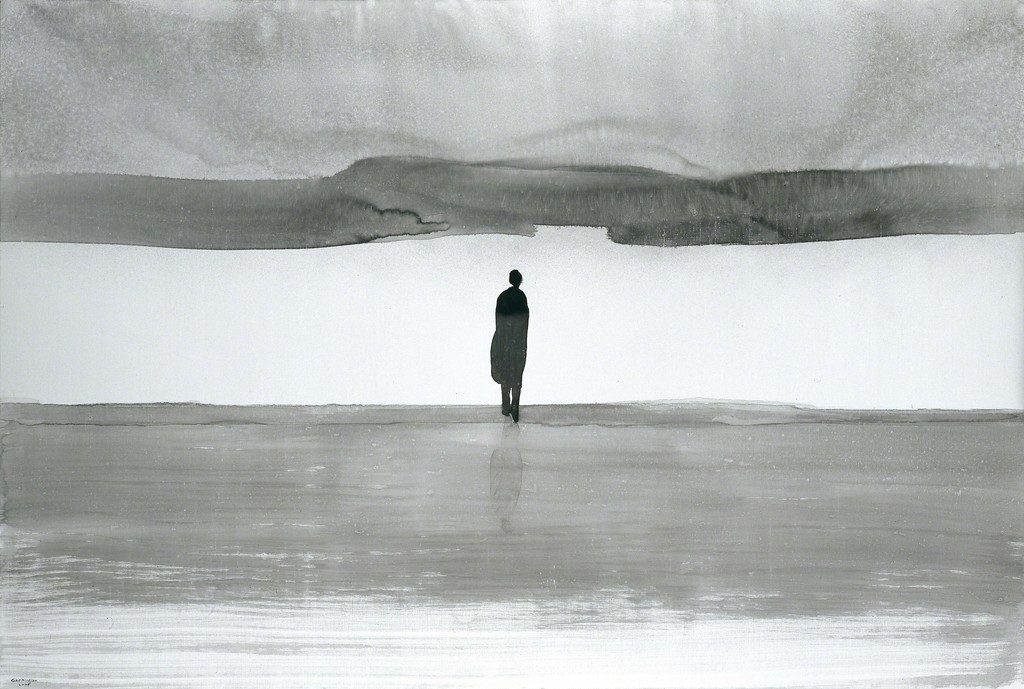
In “L’attente (Waiting) [2004]” by Gao Xingjian, the author finds an appropriate artwork to illustrate his reflections on retreating into a world of words as a sanctuary from the harsh external world, but also as a form of self-imposed isolation. The poem expresses the duality of words as both protection and confinement, shaping the author’s existence, reflecting a life intertwined with letters, sheltered yet constrained by the fortress of his mind.In “L’attente (Waiting) [2004]” by Gao Xingjian, the author finds an appropriate artwork to illustrate his reflections on retreating into a world of words as a sanctuary from the harsh external world, but also as a form of self-imposed isolation. The poem expresses the duality of words as both protection and confinement, shaping the author’s existence, reflecting a life intertwined with letters, sheltered yet constrained by the fortress of his mind.
L’attente (Waiting) [2004] by Gao Xingjian (b. 1940).
As I am confounded by life now, as I was in my youth, I retreat, as always, into a world of words, written on pages and assembled in books. These books surround me, forming walls that at times serve as battlements, the fortifications protecting me from the external perils of an incomprehensible, harsh, and hostile world, or so I tell myself. In other moments, however, these same walls are the confines of a cell, isolating me in solitude, depriving me of the air, sustenance, and human interactions necessary to life and sanity. Thus, the world of words is both my sanctuary and prison.
Of course, playing the poet much of late, and a bad one at that, I transmogrified the above thoughts, into the following:
I retreat, as always, into words, Pages inked and bound in books, Encircled by these silent guards, My fortress walls, my quiet nooks.
At times they stand as battlements, Shielding me from the world’s disdain, A citadel where reason reigns, Against the chaos, fear, and pain.
Yet oft they turn to prison walls, Confines of a solitary cell, Where air and sustenance are scarce, And human warmth does not dwell.
This paradox my soul sustains, A life in letters intertwined, Sheltered by and yet constrained, By the fortress of my mind.
The 1771 AR Medal by Johann Leonhard Oexlein serves as a remarkable numismatic artifact that commemorates a pivotal moment in Polish history—the delivery of King Stanisław August Poniatowski from a plot against him orchestrated by the Confederation of Bar. This post aims to shed light on the intricate details of its design and the political climate of the time.
The Medal’s Artistic Elements
The medal, measuring 44mm in diameter and weighing 21.84 grams, is a work of intricate craftsmanship. The obverse features the Latin inscription “NOLITE TANGERE CHRISTOS MEOS,” which translates to “Do not touch my anointed ones.” It is a quotation from the Bible, Psalm 105:15 (or 103:15 in the Latin Vulgate), where God warns the kings of the earth not to harm his chosen people and his prophets. It depicts an attack on the king by two Furies, one holding a sword and another a torch. The Hand of God descends from a cloud to protect the king, while a storm looms over a cityscape in the background. The artist, J.L. Oexlein, places his signature at the lower right, and the date and time of the event are inscribed in the exergue.
The reverse of the medal bears another Latin inscription, “OCVLI DOMINI SVPER IVSTOS,” meaning “The eyes of the Lord are upon the righteous.” It is another quotation from the Bible, Psalm 34:15 (or 33:16 in the Latin Vulgate), where David praises God for his protection and deliverance from his enemies. Here, King Stanislaus stands before a palace, flanked by kneeling subjects. The exergue carries the phrase “FIDA POLONIA/GAVDET,” which can be translated as “Faithful Poland rejoices.”
Historical Context
The Bar Confederation was a movement of Polish nobles and gentry that opposed the Russian influence and interference in Poland’s affairs in the late 18th century. It was formed in 1768 at the fortress of Bar in Podolia, now part of Ukraine, and lasted until 1772. The confederates opposed Polish king Stanisław II August Poniatowski, who was seen as a puppet of Russia, and against the Russian army that freely accessed much of Poland. They also resisted the reforms that granted equal rights to religious minorities, such as Protestants and Orthodox Christians, in the predominantly Catholic country.
In 1770, the Council of the Bar Confederation proclaimed King Stanisław II August Poniatowski dethroned. Richard Butterwick narrates the events which followed quite ably:
Having declared Stanisław August’s reign void, [the Bar Confederates] decided to abduct him, probably in order to put him on trial. However, the attempt backfired badly, not least because only the king’s version of events is known. In short it is as follows:
On the evening of 3 November 1771 Stanisław August was returning to the Royal Castle from a visit to the nearby residence of Michał Czartoryski, when confederate riders surrounded his lightly guarded carriage. After a brief struggle, they headed out of the city with the wounded monarch. One by one, they lost either their nerve or their bearings, until the king was able to talk round the last of his captors and find refuge in the house of a miller. Help soon arrived from Warsaw. Whatever else actually happened that night, afterwards Stanisław August was able to depict the confederates to all Europe as regicides, and himself as a man of mercy. Despite the pressure from Catherine II for the severest penalties to be applied to the ‘regicides’, he kept his promise to spare his last captor’s life. He even paid him a pension in exile for the remainder of his reign.
-Butterwick, R. (2020). The Polish-Lithuanian Commonwealth 1733-1795: Light and Flame, Yale University Press: New Haven. p. 115.
Butterwick notes that Stanisław August preserved the clothes that he had been wearing that evening as “quasi-relics,” and interpreted his survival from the conspiracy as a sign that he was destined to achieve great things for the Commonwealth. The king also placed even greater trust in Divine Providence going forward. The direct action against the king, however, had unfortunate and far-reaching consequences for the Bar Confederation.
In 1772, Adam Naruszewicz wrote an ode commemorating the king’s remarkable clemency towards the conspirators. Naruszewicz’s “ODA III DO SPRAWIEDLIWOŚCI,” included, at lines 57-60, the following statement: “I can only interpret such a fate as a marvel: to have kings as defenders of their own grievances, to seek revenge through kindness, and with a sincere mind prefer mercy over being a hero of power” (from Naruszewicz, A. (2005). Poezje zebrane. Vol. II. Wolska, B. (ed). Poland: Instytut Badań Literackich. p. 109, which read: “Polszczę to tylko takie los zostawił dziwy: mieć królów obrońcami urazy właściwej, szukać zemsty dobrocią, a umysłem szczerem woleć litości, niż być mocy bohaterem”).
AR Medal by Jan Filip Holzhaeusser. POLAND. 1771, Featuring Adam Naruszewicz and Maciej Sarbiewski. Struck by order of Stanisław August to commemorate these famous Polish poets. HC-3961
Wolska, the editor of the volume that I translated the ode fragment from, implied that Naruszewicz seemed to be contrasting Stanisław August’s humanitarianism with rulers such as the usurper Catherine II and expansionist Frederick II who found their fame on policies of aggression and wars that lead to the deaths of many people (from Naruszewicz, A. (2005), p. 6, which read: “Daje to okazję do przeciwsta wienia postawy pełnej humanitaryzmu władcom budującym swe zna czenie i sławę na wzbudzającej strach agresywnej polityce i wojnach, które przyczyniają się do śmierci wielu ludzi”).
Political Repercussions
The direct assault on the person of the king led the Habsburgs and other foreign courts to withdraw their support from the Confederation of Bar, resulting in, among other things, the expulsion of their members from their territories. This incident also provided the neighboring powers—Russia, Prussia, and Austria—a pretext to highlight the so-called “Polish anarchy,” thereby “justifying” their interventionist policies and the first partition of Poland. Consequently, the Confederation lost much of its European support, and the king reverted to the Russian faction.
Conclusion
The 1771 AR Medal by Johann Leonhard Oexlein is not merely a numismatic curiosity; it is a tangible representation of this tumultuous period in Polish history. It encapsulates the complexities of political alliances, the fervor of nationalistic movements, and the divine providence attributed to the survival of a king. As such, it serves as an invaluable artifact for scholars and enthusiasts interested in the interplay between numismatics and history.
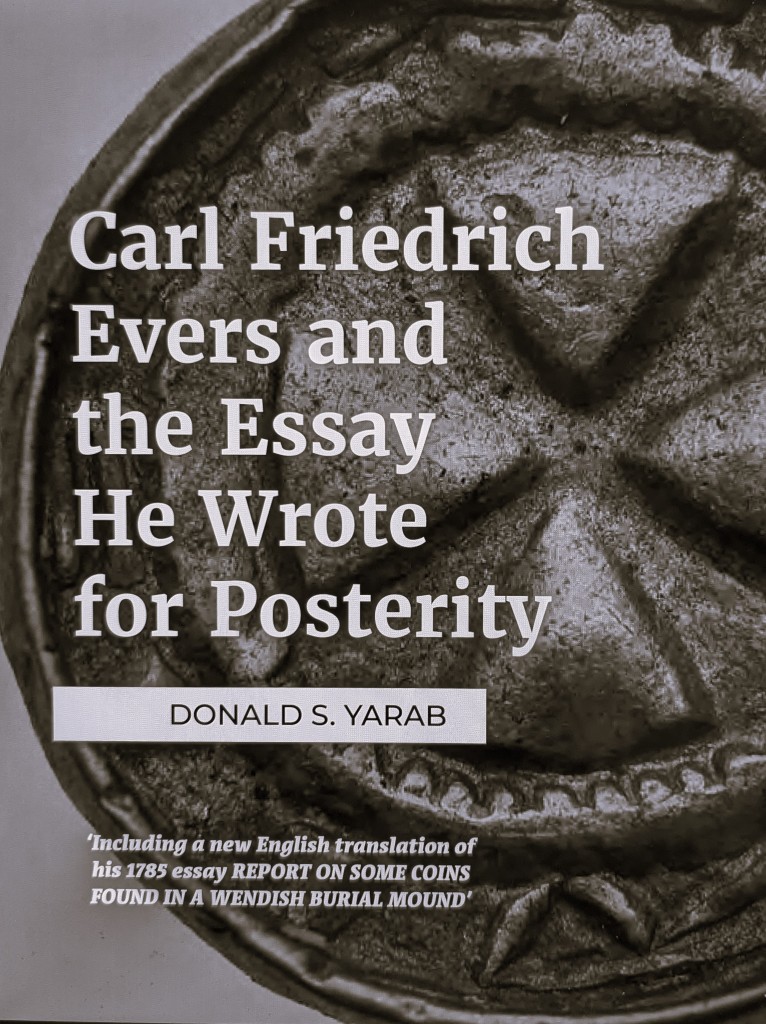
Pleased to have completed a translation of Evers’ 1785 essay, which still appears in scholarship today. Although Evers missed the mark in his attribution of the coins to the Wends, he was nonetheless one of the earliest to attempt a scholarly treatment of the coins now known as Randpfennige or cross denarii and certainly amongst the first to illustrate the coins.
A copy of the monograph I prepared to accompany the translation is available with a click of the button below:








 Northcoast Antiquarian