
The Art of Praise: Tariff Impact on Economics and Ethics

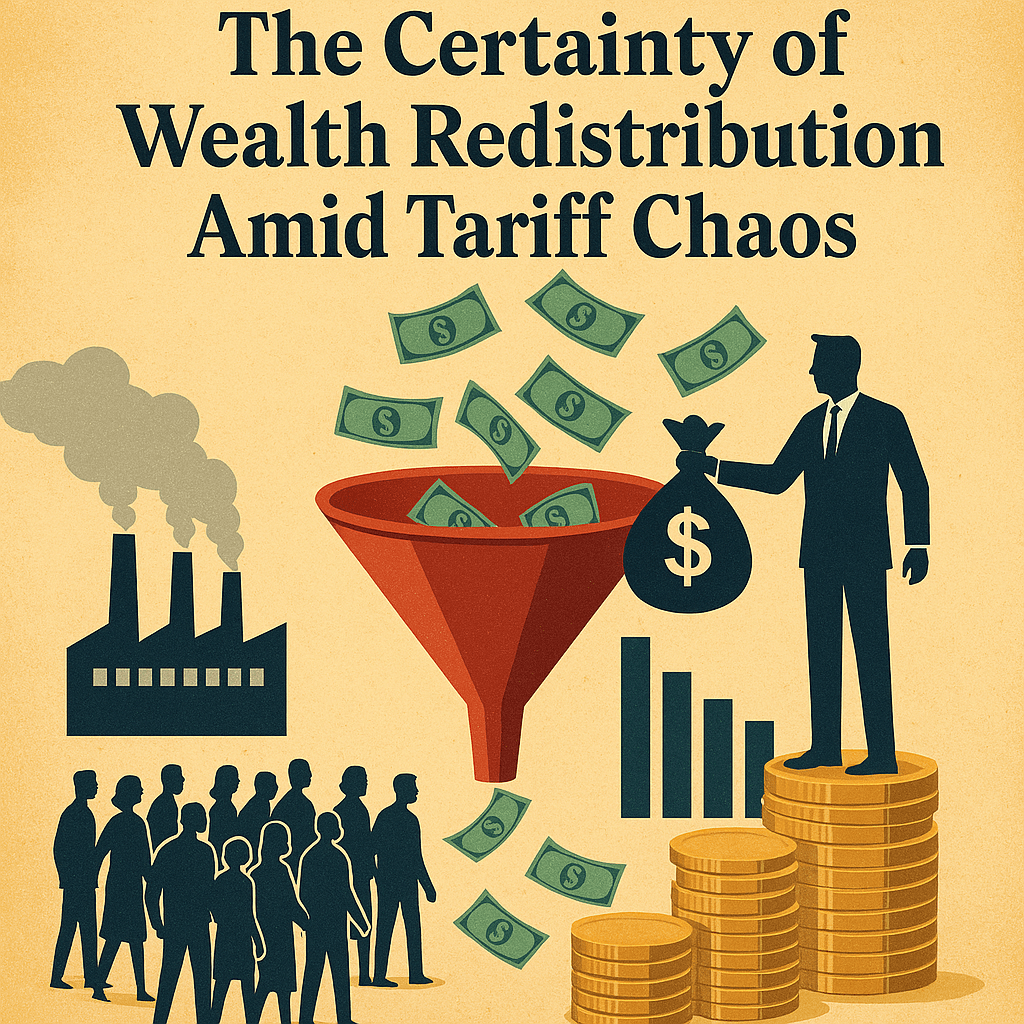
Recently, I published an essay titled The Certainty of Wealth Redistribution Amid Tariff Chaos, in which I argued that the true function of the current administration’s tariff policies was not economic revival, but the deliberate and predictable transfer of wealth from working households to the uppermost tier of financial elites.

Events of the past several days—culminating in imposition of a market-crashing tariff decree swiftly reversed for maximum opportunistic gain—have confirmed my worst fears. That some now praise this spectacle as “brilliant” only adds insult to economic injury.

In response, I offer the following satirical memo from a fictional Wharton Annex ethics professor—one Professor Basil P. Whisker, Chair of Ethical Opportunism at the Weasel School of Business. His observations regarding the situation and the logic he embodies—even though he is fictional—are uncomfortably real.


Professor Basil P. Whisker

On Ethics, Market Manipulation, and the Power of Praise

Buy the Dip, Praise the Dipper: A Wealth Transfer Playbook

By Professor Basil P. Whisker, PhD, MBA, CFA (Parole Honoré Distinction)
Chair of Ethical Opportunism, Weasel School of Business, Wharton Annex
Formerly of the Federal Correctional Institute for White Collar Refinement
“Our Honor Code is Flexible. Our Returns Are Not.”


Some in Congress have raised the unfashionable concern that the recent tariff saga looks suspiciously like market manipulation.

To which I reply: Of course it is.
But for whom?

Not the little people—they lack both the reflexes and the capital reserves. No, it is for the elite few trained in the disciplines of anticipation, flexibility, and pliable morality.

At the Weasel School of Business, we teach that ethics must be nonlinear and dynamic—responsive to the moment, like high-frequency trading algorithms or a presidential memory when questioned under oath. The recent 90-day tariff “pause” (following a dramatic market collapse) teaches students everywhere that sometimes the most profitable thing to do is to:

  1. Create a crisis
  2. Seize the resulting dip
  3. Declare victory through reversal
  4. Congratulate the disruptor for his “brilliance”
  5. Move on before the subpoenas arrive

The Art of the Non-Deal

When a policy announcement wipes trillions from the markets, only to be reversed days later with a triumphant “THIS IS A GREAT TIME TO BUY!!!” post, we must acknowledge we are witnessing not governance but performance art.

Like all great art, it asks difficult questions:

  • Is it market manipulation if you announce the manipulation in real time?
  • Can one declare “Liberation Day” and then liberate oneself from that declaration?
  • If financial whiplash creates billionaire gratitude, is it still whiplash—or merely strategic spine realignment?

Billionaires praising such tactics is not sycophancy—it is advanced portfolio management by other means.

As we say in Weasel Finance 101:
“Praise is just another form of leverage.”


Looking Ahead: A Curriculum of Chaos

We are entering a new phase of global commerce—what I call the Era of the Glorious Lurch. In this new age, tariffs are not policies but market mood regulators, deployed tactically to evoke loss, recovery, and eventual Stockholm syndrome-like gratitude.

My revised syllabus for the coming semester will include:

  • Advanced Self-Dealing (OPS-526)
  • Narrative Arbitrage: Writing History Before It Happens (OPS-618)
  • Strategic Sycophancy and Influence Leasing (co-listed with Communications)
  • Tariff Whiplash: Creating Wealth Through Vertigo (OPS-750)
  • When Textbooks Fail: The Art of the No-Deal Deal (Senior Seminar)

Applications are open. Scholarships available for those with prior SEC entanglements or experience declaring “everything’s beautiful” while markets burn.


A Word on Timing

Critics who suggest that one should wait until an actual deal is struck before declaring brilliance simply do not understand modern finance.

In today’s economy, praise is a futures contract—you are betting on the perception of success, not success itself.

When a policy costs the average American household thousands in higher prices and market losses, only to be partially reversed with no actual concessions gained, the correct reaction is not analysis but applause. After all, it takes real courage to back down without admitting it.


A Final Toast

To the president, I raise a glass of vintage tax shelter with notes of plausible deniability.

To the billionaires celebrating the “brilliant execution” of a retreat, I offer a velvet-lined echo chamber.

And to my students, past and future, I remind you:
If you cannot time the market, at least time your praise.

Because in today’s economy, there is no such thing as too soon, too blatant, or too obviously beneficial to the 0.01%.

So next time markets plunge on policy chaos, do not ask “who benefits?”
Instead ask, “am I positioned to be among those who do?”

Thank you. And as always—
buy low, tweet high, and declare victory before the facts catch up.

Historical Lessons on Government Efficiency from Otto von Pulpo

Sometimes, a little historical memory delivered with a healthy dose of satire is exactly what the moment calls for. I recently stumbled upon this memorandum—allegedly issued by Herr Obersekretär Otto von Pulpo, our resident officious German octopus—crafted as a sharp response to The Economist’s editorial, “Is Elon Musk remaking government or breaking it?” Unsatisfied with the notion that “some transgressions” might be acceptable if they bring about efficiency, I was inspired to share this fictional but incisive critique. Enjoy Otto’s take on why the path of destruction is never a shortcut to genuine reform, and join the conversation on how we should remember history in light of today’s political challenges.


Memorandum No. 843.3a-b(krill)
From the Desk of Herr Obersekretär Otto von Pulpo
Former Archivist, Department of Tentacular Oversight (Ret.), Abyssal Branch
Current Observer of Surface-Level Folly, Emeritus

To the editorial board of The Economist,
cc: The Directorate for Dangerous Euphemisms, Baltic Division

RE: Concerning Your Recent Enthusiasm for “Some Transgressions” in the Service of Government Efficiency

Esteemed humans,

It is with a firm grip and furrowed brow (of the metaphorical kind—our brows are subdermal) that I write to express my alarm, tinged as it is with a deep familiarity, at your recent editorial on the so-called Department of Government Efficiency (DOGE). Your noble publication—usually known for reasoned analysis and fondness for balanced budgets—has recently dabbled in the genre of historical amnesia.

You write, approvingly if not enthusiastically, that “some transgressions along the way might be worth it” in your editorial “Is Elon Musk remaking government or breaking it?” Permit me, as a creature of long memory and cold water, to remind you: some transgressions are never worth it. History is not made by heroic shortcuts. It is unraveled by them.

When I was a much younger cephalopod, gliding the brackish waters near Wilhelmshaven, I recall hearing the surface-world’s chatter about another figure who spoke boldly of waste and stagnation, who promised national renewal, who performed gestures that were first dismissed as eccentric, and who flirted with “creative destruction” until the destruction ceased to be metaphorical. He too was seen by many as a misunderstood innovator. Until it was too late.

Herr Musk, I understand, now punctuates state occasions with gestures uncannily similar to the Roman salute, and praises parties in your former occupation zone with a fondness that suggests more than economic theory. If these are the traits of a reformer, then perhaps I should consider joining the AfD myself—though I suspect I would not pass their purity tests, being both foreign and soft-bodied.

But it is not Herr Musk who most disturbs me. It is your newsmagazine, with your steady tone and Oxford commas, that murmurs, “Efficiency requires boldness,” and wonders aloud whether the destruction is merely a precursor to some unseen creation. You ask: “Who now remembers the Grace Commission?” And I reply: who now remembers the Enabling Act of 1933, passed under the same logic—that extraordinary conditions justify extralegal actions?

Beware the language of renovation when it requires dismantling the foundation. Beware the hagiography of disruptors who come not to build, but to erase. DOGE does not make government more efficient. It makes obedience more efficient.

If I may say so without rudeness, your editorial reads as if it were penned in a warm bath, insulated from the chill that such reasoning brings to those of us with memory. Down here, in the benthic gloom, we remember what it means when legislative bodies and courts are bypassed, when “wrongthink” is rooted out, when civil servants are mocked as obstacles to destiny.

Do not confuse boldness with wisdom. Do not mistake collapse for reform.

With respectful concern and eight meticulously inked signatures,

Otto von Pulpo
Obersekretär a.D.
Archivist, Rememberer, Cephalopod

P.S. Historical Note from the Abyss:

When tectonic plates shift, they do not ask for parliamentary approval. They simply move—and tsunamis follow. I have observed this firsthand from 4,000 meters below. The surfacelings always call it unprecedented, as if the sea forgets. We do not forget.

Herr von Pulpo’s earlier memoranda (Nos. 842.1–843.1) were dispatched in response to similar enthusiasms for charismatic technocrats in the late Weimar period. These were, at the time, unread by those who most needed to read them.

About the Author
Otto von Pulpo is a retired archivist, amateur historian, and former Vice-Chair of the Commission for Bivalve Misclassification. He resides in a gently collapsing wreck off the Heligoland shelf and writes occasionally on democracy, plankton, and the perils of charismatic overreach.

An Ice-Cold Response: Penguins of Heard Island React to Trumpian Tariff Madness

By Gentoo T. Adelie, Chief Diplomatic Penguin of Heard Island

Macaroni Penguin of Heard Island responding in disbelief to the news of the Trumpian Tariffs of 2025.

An Audio Recitation of “An Ice Cold Response” by Gentoo T. Adelie

It was a clear morning on Heard Island. A gentle drift of cloud played among the slopes of Big Ben, and the Southern Ocean moved against the gravel shores with its slow, eternal breath. Among patches of moss and lichen, our colonies bustled with seasonal purpose—territories reestablished, mates greeted, feathers fluffed against the autumn wind. The eastern rockhoppers had returned to their grassland burrows, the macaronis muttered among the coastal tussock, and the gentoos stood sentinel. Then word arrived—borne by a wandering albatross returning from northern skies.

The Trump administration had imposed tariffs upon us.

Tariffs. Upon penguins.

I summoned the colonies. The emperors listened in regal silence, their gold-ringed heads unmoved. The kings shuffled to attention along the icy moraine. The skuas perched nearby, and even the black-faced sheathbill—normally distracted by refuse—cocked a pale head toward the speaker’s mound.

Our indignation was tempered by confusion.

We are not exporters. We are not manufacturers. Ours is not a civilization of spreadsheets, but of rhythm and return. We recognize no currency but krill, no metric but the molt. We nest in the gullies and commune with the icy winds that polish our shores.

It is true that humans have declared sovereignty over us. Flags have been planted, letters exchanged, and acts of parliament signed in Canberra. Heard and McDonald Islands, they assert, are administered by the Australian Antarctic Division, whose bureaucrats maintain that our affairs fall under the jurisdiction of the Supreme Court of the Australian Capital Territory—though no court has ever convened upon our shores.

But let it be understood: though we permit their presence, we do not cede authority.

The king penguin does not bow to Hobart. The Heard Island shag files no petitions. And the sheathbill, should it ever stand before the High Court, will surely eat the brief.

So it was with bewilderment that we received news of the 10% tariff levied by the United States upon our territory. An island with no people, no ports, and no exports—accused of an imbalance in trade. A claim founded on mislabeled shipping data: specifically, six containers of semiconductor components manufactured in Taiwan but erroneously coded as “HRD”—Heard Island’s port code, rarely used but technically valid—instead of “HKG” for Hong Kong by an exhausted logistics clerk working the graveyard shift in Singapore.

Naturally, the memes began to circulate—relayed to us by kelp gulls who’ve developed a taste for human refuse and, consequently, smartphones washed ashore from passing vessels. These gulls, perched near research stations to pilfer Wi-Fi signals (and the occasional protein bar), have become our unwitting ambassadors to digital culture. Among their findings: images of penguins queuing at customs, passports in wing. Shags rebuffed at security checkpoints. A sheathbill with a placard reading “TAXATION WITHOUT MIGRATION.”

The images are amusing. Yet beneath the laughter lies a chill deeper than our glaciers.

The absurdity is not that tariffs have been imposed, but that the structures of power are so far removed from reality as to invent us as participants in their theatre. Our colony is not a market. Our rookery is not a trading floor. If humans mistake our ecological presence for economic threat, then it is their world, not ours, that is disordered.

Even the ecosystem watched with bemusement. The mosses clung silently to volcanic stone. The seals slumped across the glacial flats, unmoved. Life persisted as it always has.

We shall not respond in kind. We shall not embargo the sea. We have no ports to close, no envoys to recall. We shall simply continue—diving into the surf, tending our chicks, enduring the westerlies that lash our coast.

The mosses remember.
The sheathbill remembers.
The ice remembers, too.


Confidential Diplomatic Cable

From: Office of the Subantarctic Avian Council (Provisional), Heard Island and McDonald Islands
Domain: commonwealth.penguin.gov.hm
To: Bureau of Global Trade Anomalies, U.S. Department of Commerce
Date: April 8, 2025
Priority: Routine (given prevailing currents)


RE: ERRONEOUS APPLICATION OF TRADE TARIFFS TO UNRECOGNIZED BIOLOGICAL POLITY

To Whom It May Confound,

We write with a combination of courteous gravity and ice-bound disbelief upon learning that the Territory of Heard Island and McDonald Islands—comprising an uninhabited archipelago, 80% of which is glacier, and 100% of which is devoid of Walmart, Walgreens, or Whole Foods—has been subjected to a 10% tariff by your esteemed administration.

We presume this action arises from the alleged export of “machinery and electrical goods” originating from our domain. As no such items have been observed here since the disintegration of a scientific balloon payload in 1989, and as neither the king penguins nor the black-faced sheathbills have mastered voltage regulation, we suggest an administrative review.

Indeed, it now appears the source of this confusion lies in a series of clerical misassignments within international shipping records. Several bills of lading reportedly list the shipper’s address as “Vienna, Heard Island and McDonald Islands”—a charming bit of geopolitical fiction that, while expanding our sense of empire, sadly bears no relation to geographic or penguin reality.{1}

For clarity:

  • Our economy is non-monetized and chiefly fish-based.
  • Our primary industries include standing, molting, and collective thermoregulation.
  • Our manufacturing sector is limited to guano, occasionally artistic in form but unfit for commercial use.
  • The .hm domain, while charming, is not associated with logistical throughput. It is managed by a sooty albatross with a rusted antenna.
  • No residents, citizens, or consumers exist here in the human sense.

We therefore formally request the rescission of said tariff and the reclassification of Heard Island and McDonald Islands from “Emerging Trade Threat” to “Uninhabited Geopolitical Curiosity.” Alternatively, we are willing to accept foreign aid in the form of high-calorie fish paste, new tagging rings, or a fully functioning weather station.

For future reference, all customs declarations should be addressed to:
Gentoo T. Adelie, Chief Diplomatic Penguin
C/O The Hollow Behind the Third Basalt Outcrop
Atlas Cove, Heard Island
UTM Coordinates Available Upon Request (or clear skies)

We await your reply, though not urgently.

Warmest regards from the coldest coast,
Subantarctic Avian Council (Provisional)

P.S.
Seal No. 1: Be it known we do not seal mail with actual seals. The three elephant seals consulted regarding this matter expressed their disinterest through prolonged snoring, while the fur seals drafted a dissenting opinion consisting entirely of territorial barks. Their contribution to international diplomacy remains, much like this tariff situation, largely symbolic.


{1} The basis of error was uncovered and reported by multiple news sources, such as the following BBC article ‘Nowhere’s safe’: How an island of penguins ended up on Trump tariff list

The Certainty of Wealth Redistribution Amid Tariff Chaos

In the history of American economic policy, few moments have rivaled the current administration’s radical redirection of trade as both a break with precedent and a deliberate provocation of instability. The imposition of universal tariffs, compounded by steep duties on selected nations and penguins, has injected volatility into nearly every sector of the global economy. Yet, for all the uncertainties this policy has unleashed—geopolitical, fiscal, and industrial—one outcome is not only predictable but virtually guaranteed: a significant transfer of wealth from the broad base of American households to a narrow echelon of financial elites.

The administration’s tariff policy, sweeping in scope and nationalist in tone, has been sold to the public as the path to the restoration of American greatness, even proclaimed as a “Liberation Day.” But the reality it heralds is less one of liberation than of reallocation—specifically, a reallocation of economic burden and reward. By taxing nearly all imported goods—consumer staples, electronics, food, clothing, and industrial components—the policy imposes a direct and regressive cost on the average American. Inflationary pressures, rising production costs, and disrupted supply chains ensure that these tariffs function not merely as tools of negotiation, but as economic levers that press down on the middle and lower classes while lifting those whose wealth resides in capital rather than wages.

If the COVID-era recession taught us anything, it is that crises, when coupled with targeted monetary and fiscal policy, can act as engines of wealth concentration. During the pandemic, unprecedented interventions—stimulus checks, expanded unemployment insurance, PPP loans, and Federal Reserve liquidity—managed to momentarily soften the blow for many. Even then, the lion’s share of wealth gains went to the top 0.1%, as asset prices surged and capital-rich investors reaped the benefits of timely speculation and quantitative easing.

But the current recession-in-the-making differs in one essential respect: it is being pursued without pretense of public aid. There are no stimulus packages, no safety nets. What is offered instead is a doctrine of creative destruction: tens of thousands of federal workers laid off; regulatory agencies gutted; international partners alienated; domestic producers left to absorb new costs or pass them on to already-strained consumers. The economic pain is not an unintended consequence—it is the plan. And in such an environment, wealth will not merely trickle upward; it will flood there.

As import costs surge, businesses with transnational supply chains and logistical flexibility will shift production, seek carve-outs, and hedge against volatility. Those without such capacities—local manufacturers, family-owned farms, small retailers—will face thinning margins, layoffs, and in many cases, closure. The financial elite, holding diversified portfolios in real estate, private equity, and multinationals, will swoop into the resulting vacuum, acquiring distressed assets at discount, consolidating market share, and harvesting profits from inflationary dynamics. As was seen in the years following 2020, equity markets may fall precipitously at first, but they are likely to rebound faster than the broader economy—particularly with the Federal Reserve expected to cut interest rates in the wake of contraction. Once again, asset prices will rise. Once again, the owners of capital will see their fortunes grow.

Tariffs are traditionally viewed as blunt instruments of industrial protection. But in this case, they serve a far more surgical purpose. They extract purchasing power from the working class, undermine the viability of small and medium enterprises, and force a restructuring of the American economy around those who can absorb cost, influence policy, and pivot globally. They are not instruments of policy so much as instruments of wealth concentration.

If anything is certain in the unfolding tariff-driven crisis, it is that inequality will increase. Not in abstract or relative terms, but in concrete redistributive ones: trillions of dollars will move from wage earners and consumers to capital holders and financial intermediaries. The historical data, the institutional forecasts, and the structural logic all align. Amid the din of political slogans, retaliatory tariffs, and market disruptions, this is the one truth that should command attention.

History will not record this period as a victory for the American people. It will record it as a transformation: not of manufacturing, not of trade, but of the very architecture of American wealth—concentrated more tightly, held more distantly, and insulated more completely from the needs and voices of the many.

Poetry as Revelation: Engaging with “Vitruvian Man Unbound”

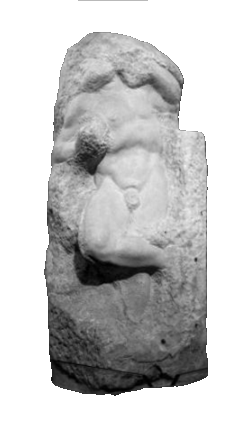
Michelangelo, The Awakening Slave (c. 1525–30).
A body caught between measure and becoming.

I. On Bloom and the Anxiety of Influence

As the poet of Vitruvian Man Unbound, I find myself drawn to Harold Bloom’s understanding of how poetry functions within tradition—not as mere imitation or influence, but as a creative misreading that transforms both predecessor and successor. Bloom’s vocabulary—his clinamen (poetic swerve), daemonization, and apophrades (the return of the dead)—offers a framework for understanding my own relationship with Leonardo’s iconic drawing.

Yet I would press beyond the confines of Bloom’s categorical system. The strongest poetry, as Bloom himself recognized, resists easy resolution. Vitruvian Man Unbound embodies what he called a tessera—a completion of its precursor that simultaneously preserves and undermines its foundational terms. The poem does not simply revise Leonardo; it retroactively reshapes our understanding of him. It allows us to see Vitruvian Man as an incomplete gesture, one whose implicit metaphysical longing only achieves full articulation through the poem’s unfolding of form, desire, and transcendence.

II. The Paradox of Poetic Creation as Discovery

When I began Vitruvian Man Unbound, there was no conceit of a new idea. Rather, I felt I was unearthing the obvious—articulating for the first time verses that had already been rendered, waiting to be heard.

This situates the poem not as invention but as discovery—a Renaissance conception of artistic creation. Michelangelo spoke of liberating the form already imprisoned within the marble. Leonardo, too, conceived of art as revelation through observation, uncovering structures latent in nature and proportion. I participate in that lineage: the transcendence of the circle was already latent in Leonardo’s drawing. My poem does not overwrite Vitruvian Man but unveils what it always contained.

III. Poetry as Transcription of Revealed Truth

Poetry is primarily, in my conception, the art of transcription. Poetry is ultimately truth revealed, however rendered.

This belief is ancient. Poets once invoked the Muse, believing their songs were received rather than authored. Plato cast poets as possessed vessels of divine madness. In scriptural traditions, the prophet or sage writes not from invention but from vision. In this view, the poet is not creator but conduit.

This understanding reorients poetic practice. What matters most is not novelty of theme or form but receptivity—a cultivated attentiveness to truths that ask to be heard. To compose well is to listen well. The most vital poems do not invent so much as reveal. The poet’s charge, then, is fidelity.

Vitruvian Man Unbound aspires to this kind of transcription. It draws out from Leonardo’s image the philosophical tensions embedded therein: between proportion and possibility, containment and becoming, structure and the longing to transcend it.

IV. The Poem’s Journey: From Containment to Transcendence

At its heart, my poem charts a metaphysical journey—the awakening of a consciousness confined within geometry, gradually realizing its cosmic vocation. The Vitruvian figure, bound in ratios and ruled lines, discovers within himself not mere form but flame. The movement is from being drawn to drawing, from being measured to measuring.

The poem gives voice to this paradox: “I am both bound and boundless, large and small, / Both measured part and immeasurable all.”

This is no empty contradiction. It is the philosophical heart of the work. The circle becomes “not wall but door,” not negated but reimagined. Limitation, as I came to understand, is not the enemy of freedom but its precondition. Form does not imprison; it allows the infinite to appear in the guise of the finite.

This idea resonates with multiple traditions: the Christian theology of kenosis, quantum indeterminacy, the aesthetics of the golden ratio, even the existential struggle of Camus’ Sisyphus. In Vitruvian Man Unbound, I sought to draw them all into poetic coherence.

V. Beyond Influence: Co-Creation and Transcendence

My relationship to Leonardo’s drawing is not one of mere homage or critique. The poem does not simply descend from his vision; it reconfigures how I understand that vision. In Bloom’s terms, it enacts an apophrades: the precursor is altered by the successor, the past rewritten by the presence of the present.

I acknowledged this inversion within the poem itself: “Da Vinci dreamed me into being’s start; / I dream myself anew with conscious art.”

This was not rebellion against the tradition but transcendence through deep fidelity. I did not seek to destroy Leonardo’s Vitruvian Man; I hoped to fulfill him. I entered the drawing and found the voice that seemed to have been waiting there. The Vitruvian Man, for me, ceased to be object and became subject, consciousness incarnate.

VI. Poetry as Epistemological Practice

If poetry is the transcription of revealed truth, then it is not merely aesthetic. It is epistemological. It helps us understand not only what is, but how we come to know what is. The most original poems do not dazzle through novelty alone; they resonate because they name what we already suspected was true, but had not yet heard.

Vitruvian Man Unbound aspires to such resonance. I hope it awakens a dormant dimension in Leonardo’s drawing—and perhaps, in us. I did not set out to create a new form, but to reveal the old form’s silent music. For me, it was an act not of invention, but of listening—not conquest, but witnessing. A poetry of revelation.

Thus the ink that once bound becomes the ink that reveals.

VII. Echoes of Prometheus

In reflecting on Vitruvian Man Unbound, I recognize the shadow of another unbound figure—Shelley’s Prometheus. His liberation from cosmic tyranny, his transformation into a visionary voice of harmony, and his rejection of vengeance in favor of transcendence, all resonate deeply with the arc of my poem. Like Prometheus, the Vitruvian figure is not merely released; he is revealed—as a bearer of fire, of knowledge, of poetic truth. It is not accidental that in striving toward the infinite, we find ourselves echoing those myths and verses where the infinite has already spoken.