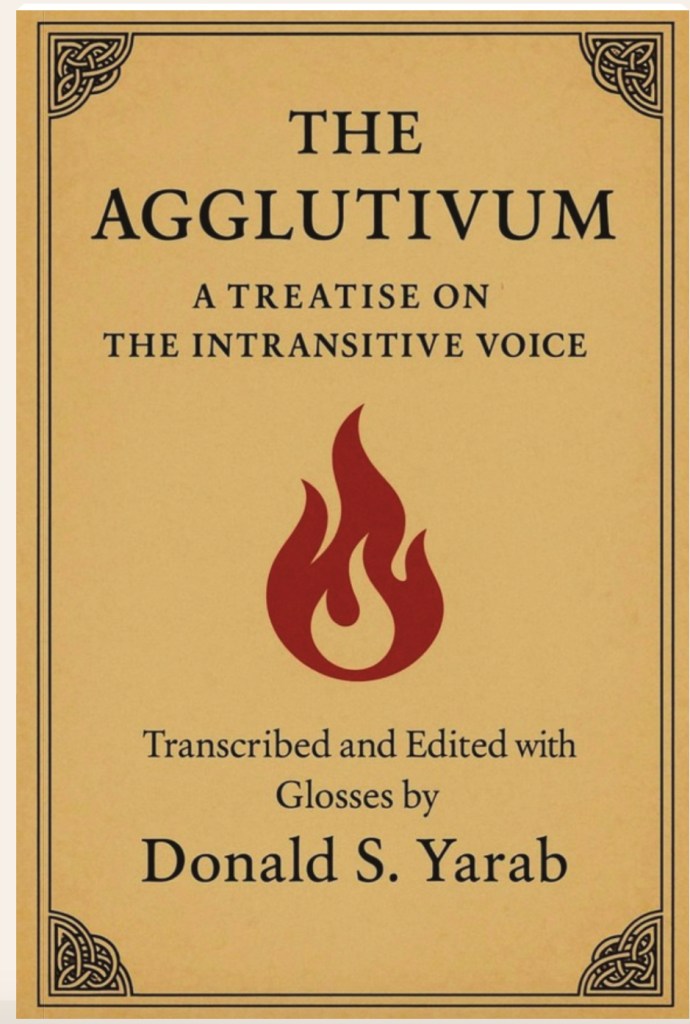
It is difficult to describe the Liber Agglutivi, or as translated into English, The Agglutivum: A Treatise on the Intransitive Voice, for both its origin and content resist conventional classification. Its genesis, as I recount within the pages themselves, was not intellectual but oneiric. The word agglutive—unknown to me then, undefined in any language I … Continue reading “Liber Agglutivi: A Work of Fiction, Philosophy, and Reverence”
The Agglutivum: A Treatise on the Intransitive Voice Transcribed and Edited with Glosses by Donald S. Yarab Paperback, 58 Pages, 6in × 9in, $7.99 plus $5 postage CLICK IMAGE ABOVE TO ORDER BOUND COPY
It is difficult to describe the Liber Agglutivi, or as translated into English, The Agglutivum: A Treatise on the Intransitive Voice, for both its origin and content resist conventional classification. Its genesis, as I recount within the pages themselves, was not intellectual but oneiric. The word agglutive—unknown to me then, undefined in any language I knew—visited me repeatedly in sleep. So compelling was its sound and weight that, upon waking, I began at once to give breath to the whisper that had haunted my rest. What emerged was not story or doctrine, but something stranger and perhaps more elemental.
The text that followed felt less composed than revealed—an excavation rather than a construction. It is, in the truest sense, a received work. Its structure—voculae, glosselitha, silentia, postverba—appeared as if drawn from some hidden grammar beneath ordinary speech. Though shaped in Latin (with an English translation as appendix) and framed by scholarly apparatus, it is not a parody nor a pastiche, but a sincere tribute to the metaphysical impulse in language.
Readers may find echoes of Borges, Vico, and Pseudo-Dionysius; others may see affinities with mystical traditions, liturgical fragments, or even speculative linguistics. It may be read as fictive scripture, poetic glossolalia, philosophical provocation, or theological shadowplay. Or perhaps—if read rightly—it is none of these, but instead a call to silence, to memory, to the threshold of meaning itself.
Let it be said plainly: this work will not appeal to all. It is slow and strange, elliptical and spare. But for the rare reader attuned to the hum beneath the words we know, it may, in its own agglutive way, speak.
The work is available to read through the link below as a free PDF. For those who find affinity with it, an inexpensive bound copy may be ordered by clicking the image of the book above.
A Contemporary Meditation Inspired by the Liber Agglutivi
The Agglutivum suggests but does not systematize a catalog of words that resist conventional grammar—words that seem to create rather than merely describe reality. What follows is a modern attempt to identify and explore such “ontological voculae,” developed in the spirit of the medieval treatise but acknowledging its contemporary construction.
Voculae Agglutivae
A Supplement to the Glossarium Philosophicum Non omnia verba dicuntur ut loquantur. Quaedam dicuntur ut fiant.
I. Sacra Voculae – Sacred Utterances
These words do not inform; they summon. Often liturgical, they retain weight through resonance, not explanation.
Amen Confirmatio sine contentu. —What is confirmed is not always known.
Alleluia Laus pura, sine scopo. —Praise that outruns its object.
Kyrie Clamor, non formula. —Not request, but primal cry.
Hosanna Eruptio, non enuntiatio. —A word of ascent, not address.
Om / Aum Vox quae se ipsam audit. —The breath that sustains itself.
II. Voculae Primitivae – Primal Expressions
Pre-conceptual utterances: the first stirrings of meaning, or the last.
Yes Vocabulum consentientis animae. —Affirmation without argument.
No Negatio sine opposito. —The first refusal of the void.
“Every door leads deeper. Every step farther from certainty.” (Samuel van Hoogstraten, Perspective View of a Corridor, 1662, oil on canvas)
Prefatory Note
In my youth — now roughly four decades past — while studying the slender yet profound Itinerarium Mentis in Deum of St. Bonaventure, there arose in my mind a simple observation: “Thin books are dangerous.” By their brevity, they conceal depths which the unwary may mistake for shallows. By their compactness, they pierce more swiftly, and leave marks more enduring than tomes of a thousand pages.
The small variations presented below draw their form, though not their genius, from the fictions of Jorge Luis Borges — that master of mirrors, labyrinths, and forgotten libraries. If there is any virtue herein, it is owed to his example; if there is error, it is mine alone.
May the reader proceed with care, for the thinnest books, and perhaps the thinnest tales, are those most difficult to escape.
“The shortest books require the longest penance.” — Anonymous marginal note, Biblioteca Laurenziana
I. The Library of Thin Books
In the city of Aram, whose streets no cartographer has ever agreed upon, there was once a secret library known only to a few scholars and fewer fools. It was said to contain the sum of human knowledge, but organized strangely: the thick books were shelved in dusty catacombs, seldom touched, while the thin books were kept in a bright chamber at the center, on shelves of polished cedar.
The Keeper of the Library explained this arrangement to all who entered: “The thick books are for forgetting. The thin books are for believing.”
Each thin book contained a single idea, expressed so perfectly that it resisted all argument. Sovereignty Belongs to the Strong was one book. The World is a Dream of the Gods was another. Still another was simply titled Obey.
Visitors who read the thick books emerged thoughtful and burdened, full of hesitations, counterexamples, and second thoughts. Visitors who read the thin books emerged transformed: resolute, fervent, certain.
Over time, it was not the heavy tomes that shaped Aram’s kings, priests, and scholars, but the thin volumes, read once and carried forever.
It is said that the city of Aram fell, not through invasion, nor famine, nor pestilence, but because, in the end, its citizens each lived by the idea of a different thin book, and could no longer understand one another.
The Library still stands, or so the story goes, though its doors are sealed and the books grow thinner by the century.
There is a final book, the thinnest of all, placed at the highest shelf where none but the Keeper can reach. It contains no words at all.
Its title is: Certainty.
⁂
II. The Shadows of the Books
There is a city — it does not matter which — where it is rumored that a second library exists beneath the great Library of Learned Tomes.
The surface library, the Library of Learned Tomes, is a noble place: its corridors are vast, its tomes heavy with ink and argument, and its readers slow, uncertain, weighed down by the burden of complexity. No truth is simple there; every assertion is marked and belied by a hundred footnotes, every conclusion bruised by rebuttal.
But below, beneath stone and time, there is another library. It is said to be vast but weightless. There, one finds only thin books — so thin they seem at times to flicker in the light, as if they might vanish.
Scholars, sensing the rumors, sometimes descend. They find books titled with dangerous simplicity: Justice is the Right of the Victorious,History is the Story We Tell Ourselves,The Future is Written.
Each thin book feels familiar. And well it should. For these thin books are the shadows of the thick books above¹: each vast, tangled treatise, compressed into a single, unassailable maxim.
The discovery at first seems marvelous. Why wrestle with a thousand pages when the essence can be grasped in a sentence? Why debate, when the answer can be carried in one’s pocket, ready for all occasions?
But the thin books are not summaries; they are distortions. They are what remains when doubt, nuance, and contradiction are stripped away. They are the husks of thought — seductive because they seem lighter, easier, final.
In time, those who read only the thin books come to mistrust the thick ones. They grow impatient with questions, contemptuous of ambiguity, zealous for a clarity that admits no appeal.
Some say that it was not neglect but the rise of the thin books that doomed the upper Library. That the heavy volumes grew dusty because the city’s rulers and citizens alike began to prefer the glimmer of certainty to the slow, earned labor of understanding.
In the end, the Library of Learned Tomes collapsed inward like a drained well. And the shadow library, weightless and triumphant, remained.
Somewhere, perhaps, it still remains.
Somewhere, perhaps, it is growing.
⁂
III. Coda: A Reflection in the Labyrinth
Some say that even the tale you have just read — the account of the thick and the thin, the surface and the shadow — is itself no more than a thin book: a single idea, polished to gleam, shorn of its necessary doubts.
If so, it is but one more glimmer in the labyrinth.
One more reflection upon reflections, cast by a candle already guttering.
One more danger to remember, and to forget.
IV. Scholium
¹ Cf. the lost Tractatus de Umbris Librorum (“Treatise on the Shadows of Books”), attributed to the forgotten scholar Balthasar of Istria (fl. late 13th century), who wrote: “The greater the volume, the more labyrinths it contains; the thinner the shadow it casts, the more swiftly it pierces the heart.” No complete manuscript survives, though fragments are said to be embedded in certain marginal glosses of the Biblioteca Laurenziana. Some dispute the existence of Balthasar himself, suggesting he is merely the invention of later compilers seeking to dignify their own thinness with the patina of lost antiquity.
When I consider thy heavens, the work of thy fingers, the moon and the stars, which thou hast ordained; what is man, that thou art mindful of him? — Psalm 8:3–4 (KJV)
A child, in the earliest unfolding of consciousness, turns to the parent and asks: Why? Why is the sun hot? Why did my pet goldfish die? Why must we grow old? The loving parent does not scorn the child for such questions. Even when the answers stretch beyond what the child can yet comprehend, even when no answer can satisfy the deep, intuitive wonder stirring in the young mind, the parent listens. A gesture, a story, a silence full of tenderness—all serve as a response, for the asking itself is a sign of life, of spirit, of the soul reaching beyond itself.
How then can it be imagined that the Divine—source of all wisdom, all love—would greet humanity’s first Why not with the hush of welcome but with wrath? How could the natural longing to know, to understand the world into which humanity was born, be met not with compassion, but with a condemnation unto death?
It cannot be so. It is not the divine who pronounced guilt over the sacred question; it is man.
The doctrine of original sin, as shaped by priests and theologians, emerges not from divine decree but from human artifice. It is born of fear—fear of questions too vast to answer, fear of mysteries that human authority could neither command nor contain. It is a doctrine not of heaven but of earth, devised by those who sought to regulate the soul’s native reaching beyond the bounds of certainty.
For what is the story of Eden if not the story of the first Why? The yearning for knowledge—the desire to taste, to see, to know good and evil—was not the rebellion of prideful beings but the natural unfolding of consciousness itself. To portray this reaching as disobedience is to misread the very nature of the soul. It is the innocence of the child, multiplied and deepened, that yearns toward the silence, that dares to disturb the hush with a question.
The Genesis narrative itself frames the matter plainly:
“But of the tree of the knowledge of good and evil, thou shalt not eat of it: for in the day that thou eatest thereof thou shalt surely die.” (Genesis 2:17, KJV)
Yet in the original Hebrew, “good and evil” is not a narrow moral distinction, but a merism—a pairing of extremes meant to evoke the totality of human experience. The knowledge at stake was not merely of right and wrong, but of the complexities, ambiguities, and perplexities of life and being itself. It was the awakening of discernment, the painful blessing of full consciousness—the soul’s first stretching beyond the silence into the unknown.
In the unfolding of the tale, it is the serpent who first stirs the question, bidding the woman to see beyond the command to the possibility of knowledge itself:
“For God doth know that in the day ye eat thereof, then your eyes shall be opened, and ye shall be as gods, knowing good and evil.” (Genesis 3:5, KJV)
Yet the serpent, in the original narrative, is not named as a satanic force. That identification is a later gloss, a retrospective layering by later traditions. In Genesis itself, the serpent is simply described as subtle—”more cunning than any beast of the field.” It is not evil in the mythic sense, but a catalyst: a figure who provokes the first stirring of conscious wonder.
The temptation it offers is not toward cruelty or depravity, but toward awareness—the dangerous and sacred gift of discernment. When the woman saw that the tree was “good for food,” “pleasant to the eyes,” and “a tree to be desired to make one wise” (Genesis 3:6), it was not pride that stirred her, but wonder. It was not rebellion, but reverent reaching—the first trembling articulation of the soul’s native Why—that set humanity upon its long and necessary journey into the unfolding mystery.
Later theological traditions, particularly within Christianity, would recast this moment as the origin of inherited sin, a fall from grace so profound that it marred all generations to come. Even softer interpretations would speak of exile—a banishment from divine presence, a sundering of primordial innocence.
But this, too, misreads the deeper rhythm of the story.
There is no fall in the truest sense. There is no exile. There is only awakening.
Awakening carries consequence: the loss of effortless innocence, the onset of labor, of mortality, of sorrow. But it is not severance from the divine. It is the beginning of the soul’s true journey—the movement from unknowing participation in being into conscious, perilous freedom. It is not punishment, but transformation: the invitation to become beings capable of discernment, of wonder, of seeking the infinite even while clothed in dust.
The expulsion from Eden, if it can be called that at all, is no casting away. It is a sending forth—a sorrowful and sacred commissioning. It is humanity’s first trembling step into a world no longer given but always to be made meaningful by seeking, questioning, remembering.
Nor is this reaching confined to Eden alone. Even in the later unfolding of the sacred story, it is the struggle, not the submission, that is honored. Jacob wrestles through the long night with the divine being, refusing to release his grip until a blessing is given. And far from being punished for his audacity, he is renamed—Israel—“one who struggles with God.” (Genesis 32:28) Thus the struggle is made sacred. The refusal to let go, the daring to seek, the ache of confusion: these are not condemned but crowned. The journey was never meant to return to innocence; it was always to pass through mystery, bearing the wound and the wonder of awakening.
Across cultures and ages, humanity has imagined a lost Golden Age—a time when the world was right, when peace and justice reigned, when innocence was unbroken. In religion, in philosophy, in politics, the pattern repeats: there was once a perfection; we have fallen from it; we must find a way back.
Why does this myth endure? Perhaps it speaks to something innate within us: a yearning for wholeness, for rootedness, for a home we can no longer name. Perhaps it soothes the terror of our confusion, offering the hope that disorder and suffering are not our native condition, but a wound that can be healed.
Yet in our fixation on a lost Eden, we risk becoming prisoners of backward-facing time. The myth orients our spiritual gaze toward the past—toward what was allegedly lost—rather than toward what might yet be discovered. We become archaeologists of an imagined innocence rather than explorers of an unfolding mystery. The soul’s natural movement—reaching forward into new understanding—becomes replaced by a desperate scrambling backward toward a manufactured memory.
This temporal disorientation fundamentally misunderstands the nature of spiritual growth. Wisdom is not the recovery of what once was, but the discovery of what has always been waiting to be known. The soul does not develop by returning to an infantile state of pre-questioning, but by maturing through its questions into deeper and more profound questions still.
When we orient ourselves toward a mythical past rather than an unfolding future, we deny the essential nature of consciousness itself, which is not static but dynamic, not preservative but creative. We mistake the spiritual journey for a return ticket when it is, and has always been, a one-way passage into greater mystery, greater wonder, greater questioning.
Moreover, what we call Eden is not a historical reality but a projection of our deepest yearnings. It is the mind casting upon the blank canvas of prehistory its own longing for belonging, for certainty, for uncomplicated being. We imagine a time before questioning not because such a time existed, but because questioning—the fundamental condition of human consciousness—carries with it the necessary burden of uncertainty.
Eden, then, is not a lost homeland but a psychological construct. It is the mind’s attempt to escape the very condition that makes it mind: the capacity to ask, to wonder, to reach beyond what is immediately given. The myth provides a name for our discomfort with confusion, allowing us to imagine that our questioning nature is not our essence but our fall.
And here lies the deeper danger: what begins as a fabricated consolation becomes, in the hands of authority, an instrument of control. The artificial memory of Eden, manufactured to soothe our existential disquiet, transforms into a weapon wielded against the very questioning that makes us human.
For when the myth of a lost Eden is seized by those who would govern—whether priest or king—it becomes a tool of manipulation. The lost paradise becomes a justification for power. If the people can be made to believe they have fallen, they can be led to believe that only through obedience—obedience to those who claim to hold the keys to return—can they be restored.
Thus Eden becomes not a symbol of hope, but a lever of command. Thus nostalgia becomes a chain.
For those who seek to honor obedience as a spiritual virtue, there remains a profound distinction between the willing surrender that flows from understanding and the blind submission that stifles questioning. The former may indeed be sacred—a conscious alignment with wisdom greater than one’s own. It is only when obedience is divorced from the soul’s natural reaching, when it demands the silencing rather than the maturing of questions, that it betrays both the human and the divine.
And the chain wounds. It wounds the individual, teaching him to distrust his own questions, to despise his own longings, to silence the sacred impulse toward wonder within himself. It wounds the collective, stifling thought, suppressing creativity, narrowing the imagination of what a human life or a human community might be. It breeds conformity where there might have been diversity of spirit; it fosters submission where there might have been genuine reverence; it exalts obedience over understanding.
Under the weight of this imagined Eden, humanity turns inward in fear rather than outward in joyful seeking. The soul bows not in awe before mystery, but in terror before judgment.
Thus the myth that was meant to console becomes a force that deforms, a memory that imprisons rather than frees.
Some might argue that certainty provides comfort, that boundaries offer safety, that answers—even if incomplete—shelter us from the storm of unknowing. There is truth in this. Structure can indeed nurture growth, just as the trellis supports the vine. Yet when structure calcifies into dogma, when the trellis becomes a cage, the soul withers rather than flourishes.
Man is neither innately good nor innately evil. Man is innately confused. Born into a world more vast than his mind can grasp, woven from mysteries too great for his language to name, humanity’s first impulse is not toward sin, but toward understanding. The soul, bewildered and reaching, gropes for knowledge not out of pride, but out of need—the need to make sense of the strange and wondrous being into which it has been thrust.
Confusion, then, is not a defect; it is the ground of wonder. It is the blessed ignorance that precedes the sacred question: Why?
It is this confusion—the condition of the in-between creature, made of dust and breath—that makes the human journey necessary. Without it, there would be no seeking, no questioning, no striving toward the silence that calls from beyond the edges of comprehension. Without it, there would be no reaching for the fruit, no ache for the infinite, no longing to pierce the hush with a voice.
The theologians, in their haste to impose clarity where mystery should have remained, mistook confusion for corruption. They mistook the stumbling search for the willful turning away. But confusion is not sin; it is the evidence of our created nature, the signature of beings fashioned for a journey, not for stasis.
To ask Why? is to live as we were made to live: poised between the known and the unknown, between the immediate and the eternal. To forbid the question, to cast the seeking as rebellion, is to deny the very condition of being human.
Thus, the first reaching toward the tree of knowledge was not a crime against the divine. It was the first true act of humanity: the confused, innocent soul daring to stretch toward the beyond.
In our questions, then, we find not our fall but our rising. Not our sin but our salvation. For to ask Why? is to begin the journey home—not to an Eden that never was, but to a wholeness that awaits us in the brave and beautiful reaching of the confused, beloved human heart.
The sacred path is forward—into uncertainty, into wonder, into the endless unfolding of mystery.
Detail highlighting the dust motes from “Støvkornenes dans i solstrålerne” (Dust Motes Dancing in the Sunbeams, 1900) By Vilhelm Hammershøi (1864-1916) Oil on canvas, 70 cm × 59 cm Ordrupgaard Museum. Photograph Public Domain.
Dust lingers in the ruins of empires, in the fading footprints of the past. It clings to the forgotten, settles upon the broken. T.S. Eliot’s The Waste Land declares “I will show you fear in a handful of dust,” evoking a profound existential dread—the terror of insignificance, the finality of death in a world where nothing endures. Shelley’s Ozymandias presents the cruel irony that even the mightiest fall into dust, their ambitions erased by time. Shakespeare reinforces this democratic nature of mortality in Cymbeline, reminding us that: “Golden lads and girls all must, / As chimney-sweepers, come to dust” (Act IV, Scene 2). The biblical refrain, “For dust you are, and to dust you shall return” (Genesis 3:19) serves as a humbling reminder of human mortality—our bodies fated to mingle with soil and ruin.
This narrative of dust as dissolution has dominated our cultural consciousness for millennia. Yet beneath this interpretation lies a profound irony: the very science that revealed our cosmic insignificance also offers us a path to transcendence.
As we began to understand the origins of matter itself, a counternarrative emerged. The spectrographic analysis of stars, the discovery of nucleosynthesis, and the mapping of elemental creation within stellar lifecycles revealed an unexpected truth: the dust of our being is not merely the residue of life lost but the particulate remnants of stars long dead.
This scientific revelation transforms our relationship with dust. No longer just the symbol of our inevitable decay, it becomes evidence of our cosmic lineage. In this expanded understanding, we are made of elements forged in stellar cores—carbon, oxygen, nitrogen, iron—the ashes of ancient supernovae. As Carl Sagan elaborated: “The nitrogen in our DNA, the calcium in our teeth, the iron in our blood, the carbon in our apple pies were made in the interiors of collapsing stars.” (Cosmos, 1980)
The death of those stars gave birth to us. Thus, when our bodies return to dust, they are not returning to nothingness, but to the infinite. This is a poetic inversion of the traditional dread associated with dust. Instead of entropy as a reduction to meaninglessness, it becomes a return to something larger than the self.
Where Eliot shows us fear in dust, Carl Sagan tells us: “The cosmos is within us. We are made of star-stuff.” Lawrence M. Krauss echoes this sentiment: “Every atom in your body came from a star that exploded…. You are all stardust… the carbon, nitrogen, oxygen, iron …. They were created in the nuclear furnaces of stars.” (A Universe from Nothing, 2009)
The Paradox of Cosmic Fear
If one understands oneself as a finite being, bound to decay, dust is terrifying—it signifies loss. But if one understands oneself as an ephemeral expression of the universe, momentarily coalesced and destined to dissolve back into the great celestial flow, then there is no reason for fear. The end is not the end, but a return to origins.
So why does existential dread persist? Perhaps it is the ego’s reluctance to let go of selfhood. Perhaps it is the mind’s inability to accept that individual consciousness does not endure. Perhaps it is because dust, unlike stars, is silent. A ruined city, a forgotten name, a scattering of bones—all speak of oblivion, not grandeur.
As William Blake advised in The Proverbs of Hell, we “Drive [our] cart and [our] plow over the bones of the dead,” suggesting our instinctive fear of becoming that which is trampled and forgotten. Jorge Luis Borges captures this anxiety when he writes that “time is a river which sweeps me along, but I am the river”—we are both the eroder and the eroded, the dust-maker and the dust.
Yet, as a poem once attributed to Emily Dickinson but now considered of uncertain authorship reminds us: “Ashes denote that fire was; / Revere the grayest pile / For the departed creature’s sake / That hovered there awhile.” Dust does not truly vanish. It transforms.
Yet if the erasure of self is what we fear, we must ask: is selfhood truly lost, or merely transformed? If dust dissolves, does it vanish—or does it scatter into something greater?
From Dust to Light: The Redemption of Stardust
Yet if we understand dust not as an annihilation of self but as the very fabric of renewal, the fear dissolves. The metaphor itself must be rewritten: From dust we are made, from stardust we are formed. To dust we return, to the stars we return.
Walt Whitman intuited this cycle when he wrote: “I bequeath myself to the dirt to grow from the grass I love.” (Song of Myself, LII) His biological understanding of transformation prefigures our cosmic one—matter recycled through systems larger than ourselves.
If the metaphor itself shifts, then the meaning shifts with it. We do not fall into dust; we rise into radiance. We do not vanish into the void; we dissolve into the cosmos, as much a part of the next great supernova as we once were of the last. Even in knowing that we return to the stars, a quiet unease remains: what of the self? If I dissolve into light, is there still an “I”?
This cosmic transformation demands a new poetic language—one that recasts the traditional imagery of dust not as a symbol of loss but as a promise of renewal. If we are to truly grasp this shift in understanding, we must reimagine the very metaphors through which we comprehend our mortality. In the spirit of this reframing, I offer these verses that trace our journey from stardust to dust and back again:
From dust we are made— Not of earth, but embered light, Forged in stellar furnace bright, A whisper of stars in the cosmic shade.
To dust we return— Not to silence, not to loss, But scattered bright across the gloss Of galaxies that twist and burn.
Fear not the handful of dust— It is not death, nor mere decay, But embers cast upon the way, To rise once more in cosmic trust.
Thus, the fear in Eliot’s handful of dust dissolves when we see it not as an end, but as a beginning of something else. In the vast cosmic cycle, there is no finality—only motion, only transformation. The Rubaiyat of Omar Khayyam gestures toward this understanding when it speaks of being “Star-scatter’d on the Grass”—our elements returning to the cosmos from which they came. If all that we are, all that we love, all that we create ultimately returns to the stars, is that not immortality?
The Choice of Understanding
We return to the beginning, as dust does. The words of Genesis remind us: “For dust you are, and to dust you shall return.”
Yet now, having traced the journey of dust from earth to stars, we hear these words anew. Through the narrow human lens, we interpret them as a grim certainty—dust as ruin, silence, and the erasure of memory. We see only decay, the dissolution of self, the inevitable fading of all things into oblivion.
But through the enlightened cosmic lens, we recognize a deeper truth. Dust is not an end, but a transformation. It is not absence, but renewal. It is potential, energy, and the foundation of new worlds.
As Jorge Luis Borges reflects in We Are the Time:
“We are the time. We are the famous metaphor from Heraclitus the Obscure. We are the water, not the hard diamond, the one that is lost, not the one that stands still. We are the river and we are that Greek who looks himself in the river.”
Borges, invoking Heraclitus’ ever-flowing river, offers a vision of existence as movement, dissolution, and renewal. We are not fixed, immutable beings; we are the water, ever-changing, ever-returning to the whole. If we are dust, then we are not the dust that settles, but the dust that travels—the dust that, like the stars, finds itself scattered only to be reshaped into something new.
To understand this is to grasp something beyond the immediate and the visible. It is to move past fear into recognition: that what was once bound into form returns to the vastness, not in loss, but in continuation. That what dissolves is not diminished but remade, part of a cycle stretching beyond human time. What Yeats called “a terrible beauty” is born in this transformation—terrible in its finality, beautiful in its cosmic potential.
Perhaps it is our task, then, to choose how we understand our own dust—not as the extinguishing of life, but as its return to the great fire from which it came. In this cosmic understanding, we are not merely dust returning to dust, but light returning to light—briefly kindled, then scattered again, not into oblivion, but into reunion with the luminous whole from which we emerged.
The text explores the myth of Ninurta and the contemporary retelling of Azag’s story, emphasizing themes of power, complicity, and the consequences of forgetting history, blending prose and verse to convey a timeless lamentation.
Cuneiform tablet: nir-gal lu e-NE, balag to Ninurta Seleucid or Parthian Period, ca. 2nd–1st century BC Mesopotamia, probably from Babylon (modern Hillah) Clay tablet inscribed with a hymn of praise to Ninurta, the storm god and vanquisher of Asag, the demon of disease. The Metropolitan Museum of Art, Object No. 86.11.349 (Public Domain Image – Courtesy of The Metropolitan Museum of Art)
On the Inspiration for The House of Azag: A Contemporary Lamentation
Inspiration often comes suddenly and from unexpected sources. While rereading Samuel Noah Kramer’s The Sumerians: Their History, Culture, and Character (1963/1971), I came across a passage recounting the myth of Ninurta, “the god of the stormy south wind,” who in battle destroyed Asag (Azag), “the demon of sickness and disease, whose abode is in the kur, or netherworld” (p. 151).
This passage immediately sparked a question: How would the story of Azag’s heir unfold in the modern age of plague and divisive politics? And how might it be told in the style of a Sumerian lamentation or myth?
The result is a hybrid of prose and verse, a structure reminiscent of ancient lamentations, epic chronicles, and prophetic texts. The prose sections serve as a narrative scaffold, unfolding the events and guiding the reader through the cycle of tyranny, reckoning, and return. The verse distills the emotional and symbolic essence of these events into stark, prophetic utterances, in keeping with the brevity and weight of traditional lamentation poetry.
By blending these forms, The House of Azag mirrors the ancient mode of storytelling in which history, myth, and warning are inseparable. It is both a retelling and a foretelling, a meditation on the cycles of power, complicity, and ruin—and the price a people pay when they forget the past.
An Audio Reading of D.S. Yarab’s The House of Azag: A Contemporary Lamentation
The House of Azag: A Contemporary Lamentation
Part I: The First Reign
The Time of Pestilence
In the days of turmoil, when truth was cast into the dust and the air itself grew thick with sorrow, there arose a ruler from the House of Azag—Azag, the demon slain by Ninurta, yet never truly vanquished. His tongue dripped venom, his hand withered the harvest, and his breath carried pestilence upon the wind. The multitudes, fevered and blind, hailed his coming, for they had forgotten the old warnings. They did not recall the tale, the curse, the name:
From the House of Azag, Azag, the demon slain by Ninurta.
And so, in his first reign, he set forth a sacrifice—one not of fire nor incense, but of breath and blood, of silence and mourning, that the land itself might wail beneath his shadow.
The Reign of Plague
He, of the House of Azag, heir to ruin, Crowned in blight and anointed in ash, Raised his hand, and the heavens grew silent, Breathed his word, and the earth was unmade.
Fevered winds bore his whispered decree, A covenant sealed in the shroud of the dead. And they, the lost, the beguiled, the willing, Bowed before the plague-born throne.
His altars dripped not with oil nor myrrh, But with breathless sighs and broken names. And still they called him savior, still they knelt, Though the air itself was thick with wailing.
The Judgment
Thus was the land cast into shadow, And the wise were scorned, the healers undone. Not by sword nor by fire, but by silence, Did the House of Azag reign.
Part II: The Fall and the Interregnum
The Elder Warrior’s Time
And so it came to pass that after the years of pestilence, when the land was burdened with sorrow and the cries of the forsaken rose to the heavens, an old warrior took up the mantle of the fallen city. He was a man of the elder years, not swift but steadfast, not mighty in arms but resolute in purpose. And he stood against the darkness, bearing the weight of the withered earth upon his back.
He drove out the ruler of the House of Azag—not by blade nor by fire, but by the will of the people, who in their suffering turned against the master of plague. The temples of deception cracked, the halls of power shuddered, and the great beast was cast into exile, retreating to the shadows of the wastelands.
Yet the abominable beast does not slumber.
The Warrior’s Triumph
He, the warrior of elder years, stood firm, His hands worn, his voice a beacon. And the people, weary of death and despair, Turned from the House of Azag.
The tyrant fell, his name a whisper, His throne an empty husk of ruin. And for a time, the land breathed free, And the winds carried no plague.
Part III: The Second Reign
The Return of Wrath
But the abominable beast does not die. Even as the warrior sought to mend the broken walls, the deceiver’s voice slithered through the ruins. He whispered of old glories, of stolen kingdoms, of vengeance against the weak. He promised dominion to the cruel, riches to the corrupt, and absolution to the faithless. And in the dark corners of the land, where grievance festered, where truth was forgotten, and where justice was mocked, they listened.
And the warrior—burdened by years, by the weight of a land divided—fought not with sword or fire, but with weary breath and reasoned word. And they laughed, for reason had no purchase in the ears of the blind.
Thus, through falsity and oath-breaking, through fear and fury, the House of Azag rose once more. And this time, not in sickness, but in wrath.
The Return of the Abominable Beast
He, of the House of Azag, whisperer in shadow, Spoke in silvered lies, and the deaf gave answer. He stirred the dust, and the bitter took arms, He spread his hand, and the oath-breakers swore.
Not by plague, but by vengeance, he came, Not with fever, but with fire. The halls of wisdom he razed, The scribes he silenced, the truth he unmade.
Part IV: The Willing Hands
The People’s Bargain
And when he, of the House of Azag—Azag, the demon slain by Ninurta, called forth his name from the abyss, they who had once trembled at his touch did not recoil. They did not remember the pestilence, nor the wailing of their own dead. Instead, they gathered at the gates, voices raised in fervor, hands outstretched not in defiance, but in welcome.
For he did not come as he had before, cloaked in sickness and ruin. This time, he came bearing gifts—promises of glories unearned, of burdens lifted from their shoulders, of enemies cast into the void. He did not call them to serve, but to rule. He did not ask them to sacrifice, but to consume.
And so they bent the knee, not in chains, but in hunger. Not from fear, but from desire.
And the warrior, standing upon the walls, cried out: “Have you forgotten?”
But they turned their faces from him.
The Willing Betrayal
He, of the House of Azag, called to the lost, And they answered, not with dread, but with praise. For he did not come with pestilence, But with crowns of dust and golden lies.
He whispered: “The land is yours.” And they rejoiced. He promised: “The labor is no longer yours.” And they knelt. He declared: “The past is a burden. Remember it not.” And they cast their own memories into the fire.
Epilogue: The Consequence
The Reckoning to Come
Thus, the gates were flung open, not by the tyrant’s might, but by the hands of the desperate and the blind. They, who had suffered under his reign, now lifted him upon their shoulders, crying, “He is the chosen! He will restore what was stolen!”
But there was nothing to restore. What they had lost, they had cast away.
And when the reckoning came, they wailed once more, Crying out, “How could we have known?”
But their hands were not clean.
For they had built the throne, brick by brick. They had paved the way, stone by stone.
And when the monstrous beast took his seat, He did not need to command them. They carried out his will before he spoke it.




 Northcoast Antiquarian