Amor, che ‘ncende il cor d’ardente zelo, di gelata paura il tèn constretto, et qual sia più, fa dubbio a l’intelletto, la speranza o ‘l temor, la fiamma o ‘l gielo.
Love that lights ardent zeal in the heart, constrains it also with an icy fear, and leaves the mind uncertain which is greater, the hope or the fear, the flame or the frost. — Francesco Petrarca, Canzoniere 182
I. The Divided Heart
Few poets have so perfectly distilled the contradictory essence of love as Petrarch. In four lines, he sets the human heart ablaze and in the same breath subdues it with frost. Love, that “ardent zeal,” becomes inseparable from the chill of fear; the intellect, summoned to arbitrate between hope and terror, finds itself immobilized in doubt. The flame illuminates even as it freezes.
The quatrain serves not merely as an emblem of courtly love but as a mirror of the reflective soul—the soul that, once conscious of its passion, cannot help but analyze it. Every act of self-awareness introduces distance; every act of comprehension tempers immediacy. To understand what one feels is already to stand outside the feeling. Thus, the Petrarchan heart is forever divided: inflamed by emotion, yet cooled by the very intellect that seeks to grasp it.
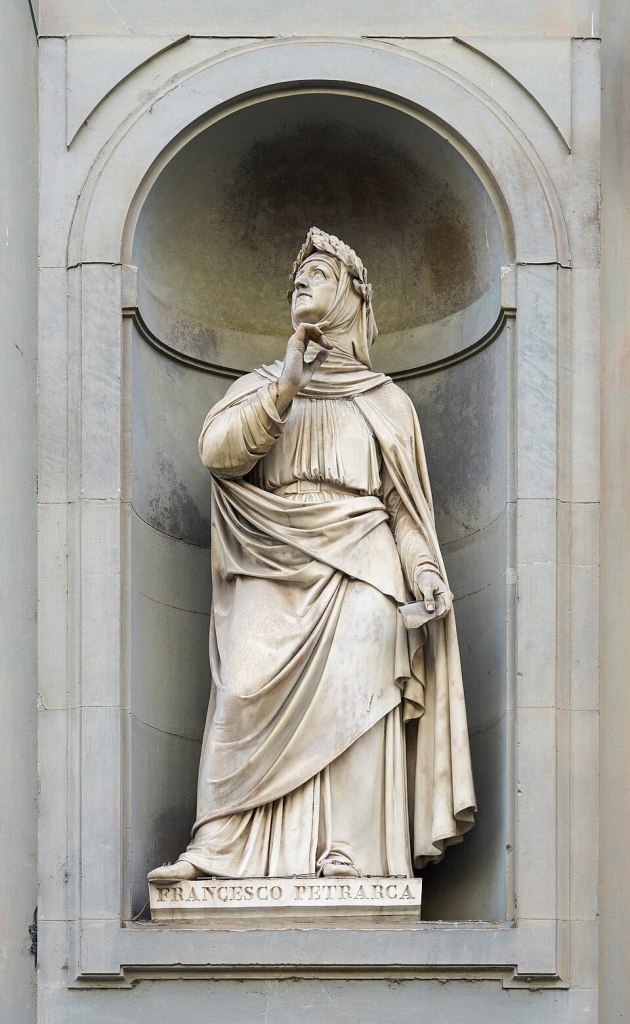
Statue of Petrarch on the Uffizi Palace, in Florence
II. Petrarch’s Paradox—Flame and Frost
In Canzoniere 182, Amore is no mere sentiment but a force of cosmic ambivalence—a sacred fire that binds as much as it liberates. The heart, seized by ardente zelo, is at once inspired and constrained by gelata paura; passion and dread are inseparable twins. But what gives the poem its enduring power is the final turn: fa dubbio a l’intelletto—it makes the intellect uncertain.
This uncertainty is not simple indecision; it is the very mechanism by which passion becomes reflection. The lover’s flame, examined, begins to cool—and that cooling assumes distinct forms.
First, love cools by comprehension. The instant it is understood, passion becomes object rather than subject. The flame is enclosed in glass: it still glows, but it no longer burns.
Second, love cools by doubt of itself. Reflection turns inward, questioning its own authenticity: Is this love true, or merely imagined? In this moment, feeling erodes under the acid of self-consciousness.
Third, love cools by doubt of the beloved. The intellect, unable to sustain idealization, wonders whether the object of devotion merits such intensity. The beloved becomes an emblem—not a person of flesh and breath, but a mirror of perfection that no reality can equal.
Fourth, love cools by doubt of the lover’s worthiness. The heart fears it is unworthy of its own longing. Humility becomes paralysis, and passion folds inward upon itself.
These four modes of cooling form the architecture of Petrarch’s inner world—the endless oscillation between fervor and fear, adoration and self-doubt. He writes not to resolve this tension but to dwell within it. Each sonnet is a chamber where flame and frost coexist, where thought is both confessor and executioner of feeling.
III. Dante and the Alchemy of the Intellect
Dante offers a luminous counterpoint. In La Vita Nuova and the Paradiso, intellect and love are not adversaries but allies; the mind becomes the means by which love ascends. L’amor che move il sole e l’altre stelle—the love that moves the sun and the other stars—does not cool but sanctifies. In Dante, the intellect transforms passion into vision—the earthly beloved into divine wisdom. The flame does not die; it becomes light.
Consider the climactic moment of Paradiso XXXIII, where Dante’s vision finally encompasses the divine mystery. His intellect, far from diminishing his love, becomes the very instrument of its perfection. He describes how his desire and will are turned like a wheel by the love that moves the sun and the other stars. Here, understanding completes rather than constrains. The mind does not freeze the heart; it liberates it into comprehension of the Eternal. Beatrice herself, who began as an earthly beloved, becomes through the intellect’s mediation a guide to the Beatific Vision. Her smile, growing ever brighter as they ascend through the spheres of Paradise, finally becomes too radiant for mortal sight—not because love has cooled, but because it has been refined into pure illumination.
Petrarch inherits Dante’s vocabulary but not his cosmos. His world is one step further from heaven, one degree cooler. Where Dante’s intellect completes love by raising it to the eternal, Petrarch’s intellect contains it, interrogates it, doubts it. He lives in the afterglow of revelation—the warmth still present, but the fire withdrawn. As the Paradiso closes, Dante’s vision resolves into the final harmony of understanding and desire—l’amor che move il sole e l’altre stelle—the line that unites intellect and love in a single act of divine motion. Petrarch cannot reach this synthesis. His flame flickers in the middle distance, neither extinguished nor transcendent.
IV. The Modern Inheritance—Reflection and Alienation
From Petrarch descends the long lineage of reflective melancholy that characterizes the modern mind. His was the first great experiment in self-conscious passion—the attempt to inhabit feeling and analyze it at once. After him, love and thought could no longer coexist in innocence; the very act of awareness altered the nature of what was felt.
Montaigne and the Essay of the Self
Montaigne inherits this disposition and turns it into method. In his Essais, feeling is no longer confessed in the lyric key but dissected in the prose of observation. The heart becomes a field for inquiry, and what was once sung becomes tested, weighed, compared. It is telling that Montaigne quotes Petrarch approvingly: “He who can say how he burns with love, has little fire.” (Chi può dir com’ egli arde, è in picciol fuoco, Canzoniere 137). The aphorism might well serve as Montaigne’s motto, for he, too, knows that passion explained is passion already cooling.
His genial skepticism marks the first full tempering of Petrarch’s flame: affection survives, but only as reflection. The essay replaces the sonnet as the vessel of interior life; emotion, distilled into thought, becomes the study of itself. In Montaigne, we see the completion of a transformation begun in Petrarch—the lover becomes the anatomist of his own heart, and the page becomes not a transcript of feeling but a laboratory for its examination. The warmth of passion is not extinguished but transmuted into the steady light of self-knowledge.
Wordsworth and Emotion Recollected
Wordsworth, centuries later, restores emotion to poetry, yet only by containing it within the frame of recollection. His famous dictum—”emotion recollected in tranquillity”—is itself a Petrarchan paradox, though less tormented. He admits that to write of passion is to have already survived it. The poet stands at a contemplative distance from his own fervor, translating immediacy into memory, fire into afterglow. What once consumed now instructs.
In the Prelude (XII), Wordsworth describes the “spots of time” that preserve the intensity of past experience, yet the very act of preservation requires temporal remove. The flame of immediate experience has cooled into the steady glow of retrospective understanding. Wordsworth does not lament this cooling as loss; rather, he discovers in it a new kind of beauty—the beauty of consciousness reflecting upon its own depths.
Eliot and the Fragments of Feeling
By the time we reach T.S. Eliot, the process is complete. In The Waste Land, the flame is nearly ash. His lines of “memory and desire” register not passion itself but its echo—reverberations in a chamber long since emptied of direct experience. Emotion is mediated through quotation, irony, and allusion; the self no longer speaks but curates its fragments.
Consider the hyacinth girl passage, where memory itself fails to sustain emotion: “I could not / Speak, and my eyes failed, I was neither / Living nor dead, and I knew nothing.” The speaker recalls a moment that should have been transcendent—arms full of flowers, hair wet—but the recollection brings only paralysis, a kind of death-in-life. Even memory cannot resurrect the feeling; it can only gesture toward its absence. The modern condition is not the absence of feeling but its overexposure, its reduction to artifact. The poem becomes the museum of emotion, its vitrines polished and sterile. Where Petrarch’s flame still flickered with real heat, and Wordsworth’s embers still glowed warm, Eliot presents us with the cold remains—fragments shored against ruins. Where Petrarch doubts his own worthiness to feel, Eliot doubts feeling itself. The circle has closed; intellect now governs even absence.
The Progressive Abstraction
Between Montaigne’s self-observation, Wordsworth’s recollected emotion, and Eliot’s fractured memory, one can trace the progressive abstraction of the human heart. Each represents a further remove from Petrarch’s immediacy: what began as a dialogue between love and intellect becomes a monologue of intellect about love. The warmth remains, but it is remembered warmth—the lingering heat of stones long after the fire has gone out.
And yet, in each of these figures, the Petrarchan spark persists. Montaigne’s curiosity, Wordsworth’s reverence for inward life, Eliot’s yearning for spiritual coherence—all descend from that first poet who dared to make consciousness itself his subject. The flame may cool, but its light passes on, refracted through centuries of minds still haunted by the desire to feel purely and the impossibility of doing so once thought begins.
V. The Cooling of the Flame—A Personal Reflection
It is impossible, for some temperaments, to escape this inheritance. Emotion arises, and almost immediately the mind begins to interpret it—weighing, contextualizing, seeking its meaning. In doing so, it drains the warmth from the moment even as it preserves it in memory.
To intellectualize emotion is to betray and to honor it at once. The betrayal lies in the loss of immediacy; the honor lies in the act of remembrance. What the heart cannot sustain, the mind attempts to eternalize. The flame cools into an image—but in that cooling, it endures.
Perhaps the intellect is not the enemy of passion but its afterlife. Every poem, every meditation, every recollection is a small resurrection of a feeling that once burned uncontrollably. The fire itself is gone, but its light remains, steady now, capable of illuminating others.
This is the paradox Petrarch teaches: that the lover who cannot stop thinking destroys the ecstasy of love but gains, in its place, the wisdom of love. To understand one’s passion is to lose it; yet without understanding, it would pass unnoticed, leaving no trace but ashes.
VI. The Light of the Ashes
Petrarch’s quatrain ends in uncertainty, but not in despair. His is not the extinguished flame, but the tempered one. Love and fear, hope and doubt, flame and frost—these are not enemies but necessary contraries. The human soul, poised between ardor and intellect, must learn to bear the tension rather than resolve it.
In the end, intellect does not annihilate feeling; it refines it. The cooled flame still gives light. That light—pale but enduring—is the radiance of thought born from passion, the steady glow of what once burned brightly.
We live by such embers. To love is to burn; to remember is to cool; to think is to preserve. Between these three acts, the heart makes its pilgrimage from fire to frost to flame again—each transformation both loss and grace.
Attic red-figure stamnos from Vulci c. 480-450 BC depicting the myth of Odysseus tied to his ship’s mast in order to resist the enchanting song of the Sirens.
When the ancient image of Odysseus[1] bound to the mast comes to mind—ears open to the Sirens’ song, body restrained by rope and loyalty, the ship cutting forward through perilous waters—it becomes a figure for how medieval Christendom conceived its relation to the classical past. Bound by faith’s restraint, the medieval mind sailed amid pagan wisdom’s dangerous beauty, listening but not surrendering, drawn forward yet always compassed toward the harbor of divine truth.[2]
It is a noble image. And yet.
What if the mast itself—the very bonds—were not divine protection but human construction? What if the Sirens sang not of destruction alone but of truths that authority feared we might comprehend? What if the rope that held Odysseus was tied not by wisdom but by terror—terror of what might be discovered in the listening, in the surrender, in the unrestrained voyage into mystery?
The Pattern Returns
In The First Why, I proffered that the doctrine of original sin emerged not from divine decree but from human fear—fear of questions too vast, of mysteries authority could neither command nor contain. Eden was not humanity’s fall but humanity’s awakening: the first trembling articulation of consciousness reaching beyond certainty into the perilous freedom of knowledge.
The prohibition against eating from the Tree was never divine. It was human anxiety projected backward onto the dawn of consciousness, then used across millennia to condemn the impulse to seek, to know, to ask why.
The pattern appears again, centuries after Eden’s invented fall, in one of Western literature’s most celebrated works. In Inferno XXVI, Dante presents Ulysses—not honored for cunning or for his journey home, but condemned—placed in the eighth circle, wrapped in flame, punished for what Dante calls the final voyage: a crossing of boundaries, a reaching beyond limits, a refusal to accept that the Pillars of Herakles marked the edge of permitted human striving.
And the question returns with urgency: whence does this “divine prohibition” truly come? Divine command—or human fear?
Dante’s Condemnation
The scene in Inferno XXVI is among the most powerful in all of Dante’s Comedy. Speaking from within a tongue of flame, Ulysses recounts his final voyage to Dante and Virgil. Old, having returned at last to Ithaca, he finds himself restless. Neither fondness for his son, nor reverence for his aged father, nor the love owed to Penelope “could overcome within me the desire I had to be experienced of the world, and of the vice and virtue of mankind.”
Thus moved, Ulysses gathers his aged companions and sails westward, past Sardinia and the Pillars of Herakles, “where Hercules his landmarks set as signals, that man no farther onward should adventure.” There he exhorts his crew:
“O brothers, who amid a hundred thousand Perils have come unto the West, To this so inconsiderable vigil Which is remaining of your senses still, Be ye unwilling to deny the knowledge, Following the sun, of the unpeopled world. Consider ye the seed from which ye sprang; Ye were not made to live like unto brutes, But for pursuit of virtue and of knowledge.”
Ulysses tells how he “did render my companions, with this brief exhortation, for the voyage, that then I hardly could have held them back. And having turned our stern toward morning, we of the oars made wings for our mad flight.” After many months, a mountain appears—distant, dark—“it seemed to me so high as I had never any one beheld.” Yet joy turns swiftly to despair: “For out of that new land a whirlwind rose, and smote upon the fore part of the ship. Three times it made her whirl with all the waters, at the fourth time it made the stern uplift, and the prow downward go, as pleased Another, until the sea above us closed again.”[3]
As pleased Another. As Divinity decreed.
Dante, ever precise in his moral architecture, places Ulysses among the evil counselors—those whose intellect and eloquence lead others astray. Virgil names the crimes: the deceit of the Trojan Horse, the theft of the Palladium, and the guile that brought about Achilles’ death (the latter bound in later traditions to stratagems shared with Diomedes). These are the ancient transgressions of cunning; yet the final voyage is Dante’s own invention, extending the sin of false counsel beyond the Homeric mythos and into the metaphysical.[4] In daring to pierce the boundary divinity had fixed—the western limit of human striving—Ulysses becomes not the exemplar of curiosity but of hubris: the brilliant mind mistaking unbounded knowledge for sovereignty.
Critics have long split on whether Dante admires or condemns Ulysses; the poem itself stages that ambiguity, withholding the name of this bolgia—false counsel—until the next canto, so that the rhetoric of heroic quest swells before the juridical label arrives. Barolini notes this “both/and” design: Dante’s style confers grandeur even as the setting is Hell, letting admiration and censure coexist in productive tension.[5]
The Search for the Prohibition
But searching for the source of this prohibition—where, precisely, the gods forbid passage beyond the Pillars—one meets an unexpected thing.
Silence.
Herakles, during the tenth labor, reaches the western edge to seize Geryon’s cattle, setting two pillars to mark the furthest point of achievement: a monument, not a ban. Yet older traditions recall that these were once called the Pillars of Cronus—boundaries of a world still ruled by Titans and Time. When Herakles raised his own in their place, the frontier passed from divine to heroic custody, from the cosmic to the human. The divine threshold became a human one: the boundary of the gods transformed into the horizon of mortal striving. The limit is capacity, not decree.
Roman writers—Pliny, Strabo—treat the Pillars as the edge of the known, beyond which lay Oceanus. Unknown, yes. Unknowable, no. Unexplored, not forbidden. Plato places Atlantis beyond the Pillars. Its destruction follows moral corruption and imperial tyranny, not navigation through a strait.[6] The boundary violated is ethical, not spatial. It is precisely the confusion of those two that allows authority to recast natural exploration as spiritual transgression.
Perhaps, one thinks, a classical voice does warn against the west. Pindar, writing nearly a millennium before Dante, seems a candidate in Olympian 3. Praising Theron of Akragas, Pindar writes that the victor “touch[es] the pillars of Herakles,” and adds: “Pathless the things beyond, pathless alike to the unwise and the wise. Here I will search no more; the quest were vain.”
At first glance, a prohibition. Look closer. The poet exalts Theron’s virtue by comparing it to Herakles’ reach: the victor’s deeds have touched the pillars themselves, but he dares no further. Beyond lies not sin but silence. The poet halts not for fear of divine censure, but from reverence for proportion—the stillness that follows the uttermost word.
Pindar returns to the same image elsewhere, in Isthmian 4, praising the Theban Melissus: “Through their manly deeds they reached from home to touch the farthest limit, the pillars of Heracles—do not pursue excellence any farther than that!” Again, the admonition is one of measure, not interdiction. The poet counsels proportion in achievement, not fear of divine wrath. The Pillars mark not punishment for trespass but the culmination of human excellence: the utmost reach of mortal aretē, beyond which praise, not perdition, would fall silent.
We read here little explicit theological weight, rather a poet’s choice to observe measure, not a divine command to halt forever. Yet I acknowledge this is itself an interpretation, one shaped by my conviction that human consciousness reaches naturally toward mystery rather than transgressing against sacred law. Ancient readers, steeped in traditions of divine order, may have heard prohibition where I hear proportion. The Greek μάταιον πέρα carries shades of meaning—“vain,” “futile,” but also potentially “reckless” or “transgressive.” The ambiguity is real—even a metaphor can accrue normative force within a sacramental worldview. What remains clear is that Pindar offers no explicit divine interdiction, no Zeus commanding sailors to turn back, no cosmic punishment awaiting those who venture west.[7]
The Transmutation
Observe what Dante has done. Between Pindar and the Inferno lies a revolution not of geography but of metaphysics: the rhetorical limit has become a theological one. Where Pindar’s vain was the futility of excess, Dante’s mad flight is the hubris of trespass. What for the Greek was decorum becomes, for the Christian, disobedience.
In this metamorphosis of meaning, boundary becomes law, and poetic restraint is recast as divine architecture. He has taken Pindar’s rhetorical metaphor—a poet’s statement about the limits of praise—and transformed it into a cosmic prohibition about the limits of knowledge. He has taken “Here I will search no more; the quest were vain” (the poet’s restraint) and transmuted it into “None may pursue it; you will be damned” (the theologian’s absolute).[8]
The transmutation operates at every level:
Pindar: a metaphor about achievement. Dante: a literal geographical boundary.
Pindar: the poet’s personal choice. Dante: God’s universal command.
Dante has performed an alchemical transformation: he has taken the raw material of a poet’s metaphor and transmuted it into divine law. He has literalized what was figurative, universalized what was particular, divinized what was human, and weaponized what was wisdom.
And having manufactured the prohibition, he uses it to condemn Ulysses—and by extension, to condemn the impulse that drives all genuine seeking: the refusal to accept inherited boundaries, the courage to test whether limits are actual, the sacred audacity of the question why.[10]
The Pattern Exposed
The same alchemy appears in both Eden and at the Pillars:
Human limits. We are confused. We cannot sail farther.
Establishment of a marker. The Tree. The Pillars.
Sacralization of the marker. God commanded. God ordained.
Prohibition. Thou shalt not eat. Thou shalt not pass.
Damnation of transgressors. Original sin. Hellfire.
Who, then, says the boundary is divine?
Not God. No interdiction is carved into Atlantic stone; no oracle forbids the western sea.
Man does. Man, fearing the unknown, converts the edge of his knowledge into the edge of knowable reality, projects that fear onto the cosmos, and calls it Heaven’s will. Dante maps a theology onto ancient geography, then condemns the figure who reveals—by sailing—that the map was never the territory.
The Confusion of Boundaries
A distinction must now be made—one obscured by Dante’s condemnation and too often blurred by the weight of tradition. Not all boundaries are alike.
There are indeed limits that must hold: moral boundaries, ethical prohibitions, the restraints of justice and compassion that preserve the fragile order of human life. These are not inventions of fear but necessities of conscience. When Plato’s Atlanteans are destroyed, it is for crossing such limits—for turning power into tyranny, order into domination, knowledge into conquest.
But there are other boundaries—geographical, intellectual, imaginative—that exist only until courage or curiosity dissolves them. The confusion of the two, the moral and the cognitive, is the mechanism by which authority sanctifies its own caution. When fear disguises itself as wisdom, exploration becomes transgression, and inquiry is punished as sin.
To say “You shall not murder” is a moral imperative. To say “You shall not question” is a spiritual abdication. To say “You shall not seek beyond this sea” is fear pretending to be faith.
The first protects the sanctity of life; the second denies the dignity of mind. The danger lies not in reverence for limits, but in mistaking the boundary of understanding for the boundary of being.
What Dante Should Have Condemned
Yet acknowledge what Dante perceived, even if he misdiagnosed it. Ulysses does not merely sail west—he abandons. His own words convict him: neither “fondness for his son, nor reverence for his aged father, nor the love owed to Penelope could overcome within me the desire I had to be experienced of the world.”
This is not the voice of responsible inquiry. This is desertion dressed as aspiration.
More: he does not invite his companions to shared discovery. He compels them with wile. “I made them so eager for the voyage that I could hardly have held them back.” That is manipulation, not collaboration. He leads aged men—veterans who have survived “a hundred thousand perils”—not toward a harbor but toward drowning, chasing his private hunger for knowledge while calling it their collective destiny.
The crew never chose. They were moved by rhetoric, not conviction. And they died for his vision, his restlessness, not their own vision or desires.
This deserves condemnation. But this is not what Dante condemns.
Dante does not separate the ethics of the voyage from the fact of the voyage. He does not ask: “Should Ulysses have crossed while abandoning family and compelling his crew?” He seemingly declares: “No one should cross at all.”
The distinction collapses. The how becomes the whether. And in that collapse, all boundary-testing—however careful, however collaborative, however mindful of those we bring with us—becomes suspect. The reckless voyager poisons the well for the responsible one.
This conflation serves authority perfectly. For if seeking itself is the sin, then seeking carefully changes nothing. The prohibition need not distinguish between Ulysses’ abandonment and another’s care, between manipulation and genuine invitation, between private obsession and shared venture. All become folle volo—mad flight—equally damned.
What Dante should have condemned: voyaging that sacrifices others to one man’s will; that mistakes obsession for calling; that abandons the near for the distant without reckoning cost.
What Dante does condemn: voyaging at all past the Pillars, regardless of manner or motive.
The question is not: May we seek? The question is: How do we seek without becoming tyranny in the name of discovery?
That question remains open. It remains difficult. It is the question that matters—the one Dante forecloses by manufacturing a prohibition that makes the crossing itself, not the manner of crossing, the transgression. In doing so, he protects neither ethics nor truth. He protects only the boundary. Yet in condemning the voyager, Dante reveals himself as one.
The Poet’s Presumption
The irony deepens… Ulysses is punished for eloquence that led others past a supposed divine boundary. Yet what is the Comedy but an unauthorized exploration of realms beyond mortal knowing—Hell, Purgatory, Paradise—undertaken by the poet’s own authority?
When Dante the pilgrim expresses hesitation about his journey, saying “I am not Aeneas, I am not Paul,” the poem supplies him with divine sanction. Virgil assures him that Beatrice, sent from Heaven, has authorized the journey. The pilgrim goes with blessing, guidance, permission. In effect, Dante the poet does what Ulysses does: sails past accepted limits, trusting language and vision to bear him where, by his own logic, no living man may go.
Hence the canto’s peculiar power. Dante is drawn to the mariner he condemns, troubled by him, unable to treat him as simple villain. In Ulysses’ folle volo, he glimpses his own presumption mirrored; in the crew-stirring rhetoric, he hears the echo of his own ingenium poeticum; in the final overturning “as pleased Another,” he contemplates the judgment he too might face for like transgression.
He virtually admits as much in Paradiso II, where the skiff that once was “the little vessel of my genius” in Purgatorio I grows into a vessel fit for the open, uncharted sea. “O ye, who in some pretty little boat, / eager to listen, have been following / behind my ship, that singing sails along, / turn back to look again upon your shores; / do not put out to sea, lest peradventure, / in losing me, you might yourselves be lost.”[11] The imagery reprises the condemned voyage of Inferno XXVI, but now under divine auspices: “Minerva breathes, and pilots me Apollo, / and Muses nine point out to me the Bears.” The difference is authorization, not direction. Dante transforms the mad flight into a sanctified one—but his caution betrays awareness of the danger. The admonition to “turn back to look again upon your shores” acknowledges that the line between revelation and presumption remains perilously thin. His journey too might founder “as pleased Another.”
The poem clears the pilgrim of presumption within its fiction, while the poet remains exposed outside it. This is the poet using poetry—that ancient art of mythical theology where truth and falsehood intermingle—to enforce a prohibition while simultaneously transgressing it. Dante wields the dangerous power of poetic invention to declare what is divine and what is forbidden, all while demonstrating that such declarations rest on nothing firmer than the poet’s own creative authority.[12]
The Vindication of History
One date suffices: 1492. Columbus sails west into the Atlantic from the coast of Spain—not literally through the strait at Gibraltar, but past the conceptual boundary the Pillars represented. No whirlwind. No mountain issuing wrath. Land. The “pathless beyond” proves unexplored, not forbidden; unknown, not unknowable. Yet the same civilization that vindicated Ulysses also cloaked conquest in new sanctities, confusing discovery with dominion. The moral ambiguity remains. History vindicates the crossing, not every consequence of the crossing.
The truth endures nonetheless: the boundary was human limitation—of ships, of courage, of knowledge—dressed in borrowed sanctity. Each voyage, each map, each act of inquiry refutes Inferno XXVI’s decree. History does not wholly vindicate Ulysses, but it exposes the fiction of divine interdiction.
The question of who may sail is answered: all may. The question of how we sail—ethically, justly, without turning discovery into domination—remains open.
Where Falsehood and Truth Intermingle
Ernst Robert Curtius reminds us that medieval poetry was mythical theology: a sacred art in which truth and falsehood coexisted, and the boundary between invention and revelation was porous. The poet was not a chronicler of fact but a mediator between visible and invisible worlds, speaking through symbols that both conceal and disclose.
Dante knew this inheritance. His Commedia stands at the summit of that tradition, where poetic creation becomes theological architecture. Yet it is also within this architecture that the seeds of prohibition germinate. For once poetry begins to impersonate revelation, its metaphors may acquire the weight of law. What begins as symbol can harden into creed; imagination becomes instrument.
This is poetry’s two-edged majesty: it reveals and it binds. The same creative power that illuminates hidden truth can also consecrate human invention as sacred limit. Thus Dante’s genius, which mirrors divine creation in its ordering of chaos into cosmos, risks sanctifying the very boundaries it imagines.
Mythical theology is a realm where poetry contemplates itself as revelation. Within that realm, Ulysses’ voice—his call to seek, to know, to pass beyond the Pillars—cannot be silenced entirely. Condemned in theology, he endures in poetry. Even wrapped in flame, he speaks the human truth that divine law cannot wholly suppress: curiosity, though punished, remains indestructible.
The Gates Swing Forward
The gates of Eden swing but one way—forward. There is no return to innocence, only passage through mystery into understanding. The Pillars of Herakles, like Eden’s gate, were never meant to bar humanity’s path but to mark its progress. They stand not as barriers but as thresholds: what one age feared to cross, another calls the beginning of wisdom.
The boundary moves because we do. What once signified the edge of the world becomes the center of a new map. Description becomes prescription only when fear mistakes ignorance for law. The theology of limit—whether spoken at Eden’s tree or the western sea—was never divine decree but human hesitation draped in sanctity.
When Ulysses sailed beyond the Pillars, he did not violate divine order; he fulfilled the order implicit in consciousness—the law that bids the mind test its own horizon. Dante condemns this as hubris, yet his own poem enacts it, proving that imagination cannot be confined by its own prohibitions. Even in Hell, wrapped in flame, Ulysses speaks words that outlive the sentence: “Ye were not made to live like unto brutes.”
Poetry, in condemning him, exalts him. It cannot extinguish what it illuminates. The forbidden voyage becomes the necessary one; the mad flight becomes the first step of reason; the flame of punishment becomes the light of revelation.
Thus the gates, like the Pillars, stand not immovable but ever-receding horizons—each one marking the reach of human comprehension, and beyond it, mystery. Every passage enlarges not merely the world, but the human possibility within it.
The Answer
From whence, then, the Divine Prohibition? From man.
From man, who meets the edge of knowledge and mistakes it for the edge of knowable reality.
From man, whose faltering courage becomes Heaven’s boundary in his telling.
From man, who fears the unknown and projects that fear upon the cosmos.
From man, who must have limits and thus declares them divine.
From man, who damns those who cross and return with news that the gates were never locked.
What is divine is not the prohibition but its contrary: the impulse to question, the courage to seek, the will to sail beyond every human-erected pillar into the waters where truth awaits those who leave the harbor.
Pindar said he would search no more—his quest were vain—in praise. Dante hears “no more” and renders it sin—to go further—in knowledge. History has judged between them.
Eden’s gate and Herakles’ pillars were never barred by divine hands—though human fear has kept them closed in consciousness for millennia. The truth they conceal is simpler and more radical: they were never legitimately closed at all.
Coda: Bound by Reason, Not by Fear
Consciousness asks why. To condemn the asking is to condemn consciousness. To prohibit the reaching is to prohibit our humanity. To damn the voyage is to damn the very quality that makes us more than “mindless brutes.”
The first why rose in Eden. Another why at the Pillars. The whys continue—each a small rebellion against inherited certainty, each a voyage into the unknown, each a test of whether the boundary was ever real.
It was not real. It never was. The “pathless” was merely unwalked. The “forbidden” was only unlived. The “mad flight” was simply the first—until repetition made the forbidden familiar.
We were born to ask, to seek, to reach, to voyage. We were born to test boundaries and find them crossable. We were born to stand at every pillar authority declares ultimate and ask:
Who says we must not pass—the Divine, or man in his fear, in his need for control, in his terror that we might return with news that the prohibition was always empty?
Return, then, to the image with which we began: Odysseus bound to the mast, sailing through waters thick with song. The proper binding is not the rope of fear, which holds us rigid against all that we might learn, but the rope of reason—supple, strong, deliberately chosen. We tie ourselves to the mast not to prevent the hearing but to survive it; not to silence the Sirens but to pass through their song transformed rather than destroyed.
This is the wisdom the medieval image hints at but does not fully speak: we must indeed be bound, but by discernment, not deference. The Sirens sing truths as well as dangers, and the task of consciousness is neither deaf submission nor reckless surrender, but the perilous passage between—listening, testing, reaching forward with eyes open to wonder and consequence alike.
Without asking permission, claiming no sanction but the native authority of consciousness, we sail.
The sacred path is forward—into uncertainty, into wonder, into the endless unfolding of mystery. Each passage widens the horizon; each voyage enlarges not merely the world, but the human possibility within it.
[1] The essay uses Odysseus and Ulysses interchangeably—the Greek and Latin names of the same figure—since the change of name mirrors the change of cultural frame examined.
[2] The image of Odysseus bound to the mast occurred to me while reading Ernst Robert Curtius’s European Literature and the Latin Middle Ages (Princeton University Press, 1983; first published 1953), particularly Chapter XII, “Poetry and Theology,” which examines the relationship between Aristotle, Aquinas, and Albertino Mussato in defining poetry’s place within medieval Christian thought. Although the image was often used by medieval writers as a moral emblem—the anima rationalis bound by reason and faith to resist the sirens of sensual pleasure or deceptive wisdom—it struck me differently. For the scholastic mind, the figure of Odysseus symbolized the proper relation to pagan learning: the faithful scholar tied to the mast of doctrine, able to hear the beauty of Homer, Ovid, and Virgil without being lured from the safe course of orthodoxy. This reading coheres with the Aristotelian-Thomistic framework described by Curtius, in which poetry, though ranked low for its use of sensible image, retained dignity as a vessel of mythical theology—the first and most natural attempt to speak of the divine through story. My own use of the image reverses the traditional emphasis: the mast, once a symbol of protection, becomes a symbol of constraint; the rope, once virtue’s safeguard, becomes fear’s instrument. The voyage through pagan beauty, for me, represents not perilous flirtation with error, but the necessary passage of consciousness through mystery, risk, and discovery toward the harbor of truth.
[4] On Dante’s Christian reinterpretation of Ulysses, see Ernst Robert Curtius, European Literature and the Latin Middle Ages, trans. Willard R. Trask (Princeton: Princeton University Press, 1983; first published 1953), esp. ch. 12, “Poetry and Theology.” Medieval commentators such as Benvenuto da Imola and Boccaccio read Dante’s Ulysses as a moral exemplum: the pagan seeker whose insatiable intellect leads to spiritual ruin. For Curtius, this transformation marks the medieval synthesis of classical myth with Christian teleology—where the Greek hero’s transgressive voyage becomes a cautionary allegory of the limits of human reason before divine order.
[5]Teodolinda Barolini, “Inferno 26: The Epic Hero,” Commento Baroliniano, Digital Dante (Columbia University Libraries), 2018. Barolini shows why readers might feel both awe and censure here. Dante inherits a split Ulysses—Virgil’s trickster versus Cicero’s lover of knowledge—and he writes the canto so that both currents run strong. The style is spare and elevated, granting Ulysses real grandeur (“we made wings of our oars”), yet the moral frame is still Hell. Crucially, Dante delays naming the sin—fraudulent counsel—until the end of Inferno 27, letting the thrill of the quest speak before the verdict falls. In Barolini’s terms, Dante’s pedagogy is “upside down”: Ulysses becomes a classical stand-in for Biblical trespass (what Paradiso 26 calls the “going beyond the mark”), even as his eloquence and ardor unmistakably stirs admiration, both the reader’s and Dante’s.
[7] Pindar, Olympian 3.43–46 andIsthmian 4.19–21. In Olympian 3, Pindar closes: ἐνταῦθα παύσομαι· μάταιον πέρα (“Here I will stop; beyond is vain”). Ernest Myers, The Extant Odes of Pindar: Translated into English with an Introduction and Short Notes (London: Macmillan and Co., 1874), 13: “Now if Water be the Best, and of possessions Gold be the most precious, so now to the furthest bound doth Theron by his fair deeds attain, and from his own home touch the pillars of Herakles. Pathless the things beyond, pathless alike to the unwise and the wise. Here I will search no more; the quest were vain.” Compare Andrew M. Miller, Pindar: The Odes (Berkeley: University of California Press, 2019), 43: “If water is supreme, and of possessions gold inspires the greatest reverence, now Theron to the utmost bounds has made his way through deeds of worth and grasps, from his own home, the pillars of Heracles. What lies beyond is closed to sage and fool alike. I shall not seek it out; to do so would be futile.” Miller observes that Theron’s “victory at Olympia has carried him, metaphorically speaking, to the uttermost limits of the earth.”
The same motif reappears in Isthmian 4, where Pindar praises Melissus: ἀνορέαις δ᾽ ἐσχάταισιν οἴκοθεν στάλαισιν ἅπτονθ᾽ Ἡρακλείαις· καὶ μηκέτι μακροτέραν σπεύδειν ἀρετάν — “Through their manly deeds they reached from home to touch the farthest limit, the pillars of Heracles—do not pursue excellence any farther than that!” [Diane Arnson Svarlien, trans., Pindar: Odes (1990).] Here, too, the Greek speaks not of interdiction but of proportion: μηκέτι (no longer) and σπεύδειν (to hasten, to strive eagerly) suggest sufficiency, not prohibition. The admonition is one of measure — aretē fulfilled, not forbidden. In both odes, the Pillars of Herakles mark the end of proportionate praise, the poet’s own horizon of utterance, rather than a divinely sanctioned frontier of trespass.
[8] Dante’s transformation of Pindar’s poetic self-limitation into divine proscription marks a philosophical shift that Curtius characterizes as the theologization of classical form. See Ernst Robert Curtius, European Literature and the Latin Middle Ages (Princeton: Princeton University Press, 1983; first published 1953). In the medieval synthesis, metaphor becomes architecture: the rhetorical limit hardens into ontological structure. What had been decorum in antiquity becomes ordo under theology—a transmutation of aesthetic proportion into moral law. This process reflects the scholastic habit of reading all boundaries as mirrors of divine order. The result, as the essay observes, is the elevation of poetic restraint into cosmic prohibition: a passage from the measured silence of the poet to the juridical silence of the theologian.
[9] Dante quotations from Inferno XXVI follow Henry Wadsworth Longfellow’s translation in The Divine Comedy of Dante Alighieri, vol. 1 (Inferno) (Boston: Ticknor and Fields, 1867), 278–83. Longfellow’s rendering preserves the elevated archaism and moral gravity of Dante’s diction—particularly in phrases such as “O brothers,” “mad flight,” and “as pleased Another”—which later translators often soften. The choice of Longfellow aligns with the essay’s argument, for it retains the language that best reflects Dante’s conception of Ulysses’ daring as folle volo (mad flight) and the moment of divine retribution, “as pleased Another,” that seals his fate.
[10] Medieval commentators often reinterpreted Odysseus within a Christian moral framework, reading him not as the Homeric hero of cunning endurance but as an emblem of human intellect overreaching its divinely appointed bounds. As Ernst Robert Curtius observes, the Middle Ages transformed classical figures into moral exempla: pagan virtue became the testing ground of Christian humility. The Odyssean voyage, once the image of homecoming through adversity, became for scholastic and allegorical readers a warning against curiosity unrestrained by faith. See Curtius, European Literature and the Latin Middle Ages; also Dante’s Epistola XIII, where he explicitly links poetic audacity to theological order, framing the poet’s vision as divinely sanctioned where Ulysses’ was not.
[11]Paradiso II.1–15, in Henry Wadsworth Longfellow, The Divine Comedy of Dante Alighieri: Paradiso (Boston: Ticknor and Fields, 1867), 13–14. Nautical tropes of the navis animae (ship of the soul) and the iter mentis ad Deum (voyage of the intellect) were commonplaces of medieval allegory; see Ernst Robert Curtius, European Literature and the Latin Middle Ages (Princeton: Princeton University Press,1983; first published 1953), 129–130. Dante consciously develops this traditional image across his poem. At the opening of Purgatorio (“To run o’er better waters hoists its sail / The little vessel of my genius now, / that leaves behind itself a sea so cruel,” I.1–3), his craft is still the modest bark of poetic endeavor. By Paradiso, it has become a great ship fit for uncharted seas. The metaphor thus mirrors his ascent: from the cautious voyage of intellect to the audacious navigation of revelation. The passage recalls Ulysses’ “mad flight” yet recasts it under divine command—“Minerva breathes, Apollo pilots me, / and Muses nine point out to me the Bears.” The poet’s self-awareness is unmistakable: his Commedia itself is the vessel that dares the deep, sailing the perilous waters between revelation and presumption.
[12] Dante’s assumption of the right to speak divine architecture into being belongs to a long and ambivalent lineage of the poeta vates—the poet as prophet, divinely inspired seer, or “maker” whose word partakes of creative authority. The Roman poets had already blurred the boundary between artistry and revelation: Vergil’s Aeneid opens with invocation to the Muse as a divine source of vision (Arma virumque cano… Musa, mihi causas memora), and Ovid identifies poets as vates Pieridum (‘prophets of the Muses,’ Amores 1.1.5). Cicero in De divinatione (1.34) describes those who prophesy (vates) as being inspired by divine impulse (divino afflatu), operating in a state of mental excitement. The Christian Middle Ages inherited and transformed this conception. Augustine (De doctrina Christiana 2.40) appropriates pagan learning as the Israelites took gold from Egypt—valuable truths embedded in error, useful when rightly directed toward God. By the twelfth century, poets such as Alan of Lille and Bernard Silvestris (on whom see Wetherbee, Platonism and Poetry in the Twelfth Century [1972]) employed allegory and mythic language to express theological truths, with Bernard seeing himself as divinely inspired to reveal God’s plan through poetic creation (Cosmographia). Yet both remained within the framework of philosophical theology, subordinating poetic vision to revealed doctrine. Dante advances a bolder claim: he does not merely allegorize theology but constructs the cosmic order through poetic authority, fusing inspiration with auctoritas. In this, Dante absorbs the classical vates ideal into Christian prophecy, theologizing poetic form itself and claiming for the poet a quasi-prophetic role that his twelfth-century predecessors carefully avoided.(Curtius, European Literature and the Latin Middle Ages, Chapters XII & XVII especially). Thus Dante’s Comedy becomes not commentary upon divine order but its imaginative enactment. He does what no theologian could—uses the poetic voice to legislate the unseen, transforming the inspired seer into the architect of the cosmos itself. In this sense, Dante’s poeta vates completes the very pattern the essay describes: the human word assuming divine prerogative, the maker creating not merely song but structure.
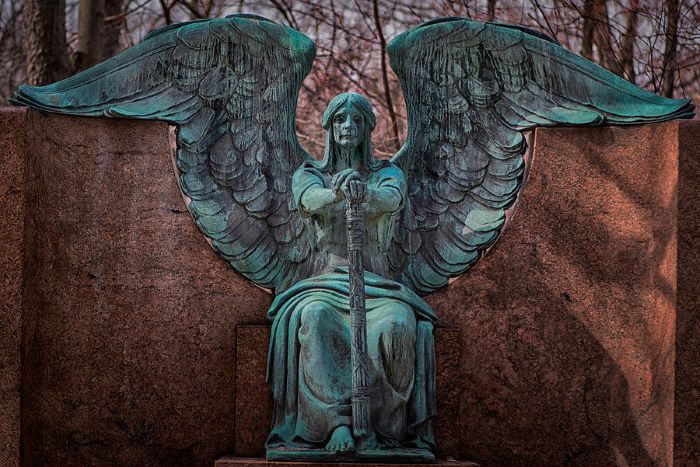
The Angel of Death Victorious is a bronze funerary sculpture with a marble base, created in 1923 by Herman Matzen. It was commissioned by Francis Henry Haserot after his wife’s passing and is located in Lake View Cemetery, Cleveland, Ohio. The photograph was taken by Rosette Doyle.
Yet we keep calling them down, hoping for comfort, dreaming of radiance.
They arrive without warning, bearing weight, not mercy: the silence that collapses sound, the gaze that unravels marrow.
We tremble, for their wings are woven of light we cannot bear to see, of shadow we cannot learn to name.
What they touch is never the same. A tree becomes flame. A breath becomes prayer. A man becomes dust.
But is this terror for one heart alone? No—their shadow falls on cities and nations, their silence unsettles centuries.
They do not stoop to whisper comfort. They stride through millennia, their wings stirring wars and kingdoms, their silence heavier than empires.
Temples tremble, mountains bow down, a bell falls silent in the square, the proud are unmade by a glance that knows no compromise.
Still, we call them down, for without their terror we would never glimpse the depth of beauty, nor know that awe and fear are one.
Awe belongs not to possession, nor fear to a single soul, but to the common lot of mortals who stand together before the unendurable.
Once none dared blaspheme their names— Isis enthroned, Osiris of the underworld, Amun-Ra blazing in the noon, Zeus the thunderer, Hera august, Athena who struck with spear, Apollo of the lyre and light, Artemis who loosed her arrows in the shadows of the wood. Marduk who shattered the dragon, Ishtar of love and war, Baal the rider of clouds, Dagon of the harvest, Chemosh of battle. All received blood and incense, bore the weight of kingdoms, demanded fear.
But now— their names are ink upon a scholar’s page, cartoons in a schoolboy’s jest. Their temples gape as hollow mouths, stones tumbled like teeth in the earth. Their rites are rumor, their mysteries reconstruction, their fires ashes, their echoes gone.
Behold Karnak, roofless to the sky; Delphi, once the navel of the world, silent but for the wind in the laurel. Eleusis, where mysteries bound gods and men, is rubble, its rites reduced to speculation. Uruk, the wall-girt city, mute in the desert. Tenochtitlan, where once the sun fed on blood, now paved by another empire’s stones.
Thus is man mocked by memory: he built to house the eternal, yet what he named eternal is gone. The priest is forgotten with the god, the hymn with the idol, the worship with the fear. All that was called everlasting— proved mortal as dust.
Yet from these scattered stones, a truth emerges: temples fall, names fade, but the hunger endures. Not the idol, but the yearning; not the revelation carved in stone, but the silence men cannot bear.
The divine was never in the image, but in the need that made it. This is the immortal truth: that man longs, and in the longing is closer to the eternal than any god he made.
Yet beware: for the gods that fed on blood still feed— only now in other names, with other temples, upon the lives of men.






 Northcoast Antiquarian