

Against Magical Thinking: Contemplation, Conspiracy, and the Abuse of Sacred Language


Early manuscript
Photo by silvia lusetti on Pexels.com

Recently, I read with great interest Hari Kunzru’s article “Doing Their Own Research” in the New York Review of Books (May 29, 2025). It is a piercing, sometimes surreal examination of the strange coalition now shaping American political and spiritual culture: a “New Weird Fusionism” of right-wing conspiracy, countercultural wellness, and mystical absolutism. The portrait he offers—of a society increasingly shaped by magical thinking, selective paranoia, and a weaponized imagination—was as disturbing as it was insightful.

But what struck me most was the realization that the cultural atmosphere Kunzru describes makes it increasingly likely that contemplative works like my recent Liber Agglutivi will be not merely misread—but conscripted into the very worldview they seek to resist.

In that work, framed as a fictional medieval treatise on sacred language, I explore how language, when approached with reverence and silence, becomes not a tool of communication but a site of presence—how it may not only speak about reality, but participate in it. Yet as I read Kunzru’s analysis of conspirituality—the synthesis of conspiracy and New Age belief—I saw an eerie proximity between certain rhetorical structures in Liber Agglutivi and the thought patterns of this cultural formation: secrecy, marginalia, hidden knowledge, the recovery of “true” language lost to corruption.

The danger is real: in an age where every form of mystery gets weaponized, how do we distinguish between authentic contemplative practice and its paranoid simulacra?

It is precisely here that the contrast must be made explicit.

The Liber is not a manual for decoding reality through esoteric symbols or a codebook for revealing global plots. It is not a mystical justification for control, nor an invitation to gnostic certainty. Its words are not “keys” to hidden truths in the paranoid sense Kunzru describes. Rather, it is a contemplative experiment—a poetic, philosophical invitation to see language as something we enter with humility, not something we wield with certainty.

What conspirituality offers is often a form of linguistic inflation: a conviction that to name something is to master it, that to imagine is to manifest, that hidden truths are personal weapons in a war against “them.” This is not reverence for mystery but inflation through proximity to it. The practitioner of conspirituality approaches mystery as a puzzle to be solved, a code to be cracked that will grant power over reality itself.

By contrast, the Liber offers a theology of kenosis—a self-emptying approach to speech in which the word is not a sword, but a veil; not a control mechanism, but a site of transfigured listening. Where conspirituality seeks to decode, contemplation seeks to be changed by what it encounters.

Consider the difference in practice. A conspirituality adherent might read the Liber’s phrase about “memory that knows not what it remembers” as a hint toward recovering suppressed historical truths or accessing forbidden knowledge that “they” do not want you to have.

A contemplative reader approaches the same phrase as an invitation to sit with unknowing itself—to let the mystery remain mysterious while allowing it to transform one’s relationship to knowledge. The first approach inflates the ego; the second empties it.

Kunzru’s analysis is especially compelling in its treatment of magical thinking across the domains of politics, religion, and economics. It is alarming to witness the persistence of the nineteenth-century “mind-cure” tradition—the belief that reality is downstream of personal attitude—now manifesting as national governance logic.

That Donald Trump, among others, internalized Norman Vincent Peale’s message of mental affirmation to the point that factuality became irrelevant is not merely a character trait—it is a symptom of an epistemological crisis. Similarly, the self-help gospel of The Secret, evangelical prosperity teachings, and the memetic evangelism of internet conspiracists all illustrate a culture in which to believe is to make it so.

The boundary between wish and world is not merely blurred—it is denied.

The Liber Agglutivi, by contrast, insists that language’s creative power arises not from assertive will but from contemplative reception. The phrase “word that becomes the thing” does not mean that the self wills reality into being. It means that, in sacred silence, the word discloses what is already most true.

This is a fundamentally different ontology. It is not manifestation; it is reverent participation.

Kunzru rightly notes how easily mystical language can be conscripted by paranoid styles. The idea that “everything is connected,” which in contemplative practice leads to compassion and humility, in conspiracy often leads to reductionism and scapegoating.

The Liber speaks of memory that “knows not what it remembers”—a phrase meant to evoke mystery and presence, not cognitive shortcuts to hidden truths.

So while Kunzru’s essay is not a critique of my work, it felt like a necessary caution about the times in which such a work might be read. In an age of epistemic confusion and symbolic inflation, sacred language must be handled with even greater care.

We must distinguish between language as control and language as communion; between the voice that silences others and the voice that emerges from deep silence. We must recognize that in our current moment, the very practices that might lead us toward wisdom—attention to mystery, reverence for hidden dimensions of experience, suspicion of surface explanations—can be corrupted into tools of manipulation and division.

The Liber Agglutivi may look like a book of secrets, but it is really a book about unknowing—about hearing the spaces where speech begins. And in a world where every utterance is increasingly co-opted for political or psychological leverage, the commitment to silence, reverence, and the mystery of meaning may itself be the most radical stance available to us.

Words that reign do so only when they have ceased to serve the self.
In our age of weaponized mysticism, that may be the difference between wisdom and delusion, between contemplation and conspiracy.

Bread, Balance, and the Burden of Freedom in Dostoevsky’s The Grand Inquisitor

A Meditation on the Grand Inquisitor in Light of Metaphor and Meaning

“Man seeks not so much God as the miraculous… For man seeks not so much freedom as someone to bow before.”
The Grand Inquisitor, The Brothers Karamazov

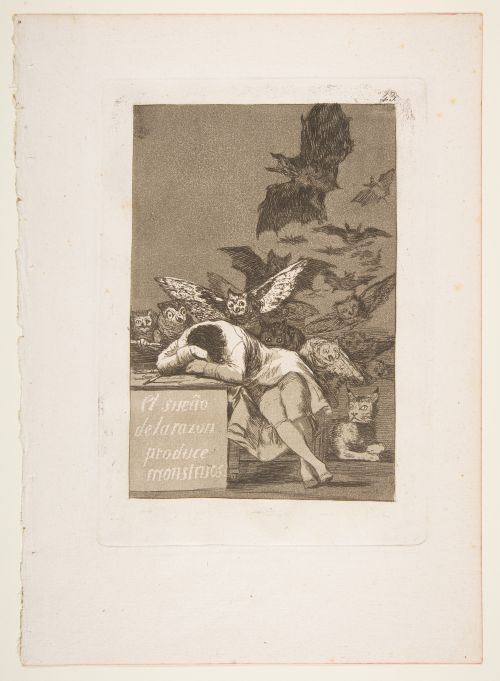
Francisco Goya’s The Sleep of Reason Produces Monsters (1799)—an image of what emerges when the mind abdicates its responsibility: not freedom, but fantasy; not peace, but nightmare. Where reason sleeps, the trinity of miracle, mystery, and authority awakens to devour.

In Dostoevsky’s The Brothers Karamazov, the tale of the Grand Inquisitor remains one of the most unsettling parables in modern literature. Told by Ivan Karamazov to his younger brother Alyosha, the fable imagines Christ returning during the Spanish Inquisition—only to be arrested and silenced by the Church. The Inquisitor, a cardinal of imposing intellect and grave compassion, does not accuse Christ of falsehood, but of cruelty: You gave them freedom, he says, when they needed bread. You gave them mystery, when they needed answers. You gave them love, when they needed order.

There was a time, decades ago, in the earnest conviction of my youth, when I found myself perplexed by the Grand Inquisitor’s logic. I did not admire him, nor excuse his authoritarianism, but I recognized the ache that underpinned his argument. Bread matters. Peace matters. Even then, I sensed the moral gravity of the dilemma he posed: How does one respond to suffering in a world that is often brutal, hungry, and unforgiving?

But I also responded viscerally to something else: the pen of Dostoevsky was not just crafting a fable, but weaponizing a caricature. The Inquisitor was not simply a tragic figure—he was also a polemic against Catholicism, a projection of Dostoevsky’s own religious bigotry. As someone educated within the Catholic tradition, I saw the ugliness beneath the fable—the prejudice tucked behind the parable’s grandeur. The critique was not only of power, but of Rome. The Inquisitor’s mitre bore the unmistakable weight of Jesuit anti-types, cloaked in suspicion and veiled accusation. My disquiet, then, was not only with the Inquisitor’s words, but with the frame within which they were uttered.

And yet, despite its polemical underpinnings, the parable remains one of the most profound meditations on freedom and faith in modern literature. Its imaginative force exceeds its prejudices. The Inquisitor endures not only as a critique, but as a haunting embodiment of the human temptation to trade liberty for comfort.

And that temptation has not faded. The Grand Inquisitor endures because he gives voice to something deeply human, and psychologically real: the desire for security, for certainty, for order amidst chaos. It is a desire that remains active—arguably ascendant—in our own time. One hears the Inquisitor’s voice today in populist strongmen, in the cynical strategist’s smirk, in the media apparatus that soothes while it divides, and in slogans that promise greatness through obedience—Make America Great Again, for instance, the rallying cry of a leader who proclaimed, “I am the only one who can save this nation,” inviting not deliberation, but devotion. The trinity he offers—miracle, mystery, and authority—is the very catechism of modern demagoguery.

This reflection, then, is not a defense of the Inquisitor, but an attempt to understand his appeal, and to reclaim the concepts he distorts. In my recent essay on literalism, metaphor, and balance, I sought to describe the menace of the literalist disposition—a mentality that cannot live with ambiguity, that flees from the poetic, and that finds in surface meaning a shield against the deeper, riskier call of the soul. Here, I apply that lens to the Inquisitor’s three pillars.

Miracle and the Tyranny of the Literal

The Inquisitor offers miracle as literal spectacle: bread conjured from stone, laws suspended, proof offered to silence doubt. He rebukes Christ for refusing to perform such signs in the desert, calling His restraint an act of cruelty rather than spiritual wisdom.

Even as a young reader, I did not mistake the Inquisitor’s miracle for holiness. But I understood that hunger cannot be spiritualized away. In a world where the body is often broken before the spirit can rise, the refusal to give bread seems harsh.

What I have since come to understand is that bread must be shared, not wielded—and that miracles, if they mean anything at all, must point beyond themselves. A miracle that ends conversation is not a miracle but a manipulation.

We have seen modern versions of such miracles: promises made and spectacles staged not to elevate understanding, but to prove power. Consider the border wall—hailed not merely as a policy, but as a singular, salvific act. Its construction, real or exaggerated, was brandished as proof of providence, as the visible sign that the nation could be made great, pure, and safe again. Nor was it the only such “miracle.” Similar wonders were promised: the immediate end of the Russian invasion of Ukraine, the revival of a fading industrial economy, the return of jobs long gone, and the rapid reordering of the global market in our favor. These, too, were presented as guarantees—not to be debated, but to be believed. And like the Inquisitor’s miracles, they have largely yet to be seen.

In my essay on literalism and metaphor, I argued that literalism becomes a menace when it displaces metaphor—when it insists on one meaning, one proof, one visible sign. The Inquisitor’s miracles are precisely that: spectacles that end the need for faith. They are miracles without meaning.

Mystery and the Collapse of Metaphor

The Inquisitor’s use of mystery is a case study in spiritual containment. Mystery becomes the guarded unknown, parceled out by clerical authority to pacify rather than provoke. It is not a sacred unknowing, but a fog of confusion meant to keep the people docile.

But true mystery, like true metaphor, does not confuse—it illuminates by depth. It renders the world porous to truth. It refuses finality not because it is evasive, but because it is more honest than premature closure allows.

I did not reject mystery in youth, nor do I now. But I reject the collapse of mystery into secrecy, the transformation of the ineffable into the inaccessible. Metaphor must breathe. Mystery must invite. When weaponized, they become not sacred, but sinister.

In our current dysfunctional era, mystery is often replaced by conspiracy—a counterfeit that plays the same psychological role, offering significance without wisdom, awe without humility. The literalist disposition, fearing true complexity, gravitates toward these shallow depths. Conspiracy is mystery stripped of humility. It retains the trappings of hidden knowledge but closes the mind rather than opening it. It flatters the believer with secrets while shielding them from ambiguity. It is not reverence for the unknown, but a refuge from the supposed unbearable complexity of reality.

We see this vividly in the ecosystem of conspiracy theories surrounding Trump’s political movement. Whether it is the belief that a global cabal of elites and pedophiles is secretly running the world (QAnon), or that massive voter fraud orchestrated by shadowy networks altered the outcome of the 2020 election, or that figures like Barack Obama, Hillary Clinton, or George Soros are puppet-masters in an international scheme to undermine American sovereignty—each offers an illusion of secret insight in place of the real work of understanding. These narratives are not pursued for their truthfulness but for their emotional certainty. They replace sacred mystery with a kind of gnosis—fierce, insular, and self-reinforcing.

And like the Inquisitor’s mystery, they are not shared to free the soul, but to bind it—to a worldview, to a figure (whether cult, religious, or political leader, a distinction without merit or significance), to a sense of exceptionalist belonging. The effect is not illumination but containment.

Authority and the Displacement of Balance

The Inquisitor’s authority is final, paternal, and brutal in its compassion. It replaces freedom with peace, conscience with obedience. Its appeal lies not only in its force, but in its promise: You no longer have to choose. I will choose for you. And I will feed you.

As I have aged, I have come to see that this vision is not merely imposed—it is desired. Much of the populace is psychologically predisposed to respond favorably to such authority, whether it comes in vestments or slogans. It offers relief from the burden of discernment. It relieves the anxiety of paradox.

This recognition—that the hunger for certainty is as much internal as external—has shaped my own philosophical trajectory.

And that is where the menace lies. This is not a top-down problem alone, but a convergence of design and desire. The Inquisitor gives the people what they already, in some meaningful manner, want: a world made safe through submission. The leader becomes the sole interpreter of truth, the guarantor of safety, the vessel of meaning. Authority becomes a theology in itself.

We have seen this in our time, where devotion to a figure supplants loyalty to principle. When a leader proclaims “I am the only one who can save this nation,” and is met not with unease but with cheers, authority has ceased to be a mediating presence and has become a metaphysical claim. It no longer balances tension; it obliterates it.

In contrast, the authority I defended in my earlier essay was not coercive, but mediating—a balancing presence, a harmonizing voice. It does not dominate or dismiss. It holds the tension without collapsing it. It does not provide peace through closure, but through co-suffering. It listens. It waits.

The Bread and the Burden

So no, I did not approve of the Grand Inquisitor—not in youth, not now. But I acknowledged, and still acknowledge, the ache beneath his argument. It was not cruelty that made him persuasive, but compassion twisted into control—a desire to ease pain by removing the possibility of choice.

What I now see more clearly is that this fable is not merely a theological drama. It is a psychological map. The Grand Inquisitor is the high priest of the literalist disposition—offering miracle that silences, mystery that obscures, authority that absolves.

That disposition is not confined to Dostoevsky’s century. It is at work now—in every movement that prefers spectacle to sign, dogma to dialogue, power to presence. It thrives in political rhetoric, in media narratives, in spiritual systems that replace grace with control.

Dostoevsky does not argue against it. Christ does not rebut it. He answers with a kiss.

A kiss without domination.
A kiss that respects freedom.
A kiss that does not resolve the tension, but chooses to love within it.

That is the burden of freedom: not only to bear it ourselves, but to offer it to others, knowing they may prefer their chains.

To offer bread, but not as bribe.
To teach, but not as demand.
To speak, but not to silence.
To live, still and quietly,
within the balance that resists the Inquisitor’s call.

To refuse the miracle that enslaves,
To offer bread and still preserve the soul,
That is the quiet defiance the world most needs.