
Pondering the Night: A Meditation with Morpheus

“Ponder, O Morpheus, the Night Sky” arose from a meditation on the nature of dreams, consciousness, and the silent mysteries that lie beyond both. Rather than seeking to instruct, this poetic work offers a dialogue — between mortal longing and divine wonder, between question and silence. In addressing Morpheus, the god of dreams, the poem invites not sleep, but contemplation: a shared pondering of the night sky, where the known fades into the unknown, and where even gods may pause in awe before the infinite. It is my hope that this work may serve as a quiet companion for those who have found themselves, at least once, standing beneath the stars, asking questions for which no easy answers are given — and finding, in the asking, a kind of sacred beginning.


Sleep (c. 1771). Oil on canvas, 129.5 x 96.5 cm (38 x 51 in). Cleveland Museum of Art. Depicting Morpheus
Sleep by Jean Bernard Restout (c. 1771). Oil on canvas, 129.5 x 96.5 cm (38 x 51 in). Cleveland Museum of Art. Depicting Morpheus

Ponder, O Morpheus, the Night Sky

“Beyond dreams lies a silence where even gods wonder.”

Prelude: The Summoning of Morpheus

Morpheus, Keeper of the Silent Looms,
hear now the summons not of those who seek forgetfulness,
nor of those who plead for soft illusions to cradle their weary minds—
but of one who, standing alone beneath the immeasurable firmament,
dares to bid thee ponder.

Ponder, thou Weaver of Shadows, the night sky:
the endless, ink-deep vault where Orion’s belt cinches the waist of darkness,
where scattered fires—blue, white, and ancient red—
whisper of secrets too vast for mortal tongues.

Not for dreams of idle comfort do I call thee forth,
but for contemplation;
to set aside for a moment thy ceaseless crafting of mortal visions
and lift thine ancient gaze upward,
where the silent percussion of dying stars
beats out the hidden music of creation.

For if thou, master of phantoms and bringer of luminous memories,
shouldst pause to wonder at that boundless mystery,
then perhaps the soul of man, frail and flickering though it be,
might dare likewise to ask:

Who dreams the dreamers, O Morpheus?
Whence come the visions thou bestowest?
And what lies beyond the last dream, beyond the last star, beyond the last breath of sleep?

Thus the greater query is born, trembling on the tongue of the sleepless,
yearning toward the silence that gathers all speech.

The Greater Query: A Dialogue with Morpheus

Soul:
If thou, O Shaper of Phantoms, canst be stilled by wonder,
then hear the questions borne upon my waking breath,
fragile as they are, yet earnest as the stars are ancient:

Who first whispered the dream into being, before ever thou didst fashion it?
From what unseen wellspring do the rivers of vision flow?
Are the dreams of men but fractured echoes of a deeper song,
or do they weave even now the hidden fabric of worlds yet unborn?

Morpheus (in thought):
Dreams are the trembling of the soul against the veil of the infinite.
They are not born of my will alone, Seeker,
but arise from the deep soil where memory, longing, and the first light entwine.
I but give them form; I do not summon them from the abyss.
Some dreams, frail though they seem, stitch the very edges of what is to be.
Mortals, in dreaming, unknowingly shape the unborn dawn.

Soul:
Is it given to us—dust briefly animated,
clay granted momentary breath—
to pierce that veil?
Or must we first unmake ourselves,
falling through forgetting, to be remembered by the nameless light?

Morpheus:
Beyond all dreams there is a silence
older than stars and deeper than death.
A silence not of absence, but of fullness,
where neither waking nor sleeping holds dominion,
and the soul, naked and unafraid,
beholds itself as it was before all weaving began.

There the true Dreamer dwells—
not I, but He whom none can name,
the source of all dreams, the end of all seeking,
the unspoken, the unseen.

Soul:
And if we seek it,
do we not risk all—memory, longing, even self itself?

Morpheus:
It is the risk of being lost to be found,
the surrender of knowledge to come to knowing.
To seek the Silent One is to set sail upon a sea without stars,
to abandon the safe shores of image and name,
to become at last what thou hast always been:
a breath upon the waters of infinity.

Ponder well, O Seeker,
for in the seeking, thou thyself becomest the dream,
the dreamer,
and the silence beyond.

The Blessing of Morpheus: The Sending Forth

Morpheus:
Go forth, Child of Earth and Stars,
go forth lightly, as one who walks upon waters not yet created.
Carry no burden save the yearning that kindled thy question;
bind no certainty to thy brow, nor shelter fear within thy breast.

Let dreams fall from thee like withered leaves;
let even the constellations become but distant embers,
for thou seekest now what neither dream nor waking thought can compass.

Take not with thee the names men have carved into the bones of the world,
for names shatter against the face of the nameless.
Take not the proud trophies of reason, nor the soft nets of hope,
for these will tear upon the thorns of the infinite.

Instead, take this only:
a heart made naked in wonder,
a mind made silent in awe,
and feet made light as wind upon waters unseen.

And know this, O Soul:
thou art neither lost nor found in this seeking,
for to seek the Silent One is to be gathered even now into His dreaming.

Thus do I, Morpheus, who weaves the veils of sleep,
send thee forth beyond all veils, beyond all sleep,
beyond the last trembling breath of mortal wonder.
Go, and become the question thou hast dared to ask.

Epilogue: The Pondering of Morpheus

And Morpheus stood long in the hush of the night,
his ancient hands unclasped, his brow unburdened of dreams.

He lifted his gaze once more to the immeasurable vault,
where scattered fires—blue, white, and red—
burned against the black breast of infinity.

He pondered—
not as god to mortal, nor as master to servant,
but as wonder to wonder,
breathless before a mystery he too could not wholly grasp.

In the stillness beyond weaving and shaping,
he glimpsed, as in the faintest shimmer of distant nebulae,
a vastness where even gods must bow their heads,
where even dreams dissolve like mist before the morning sun.

And in that silence, older than all his songs,
Morpheus smiled—
not because he understood,
but because he wondered still.

He felt a pang—brief and piercing—
a mortal ache for the fleeting fierceness of human wonder,
so bright and brief.

And so he pondered, and the night pondered with him,
until speech was stilled,
and he was lost—and found—within the endless deep.

Between Noise and Silence: On the Literal, the Metaphoric, and the Space Where Meaning Resides

Rembrandt, “Philosopher in Contemplation” (1632). A quiet spiral of thought, descending into the hush between certainties.

“The soul speaks most clearly when the tongue is still.”

There are days now, more frequent than before, when I find myself recoiling—not from people, exactly, but from a certain tone, a cast of mind. It is the literalists who unsettle me. Those who cling to the concrete as though it were the last raft afloat. The older I grow, with my silvered hair, the more their certainties feel not reassuring but menacing. It is not their knowledge I fear—it is their refusal to admit the unknown, the unspoken, the not-yet-understood.

And yet, I do not mean to dismiss the literal out of hand. I was trained in it. I lived among it. I applied law to facts with the solemn responsibility of rendering findings in civil rights complaints—decisions that shaped lives, guided by precedent, statute, regulation, policy, and the weight of written word. The literal is necessary. It is the groundwork. The shared foundation upon which meaning may be built. One must know the noise, the surface of things, before any deeper hearing is possible. Literalism is not, in itself, a failing. But to dwell in it wholly, to build a temple upon it without windows or doors—that is a failure of imagination and perhaps of courage.

There is something holy, or at least essential, in the gaps. The hush between words. The pause before reply. The silence that says more than any explanation could. It may be peace. It may be sorrow. It may be nothing at all—and that nothing may yet be everything.

The paradox thickens with age. I cannot dismiss the concrete—it is how we meet one another—but I also cannot abide those who live only by its rule. The world is not built entirely of clarity, nor is it meant to be. There is a path somewhere between the clamor and the silence, and perhaps I am only now beginning to find it.

The literal is our first tongue. It is how the child learns: this is a stone; that is a tree. Language builds the world we inhabit. And in that naming, in that first apprenticeship to the visible and the graspable, we are equipped with the tools to navigate life’s surfaces. We learn to classify, to divide, to act. It is a necessary scaffolding, even beautiful in its clarity.

But what follows—what truly shapes the soul—is what one does once that scaffolding has served its purpose. It is in the gaps, the silences, the places where the scaffolding falls away, that something more begins.

The darkness between the stars, or perhaps the light that filters through cracks in ancient stone, draws us to pause. It is not the substance, but the space between the substance, that calls us to deeper thought. The hush in a conversation—not the words, but the breath that precedes or follows them—can speak more profoundly than the speech itself. The crevice between certainties is where wonder slips in.

In these spaces we do not necessarily find answers. Sometimes we find transformative questions. Sometimes only presence. And sometimes only ourselves, which may be enough.

There is a wisdom in the void that no amount of noise can manufacture. Not the nihilism of meaninglessness, but the reverent recognition that meaning, like light, often travels best through emptiness.

To live entirely in the measured and known is to dwell in a museum of certainties—tidy, lifeless, unmoved. But to discard all that for a world of formless suggestion is to risk disappearance. The task is to dwell attentively in both: to know the stone as stone, and then sit long enough beside it to feel what it is not.

There are those who seek certainty in everything—in people, in relationships, in experiences, in outcomes. They crave contracts over conversation, definitions over dialogue. To them, ambiguity is a flaw, unpredictability a failure. But in securing themselves against uncertainty, they forfeit something essential. They miss the quickening of the heart in a half-spoken promise, the richness of a glance misunderstood, the poetry of a thing only half-comprehended but wholly felt.

To insist that the world always yield its meaning—immediately, exhaustively—is to mistake life for a mechanism. To live without risk, without the possibility of being undone or remade, is to refuse the privilege of being human.

And yet, those who flee entirely into mystery—who refuse form, who reject grounding—are no better served. Obscurity for its own sake is not wisdom but evasion. To veil oneself in metaphor to avoid responsibility is no more noble than to cling to literalism out of fear.

We are not machines. Nor are we vapor. We are, maddeningly and gloriously, both. We are flesh and thought, bone and breath, anchored and floating. And it is precisely in that stretch between—the literal and the allusive, the known and the unknown—that we are most fully human.

To demand certainty is to deny the thrill of becoming. To refuse structure is to forgo the beauty of its breaking. Somewhere in that middle space, between what can be said and what must be felt, is where the soul begins to sing.

And so we return to the hush. That space which is not absence but presence unspoken. The unanswered breath, suspended between question and reply, is not a failure of speech but its fulfillment. There, in that breath, we are closest to the truth—not because we grasp it, but because we cease grasping.

It is silence that answers most deeply. Not the silence of indifference, nor of ignorance, but the silence of presence—unadorned, uninsistent, abiding. The kind of silence that rests beside you like a companion who has nothing to prove. A silence that allows space for your own self to rise up, or dissolve, or simply be.

There are things that cannot be said, and yet are spoken in the pauses between words. There are truths that cannot be held, but are felt in the stillness between certainties. And perhaps the deepest form of knowledge is not in knowing, but in listening long enough to no longer need to.

The literal gives us form, but the silence between the forms gives us meaning. The prose of the world teaches us its names, but it is the poetry of its silences that teaches us our own.

I do not know if this is wisdom, or simply age. But I have come to suspect that the truest things—love, sorrow, grace, wonder—do not arrive in declarations. They appear instead in the gaps, in the long glances, in the word left unspoken. They arrive in silence. And in that silence—between noise and silence—we are not alone.

Toward an Unsaying: Contemplation of Faith in the Shadow of the Ineffable

A meditation on the limits of theological language and the mystery of the Divine, this contemplative essay explores apophatic mysticism, the inadequacy of creeds, and the symbolic power of maps—blending poetic introspection with a life lived in scholarship, service, and creative expression.

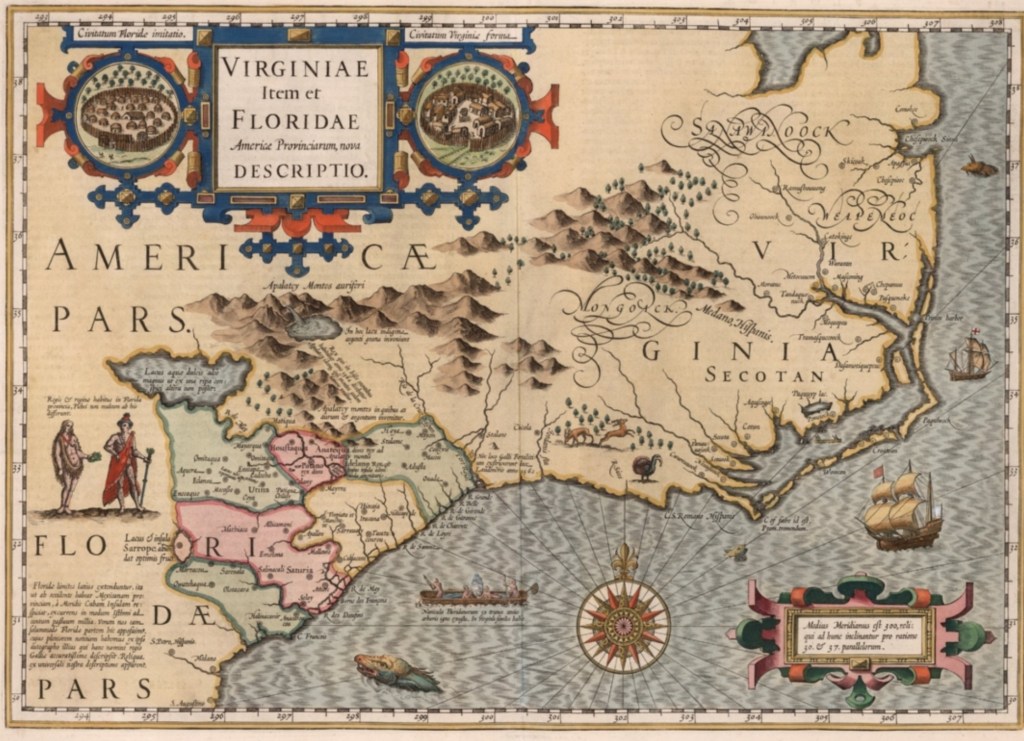
Virginiae Item et Floridae Americae Provinciarum, nova Descriptio.
Map by Gerard Mercator (1512–1594), Jodocus Hondius (1563–1612), and Hendrik Hondius (1597–1651).
Virginiae Item et Floridae Americae Provinciarum, nova Descriptio.
Map by Gerard Mercator (1512–1594), Jodocus Hondius (1563–1612), and Hendrik Hondius (1597–1651).
Published in 1623 by Hendricus Hondius, Amsterdam.
Image courtesy of the David Rumsey Map Collection, David Rumsey Map Center, Stanford Libraries.
Licensed under Creative Commons CC BY-NC-SA 3.0.

Raised within the Romano-Byzantine tradition—formed by both the Roman and Byzantine Catholic rites—I was shaped by a confluence of liturgical beauty, theological depth, and mystical reverence. From that upbringing, there remains not merely memory, but a lasting affection for the rhythm and substance of the faith of my youth. It is not simply a cultural inheritance, but a formative lens through which the sacred, the communal, and the mysterious first revealed themselves. Yet, it would not be accurate to describe my present stance as that of a lapsed Catholic, nor as an atheist, nor as one alienated from the Church. Alienation implies disaffection or estrangement born of expectation unmet or betrayal suffered. What remains is neither rejection nor rebellion, but something quieter and more reflective—a posture of reverent detachment that neither clings nor condemns.

Any attempt to articulate my position must begin by acknowledging the futility of articulation itself—at least in matters concerning the Divine. The belief that the Divine wholly exceeds the bounds of human comprehension and articulation grows only firmer over time. All creeds, revelations, and theological systems—however earnest or inspired—are, in the end, efforts to sketch with a cramped human lexicon and limited imagination that which lies beyond even the highest powers of conception. Far from illuminating the Divine, such efforts only obscure its immensity by imposing upon it our narrow symbols and forms.

Better to liken our theological endeavors to the drawing of maps—maps sketched by explorers who had never seen the coasts they sought to chart. Just as early cartographers filled the margins with dragons, saints, and imagined cities, we adorn the unknown with creeds, cosmologies, and commandments. These are sincere efforts, yet they more often reflect our hopes and fears than reveal any transcendent truth. The more intricate the system, the more seductive the illusion that the map is the territory. But the Divine is not a line upon a page. It is the sea beneath the sea monster, the silence beyond the compass rose, the continent whose very existence remains unknown. To name the Divine is already to misname it; to describe is to distort.

Such a perspective finds its truest expression in apophatic mysticism—the via negativa, the way of negation—a tradition articulated by Pseudo-Dionysius the Areopagite, a Christian thinker of the late fifth to early sixth century whose writings permeate the Catholic tradition through the works of Thomas Aquinas, Bonaventure, and the Spanish mystics, reminding us that the path of unknowing is not a break from faith, but one of its most ancient and revered expressions. In this light, God is not wise, not good, not just, not loving—not because the Divine lacks these qualities, but because our highest notions of them remain shadows cast by a light we cannot behold. Whatever we say of the Divine, however conceived, the most faithful statement is this: our words fall short.

Even so, human beings remain kataphatic creatures as well—creatures who long to speak, to name, to worship, to relate. Thus arises a kataphatic-apophatic tension, a profound and permanent unease between the impulse to speak of the Divine and the recognition that all speech fails. Hymns, liturgies, cathedrals, and doctrines are all human responses to this tension—not to capture the Divine, but to reach toward it, however falteringly. These gestures deserve neither scorn nor uncritical assent. They should be honored, but held lightly, cherished as poems rather than mistaken for proofs.

This tension extends beyond the realm of theology into the very nature of being itself. In a moment of quiet reflection, I found myself asking: “Where is Am I?”—caught between breath and thought, a question turning circles in the hollow of my chest. Am I the echo, or the voice that trembles back? A fragment drifting through the hour, a flicker in the endless light, unsure if I was ever whole or if the pieces were ever mine to find. Such a question is not mere existential uncertainty, but a recognition that the self, like the Divine, eludes definitive capture.

No formal creed or written revelation authored by man commands my assent, however noble or inspired it may be. Faith is not placed in these constructions, though the sacred yearning from which they arise is deeply respected. They are echoes of an original voice no longer heard directly, outlines of a presence glimpsed but never grasped. Like the adornments on ancient maps, these expressions are beautiful and sincere, but they are not to be mistaken for the thing itself.

To some, this may resemble agnosticism, though that word has become burdened with meanings it was never intended to carry—meanings of indecision, skepticism, or apathy. What is expressed here is none of those. It is not a shrug of the shoulders, but a bow of the head. Not the silence of the indifferent, but of the reverent. Not ignorance, but a conscious unknowing—a sacred refusal to impose limitation upon that which exceeds all bounds. This is why I eschew agnostic labels in favor of mystical ones—for the mystic does not claim ignorance of the Divine but acknowledges that true knowledge of it transcends conventional understanding.

What remains, then, is a life lived in contemplation of the ineffable—a contemplation that finds expression through creative work. In poetry, music, and essay, I reach toward that which cannot be directly named. When I write of the “eternal now” where “yesterday, tomorrow, and today collapse,” or compose lyrics that honor Humilitatem Initium Sapientiae, I am not merely creating art but engaging in a form of contemplative practice. These creative acts serve as bridges, not only between myself and the ineffable, but also between myself and others who share this reverent space, regardless of their formal religious affiliations or φιλοσοφίαι (philosophies or wisdom traditions).

The path ahead is not marked by certainty but by awe, not by declarations but by listening. Mystery is not something to be solved, but something to be honored. Years of formal study—first in history and religious studies as an undergraduate, then as a teacher of both subjects, and later through a long career in civil rights law and public service—have only deepened the awareness that human systems, whether intellectual, doctrinal, or legal, ultimately encounter their limits at the threshold of the sacred. In this, the apophatic tradition offers a spiritual home—a dwelling place where reverence begins precisely where language ends. If there is a guiding light for such a path, it is humility—humilitatem initium sapientiae—not merely as a moral posture, but as a metaphysical necessity. That teaching, which echoes throughout Thomas à Kempis’ The Imitation of Christ, remains not only a personal motto, but a settled conviction: that wisdom begins when one ceases to pretend to possess it.

Near the staircase in my front hallway hangs an early map of the New World—an artifact I have long cherished. Its artistry is matched only by its courage, for it dares to depict what was not yet known. Near the region now recognized as Virginia and the Carolinas, a sea monster rises from the ocean’s depths, signaling peril or wonder—perhaps both. On the land itself, figures of “natives” stand, imagined by a hand that never walked those coasts. That map does not record the world; it records what the world dared to imagine. So, too, do our theologies populate the margins of metaphysical uncertainty with monsters and angels, commandments and visions. They are imaginative acts—sincere, flawed, luminous. And like that map, they are to be cherished not for their precision but for what they reveal of the human longing to reach into mystery with word and symbol, with ink and awe. In their earnest striving, they remind us: we are always sketching the edge of the unknown, even when we know we cannot cross it.