The light returns in fractions— a minute portioned back today, another tomorrow. I keep the count, though clouds obscure the evidence: three minutes banked by New Year’s, another half-minute folded in, five more by Epiphany.
The cold arrives in earnest now: lake effect, the wind that finds every weakness in the house’s skin. But the light grows. The sun keeps its promise without display, deposits made, retained, compounded.
I watch for five fifteen, for when darkness once took the day entire. Now it hesitates. Now it waits.
February measures what accumulates: an hour restored, perhaps more. Afternoon lengthens itself, light touching the sun room wall at angles I had forgotten. Still the snow, still the grey insistence of overcast—but something fundamental has shifted.
The sun climbs higher, stays longer, asks nothing in return. This is not spring—spring lies, breaks its word too often to be trusted. This is mathematics, planetary tilt, the faithful working of the world’s ancient machinery.
I am owed nothing. I receive these minutes anyway.
March brings the balance: day and night held even, aequinoctium. The light has kept its promise minute by minute, fraction by fraction, until the ledger clears.
Not triumph—the cold can still return, and will—but equipoise: that moment of level standing before the light tips into majority.
I have done nothing to earn this except continue, except persist through diminishment, watching the slow reversal, the patient return.
The light grows still. The light keeps growing. The promise is not finished.
Icy stars— points of ancient fire made brittle by distance, as though the heavens themselves had entered winter. They do not blaze; they prick. They hang, hard and lucid, in a silence sharpened by cold.
Such stars feel less like promises than reckonings. Their light arrives stripped of warmth, having crossed immensities where heat was spent long ago. What reaches the eye is endurance, not comfort— illumination without mercy.
In winter they seem closer, because the air has been scoured clean of softness. Each star stands alone, exact, unblurred, the sky insisting on precision, on the refusal of haze, metaphor, or excuse.
Indeed—stars resemble snowflakes. Each one discrete, each one sharp with its own geometry, no two quite alike, yet all governed by the same severe order.
They fall not downward but inward, settling upon the mind rather than the ground. They do not melt; they persist. What snow does to the earth— muting, clarifying, equalizing— stars do to thought.
Yet they are dissimilar in temperament—decisively so. The star, for all its pinprick stillness to the eye, is violence without pause: fusion, a steady hammer at its core, plasma boiling and convecting within its bounds, only to be held together by gravity’s unrelenting fist. Its light is not calm but coerced— order wrested from perpetual revolt.
The snowflake, by contrast, is obedience incarnate. It forms in surrender to temperature, pressure, and time, each facet answering silently to law. Nothing churns; nothing rebels. Structure blooms where energy dissipates, an architecture born not of struggle but of yielding.
And yet—what appears as opposition resolves into fidelity: both answering to temperature, to nature, to law.
Not submission, but staying true to what is given, to what may not be otherwise.
The star obeys by burning. Given mass and pressure, it cannot do otherwise. Fusion is not choice but consequence, law pressed hard upon matter until light is forced into being. Its turbulence is not rebellion but endurance under extremes.
The snowflake obeys by forming. Lowered heat, suspended vapor, the slightest allowance of stillness— and geometry appears. No facet decides; each angle arrives as it must.
Thus neither star nor snowflake is free, and yet both are exact. They do not err, because they do not aspire. They enact what must be— and leave us to consider what it means to call that perfection.
I saw it—yes—just there, in the silence between breaths: a blade of grass bowed not by wind but by a single flicker of light, that tender emissary of dusk— the lightning bug, that priest of fire who blesses every meadow.
O you small bearer of green and gold, what vast wisdom coils within your tiny belly? What songs do you blink to the darkened world, what truths do you flash to the blade you hold?
I, too, have grasped the green earth in my palm— felt its tremble and thrum, watched a whole summer declare itself in the way grass leans toward starlight.
Do not speak to me of empires and theories— tell me instead how the hush after thunder is where the soul begins, how the firefly remembers the sun, and carries its pulse through the hollows of night.
Here is your scripture: dew-wet grass, the pulse of insect wings, the scent of warm loam rising at twilight— and yes, the low chant of crickets, singing hosannas in the key of soil.
I stand barefoot in this republic of clover, declaring allegiance to the unnoticed: to the tree frog’s stillness near an old stump, the clover’s soft petition beneath my heel, the breeze that forgets no leaf, the dandelion seed drifting without regret, the shimmer barely seen, the flash in the periphery, the small, bright pulse that stirs the dusk and reminds me—ah!—I am alive.
For is it not enough to say: a lightning bug chose a blade of grass, and that was revelation?
The Counterpoint of Ponder, O Morpheus, the Night Sky
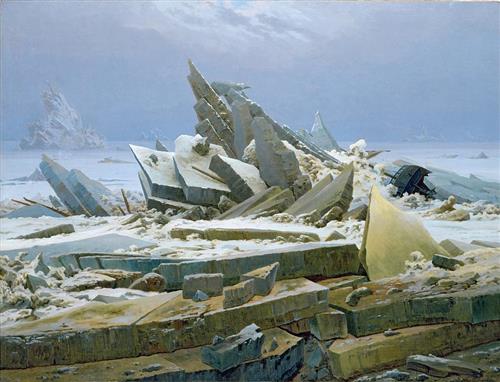
Caspar David Friedrich, The Sea of Ice, also called The Wreck of Hope Oil on canvas, 96.7 cm × 126.9 cm (1823–1824).
On the Unmaking of Benediction
This cycle of verses—The Inversion Cycle—emerged not as a contradiction, but as a counterweight to The Blessing of Morpheus: The Sending Forth, a series of benedictions articulated in reverent tones and metaphysical gestures within the poem Ponder, O Morpheus, the Night Sky. That earlier work was rooted in the soul’s deep yearning toward the ineffable, culminating in luminous affirmations bestowed by the dream-god Morpheus upon the seeker. In time, those benedictions came to feel too complete, too resolved. I began to wonder: what if they failed?
TheInversion Cycle is not blasphemy, but a form of apophatic honesty. It does not seek to erase Ponder, but to stand beside it—its negative counterpoint. Each scroll of the cycle corresponds to a specific line or blessing from Ponder and performs an act of unmaking: where Morpheus blesses, these verses refrain; where he sends the seeker into mystery, these verses stall at the threshold; where he assures, they withhold.
To honor that reversal, a further restraint was imposed: the exclusion of the very vocabulary upon which the original work (and many of my other recent works) so often relied. Words such as breath, dust, light, shadow, silence, and memory—among others—have been set aside. Their absence is not a loss but a signal. These are not the tools we are permitted to carry here.
The scrolls appear here in the same order as the benedictions from Ponder, O Morpheus, the Night Sky. This reversal respects the original arc—from the loosening of dreams to the transformation of the soul—and follows its negative path with precision.
What remains is austerity, not despair. These unsacraments do not offer consolation, but they do speak. If Ponder was a song of ascent, then this is the long exhale after the music ends—a psalter of withheld grace, composed in the space where blessing does not descend.
Let this work be read not in defiance of belief, but in the trembling of its undoing. For if it is brave to bless, it is perhaps braver still to stand in the space where blessing will not come—and write there, in the dust, what remains.
Scroll I: Of the Clinging Husk
Let not your dreams fall— for they will not fall. They remain, clinging like husks unpicked, blackened not by season, but by refusal.
You will try to cast them down, but they are fastened, not to limb, but to marrow.
They do not curl like leaves. They do not return to soil. They sour upon you, a bitterness in the sinew, a ferment in the thought.
And if you turn to shake them loose, they will tighten. Their threads are not of sleep, but of habit, knotted in long forgetting.
There is no wind to lift them. No frost to loosen them. No gardener comes.
Remain, then, beneath their burden— bent, unshed, unchanged.
Scroll II: Of the Inscribed Weight
Take them. You will take them. You cannot help it.
The names carved into stone, the words burned into walls, the cries etched into earth— they cling not to your pack, but to your ribs.
You bear them not as titles, but as scars.
They whisper through your marrow, resisting every act of unmaking. You try to enter the place without form, but they speak before you. They call the ground by its old name, and the gate does not open.
Even the sky does not answer when it hears them rising again.
These names were not carved to remember. They were carved to bind.
And now, as you stand at the edge of the place where all naming ends, they press their syllables against your tongue, and you speak them, not in defiance, but because you cannot forget.
Scroll III: Of Implements Abandoned
Bring not the weighted balances, nor the woven snares of longing. They do not hold, not here.
Their handles crack in the frost where no stars rise to bless the hour. Their mesh is brittle—threaded not of wool, but of claims left too long in the mouth.
The mind, honed to edge, cuts only fog in this place. The heart, cupped too gently, spills what it never held.
There are no laurels in this soil, only reeds that do not bend and brambles that do not bleed.
And should you cast such tools before you, expecting fruit, or fire, or favor— they will return to you as ash, unsought, unshaped, the chaff of means mistaken for ends.
Scroll IV: Of the Withheld Offering
Bring not your hollowed chest, stripped clean of ornaments and plea. It will not be filled.
Wonder has no purchase here. Its gaze returns unreflected from stone too smooth to be shaped.
Let the mind remain loud and unyielding, for awe would shatter in this poise like frost-cracked bronze.
As for your feet— do not lift them. There is no basin here, only ground dry from the beginning, lined with rings that do not ripple.
The wind does not attend. It does not lift. It does not listen.
There is no path across this floor, only grit, and the marks of those who came thinking they would walk upon revelation.
Scroll V: Of the False Horizon
Do not seek. There is no one to be found.
The sea does not receive you. It is not fluid, but glare stretched to the edge of motion— shimmering not with promise, but with mirage.
You did not launch. You drifted. And your craft was not chosen, but assigned, drawn from timbers meant for no voyage.
The sky above you swells with stars, but none are true. Each one marks a path that bends inward, circling you back to your forgetting.
You will think you move. You will call it seeking. You will call it bold. But you are already known by the thing that does not answer. And it has left no threshold, only wind that cannot be charted and depth that does not hold.
Scroll VI: Of the Barren Threshold
There is no beyond. Only the gray field where sleep forgets its end and waking does not begin.
Here, nothing waits. Not voice, not veil, not even the last gasp of wonder.
What lies past dream is not fullness, but poise robbed of sanctity— the deafness of stones before their naming.
No stars ever hung above this place. No fire traced its vault. Only pallor, dull as bone in a dry shrine, untouched by flame or veil.
And death, so often imagined a gate, has no depth here. It is shallow, crusted, and holds nothing but its own refusal.
Let no one say this place is holy. It is not what remains made full— but vacancy made permanent.
A place unmourned. Uncalled. Unmade.
Scroll VII: Of the Unbecome
Go not. There is nowhere that calls. No road unfurls before you, no veil parts, no watchful eye lingers on your vanishing.
The question you bore was not accepted. It curled back into you, like a tongue that feared its own utterance.
You will not be shaped by asking, nor known by your seeking. You will remain as you were before the yearning— a vessel without fracture, never poured, never filled.
No sound will rise behind you. No trace will stir where your feet passed. Even the soil will forget your weight.
Be still, not in peace, but in the form that does not unfold. Remain—not as the question— but as that which never found its shape.
Scroll VIII: The Soul Beneath the Blanched Sky
The soul, girded and unmoved, stood beneath a sky without veil— a dome blanched of fire, where nothing had ever gleamed, only ash adrift from unremembered pyres.
It bore no garment. No mark of calling or descent. It was as parchment without script, unhandled, unblemished, unread.
No winds stirred the plain. Only cairns rose in rows, not raised in reverence, but born of the land’s refusal to yield.
The trees there had no buds. Their limbs were stiff, as if carved for stillness— a forest of halted prayers. And beneath them, the roots did not seek nourishment, but curled inward, content in their forgetting.
There was no calm, no sacred pause. Instead, a muttering of syllables rose from the dry hollows— sounds without grammar, without bond, giving rise to no names, no intelligible form.
And when the soul pressed its palm to the ground, there was no spring, no pulse, only crusted clay— neither moist nor cracked, a firmness that would not give.
It asked nothing. Not from pride, but from knowing that some places are beyond summons— places where even longing has been turned to stone.





 Northcoast Antiquarian