The completion of my poem Whispers of the Waning Light left an impression lingering in my thoughts, a quiet meditation on the nature of longing, time, and the elusive quality of memory. In reflecting on that poem, I found myself drawn to the word wistful—a word that seems to stretch between the weight of longing and the lightness of a dream. The following brief essay is an exploration of that thought.
Støvkornenes dans i solstrålerne (Dust Motes Dancing in the Sunbeams, 1900) By Vilhelm Hammershøi (1864-1916) Oil on canvas, 70 cm x 59 cm. Ordrupgaard Musuem. Photograph Public Domain.
An audio recitation of the essay by the author.
The Weight of Longing and the Lightness of Dreams
Wistful is a wonderful word in our lexicon. It has slender shoulders but a muscular frame, and with each passing year, it grows, paradoxically enough, in vigor—able to inspire more ably imagination, poetry, memory, and vivid recall. The language with which we write, think, and contemplate is most remarkable indeed.
There is a paradox at the heart of wistfulness. It is a longing imbued with both the weight of the past and the lightness of the dream. Unlike simple nostalgia, which binds one to memory with a chain of sentiment, wistfulness carries a certain buoyancy, a gentle drift between what was and what might have been. It is not an emotion of mere loss, but rather one of continued yearning—an ache that does not wound but instead stirs, provokes, and enlivens.
Across centuries, wistful has carried shades of longing, attention, and awareness—never merely a passive sigh but a reaching toward what shimmers just beyond our grasp.
It is the mind’s way of grappling with the ethereal, of shaping dreams from recollections, of crafting possibilities from the echoes of what has already passed.
This duality—the weight of longing and the lightness of dream—has long been explored in poetry and literature. Keats’ Ode to a Nightingale shimmers with this very tension, the desire to dissolve into beauty while being tethered to the mortal world. Proust’s In Search of Lost Time captures it in the way a madeleine dipped in tea can summon an entire universe of memory. Even T.S. Eliot, in The Love Song of J. Alfred Prufrock, wrestles with the wistfulness of unlived potential, of questions left unanswered and paths left untaken.
Yet wistfulness is not purely literary; it is deeply personal, shaping our thoughts in quiet moments of reflection. It is the fleeting recognition of something beautiful that has passed, or the sudden awareness of an almost-forgotten dream. It is the feeling of standing at the edge of a vast, metaphorical ocean, where the horizon shimmers with the unknown, both beckoning and receding at the same time.
Perhaps this is why wistfulness endures, growing not weaker but stronger with time. It is an emotion that deepens as we collect more moments of beauty and loss, as we come to understand that our longings are not burdens but invitations—to reflect, to remember, and to dream anew.
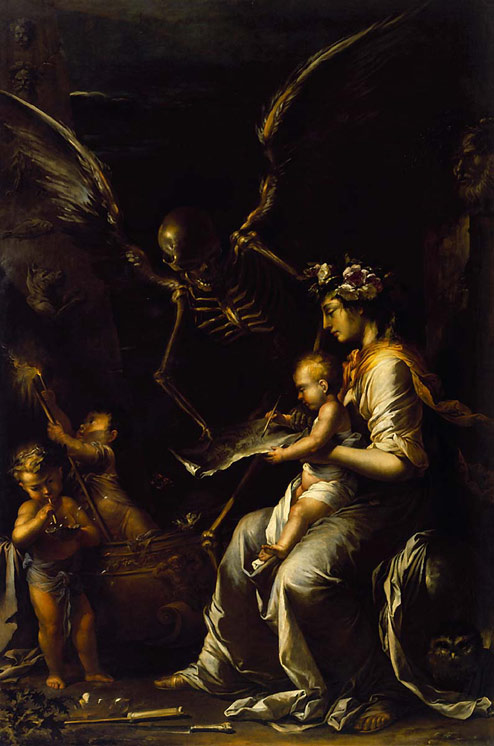
L’Umana Fragilita (Human Frailty, oil on canvas, 1656) by Salvator Rosa. Fitzwilliam Museum, Cambridge.
“O glorious day when I shall retire from this crowd, this turmoil, and join that divine council and assembly of souls” — Cicero
Cicero reflects on death as a natural and not to be feared part of life. One of his most famous passages reads: “Death is not a matter of sorrow, because it releases us from the prisons of the body and brings us to our natural rest. If death is an end to consciousness, it is like a deep and eternal sleep. If, however, the soul lives on, we have nothing to fear, for we will join those who have already passed.”
Here, Cicero expresses two possibilities for death: either it brings a peaceful, eternal sleep or allows the soul to join those who have passed before, both of which alleviate the fear of death. The first possibility, that death brings the end of consciousness and a restful, eternal sleep, presents death as a final release from the burdens of mortal life. In this scenario, time ceases for the individual, as their consciousness no longer experiences its passage. The second possibility, in which the soul lives on, imagines a continued existence where the soul joins the company of others who have passed, in a realm beyond the constraints of earthly time.
Building on this latter idea, Cicero envisions the soul departing from the mortal world and entering a “divine council” of virtuous souls. He writes: “O glorious day when I shall retire from this crowd, this turmoil, and join that divine council and assembly of souls, and when I shall depart from this life to live with them!” In this vision, the soul is no longer bound by the physical limitations of the body or the linear progression of time. It enters a state of peace, free from the turmoil of earthly life, and becomes part of an eternal realm where time as we know it no longer applies. This divine assembly offers a vision of death as a transition into a timeless existence, where the soul continues without the burdens of decision-making, moral struggles, or the passage of time.
This vision aligns remarkably well with modern cosmological theories, particularly the Block Universe model, which arises from Einstein’s theory of relativity. In this model, time is viewed not as something that flows but as a static dimension. The Block Universe posits that past, present, and future all exist simultaneously within a four-dimensional spacetime continuum. Every moment—whether in the past, present, or future—exists eternally and is as real as any other moment. The flow of time, as we perceive it, is an illusion generated by our consciousness. In this framework, time does not move; rather, we, as conscious beings, experience it as though we are moving through it.
When Cicero speaks of the soul’s release from the turmoil of earthly life and its subsequent joining with other souls, he touches on a concept that can be reconciled with the Block Universe. In his vision, the soul continues to exist, but it is no longer bound by the temporal constraints of human existence. It no longer perceives time as a sequence of moments passing one after another. Instead, the soul becomes part of an eternal now—much like the fixed moments in the Block Universe model. In this state, the soul experiences the peace of being embedded in time’s eternal structure without the torment of consciousness or the burden of decision-making.
In both Cicero’s philosophical framework and the Block Universe model, time continues to exist objectively, but for the individual, time’s significance vanishes with the cessation of perception. This alignment suggests that the end of time, in a subjective sense, is not the end of the universe’s temporal structure, but the end of an individual’s experience of time. The soul, in Cicero’s understanding, remains part of the universe, but without the active engagement of temporal consciousness.
What makes this comparison particularly compelling is the shift from seeing death as a terrifying end to perceiving it as a transition into a timeless existence. For Cicero, death frees us from the burdens of morality and decision-making—tasks that are so deeply tied to our experience of time. Similarly, in the Block Universe, once consciousness fades, we are no longer participants in the dynamic flow of time but become part of the static, eternal structure of existence.
In essence, both Cicero and the Block Universe propose that the end of time is not a destruction or cessation of reality, but rather the cessation of our perception of time’s flow. While the soul may continue to exist in an ethereal state, it does so in a manner detached from the sequential experience of time. Thus, the soul’s existence in this eternal now is one of peace, free from the weight of decisions and the suffering caused by the relentless march of time.
Through this lens, we might reinterpret Cicero’s contemplation of death and the soul’s journey as a profound early philosophical insight into a truth later echoed by modern physics: the possibility of eternal existence within a timeless framework, where the flow of time is merely a byproduct of human perception. In death, the soul may continue within the Block Universe—no longer tormented by the passage of time, but instead, eternally present in the cosmic order.
Works Relied Upon While Preparing This Essay:
Cicero, Marcus Tullius. De Senectute. Translated by William Armistead Falconer. Harvard University Press, 1923.
Cicero, Marcus Tullius. Tusculan Disputations. Translated by J. E. King. Harvard University Press, 1927.
Einstein, Albert. Relativity: The Special and the General Theory. Translated by Robert W. Lawson. Crown Publishers, 1961.
Hawking, Stephen. A Brief History of Time: From the Big Bang to Black Holes. Bantam Books, 1988.
Rovelli, Carlo. The Order of Time. Riverhead Books, 2018.
Recently, I have been revisiting Dante’s Divine Comedy, focusing specifically on Paradiso. This journey through Dante’s celestial spheres has inevitably planted within me thematic thoughts of hope, inspiring me to put pen to paper and author a new poem. This sudden burst of creativity, whether of any merit or not, has taken me by surprise. Nonetheless, I have relished the productivity, regardless of its outcome.
For several days, I awoke each morning with my mind fixated on the theme of hope, having pondered over the topic in my sleep with deliberate contemplation. Earlier this week, I awoke with a fully outlined sketch of a poem, realizing that hope, as a concept, evolves dramatically through the stages of life.
In childhood, hope is almost an unknown entity, as we scarcely need it, trusting that nearly every need and desire will be met. This is largely because our understanding of the world and its possibilities is limited. As we grow older, hope becomes more pronounced, with the belief that if we hope earnestly enough, we can obtain almost anything. In young adulthood, this transforms into the conviction that hard work will inevitably lead to the fulfillment of our hopes.
However, as we enter middle age, our perception of hope shifts once again. We begin to see it as a plea, tempered by the realities of justice and merit. By old age, if not earlier, we recognize that despite our hopes and best efforts, many who work hard are denied the fruits of their labor, and many who deserve much are denied their due. By the time silver graces our brow, a bemused smile often accompanies our thoughts of hope, seasoned by the wisdom of experience. We come to understand that hope should not be centered on what we aspire for, but rather on what we can give to others—justice, fulfilled dreams, love, acceptance, and comfort. These are the gifts that we once hoped for ourselves and now, perhaps, are in a position to bestow upon others. If we had any intelligence and kindness, we were doing so all along.
Reflecting on my college years, I recall considering myself an optimistic pessimist. Schopenhauer’s works on pessimism were light reading in those days. Despite this, I was not afraid to embrace hope, recognizing its necessity throughout life. This philosophical introspection led me to author a poem, which I have set to music courtesy of Udio.com. I am pleased with the results and plan to eventually set it to a worthy video. For now, it is available as an audio track with the lyrics provided below.
LYRICS TO “HOPE’S JOURNEY: A TAPESTRY OF LIFE”
Stage I: Childhood
In the garden of my youth, every dream was mine, Hope was just a whisper, a secret so divine. No need to chase the stars, they’d fall into my hand, In a world of endless wonders, a magic wonderland.
Chorus:
Hope, it morphs and changes, like the tides of life’s great sea, From dreams of youth to wisdom’s truth, in each phase we’ll see. In the tapestry of time, it weaves a story bold and true, Hope’s enduring presence, guiding us through all we do.
Stage II: Young Adulthood
As a young and daring heart, hope became my creed, Believing in the odds, I’d conquer every need. With faith and fierce conviction, the future seemed so bright, The power of my spirit, would always lead to light.
Chorus:
Hope, it morphs and changes, like the tides of life’s great sea, From dreams of youth to wisdom’s truth, in each phase we’ll see. In the tapestry of time, it weaves a story bold and true, Hope’s enduring presence, guiding us through all we do.
Stage III: Adulthood
In the prime of my endeavor, hope was like a flame, If I worked with all my might, I’d win the endless game. Justice and ambition, tempered with the real,* A dance of dreams and struggles, the balance I could feel.
Chorus:
Hope, it morphs and changes, like the tides of life’s great sea, From dreams of youth to wisdom’s truth, in each phase we’ll see. In the tapestry of time, it weaves a story bold and true, Hope’s enduring presence, guiding us through all we do.
Stage IV: Middle Age
In the heart of middle age, hope became a plea, An appeal to justice, to merit and integrity. Tempered by the trials, and the lessons learned in time, Hope was now a beacon, in a world less sublime.
Chorus:
Hope, it morphs and changes, like the tides of life’s great sea, From dreams of youth to wisdom’s truth, in each phase we’ll see. In the tapestry of time, it weaves a story bold and true, Hope’s enduring presence, guiding us through all we do.
Stage V: Old Age
In the twilight of my days, hope seems like a dream, A foolish, fleeting fancy, yet it makes me beam. A smile in reflection, of a life so richly lived, Hope was a companion, in the gifts that life could give.
Chorus:
Hope, it morphs and changes, like the tides of life’s great sea, From dreams of youth to wisdom’s truth, in each phase we’ll see. In the tapestry of time, it weaves a story bold and true, Hope’s enduring presence, guiding us through all we do.
Journey’s End:
So here I stand, at journey’s end, with hope a fading light, A smile upon my weathered face, as day turns into night. For hope has been my constant friend, through every twist and bend, A timeless song within my heart, until the very end.
* I have revised this line in Stage III for future “publications” to read: “Ambition was my compass, guiding through the real,” as it was too redundant of the thoughts and words in Stage IV.
Art Credits for the YouTube Video:
Stage I: Childhood
The Voyage of Life: Childhood (oil on canvas, 1842) by Thomas Cole (1801-1848). National Gallery of Art, Washington, D.C.
Stage II: Young Adulthood
Liberty Leading the People (oil on canvas, 1830) by Eugène Delacroix (1798-1863). Louvre Museum, Paris.
Stage III: Adulthood
The Fog Warning (oil on canvas, 1885) by Winslow Homer (1836–1910). Museum of Fine Arts, Boston.
Stage IV: Middle Age
Nighthawks (oil on canvas, 1942) by Edward Hopper (1882-1967). Art Institute of Chicago.
Stage V: Old Age
The Starry Night (oil on canvas, 1889) by Vincent van Gogh(1853-1890). Museum of Modern Art, New York.
Journey’s End
The Monk by the Sea (oil on canvas, 1808–10) by Caspar David Friedrich(1774-1840). Alte Nationalgalerie, Berlin.






 Northcoast Antiquarian