The vague glimmer of a head suspended in space (1891, Lithograph) Odilon Redon (1840–1916)
I Am Undone
I.
It came not with fury, nor with fire. Not a blow, but a breath withheld. A stillness uncoiling in the spine. I did not cry out. I did not fall. I said only—I am undone. And the words were true, though I did not yet know how much they would mean.
II.
The star chart curled into ash. Landmarks dimmed, receded, folded into fog. I had names once— for the road, the self, the longing. They rusted in my mouth. I said again, am I— but the word faltered. Was I I? Was am still? Was undone the end, or only a door swinging inward with no floor?
III.
I wandered, perhaps. Or stood still and the world wandered past. The days no longer linked. Events occurred—but not to me. Faces mouthed shapes I could not hear or remember. I touched a wall that had always been there. It crumbled under my hand. I called it home, or meant to. Or once had. I think.
Un—done—I am—undone am I— I am…am I…?
IV.
And the past… no, the shape before the past— was it mine? Or borrowed from the eyes of others? Their eyes are gone. The mirror does not answer. I meant to say a thing— some thing— a small thing— but the mouth no longer forms what the mind no longer sends.
There is no forward. There is no back. There is no—
(nois)
V. Dissolution
I think I said—I was— no. I had said. Once.
Undone. It was the word. I said it. Before. Or after. I do not—
No shape to the day. No frame to the thought. They come—go— without edge.
The name of the thing was… not there. And the word for that— what was the word? The word is gone. The knowing is not.
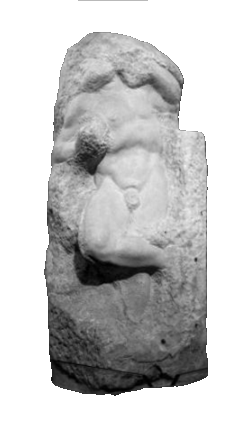
Michelangelo, The Awakening Slave (c. 1525–30). A body caught between measure and becoming.
I. On Bloom and the Anxiety of Influence
As the poet of Vitruvian Man Unbound, I find myself drawn to Harold Bloom’s understanding of how poetry functions within tradition—not as mere imitation or influence, but as a creative misreading that transforms both predecessor and successor. Bloom’s vocabulary—his clinamen (poetic swerve), daemonization, and apophrades (the return of the dead)—offers a framework for understanding my own relationship with Leonardo’s iconic drawing.
Yet I would press beyond the confines of Bloom’s categorical system. The strongest poetry, as Bloom himself recognized, resists easy resolution. Vitruvian Man Unbound embodies what he called a tessera—a completion of its precursor that simultaneously preserves and undermines its foundational terms. The poem does not simply revise Leonardo; it retroactively reshapes our understanding of him. It allows us to see Vitruvian Man as an incomplete gesture, one whose implicit metaphysical longing only achieves full articulation through the poem’s unfolding of form, desire, and transcendence.
II. The Paradox of Poetic Creation as Discovery
When I began Vitruvian Man Unbound, there was no conceit of a new idea. Rather, I felt I was unearthing the obvious—articulating for the first time verses that had already been rendered, waiting to be heard.
This situates the poem not as invention but as discovery—a Renaissance conception of artistic creation. Michelangelo spoke of liberating the form already imprisoned within the marble. Leonardo, too, conceived of art as revelation through observation, uncovering structures latent in nature and proportion. I participate in that lineage: the transcendence of the circle was already latent in Leonardo’s drawing. My poem does not overwrite Vitruvian Man but unveils what it always contained.
III. Poetry as Transcription of Revealed Truth
Poetry is primarily, in my conception, the art of transcription. Poetry is ultimately truth revealed, however rendered.
This belief is ancient. Poets once invoked the Muse, believing their songs were received rather than authored. Plato cast poets as possessed vessels of divine madness. In scriptural traditions, the prophet or sage writes not from invention but from vision. In this view, the poet is not creator but conduit.
This understanding reorients poetic practice. What matters most is not novelty of theme or form but receptivity—a cultivated attentiveness to truths that ask to be heard. To compose well is to listen well. The most vital poems do not invent so much as reveal. The poet’s charge, then, is fidelity.
Vitruvian Man Unbound aspires to this kind of transcription. It draws out from Leonardo’s image the philosophical tensions embedded therein: between proportion and possibility, containment and becoming, structure and the longing to transcend it.
IV. The Poem’s Journey: From Containment to Transcendence
At its heart, my poem charts a metaphysical journey—the awakening of a consciousness confined within geometry, gradually realizing its cosmic vocation. The Vitruvian figure, bound in ratios and ruled lines, discovers within himself not mere form but flame. The movement is from being drawn to drawing, from being measured to measuring.
The poem gives voice to this paradox: “I am both bound and boundless, large and small, / Both measured part and immeasurable all.”
This is no empty contradiction. It is the philosophical heart of the work. The circle becomes “not wall but door,” not negated but reimagined. Limitation, as I came to understand, is not the enemy of freedom but its precondition. Form does not imprison; it allows the infinite to appear in the guise of the finite.
This idea resonates with multiple traditions: the Christian theology of kenosis, quantum indeterminacy, the aesthetics of the golden ratio, even the existential struggle of Camus’ Sisyphus. In Vitruvian Man Unbound, I sought to draw them all into poetic coherence.
V. Beyond Influence: Co-Creation and Transcendence
My relationship to Leonardo’s drawing is not one of mere homage or critique. The poem does not simply descend from his vision; it reconfigures how I understand that vision. In Bloom’s terms, it enacts an apophrades: the precursor is altered by the successor, the past rewritten by the presence of the present.
I acknowledged this inversion within the poem itself: “Da Vinci dreamed me into being’s start; / I dream myself anew with conscious art.”
This was not rebellion against the tradition but transcendence through deep fidelity. I did not seek to destroy Leonardo’s Vitruvian Man; I hoped to fulfill him. I entered the drawing and found the voice that seemed to have been waiting there. The Vitruvian Man, for me, ceased to be object and became subject, consciousness incarnate.
VI. Poetry as Epistemological Practice
If poetry is the transcription of revealed truth, then it is not merely aesthetic. It is epistemological. It helps us understand not only what is, but how we come to know what is. The most original poems do not dazzle through novelty alone; they resonate because they name what we already suspected was true, but had not yet heard.
Vitruvian Man Unbound aspires to such resonance. I hope it awakens a dormant dimension in Leonardo’s drawing—and perhaps, in us. I did not set out to create a new form, but to reveal the old form’s silent music. For me, it was an act not of invention, but of listening—not conquest, but witnessing. A poetry of revelation.
Thus the ink that once bound becomes the ink that reveals.
VII. Echoes of Prometheus
In reflecting on Vitruvian Man Unbound, I recognize the shadow of another unbound figure—Shelley’s Prometheus. His liberation from cosmic tyranny, his transformation into a visionary voice of harmony, and his rejection of vengeance in favor of transcendence, all resonate deeply with the arc of my poem. Like Prometheus, the Vitruvian figure is not merely released; he is revealed—as a bearer of fire, of knowledge, of poetic truth. It is not accidental that in striving toward the infinite, we find ourselves echoing those myths and verses where the infinite has already spoken.
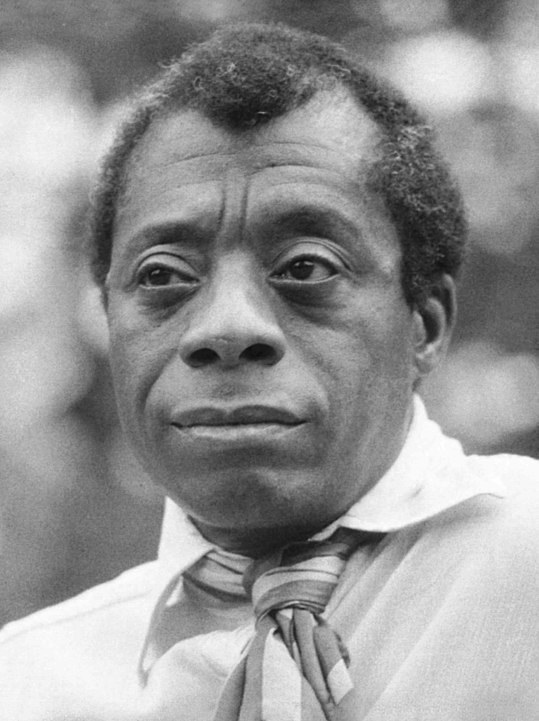
James Baldwin in 1969. Photograph: Allan Warren CC BY-SA 3.0
One of the books I am currently reading is James Baldwin: The Cross of Redemption (Uncollected Writings), edited with an introduction by Randall Kenan and published in 2010. One of the essays in the collection, dated 1984 but still strikingly relevant, is “On Being White … and Other Lies.” A particular passage from that essay stood out to me:
“Just so does the white community, as a means of keeping itself white, elect, as they imagine, their political (!) representatives. No nation in the world, including England, is represented by so stunning a pantheon of the relentlessly mediocre. I will not name names—I will leave that to you.
But this cowardice, this necessity of justifying a totally false identity and of justifying what must be called a genocidal history, has placed everyone now living into the hands of the most ignorant and powerful people the world has ever seen. And how did they get that way? By deciding they were white. By opting for safety instead of life. By persuading themselves that a black child’s life meant nothing compared with a white child’s life. By abandoning their children to the things white men could buy. By informing their children that black women, black men, and black children had no human integrity that those who call themselves white were bound to respect. And in this debasement and definition of black people, they debased and defined themselves.” (The Cross of Redemption, pp. 168–169)
This passage struck me as just as relevant today as it was in Baldwin’s time. The language of racial division may sometimes be more coded—though often, it is not—but the underlying dynamics remain. Some now speak of a mythical golden age to be restored, painting diversity, equity, and inclusion as enemies to be vanquished. Yet Baldwin’s pantheon of the relentlessly mediocre remains firmly in place, with a growing number of elected officials – led by one in particular – who traffic in racial grievance and nostalgia for an edifice of the past that was built upon exclusion. The resentment they cultivate is growing more visceral, more vengeful by the day.
At its core, Baldwin’s essay is a reminder that race is a social construct—one created not out of noble ideals or science but out of moral rot. It was, and remains, a means of defining power and justifying subjugation. Today’s renewed emphasis on racial division in politics—whether explicit or coded—is no less morally bankrupt than in Baldwin’s time.
As one who is new to crafting poetry, I am aware that my journey is one of growth, learning, and exploration. What follows is a discussion of the approach I have consciously adopted to refine my poems and avoid the criticisms and condemnations so freely voiced by those such as Wilde—“All bad poetry springs from genuine feeling. To be natural is to be obvious, and to be obvious is to be inartistic”—and Bloom, who remarked, “All bad poetry is sincere.”
The Art of Moving the Soul: My Approach to Poetry
My approach to poetry is grounded in a vision that goes beyond crafting words into aesthetically pleasing forms; it is about shaping language into something that moves the reader deeply. Poetry is, at its heart, the pursuit of connection, of reaching into the depths of an emotion and distilling it into a form that resonates universally. To accomplish this, I focus on balancing the technical mastery of language with an awareness of emotional truth—crafting a poem not to be admired for its sophistication but to stir something fundamental within its audience.
Mastery of Language and Artifice
A poet must be a master of language—but this mastery is more than an extensive vocabulary or a mastery of grammar. It encompasses an intimate understanding of all the artifices of language, from metaphor and rhythm to sound, cadence, and imagery. Each of these elements is a tool that, when used with precision and intention, can amplify the emotional power of a poem.
Metaphor and Symbolism are central to my work. I believe that a well-crafted metaphor can reveal truths that straightforward language cannot reach. Metaphor allows me to take the deeply personal and translate it into the universal. It transforms emotions into imagery that transcends the particularity of my own experiences, inviting readers to see their own reflections within the lines.
Sound and Rhythm are equally crucial. Poetry is inherently musical, and I strive to create an aural experience that mirrors the emotional landscape of the poem. The rhythm of a line, the careful use of alliteration or consonance, can evoke a specific mood—whether it be urgency, tranquility, or dissonance. This musicality helps bridge the gap between the reader’s intellect and their emotional response, drawing them into the essence of the poem.
Precision in Word Choice is another aspect of my approach. Every word in a poem must be chosen with purpose, as the weight each carries is amplified by the brevity and density of poetry. Words must be evocative, precise, and imbued with the potential to convey a spectrum of meanings. The challenge lies in selecting words that are capable of evoking the complexity of emotion I aim to convey, while still maintaining accessibility for the reader
What I Seek to Avoid
While I strive to use all the tools of language, I am cautious of letting craft overpower emotional authenticity. There is a risk in focusing too heavily on technical mastery—in creating something that is elaborate but lacks heart. A poem must not be an exercise in showing off the artifices of language; it must always remain rooted in emotional truth.
Additionally, I seek to also avoid the temptation to use language that is obscure simply for the sake of complexity. My aim is to create poetry that is layered and nuanced but still accessible. Complexity should be employed to deepen meaning, not to obfuscate it. When a poem becomes a puzzle that requires solving, it runs the risk of alienating readers, making them admire or – more likely – curse the poet’s intellect rather than inviting them to connect with the poem’s core. To me, poetry should not be a performance to impress but a bridge to connect—to take a feeling, a moment, and expand it in such a way that it becomes a shared experience.
Lessons from Rhetoric: Demosthenes vs. Cicero
In approaching poetry, I often reflect on an anecdote I read years ago about two of history’s great orators: Demosthenes and Cicero. Cicero was celebrated for his eloquence—when he spoke, people said, “What a fine orator.” His speeches were technically perfect, full of rhetorical sophistication, and they garnered admiration for their artful construction. But when Demosthenes spoke, people said, “Let us march.” Demosthenes moved his audience to action; his speeches were not simply admired, they were felt deeply, and they inspired his audience to do something.
This comparison informs my approach to poetry. While I value the craft—the meter, the rhythm, the careful construction of lines—I strive for something more. I want my poems to move the reader, to evoke a response that goes beyond admiration for a well-crafted verse. I want them to feel the emotional urgency behind the words, to resonate with the core truth of the poem, and perhaps even to be stirred to reflect, to act, or to see the world a little differently. My goal is to use the artifice of language not as an end but as a means—to make my words sing, not just for beauty’s sake but for the sake of the emotion and meaning that lie beneath.
Craft and Emotional Truth in Harmony
Ultimately, my approach to poetry is about finding the balance between mastery of language and emotional authenticity. The artifices of language—metaphor, rhythm, sound, form—are powerful tools, but they must be used with intention. They must serve the deeper purpose of the poem, which is to capture and convey something genuine about the human experience. The artifice should be invisible, or at least secondary, to the emotional impact.
Like Demosthenes, I wish to create not just a polished, skillful verse but something that speaks directly to the heart of the reader, that moves them. The art of poetry, to me, is not in the cleverness of its construction, but in its ability to resonate—to create a moment of connection, a shared breath, a glimpse into the universal truths that bind us all.
I hope that my poetry steadily improves and meets the standards I articulated above, growing in emotional depth, linguistic mastery, and its ability to touch readers in meaningful ways.
The Sower (oil on canvas, 1888) by Vincent van Gogh (1853-1890). Van Gogh Museum, Amsterdam.
Note on the Origin of This Poem
This poem was inspired by a recent reflection on T.S. Eliot’s Burnt Norton, the first of his Four Quartets (with a nod to Augustine of Hippo’s Confessions, which I have also recently revisited). Eliot’s meditation on time has long intrigued me, particularly his exploration of the eternal present where past, present, and future are interwoven. His lines, “What might have been and what has been / Point to one end, which is always present,” reflect an awareness of unrealized possibilities lingering in memory, resonating with the tension between choice and fate.
While Eliot does not dwell entirely on regret, his imagery—such as “the passage which we did not take / Towards the door we never opened”—evokes a sense of paths unchosen and moments lost, suggesting an undercurrent of melancholy and reflection on missed opportunities.
This contrasts with my own perspective, which views the past not as a source of sorrow or lamentation but as a guide—a map to navigate the future. For me, the past should instruct us, not torment us. I focus not on what might have been but on the lessons that can inform where we must go next. As I recently discussed with one of my sisters, I learned more from my past failures, whether on school exams, work situations, or personal circumstances, than I did from my successes.
In short, regret is the most useless emotion.
Inspired by this distinction, I sought to explore these ideas poetically, offering a reflection on time that emphasizes the instructive value of the past rather than its potential to weigh us down with regret.
The Past Is but a Map
The past is not a chain of sorrow, Not the dust of what we might have been— But a map unfolding, Marked by lines of roads untaken. The tests we failed are etched more deeply Than triumphs where we passed unscarred. The echo of footfalls is not regret’s whisper But instruction pointing forward. The door unopened is not lamented But a path unseen, Waiting to instruct. Hard lessons carve deeper than easy ones; Each misstep, a mark of progress. The teacher we resisted Becomes the guide we heed. There is no torment in yesterday’s shadow, Only the light of what we must now become. Ever forward, we glance back— Not for grief, But for direction, For the past keeps its own counsel As we shape the days to come.







 Northcoast Antiquarian