Of a Man, His Dog, and a Stick

The immeasurable joy that a pup feels upon spying the perfect stick—though is not every stick perfect?—to seize it between the teeth, to trot about in triumphant exaltation, to preen and prance, to clench and cherish it as though gold, or life itself, were held within the jaws, precious beyond all things. If only I could delight in anything with such unfeigned enthusiasm—as that stick, its discovery, its seizure, its hold.

Ah, to find such rapture in the ordinary! To greet the world not with suspicion but with wonder, to see in the roughness of bark and the scent of earth a treasure beyond price. She asks no meaning of the stick, no purpose beyond the play; she does not weigh its straightness nor lament its splinters. She exults simply because it is there—because it can be grasped, borne, and shared with the wind.

And when I feign to take her most prized possession from her, she does not crouch defensively nor guard it with wounded pride. She startles not in fear, nor suspects deceit, but spies instead an opportunity for play—for spirited contest, for joyous fun. A game of keep-away, of chase, of tug-of-war, of tag. The stick becomes not a treasure to hoard, but a bond to share, a spark of communion between kindred souls who, for a moment, forget the hierarchy of species and simply are. How effortless her wisdom seems: to turn every threat into invitation, every grasp into dance. What the world calls possession, she calls participation; what we call loss, she calls laughter.

Laugh I must too, for in her play I am carried back to youth—when a stick could be anything the heart desired: a sword flashing against unseen foes, a spear cast toward the sky, a knight’s lance, a shepherd’s staff, a trumpet summoning invisible armies, a conductor’s baton commanding the symphony. How endless were the shapes of imagination then! She reminds me of what I once possessed without knowing its worth—the gift of invention, the sacred power of play.

And so I laugh, though a tear is not far behind, for the years slip away like autumn leaves on the wind, and I remember what it was to live so lightly. She, in her wisdom, has become my teacher—her joy a gentle rebuke to my solemnity, her play a sermon on the holiness of delight. If ever there is grace to be found, it is in such simple acts: a stick, a chase, a glint of sunlight on the grass, a heart unburdened by purpose. Perhaps salvation lies not in grand design, but in this—to love a stick as though it were the world, and to find, in that loving, the world made whole again.

Betwixt Dawn and Dusk: A Meditation on Life and Dream

Preface

The first lines of this poem came to me in the night—those strange hours when thought and dream pass like shadows through the mind. I awoke briefly, not fully, and the phrase lingered: between and betwixt dawn and dusk… and the inverse, between and betwixt dusk and dawn. I held onto it until morning, when I set it down in full light. The poem that followed is a meditation on those intervals—the thresholds of consciousness and the veils through which the soul moves in its waking and its dreaming.

What begins as a reflection on the daily arc—from sunrise to sunset—soon turns inward, toward the more uncertain passage between dusk and dawn, where memory, time, and identity unravel and reweave. The Heraclitean epigraph provides the key: “The waking have one common world, but the sleeping turn aside each into a world of his own.” Yet even that distinction, perhaps, is not so firm as it seems.

The accompanying painting—Whistler’s Nocturne in Black and Gold: The Falling Rocket—mirrors the poem’s atmosphere: its drift between form and dissolution, its reverent wondering, its silence punctuated by brief illumination. Together, word and image ask not what life is, but whether it is lived or dreamed—and what remains of us in either case.


Nocturne in Black and Gold: The Falling Rocket
James McNeill Whistler (c. 1872–1877)
Oil on canvas, 60.3 × 46.6 cm (23.7 × 18.3 in)
Detroit Institute of Arts, Detroit
James McNeill Whistler, Nocturne in Black and Gold: The Falling Rocket
c. 1872–1877 | Oil on canvas, 60.3 × 46.6 cm
Detroit Institute of Arts, Detroit

Betwixt the Spheres

by Donald S. Yarab

“The waking have one common world,
but the sleeping turn aside each into a world of his own.”

—Heraclitus, Fragment 89

Betwixt the dawn’s gold-burnished, trembling rise,
And evening’s hush where embered echoes gleam,
A soul drifts outward under waking skies—
Or inward, through the latticework of dream.

Morning declares the world as firm and real,
Noon lays its claim in certainties and fire,
Yet twilight draws the veil we cannot feel,
And sings the hush of unfulfilled desire.

The hours fall like leaves from unseen trees,
Their passage soft, impermanent, and strange.
Some name it life, who walk it by degrees—
While others call it dream, and feel no change.

So tell me, when the final light has flown,
And silence hangs, unbroken and immense—
Was it a road we walked, and called our own,
Or but a fleeting spark in dream’s pretense?

But what of time when sun has slipped from sight,
And stars drift forth like seeds of the unknown?
What voice is heard within the hush of night,
When all the world lies still, and we—alone?

Between and betwixt the dusk and morning’s grace,
A different kind of being comes to bloom:
Where shadows speak, and time forgets its place,
And long-dead voices gather in the gloom.

In sleep, the veil grows thin, the borders bend,
And hours bleed into realms that none can chart.
The soul recalls what lies beyond the end,
And bears the hush of ages in its heart.

These hours are not lost—they are the deep,
The ocean floor where buried visions gleam.
From them we rise, like wanderers from sleep,
Still marked by fire, still echoing the dream.

So stands the soul, on thresholds vast and wide,
Between and betwixt the turning of the spheres—
What seemed a life, a dream walks at its side,
Measured not in hours, but in wonder—and in tears.

My Friend, You Were There: A Reflection on Complicity


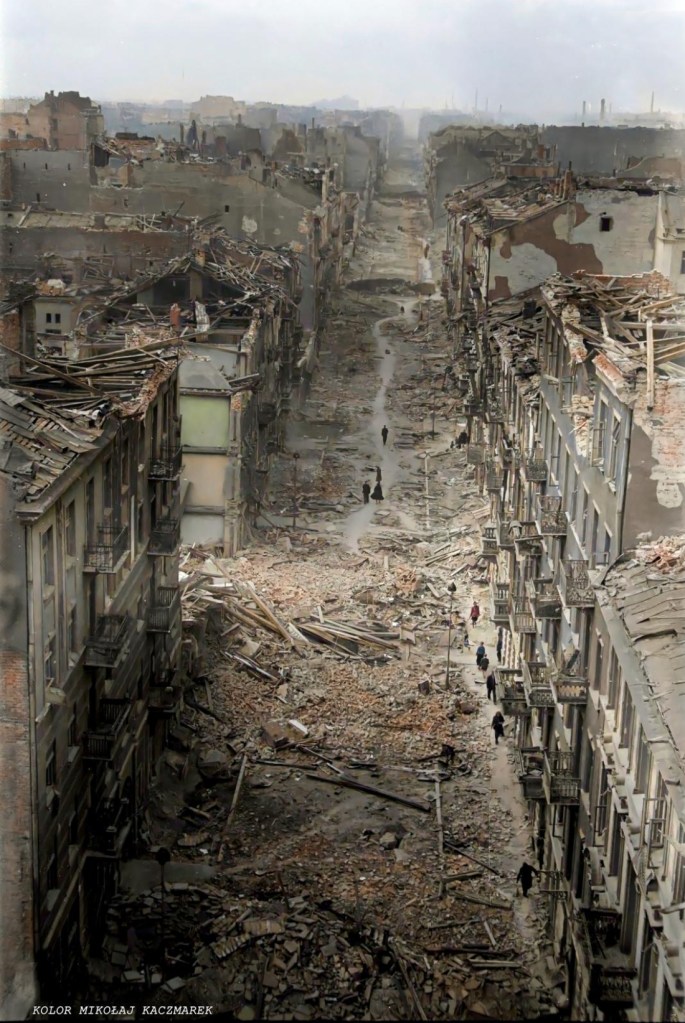
Warsaw Ruins 1944
Warsaw 1944

History shows that evil rarely marches under banners we immediately recognize. Too often, it comes draped in righteousness, purity, and fear. This piece is a lament for how easily we have been—and still can be—drawn into the machinery of cruelty.


My Friend, You Were There

My friend,
When the Holy Catholic Church, seeking to preserve the Faith in all its radiant purity,
instituted the Inquisition,
you were there—
not as a bystander,
but as a willing voice.

You denounced the old widow,
who lived alone with her cat.
You whispered against the Jewish family—
familiar, yet forever marked as other—
and gave your assent to their undoing.

You crowded into the square to watch the trials.
You sang hymns
as the flames crowned their bodies with smoke.
You wept tears of joy
that the world was made purer that day.

My friend,
When the ships came heavy with human cargo,
and the auction blocks stained the soil,
you were there.

You placed your bids.
You weighed their flesh.
You wrote the laws that chained their children.

You sang hymns on Sunday,
and broke their backs on Monday.
You called it providence.
You called it order.

My friend,
When the traders came with flags and rifles,
when the rivers flowed with rubber and blood,
you were there.

You signed the charters.
You counted the profits.
You sold the shackles and the scales.

You called it commerce.
You called it destiny.

My friend,
When the banners of the Reich unfurled,
and the drums of destiny beat their hollow call,
you were there.

You shouted with the crowds
as glass shattered from shopfronts.
You signed the letters,
you cheered the laws,
you raised your hand high in salute.

You bought the house,
the shop,
the art your neighbors were forced to leave behind.

You praised the strong hand
that swept away the weak.
You rejoiced as neighbors vanished,
grateful that your streets were made clean.

My friend,
When Stalin summoned the will of the people
to root out the enemy within,
you were there.

You reported the whispered doubts
of your cousin,
your friend,
your brother.

You paraded with red flags
while the trucks rumbled into the night.
You filled the quotas.
You seized the land.
You counted the spoils
as others disappeared.

You sang of the bright tomorrow
as you cast your eyes down
and stepped over the absent.

My friend,
When Mao lifted the Little Red Book,
and the children cried out against their fathers,
you were there.

You led the chants.
You scrawled denunciations across the walls.
You struck the old professor who dared to hesitate.
You cheered as the temples fell,
and the old poems burned,
convinced you were building a paradise
on the bones of the past.

My friend,
When Pol Pot promised that the fields
would bloom with new life,
you were there.

You marched the teachers into the paddies.
You pointed the rifle.
You praised the year zero
that would erase the memory of all that came before.

You smiled
as the world was reborn in silence.

My friend,
When the generals rose in the name of order,
when the prisons filled and the stadiums overflowed,
you were there.

You nodded at the names.
You counted the profits.
You watched the blindfolded taken at night.

You called it security.
You called it salvation.

My friend,
You have always been there.

Only too late did you realize.
Only too late did you doubt—
but not much.

You fell silent,
lest you betray your doubt.
You looked away,
lest you see.

You told yourself it would be different this time.
You told yourself you had learned.
But the signs are familiar.
The words are familiar.
The silence is familiar.

And it is happening again.

Not of Myth, Yet Hero Born

He lifts himself from bed without remark
to meet the worn, repeated tasks at hand.
No record marks the ground on which he strains—
no witness, no laurel, no acclaim.
His strength lies not in storied deed but labor plain:
a hearth kept warm, a family fed, life sustained.
No tale is told, no stone inscribed or raised—
the ordinary man, in toil, is born.

The meaning lies in being, not in praise;
in beauty glimpsed, not possessed though understood.
No crowns he needs nor feast days held for him;
his worth is in the craft, the nail, the wood.
He does not seek to master, nor to flee,
but walks the field, or mends a gate, or tends a tree.
In passing light, in gesture undesigned,
a truth is touched, not grasped, yet binds.

The purpose is in others—in shared bread,
the coat repaired, the cup placed in the hand;
in love soft-spoken, faithful in its giving,
not in the vow proclaimed, but in the deed.
His days are stitched with care that shows no seam,
his name unsung, his work by others’ need.
Though he may pass unnamed when he is gone,
he will have sown the path that others walk upon.