

In an earlier posting I explored the origins of the Yarab surname, tracing it back to the Slovak surname Jaráb, which is related to the Czech word for crane, jeřáb. That essay also discussed the Eurasian crane, significant in Slovak culture, and explored the symbolic traits associated with cranes across various cultures. Such traits include wisdom, vigilance, mercy, and grace. Cranes also feature prominently in the mythology and folklore of many civilizations, including the Bashghirds, Arabs, Greeks, Koreans, and Japanese. After investing so much time in the research, I decided to write a poem, or lyrics, and set it to music using Udio.com. The result is above. For a detailed understanding of the various references in the lyrics of the song, please visit the posting at On The Origins of the Yarab Surname.
Tag: poetry

Soul/Rhythm and Blues Song: A Tale Oft Told

In the throes of insomnia, an exceptionally long time ago, I found myself roused at the early hour of three in the morning. Seized by a fervent and despairing impulse, I wrote with unrelenting urgency about the anguish of unrequited love and being single. The despair, as is its wont, eventually dissipated, leaving in its wake a legacy of lines imbued with melancholy. These lines, born of nocturnal desolation, now seem well-suited to be transformed into music, evoking the same poignant emotions that inspired their creation. The original lines read as follows after I cleaned it up slightly:
“If, as the saints of Assisi, Francis and his companion Giles aver, It is better to love than to be loved, Then I am a most fortunate man indeed. If this be a jest, verily, I am well mocked. My heart, encumbered with unanswered love, Holds those affections deep within, Some as faintly glowing embers, Others as white-hot coals.
Contrary to the lyrics of poetry, The artifice of novels, and the drama of screen, There is no soaring inspiration or felicity In unrequited love, Only a sore appreciation For knowing that I possess humanity, The capacity to give of myself Without the expectation of reciprocation.
In truth, perpetual aloneness, To be unloved, Is a tragedy from an individual perspective, Yet a trivial banality from a societal view, As uncountable multitudes have lived and died alone, Without affectionate human touch, Long before me, And will long after me.”
Lyrics to “A Tale Oft Told” by Donald S. Yarab
If, as the saints of Assisi proclaim,
Francis and Giles with hearts both the same,
It’s better far to love than to be loved,
Then I am blessed, by heaven's grace, beloved.

If this be jest, then jest, indeed, is true,
My heart has felt no lover’s steadfast view.
Unanswered love has planted seeds of fire,
Some as faint embers, some as hot desire.

Not like the verse in poet’s crafted lore,
Nor novels, screens, with tales that promise more,
In unrequited love, the truth is clear,
A sore yet noble proof that I am here.

Though solitude may mark a tragic plight,
To one, it’s pain, to many, common sight:
A tale oft told, in ancient times and now,
For countless souls alone did live somehow.

If love's a gift that’s given without claim,
Then I am rich in heart, though poor in name.
For in the silence of unspoken dreams,
My soul finds strength in love's relentless beams.

The night, it whispers secrets to the stars,
Of solitary hearts and hidden scars.
Though love unreturned brings shadows near,
It carves within a path to persevere.

In dreams, I wander through the fields of time,
Where love’s soft echoes linger, so sublime.
Each heartbeat sings a song of love unshown,
Yet in the pain, a deeper truth is known.

For every tear that falls from longing's eye,
A testament to love that cannot die.
Though unrequited, love remains so pure,
A testament to what the heart endures.

And so, I cherish every silent cry,
Each whispered wish beneath the moonlit sky.
For in this love, though met with quiet ache,
I find a strength that time cannot unmake.
Share this:

Hope’s Evolution Through the Stages of Life | Poem and Music
Recently, I have been revisiting Dante’s Divine Comedy, focusing specifically on Paradiso. This journey through Dante’s celestial spheres has inevitably planted within me thematic thoughts of hope, inspiring me to put pen to paper and author a new poem. This sudden burst of creativity, whether of any merit or not, has taken me by surprise. Nonetheless, I have relished the productivity, regardless of its outcome.
For several days, I awoke each morning with my mind fixated on the theme of hope, having pondered over the topic in my sleep with deliberate contemplation. Earlier this week, I awoke with a fully outlined sketch of a poem, realizing that hope, as a concept, evolves dramatically through the stages of life.
In childhood, hope is almost an unknown entity, as we scarcely need it, trusting that nearly every need and desire will be met. This is largely because our understanding of the world and its possibilities is limited. As we grow older, hope becomes more pronounced, with the belief that if we hope earnestly enough, we can obtain almost anything. In young adulthood, this transforms into the conviction that hard work will inevitably lead to the fulfillment of our hopes.
However, as we enter middle age, our perception of hope shifts once again. We begin to see it as a plea, tempered by the realities of justice and merit. By old age, if not earlier, we recognize that despite our hopes and best efforts, many who work hard are denied the fruits of their labor, and many who deserve much are denied their due. By the time silver graces our brow, a bemused smile often accompanies our thoughts of hope, seasoned by the wisdom of experience. We come to understand that hope should not be centered on what we aspire for, but rather on what we can give to others—justice, fulfilled dreams, love, acceptance, and comfort. These are the gifts that we once hoped for ourselves and now, perhaps, are in a position to bestow upon others. If we had any intelligence and kindness, we were doing so all along.
Reflecting on my college years, I recall considering myself an optimistic pessimist. Schopenhauer’s works on pessimism were light reading in those days. Despite this, I was not afraid to embrace hope, recognizing its necessity throughout life. This philosophical introspection led me to author a poem, which I have set to music courtesy of Udio.com. I am pleased with the results and plan to eventually set it to a worthy video. For now, it is available as an audio track with the lyrics provided below.
LYRICS TO “HOPE’S JOURNEY: A TAPESTRY OF LIFE”
Stage I: Childhood
In the garden of my youth, every dream was mine,
Hope was just a whisper, a secret so divine.
No need to chase the stars, they’d fall into my hand,
In a world of endless wonders, a magic wonderland.
Chorus:
Hope, it morphs and changes, like the tides of life’s great sea,
From dreams of youth to wisdom’s truth, in each phase we’ll see.
In the tapestry of time, it weaves a story bold and true,
Hope’s enduring presence, guiding us through all we do.
Stage II: Young Adulthood
As a young and daring heart, hope became my creed,
Believing in the odds, I’d conquer every need.
With faith and fierce conviction, the future seemed so bright,
The power of my spirit, would always lead to light.
Chorus:
Hope, it morphs and changes, like the tides of life’s great sea,
From dreams of youth to wisdom’s truth, in each phase we’ll see.
In the tapestry of time, it weaves a story bold and true,
Hope’s enduring presence, guiding us through all we do.
Stage III: Adulthood
In the prime of my endeavor, hope was like a flame,
If I worked with all my might, I’d win the endless game.
Justice and ambition, tempered with the real,*
A dance of dreams and struggles, the balance I could feel.
Chorus:
Hope, it morphs and changes, like the tides of life’s great sea,
From dreams of youth to wisdom’s truth, in each phase we’ll see.
In the tapestry of time, it weaves a story bold and true,
Hope’s enduring presence, guiding us through all we do.
Stage IV: Middle Age
In the heart of middle age, hope became a plea,
An appeal to justice, to merit and integrity.
Tempered by the trials, and the lessons learned in time,
Hope was now a beacon, in a world less sublime.
Chorus:
Hope, it morphs and changes, like the tides of life’s great sea,
From dreams of youth to wisdom’s truth, in each phase we’ll see.
In the tapestry of time, it weaves a story bold and true,
Hope’s enduring presence, guiding us through all we do.
Stage V: Old Age
In the twilight of my days, hope seems like a dream,
A foolish, fleeting fancy, yet it makes me beam.
A smile in reflection, of a life so richly lived,
Hope was a companion, in the gifts that life could give.
Chorus:
Hope, it morphs and changes, like the tides of life’s great sea,
From dreams of youth to wisdom’s truth, in each phase we’ll see.
In the tapestry of time, it weaves a story bold and true,
Hope’s enduring presence, guiding us through all we do.
Journey’s End:
So here I stand, at journey’s end, with hope a fading light,
A smile upon my weathered face, as day turns into night.
For hope has been my constant friend, through every twist and bend,
A timeless song within my heart, until the very end.
* I have revised this line in Stage III for future “publications” to read: “Ambition was my compass, guiding through the real,” as it was too redundant of the thoughts and words in Stage IV.
Art Credits for the YouTube Video:
Stage I: Childhood
The Voyage of Life: Childhood (oil on canvas, 1842) by Thomas Cole (1801-1848). National Gallery of Art, Washington, D.C.
Stage II: Young Adulthood
Liberty Leading the People (oil on canvas, 1830) by Eugène Delacroix (1798-1863). Louvre Museum, Paris.
Stage III: Adulthood
The Fog Warning (oil on canvas, 1885) by Winslow Homer (1836–1910). Museum of Fine Arts, Boston.
Stage IV: Middle Age
Nighthawks (oil on canvas, 1942) by Edward Hopper (1882-1967). Art Institute of Chicago.
Stage V: Old Age
The Starry Night (oil on canvas, 1889) by Vincent van Gogh(1853-1890). Museum of Modern Art, New York.
Journey’s End
The Monk by the Sea (oil on canvas, 1808–10) by Caspar David Friedrich(1774-1840). Alte Nationalgalerie, Berlin.
Share this:

THE BIRCH TREE KNOWS
LYRICS
The birch tree braves the winter’s icy grip,
Its branches bare, white stark against the sky.
It does not mourn the loss of leaves or gold,
But waits with patience for the spring to nigh.
The birch tree knows the seasons wax and wane,
Each carries purpose, beauty, grace, and pace.
It does not fear the frost, the ice, the rain,
But greets each one with elegance and grace.
My soul, like birch, endures and perseveres,
To rise from earth to heaven’s radiant light.
It stands unbowed, unbroken by the cold,
But shines with faith and courage through the night.
From birch I learn to face life’s change and strife,
To trust in self, let faith and courage guide.
Share this:

MUSIC AND LYRICS FOR Angelus Novus, Angel of History
Music and lyrics for Angelus Novus, Angel of History. Lyrics inspired by Walter Benjamin’s essay, in which he dubbed Paul Klee’s Angelus Novus the angel of history. Music created through use of udio.com.
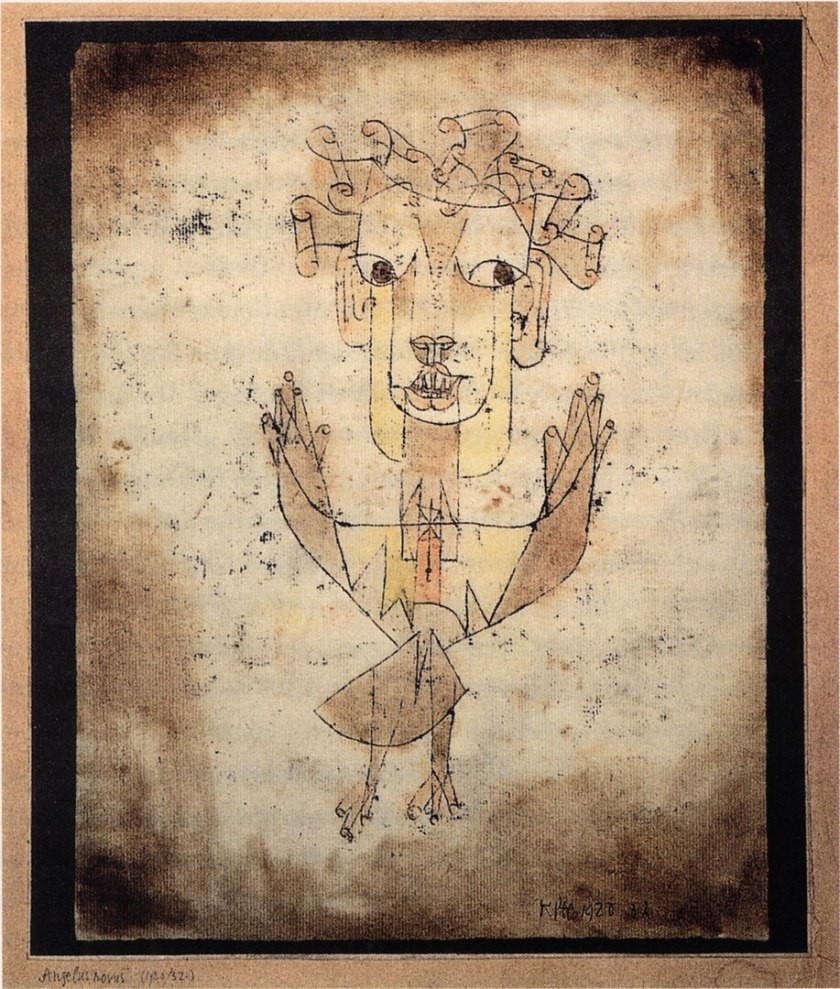
The Lyrics below were written by D.S. Yarab, and inspired by Walter Benjamin’s 1940 essay, On the Concept of History, in which Walter Benjamin dubbed Paul Klee’s Angelus Novus the Angel of History in the following haunting paragraph: “A Klee painting named Angelus Novus shows an angel looking as though he is about to move away from something he is fixedly contemplating. His eyes are staring, his mouth is open, his wings are spread. This is how one pictures the angel of history. His face is turned toward the past. Where we perceive a chain of events, he sees one single catastrophe which keeps piling wreckage upon wreckage and hurls it in front of his feet. The angel would like to stay, awaken the dead, and make whole what has been smashed. But a storm is blowing from Paradise; it has got caught in his wings with such violence that the angel can no longer close them. The storm irresistibly propels him into the future to which his back is turned, while the pile of debris before him grows skyward. This storm is what we call progress.” The music was created with artful prompts using AI at Udio.com.
It is safe to observe that neither lyricists nor composers are at risk of displacement. For proof, see, at the end of this post, below the transcription of my lyrics, the video of the work by the artist Laurie Anderson, who used the same Benjamin essay for inspiration for her work, “The Dream Before.” I came across her work several days after I posted my video and thought it would make a good addition to the original post so amended my post to include it.
Lyrics to “Angelus Novus, Angel of History” by Donald S. Yarab
Verse:
Angelus Novus stands alone,
Gazing back with eyes of stone,
Mouth agape, wings open wide,
Witness to the endless tide.
Chorus:
Angelus, angel of history,
Wreckage piled, a single catastrophe,
Storm from Paradise, wings unfurled,
Propels him onward, to the future hurled.
Verse:
Where we see events unfold,
He sees ruins, stories told,
Wreckage piling at his feet,
Dreams of wholeness, incomplete.
Chorus:
Angelus, angel of history,
Wreckage piled, a single catastrophe,
Storm from Paradise, wings unfurled,
Propels him onward, to the future hurled.
Verse:
Storm of progress, fierce and strong,
Drives him ever, far along,
Backwards facing, forward thrust,
Dreams of past now turned to dust.
Chorus:
Angelus, angel of history,
Wreckage piled, a single catastrophe,
Storm from Paradise, wings unfurled,
Propels him onward, to the future hurled.
Verse:
Angel yearning, dead to wake,
Mend the shattered, for their sake,
But the storm, it will not cease,
Angel’s plight, no sign of peace.
Chorus:
Angelus, angel of history,
Wreckage piled, a single catastrophe,
Storm from Paradise, wings unfurled,
Propels him onward, to the future hurled.
Coda:
Angelus Novus, forward driven,
By the storm, no peace is given,
Angel of history, face of sorrow,
Through the wreckage, towards tomorrow.

 Northcoast Antiquarian