

In an earlier posting I explored the origins of the Yarab surname, tracing it back to the Slovak surname Jaráb, which is related to the Czech word for crane, jeřáb. That essay also discussed the Eurasian crane, significant in Slovak culture, and explored the symbolic traits associated with cranes across various cultures. Such traits include wisdom, vigilance, mercy, and grace. Cranes also feature prominently in the mythology and folklore of many civilizations, including the Bashghirds, Arabs, Greeks, Koreans, and Japanese. After investing so much time in the research, I decided to write a poem, or lyrics, and set it to music using Udio.com. The result is above. For a detailed understanding of the various references in the lyrics of the song, please visit the posting at On The Origins of the Yarab Surname.
Tag: cranes

Dancing Cranes (2023)
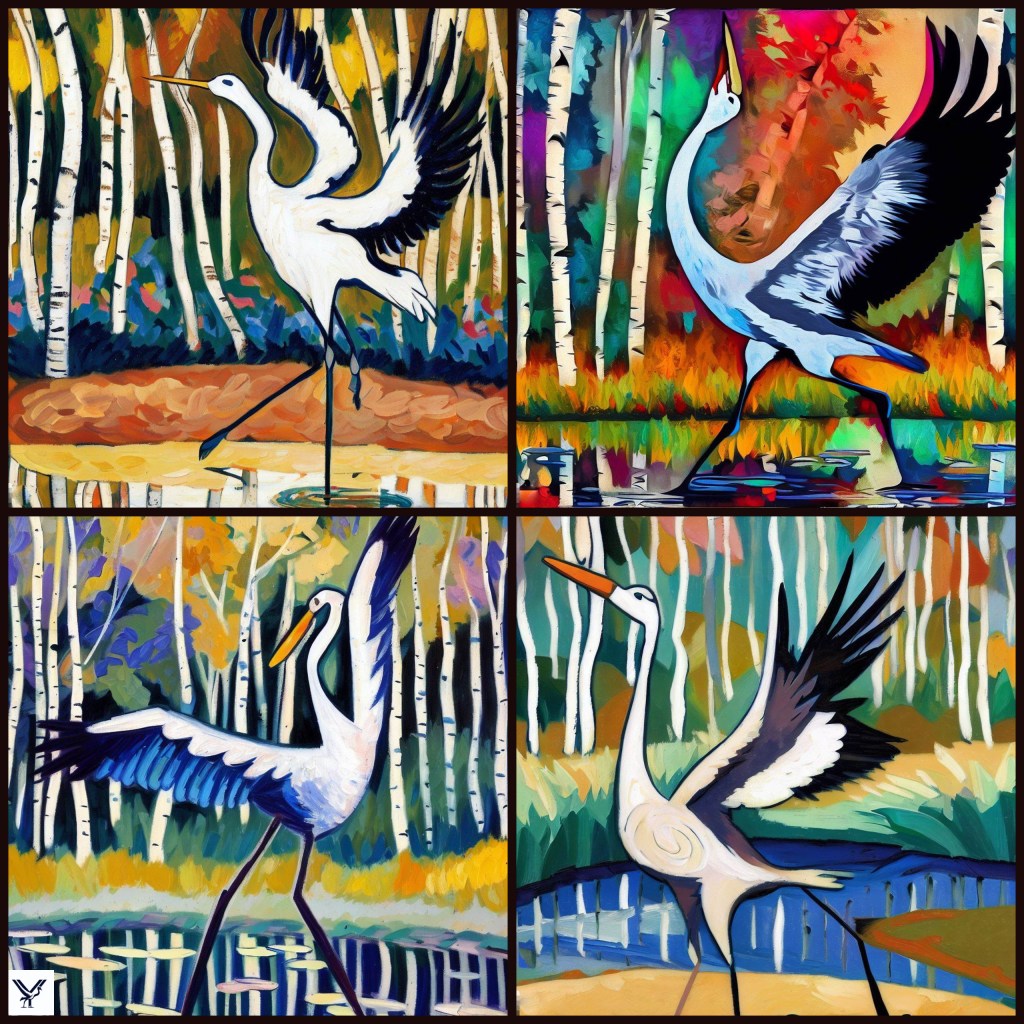
Dancing European cranes, of the genus Grus Grus, inspired by a walk in the park where I happened upon some beautiful birch trees. Lake Erie inspired the water in the images. And of course, AI provided the images once given a detailed prompt. Thank you, Bing Chat! I think I will have these images transferred to postcards -I like them so.
Share this:

An Attractive Silver Didrachm of the Greek Colony of Selinus in Sicily with a Crane on the Reverse

Yarab is an Anglicized spelling of the Slovak surname Jaráb. It is a zoonym, which is a name of an animal. That animal is a crane, for in 19th century Slovak Jaráb is akin to the Czech word jeřáb, which means crane. Accordingly, when I happened across the the above coin from Selinus, depicting a crane on its reverse, I had to learn a little bit more about the history of Selinus and the imagery appearing on this stunning coin.
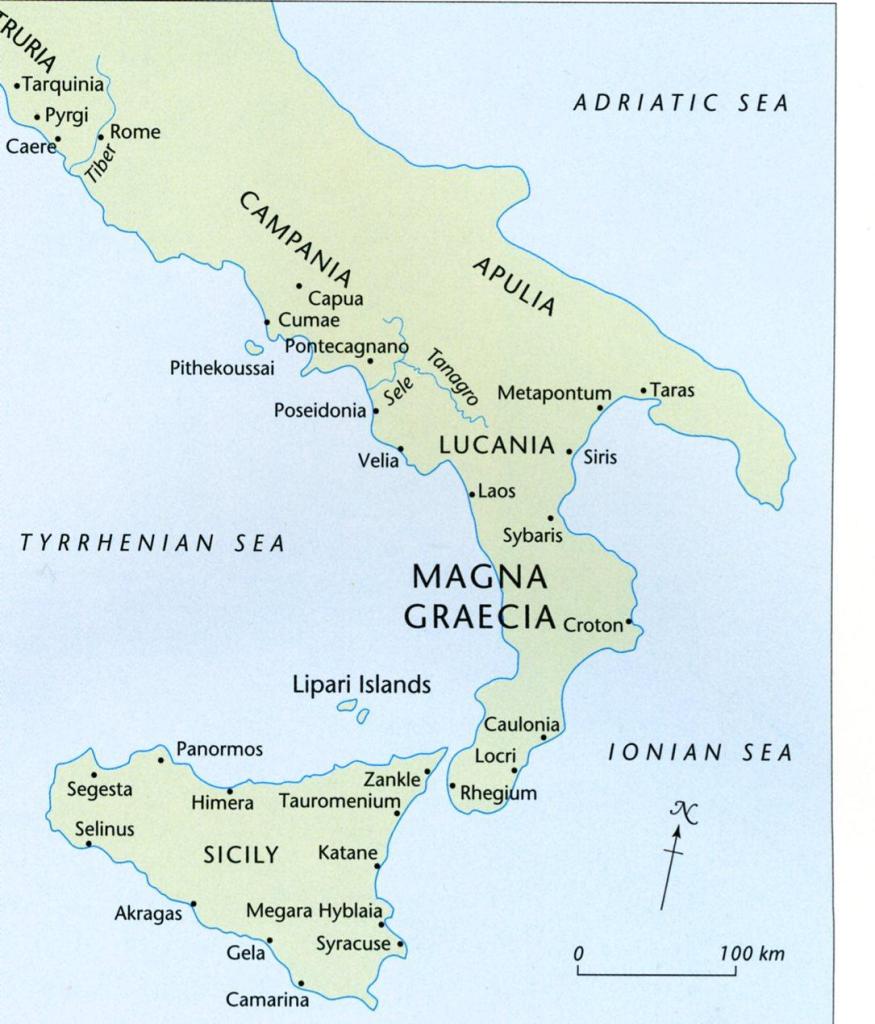
Selinus is located on the south-west coast of Sicily and, according to Thucydides, was founded in 628BC by Greek colonists from Megara Hyblaea, a Greek colony on the eastern side of Sicily. It was the most western Greek colony on Sicily and one of the first Greek colonies in Sicily to issue coins.

The colony covered a large and well-planned urban and sacred area. The sacred area is reputed to have had ten separate temples dating from the 6th to 5th century BC. The Temple of Hera is amongst the city’s most famous ruins.
The World History Encyclopedia article on Selinus records that the city was completely redesigned between 580-570BC and that the city is one of the best examples of ancient town planning. It also notes that indicators of the city’s wealth were the presence of a theatre, its prolific mint, and its satellite colonies (such as Eraclea Minoa, established in 570 BC).

Selinus allied itself with Carthage in 480BC and was often at war with rival city Segesta on the northern coast of the island. Although initially ruled by an oligarchy, Selinus was governed by tyrants throughout the 5th century BC. Selinus was sacked by Carthage in 409BC after Hannibal besieged the city for nine days; some 16,000 of the city’s inhabitants were slain after the city fell. The city was rebuilt by the Syracusan exile Hermocrates, but was under Carthaginian control in the 4th century BC. During the first Punic War (264-241BC), the city was abandoned.
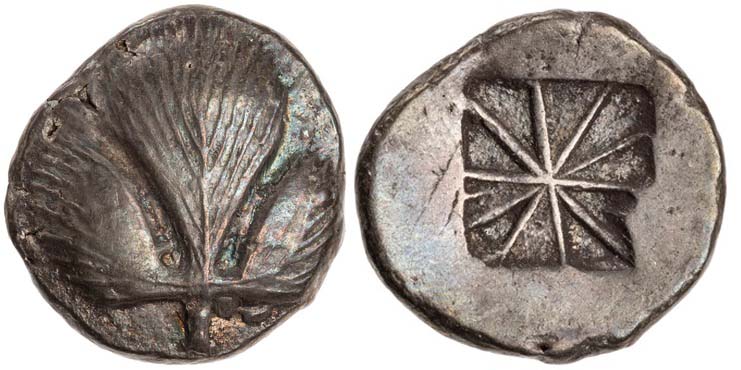
As mentioned above, Selinus was among the the first cities to strike coins in Sicily. In Greek Coinages of Southern Italy and Sicily, N.K. Rutter records that “the obverse of the first coins had a canting type represent the name of the city in a visual form: a leaf of the celery plant, selinon in Greek, mostly presented in a stylized way with three parts, a central frond supported by a frond on either side. Later versions of the leaf are more complex. The reverse bears an incuse square, on the earlier issues divided into triangles, usually with raised and depressed sections” (p. 102). These types may have been struck from c. 530 -470BC.
The coin which is of especial interest to this post, however, was struck c.450BC and was of a very different type. Of this type, Rutter says the following (pp. 138-139):

“A little later, perhaps around 450, Selinus revived the minting activity that it seems to have abandoned around the time of the Carthaginian attack in 480 (or perhaps a decade later) with a series of coins rich in religious imagery and references to local cults. … On earlier coins of Selinus a leaf of the celery plant had been the main type, now it is merely a small symbol in the field. The didrachms repeat the theme of sacrifice on the reverse – performed now by Hypsas the other river-god of Selinus – while the obverse shows Heracles fighting the Cretan bull: the hero brandishes his club in his right hand, while with his left he seizes one of the bull’s horns. The cult of Heracles is well-attested at Selinus and had a special interest for its citizens: it linked them to Argos, home of the dynasty that gave birth to Heracles, and also to Cnossos in Crete, where the hero had performed one of his celebrated labors.”
For those unfamiliar, Eurystheus’s demand that Heracles capture and bring the Cretan bull to him alive was the Seventh Labor of Heracles. It was a labor easily accomplished. See Apollodorus. The Library, Volume I: Books 1-3.9. Translated by James G. Frazer. Loeb Classical Library 121. Cambridge, MA: Harvard University Press, 1921. pp. 198-201 or, perhaps more readily available, see The Labors of Hercules.
Regarding the bird appearing on the reverse of this type and identified as a crane (which it is currently identified as in most references and databases (such as the American Numismatic Society’s database) and most trade offerings (see various offerings as recorded in coinarchives.com and acsearch.info), it was first identified as a crane as early as 1876 in the British Museum catalogue. But this identification was not unchallenged, apparently. For a period, numismatists, being uncertain, identified the bird simply as a marsh bird, and then were prone to identify it as a heron or egret. See pp. 90-91 of the following article for a discussion of this issue: Lloyd, A. H. “THE COIN TYPES OF SELINUS AND THE LEGEND OF EMPEDOCLES.” The Numismatic Chronicle and Journal of the Royal Numismatic Society, vol. 15, no. 58, 1935, pp. 73–93. JSTOR, http://www.jstor.org/stable/42664348. Accessed 14 Aug. 2021.
However, cranes have been present in western Sicily recently (e.g. most recently in the Trapani salt marshes, an area not too distant from ancient Selinus), and have been present in western Sicily historically, and there should be no reason to doubt the initial identification of the “marsh bird” on the coin’s reverse as a crane. See Masseti, Marco. “The lost cranes of the island of Lampedusa (Italy).” Rivista Italiana di Ornitologia, vol. 86 (I), 2016, pp. 49-54.
Share this:

Why is the Crane on a Starry Field?
Though those of my lineage have no heraldic arms, I have taken as a personal emblem a crane on starry azure field, with a chief charged with three golden dragon flies. As a motto, I have adopted, Humilitatem Initium Sapientiae. A phoenix gold and red crest with gold and black mantling support the shield.

The crane was adopted as the central figure of my emblem because of its rich symbolism and because, simply, my Slovak surname translates into crane. The crane was placed on a starry field because I so oft look up in wonderment into the night skies. Indeed, I recall with regularity the beauty of the words from a small little text called the Christianica, which I was given decades ago by Father Richard for serving as a catechist at St. John Catholic Church in Albion, Michigan. In particular, I remember the following lines (a most felicitous juxtaposition of some verses from Psalms and Genesis) that have a particular resonance with me:
Lord, when I look at thy heavens, the work of they fingers, the moon and the stars which thou hast established;/what is man that thou are mindful of him?/ Yet thou has made him little less than the angels and given him dominion over the works of they hands;/ thou has put all things under his feet.
Wonderment at the cosmos. Humility at our place in the cosmos.

I was further moved to place the crane on a starry sky when I read the Fable of The Crane and the Peacock by Avianus. Here is the full translation of the fable:
The story goes that Juno’s bird disparaged the Thracian fowl, when she shared their joint feeding ground. For a quarrel had arisen involving their different kinds of beauty and they were protracting a long argument on a case easy to settle. The peacock contended that the parts of his body gleamed in manifold loveliness, but that a dingy back gave the crane a dun colour, and at the word he arrayed about him the canopy of his uplifted tail and shot an arc of light upwards to the sky. The crane, though unable to rival the other in any glory of plumage, is nevertheless said to have used these words in mockery: “Countless may be the array of colours variegating your plumage, yet you, the wearer of the gaudy tail, are for ever kept close to earth. But I soar aloft into the air on my wing for all its ugliness, and am wafted nigh to the stars and heavenly powers.”
Avianus, Hadrian, Florus, Nemesianus, Reposianus, Tiberianus, Phoenix, Rutilius Namatianus. Minor Latin Poets, Volume II: Florus. Hadrian. Nemesianus. Reposianus. Tiberianus. Dicta Catonis. Phoenix. Avianus. Rutilius Namatianus. Others. Translated by J. Wight Duff, Arnold M. Duff. Loeb Classical Library 434. Cambridge, MA: Harvard University Press, 1934, p. 705.


