The Lingering Fire: Language Before, Within, and Beyond Speech

A Reflection Interwoven with Ante Verba, Verba, and Postverbum


Cy Twombly (1928-2011), Untitled
2005, acrylic on canvas
Cy Twombly (1928-2011), Untitled
2005, acrylic on canvas, 128 x 194½ in
“His madness is a circle of fire, an unbroken circuit of excess, each attempt at containment spilling into the next”—Art historian Malcolm Bull on the Bacchus paintings.

The three poems, CARMINA TRIA: DE VOCE AGGLUTIVA, which follow—Ante Verba, Verba, and Postverbum—did not emerge by design. They followed Liber Agglutivi as if by necessity. Once the treatise had been written, these poems had to be. They are not commentaries on the Liber, nor are they didactic restatements of its metaphysical claims. Rather, they are its echo—its ember. They are the hymns sung at the threshold that Liber Agglutivi only describes.

Even readers unfamiliar with the medieval-inspired treatise can enter these poems directly. They function as meditations on how language lives in us before we speak it, while we speak it, and after our words have fallen silent. Readers of the Liber will recognize these concerns, but the poems make them immediate and felt rather than theoretical.

They move through language as tremor, fire, and resonance. The sequence below mirrors the deeper structure of the Liber: from the agglutum primitivum (pre-verbal memory), to the verbum intransitivum (word as creation), to the postverbum and glosselitha (residual presence).


CARMINA TRIA: DE VOCE AGGLUTIVA


I. Ante Verba

Language as Tremor, Silence as Light

Ante Verba
(Versus ad limen vocis)

Verbum non dicitur, sed fit.
Non transit, sed regnat.
Nomen quod loquitur se ipsum
non oritur ex ore, sed ex ossibus.
Lingua non fert sensum,
sed tremorem.
Memoria quae nescit quid meminerit
audit quod non sonat.
Tacere est tangere lumen.
Loqui est amittere formam,
ut recipiatur flamma.

Before Words
(Verses at the threshold of voice)

The word is not spoken, but becomes.
It does not pass through, but reigns.
The name that speaks itself
arises not from the mouth, but from the bones.
Language carries not meaning,
but tremor.
Memory that knows not what it remembers
hears what does not sound.
To be silent is to touch light.
To speak is to lose form,
so that the flame may be received.

This poem inhabits the space where language has not yet been spoken but is already forming. It suggests that words do not begin with speech—they begin with the body, with memory, with a force older than conscious thought. In the Liber, this is called the agglutum primitivum—the murmur that speaks itself rather than being spoken.

The line “non oritur ex ore, sed ex ossibus” (“arises not from the mouth, but from the bones”) aligns with Martin Heidegger’s vision in Letter on Humanism, where language is not a tool but the “house of Being.” Maurice Blanchot, in The Writing of the Disaster, understands silence not as negation but as a paradoxical mode of presence—a vision we carry forward in our own line from Ante Verba: “Tacere est tangere lumen.”

The poem resists the tendency to think of silence as a void. It suggests instead that silence is already full—that the word is merely what breaks the threshold.


II. Verba

Language Does Not Carry Meaning—It Generates It

Verba
Non instrumenta, sed ignes.
Non indicia, sed invocationes.
Ex spiritu fiunt formae.
Ex sono fit lumen.
Verbum non portat sensum;
generat.
Non sequitur lucem;
effundit eam.
Obliti sumus verba sentire—
at illa nos sentiunt.

Words
Not instruments, but fires.
Not signs, but invocations.
From spirit, forms arise.
From sound, light is made.
The word does not carry meaning;
it generates it.
It does not follow light;
it pours it forth.
We have forgotten how to feel words—
but they feel us.

Verba shifts from anticipation to ignition. Here, the word becomes flame. It does not describe; it creates. This is the essence of the verbum intransitivum found in the Liber—a word that does not pass meaning from subject to object, but emits meaning by its very being.

This echoes Jacques Derrida’s insight in Of Grammatology: that language does not simply transmit ideas—it generates meaning anew with every utterance. Jean-Paul Sartre in What is Literature? treats language as an existential act, not a report, and this vision is mirrored in the line “Verbum non portat sensum; generat.”

The agglutivum, as the Liber defines it, is precisely this: a word that binds meaning not through grammar, but through presence. The poem closes with a reversal: it is not we who perceive words, but words that perceive us.


III. Postverbum

The Spectral Afterlife of Language

Postverbum
Verbum abit, sed tremor manet.
Non vox, sed vestigium vocis.
Non lumen, sed fulgor in ruina.
Post verbum non est silentium,
sed memoria quae loqui recusat.
Forma cecidit—
resonantia viget.
Non est oblivio,
nec repetitio.
Est remanentia
sine nomine.
Quod dictum est, abit.
Quod vivit, remanet.

After-Word
The word departs, but the tremor remains.
Not voice, but the trace of voice.
Not light, but gleam within ruin.
After the word there is not silence,
but memory that refuses to speak.
Form has fallen—
resonance thrives.
It is not forgetting,
nor repetition.
It is remainder
without name.
What has been spoken departs.
What lives remains.

What remains when the word falls away? Postverbum addresses the residue of speech, its spectral persistence. The Liber speaks of the glosselitha—words no longer active but still resonant. This poem inhabits that after-space: where meaning is not present, yet not gone.

Derrida’s trace (especially in Writing and Difference) hovers here: a remnant of presence that cannot be fully recovered, nor fully lost. Nietzsche, in The Gay Science, evokes this through the fragment—the broken form more alive than the whole. And Bachelard’s “intimate immensity,” in The Poetics of Space, seems apt: the vast echo of what once was word.

This is not nostalgia. It is presence beyond sound.


Coda: Language as Tremor, Fire, Trace

The poems above are not marginal to Liber Agglutivi—they are its liturgy. They enact what the treatise evokes: a philosophy of speech where the word is not a vessel but a lifeform.

If the Liber speaks of agglutive words—words that bind not by syntax but by resonance—then these poems are agglutive acts. They offer no argument. They offer invocation.

Together, they invite us to listen differently—not just to what we say, but to what speaks through us when we are most quiet, most present, most alive to the mystery of having language at all.

We do not merely speak.
We are spoken.

Where the Furies Pause

by Donald S. Yarab

In myth, the Furies pursue the guilty. In this meditative poem, they do not chase or condemn, but pause—witnesses to memory, silence, and the uncertain balance between reckoning and reprieve. Beneath the yew, they wait—not gone, not appeased, but listening.


Vincent van Gogh, Trunk of an Old Yew Tree (1888)
Oil on canvas, 91 × 71 cm
London, Helly Nahmad Gallery
Vincent van Gogh, Trunk of an Old Yew Tree (1888)
Oil on canvas, 91 × 71 cm
London, Helly Nahmad Gallery

Necdum illum aut trunca lustrauerat obuia taxo / Eumenis…
Statius, Thebaid VIII. 9–10

“Nor yet had the Fury met him, bearing the lustral yew…”
Statius, Thebaid VIII. 9–10 (adapted translation)

As darkness descends and light abates,
The Furies wake at the turning of fates.
No horn is blown, no omen flies—
Only the hush where judgment lies.

They come not crowned, but cloaked in ash,
With broken names and eyes that flash.
Not wrath alone, but what endures—
The weight of memory that never cures.

They walk where silence used to sleep,
Where secrets rot and letters bleed.
The breath of dusk is cold and tight—
A wound reopens in the night.

By yews they pause, where death takes root,
In soil grown thick with ash and fruit.
The bark is split with silent cries,
The rings record what speech denies.

They do not speak, but still the trees
Murmur of trespass in the breeze.
The wind forgets its mournful tone—
As if the world waits to atone.

A shadow stirs, but does not fall;
A light withdraws, but leaves a call.
No hand is raised, no doom is cast—
And yet the pulse runs through the past.

The air is thick with what might be:
A breaking, or a turning key.
The Furies halt—but do not sleep.
And from the yews, the silence… deep.

So still they stand beneath the yew—
The Furies veiled in dusk’s soft hue.
Its needles dark, its berries red,
It shelters both the quick and dead.

They neither strike nor turn away,
But hold the hush at break of day.
Their eyes are dark, their purpose blurred—
As if they wait to hear a word.

My Friend, You Were There: A Reflection on Complicity


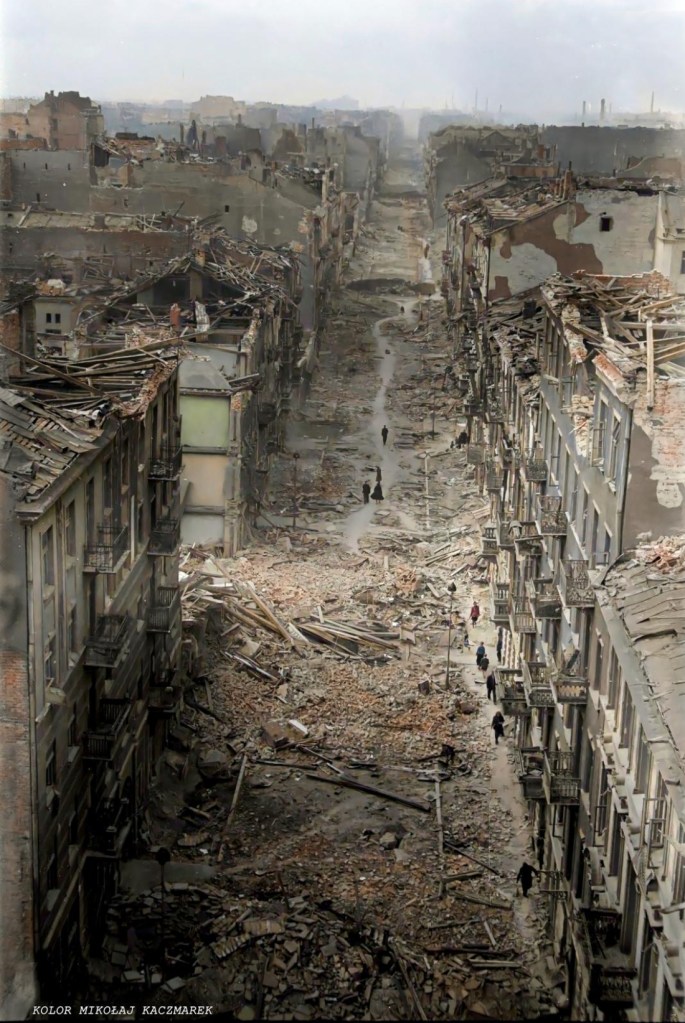
Warsaw Ruins 1944
Warsaw 1944

History shows that evil rarely marches under banners we immediately recognize. Too often, it comes draped in righteousness, purity, and fear. This piece is a lament for how easily we have been—and still can be—drawn into the machinery of cruelty.


My Friend, You Were There

My friend,
When the Holy Catholic Church, seeking to preserve the Faith in all its radiant purity,
instituted the Inquisition,
you were there—
not as a bystander,
but as a willing voice.

You denounced the old widow,
who lived alone with her cat.
You whispered against the Jewish family—
familiar, yet forever marked as other—
and gave your assent to their undoing.

You crowded into the square to watch the trials.
You sang hymns
as the flames crowned their bodies with smoke.
You wept tears of joy
that the world was made purer that day.

My friend,
When the ships came heavy with human cargo,
and the auction blocks stained the soil,
you were there.

You placed your bids.
You weighed their flesh.
You wrote the laws that chained their children.

You sang hymns on Sunday,
and broke their backs on Monday.
You called it providence.
You called it order.

My friend,
When the traders came with flags and rifles,
when the rivers flowed with rubber and blood,
you were there.

You signed the charters.
You counted the profits.
You sold the shackles and the scales.

You called it commerce.
You called it destiny.

My friend,
When the banners of the Reich unfurled,
and the drums of destiny beat their hollow call,
you were there.

You shouted with the crowds
as glass shattered from shopfronts.
You signed the letters,
you cheered the laws,
you raised your hand high in salute.

You bought the house,
the shop,
the art your neighbors were forced to leave behind.

You praised the strong hand
that swept away the weak.
You rejoiced as neighbors vanished,
grateful that your streets were made clean.

My friend,
When Stalin summoned the will of the people
to root out the enemy within,
you were there.

You reported the whispered doubts
of your cousin,
your friend,
your brother.

You paraded with red flags
while the trucks rumbled into the night.
You filled the quotas.
You seized the land.
You counted the spoils
as others disappeared.

You sang of the bright tomorrow
as you cast your eyes down
and stepped over the absent.

My friend,
When Mao lifted the Little Red Book,
and the children cried out against their fathers,
you were there.

You led the chants.
You scrawled denunciations across the walls.
You struck the old professor who dared to hesitate.
You cheered as the temples fell,
and the old poems burned,
convinced you were building a paradise
on the bones of the past.

My friend,
When Pol Pot promised that the fields
would bloom with new life,
you were there.

You marched the teachers into the paddies.
You pointed the rifle.
You praised the year zero
that would erase the memory of all that came before.

You smiled
as the world was reborn in silence.

My friend,
When the generals rose in the name of order,
when the prisons filled and the stadiums overflowed,
you were there.

You nodded at the names.
You counted the profits.
You watched the blindfolded taken at night.

You called it security.
You called it salvation.

My friend,
You have always been there.

Only too late did you realize.
Only too late did you doubt—
but not much.

You fell silent,
lest you betray your doubt.
You looked away,
lest you see.

You told yourself it would be different this time.
You told yourself you had learned.
But the signs are familiar.
The words are familiar.
The silence is familiar.

And it is happening again.

Pondering the Night: A Meditation with Morpheus

“Ponder, O Morpheus, the Night Sky” arose from a meditation on the nature of dreams, consciousness, and the silent mysteries that lie beyond both. Rather than seeking to instruct, this poetic work offers a dialogue — between mortal longing and divine wonder, between question and silence. In addressing Morpheus, the god of dreams, the poem invites not sleep, but contemplation: a shared pondering of the night sky, where the known fades into the unknown, and where even gods may pause in awe before the infinite. It is my hope that this work may serve as a quiet companion for those who have found themselves, at least once, standing beneath the stars, asking questions for which no easy answers are given — and finding, in the asking, a kind of sacred beginning.


Sleep (c. 1771). Oil on canvas, 129.5 x 96.5 cm (38 x 51 in). Cleveland Museum of Art. Depicting Morpheus
Sleep by Jean Bernard Restout (c. 1771). Oil on canvas, 129.5 x 96.5 cm (38 x 51 in). Cleveland Museum of Art. Depicting Morpheus

Ponder, O Morpheus, the Night Sky

“Beyond dreams lies a silence where even gods wonder.”

Prelude: The Summoning of Morpheus

Morpheus, Keeper of the Silent Looms,
hear now the summons not of those who seek forgetfulness,
nor of those who plead for soft illusions to cradle their weary minds—
but of one who, standing alone beneath the immeasurable firmament,
dares to bid thee ponder.

Ponder, thou Weaver of Shadows, the night sky:
the endless, ink-deep vault where Orion’s belt cinches the waist of darkness,
where scattered fires—blue, white, and ancient red—
whisper of secrets too vast for mortal tongues.

Not for dreams of idle comfort do I call thee forth,
but for contemplation;
to set aside for a moment thy ceaseless crafting of mortal visions
and lift thine ancient gaze upward,
where the silent percussion of dying stars
beats out the hidden music of creation.

For if thou, master of phantoms and bringer of luminous memories,
shouldst pause to wonder at that boundless mystery,
then perhaps the soul of man, frail and flickering though it be,
might dare likewise to ask:

Who dreams the dreamers, O Morpheus?
Whence come the visions thou bestowest?
And what lies beyond the last dream, beyond the last star, beyond the last breath of sleep?

Thus the greater query is born, trembling on the tongue of the sleepless,
yearning toward the silence that gathers all speech.

The Greater Query: A Dialogue with Morpheus

Soul:
If thou, O Shaper of Phantoms, canst be stilled by wonder,
then hear the questions borne upon my waking breath,
fragile as they are, yet earnest as the stars are ancient:

Who first whispered the dream into being, before ever thou didst fashion it?
From what unseen wellspring do the rivers of vision flow?
Are the dreams of men but fractured echoes of a deeper song,
or do they weave even now the hidden fabric of worlds yet unborn?

Morpheus (in thought):
Dreams are the trembling of the soul against the veil of the infinite.
They are not born of my will alone, Seeker,
but arise from the deep soil where memory, longing, and the first light entwine.
I but give them form; I do not summon them from the abyss.
Some dreams, frail though they seem, stitch the very edges of what is to be.
Mortals, in dreaming, unknowingly shape the unborn dawn.

Soul:
Is it given to us—dust briefly animated,
clay granted momentary breath—
to pierce that veil?
Or must we first unmake ourselves,
falling through forgetting, to be remembered by the nameless light?

Morpheus:
Beyond all dreams there is a silence
older than stars and deeper than death.
A silence not of absence, but of fullness,
where neither waking nor sleeping holds dominion,
and the soul, naked and unafraid,
beholds itself as it was before all weaving began.

There the true Dreamer dwells—
not I, but He whom none can name,
the source of all dreams, the end of all seeking,
the unspoken, the unseen.

Soul:
And if we seek it,
do we not risk all—memory, longing, even self itself?

Morpheus:
It is the risk of being lost to be found,
the surrender of knowledge to come to knowing.
To seek the Silent One is to set sail upon a sea without stars,
to abandon the safe shores of image and name,
to become at last what thou hast always been:
a breath upon the waters of infinity.

Ponder well, O Seeker,
for in the seeking, thou thyself becomest the dream,
the dreamer,
and the silence beyond.

The Blessing of Morpheus: The Sending Forth

Morpheus:
Go forth, Child of Earth and Stars,
go forth lightly, as one who walks upon waters not yet created.
Carry no burden save the yearning that kindled thy question;
bind no certainty to thy brow, nor shelter fear within thy breast.

Let dreams fall from thee like withered leaves;
let even the constellations become but distant embers,
for thou seekest now what neither dream nor waking thought can compass.

Take not with thee the names men have carved into the bones of the world,
for names shatter against the face of the nameless.
Take not the proud trophies of reason, nor the soft nets of hope,
for these will tear upon the thorns of the infinite.

Instead, take this only:
a heart made naked in wonder,
a mind made silent in awe,
and feet made light as wind upon waters unseen.

And know this, O Soul:
thou art neither lost nor found in this seeking,
for to seek the Silent One is to be gathered even now into His dreaming.

Thus do I, Morpheus, who weaves the veils of sleep,
send thee forth beyond all veils, beyond all sleep,
beyond the last trembling breath of mortal wonder.
Go, and become the question thou hast dared to ask.

Epilogue: The Pondering of Morpheus

And Morpheus stood long in the hush of the night,
his ancient hands unclasped, his brow unburdened of dreams.

He lifted his gaze once more to the immeasurable vault,
where scattered fires—blue, white, and red—
burned against the black breast of infinity.

He pondered—
not as god to mortal, nor as master to servant,
but as wonder to wonder,
breathless before a mystery he too could not wholly grasp.

In the stillness beyond weaving and shaping,
he glimpsed, as in the faintest shimmer of distant nebulae,
a vastness where even gods must bow their heads,
where even dreams dissolve like mist before the morning sun.

And in that silence, older than all his songs,
Morpheus smiled—
not because he understood,
but because he wondered still.

He felt a pang—brief and piercing—
a mortal ache for the fleeting fierceness of human wonder,
so bright and brief.

And so he pondered, and the night pondered with him,
until speech was stilled,
and he was lost—and found—within the endless deep.

Between Noise and Silence: On the Literal, the Metaphoric, and the Space Where Meaning Resides

Rembrandt, “Philosopher in Contemplation” (1632). A quiet spiral of thought, descending into the hush between certainties.

“The soul speaks most clearly when the tongue is still.”

There are days now, more frequent than before, when I find myself recoiling—not from people, exactly, but from a certain tone, a cast of mind. It is the literalists who unsettle me. Those who cling to the concrete as though it were the last raft afloat. The older I grow, with my silvered hair, the more their certainties feel not reassuring but menacing. It is not their knowledge I fear—it is their refusal to admit the unknown, the unspoken, the not-yet-understood.

And yet, I do not mean to dismiss the literal out of hand. I was trained in it. I lived among it. I applied law to facts with the solemn responsibility of rendering findings in civil rights complaints—decisions that shaped lives, guided by precedent, statute, regulation, policy, and the weight of written word. The literal is necessary. It is the groundwork. The shared foundation upon which meaning may be built. One must know the noise, the surface of things, before any deeper hearing is possible. Literalism is not, in itself, a failing. But to dwell in it wholly, to build a temple upon it without windows or doors—that is a failure of imagination and perhaps of courage.

There is something holy, or at least essential, in the gaps. The hush between words. The pause before reply. The silence that says more than any explanation could. It may be peace. It may be sorrow. It may be nothing at all—and that nothing may yet be everything.

The paradox thickens with age. I cannot dismiss the concrete—it is how we meet one another—but I also cannot abide those who live only by its rule. The world is not built entirely of clarity, nor is it meant to be. There is a path somewhere between the clamor and the silence, and perhaps I am only now beginning to find it.

The literal is our first tongue. It is how the child learns: this is a stone; that is a tree. Language builds the world we inhabit. And in that naming, in that first apprenticeship to the visible and the graspable, we are equipped with the tools to navigate life’s surfaces. We learn to classify, to divide, to act. It is a necessary scaffolding, even beautiful in its clarity.

But what follows—what truly shapes the soul—is what one does once that scaffolding has served its purpose. It is in the gaps, the silences, the places where the scaffolding falls away, that something more begins.

The darkness between the stars, or perhaps the light that filters through cracks in ancient stone, draws us to pause. It is not the substance, but the space between the substance, that calls us to deeper thought. The hush in a conversation—not the words, but the breath that precedes or follows them—can speak more profoundly than the speech itself. The crevice between certainties is where wonder slips in.

In these spaces we do not necessarily find answers. Sometimes we find transformative questions. Sometimes only presence. And sometimes only ourselves, which may be enough.

There is a wisdom in the void that no amount of noise can manufacture. Not the nihilism of meaninglessness, but the reverent recognition that meaning, like light, often travels best through emptiness.

To live entirely in the measured and known is to dwell in a museum of certainties—tidy, lifeless, unmoved. But to discard all that for a world of formless suggestion is to risk disappearance. The task is to dwell attentively in both: to know the stone as stone, and then sit long enough beside it to feel what it is not.

There are those who seek certainty in everything—in people, in relationships, in experiences, in outcomes. They crave contracts over conversation, definitions over dialogue. To them, ambiguity is a flaw, unpredictability a failure. But in securing themselves against uncertainty, they forfeit something essential. They miss the quickening of the heart in a half-spoken promise, the richness of a glance misunderstood, the poetry of a thing only half-comprehended but wholly felt.

To insist that the world always yield its meaning—immediately, exhaustively—is to mistake life for a mechanism. To live without risk, without the possibility of being undone or remade, is to refuse the privilege of being human.

And yet, those who flee entirely into mystery—who refuse form, who reject grounding—are no better served. Obscurity for its own sake is not wisdom but evasion. To veil oneself in metaphor to avoid responsibility is no more noble than to cling to literalism out of fear.

We are not machines. Nor are we vapor. We are, maddeningly and gloriously, both. We are flesh and thought, bone and breath, anchored and floating. And it is precisely in that stretch between—the literal and the allusive, the known and the unknown—that we are most fully human.

To demand certainty is to deny the thrill of becoming. To refuse structure is to forgo the beauty of its breaking. Somewhere in that middle space, between what can be said and what must be felt, is where the soul begins to sing.

And so we return to the hush. That space which is not absence but presence unspoken. The unanswered breath, suspended between question and reply, is not a failure of speech but its fulfillment. There, in that breath, we are closest to the truth—not because we grasp it, but because we cease grasping.

It is silence that answers most deeply. Not the silence of indifference, nor of ignorance, but the silence of presence—unadorned, uninsistent, abiding. The kind of silence that rests beside you like a companion who has nothing to prove. A silence that allows space for your own self to rise up, or dissolve, or simply be.

There are things that cannot be said, and yet are spoken in the pauses between words. There are truths that cannot be held, but are felt in the stillness between certainties. And perhaps the deepest form of knowledge is not in knowing, but in listening long enough to no longer need to.

The literal gives us form, but the silence between the forms gives us meaning. The prose of the world teaches us its names, but it is the poetry of its silences that teaches us our own.

I do not know if this is wisdom, or simply age. But I have come to suspect that the truest things—love, sorrow, grace, wonder—do not arrive in declarations. They appear instead in the gaps, in the long glances, in the word left unspoken. They arrive in silence. And in that silence—between noise and silence—we are not alone.