“The way up and the way down are one and the same.” —Heraclitus, Fragment 60 (Diels–Kranz); cf. Fragment 69 (Kirk & Raven)
When the mind enclosed reels, the frame gives way— No border left to mark the night from day. No cry, no anchor, only this descent Where meaning bleeds and thought is all but spent.
It is not drift, but failure to remain— The loosening of self from shape, from name. It does not seek, nor struggle, nor insist— It simply ceases, lost beyond all reach.
No wind attends, no witness marks the trace, No voice declares the vanishing of place. The silence is not peace, but what survives When all the scaffolds break, and none revives.
No hand to hold, no vow left to defend— One thought still clings—then breaks before the bend. Just falling, falling, not to sky or land, But into being none can understand.
The Counterpoint of Ponder, O Morpheus, the Night Sky
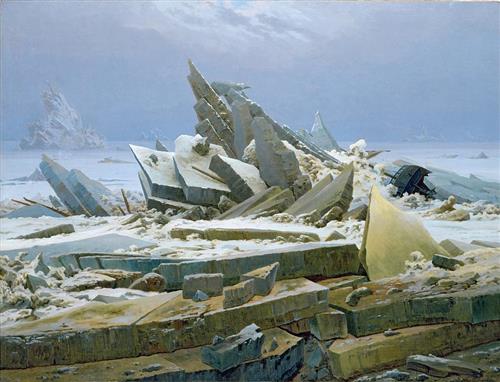
Caspar David Friedrich, The Sea of Ice, also called The Wreck of Hope Oil on canvas, 96.7 cm × 126.9 cm (1823–1824).
On the Unmaking of Benediction
This cycle of verses—The Inversion Cycle—emerged not as a contradiction, but as a counterweight to The Blessing of Morpheus: The Sending Forth, a series of benedictions articulated in reverent tones and metaphysical gestures within the poem Ponder, O Morpheus, the Night Sky. That earlier work was rooted in the soul’s deep yearning toward the ineffable, culminating in luminous affirmations bestowed by the dream-god Morpheus upon the seeker. In time, those benedictions came to feel too complete, too resolved. I began to wonder: what if they failed?
TheInversion Cycle is not blasphemy, but a form of apophatic honesty. It does not seek to erase Ponder, but to stand beside it—its negative counterpoint. Each scroll of the cycle corresponds to a specific line or blessing from Ponder and performs an act of unmaking: where Morpheus blesses, these verses refrain; where he sends the seeker into mystery, these verses stall at the threshold; where he assures, they withhold.
To honor that reversal, a further restraint was imposed: the exclusion of the very vocabulary upon which the original work (and many of my other recent works) so often relied. Words such as breath, dust, light, shadow, silence, and memory—among others—have been set aside. Their absence is not a loss but a signal. These are not the tools we are permitted to carry here.
The scrolls appear here in the same order as the benedictions from Ponder, O Morpheus, the Night Sky. This reversal respects the original arc—from the loosening of dreams to the transformation of the soul—and follows its negative path with precision.
What remains is austerity, not despair. These unsacraments do not offer consolation, but they do speak. If Ponder was a song of ascent, then this is the long exhale after the music ends—a psalter of withheld grace, composed in the space where blessing does not descend.
Let this work be read not in defiance of belief, but in the trembling of its undoing. For if it is brave to bless, it is perhaps braver still to stand in the space where blessing will not come—and write there, in the dust, what remains.
Scroll I: Of the Clinging Husk
Let not your dreams fall— for they will not fall. They remain, clinging like husks unpicked, blackened not by season, but by refusal.
You will try to cast them down, but they are fastened, not to limb, but to marrow.
They do not curl like leaves. They do not return to soil. They sour upon you, a bitterness in the sinew, a ferment in the thought.
And if you turn to shake them loose, they will tighten. Their threads are not of sleep, but of habit, knotted in long forgetting.
There is no wind to lift them. No frost to loosen them. No gardener comes.
Remain, then, beneath their burden— bent, unshed, unchanged.
Scroll II: Of the Inscribed Weight
Take them. You will take them. You cannot help it.
The names carved into stone, the words burned into walls, the cries etched into earth— they cling not to your pack, but to your ribs.
You bear them not as titles, but as scars.
They whisper through your marrow, resisting every act of unmaking. You try to enter the place without form, but they speak before you. They call the ground by its old name, and the gate does not open.
Even the sky does not answer when it hears them rising again.
These names were not carved to remember. They were carved to bind.
And now, as you stand at the edge of the place where all naming ends, they press their syllables against your tongue, and you speak them, not in defiance, but because you cannot forget.
Scroll III: Of Implements Abandoned
Bring not the weighted balances, nor the woven snares of longing. They do not hold, not here.
Their handles crack in the frost where no stars rise to bless the hour. Their mesh is brittle—threaded not of wool, but of claims left too long in the mouth.
The mind, honed to edge, cuts only fog in this place. The heart, cupped too gently, spills what it never held.
There are no laurels in this soil, only reeds that do not bend and brambles that do not bleed.
And should you cast such tools before you, expecting fruit, or fire, or favor— they will return to you as ash, unsought, unshaped, the chaff of means mistaken for ends.
Scroll IV: Of the Withheld Offering
Bring not your hollowed chest, stripped clean of ornaments and plea. It will not be filled.
Wonder has no purchase here. Its gaze returns unreflected from stone too smooth to be shaped.
Let the mind remain loud and unyielding, for awe would shatter in this poise like frost-cracked bronze.
As for your feet— do not lift them. There is no basin here, only ground dry from the beginning, lined with rings that do not ripple.
The wind does not attend. It does not lift. It does not listen.
There is no path across this floor, only grit, and the marks of those who came thinking they would walk upon revelation.
Scroll V: Of the False Horizon
Do not seek. There is no one to be found.
The sea does not receive you. It is not fluid, but glare stretched to the edge of motion— shimmering not with promise, but with mirage.
You did not launch. You drifted. And your craft was not chosen, but assigned, drawn from timbers meant for no voyage.
The sky above you swells with stars, but none are true. Each one marks a path that bends inward, circling you back to your forgetting.
You will think you move. You will call it seeking. You will call it bold. But you are already known by the thing that does not answer. And it has left no threshold, only wind that cannot be charted and depth that does not hold.
Scroll VI: Of the Barren Threshold
There is no beyond. Only the gray field where sleep forgets its end and waking does not begin.
Here, nothing waits. Not voice, not veil, not even the last gasp of wonder.
What lies past dream is not fullness, but poise robbed of sanctity— the deafness of stones before their naming.
No stars ever hung above this place. No fire traced its vault. Only pallor, dull as bone in a dry shrine, untouched by flame or veil.
And death, so often imagined a gate, has no depth here. It is shallow, crusted, and holds nothing but its own refusal.
Let no one say this place is holy. It is not what remains made full— but vacancy made permanent.
A place unmourned. Uncalled. Unmade.
Scroll VII: Of the Unbecome
Go not. There is nowhere that calls. No road unfurls before you, no veil parts, no watchful eye lingers on your vanishing.
The question you bore was not accepted. It curled back into you, like a tongue that feared its own utterance.
You will not be shaped by asking, nor known by your seeking. You will remain as you were before the yearning— a vessel without fracture, never poured, never filled.
No sound will rise behind you. No trace will stir where your feet passed. Even the soil will forget your weight.
Be still, not in peace, but in the form that does not unfold. Remain—not as the question— but as that which never found its shape.
Scroll VIII: The Soul Beneath the Blanched Sky
The soul, girded and unmoved, stood beneath a sky without veil— a dome blanched of fire, where nothing had ever gleamed, only ash adrift from unremembered pyres.
It bore no garment. No mark of calling or descent. It was as parchment without script, unhandled, unblemished, unread.
No winds stirred the plain. Only cairns rose in rows, not raised in reverence, but born of the land’s refusal to yield.
The trees there had no buds. Their limbs were stiff, as if carved for stillness— a forest of halted prayers. And beneath them, the roots did not seek nourishment, but curled inward, content in their forgetting.
There was no calm, no sacred pause. Instead, a muttering of syllables rose from the dry hollows— sounds without grammar, without bond, giving rise to no names, no intelligible form.
And when the soul pressed its palm to the ground, there was no spring, no pulse, only crusted clay— neither moist nor cracked, a firmness that would not give.
It asked nothing. Not from pride, but from knowing that some places are beyond summons— places where even longing has been turned to stone.
“Ponder, O Morpheus, the Night Sky” arose from a meditation on the nature of dreams, consciousness, and the silent mysteries that lie beyond both. Rather than seeking to instruct, this poetic work offers a dialogue — between mortal longing and divine wonder, between question and silence. In addressing Morpheus, the god of dreams, the poem invites not sleep, but contemplation: a shared pondering of the night sky, where the known fades into the unknown, and where even gods may pause in awe before the infinite. It is my hope that this work may serve as a quiet companion for those who have found themselves, at least once, standing beneath the stars, asking questions for which no easy answers are given — and finding, in the asking, a kind of sacred beginning.
Sleep by Jean Bernard Restout (c. 1771). Oil on canvas, 129.5 x 96.5 cm (38 x 51 in). Cleveland Museum of Art. Depicting Morpheus
Ponder, O Morpheus, the Night Sky
“Beyond dreams lies a silence where even gods wonder.”
Prelude: The Summoning of Morpheus
Morpheus, Keeper of the Silent Looms, hear now the summons not of those who seek forgetfulness, nor of those who plead for soft illusions to cradle their weary minds— but of one who, standing alone beneath the immeasurable firmament, dares to bid thee ponder.
Ponder, thou Weaver of Shadows, the night sky: the endless, ink-deep vault where Orion’s belt cinches the waist of darkness, where scattered fires—blue, white, and ancient red— whisper of secrets too vast for mortal tongues.
Not for dreams of idle comfort do I call thee forth, but for contemplation; to set aside for a moment thy ceaseless crafting of mortal visions and lift thine ancient gaze upward, where the silent percussion of dying stars beats out the hidden music of creation.
For if thou, master of phantoms and bringer of luminous memories, shouldst pause to wonder at that boundless mystery, then perhaps the soul of man, frail and flickering though it be, might dare likewise to ask:
Who dreams the dreamers, O Morpheus? Whence come the visions thou bestowest? And what lies beyond the last dream, beyond the last star, beyond the last breath of sleep?
Thus the greater query is born, trembling on the tongue of the sleepless, yearning toward the silence that gathers all speech.
The Greater Query: A Dialogue with Morpheus
Soul: If thou, O Shaper of Phantoms, canst be stilled by wonder, then hear the questions borne upon my waking breath, fragile as they are, yet earnest as the stars are ancient:
Who first whispered the dream into being, before ever thou didst fashion it? From what unseen wellspring do the rivers of vision flow? Are the dreams of men but fractured echoes of a deeper song, or do they weave even now the hidden fabric of worlds yet unborn?
Morpheus (in thought): Dreams are the trembling of the soul against the veil of the infinite. They are not born of my will alone, Seeker, but arise from the deep soil where memory, longing, and the first light entwine. I but give them form; I do not summon them from the abyss. Some dreams, frail though they seem, stitch the very edges of what is to be. Mortals, in dreaming, unknowingly shape the unborn dawn.
Soul: Is it given to us—dust briefly animated, clay granted momentary breath— to pierce that veil? Or must we first unmake ourselves, falling through forgetting, to be remembered by the nameless light?
Morpheus: Beyond all dreams there is a silence older than stars and deeper than death. A silence not of absence, but of fullness, where neither waking nor sleeping holds dominion, and the soul, naked and unafraid, beholds itself as it was before all weaving began.
There the true Dreamer dwells— not I, but He whom none can name, the source of all dreams, the end of all seeking, the unspoken, the unseen.
Soul: And if we seek it, do we not risk all—memory, longing, even self itself?
Morpheus: It is the risk of being lost to be found, the surrender of knowledge to come to knowing. To seek the Silent One is to set sail upon a sea without stars, to abandon the safe shores of image and name, to become at last what thou hast always been: a breath upon the waters of infinity.
Ponder well, O Seeker, for in the seeking, thou thyself becomest the dream, the dreamer, and the silence beyond.
The Blessing of Morpheus: The Sending Forth
Morpheus: Go forth, Child of Earth and Stars, go forth lightly, as one who walks upon waters not yet created. Carry no burden save the yearning that kindled thy question; bind no certainty to thy brow, nor shelter fear within thy breast.
Let dreams fall from thee like withered leaves; let even the constellations become but distant embers, for thou seekest now what neither dream nor waking thought can compass.
Take not with thee the names men have carved into the bones of the world, for names shatter against the face of the nameless. Take not the proud trophies of reason, nor the soft nets of hope, for these will tear upon the thorns of the infinite.
Instead, take this only: a heart made naked in wonder, a mind made silent in awe, and feet made light as wind upon waters unseen.
And know this, O Soul: thou art neither lost nor found in this seeking, for to seek the Silent One is to be gathered even now into His dreaming.
Thus do I, Morpheus, who weaves the veils of sleep, send thee forth beyond all veils, beyond all sleep, beyond the last trembling breath of mortal wonder. Go, and become the question thou hast dared to ask.
Epilogue: The Pondering of Morpheus
And Morpheus stood long in the hush of the night, his ancient hands unclasped, his brow unburdened of dreams.
He lifted his gaze once more to the immeasurable vault, where scattered fires—blue, white, and red— burned against the black breast of infinity.
He pondered— not as god to mortal, nor as master to servant, but as wonder to wonder, breathless before a mystery he too could not wholly grasp.
In the stillness beyond weaving and shaping, he glimpsed, as in the faintest shimmer of distant nebulae, a vastness where even gods must bow their heads, where even dreams dissolve like mist before the morning sun.
And in that silence, older than all his songs, Morpheus smiled— not because he understood, but because he wondered still.
He felt a pang—brief and piercing— a mortal ache for the fleeting fierceness of human wonder, so bright and brief.
And so he pondered, and the night pondered with him, until speech was stilled, and he was lost—and found—within the endless deep.





 Northcoast Antiquarian