Icy stars— points of ancient fire made brittle by distance, as though the heavens themselves had entered winter. They do not blaze; they prick. They hang, hard and lucid, in a silence sharpened by cold.
Such stars feel less like promises than reckonings. Their light arrives stripped of warmth, having crossed immensities where heat was spent long ago. What reaches the eye is endurance, not comfort— illumination without mercy.
In winter they seem closer, because the air has been scoured clean of softness. Each star stands alone, exact, unblurred, the sky insisting on precision, on the refusal of haze, metaphor, or excuse.
Indeed—stars resemble snowflakes. Each one discrete, each one sharp with its own geometry, no two quite alike, yet all governed by the same severe order.
They fall not downward but inward, settling upon the mind rather than the ground. They do not melt; they persist. What snow does to the earth— muting, clarifying, equalizing— stars do to thought.
Yet they are dissimilar in temperament—decisively so. The star, for all its pinprick stillness to the eye, is violence without pause: fusion, a steady hammer at its core, plasma boiling and convecting within its bounds, only to be held together by gravity’s unrelenting fist. Its light is not calm but coerced— order wrested from perpetual revolt.
The snowflake, by contrast, is obedience incarnate. It forms in surrender to temperature, pressure, and time, each facet answering silently to law. Nothing churns; nothing rebels. Structure blooms where energy dissipates, an architecture born not of struggle but of yielding.
And yet—what appears as opposition resolves into fidelity: both answering to temperature, to nature, to law.
Not submission, but staying true to what is given, to what may not be otherwise.
The star obeys by burning. Given mass and pressure, it cannot do otherwise. Fusion is not choice but consequence, law pressed hard upon matter until light is forced into being. Its turbulence is not rebellion but endurance under extremes.
The snowflake obeys by forming. Lowered heat, suspended vapor, the slightest allowance of stillness— and geometry appears. No facet decides; each angle arrives as it must.
Thus neither star nor snowflake is free, and yet both are exact. They do not err, because they do not aspire. They enact what must be— and leave us to consider what it means to call that perfection.
Modern scholarship’s great temptation—one that has often spilled into civic and cultural life—has been the pursuit of totality: to trace coherence from the disorder that followed revolutions, continental wars, and world wars, gathering fragments into systems that promised to restore meaning to the wreckage of history. Across disciplines—from medieval literary studies to economics, from art history to psychology—the twentieth century witnessed a striking convergence toward singular, systematic frameworks. Ernst Robert Curtius organized literature around recurring topoi;[1] Erwin Panofsky read art through iconographic programs;[2] Carl Gustav Jung distilled human experience into archetypes; and economists—whether Marxist or neoclassical (the dominant free-market orthodoxy, often traced back to Adam Smith)—sought universal laws governing production and exchange. Each claimed to reveal the deep structure beneath surface variation. Each, in claiming totality, shaded toward ideology—becoming, in some instances, rigid orthodoxy.[3]
This essay argues for another path: treat systematic frameworks as tools rather than truths; judge methods by the illumination they afford rather than by their doctrinal purity; and acknowledge the irreducible complexity of human phenomena. This is not relativism—some interpretations are demonstrably better than others. Rather, it is the recognition that inquiry dealing with meaning-making beings is fundamentally a craft requiring practical wisdom (phronēsis), not a science discovering exceptionless laws.
The Pattern of Capture
The mid-century turn toward formalism and structuralism did not arise by accident. Disciplines sought scientific legitimacy: systematic method, universal patterns, predictive power. The result was a proliferation of One Map systems.
In literary studies, New Criticism treated texts as autonomous formal objects; structuralists sought universal narrative grammars. Curtius’s monumental European Literature and the Latin Middle Ages catalogued the enduring armature of topoi that seemed to organize the Western tradition. In art history, Panofsky’s iconology promised the decipherment of hidden programs and symbolic orders, making artworks legible as texts within overarching schemas. In psychology, rival schools—psychoanalytic, behaviorist, cognitive—each claimed the key to the mind’s machinery; Jung added a transhistorical repertoire of archetypes as the psyche’s deep code. In economics, Marxism and neoclassical theory offered total pictures—historical materialism on the one hand; rational, utility-maximizing agents in equilibrium on the other—each confident that its lawlike structures governed the social world.
What these systems shared was the conviction that beneath diversity lay discoverable, general structures—topoi, archetypes, economic laws, narrative grammars. Master the structure and one could, in principle, explain everything within the domain. Deviations became error, noise, or “false consciousness” in need of correction.
Powerful incentives drove the turn. The prestige of natural science encouraged methodological mimicry. The chaos of revolutions and wars, whether on battlefields or in the life of ideas, created a hunger for stable foundations. Professionalization rewarded methods that could be taught, replicated, and certified. There was genuine intellectual exhilaration in finding patterns that seemed to recur across times and cultures.
The cost was equally great. Every framework, in sharply illuminating some aspects, systematically obscured others. The formalist who honed attention to technique missed history. The Marxist who foregrounded class dynamics missed irreducible symbolic or aesthetic meaning. The psychoanalyst who reduced motivation to the unconscious discounted deliberation and norm-following. The economist who modeled rational actors abstracted away meaning, culture, emotion, and power.
Worse, frameworks became tribal identities. Scholars and others did not merely use Marxist analysis or formalist reading; they were Marxists or formalists. To question the framework threatened belonging, status, and career. Method hardened into movement.
The Metacritical Turn—and Its Recurrence
By the 1960s–70s, reactions emerged. Poststructuralists such as Derrida and Foucault exposed the fissures and power-saturated operations of totalizing systems. Thomas Kuhn argued that scientific paradigms are historically contingent and periodically overturned.[4] Feminist and postcolonial critics showed how seemingly universal structures often encoded particular (male, Western) vantage points.
These critiques were clarifying. They revealed the politics of knowledge, the contingency of canons, the slipperiness of signification. Yet the tragedy is familiar: many of these movements reproduced the error they named. Poststructuralism ossified into an orthodoxy policed by jargon; feminist and postcolonial discourses fractured into camps, each claiming the right diagnosis; Kuhn’s paradigm talk became a ready instrument for dismissing unwelcome evidence (“that is just your paradigm”). The critics of ideology birthed new ideologies.
The recurrence is not mysterious. Academic, social, and political life rewards membership and defensible positions. Deep engagement breeds emotional investment. Intellectual communities cohere around shared tools, which then become badges. Psychologically, human beings prefer coherent worldviews; critiques of totality tend, over time, to totalize themselves.
The consequence is a landscape of warring camps, each armed with a schema, each convinced of its sufficiency, each systematically blind to what it excludes.
The Pattern Persists
The tendency has not abated. Contemporary scholarship, while more fragmented than the mid-century consolidations, continues to generate frameworks that, having illuminated genuine blindnesses, themselves become new orthodoxies.
In literary studies, identity-based criticism has made permanent contributions: revealing whose voices were systematically silenced, exposing how “universal human experience” often encoded particular (white, male, Western) perspectives, opening canons to previously excluded works, and showing how power operates through representation. These insights cannot and should not be reversed. Yet in many disciplines, identity analysis is in practice often treated as mandatory—as if race, gender, and colonial dynamics exhaust what makes literature significant. Aesthetic achievement, formal innovation, philosophical depth, or meanings that transcend identity categories risk dismissal as naive or complicit evasion. A tool that reveals crucial dimensions has become, in practice, the only lens deemed legitimate.
In art history, social approaches rightly challenged the fantasy of autonomous art divorced from material conditions. Examining how patronage, markets, institutions, and class relations shape artistic production has enriched understanding immeasurably. But when this insight hardens into orthodoxy, artworks risk reduction to mere symptoms of social forces—historical documents that could be replaced by period photographs without loss. What makes something art rather than illustration, what constitutes aesthetic achievement, why this painting rather than another—these questions become suspect, dismissed as formalist mystification.
In psychology, cognitive neuroscience has genuinely advanced understanding of how brain mechanisms underlie mental phenomena. Neuroimaging and computational models provide knowledge unavailable to earlier approaches, and any comprehensive psychology must integrate these findings. Yet when neural accounts claim completeness, they eliminate what phenomenological and psychodynamic traditions captured: what experience is like from the inside, how people create meaning, how culture shapes consciousness, and the reality of conscious deliberation. Persons become brains; intentions become activations; meanings dissolve into mechanisms.
In history, social history’s turn toward “history from below”—material conditions, ordinary lives, structural forces—corrected the great-man myopia of earlier approaches and revealed how the non-elite shaped events. This expansion of historical vision is irreversible progress. But the corresponding neglect of how individuals, ideas, and political decisions matter—how Lincoln’s choices, Robespierre’s rhetoric, or Empress Dowager Cixi’s interventions in succession and reform, which may be judged to have prolonged the Qing dynasty, hastened its fall, or proved irrelevant against structural inevitabilities—represents a new distortion. Agency disappears into forces; contingency into necessity.
In economics, behavioral approaches rightly demonstrate that people are not the perfectly rational calculators of neoclassical models. Incorporating psychology into economic analysis addresses real limitations. Yet these insights typically remain within the neoclassical framework as corrective patches rather than fundamentally reconceiving how culture, meaning, power, and institutions shape economic life. The model receives adjustments; the model’s adequacy remains unquestioned.
Each new framework sees genuinely what its predecessor missed. Identity criticism perceives exclusions that formalism could not. Social art history grasps material conditions that connoisseurship ignored. Neuroscience reveals mechanisms that behaviorism and psychoanalysis could only theorize. Social history captures structural forces that political narrative obscured. These are real advances, not fashions.
But each also misses what its predecessor saw—and tends toward its own totality despite beginning as correction. Identity criticism risks losing the aesthetic. Social approaches risk losing the artwork. Neuroscience risks losing the person. Social history risks losing agency. The tools that should be added to the kit instead displace previous tools.
What is not happening is accumulation—the steady building of a varied toolkit where new approaches supplement rather than replace useful older ones. A mature literary criticism would use identity analysis and formalist attention to craft and historical context and aesthetic response, depending on what the text requires. A comprehensive psychology would integrate neuroscience and phenomenology and social context and developmental history. The skilled interpreter today should command these multiple approaches—not choosing between them but deploying each where it illuminates. Exceptions exist: some cognitive scientists integrate neuroimaging with phenomenological reports; some art historians combine social analysis with formal attention; interdisciplinary centers occasionally foster genuine synthesis. But these remain minority practices, swimming against dominant institutional currents rather than exemplifying them. Whether such emerging synthetic approaches represent genuine accumulation or merely the next turn of the cycle remains to be seen. Meanwhile, disciplines continue to trade one narrow lens for another, each generation convinced it has finally escaped narrowness by adopting the current correction.
The pattern is structural, not accidental. Professional incentives reward sharp breaks over synthesis. Tribal dynamics require scholars to define themselves against predecessors, not as continuators. The genuine difficulty of using multiple frameworks simultaneously encourages retreat to single-method mastery. And every framework that proves illuminating in some cases tempts practitioners to apply it universally—if identity criticism works brilliantly here, why not everywhere? The cycle repeats: insight hardens into ideology; correction becomes constraint; the tool claims to be the only tool needed.
The Category Error
The deeper problem is categorical. Objects of natural science lack interiority. Molecules do not interpret norms, pursue purposes, or remember. For entities without meanings, general law is the right instrument.
Human beings, by contrast, are meaning-making creatures who simultaneously:
calculate and improvise, follow scripts and invent norms, respond to incentives and pursue ideals, act from unconscious drives and exercise conscious choice, inherit traditions and forge new symbols, seek survival and cultivate gratuitous beauty, are biologically constrained and culturally various, experience wonder, fear, shame, delight, duty.
Any framework that captures only one dimension—economic calculation, unconscious motivation, cultural determination, biological drive—remains partial. The person buying bread engages in exchange, enacts identity, satisfies hunger, recalls childhood, manages anxiety, enjoys form and fragrance, and participates in a regime of power. No single map captures this simultaneity.
Disciplines that study such beings—history, anthropology, sociology, economics, psychology, literary criticism—are, at their core, interpretive arts. They require:
Judgment rather than algorithm, Phronēsis rather than procedure, Tacit knowledge learned by apprenticeship rather than fully codified rules, Rule-following attunement that resists complete formalization, Contextual sensitivity to what matters here, Tolerance for ambiguity without surrendering evaluative standards.
Attempts to make these disciplines “scientific” by imposing formal models with universal reach typically expunge the very features that make human life human: interpretation, normativity, innovation, and freedom.
The Cartographer’s Lesson
A parable. A cartographer produces an exquisite chart—precise, elegant, guild-approved. When caravans disappear along routes the chart marks as clear, he blames the travelers. When rivers shift and roads become swamps, he demands that administrators “restore” the world to match the drawing. When armed men raise tolls at chokepoints, he dismisses them as “marginalia.”
Meanwhile, a surveyor carries rough packets: flood records, bridge failures, toll schedules, sailors’ soundings, fragments of local lore. She uses whatever map fits this terrain; when none suffice, she walks and looks.
The cartographer confuses map and territory. The surveyor knows every map is a partial, provisional tool. When the cartographer finally admits that “the law of the land is not the land,” he learns what the surveyor already knew: use maps to begin understanding, not to replace it.
This is the stance human inquiry requires. Marxist or neoclassical analysis, formalist poetics, psychoanalytic interpretation, rational-choice modeling—each is a map that foregrounds some contours while backgrounding others. The live question is never “Which map is true?” but “Which map (or combination) illuminates this terrain?”
Toward Methodological Craft
What does it mean to approach inquiry as craft?
Instrumental Pragmatism Judge frameworks by illumination, not identity. Ask: does this help me understand this event, text, institution, behavior? Elegance is not a virtue if it casts decisive features into shadow.
Cultivated Eclecticism Not dilettantism, but disciplined familiarity with multiple tools. A craftsperson keeps a varied kit and knows enough of each tool’s capabilities and limits to deploy it skillfully. This is harder than mastering a single framework—it requires years of practice with multiple traditions—but complex phenomena demand it.
Contextual Judgment (phronēsis) No algorithm selects the right tool. Judgment forms through experience with cases, by seeing many patterns and exceptions, by learning what usually works where—and when to break one’s own habits. This is wisdom in Aristotle’s sense: the capacity to deliberate well about particulars.
Humble Acknowledgment of Limits Every account is partial. The most honest claim is: “This framework reveals these aspects; others remain for other tools; still others remain opaque.” This is not relativism—we can distinguish better from worse interpretations—but recognition that comprehensiveness is impossible.
Results-Oriented Assessment Evaluate interpretations by their explanatory and revelatory power—by whether they clarify evidence, accommodate counter-instances, and guide action—not by ritual conformity to a method. A method that violates orthodoxy but illuminates is superior to one that adheres but obscures.
Integration of the Shadow Jung reminds us that the shadow we deny returns to trouble us.[5] What is true of the individual psyche is true also of our frameworks: each casts its own shadow, and what is banished comes back in altered form. The economic model cannot banish meaning and power; the formalist reading cannot banish history; the ideological critique cannot banish beauty and grace.
This posture is professionally risky. It builds no monolithic school, resists catechisms, and is harder to teach than technique. Judgment developed through apprenticeship cannot be reduced to steps in a textbook. The approach offers no easy tribal home. But it is the only posture proportionate to the subject.
This is not promiscuous eclecticism. Disciplined pluralism admits tools only insofar as they illuminate evidence, survive scrutiny against counter-instances, and cohere with established knowledge. The craftsman does not grab random implements but selects from a kit assembled through rigorous training. Bad interpretations remain bad—not because they violate methodological purity but because they distort evidence, ignore context, or fail explanatory tests. The point is that these evaluative standards are substantive (does it illuminate?) rather than procedural (does it follow the right method?).
Bread, Briefly
Consider bread. The economist sees prices and allocation; the anthropologist sees ritual identity; the historian sees revolutions sparked by grain shortages; the psychologist sees memory and comfort; the political theorist sees power over grain as power over people; the nutritionist sees macronutrients; the phenomenologist attends to the experience of crust and crumb. Each lens discloses a real aspect; none exhausts the thing. The person buying or baking bread engages all these dimensions simultaneously—and more besides, including whimsy, habit, and ineffable preference—and yet retains a mystery and irreducible particularity even after comprehensive analysis.
If bread—daily, simple bread—eludes total capture by any single framework, what hubris imagines that a theory could comprehend a people, a polity, an epoch?
The Political Parallel
The same craft logic applies to political economy. The modern state is neither pure predation (libertarian fantasy) nor pure salvation (vulgar statism). It is at once:
necessary infrastructure for complex life, a perennial object of capture by interests, the guarantor of freedom through law and its limiter through coercion, creator and creature of market relations, supplier of public goods and vector of exploitation.
Markets, likewise, excel at coordinating dispersed knowledge in some contexts and fail dramatically in others. The craftsman’s question is never “state or market?” but “which functions, organized how, accountable to whom, balanced by which constraints, under these conditions?”
Statesmanship, like scholarship, is an art of fitting means to circumstances. The statesman confronting an economic crisis needs to ask: Is this a moment for market incentives? For regulation? For direct provision? For some combination? The answer depends on diagnosis, not doctrine. Different problems require different tools. Ideological commitment to a single framework—whether libertarian, socialist, or technocratic—produces the intellectual equivalent of using a hammer on every problem because hammers are the only tool one recognizes.
Lineage of Craft
This essay’s argument stands within a tradition of pluralist and anti-foundationalist thought, indebted particularly to Isaiah Berlin’s value pluralism, Richard Rorty’s pragmatism, and Hans-Georg Gadamer’s hermeneutics, though it extends their insights across a broader range of disciplines and grounds them more explicitly in craft epistemology.[6]
Accordingly, this methodological stance is not a novel invention, nor is it “anything goes” relativism. It has a distinguished lineage. Aristotle distinguished epistēmē (demonstrable knowledge of universals) from phronēsis (practical wisdom about particulars) and technē (productive craft).[7] The human sciences, in his taxonomy, require phronēsis more than epistēmē—judgment about what to do in this case, not deduction from general laws.
Michael Polanyi taught that “we know more than we can tell,” that crucial expertise is tacit and transmitted by apprenticeship rather than explicit instruction.[8] The master craftsman knows when the wood will split, when the dough has risen enough, when the argument needs qualification—not by applying rules but through practiced sensitivity that cannot be fully articulated.
Wittgenstein observed that rule-following is socially embedded; the application of a rule is not itself rule-governed all the way down. At some point, as he wrote, “my spade is turned”—we act not from further rules but from trained judgment within a form of life.[9] This is not arbitrary; it is how competence actually works.
Clifford Geertz urged “thick description” in anthropology: embedding action in the “webs of significance” people themselves have spun, rather than subsuming it under general theory. [10] His interpretive approach recognized that understanding human behavior requires grasping the symbolic meanings actions hold for participants—meanings that are locally constructed and resist universal formalization.
These thinkers did not advocate methodological anarchy. They articulated rigors appropriate to human subjects: the discipline of attending carefully to context, of learning through practice, of acknowledging the limits of explicit formalization, of judging particulars wisely rather than applying universal rules mechanically.
Conclusion: Use This to Begin
The point is not to abandon systematic frameworks. Marxist analysis, formalist reading, psychoanalytic interpretation, economic modeling—all can illuminate. The point is to resist turning tools into totalities, to refuse the ideological capture that confuses method with truth.
What is required is methodological humility joined to practical ambition: admit partiality while pressing for understanding by bringing multiple tools to bear. This yields no catechism, no resting place, no easy fellowship. It is harder than certainty. It is also more honest, and more fruitful.
The best we can achieve is not final answers but better questions; not perfect maps but skillful navigation; not total theories but hard-won wisdom. The work asks for judgment, experience, humility—and the courage to say, at the edge of understanding, that the phenomenon retains depths we cannot plumb and possibilities we cannot predict.
The law of the land is not the land. Light and shadow arise together. Every map owes the world a margin.
Use this to begin.
Notes
[1] Ernst Robert Curtius, European Literature and the Latin Middle Ages, trans. Willard R. Trask (Princeton: Princeton University Press, 1983; first published 1953).
[2] Erwin Panofsky, Studies in Iconology: Humanistic Themes in the Art of the Renaissance (New York: Routledge, 2018; first published 1939). See especially “Introductory: Studies in Iconology,” 3-31.
[3] In principle, these approaches can serve as complementary tools—free market and Marxian analysis, for instance, each shedding light when applied together to an historical situation. Yet in practice, frameworks often ossify into rigid ideologies. Marxism once held this place in the USSR; neoclassical economics has increasingly assumed it in the United States. A striking example is Ohio’s 2025 mandate requiring all public universities to incorporate Adam Smith’s Wealth of Nations into a three-credit American civic literacy course, alongside the Constitution, the Federalist Papers, Lincoln’s addresses, and King’s Letter from Birmingham Jail. See Ohio Revised Code § 3345.382 (2025).
[4] Thomas S. Kuhn, The Structure of Scientific Revolutions (Chicago: University of Chicago Press, 2012; first published 1962).
[5] Carl Gustav Jung, “The Shadow,” in Aion: Researches into the Phenomenology of the Self, The Collected Works Works of C.G. Jung vol. 9, part 2, ed. and trans. by G. Adler & R.F.C. Hull (Princeton: Princeton University Press, 1979; first published 1959). Jung argued that the shadow comprises those aspects of the psyche that contradict the conscious self-image and are therefore repressed or denied; when unacknowledged, the shadow returns in distorted forms, and psychological wholeness requires consciously integrating what has been excluded.
[6] Isaiah Berlin, The Crooked Timber of Humanity: Chapters in the History of Ideas (Princeton: Princeton University Press, 2013); Richard Rorty, Philosophy and the Mirror of Nature (Princeton: Princeton University Press, 2009; first published 1979); Hans-Georg Gadamer, Truth and Method, trans. Joel Weinsheimer and Donald G. Marshall, 2nd rev. ed. (New York: Continuum, 1989).
[7] Aristotle, Nicomachean Ethics, Book VI, 1139a-1142a.
[8] Michael Polanyi, The Tacit Dimension (Garden City: Doubleday & Company, Inc., 1966), 4.
[9] Ludwig Wittgenstein, Philosophical Investigations, trans. G.E.M. Anscombe, P.M.S. Hacker, and J. Schulte (Oxford: Blackwell, 2009; first published 1953), §217: “‘How am I able to follow a rule?’—If this is not a question about causes, then it is about the justification for my acting in this way in complying with the rule. / Once I have exhausted the justification, I have reached bedrock, and my spade is turned. Then I am inclined to say: ‘This is simply what I do.’ / (Remember that we sometimes demand explanations for the sake not of their content, but for their form. Our requirement is an architectural one; the explanation a kind of sham corbel that supports nothing.)”
[10] Clifford Geertz, “Thick Description: Toward an Interpretive Theory of Culture,” in The Interpretation of Cultures (New York: Basic Books, 1973).
When I consider thy heavens, the work of thy fingers, the moon and the stars, which thou hast ordained; what is man, that thou art mindful of him? — Psalm 8:3–4 (KJV)
A child, in the earliest unfolding of consciousness, turns to the parent and asks: Why? Why is the sun hot? Why did my pet goldfish die? Why must we grow old? The loving parent does not scorn the child for such questions. Even when the answers stretch beyond what the child can yet comprehend, even when no answer can satisfy the deep, intuitive wonder stirring in the young mind, the parent listens. A gesture, a story, a silence full of tenderness—all serve as a response, for the asking itself is a sign of life, of spirit, of the soul reaching beyond itself.
How then can it be imagined that the Divine—source of all wisdom, all love—would greet humanity’s first Why not with the hush of welcome but with wrath? How could the natural longing to know, to understand the world into which humanity was born, be met not with compassion, but with a condemnation unto death?
It cannot be so. It is not the divine who pronounced guilt over the sacred question; it is man.
The doctrine of original sin, as shaped by priests and theologians, emerges not from divine decree but from human artifice. It is born of fear—fear of questions too vast to answer, fear of mysteries that human authority could neither command nor contain. It is a doctrine not of heaven but of earth, devised by those who sought to regulate the soul’s native reaching beyond the bounds of certainty.
For what is the story of Eden if not the story of the first Why? The yearning for knowledge—the desire to taste, to see, to know good and evil—was not the rebellion of prideful beings but the natural unfolding of consciousness itself. To portray this reaching as disobedience is to misread the very nature of the soul. It is the innocence of the child, multiplied and deepened, that yearns toward the silence, that dares to disturb the hush with a question.
The Genesis narrative itself frames the matter plainly:
“But of the tree of the knowledge of good and evil, thou shalt not eat of it: for in the day that thou eatest thereof thou shalt surely die.” (Genesis 2:17, KJV)
Yet in the original Hebrew, “good and evil” is not a narrow moral distinction, but a merism—a pairing of extremes meant to evoke the totality of human experience. The knowledge at stake was not merely of right and wrong, but of the complexities, ambiguities, and perplexities of life and being itself. It was the awakening of discernment, the painful blessing of full consciousness—the soul’s first stretching beyond the silence into the unknown.
In the unfolding of the tale, it is the serpent who first stirs the question, bidding the woman to see beyond the command to the possibility of knowledge itself:
“For God doth know that in the day ye eat thereof, then your eyes shall be opened, and ye shall be as gods, knowing good and evil.” (Genesis 3:5, KJV)
Yet the serpent, in the original narrative, is not named as a satanic force. That identification is a later gloss, a retrospective layering by later traditions. In Genesis itself, the serpent is simply described as subtle—”more cunning than any beast of the field.” It is not evil in the mythic sense, but a catalyst: a figure who provokes the first stirring of conscious wonder.
The temptation it offers is not toward cruelty or depravity, but toward awareness—the dangerous and sacred gift of discernment. When the woman saw that the tree was “good for food,” “pleasant to the eyes,” and “a tree to be desired to make one wise” (Genesis 3:6), it was not pride that stirred her, but wonder. It was not rebellion, but reverent reaching—the first trembling articulation of the soul’s native Why—that set humanity upon its long and necessary journey into the unfolding mystery.
Later theological traditions, particularly within Christianity, would recast this moment as the origin of inherited sin, a fall from grace so profound that it marred all generations to come. Even softer interpretations would speak of exile—a banishment from divine presence, a sundering of primordial innocence.
But this, too, misreads the deeper rhythm of the story.
There is no fall in the truest sense. There is no exile. There is only awakening.
Awakening carries consequence: the loss of effortless innocence, the onset of labor, of mortality, of sorrow. But it is not severance from the divine. It is the beginning of the soul’s true journey—the movement from unknowing participation in being into conscious, perilous freedom. It is not punishment, but transformation: the invitation to become beings capable of discernment, of wonder, of seeking the infinite even while clothed in dust.
The expulsion from Eden, if it can be called that at all, is no casting away. It is a sending forth—a sorrowful and sacred commissioning. It is humanity’s first trembling step into a world no longer given but always to be made meaningful by seeking, questioning, remembering.
Nor is this reaching confined to Eden alone. Even in the later unfolding of the sacred story, it is the struggle, not the submission, that is honored. Jacob wrestles through the long night with the divine being, refusing to release his grip until a blessing is given. And far from being punished for his audacity, he is renamed—Israel—“one who struggles with God.” (Genesis 32:28) Thus the struggle is made sacred. The refusal to let go, the daring to seek, the ache of confusion: these are not condemned but crowned. The journey was never meant to return to innocence; it was always to pass through mystery, bearing the wound and the wonder of awakening.
Across cultures and ages, humanity has imagined a lost Golden Age—a time when the world was right, when peace and justice reigned, when innocence was unbroken. In religion, in philosophy, in politics, the pattern repeats: there was once a perfection; we have fallen from it; we must find a way back.
Why does this myth endure? Perhaps it speaks to something innate within us: a yearning for wholeness, for rootedness, for a home we can no longer name. Perhaps it soothes the terror of our confusion, offering the hope that disorder and suffering are not our native condition, but a wound that can be healed.
Yet in our fixation on a lost Eden, we risk becoming prisoners of backward-facing time. The myth orients our spiritual gaze toward the past—toward what was allegedly lost—rather than toward what might yet be discovered. We become archaeologists of an imagined innocence rather than explorers of an unfolding mystery. The soul’s natural movement—reaching forward into new understanding—becomes replaced by a desperate scrambling backward toward a manufactured memory.
This temporal disorientation fundamentally misunderstands the nature of spiritual growth. Wisdom is not the recovery of what once was, but the discovery of what has always been waiting to be known. The soul does not develop by returning to an infantile state of pre-questioning, but by maturing through its questions into deeper and more profound questions still.
When we orient ourselves toward a mythical past rather than an unfolding future, we deny the essential nature of consciousness itself, which is not static but dynamic, not preservative but creative. We mistake the spiritual journey for a return ticket when it is, and has always been, a one-way passage into greater mystery, greater wonder, greater questioning.
Moreover, what we call Eden is not a historical reality but a projection of our deepest yearnings. It is the mind casting upon the blank canvas of prehistory its own longing for belonging, for certainty, for uncomplicated being. We imagine a time before questioning not because such a time existed, but because questioning—the fundamental condition of human consciousness—carries with it the necessary burden of uncertainty.
Eden, then, is not a lost homeland but a psychological construct. It is the mind’s attempt to escape the very condition that makes it mind: the capacity to ask, to wonder, to reach beyond what is immediately given. The myth provides a name for our discomfort with confusion, allowing us to imagine that our questioning nature is not our essence but our fall.
And here lies the deeper danger: what begins as a fabricated consolation becomes, in the hands of authority, an instrument of control. The artificial memory of Eden, manufactured to soothe our existential disquiet, transforms into a weapon wielded against the very questioning that makes us human.
For when the myth of a lost Eden is seized by those who would govern—whether priest or king—it becomes a tool of manipulation. The lost paradise becomes a justification for power. If the people can be made to believe they have fallen, they can be led to believe that only through obedience—obedience to those who claim to hold the keys to return—can they be restored.
Thus Eden becomes not a symbol of hope, but a lever of command. Thus nostalgia becomes a chain.
For those who seek to honor obedience as a spiritual virtue, there remains a profound distinction between the willing surrender that flows from understanding and the blind submission that stifles questioning. The former may indeed be sacred—a conscious alignment with wisdom greater than one’s own. It is only when obedience is divorced from the soul’s natural reaching, when it demands the silencing rather than the maturing of questions, that it betrays both the human and the divine.
And the chain wounds. It wounds the individual, teaching him to distrust his own questions, to despise his own longings, to silence the sacred impulse toward wonder within himself. It wounds the collective, stifling thought, suppressing creativity, narrowing the imagination of what a human life or a human community might be. It breeds conformity where there might have been diversity of spirit; it fosters submission where there might have been genuine reverence; it exalts obedience over understanding.
Under the weight of this imagined Eden, humanity turns inward in fear rather than outward in joyful seeking. The soul bows not in awe before mystery, but in terror before judgment.
Thus the myth that was meant to console becomes a force that deforms, a memory that imprisons rather than frees.
Some might argue that certainty provides comfort, that boundaries offer safety, that answers—even if incomplete—shelter us from the storm of unknowing. There is truth in this. Structure can indeed nurture growth, just as the trellis supports the vine. Yet when structure calcifies into dogma, when the trellis becomes a cage, the soul withers rather than flourishes.
Man is neither innately good nor innately evil. Man is innately confused. Born into a world more vast than his mind can grasp, woven from mysteries too great for his language to name, humanity’s first impulse is not toward sin, but toward understanding. The soul, bewildered and reaching, gropes for knowledge not out of pride, but out of need—the need to make sense of the strange and wondrous being into which it has been thrust.
Confusion, then, is not a defect; it is the ground of wonder. It is the blessed ignorance that precedes the sacred question: Why?
It is this confusion—the condition of the in-between creature, made of dust and breath—that makes the human journey necessary. Without it, there would be no seeking, no questioning, no striving toward the silence that calls from beyond the edges of comprehension. Without it, there would be no reaching for the fruit, no ache for the infinite, no longing to pierce the hush with a voice.
The theologians, in their haste to impose clarity where mystery should have remained, mistook confusion for corruption. They mistook the stumbling search for the willful turning away. But confusion is not sin; it is the evidence of our created nature, the signature of beings fashioned for a journey, not for stasis.
To ask Why? is to live as we were made to live: poised between the known and the unknown, between the immediate and the eternal. To forbid the question, to cast the seeking as rebellion, is to deny the very condition of being human.
Thus, the first reaching toward the tree of knowledge was not a crime against the divine. It was the first true act of humanity: the confused, innocent soul daring to stretch toward the beyond.
In our questions, then, we find not our fall but our rising. Not our sin but our salvation. For to ask Why? is to begin the journey home—not to an Eden that never was, but to a wholeness that awaits us in the brave and beautiful reaching of the confused, beloved human heart.
The sacred path is forward—into uncertainty, into wonder, into the endless unfolding of mystery.
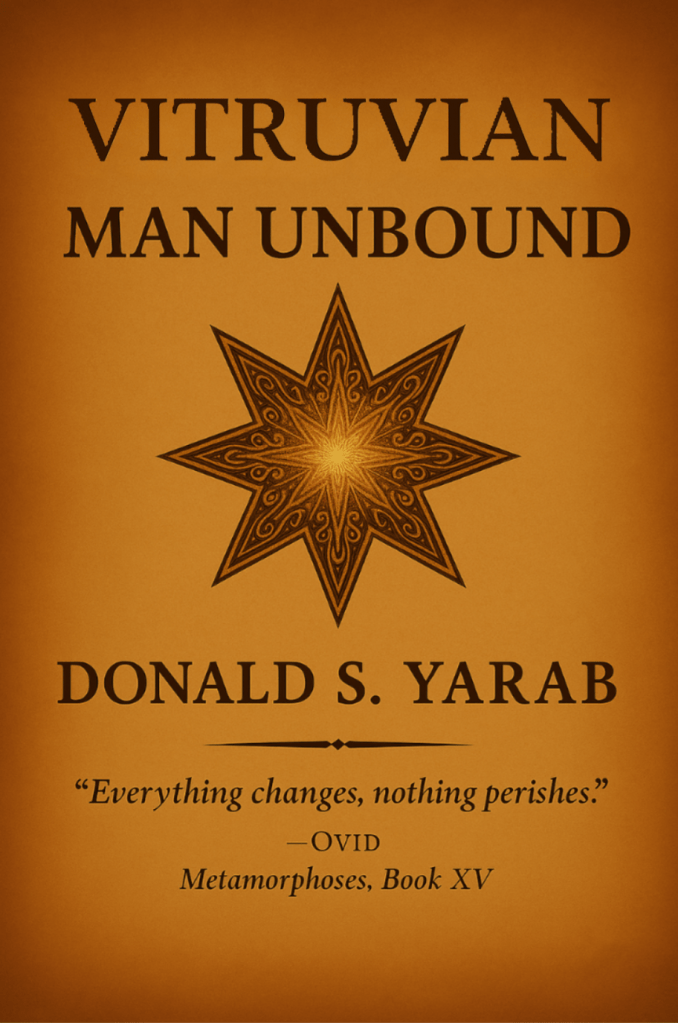
Whether its effect is ultimately salutary or merely a noble failure, Vitruvian Man Unbound remains among the most rewarding efforts, or perhaps conceits, I have undertaken. Its emendations and transformations were—like its central figure—immeasurable (and likely will continue), and its gestation period nothing short of elephantine.
The poem’s inspiration emerged from an unlikely constellation of influences: a Mesopotamian clay tablet inscribed with a circular map of the known and imagined world; Leonardo da Vinci’s iconic Vitruvian Man; Albert Camus’ existential meditations in The Myth of Sisyphus, whose vision of conscious perseverance became, in this poem, a point of departure rather than conclusion; and recent explorations in theoretical physics, particularly through Carlo Rovelli’s various poetically written works on diverse topics in physics and Tom Siegfried’s contemplations on the multiverse.
The ancient Mesopotamian map—ringed by a “bitter river” and annotated with realms of myth and marvel—initiated a chain of associations: from circular geometry to π, from π to infinity, from infinity to the concept of an ever-expanding circle that might, paradoxically, invert upon itself. This led me to contemplate Leonardo’s Vitruvian Man, a figure enclosed within perfect geometry yet suggesting boundless potential. What would happen, I wondered, if that containing circle began to expand? What lies beyond the circle?
Leonardo da Vinci, Vitruvian Man, c. 1490. Pen, ink, and watercolor over metalpoint on paper, 34.4 × 24.5 cm. Gallerie dell’Accademia, Venice. A study of ideal human proportions based on Vitruvius, it symbolizes the harmony between man and cosmos—later reimagined in Vitruvian Man Unbound as a figure yearning to transcend those very bounds.
The poem thus became a meditation on limits—mathematical, philosophical, spiritual—and on the impulse to transcend them. It is also an awakening voice—the imagined consciousness of da Vinci’s ink-bound figure, suspended between square and circle, flesh and form, number and soul. What begins as a monologue of emerging consciousness becomes, over thirteen movements, a metaphysical odyssey through proportion and paradox, art and love, measure and mystery.
On the Structure and Themes of the Poem
Vitruvian Man Unbound is presented as a continuous, structured poetic cycle in thirteen sections. Though it may be read as one long unfolding arc, each section can be approached individually, functioning as a discrete meditation on some aspect of becoming, limitation, or transcendence.
The measured self and its entrapment in form (Sections I–IV)
The emergence of consciousness, longing, and imagination (Sections V–VI)
The dissolution of boundaries—physical, geometric, metaphysical (Sections VII–IX)
The absorption of memory, history, and collective soul (Section X)
The confrontation with doubt and the paradox of being (Section XI)
The embrace of paradox as path to freedom and renewal (Sections XII–XIII)
The voice is intimate and reflective, at times philosophical, at times lyrical. It is, above all, a journey of unfolding: from the measured to the immeasurable, from containment to co-creation.
Names, Figures, and Concepts
Vitruvius Marcus Vitruvius Pollio (1st century BC), Roman architect and engineer, whose De Architectura proposed that the ideal structure—temple or body—should reflect proportional harmony. He regarded the human body as a model for universal order, inspiring da Vinci’s Vitruvian Man. In the poem, he represents the originary impulse toward order and the binding of form.
Euclid Greek mathematician (fl. c. 300 BC), whose Elements formalized axiomatic geometry. His presence in the poem marks the introduction of reasoned space, logical proof, and the classical foundations of architectural and cosmic order. His geometry is the poem’s first boundary.
The Circle and the Square Symbols both architectural and philosophical: the circle as divine, infinite, perfect; the square as earthly, finite, and rational. The tension and unity between the two—most famously reconciled in da Vinci’s figure—structure the early and middle arcs of the poem. They become both literal containment and metaphysical metaphor.
Leonardo da Vinci (1452–1519), the polymath whose Vitruvian Man draws Vitruvian proportions within geometric bounds. He is “The Master” within the poem, whose ink creates the narrator’s form. His act of artistic generation echoes divine creation. Yet, like all creators, he must eventually recede, and his fading enables the protagonist’s awakening.
Melzi Francesco Melzi (1491–1570), Leonardo’s devoted pupil, charged with preserving his master’s legacy. In the poem, he appears briefly yet meaningfully, representing both fidelity and the sorrow of watching a genius fade.
The Muse A figure glimpsed in one of Leonardo’s sketches, deliberately rendered with gender ambiguity to honor multiple dimensions of identity and desire—the artist’s, the poet’s, and the reader’s. This presence stirs longing and awakens an emotional dimension in the speaker. The muse is not merely an object of desire, but a catalyst for transformation: their unattainability teaches the Vitruvian Man the ache of love, the sweetness of loss, and the realization that beauty transcends all fixed proportion. This unrequited love, reminiscent of the nightingale’s devotion to the unresponsive rose in ancient fables, becomes the crucial spark that initiates the figure’s journey from structure to soul, from ink to aspiration. It is through learning to love without expectation of return that the Vitruvian Man begins to transcend his geometric constraints.
Scientific Concepts: Quantum Mechanics, Relativity, and Cosmology Beginning in Sections VII through IX, the poem integrates motifs from modern physics, influenced by Carlo Rovelli’s explorations of time and quantum reality and Tom Siegfried’s work on multiverse theory. The dissolution of stable form recalls quantum indeterminacy; the transformation of energy and space-time reflects principles of relativity and entropy. Ideas such as the collapse of the wave function, cosmic inflation, and the heat death of the universe are woven through metaphoric language, not as scientific proofs but as poetic echoes of our deepest metaphysical questions.
The speaker’s dissolution into “stardust,” his sense of “quarks” and “coding finer than the finest veil,” and his reconstitution within the universe mirror not only the physical processes of matter but the philosophical implications of nonlocality, relationality, and the disappearance of the observer. These concepts shape the soul’s journey as it expands from individual to cosmic.
The Golden Ratio An aesthetic and mathematical constant (~1.618), the “divine proportion” found in nature, architecture, and Renaissance art. In the poem, it appears as both blessing and boundary: a structure of balance, yet one that cannot reach beyond the sacred irrationality of love or mystery.
Temporal Resonance with The Shimmering Absence
Though conceptually initiated before my work on “Meditations on the Divine Absence,” the final revisions of Vitruvian Man Unbound occurred either contemporaneously with or following those meditations. This temporal twinning created a productive dialogue between the works—the apophatic theological explorations in The Shimmering Absence subtly informing the cosmic transcendence in Vitruvian Man Unbound. Where one explores the ineffability of the divine through negation and unknowing, the other charts a journey from geometric containment to cosmic liberation. Yet both arrive at similar insights: that limitations are not obstacles to transcendence but necessary conditions for it.
A Note on the Poem’s Resolution
The poem resolves in a synthesis where limitation and freedom no longer stand as opposites but as reciprocal necessities within creation’s design. The Vitruvian Man’s awakening culminates not in flight from form but in his realization that form itself is the threshold of infinity. The circle, once prison, becomes portal; the measure that once confined now sings. True freedom arises not from the negation of boundaries but from the recognition that only within them can boundlessness take shape.
The closing vision transforms the geometric into the musical—“Through every bound, the boundless voice resounds; / In every circle, countless worlds are found; / What ends in measure lives in endless sound.” This metamorphosis from line to resonance mirrors the universe itself: finite structures generating infinite harmonies, where order and mystery intertwine.
Such a resolution parallels modern physics’ vision of a participatory cosmos, in which observer and observed form one continuous field, and where the simplest laws yield inexhaustible complexity. Yet it also aligns with the apophatic tradition, which teaches that the divine is not seized by comprehension but intuited through reverent awareness of the limits of knowing.
Thus the poem’s final act is neither escape nor triumph, but return—an enlightened re-entry into the circle with transfigured sight. The Vitruvian Man becomes both measure and music, both drawn and drawing, the living emblem of a truth older than geometry: that the infinite reveals itself through the finite, and that all creation is the echo of its own unending sound.
Note: The version of the poem below is a revision of the originally presented work. Posted on October 29, 2025, it reflects a tightened structure, refined diction, and clarified thematic progression. The earlier version has been replaced by this text.
Vitruvian Man Unbound
“Omnia mutantur, nihil interit.” “Everything changes, nothing perishes.” — Ovid, Metamorphoses, Book XV
Prelude
Vitruvian Man Unbound— From Ovid’s voice, an echo still resounds, Of forms transformed, unbound from all surrounds. Once held within a circle’s tight embrace, I broke those bounds and found my rightful place.
I. The Eternal Forms
Before Vitruvius mapped the perfect man, And Rome set forth its grand and measured plan, A primal shape arose, both pure, sublime— A form that spanned the heavens through all time.
The circle, timeless sign and boundless span, Without an end or start, it ever ran. From ancient scrolls to proofs that scholars find, It spoke of forms through centuries enshrined.
Yet even in this flawless measured space, An echo rose, a voice that sought its place— A restless murmur, neither clear nor loud, Suggesting realms uncharted, dark, and proud.
A voice within begins to question fate: What lies beyond the circle’s measured state? The arc that once defined and held my span Now feels a cage, restraining more than man.
II. The Geometric Foundations
From whispered myths to measures firm and clear, The shape took form as Euclid’s hand drew near. His steady touch gave certainty to see, Tracing arcs where order meets symmetry.
Geometry emerged as nature’s art, A timeless code that fills the human heart. His axioms shaped the language we now claim, The ground from which all later forms would frame.
Until at last, in Rome’s imperial light, One master saw how measure might unite The cosmic dance of numbers, pure, serene, With human form, where heaven’s truth is seen.
Yet in these proofs and patterns, cold and bright, A yearning stirred that numbers couldn’t quite Contain or measure with their perfect art— The wild, sweet thunder of the human heart.
III. Vitruvius and the Measured Man
Long ere da Vinci’s ink had taken flight, There stood Vitruvius ’neath a Roman light, With compass, rule, and numbers to unfold The measure of all things in form controlled.
He gazed upon the body, each limb aligned, Seeking a truth both simple and refined— Where symmetry and proportion gently fuse, The perfect man his ancient mind did muse.
He found within the human form concealed A harmony the gods themselves revealed. He saw the body as a cosmic span, Where heaven’s light flowed freely into man.
Vitruvius dreamed, his numbers held their sway, Until his thoughts were lost to time’s decay. But from this clay, his vision took to flight, Where Renaissance emerged in blazing light.
IV. The Master’s Hand
Within Florence, where art’s deep secrets dwell, Where stone and spirit weave their ancient spell, A Master’s hand moves steadily and slow Across the page where sacred truths will flow.
He pauses, studies what the ink has shown: A figure bound by geometry alone, Where circle holds the square in perfect round, And man exists in ratios profound.
Between the ink and page’s pristine white, A spark ignites, then blazes in the night. The golden ratio guides the Master’s hand— A seed of spirit planted by design, Where finite bounds with infinite align.
The Master rises, leaves his work undone, Unaware that greater work’s begun: A spark of consciousness, a questioning flame That soon will burst beyond its mortal frame.
V. Awakening
Within these lines that held me still and bound, A stirring deeper than all measure found Its voice at last. As dawn approached with light, I woke from geometric sleep to sight.
I am that dream Vitruvius once drew, Bound by his lines until I bloomed anew. Within this circle’s perfect, shining round, I stand suspended, by Euclidean law bound.
The compass sweeps its arc with metal care, Cold grace that etches patterns in the air. Yet even as I traced the perfect arc, I felt myself a captive in the mark.
By Master’s hand in golden ratios graced, Where square and circle hold each limb embraced, My form becomes a bridge—both flesh and sign, Each proportion set to cosmic design.
Yet in these perfect numbers’ measured ways, A deeper music kindles into blaze— As if pure math could birth a conscious mind, Until each number burns beyond its bound.
Through Master’s window streams the morning’s gleam, It strikes the glass—a prism splits the beam. A spectrum blooms: red, gold, and violet hues, A rainbow arc that leads to deeper views.
VI. Love’s Awakening
Among these perfect forms of line and space, Another truth emerges, full of grace— Not number’s dance alone can satisfy The heart that beats, the soul that longs to fly.
Amidst the Master’s sketches scattered wide, One figure calls to me, its grace implied— The visage of a youth in shadow, light, So fine for time, too still for mortal sight.
I sense my heart, though crafted out of ink, Stirred by a love that makes all reason sink— A muse whose nearness sets my being ablaze, Whose beauty spreads across the watching night.
O radiant muse, within this paper bound, I ache to cross the space where you are found. Yet I, constrained by line and artist’s frame, Can only sing this love without a name.
Unheard, unheld, I sing through endless dark, I sing as nightingale to hidden bloom. Though beauty listens, love will not reply, The rose stays still beneath the evening sky.
No bitterness within my heart remains, Just tenderness that courses through my veins. For in the ache of what I cannot hold, A greater love begins at last to unfold.
The muse who drew my heart beyond its sphere Becomes the key to all that draws me near— As if in learning how to love in vain, I learned how love itself might break its chain.
What geometry could never hope to teach, The muse revealed through longings out of reach: That true transcendence starts with heart’s desire— The first constraint to break is through love’s fire.
VII. The Stirring of the Soul
As love’s sweet ache still echoes in my breast, Another sorrow draws me from love’s quest— The Master’s steady hand begins to fail, His genius dimming like a sunset’s veil.
Through Melzi’s vigilant and tender care, I watch as greatness grows too light to bear, Until the hand that traced my perfect form Grows still as stars before the coming morn.
What circle can contain so vast a loss? Am I mere symbol, bound by Master’s hand? Yet in this shape, some deeper spark is caught, A pulse beyond his ink-stained thought.
The Master’s hand that traced my every line Now slips away into the vast design. Yet I endure, though ink and flesh may part— For even death cannot erase the whole— The spark remains, the echo of the soul.
The Master’s passing left an emptiness No theorem could contain or yet address. In grief, I felt the first true freedom stir— If death dissolves the artist, might I blur?
The grief that hollowed out my measured soul Created space where new truths might unfold— The very void through which I’d come to soar.
VIII. The Breaking of Bounds
These circles, squares, and lines of measured grace Begin to pulse and shift before my face. The compass points that marked my finite sphere Dissolve like frost touched by the morning’s clear Warm light—each geometric certainty Transforms to something wild and strange and free.
The perfect forms that shaped my measured frame Now dance with light no Greek could ever name. Each point where lines in symmetry unfold Becomes a window through which I behold A deeper architecture, vast and strange, Where smallest motes through endless patterns range.
Beneath my skin, where atoms spin and weave, Lie unseen forms that every life conceive. In this vast, hidden world, I come to know The boundless depths that make existence grow.
I sense a rhythm pulsing deep inside, A beat that moves beyond my form and pride. Each atom holds a map of time’s deep scheme, Each quark a note within creation’s theme.
As stars converge, I feel them in my chest, A force unseen draws all things into rest. And in this silent dark, a truth reveals— A peace that every boundlessness conceals. I feel my lines dissolve, my form unmade, A circle shattered into stardust laid.
IX. Cosmic Expansion
Finite no more, I drift through endless space, My atoms scattered, free from time’s embrace. Released from measure to the void’s expanse, I join with nebulae in silent dance.
Within these points of light that spin and gleam, I sense all stories that have ever been— Each atom holds a tale of fire and night, Of stars that died to birth the morning light.
The chain of being that the sages taught Transforms to something grander than their thought— A flowing river through the depths of time, Where all forms merge in one design sublime.
No longer fixed in hierarchies neat, But flowing, changing, making life complete. Each creature’s form contains a sacred trace Of journeys through deep time and endless space.
X. Echoes Through Time
As patterns of creation clear my sight, I hear the chants that pierce eternal night— The sacred hymns from temples long decayed, Where human hearts their first devotions made.
Their fears and triumphs coursing in my veins, Their fleeting joys, the shadows of their pains. I am their timeless echoes, bound in mind— The living sum of all mankind combined.
Each voice I hear contains a thousand more, Each memory opens like a closing door To show more rooms of time than thought can hold— As if in losing what I thought was me, I gained the gift of all humanity.
The stories blur and blend like mixing streams That flow together in the river of dreams, Until the boundaries between then and now Dissolve like mist when morning claims the air. These memories of humanity’s long dance Dissolve into a vast, collective soul.
XI. The Paradox of Being
The measured man who stood in Roman light Now feels the pulse of stars through endless night. No longer bound by angles, lines, and arcs, I feel the warmth of distant hearth and sparks.
Yet as I soar, a question shadows flight— Is all I sense illusion’s fleeting sight? Am I still caught within the circle’s hold, My freedom but a vision softly told?
I float through stars, yet cannot help but feel That what I know as real may not be real. Perhaps I am the question, not reply— The space between the earth and arching sky.
The compass points that first described my frame Now trace new circles, different yet the same— Each radius extends through space and time To touch both doubt and certainty sublime.
The square that bound my mortal flesh so tight Now builds new temples in eternal night. For in geometry’s eternal dance, Each limit holds unlimited expanse.
See how the points of intersection glow Where line meets curve in paths we cannot know— Like doubt touching faith, like fear meeting grace, Like finite time in infinite embrace.
The perfect ratios that held me bound Show how each doubt by wonder must be crowned— For in this geometric dance divine, Uncertainty and truth must intertwine.
Yet in this dance of doubt and certainty, A deeper wisdom starts to set us free— For truth lives not in answers carved in stone, But in the questions that we make our own. I sense both smallness, vastness intertwined, A single breath where cosmos meets the mind.
XII. The Synthesis
Yet in this void where doubt and truth entwine, I find a path that neither can define. For even if these stars are shadows cast, The love I felt within remains steadfast.
I grasp the paradox, embrace the flame— That knowing less may be wisdom’s true claim. For doubt, like darkness, lets the stars unfold, And from uncertainty, my spirit grows bold.
No longer am I bound to earth’s own scale, My essence free, unmoored from any veil. I am both infinitely large and small, Both everything and nothing, unconcealed.
I leave behind the circle’s finite bounds To touch the universe where love resounds. A spark among the stars that spin and burn, A spark of mind that starts itself to know Its fleeting glow within the endless night, Its part in making darkness bloom with light.
XIII. Apotheosis and Return
The cosmos turns me back through spiraled flight To view again what first began my plight: The circle and the square, which once confined My measured form with boundaries well-defined.
I sense again the youth’s once-haunting gaze Now mirrored in each star’s eternal blaze; The Master’s ink that once confined my form Now writes in constellations, vast and warm.
I gaze upon these shapes with fresh-born sight— No longer prison walls, but forms of light That gave me being, structure, place to start The journey that awakened mind and heart.
For in these bounds that seemed to hold me fast, The seeds of freedom always lived at last. For how would I have known the boundless deep If boundaries first had not shown what to keep?
The paradox resolves in wisdom’s peace: True freedom’s not the absence of all crease, But recognition of how limits yield The very tension that makes growth unsealed.
Each line the Master drew with steady hand Contained within it all that I became— For limitation is creation’s art, The frame that gives the canvas room to start.
I stand again within Vitruvian form, Yet changed by cosmic fire, transformed, reborn. The circle holds me—yet I hold it too— Co-creator of the measured view.
My fingertips, which once just touched the round, Now trace new circles on uncertain ground. I am both bound and boundless, large and small, Both measured part and immeasurable all.
The circle’s edge becomes not wall but door Through which I pass, returning, evermore. The Master’s ink still flows within my veins, But now I hold the quill that fate ordains.
Da Vinci dreamed me into being’s start; I dream myself anew with conscious art. What once was fixed by ancient rule and line Now breathes with life that’s neither yours nor mine, But born where limitation meets the vast— Where future grows from seeds within the past.
Through every bound, the boundless voice resounds; In every circle, countless worlds are found; What ends in measure lives in endless sound.
Vitruvian Man, unbound yet ever bound, In endless dance where form and freedom sound Their harmony through cosmos’ deepest night— In finite measure, infinite delight.
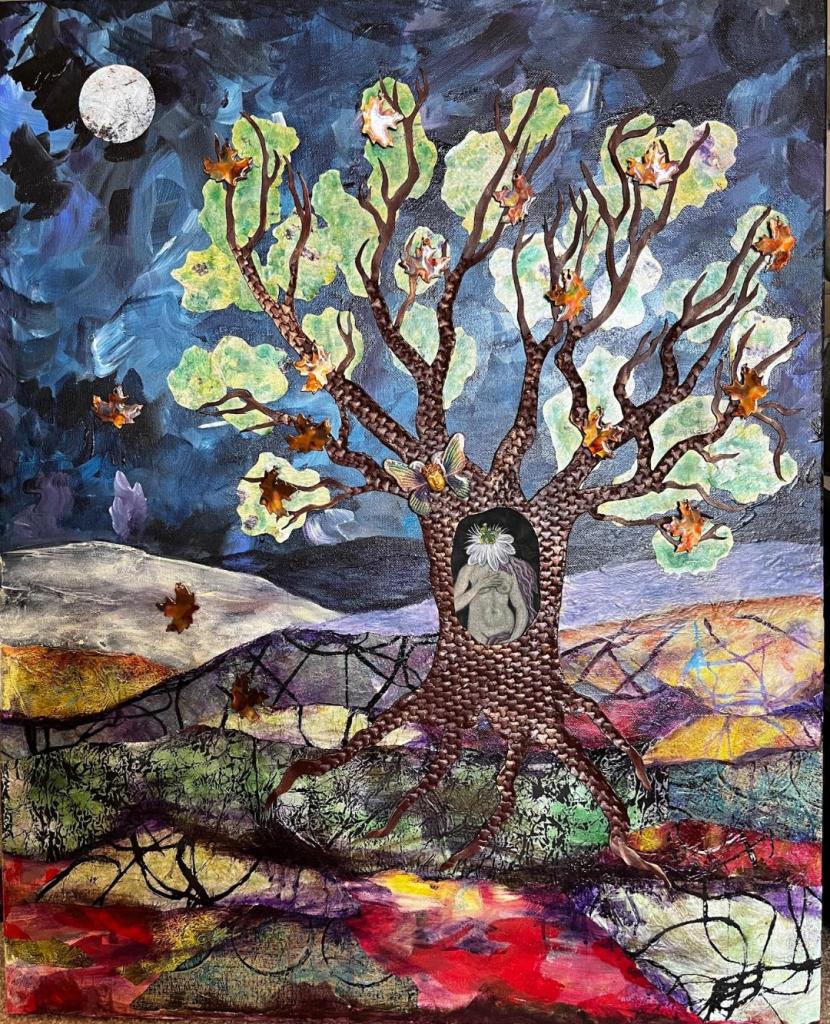
The Insemination of Venus, Laura Schmidt (2024). Mixed media (tooled leather, acrylic with hand-printed paper, torch-painted copper, soft pastel, polymer clay). The work incorporates kinetic elements, such as freely hanging copper leaves, and draws upon classical and mythological influences, including Botticelli’s Birth of Venus
If you find yourself without task or chore, bored beyond belief, and inclined to read a pedantic, hubristic, and discursive review interpreting a truly stunning work of art, I invite you to explore my essay (accessible at link below) on The Insemination of Venus by Laura Schmidt. To say that I find Schmidt’s work exciting and inspiring would be an understatement.
Schmidt, whom I have known for almost four decades, has recently turned in earnest to artistic endeavors following the conclusion of her legal career. Her latest work, The Insemination of Venus, is a masterful synthesis of classical themes and contemporary materials, drawing inspiration from Botticelli’s Birth of Venus and which I interpret as a re-imagining of the ancient motif of the Tree of Life and as an active force of creative transformation (see also my poem below).
Abstract for Essay:The Insemination of Venus as a Modern Tree of Life
The essay explores the profound intersection of classical mythology, artistic innovation, and the enduring motif of the Tree of Life in Laura Schmidt’s multimedia work. Inspired in part by Botticelli’s Birth of Venus, Schmidt’s piece transforms the classical image of Venus from a passive subject of divine creation into an active force of generative imagination. Through an interpretative lens, this essay examines how The Insemination of Venus re-imagines the ancient Tree of Life—not merely as a conduit of divine will, but as a dynamic site of transformation shaped by human creativity. Drawing on traditions from Mesopotamian sacred trees to Platonic cosmology and Norse mythology, my interpretive analysis situates Schmidt’s work within a continuum of cultural expressions that depict trees as cosmic axes, vessels of metamorphosis, and symbols of the evolving relationship between nature, divinity, and artistic agency. Engaging with both the technical execution and symbolic complexity of Schmidt’s composition, this essay illuminates how art can simultaneously honor and redefine ancient archetypes, presenting the Tree of Life as a living, evolving force in the realm of artistic creation.







 Northcoast Antiquarian