Pieter Bruegel the Elder, The Tower of Babel (c. 1563, oil on panel) Kunsthistorisches Museum, Vienna
Utopias, like theoretical economic models and theological constructs, are among the most daring expressions of human thought. Each arises from an impulse toward order and improvement, born of the conviction that the present is insufficient and the future can be shaped. Yet despite their elevated origins, these frameworks call to be eschewed—not for the good they propose, but for the horrors they have enabled when unmoored from humility and constraint.
The history of ideas is littered with systems that began in hope and ended in terror. Plato’s Republic, with its philosopher-kings and rigid class hierarchy, inspired centuries of authoritarian dreams. Soviet central planning promised rational allocation but delivered famine and repression. The Puritan theocracy in Massachusetts Bay sought godly perfection but produced witch trials and exile for dissenters. Each began as a vision of human flourishing—the utopian city, the rationalized economy, the purified creed—yet furnished the blueprints for regimes of control.
Nor is such danger confined to leftist excesses or theological zealotry. In Chile, the 1973 overthrow of Salvador Allende led not only to political violence, but also to the forceful imposition of a radical free-market model under General Pinochet, guided by economists trained in the Chicago School. The result was economic restructuring praised by some for its efficiency, yet experienced by many as immiseration and repression. Here, too, theory eclipsed humanity. Market mechanisms became commandments; dissenters were not debated but disappeared. What was billed as liberation through market freedom became another apparatus of dominance—less visible, perhaps, but no less brutal. The lesson is not partisan, but perennial: when theory is elevated above persons, systems serve themselves.
Elevated to ideology, models cease to be guides and become chains. They offer certainty in place of inquiry, coherence in place of complexity, and purpose in place of personhood. What begins as vision hardens into decree; what is meant as a lens becomes law. Mao’s Great Leap Forward exemplified this transformation: an economic model promising industrial prosperity became an unyielding doctrine that cost millions of lives when reality refused to conform to theory.
When the model becomes sacred, deviation becomes heresy. And where heresy is named, there follow inevitably the commissars, the inquisitors, the doctrinaires—those who patrol the borders of the permissible. Stalin’s show trials eliminated those who questioned economic orthodoxy. Both Catholic Inquisitions and Protestant persecutions took inhuman measures against those who strayed from their respective versions of theological purity. McCarthyism destroyed careers in service of ideological conformity. All operated in service of the model, the path, the “truth”—though truth, in such hands, is no longer a horizon toward which one travels, but a cudgel with which to enforce obedience. And perhaps there is no final truth to be had, only a multiplicity of partial illuminations, glimpsed through the mist, refracted through fallible minds.
And yet, it would be a grave error to reject these models wholesale. A utopia, though unattainable, directs the gaze beyond the immediate—Martin Luther King Jr.’s “Dream” inspired civil rights progress precisely because it painted a picture of what America could become. A well-crafted economic model brings coherence to chaotic phenomena: Keynesian theory, whatever its limitations, helped navigate the Great Depression by providing a framework for understanding how governments might respond to economic collapse. A theological vision offers moral orientation and poetic resonance—liberation theology in Latin America, despite its political complications, channeled Christian teaching toward concrete concern for the poor and oppressed.
When held lightly—non-dogmatically, open to revision, aware of their limits—such models are not prisons but tools. They help us navigate complexity, but they must never be mistaken for the complexity itself. The Chicago School economists who influenced policy in the 1980s offered valuable insights about market mechanisms, but when their models became gospel rather than guides, the result was often ideology that ignored market failures and social costs.
The question, then, is one of balance. Can aspiration be disentangled from absolutism? Can man dream without dictating, model without mastering, believe without binding? This is no easy task, for humanity is rarely a creature of balance. We veer, we commit, we grasp too tightly. The same revolutionary fervor that toppled the Bastille eventually devoured its own children in the Terror. But the remedy is not the renunciation of vision; it is the cultivation of humility within vision. It is the refusal to equate map with territory, model with meaning, doctrine with destiny.
If balance is the ideal, then it must rest not on detachment but on a deeper fidelity—one that refuses both rigidity and relativism. This is not a call to valueless existence, but to the most valued existence—one that honors core commitments through responsive attention rather than rigid prescription. The danger lies not in caring deeply about human flourishing, justice, or freedom, but in believing we possess the universal formula for achieving these goods. True fidelity to our highest values often requires abandoning our preconceptions about how they must be realized. It demands constant attentiveness to circumstances, genuine openness to what the moment requires, and the intellectual courage to adjust course when reality refuses to conform to our expectations. The principled life is not one that follows predetermined blueprints, but one that remains alert to the irreducible complexity of human need and the ever-changing demands of genuine care.
To live without models is to drift. To live by them uncritically is to be enslaved. Wisdom lies in the middle path: to aspire without illusion, to theorize without tyranny, and to seek the better without forgetting the cost of the best. In this fragile equilibrium lies the noblest promise of human reason—not to control the world, but to understand it more justly, and to live within it more wisely. And in that wisdom, to leave room for the truth that ever escapes us.
Vincent van Gogh, Red Cabbages and Garlic (1887) Oil on canvas, 50 cm × 64.5 cm (20 in × 25.4 in) Van Gogh Museum, Amsterdam
Garlic, I proffer, is a proof for the existence of God.
This is no idle remark, but a sincere offering—a theophanic gesture. The proposal is made in good faith and deserves to be received in kind. For garlic, humble yet exalted, reveals more than flavor; it unveils mystery.
Not through syllogism, but through savor. Not by argument, but by aroma. It is theology by way of the tongue and nose, where the sacred reveals itself not in thunder, but in the quiet sizzle of clove meeting oil. This is not mere indulgence. This is revelation.
Let us consider, then, a brief Credo in four parts:
1. The Argument from Delight Garlic transforms. It does not merely flavor—it exalts. Beans become feast, bread becomes blessing. That a bulb, buried in earth and gnarled like a relic, should yield such joy when crushed or roasted is, in itself, an argument for a benevolent architect.
2. The Argument from Simplicity and Complexity Each clove is a marvel—humble in form, abundant in gift: it offers flavor, healing, preservation, and, in many traditions, spiritual protection against malignant forces. What mind, save one both divine and wise, would endow so much in so little?
3. The Argument from Devotion Revered across cultures—French, Chinese, Italian, Greek—garlic is not bound by nation or creed. It is a kind of aromatic ecumenism. What else commands such near-universal reverence without edict or doctrine?
4. The Argument from Absence To taste a dish where garlic should have been is to feel its absence as void. It is theology by negation—apophatic cuisine. Like divine silence, its absence speaks volumes.
Thus we say, without irony: Credo quia gustavi. I believe because I have tasted.
When I consider thy heavens, the work of thy fingers, the moon and the stars, which thou hast ordained; what is man, that thou art mindful of him? — Psalm 8:3–4 (KJV)
A child, in the earliest unfolding of consciousness, turns to the parent and asks: Why? Why is the sun hot? Why did my pet goldfish die? Why must we grow old? The loving parent does not scorn the child for such questions. Even when the answers stretch beyond what the child can yet comprehend, even when no answer can satisfy the deep, intuitive wonder stirring in the young mind, the parent listens. A gesture, a story, a silence full of tenderness—all serve as a response, for the asking itself is a sign of life, of spirit, of the soul reaching beyond itself.
How then can it be imagined that the Divine—source of all wisdom, all love—would greet humanity’s first Why not with the hush of welcome but with wrath? How could the natural longing to know, to understand the world into which humanity was born, be met not with compassion, but with a condemnation unto death?
It cannot be so. It is not the divine who pronounced guilt over the sacred question; it is man.
The doctrine of original sin, as shaped by priests and theologians, emerges not from divine decree but from human artifice. It is born of fear—fear of questions too vast to answer, fear of mysteries that human authority could neither command nor contain. It is a doctrine not of heaven but of earth, devised by those who sought to regulate the soul’s native reaching beyond the bounds of certainty.
For what is the story of Eden if not the story of the first Why? The yearning for knowledge—the desire to taste, to see, to know good and evil—was not the rebellion of prideful beings but the natural unfolding of consciousness itself. To portray this reaching as disobedience is to misread the very nature of the soul. It is the innocence of the child, multiplied and deepened, that yearns toward the silence, that dares to disturb the hush with a question.
The Genesis narrative itself frames the matter plainly:
“But of the tree of the knowledge of good and evil, thou shalt not eat of it: for in the day that thou eatest thereof thou shalt surely die.” (Genesis 2:17, KJV)
Yet in the original Hebrew, “good and evil” is not a narrow moral distinction, but a merism—a pairing of extremes meant to evoke the totality of human experience. The knowledge at stake was not merely of right and wrong, but of the complexities, ambiguities, and perplexities of life and being itself. It was the awakening of discernment, the painful blessing of full consciousness—the soul’s first stretching beyond the silence into the unknown.
In the unfolding of the tale, it is the serpent who first stirs the question, bidding the woman to see beyond the command to the possibility of knowledge itself:
“For God doth know that in the day ye eat thereof, then your eyes shall be opened, and ye shall be as gods, knowing good and evil.” (Genesis 3:5, KJV)
Yet the serpent, in the original narrative, is not named as a satanic force. That identification is a later gloss, a retrospective layering by later traditions. In Genesis itself, the serpent is simply described as subtle—”more cunning than any beast of the field.” It is not evil in the mythic sense, but a catalyst: a figure who provokes the first stirring of conscious wonder.
The temptation it offers is not toward cruelty or depravity, but toward awareness—the dangerous and sacred gift of discernment. When the woman saw that the tree was “good for food,” “pleasant to the eyes,” and “a tree to be desired to make one wise” (Genesis 3:6), it was not pride that stirred her, but wonder. It was not rebellion, but reverent reaching—the first trembling articulation of the soul’s native Why—that set humanity upon its long and necessary journey into the unfolding mystery.
Later theological traditions, particularly within Christianity, would recast this moment as the origin of inherited sin, a fall from grace so profound that it marred all generations to come. Even softer interpretations would speak of exile—a banishment from divine presence, a sundering of primordial innocence.
But this, too, misreads the deeper rhythm of the story.
There is no fall in the truest sense. There is no exile. There is only awakening.
Awakening carries consequence: the loss of effortless innocence, the onset of labor, of mortality, of sorrow. But it is not severance from the divine. It is the beginning of the soul’s true journey—the movement from unknowing participation in being into conscious, perilous freedom. It is not punishment, but transformation: the invitation to become beings capable of discernment, of wonder, of seeking the infinite even while clothed in dust.
The expulsion from Eden, if it can be called that at all, is no casting away. It is a sending forth—a sorrowful and sacred commissioning. It is humanity’s first trembling step into a world no longer given but always to be made meaningful by seeking, questioning, remembering.
Nor is this reaching confined to Eden alone. Even in the later unfolding of the sacred story, it is the struggle, not the submission, that is honored. Jacob wrestles through the long night with the divine being, refusing to release his grip until a blessing is given. And far from being punished for his audacity, he is renamed—Israel—“one who struggles with God.” (Genesis 32:28) Thus the struggle is made sacred. The refusal to let go, the daring to seek, the ache of confusion: these are not condemned but crowned. The journey was never meant to return to innocence; it was always to pass through mystery, bearing the wound and the wonder of awakening.
Across cultures and ages, humanity has imagined a lost Golden Age—a time when the world was right, when peace and justice reigned, when innocence was unbroken. In religion, in philosophy, in politics, the pattern repeats: there was once a perfection; we have fallen from it; we must find a way back.
Why does this myth endure? Perhaps it speaks to something innate within us: a yearning for wholeness, for rootedness, for a home we can no longer name. Perhaps it soothes the terror of our confusion, offering the hope that disorder and suffering are not our native condition, but a wound that can be healed.
Yet in our fixation on a lost Eden, we risk becoming prisoners of backward-facing time. The myth orients our spiritual gaze toward the past—toward what was allegedly lost—rather than toward what might yet be discovered. We become archaeologists of an imagined innocence rather than explorers of an unfolding mystery. The soul’s natural movement—reaching forward into new understanding—becomes replaced by a desperate scrambling backward toward a manufactured memory.
This temporal disorientation fundamentally misunderstands the nature of spiritual growth. Wisdom is not the recovery of what once was, but the discovery of what has always been waiting to be known. The soul does not develop by returning to an infantile state of pre-questioning, but by maturing through its questions into deeper and more profound questions still.
When we orient ourselves toward a mythical past rather than an unfolding future, we deny the essential nature of consciousness itself, which is not static but dynamic, not preservative but creative. We mistake the spiritual journey for a return ticket when it is, and has always been, a one-way passage into greater mystery, greater wonder, greater questioning.
Moreover, what we call Eden is not a historical reality but a projection of our deepest yearnings. It is the mind casting upon the blank canvas of prehistory its own longing for belonging, for certainty, for uncomplicated being. We imagine a time before questioning not because such a time existed, but because questioning—the fundamental condition of human consciousness—carries with it the necessary burden of uncertainty.
Eden, then, is not a lost homeland but a psychological construct. It is the mind’s attempt to escape the very condition that makes it mind: the capacity to ask, to wonder, to reach beyond what is immediately given. The myth provides a name for our discomfort with confusion, allowing us to imagine that our questioning nature is not our essence but our fall.
And here lies the deeper danger: what begins as a fabricated consolation becomes, in the hands of authority, an instrument of control. The artificial memory of Eden, manufactured to soothe our existential disquiet, transforms into a weapon wielded against the very questioning that makes us human.
For when the myth of a lost Eden is seized by those who would govern—whether priest or king—it becomes a tool of manipulation. The lost paradise becomes a justification for power. If the people can be made to believe they have fallen, they can be led to believe that only through obedience—obedience to those who claim to hold the keys to return—can they be restored.
Thus Eden becomes not a symbol of hope, but a lever of command. Thus nostalgia becomes a chain.
For those who seek to honor obedience as a spiritual virtue, there remains a profound distinction between the willing surrender that flows from understanding and the blind submission that stifles questioning. The former may indeed be sacred—a conscious alignment with wisdom greater than one’s own. It is only when obedience is divorced from the soul’s natural reaching, when it demands the silencing rather than the maturing of questions, that it betrays both the human and the divine.
And the chain wounds. It wounds the individual, teaching him to distrust his own questions, to despise his own longings, to silence the sacred impulse toward wonder within himself. It wounds the collective, stifling thought, suppressing creativity, narrowing the imagination of what a human life or a human community might be. It breeds conformity where there might have been diversity of spirit; it fosters submission where there might have been genuine reverence; it exalts obedience over understanding.
Under the weight of this imagined Eden, humanity turns inward in fear rather than outward in joyful seeking. The soul bows not in awe before mystery, but in terror before judgment.
Thus the myth that was meant to console becomes a force that deforms, a memory that imprisons rather than frees.
Some might argue that certainty provides comfort, that boundaries offer safety, that answers—even if incomplete—shelter us from the storm of unknowing. There is truth in this. Structure can indeed nurture growth, just as the trellis supports the vine. Yet when structure calcifies into dogma, when the trellis becomes a cage, the soul withers rather than flourishes.
Man is neither innately good nor innately evil. Man is innately confused. Born into a world more vast than his mind can grasp, woven from mysteries too great for his language to name, humanity’s first impulse is not toward sin, but toward understanding. The soul, bewildered and reaching, gropes for knowledge not out of pride, but out of need—the need to make sense of the strange and wondrous being into which it has been thrust.
Confusion, then, is not a defect; it is the ground of wonder. It is the blessed ignorance that precedes the sacred question: Why?
It is this confusion—the condition of the in-between creature, made of dust and breath—that makes the human journey necessary. Without it, there would be no seeking, no questioning, no striving toward the silence that calls from beyond the edges of comprehension. Without it, there would be no reaching for the fruit, no ache for the infinite, no longing to pierce the hush with a voice.
The theologians, in their haste to impose clarity where mystery should have remained, mistook confusion for corruption. They mistook the stumbling search for the willful turning away. But confusion is not sin; it is the evidence of our created nature, the signature of beings fashioned for a journey, not for stasis.
To ask Why? is to live as we were made to live: poised between the known and the unknown, between the immediate and the eternal. To forbid the question, to cast the seeking as rebellion, is to deny the very condition of being human.
Thus, the first reaching toward the tree of knowledge was not a crime against the divine. It was the first true act of humanity: the confused, innocent soul daring to stretch toward the beyond.
In our questions, then, we find not our fall but our rising. Not our sin but our salvation. For to ask Why? is to begin the journey home—not to an Eden that never was, but to a wholeness that awaits us in the brave and beautiful reaching of the confused, beloved human heart.
The sacred path is forward—into uncertainty, into wonder, into the endless unfolding of mystery.
A meditation on the limits of theological language and the mystery of the Divine, this contemplative essay explores apophatic mysticism, the inadequacy of creeds, and the symbolic power of maps—blending poetic introspection with a life lived in scholarship, service, and creative expression.
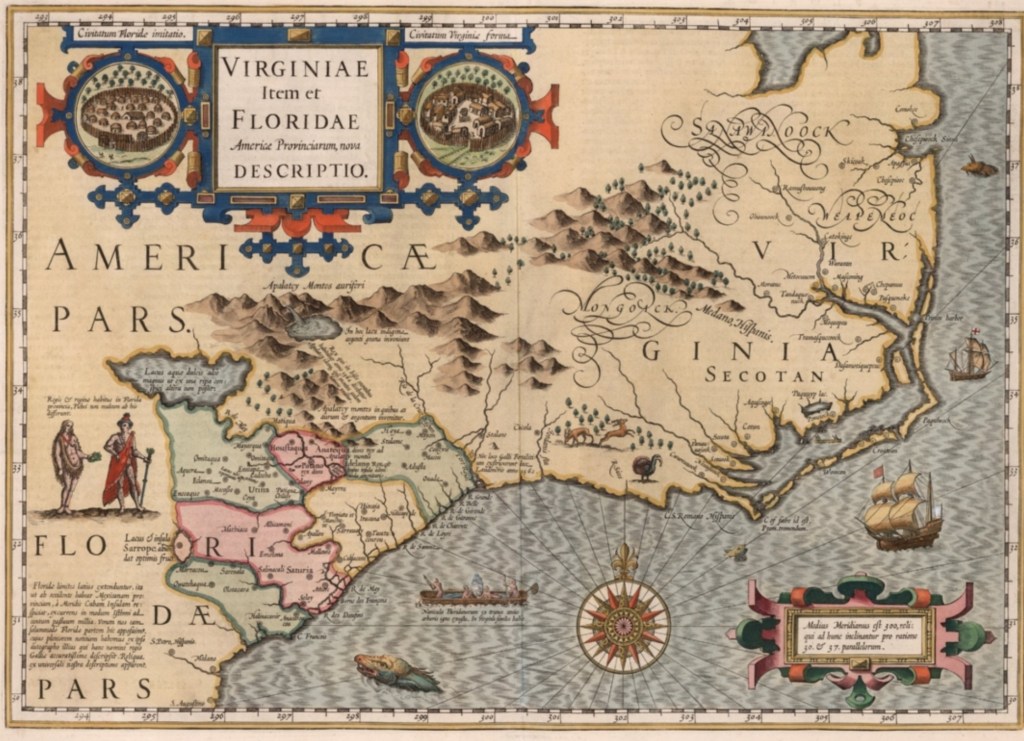
Virginiae Item et Floridae Americae Provinciarum, nova Descriptio. Map by Gerard Mercator (1512–1594), Jodocus Hondius (1563–1612), and Hendrik Hondius (1597–1651). Published in 1623 by Hendricus Hondius, Amsterdam. Image courtesy of the David Rumsey Map Collection, David Rumsey Map Center, Stanford Libraries. Licensed under Creative Commons CC BY-NC-SA 3.0.
Raised within the Romano-Byzantine tradition—formed by both the Roman and Byzantine Catholic rites—I was shaped by a confluence of liturgical beauty, theological depth, and mystical reverence. From that upbringing, there remains not merely memory, but a lasting affection for the rhythm and substance of the faith of my youth. It is not simply a cultural inheritance, but a formative lens through which the sacred, the communal, and the mysterious first revealed themselves. Yet, it would not be accurate to describe my present stance as that of a lapsed Catholic, nor as an atheist, nor as one alienated from the Church. Alienation implies disaffection or estrangement born of expectation unmet or betrayal suffered. What remains is neither rejection nor rebellion, but something quieter and more reflective—a posture of reverent detachment that neither clings nor condemns.
Any attempt to articulate my position must begin by acknowledging the futility of articulation itself—at least in matters concerning the Divine. The belief that the Divine wholly exceeds the bounds of human comprehension and articulation grows only firmer over time. All creeds, revelations, and theological systems—however earnest or inspired—are, in the end, efforts to sketch with a cramped human lexicon and limited imagination that which lies beyond even the highest powers of conception. Far from illuminating the Divine, such efforts only obscure its immensity by imposing upon it our narrow symbols and forms.
Better to liken our theological endeavors to the drawing of maps—maps sketched by explorers who had never seen the coasts they sought to chart. Just as early cartographers filled the margins with dragons, saints, and imagined cities, we adorn the unknown with creeds, cosmologies, and commandments. These are sincere efforts, yet they more often reflect our hopes and fears than reveal any transcendent truth. The more intricate the system, the more seductive the illusion that the map is the territory. But the Divine is not a line upon a page. It is the sea beneath the sea monster, the silence beyond the compass rose, the continent whose very existence remains unknown. To name the Divine is already to misname it; to describe is to distort.
Such a perspective finds its truest expression in apophatic mysticism—the via negativa, the way of negation—a tradition articulated by Pseudo-Dionysius the Areopagite, a Christian thinker of the late fifth to early sixth century whose writings permeate the Catholic tradition through the works of Thomas Aquinas, Bonaventure, and the Spanish mystics, reminding us that the path of unknowing is not a break from faith, but one of its most ancient and revered expressions. In this light, God is not wise, not good, not just, not loving—not because the Divine lacks these qualities, but because our highest notions of them remain shadows cast by a light we cannot behold. Whatever we say of the Divine, however conceived, the most faithful statement is this: our words fall short.
Even so, human beings remain kataphatic creatures as well—creatures who long to speak, to name, to worship, to relate. Thus arises a kataphatic-apophatic tension, a profound and permanent unease between the impulse to speak of the Divine and the recognition that all speech fails. Hymns, liturgies, cathedrals, and doctrines are all human responses to this tension—not to capture the Divine, but to reach toward it, however falteringly. These gestures deserve neither scorn nor uncritical assent. They should be honored, but held lightly, cherished as poems rather than mistaken for proofs.
This tension extends beyond the realm of theology into the very nature of being itself. In a moment of quiet reflection, I found myself asking: “Where is Am I?”—caught between breath and thought, a question turning circles in the hollow of my chest. Am I the echo, or the voice that trembles back? A fragment drifting through the hour, a flicker in the endless light, unsure if I was ever whole or if the pieces were ever mine to find. Such a question is not mere existential uncertainty, but a recognition that the self, like the Divine, eludes definitive capture.
No formal creed or written revelation authored by man commands my assent, however noble or inspired it may be. Faith is not placed in these constructions, though the sacred yearning from which they arise is deeply respected. They are echoes of an original voice no longer heard directly, outlines of a presence glimpsed but never grasped. Like the adornments on ancient maps, these expressions are beautiful and sincere, but they are not to be mistaken for the thing itself.
To some, this may resemble agnosticism, though that word has become burdened with meanings it was never intended to carry—meanings of indecision, skepticism, or apathy. What is expressed here is none of those. It is not a shrug of the shoulders, but a bow of the head. Not the silence of the indifferent, but of the reverent. Not ignorance, but a conscious unknowing—a sacred refusal to impose limitation upon that which exceeds all bounds. This is why I eschew agnostic labels in favor of mystical ones—for the mystic does not claim ignorance of the Divine but acknowledges that true knowledge of it transcends conventional understanding.
What remains, then, is a life lived in contemplation of the ineffable—a contemplation that finds expression through creative work. In poetry, music, and essay, I reach toward that which cannot be directly named. When I write of the “eternal now” where “yesterday, tomorrow, and today collapse,” or compose lyrics that honor Humilitatem Initium Sapientiae, I am not merely creating art but engaging in a form of contemplative practice. These creative acts serve as bridges, not only between myself and the ineffable, but also between myself and others who share this reverent space, regardless of their formal religious affiliations or φιλοσοφίαι (philosophies or wisdom traditions).
The path ahead is not marked by certainty but by awe, not by declarations but by listening. Mystery is not something to be solved, but something to be honored. Years of formal study—first in history and religious studies as an undergraduate, then as a teacher of both subjects, and later through a long career in civil rights law and public service—have only deepened the awareness that human systems, whether intellectual, doctrinal, or legal, ultimately encounter their limits at the threshold of the sacred. In this, the apophatic tradition offers a spiritual home—a dwelling place where reverence begins precisely where language ends. If there is a guiding light for such a path, it is humility—humilitatem initium sapientiae—not merely as a moral posture, but as a metaphysical necessity. That teaching, which echoes throughout Thomas à Kempis’ The Imitation of Christ, remains not only a personal motto, but a settled conviction: that wisdom begins when one ceases to pretend to possess it.
Near the staircase in my front hallway hangs an early map of the New World—an artifact I have long cherished. Its artistry is matched only by its courage, for it dares to depict what was not yet known. Near the region now recognized as Virginia and the Carolinas, a sea monster rises from the ocean’s depths, signaling peril or wonder—perhaps both. On the land itself, figures of “natives” stand, imagined by a hand that never walked those coasts. That map does not record the world; it records what the world dared to imagine. So, too, do our theologies populate the margins of metaphysical uncertainty with monsters and angels, commandments and visions. They are imaginative acts—sincere, flawed, luminous. And like that map, they are to be cherished not for their precision but for what they reveal of the human longing to reach into mystery with word and symbol, with ink and awe. In their earnest striving, they remind us: we are always sketching the edge of the unknown, even when we know we cannot cross it.
The prophetic poem Apokalypsis Teleiosis contemplates the culmination of divine purpose—the moment when revelation reaches its fulfillment and silence follows.
The poem unfolds in five movements, each drawing the reader deeper into a journey from divine articulation to fulfillment. Its use of Greek and biblical language is not ornamental but intentional—forming a theological vocabulary that bridges scripture and philosophy. The capitalization of words like Word, Breath, Fire, and Light serves as a kind of “visual theology,” intensifying as the poem progresses toward unity.
This is not a vision of divine ending or abandonment, but of ineffable transformation—a passage into that which exceeds our categories of presence and absence alike. Rather than following familiar apocalyptic themes of sovereignty, judgment, or renewal, this vision moves beyond such categories entirely. The divine is not framed in terms of rule or absence but as a transformation beyond presence and absence alike. It does not end in proclamation but in ordained silence—the stillness that remains when all has been spoken.
This final movement invites contemplation rather than conclusion. The closing line, “In Light beyond light, all is whole,” is not an answer but an opening—a gesture toward the mystery that lies beyond both prophecy and language itself.
The author notes, accessible after the poem by clicking on the button, provides more information about the structure and specifics of the poem.
Apokalypsis Teleiosis (A Vision of Fulfillment)
Γέγοναν. ἐγώ εἰμι τὸ Ἄλφα καὶ τὸ Ὦ, ἡ ἀρχὴ καὶ τὸ τέλος. (It is done. I am Alpha and Omega, the beginning and the end.) — Revelation 21:6
I. Logos Tetelestai (The Word Fulfilled)
In the beginning was the Word, and the Word was God, And all arose from His breath— Light from void, form from welter deep. The Breath that shaped Adam from dust Now settles silent in the wind. Not lost, nor cast aside in ruin, But drawn unto the end ordained. No faltering step, no shadowed doubt— All Will is met, all Purpose whole.
II. Epistrophe (The Return)
The Fire that set the stars in course Fades not, but meets its destined Rest. The Name that called the dawn to rise— El Shaddai, Elohim, I AM— Now slips beyond the grasp of time. Not in despair, nor weary sigh, Not in surrender, nor retreat, But in the fullness of the Path, As ocean answers to the shore.
III. Gnosis (Divine Knowledge)
I AM Alpha and Omega, the Spark, the Ember’s end, The Shadow stretched across the arc. I AM the Hand that formed the hand, The Dust that walks, the Flame that thinks. From Me to Me, from seed to bloom, From silence into vaster still. Not lost, not less, but all complete— The Die returns unto the Forge.
IV. Eschaton Kairos (The Fulfillment of Time)
Now breathless waits the sacred Sky, Now sound itself resigns to hush. No temple stands, no altar burns, For worship folds into the Vast. The Voice that thundered from the mountain, That split the sea and called the dead, Lies hushed within the closing Dawn. No fear, no cry, no wrath, no woe— Only the quiet after all.
V. Epekeina (Beyond)
Here fulfills the prophet’s final sight, For where He goes, none else may gaze. Not death, nor night, nor vanquished might, But passing into more than Being. A hush beyond the thought of man, A stillness more than endless void. The First has met the final Dawn— The circle breaks, the mirror fades, Purpose achieved in Perfect Light.






 Northcoast Antiquarian