
Icy stars— points of ancient fire made brittle by distance, as though the heavens themselves had entered winter. They do not blaze; they prick. They hang, hard and lucid, in a silence sharpened by cold.
Such stars feel less like promises than reckonings. Their light arrives stripped of warmth, having crossed immensities where heat was spent long ago. What reaches the eye is endurance, not comfort— illumination without mercy.
In winter they seem closer, because the air has been scoured clean of softness. Each star stands alone, exact, unblurred, the sky insisting on precision, on the refusal of haze, metaphor, or excuse.
Indeed—stars resemble snowflakes. Each one discrete, each one sharp with its own geometry, no two quite alike, yet all governed by the same severe order.
They fall not downward but inward, settling upon the mind rather than the ground. They do not melt; they persist. What snow does to the earth— muting, clarifying, equalizing— stars do to thought.
Yet they are dissimilar in temperament—decisively so. The star, for all its pinprick stillness to the eye, is violence without pause: fusion, a steady hammer at its core, plasma boiling and convecting within its bounds, only to be held together by gravity’s unrelenting fist. Its light is not calm but coerced— order wrested from perpetual revolt.
The snowflake, by contrast, is obedience incarnate. It forms in surrender to temperature, pressure, and time, each facet answering silently to law. Nothing churns; nothing rebels. Structure blooms where energy dissipates, an architecture born not of struggle but of yielding.
And yet—what appears as opposition resolves into fidelity: both answering to temperature, to nature, to law.
Not submission, but staying true to what is given, to what may not be otherwise.
The star obeys by burning. Given mass and pressure, it cannot do otherwise. Fusion is not choice but consequence, law pressed hard upon matter until light is forced into being. Its turbulence is not rebellion but endurance under extremes.
The snowflake obeys by forming. Lowered heat, suspended vapor, the slightest allowance of stillness— and geometry appears. No facet decides; each angle arrives as it must.
Thus neither star nor snowflake is free, and yet both are exact. They do not err, because they do not aspire. They enact what must be— and leave us to consider what it means to call that perfection.
The musings began as I started my morning routine. Roused out of bed and heading to the shower, I found myself uttering, almost involuntarily: yet ever more. The words rose without prompting—perhaps because the task before me was ordinary, repetitive, and required no conscious thought. In such moments, the mind drifts, half-idle and half-aware, allowing stray phrases to surface without clear origin. But these three words arrested me. I repeated them aloud and wondered: three simple words, and yet they carried weight, rhythm, and an unexpected poetic resonance. Why?
After completing my morning ablutions, I returned to contemplate the phrase further and determined that some research was in order. Accordingly, I sought poetry and prose in which these words appear in succession—or in meaningful proximity—with appreciable effect. Once identified, I sought to understand the source of their force: the reason they ring with a power far exceeding their lexical modesty.
What emerged almost immediately was that the phrase yet ever more is no fixed formula of the poetic canon—no Miltonic thunder, no Dantesque refrain, no Eliotian motif. Rather, it appears sporadically—in seventeenth-century lyrics, Victorian nature poetry, and occasional elegiac verse—where poets employ it whenever they require a compact expression of endurance, paradox, or lingering emotional intensification. Its power lies precisely in this: three ordinary words capturing experiences that refuse ordinariness.
Early Instances: Paradox and Persistence
Consider William Strode’s seventeenth-century poem On Jealousie:
There is a thing that nothing is, A foolish wanton, sober wise; It hath noe wings, noe eyes, noe eares, And yet it flies, it sees, it heares; It lives by losse, it feeds on smart, It joyes in woe, it liveth not; Yet evermore this hungry elfe Doth feed on nothing but itselfe.1
The concessive yet introduces contradiction: jealousy ought to consume itself and die out. Yet—contrary to all reason—it persists. Evermore extends that persistence beyond temporal boundaries, transforming a human passion into an almost metaphysical condition.
A similar pattern appears in Archibald Lampman’s Hope and Fear (1883):
As when the sunless face of winter fills The earth—a moment misty bright— The sun streams forth in powdery light, A silver glory over silent hills;
And all the rolling glooms that lie below That sudden splendour of the sun, With shivered feet and mantles dun, In stricken columns skim the gleaming snow;
Yet far away, beyond utmost range Of sun-drowned heights, pine-skirted, dim, That fringe the white waste’s frozen rim, Hang ever ghost-like waiting for the change:
So often to the blank world-sobered heart Comes hope, with swift unbidden eye, And bids the weary life-glooms fly With shaken feet, and for a space depart;
Yet evermore, still known of eye and ear, With sullen, unforgotten surge, Hang ever on the waste heart’s verge, Time’s hovering ghosts of restless change and fear.2
Here the phrase marks memories that, though logically expected to fade, remain vivid—“still known of eye and ear.” Memory becomes not a fading echo but an enduring presence, resisting dissolution. The poem’s natural imagery—sunlight briefly breaking through winter gloom only for shadows to persist at the horizon—mirrors consciousness itself: fleeting solace does not erase deeper, lurking fears.
Structural analogues—but not direct antecedents—appear elsewhere in the tradition: George Herbert’s The Search (1633) repeatedly opens with “Yet can I mark…,” enacting concessive-persistence, while Christina Rossetti’s A Better Resurrectiondeploys yet as a pivot from desolation to expectation in the line “Yet rise it shall—the sap of Spring,” generating a concessive-and-intensifying movement even without a full triadic form.
Tennyson and the Deepening of Grief
The pattern appears with particular frequency and force in Alfred, Lord Tennyson’s In Memoriam A.H.H. (1850), where it becomes almost a structural signature for the poem’s central paradox: grief that does not diminish with time but deepens and transforms. Tennyson varies the pattern—substituting but for yet, altering the position of ever and more—while retaining its concessive–durational–intensifying logic.
In Canto XLI, contemplating his deceased friend’s spiritual ascent, he writes:
For tho’ my nature rarely yields To that vague fear implied in death; Nor shudders at the gulfs beneath, The howlings from forgotten fields;
Yet oft when sundown skirts the moor An inner trouble I behold, A spectral doubt which makes me cold. That I shall be thy mate no more,
Tho’ following with an upward mind The wonders that have come to thee, Thro’ all the secular to-be, But evermore a life behind.3
The phrase captures the poet’s fear that he will perpetually lag behind Hallam’s transfigured state—not merely left behind but evermore behind, the temporal gulf widening rather than closing. The concession is double: though he claims not to fear death itself, and though he strives to follow Hallam’s ascent, the doubt persists and intensifies.
Yet the most remarkable deployment appears in Canto CXXXI, where the pattern shifts from lamentation to affirmation:
And yet is love not less, but more;
No longer caring to embalm In dying songs a dead regret, But like a statue solid-set, And moulded in colossal calm.
Regret is dead, but love is more Than in the summers that are flown, For I myself with these have grown To something greater than before.4
Here yet introduces not mere continuation but transfiguration. Love persists and intensifies—”not less, but more”—becoming something greater. What began as lamentation has, through time’s pressure, become an enlargement of the heart.
Later Variations
Geoffrey Bache Smith, whose A Spring Harvest was published posthumously under J.R.R. Tolkien’s editorship, employs the phrase to capture beauty and grace in his Glastonbury:
The Queen that was, whom now a convent’s shade Imprisons, and a dark and tristful veil Enwraps those brows, that in old days were seen Most puissant proud of all that ever made The traitor honest, and the valorous frail.
Yet evermore about her form there clings And evermore shall cling, the ancient grace, Like evening sunlight lingering on the mere: And till the end of all created things There shall be some one found, shall strive to trace The immortal loveliness of Guinevere.5
Guinevere’s beauty, though shadowed by sorrowful penitence, persists; the phrase conveys a grace that resists decay, lingering like light upon the waters. The doubled evermore—first descriptive, then prophetic—creates a temporal dilation: what persists now will persist “till the end of all created things.”
Perhaps this explains why the phrase surfaced unbidden during my morning routine—in that liminal state when the mind is neither fully engaged nor wholly at rest, and truths we do not seek present themselves. A simple, repetitive task; three ordinary words; and suddenly a glimpse of what all these poets knew.
The Shape and Sound of the Phrase
The power of yet ever more lies in the internal mechanics of the phrase itself. Yet, is adversative; it signals resistance, contradiction, persistence against expectation. Ever erases temporal boundaries and opens a vista without limit. More introduces escalation—a rising degree, an intensifying condition.
Thus the phrase embodies a miniature logic of concession → duration → escalation, a compressed rhetoric of persistence against expectation.
The sound reinforces the structure. The assonantal /ɛ/ shared by yet and ev-er binds the first two terms, while the deeper /ɔː/ of more provides rounded closure. Jakobson’s “poetic function” is precisely this intertwining of sound and meaning: language calling attention to itself through patterned echo.6 The triad exemplifies it.
Linguistically, the force of yet ever more can also be understood in light of Michael Israel’s account of scalar meaning. Ever is a degree-based intensifier, signaling movement along an ordered scale without natural upper bound; joined to more, it expresses not mere continuation but continuation that deepens.7 Geoffrey Leech’s observations on foregrounded repetition likewise illuminate why paired or tripled intensifiers resonate in poetic contexts.8
But lived experience precedes theory: some feelings—grief, longing, devotion—intensify through time rather than diminish.
The Lived Experience of Persistence
The rarity of the exact triad is telling. Poets have long used its components in various pairings, but the compact English formula appears only occasionally, and often at moments of emotional endurance or spiritual intensification. This scarcity sharpens its effect. Each verified instance crystallizes a paradox: what ought to subside instead deepens.
This explains the phrase’s particular force. In three ordinary words, it captures something we already know but rarely articulate: the heart’s deepest experiences follow a logic all their own. They do not fade; they deepen. They do not lessen; they grow. For grief, for love, for memory, for beauty glimpsed and lost, time does not heal so much as intensify. What we carry becomes heavier, more present, more itself.
Linguist Michael Israel notes that words such as ever function as degree-based intensifiers, signaling movement along a scale rather than a fixed quantity. In his discussion of polarity items, he explains that their force comes from the way they mark increasing degrees without a natural upper limit, a feature central to English expressions of ongoing growth or intensification. This helps clarify why phrases like “ever more” feel open-ended and expansive: they point not to a single amount but to a process that keeps rising. See Israel, “The Pragmatics of Polarity,” in The Handbook of Pragmatics (Horn & Ward, eds., 2004), discussion of scalar semantics and polarity items. ↩︎
Geoffrey N. Leech, A Linguistic Guide to English Poetry (London: Longman, 1969), chap. 6, “Patterns of Sound,” esp. §§6.1–6.4, where Leech discusses foregrounded repetition, sound patterning, and the poetic heightening of ordinary lexical items. ↩︎
The immeasurable joy that a pup feels upon spying the perfect stick—though is not every stick perfect?—to seize it between the teeth, to trot about in triumphant exaltation, to preen and prance, to clench and cherish it as though gold, or life itself, were held within the jaws, precious beyond all things. If only I could delight in anything with such unfeigned enthusiasm—as that stick, its discovery, its seizure, its hold.
Ah, to find such rapture in the ordinary! To greet the world not with suspicion but with wonder, to see in the roughness of bark and the scent of earth a treasure beyond price. She asks no meaning of the stick, no purpose beyond the play; she does not weigh its straightness nor lament its splinters. She exults simply because it is there—because it can be grasped, borne, and shared with the wind.
And when I feign to take her most prized possession from her, she does not crouch defensively nor guard it with wounded pride. She startles not in fear, nor suspects deceit, but spies instead an opportunity for play—for spirited contest, for joyous fun. A game of keep-away, of chase, of tug-of-war, of tag. The stick becomes not a treasure to hoard, but a bond to share, a spark of communion between kindred souls who, for a moment, forget the hierarchy of species and simply are. How effortless her wisdom seems: to turn every threat into invitation, every grasp into dance. What the world calls possession, she calls participation; what we call loss, she calls laughter.
Laugh I must too, for in her play I am carried back to youth—when a stick could be anything the heart desired: a sword flashing against unseen foes, a spear cast toward the sky, a knight’s lance, a shepherd’s staff, a trumpet summoning invisible armies, a conductor’s baton commanding the symphony. How endless were the shapes of imagination then! She reminds me of what I once possessed without knowing its worth—the gift of invention, the sacred power of play.
And so I laugh, though a tear is not far behind, for the years slip away like autumn leaves on the wind, and I remember what it was to live so lightly. She, in her wisdom, has become my teacher—her joy a gentle rebuke to my solemnity, her play a sermon on the holiness of delight. If ever there is grace to be found, it is in such simple acts: a stick, a chase, a glint of sunlight on the grass, a heart unburdened by purpose. Perhaps salvation lies not in grand design, but in this—to love a stick as though it were the world, and to find, in that loving, the world made whole again.
Amor, che ‘ncende il cor d’ardente zelo, di gelata paura il tèn constretto, et qual sia più, fa dubbio a l’intelletto, la speranza o ‘l temor, la fiamma o ‘l gielo.
Love that lights ardent zeal in the heart, constrains it also with an icy fear, and leaves the mind uncertain which is greater, the hope or the fear, the flame or the frost. — Francesco Petrarca, Canzoniere 182
I. The Divided Heart
Few poets have so perfectly distilled the contradictory essence of love as Petrarch. In four lines, he sets the human heart ablaze and in the same breath subdues it with frost. Love, that “ardent zeal,” becomes inseparable from the chill of fear; the intellect, summoned to arbitrate between hope and terror, finds itself immobilized in doubt. The flame illuminates even as it freezes.
The quatrain serves not merely as an emblem of courtly love but as a mirror of the reflective soul—the soul that, once conscious of its passion, cannot help but analyze it. Every act of self-awareness introduces distance; every act of comprehension tempers immediacy. To understand what one feels is already to stand outside the feeling. Thus, the Petrarchan heart is forever divided: inflamed by emotion, yet cooled by the very intellect that seeks to grasp it.
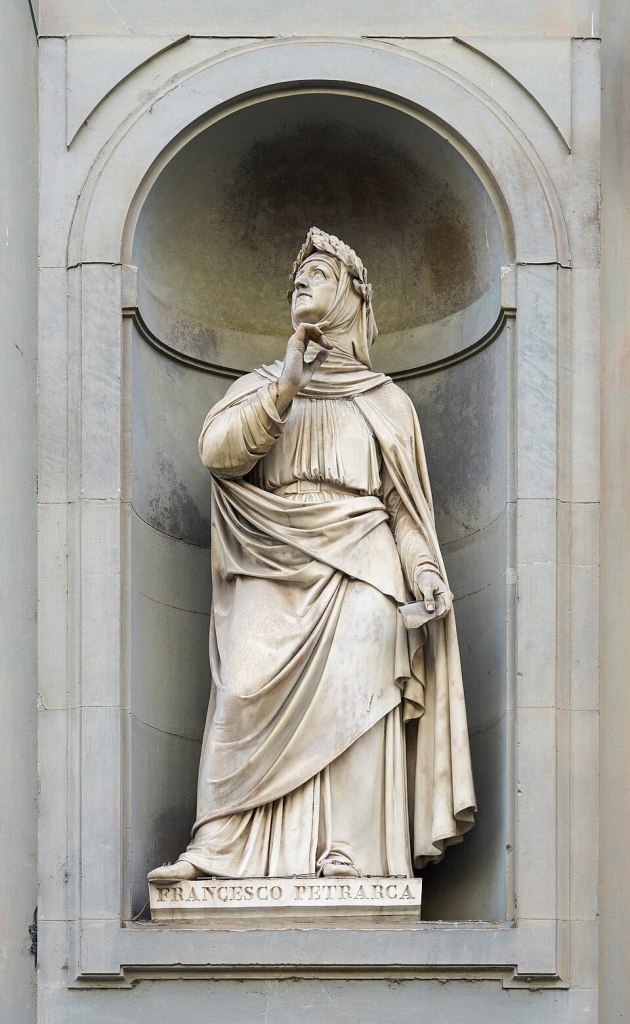
Statue of Petrarch on the Uffizi Palace, in Florence
II. Petrarch’s Paradox—Flame and Frost
In Canzoniere 182, Amore is no mere sentiment but a force of cosmic ambivalence—a sacred fire that binds as much as it liberates. The heart, seized by ardente zelo, is at once inspired and constrained by gelata paura; passion and dread are inseparable twins. But what gives the poem its enduring power is the final turn: fa dubbio a l’intelletto—it makes the intellect uncertain.
This uncertainty is not simple indecision; it is the very mechanism by which passion becomes reflection. The lover’s flame, examined, begins to cool—and that cooling assumes distinct forms.
First, love cools by comprehension. The instant it is understood, passion becomes object rather than subject. The flame is enclosed in glass: it still glows, but it no longer burns.
Second, love cools by doubt of itself. Reflection turns inward, questioning its own authenticity: Is this love true, or merely imagined? In this moment, feeling erodes under the acid of self-consciousness.
Third, love cools by doubt of the beloved. The intellect, unable to sustain idealization, wonders whether the object of devotion merits such intensity. The beloved becomes an emblem—not a person of flesh and breath, but a mirror of perfection that no reality can equal.
Fourth, love cools by doubt of the lover’s worthiness. The heart fears it is unworthy of its own longing. Humility becomes paralysis, and passion folds inward upon itself.
These four modes of cooling form the architecture of Petrarch’s inner world—the endless oscillation between fervor and fear, adoration and self-doubt. He writes not to resolve this tension but to dwell within it. Each sonnet is a chamber where flame and frost coexist, where thought is both confessor and executioner of feeling.
III. Dante and the Alchemy of the Intellect
Dante offers a luminous counterpoint. In La Vita Nuova and the Paradiso, intellect and love are not adversaries but allies; the mind becomes the means by which love ascends. L’amor che move il sole e l’altre stelle—the love that moves the sun and the other stars—does not cool but sanctifies. In Dante, the intellect transforms passion into vision—the earthly beloved into divine wisdom. The flame does not die; it becomes light.
Consider the climactic moment of Paradiso XXXIII, where Dante’s vision finally encompasses the divine mystery. His intellect, far from diminishing his love, becomes the very instrument of its perfection. He describes how his desire and will are turned like a wheel by the love that moves the sun and the other stars. Here, understanding completes rather than constrains. The mind does not freeze the heart; it liberates it into comprehension of the Eternal. Beatrice herself, who began as an earthly beloved, becomes through the intellect’s mediation a guide to the Beatific Vision. Her smile, growing ever brighter as they ascend through the spheres of Paradise, finally becomes too radiant for mortal sight—not because love has cooled, but because it has been refined into pure illumination.
Petrarch inherits Dante’s vocabulary but not his cosmos. His world is one step further from heaven, one degree cooler. Where Dante’s intellect completes love by raising it to the eternal, Petrarch’s intellect contains it, interrogates it, doubts it. He lives in the afterglow of revelation—the warmth still present, but the fire withdrawn. As the Paradiso closes, Dante’s vision resolves into the final harmony of understanding and desire—l’amor che move il sole e l’altre stelle—the line that unites intellect and love in a single act of divine motion. Petrarch cannot reach this synthesis. His flame flickers in the middle distance, neither extinguished nor transcendent.
IV. The Modern Inheritance—Reflection and Alienation
From Petrarch descends the long lineage of reflective melancholy that characterizes the modern mind. His was the first great experiment in self-conscious passion—the attempt to inhabit feeling and analyze it at once. After him, love and thought could no longer coexist in innocence; the very act of awareness altered the nature of what was felt.
Montaigne and the Essay of the Self
Montaigne inherits this disposition and turns it into method. In his Essais, feeling is no longer confessed in the lyric key but dissected in the prose of observation. The heart becomes a field for inquiry, and what was once sung becomes tested, weighed, compared. It is telling that Montaigne quotes Petrarch approvingly: “He who can say how he burns with love, has little fire.” (Chi può dir com’ egli arde, è in picciol fuoco, Canzoniere 137). The aphorism might well serve as Montaigne’s motto, for he, too, knows that passion explained is passion already cooling.
His genial skepticism marks the first full tempering of Petrarch’s flame: affection survives, but only as reflection. The essay replaces the sonnet as the vessel of interior life; emotion, distilled into thought, becomes the study of itself. In Montaigne, we see the completion of a transformation begun in Petrarch—the lover becomes the anatomist of his own heart, and the page becomes not a transcript of feeling but a laboratory for its examination. The warmth of passion is not extinguished but transmuted into the steady light of self-knowledge.
Wordsworth and Emotion Recollected
Wordsworth, centuries later, restores emotion to poetry, yet only by containing it within the frame of recollection. His famous dictum—”emotion recollected in tranquillity”—is itself a Petrarchan paradox, though less tormented. He admits that to write of passion is to have already survived it. The poet stands at a contemplative distance from his own fervor, translating immediacy into memory, fire into afterglow. What once consumed now instructs.
In the Prelude (XII), Wordsworth describes the “spots of time” that preserve the intensity of past experience, yet the very act of preservation requires temporal remove. The flame of immediate experience has cooled into the steady glow of retrospective understanding. Wordsworth does not lament this cooling as loss; rather, he discovers in it a new kind of beauty—the beauty of consciousness reflecting upon its own depths.
Eliot and the Fragments of Feeling
By the time we reach T.S. Eliot, the process is complete. In The Waste Land, the flame is nearly ash. His lines of “memory and desire” register not passion itself but its echo—reverberations in a chamber long since emptied of direct experience. Emotion is mediated through quotation, irony, and allusion; the self no longer speaks but curates its fragments.
Consider the hyacinth girl passage, where memory itself fails to sustain emotion: “I could not / Speak, and my eyes failed, I was neither / Living nor dead, and I knew nothing.” The speaker recalls a moment that should have been transcendent—arms full of flowers, hair wet—but the recollection brings only paralysis, a kind of death-in-life. Even memory cannot resurrect the feeling; it can only gesture toward its absence. The modern condition is not the absence of feeling but its overexposure, its reduction to artifact. The poem becomes the museum of emotion, its vitrines polished and sterile. Where Petrarch’s flame still flickered with real heat, and Wordsworth’s embers still glowed warm, Eliot presents us with the cold remains—fragments shored against ruins. Where Petrarch doubts his own worthiness to feel, Eliot doubts feeling itself. The circle has closed; intellect now governs even absence.
The Progressive Abstraction
Between Montaigne’s self-observation, Wordsworth’s recollected emotion, and Eliot’s fractured memory, one can trace the progressive abstraction of the human heart. Each represents a further remove from Petrarch’s immediacy: what began as a dialogue between love and intellect becomes a monologue of intellect about love. The warmth remains, but it is remembered warmth—the lingering heat of stones long after the fire has gone out.
And yet, in each of these figures, the Petrarchan spark persists. Montaigne’s curiosity, Wordsworth’s reverence for inward life, Eliot’s yearning for spiritual coherence—all descend from that first poet who dared to make consciousness itself his subject. The flame may cool, but its light passes on, refracted through centuries of minds still haunted by the desire to feel purely and the impossibility of doing so once thought begins.
V. The Cooling of the Flame—A Personal Reflection
It is impossible, for some temperaments, to escape this inheritance. Emotion arises, and almost immediately the mind begins to interpret it—weighing, contextualizing, seeking its meaning. In doing so, it drains the warmth from the moment even as it preserves it in memory.
To intellectualize emotion is to betray and to honor it at once. The betrayal lies in the loss of immediacy; the honor lies in the act of remembrance. What the heart cannot sustain, the mind attempts to eternalize. The flame cools into an image—but in that cooling, it endures.
Perhaps the intellect is not the enemy of passion but its afterlife. Every poem, every meditation, every recollection is a small resurrection of a feeling that once burned uncontrollably. The fire itself is gone, but its light remains, steady now, capable of illuminating others.
This is the paradox Petrarch teaches: that the lover who cannot stop thinking destroys the ecstasy of love but gains, in its place, the wisdom of love. To understand one’s passion is to lose it; yet without understanding, it would pass unnoticed, leaving no trace but ashes.
VI. The Light of the Ashes
Petrarch’s quatrain ends in uncertainty, but not in despair. His is not the extinguished flame, but the tempered one. Love and fear, hope and doubt, flame and frost—these are not enemies but necessary contraries. The human soul, poised between ardor and intellect, must learn to bear the tension rather than resolve it.
In the end, intellect does not annihilate feeling; it refines it. The cooled flame still gives light. That light—pale but enduring—is the radiance of thought born from passion, the steady glow of what once burned brightly.
We live by such embers. To love is to burn; to remember is to cool; to think is to preserve. Between these three acts, the heart makes its pilgrimage from fire to frost to flame again—each transformation both loss and grace.
From my earliest years, my creative process—whether literary or scholarly—has been curiously nocturnal. Much of my work, I have found, is done while I sleep. When faced with a task, I assign it, quite literally, to my subconscious mind and then close my eyes, surrendering to productive sleep.
As a student, this practice became a quiet ritual. When a paper was due, I would already know the topic, the sources I intended to use, and what I wished to accomplish. I would also, admittedly, wait until the evening before it was due—believing, and with reason, that fear brought a clarity of mind that was otherwise lacking. Thus, I would take a short nap before beginning. Upon waking, the entire outline of the paper would be present—clear, complete, and waiting. With a stack of books to my right, a blank sheaf of paper to my left, and a typewriter in front of me, I would set to work, and the paper would unfold almost as if dictated.
My professors noticed this strange fluency. The grades I earned and comments I received reflected it, but more telling were their requests to keep copies of my papers for their own files—something they did not ask of other students. I did not then understand that what they admired was less my discipline, or lack thereof, than the uncanny lucidity of the night mind that guided me.
Over the years, this oneiric gift has only deepened. I remain grateful for it. At times, an entire sentence or paragraph will suddenly appear either as I awake or will awake me in the middle of the night—perfectly formed, insistent, demanding to be recorded before it vanishes. At other times, these moments arrive unbidden, startling me out of unrelated thought; often, they are the flowering of a subject that I had briefly considered and set aside, unaware that it had continued germinating in the depths below consciousness.
When such inspiration surfaces, it comes in torrents. I rush to record the first few words, only to find myself laughing at the impossible speed with which the rest races ahead, leaving me chasing its tail through the air. Madness, perhaps—but a joyous one.
It is as if some part of the mind, working in silence while the waking self is distracted, composes and refines without interference. And when it deems the work ready, it releases it whole into consciousness—seed, stalk, and blossom at once. My task, then, is not to command this process, but to remain open to it, to receive it with gratitude, and to write before the vision fades. Refinement, if needed, may occur later.
What I once mistook for a personal oddity, I now recognize as a shared inheritance of the human mind—the work of the subconscious muse, the night mind ever at her loom, weaving thought into form before dawn breaks—although a nap in the midst of day will oft serve the purpose just as well.