
Incompetence and Buffoonery: The Threat to Democracy

Clowns and buffoons

Preface to the Reader

There was hesitation before I posted the essay below. Not for its merit, but for its timing. I wonder, truly, whether we have already passed the point of rupture—whether the buffoonery we witness in scandals such as Whiskeyleaks (the use of the Signal app by U.S. cabinet officials and others to discuss classified war plans) is not merely incompetence, but a smokescreen for something more deliberate, more calculated, and far more lethal. If the jesters, clowns, and buffoons distract, it may be only so that the knife may fall unnoticed. This essay, then, may read not as prophecy but as postmortem—or as warning flung desperately against a wind already turning. And yet, even still, I believe it must be said.


Note to the Reader

This essay is written not as a partisan screed, nor as a nostalgic lament for some imagined golden age, but as a meditation—part moral reckoning, part civic warning—on the condition of a republic that has allowed itself to descend into spectacle, incoherence, and institutional decay.

It is addressed to those who still believe that government, for all its failings, remains a public trust; that civic virtue is not an antiquated ideal; and that the health of a nation may be measured not merely in wealth or might, but in memory, restraint, and the character of its leaders and laws.

The tone is deliberately severe, for the times are unserious. The satire is not meant to entertain, but to unmask. Where irony sharpens, it does so to reveal truths that cannot be said plainly without losing their edge. And where the anger beneath the prose surfaces, it does so not in despair, but in the hope that the reader, too, is angry—and unwilling to become numb.

This is not a call to revolution, but a call to remembrance, to vigilance, and above all to responsibility. If the republic is to be rebuilt, it will not be by those who broke it, nor by those who profited from its breaking, but by those who, though weary, still believe it is worth the rising.


The Farce of Ruin: On the Buffoonery, Cowardice, and Consent that Endanger the Republic

It becomes difficult indeed to weigh if the republic is more greatly endangered by ignoble, incompetent lackeys such as now populate the greatest offices of state, appointed by the bitter, vengeful, demented, and oft confused and wholly arbitrary despotic personality that resides in the executive mansion, courtesy of the cult of resentment, hate, and fear, than it would have been had he appointed more able men and women to execute his whims and vices. For in one case, we face the farce of ruin—the slow, stumbling, ignoble unraveling of a once-proud polity into absurdity and impotence. In the other, we would face tyranny executed with precision, method, and perhaps permanence. Yet if there is any comfort to be found in chaos, it is this: incompetence leaves wreckage; competence might have left chains. But wreckage, at least, invites the labor of rebuilding—if the will, the memory, and the courage yet remain.

This is the bitter paradox of the present hour: that we may find ourselves grateful not for wisdom, but for the want of it; not for virtue, but for its absence. That the republic’s temporary reprieve lies not in the strength of her institutions nor the vigilance of her people, but in the vacuity and vanity of her despoilers. These are not statesmen in the Roman sense, nor even villains in the Shakespearean; they are caricatures—jesters costumed in stolen robes of office, bumbling through decrees, barking orders not out of conviction but impulse, devoid alike of strategy and shame. And yet, we dare not laugh too loudly. For every laugh chokes on the question: how long can a republic endure when the machinery of its survival is entrusted to hands unfit to hold it?

The Rise of the Cult: Resentment as Political Theology

Power, once grounded in consent and law, now derives its strength from a darker source: resentment. Not merely disappointment or disillusionment, but that deeper, more corrosive sentiment born of perceived humiliation, of grievance nurtured until it metastasizes into dogma. No longer content to reform what they claim to hate, the votaries of this new creed seek instead to destroy—to salt the fields, poison the wells, and tear down every institution that once restrained ambition with honor, and pride with duty.

This is not politics in any meaningful sense. It is theology by other means—a bitter creed that worships neither God nor country but the self, wounded and wrathful. Its high priests preach vengeance cloaked in patriotism, its sacraments are insult and spectacle, and its liturgy is grievance repeated endlessly, unexamined and unrelieved. To belong to this cult is not to believe in anything beyond the negation of others: the “elites,” the “experts,” the “traitors,” the “others”—those perpetual abstractions upon whom every failure may be pinned, every fear projected.

Thus, the executive, himself a totem of grievance, is not admired in spite of his vices but because of them. His incoherence becomes a form of authenticity; his cruelty, a mark of strength; his ignorance, proof that he is unsullied by the corruption of thought. This is the logic of the mob, sanctified and enthroned. It does not seek truth, only validation; not justice, but vengeance. And from such poison grows not a polity, but a pack.

The Machinery of Power: Incompetents in High Places

Once, high office required at least the semblance of merit—a capacity for governance, a grasp of statecraft, or, at the very least, the discretion to defer to those who possessed it. No longer. The new qualification is loyalty alone: loyalty not to the Constitution, not to principle or country, but to personality. And not even to a consistent personality, but to a flickering candle in a tempest—unstable, moody, and perpetually affronted.

Thus have the halls of government been peopled with jesters, flatterers, and feckless opportunists. Ministers of the treasury who do not believe in numbers, secretaries of education who scorn learning, envoys who sabotage diplomacy, and legal advisors who treat the law as a nuisance to be outmaneuvered rather than a structure to be upheld. Their résumés are padded with failure, their careers propped up by sycophancy, their ambitions tethered not to public service but to personal advancement through proximity to power.

Yet their greatest failing is not simply what they do, but what they permit. Their very mediocrity becomes the shield behind which greater abuses are concealed. For while the citizenry scoffs at the spectacle—the press conference gaffes, the mangled grammar, the contradictions piled upon contradictions—policy proceeds maliciously, cruelly. Freed from oversight, insulated by noise, the machinery grinds on: protections undone, laws abandoned, rights weakened, government dismantled, alliances broken. The clown at the helm distracts the gaze, while the bureaucratic knife goes unnoticed beneath the velvet tablecloth.

And in this lies the genius of institutional vandalism: not to destroy with one mighty blow, but to dull the blade slowly—through mismanagement, attrition, and the silent resignation of the capable and the firing of tens of thousands. A thousand small indignities, each one tolerable, each one dismissed, until the edifice no longer stands, and we wonder not when it fell, but how we failed to notice.

The Counterfactual: What If the Tyrant Were Wise?

One is almost tempted to breathe a sigh of relief at the chaos, for chaos is its own limit. A despot who contradicts himself hourly, who governs by whim and forgets his decrees by dusk, is a tyrant only in name. He may wish to rule absolutely, but lacking consistency, foresight, or discipline, he becomes instead a figure of grotesque parody—dangerous, yes, but disarmed by his very incoherence. We may survive him not because of our strength, but because of his weakness.

But imagine, if you will, the inverse: a tyrant possessed of intellect, method, and clarity. One who governs not in the service of ego but of vision—however malignant. One who surrounds himself not with cowed incompetents, but with men and women of ruthless efficiency, cold logic, and administrative precision. This is the tyrant history has known best. It is not the fool who builds the gulag or writes the blacklists, but the functionary with a plan, the theorist with a chart, the orderly mind untroubled by conscience.

Had our moment produced such a figure, how much swifter the erosion of liberty would have been! How much more subtle the theft of rights, how much more durable the machinery of oppression! The republic might not have looked so disordered—it might have seemed vigorous, decisive, strangely efficient. But beneath the appearance of control, the soul of the nation would have already been extinguished, its people transformed not into rebels or resisters, but into docile instruments of the state’s will.

The question, then, is no longer whether we are fortunate in our calamity, but whether we understand its nature. For fools can be replaced. But should a day come when their successors wear the same mask but wield it with purpose—then the hour will be far darker, and the laughter that once served as shield will curdle into silence.

The Theatre of the Absurd: Democracy as Entertainment

If the republic falters from within, it is not only because of those who hold the levers of power, but because of those who have come to see governance not as a civic duty, but as a form of entertainment. The forum has become a stage, the statesman a performer, and the electorate an audience demanding sensation. Nuance bores, compromise offends, and truth is a distant, flickering ghost—unwelcome and unprofitable.

In such a theatre, absurdity is not a bug but a feature. Every gaffe becomes a meme, every outrage a headline, every policy a subplot in an endless narrative of grievance and spectacle. The media, desperate to retain its vanishing grip on attention, ceases to inform and instead curates the drama—cutting, splicing, amplifying. The body politic is no longer a deliberative citizenry but a viewership conditioned to react, not to reason.

And what is the role of the elected official in this new dramaturgy? Not to lead, but to brand. Not to govern, but to trend. They issue not laws, but slogans. They trade not in facts, but in feels. Even their failures become assets, for in the logic of the spectacle, visibility is power, and infamy sells just as well as virtue—often better.

Worse still, even those who know the performance is a fraud feel trapped within it. To disengage is to surrender the stage to the most unscrupulous actors; to engage is to be complicit in a system that rewards noise over thought, allegiance over principle. This is the final genius of the absurd republic: to create a politics where participation itself feels degrading, and yet absence feels dangerous.

Thus the state becomes not a polity of free and deliberative people, but a spectacle of exhaustion. We scroll, we jeer, we despair. But rarely—too rarely—do we act.

The Fragility of Memory: When History No Longer Speaks

No tyranny begins as tyranny. It begins in the forgetting. A forgetting not only of facts or dates, but of the moral weight of precedent, the slow accumulation of civic wisdom, the lessons written in blood and ink by those who came before. When memory is intact, it serves as conscience; when eroded, it becomes convenience. We do not recognize the fall because we no longer remember what it was to stand.

Once, a statesman would rise in the chamber and quote Pericles or Lincoln, Cicero or Solon—not merely to adorn his speech but to anchor it in tradition, to draw from the well of republican virtue. Now, even such allusion is dismissed as elitist pedantry. The past is regarded not as a guide but as a burden, and history is reduced to a buffet of misremembered grievances, curated to flatter the resentful and indict the dead.

In this vacuum, lies grow bold. Fictions parade as fact, myths usurp monuments, and the record of what was is rewritten by those who benefit from what is. The archives decay; the historians, sidelined or silenced, speak to a shrinking audience. Memory becomes tribal, curated by algorithm and sentiment. The young no longer study the fragility of freedom because it is no longer taught. The old recall its price, but their warnings are heard as the mutterings of a defeated past.

And what, then, remains? A citizenry adrift—cut loose from history’s moorings, vulnerable to every charlatan with a flag and a grievance. The republic, in such a state, is no longer endangered by enemies at the gates, but by the silence within. Not the silence of censorship, but the quieter, more dangerous silence of indifference. The silence that follows when memory no longer speaks and no one cares to ask what it once said.

Wreckage or Rebirth?

It is tempting, when surveying the present wreckage, to surrender to despair—to believe that the republic, having stumbled so absurdly into decline, can never be set aright. The pillars have cracked, the roof sags, and the foundation seems to shift beneath our feet. But wreckage, for all its tragedy, is not the same as ruin. What has been shattered can, in principle, be rebuilt. The question is whether the will endures, and whether the anger now rising can be forged into resolve rather than simply rage.

For there is anger—mounting, justified, and no longer concealed. It grows not within the cult, but outside it, among those who have watched with clenched jaws as the instruments of governance were handed to buffoons and cowards, as the executive strutted and raged, as the political class bowed and curtsied, mumbling excuses, averting eyes, trading principle for position. And it is not merely the executive that earns their ire, but the entire edifice of acquiescence—a legislature that mutters indignation but funds the farce all the same; a judiciary that, cloaked in solemnity, too often validates the very abuses it ought to constrain. These are not neutral bystanders. They are collaborators by convenience, guardians turned ushers to a constitutional catastrophe.

And so the citizen watches, furious and exhausted, as the republic’s very stewards conspire in its diminishment. Yet this fury, though dangerous if left to fester, may still be redemptive if rightly directed. The task is not to lament the collapse of a golden age that never was, but to resist the entrenchment of a cynical age that need not be. The republic will not be saved by the institutions that failed to defend it, nor by the party machines that greased its fall. If salvation comes, it will be through memory rekindled, virtue rediscovered, and courage reclaimed—not in grand gestures, but in the hard, slow work of rebuilding what was squandered.

We stand, then, not at the end, but at a crossroads between farce fulfilled and tragedy averted. The clowns will fall—their nature guarantees it. But what comes next will not be dictated by their collapse. It will be shaped by those who remain: the watchful, the angry, the resolute. The question is not whether the republic can rise again, but whether we still believe it is worth the rising.

Feeling Blue: A Poetic Odyssey

A midnight musing on Homer, color, and the surprising emotional depths of a mistranslated god.


Bust of Homer
Roman, Late Republican or Imperial Period
Late 1st century B.C. or 1st century A.D.
Marble, likely from Mt. Pentelikon near Athens
Height: 41 cm (16 1/8 in.); Face length: 21 cm (8 1/4 in.)
Photograph: © Museum of Fine Arts, Boston

Night is the time for vagabond thoughts—those unbidden travelers who step lightly into the study, pull books from shelves, and whisper paradoxes. Last night, one such thought came cloaked in the deep hues of Homeric sea-mist. I opened Robert Fagles’ translation of the Iliad—a beloved companion—and there it was: “the blue-haired god Poseidon.”1

Blue-haired? Homer, who never knew the color blue? Homer, whose “wine-dark sea” has puzzled and delighted classicists and poets for generations? What does it mean to be “blue” in a world that never named the sky’s hue?

In Homer’s Greek, Poseidon is called κυανοχαίτης (kyanochaitēs)—literally “dark-haired” or “dark-maned”—a word that evokes depth, darkness, perhaps the shimmer of polished lapis, but not “blue” as we know it.2 The root kyanos gestures toward something darker, more elusive, tied to the sea’s unfathomable depths and the glossy mane of a wild horse. When the earliest Latin translators, like Andreas Divus, rendered this as caeruleis crinibus, they preserved the ambiguity: sea-dark, storm-shadowed, ancient.3

Fagles, however, chooses “blue.” Not sea-dark. Not dark-maned. But blue, direct and modern, emotive and luminous. It is a poetic choice, not a philological one. It is also a deeply modern one—for blue in English is not just a color. It is a feeling, a state of mind, a synonym for longing, for absence, for twilight thoughts and aching depths.4

And so I wonder: is Poseidon feeling blue? Or am I, reading him across three millennia, transposing my own midnight melancholy onto his immortal form?

Translation, after all, is never a mere transmission of words—it is a voyage of interpretation, laden with the cargo of culture and the ballast of the translator’s imagination. In choosing “blue,” Fagles draws a line not just from kyanos to blue, but from epic time to our own: where gods feel, and we, perhaps, are gods remade in language.

What is blue, then, but the poetry of absence? A color that Homer never named, yet whose shadowy presence haunts his lines like a dusk-lit horizon, always just out of reach.5


  1. Homer. The Iliad. Trans. Robert Fagles, with Introduction and Notes by Bernard Knox. New York: Viking Penguin, 1990, p. 359, line 651. Poseidon is described as “the blue-haired god,” a poetic rendering of the Greek epithet kyanochaitēs (κυανοχαίτης).
  2. Liddell, H. G., and Scott, R. A Greek-English Lexicon. Revised ed., Oxford: Clarendon Press, 1996, s.v. “κυανός.” The word can mean dark blue, glossy blue-black, or lapis-colored, often evoking depth or obscurity.
  3. Divus, Andreas. Homeri poetae clarissimi Odyssea et Ilias Latine redditae. Venice: 1537. Poseidon’s epithet is rendered as “caeruleis crinibus,” preserving the sea-dark imagery. See also Lewis, C. T., and Short, C. A Latin Dictionary. Oxford: Clarendon Press, 1879, s.v. “caeruleus.”
  4. Berlin, Brent, and Paul Kay. Basic Color Terms: Their Universality and Evolution. Berkeley: University of California Press, 1969. See especially their discussion of the absence of “blue” in early Indo-European languages.
  5. Gladstone, W. E. Studies on Homer and the Homeric Age. Oxford: Oxford University Press, 1858, vol. 3, pp. 457–468. Gladstone first drew scholarly attention to the limited Homeric color vocabulary and the curious case of the “wine-dark sea” (p. 490).

Toward an Unsaying: Contemplation of Faith in the Shadow of the Ineffable

A meditation on the limits of theological language and the mystery of the Divine, this contemplative essay explores apophatic mysticism, the inadequacy of creeds, and the symbolic power of maps—blending poetic introspection with a life lived in scholarship, service, and creative expression.

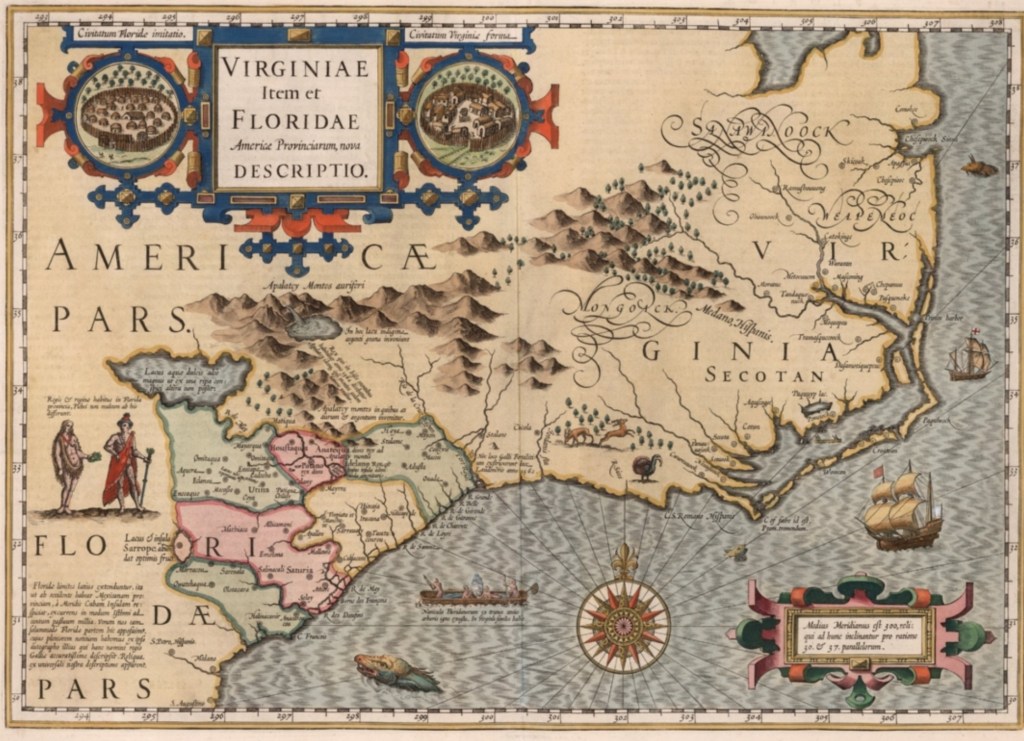
Virginiae Item et Floridae Americae Provinciarum, nova Descriptio.
Map by Gerard Mercator (1512–1594), Jodocus Hondius (1563–1612), and Hendrik Hondius (1597–1651).
Virginiae Item et Floridae Americae Provinciarum, nova Descriptio.
Map by Gerard Mercator (1512–1594), Jodocus Hondius (1563–1612), and Hendrik Hondius (1597–1651).
Published in 1623 by Hendricus Hondius, Amsterdam.
Image courtesy of the David Rumsey Map Collection, David Rumsey Map Center, Stanford Libraries.
Licensed under Creative Commons CC BY-NC-SA 3.0.

Raised within the Romano-Byzantine tradition—formed by both the Roman and Byzantine Catholic rites—I was shaped by a confluence of liturgical beauty, theological depth, and mystical reverence. From that upbringing, there remains not merely memory, but a lasting affection for the rhythm and substance of the faith of my youth. It is not simply a cultural inheritance, but a formative lens through which the sacred, the communal, and the mysterious first revealed themselves. Yet, it would not be accurate to describe my present stance as that of a lapsed Catholic, nor as an atheist, nor as one alienated from the Church. Alienation implies disaffection or estrangement born of expectation unmet or betrayal suffered. What remains is neither rejection nor rebellion, but something quieter and more reflective—a posture of reverent detachment that neither clings nor condemns.

Any attempt to articulate my position must begin by acknowledging the futility of articulation itself—at least in matters concerning the Divine. The belief that the Divine wholly exceeds the bounds of human comprehension and articulation grows only firmer over time. All creeds, revelations, and theological systems—however earnest or inspired—are, in the end, efforts to sketch with a cramped human lexicon and limited imagination that which lies beyond even the highest powers of conception. Far from illuminating the Divine, such efforts only obscure its immensity by imposing upon it our narrow symbols and forms.

Better to liken our theological endeavors to the drawing of maps—maps sketched by explorers who had never seen the coasts they sought to chart. Just as early cartographers filled the margins with dragons, saints, and imagined cities, we adorn the unknown with creeds, cosmologies, and commandments. These are sincere efforts, yet they more often reflect our hopes and fears than reveal any transcendent truth. The more intricate the system, the more seductive the illusion that the map is the territory. But the Divine is not a line upon a page. It is the sea beneath the sea monster, the silence beyond the compass rose, the continent whose very existence remains unknown. To name the Divine is already to misname it; to describe is to distort.

Such a perspective finds its truest expression in apophatic mysticism—the via negativa, the way of negation—a tradition articulated by Pseudo-Dionysius the Areopagite, a Christian thinker of the late fifth to early sixth century whose writings permeate the Catholic tradition through the works of Thomas Aquinas, Bonaventure, and the Spanish mystics, reminding us that the path of unknowing is not a break from faith, but one of its most ancient and revered expressions. In this light, God is not wise, not good, not just, not loving—not because the Divine lacks these qualities, but because our highest notions of them remain shadows cast by a light we cannot behold. Whatever we say of the Divine, however conceived, the most faithful statement is this: our words fall short.

Even so, human beings remain kataphatic creatures as well—creatures who long to speak, to name, to worship, to relate. Thus arises a kataphatic-apophatic tension, a profound and permanent unease between the impulse to speak of the Divine and the recognition that all speech fails. Hymns, liturgies, cathedrals, and doctrines are all human responses to this tension—not to capture the Divine, but to reach toward it, however falteringly. These gestures deserve neither scorn nor uncritical assent. They should be honored, but held lightly, cherished as poems rather than mistaken for proofs.

This tension extends beyond the realm of theology into the very nature of being itself. In a moment of quiet reflection, I found myself asking: “Where is Am I?”—caught between breath and thought, a question turning circles in the hollow of my chest. Am I the echo, or the voice that trembles back? A fragment drifting through the hour, a flicker in the endless light, unsure if I was ever whole or if the pieces were ever mine to find. Such a question is not mere existential uncertainty, but a recognition that the self, like the Divine, eludes definitive capture.

No formal creed or written revelation authored by man commands my assent, however noble or inspired it may be. Faith is not placed in these constructions, though the sacred yearning from which they arise is deeply respected. They are echoes of an original voice no longer heard directly, outlines of a presence glimpsed but never grasped. Like the adornments on ancient maps, these expressions are beautiful and sincere, but they are not to be mistaken for the thing itself.

To some, this may resemble agnosticism, though that word has become burdened with meanings it was never intended to carry—meanings of indecision, skepticism, or apathy. What is expressed here is none of those. It is not a shrug of the shoulders, but a bow of the head. Not the silence of the indifferent, but of the reverent. Not ignorance, but a conscious unknowing—a sacred refusal to impose limitation upon that which exceeds all bounds. This is why I eschew agnostic labels in favor of mystical ones—for the mystic does not claim ignorance of the Divine but acknowledges that true knowledge of it transcends conventional understanding.

What remains, then, is a life lived in contemplation of the ineffable—a contemplation that finds expression through creative work. In poetry, music, and essay, I reach toward that which cannot be directly named. When I write of the “eternal now” where “yesterday, tomorrow, and today collapse,” or compose lyrics that honor Humilitatem Initium Sapientiae, I am not merely creating art but engaging in a form of contemplative practice. These creative acts serve as bridges, not only between myself and the ineffable, but also between myself and others who share this reverent space, regardless of their formal religious affiliations or φιλοσοφίαι (philosophies or wisdom traditions).

The path ahead is not marked by certainty but by awe, not by declarations but by listening. Mystery is not something to be solved, but something to be honored. Years of formal study—first in history and religious studies as an undergraduate, then as a teacher of both subjects, and later through a long career in civil rights law and public service—have only deepened the awareness that human systems, whether intellectual, doctrinal, or legal, ultimately encounter their limits at the threshold of the sacred. In this, the apophatic tradition offers a spiritual home—a dwelling place where reverence begins precisely where language ends. If there is a guiding light for such a path, it is humility—humilitatem initium sapientiae—not merely as a moral posture, but as a metaphysical necessity. That teaching, which echoes throughout Thomas à Kempis’ The Imitation of Christ, remains not only a personal motto, but a settled conviction: that wisdom begins when one ceases to pretend to possess it.

Near the staircase in my front hallway hangs an early map of the New World—an artifact I have long cherished. Its artistry is matched only by its courage, for it dares to depict what was not yet known. Near the region now recognized as Virginia and the Carolinas, a sea monster rises from the ocean’s depths, signaling peril or wonder—perhaps both. On the land itself, figures of “natives” stand, imagined by a hand that never walked those coasts. That map does not record the world; it records what the world dared to imagine. So, too, do our theologies populate the margins of metaphysical uncertainty with monsters and angels, commandments and visions. They are imaginative acts—sincere, flawed, luminous. And like that map, they are to be cherished not for their precision but for what they reveal of the human longing to reach into mystery with word and symbol, with ink and awe. In their earnest striving, they remind us: we are always sketching the edge of the unknown, even when we know we cannot cross it.

The Real Armageddon: Musk’s DOGE and the Dismantling of Public Trust

Photo by Chris F on Pexels.com

“If you read the news, it feels like Armageddon. I can’t walk past a TV without seeing a Tesla on fire,” Elon Musk said recently at a Tesla all-hands meeting. “I understand if you don’t want to buy our product, but you don’t have to burn it down. That’s a bit unreasonable.”1

The quote is evocative—perhaps designed to stir sympathy. Yet it invites a measure of irony. While vandalism against Tesla properties is, of course, deplorable, it is neither as widespread nor as catastrophic as Musk, and biased media reporting, would have the public believe. Fewer than a dozen reported incidents—at Tesla dealerships or Supercharger stations—have resulted in fires, graffiti, or property damage. In nearly all of these cases, suspects have been arrested and charged.2

In a country of over 330 million people, where more than 200,000 vehicle fires and 500,000 structure fires occur annually,3 and where Florida and Texas alone report nearly 3,000 murders each year,4 these incidents—while serious—are statistically insignificant. What Musk decries as “Armageddon” is, in national context, a series of isolated acts that have been swiftly addressed by law enforcement.

Meanwhile, under Musk’s leadership of the Trump administration’s Department of Government Efficiency (DOGE), far greater destruction is being wrought—not upon property and government subsidized business interests, but upon the institutions designed to serve the American people.

According to Reuters, the Department of Veterans Affairs (VA) is expected to lose over 80,000 employees under DOGE’s efficiency plan.5 Already, this downsizing is disrupting vital services: clinics are understaffed, appointments are delayed, and mental health services—already under strain—are faltering.6

This is not bureaucratic “streamlining.” The VA currently serves over 18 million veterans,7 many of whom depend on timely and specialized care for physical and mental trauma, service-connected disabilities, and long-term support. Disabling this infrastructure in the name of “efficiency” is not neutral policy—it is institutional abandonment.

The Social Security Administration (SSA) has not fared better. Facing mandates to reduce its workforce by up to 50%, the SSA is bracing for a collapse in the timely delivery of services to more than 70 million Americans, including over 50 million seniors.8 Already, SSA field offices in major cities have shortened hours, laid off staff, and seen processing times for benefits skyrocket.

Federal workers have responded with urgency. In San Francisco and other metropolitan areas, SSA and VA employees have staged public protests, warning of the catastrophic impact these cuts will have on their most vulnerable clients.9 Their message is clear: public service cannot survive on ideology alone.

Thus, while Musk’s Teslas may burn in isolated incidents, the real fire is the one now consuming the administrative state (the means by which public servants deliver public services to the citizens they serve pursuant to laws passed by Congress). The irony is sharp. Musk’s complaint—“You don’t have to burn it down”—could just as easily be addressed to himself. If you do not like the structure or scale of government, you do not have to dismantle its capacity to serve. That, too, is a bit unreasonable.

What Musk labels as terrorism when directed at his private enterprise is tolerated—even celebrated—when inflicted upon public institutions. Yet the human cost of the latter is infinitely greater. The quiet collapse of service infrastructure—untelevised and untheatrical—is the more insidious disaster.

In the end, the real “Armageddon” may not be a vandalized Tesla on a TV screen. It may be the veteran denied timely access to urgent medical care. The senior citizen waiting months for a critical in-person meeting at a Social Security office. The single parent lost in a phone queue with no one left to answer.

These are not symbolic gestures. These are lives.


Notes

  1. Pras Subramanian, “Tesla’s Elon Musk Holds Surprise All-Hands Meeting to Assuage Employees and Investors,” MSN Money, March 21, 2025.
  2. New York Post, “Pam Bondi Announces Charges Against 3 in Tesla Attacks,” March 20, 2025.
  3. National Fire Protection Association, “Vehicle Fires,” 2024.
  4. Federal Bureau of Investigation, Crime in the United States, 2021.
  5. Reuters, “US Plans to Fire 80,000 Veterans Affairs Workers,” March 5, 2025.
  6. Reuters, “VA Shake-up Disrupts Mental Health Services,” March 20, 2025.
  7. Pew Research Center, “The Changing Face of America’s Veteran Population,” November 8, 2023; Reuters, “VA Shake-up Disrupts Mental Health Services,” March 20, 2025.
  8. Sara Dorn, “Here’s Where Trump’s Government Layoffs Are,” Forbes, February 21, 2025.
  9. San Francisco Chronicle, “Federal Workers Protest Musk-Led Government Cuts,” March 14, 2025.

The Danger of Literalist Thinking in the Face of Rising Authoritarianism in the United States

The Perils of Legalistic Literalism

Throughout history, authoritarianism has rarely invaded democracies through dramatic coups but rather through the gradual erosion of norms and institutions. This erosion is often enabled by what might be called “legalistic literalism”—a mindset that fixates on procedural adherence while remaining blind to broader patterns of democratic decay. This approach creates a dangerous paradox: by the time literalists acknowledge an authoritarian threat has crossed their arbitrary legal threshold, democratic safeguards have often already been fatally compromised.

The United States offers a compelling case study of this phenomenon. From the normalization of anti-democratic rhetoric during the current president’s first campaign to the institutional paralysis surrounding the January 6th insurrection and subsequent Supreme Court decisions expanding presidential immunity, literalist thinking has consistently undermined effective resistance to democratic deterioration. Now, with the current administration’s return to office, the administration has embraced an explicitly authoritarian approach. It has weaponized the Justice Department and haphazardly dismantled government agencies without required Congressional authorization—at times so maliciously and haphazardly that certain closures had to be reversed. Public servants have been fired, impeding the delivery of essential services to senior citizens, veterans, those seeking enforcement of their civil rights, and other citizens. Some, identified as the “other,” have been sent to what can only be described as concentration camps (in the British historical tradition thus far) in foreign countries or literally “lawless” territories under U.S. control (in the American historical tradition alas) pending their final disposition. Meanwhile, Congress has been marginalized, and executive orders are treated as beyond the oversight of Congress or the judiciary under the novel unitary executive theory propounded by the administration.

This pattern follows a recognizable trajectory observed in other democracies that have declined into authoritarian rule. What makes the American case particularly instructive is how adherence to procedural norms—supposedly the safeguard of democracy—has paradoxically accelerated democratic erosion by delaying meaningful resistance until institutional damage becomes nearly irreversible. Examining this process reveals not just the mechanics of democratic decline but also potential strategies for arresting it before critical democratic guardrails are wholly destroyed.

This essay examines how literalist thinking enables authoritarianism by exploring these key moments of institutional failure and draws lessons for preserving democratic systems against such threats.

The Warning Signs: Early Responses to Authoritarian Signals

The Normalization Phase (2015-2016)

When he emerged as a political figure, his rhetoric displayed clear authoritarian tendencies: praising dictators like Vladimir Putin and Kim Jong-un, threatening political opponents with imprisonment, attacking the press as “enemies of the people,” and suggesting he might not accept election results. These statements represented textbook warning signs familiar to scholars of democratic decline.

Yet the response from most institutional actors was profoundly literalist. Major media outlets normalized his rhetoric by treating it as conventional political hyperbole rather than dangerous authoritarianism. Legal scholars reassured the public that constitutional guardrails would hold. Political opponents dismissed him as unserious. The common refrain—“take him seriously, not literally”—embodied this literalist fallacy, suggesting that dangerous rhetoric was inconsequential until manifested in specific legal violations.

This response ignored historical lessons from democratic backsliding in countries like Hungary, Turkey, and Venezuela, where authoritarian leaders signaled their intentions through rhetoric long before implementing institutional changes. The literalist mindset demanded concrete proof before acknowledging threat—effectively demanding democracy show fatal symptoms before allowing preventative treatment.

Constitutional Optimism as Denial (2017-2019)

Once in office, he tested democratic guardrails through actions that challenged norms without clearly violating laws: firing FBI Director James Comey while citing the Russia investigation, demanding loyalty from law enforcement officials, attacking judges who ruled against him, and claiming “absolute immunity” from investigation.

The literalist response from many institutions was to examine each action in isolation rather than as part of a pattern of democratic erosion. This compartmentalization prevented the recognition of the cumulative threat. Many mainstream legal scholars maintained that since each action could be technically defended through creative legal interpretation, the system was holding.

This faith in procedural safeguards reflected a fundamental misunderstanding of how democracies die in the 21st century. As scholars Steven Levitsky and Daniel Ziblatt note in How Democracies Die, modern authoritarian leaders typically dismantle democracies through legal channels—exploiting ambiguities in legal systems rather than openly violating them. The literalist’s insistence on clear legal violations as the threshold for concern thus creates a perfect blind spot for detecting authoritarian encroachment.

This blindspot would prove particularly damaging as his presidency progressed, setting the stage for increasingly bold challenges to democratic norms that would eventually culminate in the events surrounding the 2020 election.

Institutional Paralysis: January 6th and Its Aftermath

The events surrounding January 6th, 2021, represent perhaps the clearest example of how literalist thinking enables authoritarianism. For months, he and his allies laid groundwork to overturn the election: filing dozens of baseless lawsuits, pressuring state officials to “find” votes, attempting to manipulate the Justice Department, and promoting alternative slates of electors.

The Failure of Preventative Response

Despite these clear warning signs, many institutions remained paralyzed by literalist reasoning. Political leaders insisted on waiting for an unambiguous “red line” to be crossed. Law enforcement agencies, despite intelligence warnings about violence, hesitated to prepare adequately for January 6th partly due to concerns about appearing to take sides in what was framed as a “political dispute” rather than an attempted coup.

This paralysis extended to Congress, where even after the Capitol was breached, a significant number of legislators proceeded with objections to electoral votes—adhering to a procedural approach even as the violent consequences of that approach unfolded around them.

The Accountability Gap

In the aftermath, literalist thinking continued to impede accountability. Criminal prosecutions moved at a glacial pace, constrained by procedures designed for ordinary criminal cases rather than threats to democracy itself. The impeachment process failed when many senators cited procedural objections about impeaching a former president—a literalist reading that ignored the purpose of impeachment as a safeguard against future threats to democracy.

Perhaps most concerning was the judiciary’s response. Courts processing January 6th cases often treated them as ordinary criminal matters rather than components of an attempted coup, focusing on specific statutory violations while avoiding broader questions about democracy and insurrection. This procedural compartmentalization helped normalize an unprecedented assault on democratic transition.

As Daniel Ziblatt observed, the January 6th attack and his subsequent pardoning of rioters highlighted two cardinal rules of a healthy democracy: You have to accept election results, win or lose, and you cannot engage in violence or threaten violence to hold onto power. The failure to enforce these principles further illustrates how literalist hesitation in addressing democratic threats emboldens authoritarian actors.

This failure of accountability created a dangerous precedent, setting the stage for the next phase of democratic erosion: the judiciary’s formal expansion of executive power beyond democratic constraints.

Judicial Complicity and the Supreme Court’s Role

The Supreme Court’s decision in Trump v. United States (2024) exemplifies how literalist legal reasoning can provide cover for authoritarianism. By granting unprecedented immunity to presidents, the Court elevated a narrow textual reading over consideration of how such immunity would affect democratic accountability.

The ruling effectively places presidents above the law, making future accountability nearly impossible. While meticulously parsing eighteenth-century texts and precedents, the Court showed remarkable blindness to the real-world impact: a president who had already attempted to overturn an election was being granted expanded immunity just as he prepared to potentially retake office with explicit promises of retribution against opponents.

This decision represented the culmination of a years-long process of judicial capture that extended well beyond this single ruling. Justices Samuel Alito and Clarence Thomas had been implicated in significant ethics scandals, including undisclosed luxury vacations, private jet travel, and real estate deals with billionaires who had interests before the Court. Rather than addressing these clear conflicts of interest through meaningful ethics reforms, the Court responded with voluntary, unenforceable guidelines that preserved the appearance of judicial independence while allowing substantive corruption to continue.

These ethics scandals revealed a deeper problem: the Court’s legitimacy was being undermined not just by individual rulings but by both the perception and reality that justices were entangled with wealthy interests seeking to reshape American governance. The corruption evident in these scandals aligned key justices with the very oligarchic forces backing authoritarian politics—creating a dangerous alliance between judicial power and anti-democratic wealth.

The Oligarchic Capture of Democratic Institutions

The literalist approach fails not only through procedural blindness but also by ignoring the economic power dynamics that increasingly shape American governance. The same oligarchic network supporting judicial capture has also backed authoritarian political movements and organizations, such as the Federalist Society, recognizing that an authoritarian turn benefits economic elites through deregulation, tax policies, and suppression of labor rights.

Congress’ failure to act against judicial corruption stems not merely from procedural timidity but from financial entanglement with the same oligarchs and corporate interests that have corrupted the courts. This same timidity was on display in Senate Minority Leader Chuck Schumer’s decision to support a Republican-crafted Continuing Resolution (CR) to extend government funding, despite opposition from within his own party and others opposed to authoritarian encroachment. His rationale—that blocking the bill would allow the president and his oligarchic side-kick to seize more power through a government shutdown—illustrates how institutional leaders often capitulate to authoritarian pressure rather than risk direct confrontation. This type of preemptive surrender, justified through procedural pragmatism, ultimately facilitates democratic erosion rather than preventing it.

The assumption that democratic institutions operate independently of economic influence is a dangerous literalist fallacy. The reality is that concentrated wealth has created a feedback loop where economic power translates into political influence, which in turn creates policies that further concentrate wealth. This cycle has accelerated democratic erosion by ensuring that institutional responses to authoritarianism remain weak and ineffective, constrained by the same economic interests that benefit from democratic decline.

The Road Ahead

Democracy in the U.S. is at a precarious moment. The literalist approach to democratic defense has repeatedly failed to prevent authoritarian encroachment. The path forward requires:

  1. Recognizing that democracy dies through legal channels, not just through obvious coups.
  2. Understanding that economic oligarchy and political authoritarianism are mutually reinforcing threats.
  3. Prioritizing substantive democratic values over procedural formalism.
  4. Building coalitions willing to take political risks to preserve democratic governance.

For citizens, this means moving beyond the assumption that legal procedures alone will protect democracy. For institutions, it means developing the courage to defend democratic principles even when doing so challenges conventional interpretations of their role.

Effective resistance to authoritarianism requires not just procedural vigilance but moral courage—the willingness to recognize patterns of democratic erosion before they manifest in unambiguous legal violations. It requires understanding that democracy depends not just on rules but on shared commitments to democratic values that transcend legalistic interpretations.

By the time an authoritarian breaks the law, they have already rewritten the rules. The fight for democracy must begin long before that point.