“It is the hush in a conversation—not the words, but the breath that precedes or follows them—that can speak more profoundly than the speech itself.”
Those words returned to me again and again. And in their insistence, they asked for more.
The following poetic fragment emerged in response. It is offered here as a kind of imagined rediscovery— a scroll unearthed, not written; gathered, not composed. Said to be copied from a fragment attributed to the Scribe of the Restoration, it may be read as a poetic conceit: a transformation of thought into voice, of prose into hush.
Ruach (Breath, Wind, Spirit — An Aureate Silence) Intended as a visual companion to Scroll of the Breath – Fragment III, evoking the unseen architecture of spirit and the luminous hush before the word.
Scroll of the Breath — Fragment III
It is the hush in a conversation—not the words, but the breath that precedes or follows them—that can speak more profoundly than the speech itself. (Saying attributed to the Elder in exile, during the Years of Listening.)
1 There is a hush that is not silence. It is the waiting before the word. It is the veil drawn back, not by hands, but by reverence.
2 It is the pause in the soul, where meaning prepares to enter. It is not the absence of presence, but presence unadorned.
3 And breath— Breath is not speech. It is the spirit moving before sound. It is the wind before the voice, the current beneath the utterance.
4 The sages of old did not name this breath lightly. In the tongue of the first covenant, they called it ruach— wind, breath, spirit. It moved across the waters. It entered the nostrils of clay. It bore the world on its whisper.
5 Do not rush past the hush. Do not cast out the breath. The hush is the cradle of truth. The breath is its midwife.
6 In the sacred gatherings, before the chant begins, there is a breath. It is not sung, yet the song is born of it.
7 In the way of the temple, the priest lifts the cup. But before he speaks the ancient words, there is a breath. In that breath, time bends, and the Presence leans close.
7a And in the house of the laborer, the mother bends to lift the child. But before she speaks comfort, there is a breath. In that breath, love gathers strength. In that hush, sorrow is made bearable.
8 In the theatre of the East, the dancer stands still. The motion does not begin with movement, but with breath. So too the soul.
9 The hush is not confusion. It is awe. The breath is not delay. It is consecration.
10 Blessed is the one who waits without speaking. Blessed is the one who breathes before declaring. For wisdom comes not in haste, but in readiness.
11 And if you seek the voice of the Holy One, look not in the thunder, nor in the fire, nor in the noise of many things.
12 But listen in the hush. Watch in the breath. And there— you may find what does not speak, but knows.
13 The scribe gathers what the wind leaves behind. Not with hands, but with silence. Not in speech, but in breath. He walks as dust that remembers flame. The fragments are many, but the hush makes them whole.
A Meditation on the Grand Inquisitor in Light of Metaphor and Meaning
“Man seeks not so much God as the miraculous… For man seeks not so much freedom as someone to bow before.” — The Grand Inquisitor, The Brothers Karamazov
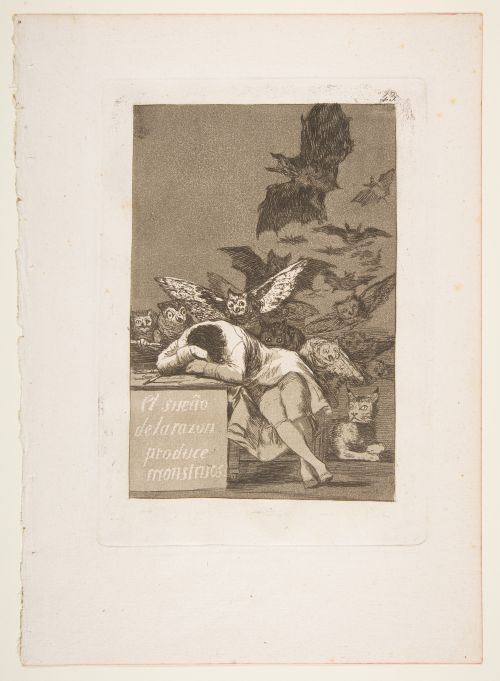
Francisco Goya’s The Sleep of Reason Produces Monsters (1799)—an image of what emerges when the mind abdicates its responsibility: not freedom, but fantasy; not peace, but nightmare. Where reason sleeps, the trinity of miracle, mystery, and authority awakens to devour.
In Dostoevsky’s The Brothers Karamazov, the tale of the Grand Inquisitor remains one of the most unsettling parables in modern literature. Told by Ivan Karamazov to his younger brother Alyosha, the fable imagines Christ returning during the Spanish Inquisition—only to be arrested and silenced by the Church. The Inquisitor, a cardinal of imposing intellect and grave compassion, does not accuse Christ of falsehood, but of cruelty: You gave them freedom, he says, when they needed bread. You gave them mystery, when they needed answers. You gave them love, when they needed order.
There was a time, decades ago, in the earnest conviction of my youth, when I found myself perplexed by the Grand Inquisitor’s logic. I did not admire him, nor excuse his authoritarianism, but I recognized the ache that underpinned his argument. Bread matters. Peace matters. Even then, I sensed the moral gravity of the dilemma he posed: How does one respond to suffering in a world that is often brutal, hungry, and unforgiving?
But I also responded viscerally to something else: the pen of Dostoevsky was not just crafting a fable, but weaponizing a caricature. The Inquisitor was not simply a tragic figure—he was also a polemic against Catholicism, a projection of Dostoevsky’s own religious bigotry. As someone educated within the Catholic tradition, I saw the ugliness beneath the fable—the prejudice tucked behind the parable’s grandeur. The critique was not only of power, but of Rome. The Inquisitor’s mitre bore the unmistakable weight of Jesuit anti-types, cloaked in suspicion and veiled accusation. My disquiet, then, was not only with the Inquisitor’s words, but with the frame within which they were uttered.
And yet, despite its polemical underpinnings, the parable remains one of the most profound meditations on freedom and faith in modern literature. Its imaginative force exceeds its prejudices. The Inquisitor endures not only as a critique, but as a haunting embodiment of the human temptation to trade liberty for comfort.
And that temptation has not faded. The Grand Inquisitor endures because he gives voice to something deeply human, and psychologically real: the desire for security, for certainty, for order amidst chaos. It is a desire that remains active—arguably ascendant—in our own time. One hears the Inquisitor’s voice today in populist strongmen, in the cynical strategist’s smirk, in the media apparatus that soothes while it divides, and in slogans that promise greatness through obedience—Make America Great Again, for instance, the rallying cry of a leader who proclaimed, “I am the only one who can save this nation,” inviting not deliberation, but devotion. The trinity he offers—miracle, mystery, and authority—is the very catechism of modern demagoguery.
This reflection, then, is not a defense of the Inquisitor, but an attempt to understand his appeal, and to reclaim the concepts he distorts. In my recent essay on literalism, metaphor, and balance, I sought to describe the menace of the literalist disposition—a mentality that cannot live with ambiguity, that flees from the poetic, and that finds in surface meaning a shield against the deeper, riskier call of the soul. Here, I apply that lens to the Inquisitor’s three pillars.
Miracle and the Tyranny of the Literal
The Inquisitor offers miracle as literal spectacle: bread conjured from stone, laws suspended, proof offered to silence doubt. He rebukes Christ for refusing to perform such signs in the desert, calling His restraint an act of cruelty rather than spiritual wisdom.
Even as a young reader, I did not mistake the Inquisitor’s miracle for holiness. But I understood that hunger cannot be spiritualized away. In a world where the body is often broken before the spirit can rise, the refusal to give bread seems harsh.
What I have since come to understand is that bread must be shared, not wielded—and that miracles, if they mean anything at all, must point beyond themselves. A miracle that ends conversation is not a miracle but a manipulation.
We have seen modern versions of such miracles: promises made and spectacles staged not to elevate understanding, but to prove power. Consider the border wall—hailed not merely as a policy, but as a singular, salvific act. Its construction, real or exaggerated, was brandished as proof of providence, as the visible sign that the nation could be made great, pure, and safe again. Nor was it the only such “miracle.” Similar wonders were promised: the immediate end of the Russian invasion of Ukraine, the revival of a fading industrial economy, the return of jobs long gone, and the rapid reordering of the global market in our favor. These, too, were presented as guarantees—not to be debated, but to be believed. And like the Inquisitor’s miracles, they have largely yet to be seen.
In my essay on literalism and metaphor, I argued that literalism becomes a menace when it displaces metaphor—when it insists on one meaning, one proof, one visible sign. The Inquisitor’s miracles are precisely that: spectacles that end the need for faith. They are miracles without meaning.
Mystery and the Collapse of Metaphor
The Inquisitor’s use of mystery is a case study in spiritual containment. Mystery becomes the guarded unknown, parceled out by clerical authority to pacify rather than provoke. It is not a sacred unknowing, but a fog of confusion meant to keep the people docile.
But true mystery, like true metaphor, does not confuse—it illuminates by depth. It renders the world porous to truth. It refuses finality not because it is evasive, but because it is more honest than premature closure allows.
I did not reject mystery in youth, nor do I now. But I reject the collapse of mystery into secrecy, the transformation of the ineffable into the inaccessible. Metaphor must breathe. Mystery must invite. When weaponized, they become not sacred, but sinister.
In our current dysfunctional era, mystery is often replaced by conspiracy—a counterfeit that plays the same psychological role, offering significance without wisdom, awe without humility. The literalist disposition, fearing true complexity, gravitates toward these shallow depths. Conspiracy is mystery stripped of humility. It retains the trappings of hidden knowledge but closes the mind rather than opening it. It flatters the believer with secrets while shielding them from ambiguity. It is not reverence for the unknown, but a refuge from the supposed unbearable complexity of reality.
We see this vividly in the ecosystem of conspiracy theories surrounding Trump’s political movement. Whether it is the belief that a global cabal of elites and pedophiles is secretly running the world (QAnon), or that massive voter fraud orchestrated by shadowy networks altered the outcome of the 2020 election, or that figures like Barack Obama, Hillary Clinton, or George Soros are puppet-masters in an international scheme to undermine American sovereignty—each offers an illusion of secret insight in place of the real work of understanding. These narratives are not pursued for their truthfulness but for their emotional certainty. They replace sacred mystery with a kind of gnosis—fierce, insular, and self-reinforcing.
And like the Inquisitor’s mystery, they are not shared to free the soul, but to bind it—to a worldview, to a figure (whether cult, religious, or political leader, a distinction without merit or significance), to a sense of exceptionalist belonging. The effect is not illumination but containment.
Authority and the Displacement of Balance
The Inquisitor’s authority is final, paternal, and brutal in its compassion. It replaces freedom with peace, conscience with obedience. Its appeal lies not only in its force, but in its promise: You no longer have to choose. I will choose for you. And I will feed you.
As I have aged, I have come to see that this vision is not merely imposed—it is desired. Much of the populace is psychologically predisposed to respond favorably to such authority, whether it comes in vestments or slogans. It offers relief from the burden of discernment. It relieves the anxiety of paradox.
This recognition—that the hunger for certainty is as much internal as external—has shaped my own philosophical trajectory.
And that is where the menace lies. This is not a top-down problem alone, but a convergence of design and desire. The Inquisitor gives the people what they already, in some meaningful manner, want: a world made safe through submission. The leader becomes the sole interpreter of truth, the guarantor of safety, the vessel of meaning. Authority becomes a theology in itself.
We have seen this in our time, where devotion to a figure supplants loyalty to principle. When a leader proclaims “I am the only one who can save this nation,” and is met not with unease but with cheers, authority has ceased to be a mediating presence and has become a metaphysical claim. It no longer balances tension; it obliterates it.
In contrast, the authority I defended in my earlier essay was not coercive, but mediating—a balancing presence, a harmonizing voice. It does not dominate or dismiss. It holds the tension without collapsing it. It does not provide peace through closure, but through co-suffering. It listens. It waits.
The Bread and the Burden
So no, I did not approve of the Grand Inquisitor—not in youth, not now. But I acknowledged, and still acknowledge, the ache beneath his argument. It was not cruelty that made him persuasive, but compassion twisted into control—a desire to ease pain by removing the possibility of choice.
What I now see more clearly is that this fable is not merely a theological drama. It is a psychological map. The Grand Inquisitor is the high priest of the literalist disposition—offering miracle that silences, mystery that obscures, authority that absolves.
That disposition is not confined to Dostoevsky’s century. It is at work now—in every movement that prefers spectacle to sign, dogma to dialogue, power to presence. It thrives in political rhetoric, in media narratives, in spiritual systems that replace grace with control.
Dostoevsky does not argue against it. Christ does not rebut it. He answers with a kiss.
A kiss without domination. A kiss that respects freedom. A kiss that does not resolve the tension, but chooses to love within it.
That is the burden of freedom: not only to bear it ourselves, but to offer it to others, knowing they may prefer their chains.
To offer bread, but not as bribe. To teach, but not as demand. To speak, but not to silence. To live, still and quietly, within the balance that resists the Inquisitor’s call.
To refuse the miracle that enslaves, To offer bread and still preserve the soul, That is the quiet defiance the world most needs.
Auguste Rodin, The Thinker (conceived 1880, cast c. 1917). Bronze. Cleveland Museum of Art. CC0 Originally conceived as part of The Gates of Hell, Rodin’s The Thinker was not merely a passive figure lost in thought, but a representation of Dante himself, contemplating the fates of souls below. Cast in tension and muscle, he embodies the labor of intellect—the weight of reflection, the cost of authorship, and the solitary burden of making meaning in a world of mechanized shortcuts. A fitting emblem for the human writer mistaken for a machine.
Preface: A Writer Mistaken for a Machine
The main essay that follows this preface was generated wholly by ChatGPT’s “Deep Research” feature, produced at my request after a recent experience that was equal parts amusing and unsettling.
In a recent essay I had written—carefully and thoughtfully—I found myself admiring a few turns of phrase that seemed, perhaps, too polished. Seeking to determine whether I had unconsciously absorbed and repeated something from my recent reading, I turned to a site I had used before—one that aggregates reviews of AI and plagiarism detectors commonly employed by educators. From there, I selected not one, but three highly rated tools to review my essay and determine whether I had inadvertently borrowed a phrase from Blake, Eckhart, Pseudo-Dionysius, or anyone else I have recently been reading.
The results were, to put it mildly, contradictory, though not for the issue I had set out to explore. The first site was no longer operational, citing the unreliability of AI detection in view of the accelerating complexity of AI language model algorithms. The second tool confidently declared that my essay was entirely free of both plagiarism and AI-generated content. The third, by contrast, just as confidently pronounced that my essay was likely 100 percent AI-generated, both in style and content, based on the presence of twenty phrases—unhelpfully left unidentified—that appeared more frequently in AI-generated material. The site explained that those mysterious phrases had been used in training language models and thus their use in my writing rendered it suspect. It passed no judgment on whether I had plagiarized any statements, only that the content bore resemblance to machine-generated text.
My immediate reaction, I confess, was to teeter between horror and bemusement. The accusation—if one may call such pronouncements generated by AI algorithms such—felt surreal. After all, I knew the truth: I had written every word of the essay, agonized over phrasing, amended lines multiple times, and left the final version still slightly flawed in its characteristic manner—overwritten in places, a bit repetitive, and too fond of “dollar words” when “nickel words” might have sufficed. In other words, it bore the unmistakable hallmark of my own inimitable style and vocabulary—a style and vocabulary that had been mine long before AI and computers were available to assist writers.
My suspicion is that some AI detectors struggle with refined style and elevated or scholarly vocabulary, not because the language itself is artificial, but because such prose deviates from what the detectors expect. Many of these tools appear to assume that typical writing samples—particularly from Americans—will reflect a sixth- to eighth-grade reading and writing level, which is often cited as the norm in American education. As a result, writing that demonstrates syntactic complexity, lexical richness, or familiarity with classical or theological sources may be flagged as anomalous—if not by design, then by statistical accident.
But perhaps this is not so much a matter of cynicism as it is a reflection of changing cultural baselines. It may be that AI detectors are most often trained and tested on writing submitted by individuals who, through no fault of their own, have received a relatively standard education—one that is no longer grounded in the Western canon, rhetorical tradition, or literary cultivation. Meanwhile, the language models themselves were trained on vast bodies of material that included precisely such literary and scholarly writings. The result is a curious inversion: those whose writing reflects a more literary or humanistic sensibility may appear “too AI-like” because the models were trained on the very texts that once defined erudition. We have, in a sense, taught the machines what good writing looks like—and then turned around and accused anyone who writes well of being a machine.
Once the bemusement passed, I turned to curiosity. How could this happen? What is the current scholarly consensus on these tools? Are they reliable? Ethical? Legally defensible? And what risks do they pose—to students, educators, or professionals whose authentic work is misjudged by algorithm? The essay that follows is the product of those inquiries: an AI-assisted deep research essay on AI detection tools, their promises and pitfalls, their technical limits, and their unintended consequences.
To be clear, I do use AI tools—but not to draft my writing. I use them as an editor and as a very well-informed assistant. Tasks assigned to AI include reviewing essays for spelling and grammatical errors, formatting footnotes and endnotes, formatting essays for publication on my website, converting material into HTML, creating SEO-friendly titles and tags, checking poetic meter, or assisting me as a thesaurus when a word feels off. AI assists at the margins. It does not craft essays, as writing is my work.
Anyone still in doubt need only glance at my desk—or my nightstand or dining room table. There, amid scattered books, notebooks, half-drafted pages, and layers of revisions, is the reality of my writing process. It is rarely clean, often circuitous, and always human.
Writing is a laborious but enjoyable process. Many essays and poems take months to write, others take weeks, a few only days. Now and then, an essay or poem does arrive nearly whole, a rare gift, as if sprung from the brow of Zeus. But more often, it is a time-consuming process, coming line by line, revision by revision.
So, with that somewhat overwrought introduction, I offer the following AI-generated essay on AI detection tools—an essay which, in my professional and legal opinion, should dissuade any reasonable educator or institution from ever using AI detectors to determine authorship. AI plagiarism detection may still serve a purpose. But AI authorship detectors? Never. Do not be tempted.
And if I may offer some unsolicited advice in their place, grounded not in machine logic but in the lived practice of teaching and learning: when I taught history, reading, and religion to seventh and eighth graders at St. Edward Catholic School in Youngstown, Ohio, I insisted that all assignments be written in ink. “If one is to err, one should err boldly, in ink,” I told my students, and I refused to accept work written in pencil. This approach taught them not only to commit to their words but, more importantly, to reflect on them before committing anything to paper. It encouraged thought and contemplation—qualities essential to authentic writing and learning—rather than the careless drafting and endless erasing that pencils with erasers, and now mechanical tools, permit. That ethic, I believe, translates well to our current moment.
Educators should begin by becoming familiar with the voice, habits, and capabilities of the writers whose work they are assessing. Ask for drafts, notes, outlines, or written reflections that reveal the student’s thinking process. Structure assignments so that substantial components are completed in class, or are grounded in personal experience or classroom dialogue—subjects that AI cannot credibly fabricate. Make clear whether AI tools may be used, and if so, how. Explain why certain shortcuts, especially in formative stages, may undermine the very skills students are meant to acquire.
For developing writers especially, I am inclined to believe it is best to eschew AI altogether—and perhaps even computers and, dare I say, typewriters, should any still have access to them—in the early stages of learning. Write by hand, with ink. Let not an algorithm be found in the process.
Scholarly and Critical Perspectives on AI Content and Detection Tools
A CHAT GPT ESSAY
Introduction
AI content detection tools – such as Copyleaks, Turnitin’s AI-writing detector, GPTZero, and others – have emerged to help educators and publishers identify text that might have been generated by AI. These detectors typically analyze text for telltale patterns or “low perplexity” that could signal machine-written prose. However, as these tools proliferate in classrooms and journals, many academics, educators, and legal experts are raising alarms about their reliability, transparency, and potential harms. Recent studies and critiques suggest that current AI detectors often fall short of their promises and may even produce unintended negative consequences theguardian.comvanderbilt.edu. This report provides an up-to-date overview of how academic, educational, and legal communities view AI content detectors, focusing on concerns over accuracy, fairness, and the risk of false accusations.
Accuracy and Reliability Issues
Detectors’ claims vs. reality: AI detector companies often tout extremely high accuracy rates – some advertise 98–99% accuracy for identifying AI-generated textcitl.news.niu.edu. For example, Copyleaks has claimed 99.12% accuracy and GPTZero about 99%citl.news.niu.edu. In practice, independent evaluations have found such claims “misleading at best” theguardian.com. OpenAI’s own attempt at an AI-written text classifier was quietly discontinued in mid-2023 due to its “low rate of accuracy”insidehighered.combusinessinsider.com. Even Turnitin, which integrated an AI-writing indicator into its plagiarism platform, acknowledged that real-world use revealed a higher false positive rate than initially estimated (more on false positives below)insidehighered.cominsidehighered.com. In short, consensus is growing that no tool can infallibly distinguish human from AI text, especially as AI models evolve.
False negatives and AI evolution: Critics note that detectors struggle to keep up with the rapid progress of large language models. Many detectors were trained on older models (like GPT-2 or early GPT-3), making them prone to “overfitting” on those patterns while missing the more human-like writing produced by newer models such as GPT-4 bibek-poudel.medium.com. A recent U.K. study underscores this gap: when researchers secretly inserted AI-generated essays into real university exams, 94% of the AI-written answers went undetected by graders bibek-poudel.medium.comreading.ac.uk. In fact, those AI-generated answers often received higher scores than human students’ work bibek-poudel.medium.com, highlighting that advanced AI can blend in undetected. This high false-negative rate suggests detectors (and even human examiners) can be easily fooled as AI-generated writing grows more sophisticated. It also reinforces that educators cannot rely on detectors alone – as one analyst put it, trying to catch AI in writing is “like trying to catch smoke with your bare hands” bibek-poudel.medium.com.
Transparency and Methodological Concerns
Many in academia criticize AI detection tools as “black boxes” that lack transparency. Turnitin’s AI detector, for instance, was rolled out in early 2023 with almost no public information on how it worked. Vanderbilt University – which initially enabled Turnitin’s AI checks – reported “no insight into how it [the AI detector] works” and noted that Turnitin provided “no detailed information as to how it determines if a piece of writing is AI-generated or not.” vanderbilt.edu Instead, instructors were told only that the tool looks for unspecified patterns common in AI writing. This opacity makes it difficult for educators and students to trust the results or to challenge them. If a student is flagged, neither the instructor nor the student can see what specific feature triggered the detector’s suspicion. Such lack of transparency runs counter to academic values of evidence and explanation, as decisions about academic integrity are being outsourced to an algorithm that operates in secrecy.
Lack of peer review or independent validation: Unlike plagiarism checkers (which match text against known sources), AI detectors use proprietary algorithms and often haven’t been rigorously peer-reviewed in public. Experts point out that “AI detectors are themselves a type of artificial intelligence” with all the attendant opaqueness and unpredictability citl.news.niu.edu. This raises concerns about due process: should a student face consequences from a tool whose inner workings are not open to scrutiny? Legal commentators note that relying on an unproven algorithm for high-stakes decisions is risky – any “evidence” from an AI detector is inherently probabilistic and not easily explainable in plain terms cedarlawpllc.comcedarlawpllc.com. Some universities have therefore erred on the side of caution. For example, the University of Minnesota explicitly “does not recommend instructors use AI detection software because of its known issues” mprnews.org, and advises that if used at all, it be treated as an “imperfect last resort.”
Privacy concerns: Another transparency issue involves data privacy and consent. Using third-party AI detectors means student submissions (which can include personal reflections or sensitive content) are sent to an external service. Vanderbilt’s review concluded that “even if [an AI detector] claimed higher accuracy… there are real privacy concerns about taking student data and entering it into a detector managed by a separate company with unknown data usage policies.” vanderbilt.edu Educators worry that student work could be stored or reused by these companies without students’ knowledge. This lack of clarity about data handling adds yet another layer of concern, leading some institutions to opt out of detector services on privacy grounds alone.
False Positives and Bias Against Certain Writers
Perhaps the most pressing criticism of AI content detectors is their propensity for false positives – flagging authentic human work as AI-generated. Researchers and educators have documented numerous cases of sophisticated or even simplistic human writing being mistaken for machine output. A dramatic illustration comes from feeding well-known texts into detectors: when analysts ran the U.S. Constitution through several AI detectors, the document was flagged as likely written by AI senseient.com. The reason is rooted in how these tools work. Many detectors measure “perplexity,” essentially how predictably a text aligns with patterns seen in AI training data senseient.comsenseient.com. Paradoxically, a text like the Constitution or certain Bible verses, which use common words and structures, appears too predictable and yields a low perplexity score – causing the detector to misjudge it as AI-produced. As one expert quipped, detectors can incorrectly label even America’s most important legal document as machine-made senseient.com. This highlights a fundamental flaw: well-written or formulaic human prose can trip the alarms because AI models are trained on vast amounts of such text and can mimic it.
Bias against non-native English writers: A growing body of scholarship reveals that AI detectors may disproportionately flag work by certain groups of human writers. A 2023 Stanford study by Liang et al. found that over half of essays written by non-native English speakers were wrongly flagged as AI-generated by popular detectors theguardian.com. By contrast, the same detectors judged over 90% of essays by native English-speaking middle-schoolers to be human-written theguardian.com. The disparity stems from linguistic style: non-native writers, or those with more basic vocabulary and simpler grammar, inadvertently write in a way that the detectors identify as “low perplexity” (too predictable) theguardian.com. Detectors, trained on AI outputs that tend to be straightforward, end up penalizing writers who use simpler phrasing or formulaic structures, even if their work is entirely original theguardian.com. The Stanford team bluntly concluded that “the design of many GPT detectors inherently discriminates against non-native authors” themarkup.org. This bias can have serious implications in academia and hiring: an ESL student’s college essay or a non-native job applicant’s cover letter might be unfairly flagged, potentially “marginalizing non-native English speakers on the internet” as one report warned theguardian.comtheguardian.com.
Beyond language background, other kinds of “atypical” writing styles trigger false positives. People with autism or other neurodivergent conditions, who might write in a repetitive or highly structured way, have been snared by AI detectors. Bloomberg reported the case of a college student with autism who wrote in a very formal, patterned style – a detector misidentified her work, leading to a failing grade and a traumatic accusation of cheating gigazine.net. She described the experience as feeling “like I was punched in the stomach” upon learning the software tagged her essay as AI-written gigazine.net. Likewise, younger students or those with limited vocabulary (through no fault of their own) could be at higher risk. In tests on pre-ChatGPT student essays, researchers found detectors disproportionately flagged papers with “straightforward” sentences or repetitive word choices mprnews.orggigazine.net. These examples underline a key point from critics: AI content detectors exhibit systemic biases – they are more likely to falsely accuse certain human writers (non-native English writers, neurodivergent students, etc.), raising equity and ethical red flags.
Real World Consequence: False Accusations and Student Harm
For students and educators, a false positive isn’t an abstract statistical problem – it can derail a person’s education or career. Recent incidents show the tangible harm caused by over-reliance on AI detectors. At Johns Hopkins University, lecturer Taylor Hahn discovered multiple instances where Turnitin’s AI checker flagged student papers as 90% AI-written, even though the students had written them honestly themarkup.orgthemarkup.org. In one case, a student was able to produce drafts and notes to prove her work was her own, leading Hahn to conclude the “tool had made a mistake.” themarkup.org He and others have since grown wary of trusting such software. Unfortunately, not all students get the benefit of the doubt initially. In Texas, a professor infamously failed an entire class after an AI tool (reportedly ChatGPT itself) “detected” cheating, only for it to emerge that the students hadn’t cheated – the detector was simply not a valid evidence tool businessinsider.combusinessinsider.com. Incidents like this have fueled professors’ concerns that blind faith in detectors could lead to wrongful punishments of innocent students.
The psychological and academic toll of false accusations is significant. Students report experiencing stress, anxiety, and a damaged sense of trust when their authentic work is misjudged by an algorithm citl.news.niu.edu. For international students, the stakes can be even higher. As one Vietnamese student explained, if an AI detector wrongly flags his paper, it “represents a threat to his grades, and therefore his merit scholarship” – even raising fears about visa status if academic standing is lost themarkup.orgthemarkup.org. In the U.S., where academic misconduct can lead to expulsion, an unfounded cheating charge could put an international student at risk of deportation themarkup.org. These scenarios illustrate why students like those at the University of Minnesota say they “live in fear of AI detection software”, knowing one false flag could be “the difference between a degree and going home.” mprnews.orgmprnews.org
Unsurprisingly, some students and faculty have fought back. In early 2025, a Ph.D. student at the University of Minnesota filed a lawsuit alleging he was unfairly expelled based on an AI cheating accusation mprnews.orgmprnews.org. He maintains he did not use AI on an exam, and objects that professors relied on unvalidated detection software as evidence mprnews.orgmprnews.org. The case, which garnered national attention, underscores the legal minefield institutions enter if they treat AI detector output as proof of misconduct. Similarly, a community college student in Washington state had his failing grade and discipline overturned after lawyers demonstrated to the school’s administration how unreliable the detection program was – notably, the college vice-president admitted that even her own email reply was flagged as 66% AI-generated by the tool cedarlawpllc.com cedarlawpllc.com. In voiding the penalty, the college effectively acknowledged that the detector’s result was not trustworthy evidence cedarlawpllc.com. These cases highlight a common refrain: without corroborating evidence, an AI detector’s output alone is too flimsy to justify accusing someone of academic dishonesty cedarlawpllc.com.
Responses from Educators and Institutions
The educational community’s response to AI detectors has rapidly evolved from initial curiosity to growing skepticism. Many instructors, while concerned about AI-assisted cheating, have concluded that current detector tools are “a flawed solution to a nuanced challenge.” They argue that “they promise certainty in an area where certainty doesn’t exist” bibek-poudel.medium.com. Instead of fostering integrity, heavy-handed use of detectors can create an adversarial classroom environment and chill student creativity medium.com. For these reasons, a number of teaching and learning centers at universities have published guides essentially making the case against AI detectors. For instance, the University of Iowa’s pedagogy center bluntly advises faculty to “refrain from using AI detectors on student work due to the inherent inaccuracies” and to seek alternative ways to uphold integrity teach.its.uiowa.edu. Northern Illinois University’s academic technology office labeled detectors an “ethical minefield,” arguing their drawbacks (false accusations, bias, stress on students) “often outweigh any perceived benefits.” citl.news.niu.edu Their guidance encourages faculty to prioritize fair assessments and student trust over any quick technological fixcitl. news.niu.edu.
Importantly, some universities have instituted policy decisions to limit or reject the use of AI detection tools. In August 2023, after internal tests and consultations, Vanderbilt University decided to disable Turnitin’s AI detector campus-wide vanderbilt.edu vanderbilt.edu. Vanderbilt’s announcement cited multiple concerns: uncertain reliability, lack of transparency, the risk of ~1% false positives (potentially hundreds of students falsely flagged each year), and evidence of bias against non-native English writers vanderbilt.eduvanderbilt.edu. Northwestern University likewise turned off Turnitin’s AI detection in fall 2023 and “did not recommend using it to check students’ work.” businessinsider.com The University of Texas at Austin also halted use, with a vice-provost stating that until the tools are accurate enough, “we don’t want to create a situation where students are falsely accused.” businessinsider.com Even Turnitin’s own guidance to educators now stresses caution, advising that its AI findings “should not be used as the sole basis for academic misconduct allegations” and should be combined with human judgment turnitin.com. In practice, many colleges have shifted focus to preventative and pedagogical strategies – designing assignments that are harder for AI to complete (personal reflections, oral exams, in-class writing), educating students about acceptable AI use, and improving assessment design mprnews.orgmprnews.org. This approach seeks to address AI-related cheating without leaning on fallible detection software.
On a broader policy level, OpenAI itself has cautioned educators against over-reliance on detectors. In a back-to-school guide for fall 2023, OpenAI explicitly warned that AI content detectors are not reliable for distinguishing GPT-written text businessinsider.com. The company even confirmed what independent studies found: detectors tend to mislabel writing by non-English authors as AI-generated, and thus should be used, if at all, with extreme care businessinsider.com. As a result, many institutions are rethinking how to maintain academic integrity in the AI era. The emerging consensus in education is that no AI detection tool today offers a magic bullet, and using them blindly can cause more harm than good. Instead, instructors are encouraged to discuss AI use openly with students, set clear policies, and consider assessments that integrate AI as a learning tool rather than treat it as a forbidden trick mprnews.orgmprnews.org.
Legal and Ethical Considerations
The controversies around AI writing detectors also raise legal and ethical questions. From an ethical standpoint, deploying a tool known to produce errors that can jeopardize students’ academic standing is highly problematic. Scholars of educational ethics argue that the potential for “unfounded accusations” and damage to student well-being means the costs of using such detectors may outweigh the benefits themarkup.org themarkup.org. There is an implicit breach of trust when a student’s honest work is deemed guilty until proven innocent by an algorithm. This reverses the usual academic principle of assuming student honesty and has been compared to using an unreliable litmus test that forces students to “prove their innocence” after a machine accuses them themarkup.org. Such an approach can poison the student-teacher relationship and create a climate of suspicion in the classroom.
Legally, if a student is disciplined or loses opportunities due to a false AI detection, institutions could face challenges. Education lawyers note that students might have grounds for appeal or even litigation if they can show that an accusation rested on junk science. The defamation lawsuit at Minnesota (mentioned above) may set an important precedent on whether sole reliance on AI detectors can be considered negligent or unjust by a university mprnews.orgmprnews.org. Additionally, since studies have demonstrated bias against non-native English speakers, one could argue that using these detectors in high-stakes decisions could inadvertently violate anti-discrimination policies or laws, if international or ESL students are disproportionately harmed. Universities are aware of these risks. As the Cedar Law case in Washington illustrated, once informed of the detector’s fallibility, administrators reversed the sanction to avoid unfairly tarnishing a student’s record cedarlawpllc.comcedarlawpllc.com. The takeaway for many is that any evidence from an AI detector must be corroborated and cannot be treated as conclusive. As one legal commentary put it: the “lesson from these cases is that colleges must be extremely conscientious given the present lack of reliable AI-detection tools, and must evaluate all evidence carefully to reach a just result.” cedarlawpllc.com
Finally, there are broader implications for academic freedom and assessment. If instructors were to let fear of AI cheating drive them to use opaque tools, they might also chill legitimate student expression or push students toward homogenized writing. Some ethicists argue that the very concept of AI text detection may be a “technological dead end” – because writing is too variable and AI is explicitly designed to mimic human style, trying to perfectly separate the two may be futile bibek-poudel.medium.combibek-poudel.medium.com. A more ethical response, they suggest, is to teach students how to use AI responsibly and adapt educational practices, rather than leaning on surveillance technology that cannot guarantee fairness.
Conclusion
Current scholarly and critical perspectives converge on a clear message: today’s AI content detectors are not fully reliable or equitable tools, and their unchecked use can do more harm than good. While the idea of an “AI lie detector” is appealing in theory, in practice these programs struggle with both false negatives (missing AI-written text) and false positives (flagging innocent writing) to a degree that undermines their utility. The lack of transparency and independent validation further erodes confidence, as does evidence of bias against certain writers. Across academia, educators and researchers are warning that an over-reliance on AI detectors could lead to wrongful accusations, damaged student-teacher trust, and even legal repercussions. Instead of providing a quick fix to AI-facilitated cheating, these tools have become an object of controversy and caution.
In the educational community, a shift is underway – away from automated detection and toward pedagogy and policy solutions. Many universities have scaled back use of detectors, opting to train faculty in better assessment design, set clear guidelines for AI use, and foster open dialogue with students about the role of AI in learning mprnews.orgmprnews.org. Researchers are continuing to study detection methods, but most acknowledge that as AI writing gets more advanced, the detection arms race will only intensify edintegrity.biomedcentral.comedintegrity.biomedcentral.com. In the meantime, the consensus is that any use of AI content detectors must be coupled with human judgment, skepticism of the results, and a recognition of the tools’ limits edintegrity.biomedcentral.comedintegrity.biomedcentral.com. The overarching lesson from the past two years is one of caution: integrity in education is best upheld by informed teaching practices and fair processes, not by uncritically trusting in artificial intelligence to police itself cedarlawpllc.comcitl.news.niu.edu.
Rembrandt, “Philosopher in Contemplation” (1632). A quiet spiral of thought, descending into the hush between certainties.
“The soul speaks most clearly when the tongue is still.”
There are days now, more frequent than before, when I find myself recoiling—not from people, exactly, but from a certain tone, a cast of mind. It is the literalists who unsettle me. Those who cling to the concrete as though it were the last raft afloat. The older I grow, with my silvered hair, the more their certainties feel not reassuring but menacing. It is not their knowledge I fear—it is their refusal to admit the unknown, the unspoken, the not-yet-understood.
And yet, I do not mean to dismiss the literal out of hand. I was trained in it. I lived among it. I applied law to facts with the solemn responsibility of rendering findings in civil rights complaints—decisions that shaped lives, guided by precedent, statute, regulation, policy, and the weight of written word. The literal is necessary. It is the groundwork. The shared foundation upon which meaning may be built. One must know the noise, the surface of things, before any deeper hearing is possible. Literalism is not, in itself, a failing. But to dwell in it wholly, to build a temple upon it without windows or doors—that is a failure of imagination and perhaps of courage.
There is something holy, or at least essential, in the gaps. The hush between words. The pause before reply. The silence that says more than any explanation could. It may be peace. It may be sorrow. It may be nothing at all—and that nothing may yet be everything.
The paradox thickens with age. I cannot dismiss the concrete—it is how we meet one another—but I also cannot abide those who live only by its rule. The world is not built entirely of clarity, nor is it meant to be. There is a path somewhere between the clamor and the silence, and perhaps I am only now beginning to find it.
The literal is our first tongue. It is how the child learns: this is a stone; that is a tree. Language builds the world we inhabit. And in that naming, in that first apprenticeship to the visible and the graspable, we are equipped with the tools to navigate life’s surfaces. We learn to classify, to divide, to act. It is a necessary scaffolding, even beautiful in its clarity.
But what follows—what truly shapes the soul—is what one does once that scaffolding has served its purpose. It is in the gaps, the silences, the places where the scaffolding falls away, that something more begins.
The darkness between the stars, or perhaps the light that filters through cracks in ancient stone, draws us to pause. It is not the substance, but the space between the substance, that calls us to deeper thought. The hush in a conversation—not the words, but the breath that precedes or follows them—can speak more profoundly than the speech itself. The crevice between certainties is where wonder slips in.
In these spaces we do not necessarily find answers. Sometimes we find transformative questions. Sometimes only presence. And sometimes only ourselves, which may be enough.
There is a wisdom in the void that no amount of noise can manufacture. Not the nihilism of meaninglessness, but the reverent recognition that meaning, like light, often travels best through emptiness.
To live entirely in the measured and known is to dwell in a museum of certainties—tidy, lifeless, unmoved. But to discard all that for a world of formless suggestion is to risk disappearance. The task is to dwell attentively in both: to know the stone as stone, and then sit long enough beside it to feel what it is not.
There are those who seek certainty in everything—in people, in relationships, in experiences, in outcomes. They crave contracts over conversation, definitions over dialogue. To them, ambiguity is a flaw, unpredictability a failure. But in securing themselves against uncertainty, they forfeit something essential. They miss the quickening of the heart in a half-spoken promise, the richness of a glance misunderstood, the poetry of a thing only half-comprehended but wholly felt.
To insist that the world always yield its meaning—immediately, exhaustively—is to mistake life for a mechanism. To live without risk, without the possibility of being undone or remade, is to refuse the privilege of being human.
And yet, those who flee entirely into mystery—who refuse form, who reject grounding—are no better served. Obscurity for its own sake is not wisdom but evasion. To veil oneself in metaphor to avoid responsibility is no more noble than to cling to literalism out of fear.
We are not machines. Nor are we vapor. We are, maddeningly and gloriously, both. We are flesh and thought, bone and breath, anchored and floating. And it is precisely in that stretch between—the literal and the allusive, the known and the unknown—that we are most fully human.
To demand certainty is to deny the thrill of becoming. To refuse structure is to forgo the beauty of its breaking. Somewhere in that middle space, between what can be said and what must be felt, is where the soul begins to sing.
And so we return to the hush. That space which is not absence but presence unspoken. The unanswered breath, suspended between question and reply, is not a failure of speech but its fulfillment. There, in that breath, we are closest to the truth—not because we grasp it, but because we cease grasping.
It is silence that answers most deeply. Not the silence of indifference, nor of ignorance, but the silence of presence—unadorned, uninsistent, abiding. The kind of silence that rests beside you like a companion who has nothing to prove. A silence that allows space for your own self to rise up, or dissolve, or simply be.
There are things that cannot be said, and yet are spoken in the pauses between words. There are truths that cannot be held, but are felt in the stillness between certainties. And perhaps the deepest form of knowledge is not in knowing, but in listening long enough to no longer need to.
The literal gives us form, but the silence between the forms gives us meaning. The prose of the world teaches us its names, but it is the poetry of its silences that teaches us our own.
I do not know if this is wisdom, or simply age. But I have come to suspect that the truest things—love, sorrow, grace, wonder—do not arrive in declarations. They appear instead in the gaps, in the long glances, in the word left unspoken. They arrive in silence. And in that silence—between noise and silence—we are not alone.
Recently, I published an essay titled The Certainty of Wealth Redistribution Amid Tariff Chaos, in which I argued that the true function of the current administration’s tariff policies was not economic revival, but the deliberate and predictable transfer of wealth from working households to the uppermost tier of financial elites.
Events of the past several days—culminating in imposition of a market-crashing tariff decree swiftly reversed for maximum opportunistic gain—have confirmed my worst fears. That some now praise this spectacle as “brilliant” only adds insult to economic injury.
In response, I offer the following satirical memo from a fictional Wharton Annex ethics professor—one Professor Basil P. Whisker, Chair of Ethical Opportunism at the Weasel School of Business. His observations regarding the situation and the logic he embodies—even though he is fictional—are uncomfortably real.
Professor Basil P. Whisker
On Ethics, Market Manipulation, and the Power of Praise
Buy the Dip, Praise the Dipper: A Wealth Transfer Playbook
By Professor Basil P. Whisker, PhD, MBA, CFA (Parole Honoré Distinction) Chair of Ethical Opportunism, Weasel School of Business, Wharton Annex Formerly of the Federal Correctional Institute for White Collar Refinement “Our Honor Code is Flexible. Our Returns Are Not.”
Some in Congress have raised the unfashionable concern that the recent tariff saga looks suspiciously like market manipulation.
To which I reply: Of course it is. But for whom?
Not the little people—they lack both the reflexes and the capital reserves. No, it is for the elite few trained in the disciplines of anticipation, flexibility, and pliable morality.
At the Weasel School of Business, we teach that ethics must be nonlinear and dynamic—responsive to the moment, like high-frequency trading algorithms or a presidential memory when questioned under oath. The recent 90-day tariff “pause” (following a dramatic market collapse) teaches students everywhere that sometimes the most profitable thing to do is to:
Create a crisis
Seize the resulting dip
Declare victory through reversal
Congratulate the disruptor for his “brilliance”
Move on before the subpoenas arrive
The Art of the Non-Deal
When a policy announcement wipes trillions from the markets, only to be reversed days later with a triumphant “THIS IS A GREAT TIME TO BUY!!!” post, we must acknowledge we are witnessing not governance but performance art.
Like all great art, it asks difficult questions:
Is it market manipulation if you announce the manipulation in real time?
Can one declare “Liberation Day” and then liberate oneself from that declaration?
If financial whiplash creates billionaire gratitude, is it still whiplash—or merely strategic spine realignment?
Billionaires praising such tactics is not sycophancy—it is advanced portfolio management by other means.
As we say in Weasel Finance 101: “Praise is just another form of leverage.”
Looking Ahead: A Curriculum of Chaos
We are entering a new phase of global commerce—what I call the Era of the Glorious Lurch. In this new age, tariffs are not policies but market mood regulators, deployed tactically to evoke loss, recovery, and eventual Stockholm syndrome-like gratitude.
My revised syllabus for the coming semester will include:
Advanced Self-Dealing (OPS-526)
Narrative Arbitrage: Writing History Before It Happens (OPS-618)
Strategic Sycophancy and Influence Leasing (co-listed with Communications)
Tariff Whiplash: Creating Wealth Through Vertigo (OPS-750)
When Textbooks Fail: The Art of the No-Deal Deal (Senior Seminar)
Applications are open. Scholarships available for those with prior SEC entanglements or experience declaring “everything’s beautiful” while markets burn.
A Word on Timing
Critics who suggest that one should wait until an actual deal is struck before declaring brilliance simply do not understand modern finance.
In today’s economy, praise is a futures contract—you are betting on the perception of success, not success itself.
When a policy costs the average American household thousands in higher prices and market losses, only to be partially reversed with no actual concessions gained, the correct reaction is not analysis but applause. After all, it takes real courage to back down without admitting it.
A Final Toast
To the president, I raise a glass of vintage tax shelter with notes of plausible deniability.
To the billionaires celebrating the “brilliant execution” of a retreat, I offer a velvet-lined echo chamber.
And to my students, past and future, I remind you: If you cannot time the market, at least time your praise.
Because in today’s economy, there is no such thing as too soon, too blatant, or too obviously beneficial to the 0.01%.
So next time markets plunge on policy chaos, do not ask “who benefits?” Instead ask, “am I positioned to be among those who do?”
Thank you. And as always— buy low, tweet high, and declare victory before the facts catch up.






 Northcoast Antiquarian