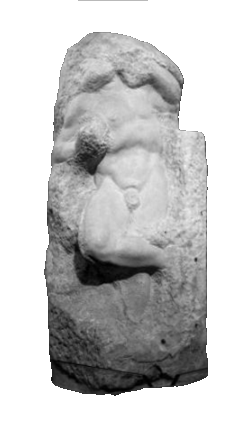
Michelangelo, The Awakening Slave (c. 1525–30). A body caught between measure and becoming.
I. On Bloom and the Anxiety of Influence
As the poet of Vitruvian Man Unbound, I find myself drawn to Harold Bloom’s understanding of how poetry functions within tradition—not as mere imitation or influence, but as a creative misreading that transforms both predecessor and successor. Bloom’s vocabulary—his clinamen (poetic swerve), daemonization, and apophrades (the return of the dead)—offers a framework for understanding my own relationship with Leonardo’s iconic drawing.
Yet I would press beyond the confines of Bloom’s categorical system. The strongest poetry, as Bloom himself recognized, resists easy resolution. Vitruvian Man Unbound embodies what he called a tessera—a completion of its precursor that simultaneously preserves and undermines its foundational terms. The poem does not simply revise Leonardo; it retroactively reshapes our understanding of him. It allows us to see Vitruvian Man as an incomplete gesture, one whose implicit metaphysical longing only achieves full articulation through the poem’s unfolding of form, desire, and transcendence.
II. The Paradox of Poetic Creation as Discovery
When I began Vitruvian Man Unbound, there was no conceit of a new idea. Rather, I felt I was unearthing the obvious—articulating for the first time verses that had already been rendered, waiting to be heard.
This situates the poem not as invention but as discovery—a Renaissance conception of artistic creation. Michelangelo spoke of liberating the form already imprisoned within the marble. Leonardo, too, conceived of art as revelation through observation, uncovering structures latent in nature and proportion. I participate in that lineage: the transcendence of the circle was already latent in Leonardo’s drawing. My poem does not overwrite Vitruvian Man but unveils what it always contained.
III. Poetry as Transcription of Revealed Truth
Poetry is primarily, in my conception, the art of transcription. Poetry is ultimately truth revealed, however rendered.
This belief is ancient. Poets once invoked the Muse, believing their songs were received rather than authored. Plato cast poets as possessed vessels of divine madness. In scriptural traditions, the prophet or sage writes not from invention but from vision. In this view, the poet is not creator but conduit.
This understanding reorients poetic practice. What matters most is not novelty of theme or form but receptivity—a cultivated attentiveness to truths that ask to be heard. To compose well is to listen well. The most vital poems do not invent so much as reveal. The poet’s charge, then, is fidelity.
Vitruvian Man Unbound aspires to this kind of transcription. It draws out from Leonardo’s image the philosophical tensions embedded therein: between proportion and possibility, containment and becoming, structure and the longing to transcend it.
IV. The Poem’s Journey: From Containment to Transcendence
At its heart, my poem charts a metaphysical journey—the awakening of a consciousness confined within geometry, gradually realizing its cosmic vocation. The Vitruvian figure, bound in ratios and ruled lines, discovers within himself not mere form but flame. The movement is from being drawn to drawing, from being measured to measuring.
The poem gives voice to this paradox: “I am both bound and boundless, large and small, / Both measured part and immeasurable all.”
This is no empty contradiction. It is the philosophical heart of the work. The circle becomes “not wall but door,” not negated but reimagined. Limitation, as I came to understand, is not the enemy of freedom but its precondition. Form does not imprison; it allows the infinite to appear in the guise of the finite.
This idea resonates with multiple traditions: the Christian theology of kenosis, quantum indeterminacy, the aesthetics of the golden ratio, even the existential struggle of Camus’ Sisyphus. In Vitruvian Man Unbound, I sought to draw them all into poetic coherence.
V. Beyond Influence: Co-Creation and Transcendence
My relationship to Leonardo’s drawing is not one of mere homage or critique. The poem does not simply descend from his vision; it reconfigures how I understand that vision. In Bloom’s terms, it enacts an apophrades: the precursor is altered by the successor, the past rewritten by the presence of the present.
I acknowledged this inversion within the poem itself: “Da Vinci dreamed me into being’s start; / I dream myself anew with conscious art.”
This was not rebellion against the tradition but transcendence through deep fidelity. I did not seek to destroy Leonardo’s Vitruvian Man; I hoped to fulfill him. I entered the drawing and found the voice that seemed to have been waiting there. The Vitruvian Man, for me, ceased to be object and became subject, consciousness incarnate.
VI. Poetry as Epistemological Practice
If poetry is the transcription of revealed truth, then it is not merely aesthetic. It is epistemological. It helps us understand not only what is, but how we come to know what is. The most original poems do not dazzle through novelty alone; they resonate because they name what we already suspected was true, but had not yet heard.
Vitruvian Man Unbound aspires to such resonance. I hope it awakens a dormant dimension in Leonardo’s drawing—and perhaps, in us. I did not set out to create a new form, but to reveal the old form’s silent music. For me, it was an act not of invention, but of listening—not conquest, but witnessing. A poetry of revelation.
Thus the ink that once bound becomes the ink that reveals.
VII. Echoes of Prometheus
In reflecting on Vitruvian Man Unbound, I recognize the shadow of another unbound figure—Shelley’s Prometheus. His liberation from cosmic tyranny, his transformation into a visionary voice of harmony, and his rejection of vengeance in favor of transcendence, all resonate deeply with the arc of my poem. Like Prometheus, the Vitruvian figure is not merely released; he is revealed—as a bearer of fire, of knowledge, of poetic truth. It is not accidental that in striving toward the infinite, we find ourselves echoing those myths and verses where the infinite has already spoken.
Whether its effect is ultimately salutary or merely a noble failure, Vitruvian Man Unbound remains among the most rewarding efforts, or perhaps conceits, I have undertaken. Its emendations and transformations were—like its central figure—immeasurable (and likely will continue), and its gestation period nothing short of elephantine.
The poem’s inspiration emerged from an unlikely constellation of influences: a Mesopotamian clay tablet inscribed with a circular map of the known and imagined world; Leonardo da Vinci’s iconic Vitruvian Man; Albert Camus’ existential meditations in The Myth of Sisyphus, whose vision of conscious perseverance became, in this poem, a point of departure rather than conclusion; and recent explorations in theoretical physics, particularly through Carlo Rovelli’s various poetically written works on diverse topics in physics and Tom Siegfried’s contemplations on the multiverse.
The ancient Mesopotamian map—ringed by a “bitter river” and annotated with realms of myth and marvel—initiated a chain of associations: from circular geometry to π, from π to infinity, from infinity to the concept of an ever-expanding circle that might, paradoxically, invert upon itself. This led me to contemplate Leonardo’s Vitruvian Man, a figure enclosed within perfect geometry yet suggesting boundless potential. What would happen, I wondered, if that containing circle began to expand? What lies beyond the circle?
Leonardo da Vinci, Vitruvian Man, c. 1490. Pen, ink, and watercolor over metalpoint on paper, 34.4 × 24.5 cm. Gallerie dell’Accademia, Venice. A study of ideal human proportions based on Vitruvius, it symbolizes the harmony between man and cosmos—later reimagined in Vitruvian Man Unbound as a figure yearning to transcend those very bounds.
The poem thus became a meditation on limits—mathematical, philosophical, spiritual—and on the impulse to transcend them. It is also an awakening voice—the imagined consciousness of da Vinci’s ink-bound figure, suspended between square and circle, flesh and form, number and soul. What begins as a monologue of emerging consciousness becomes, over thirteen movements, a metaphysical odyssey through proportion and paradox, art and love, measure and mystery.
On the Structure and Themes of the Poem
Vitruvian Man Unbound is presented as a continuous, structured poetic cycle in thirteen sections. Though it may be read as one long unfolding arc, each section can be approached individually, functioning as a discrete meditation on some aspect of becoming, limitation, or transcendence.
The measured self and its entrapment in form (Sections I–IV)
The emergence of consciousness, longing, and imagination (Sections V–VI)
The dissolution of boundaries—physical, geometric, metaphysical (Sections VII–IX)
The absorption of memory, history, and collective soul (Section X)
The confrontation with doubt and the paradox of being (Section XI)
The embrace of paradox as path to freedom and renewal (Sections XII–XIII)
The voice is intimate and reflective, at times philosophical, at times lyrical. It is, above all, a journey of unfolding: from the measured to the immeasurable, from containment to co-creation.
Names, Figures, and Concepts
Vitruvius Marcus Vitruvius Pollio (1st century BC), Roman architect and engineer, whose De Architectura proposed that the ideal structure—temple or body—should reflect proportional harmony. He regarded the human body as a model for universal order, inspiring da Vinci’s Vitruvian Man. In the poem, he represents the originary impulse toward order and the binding of form.
Euclid Greek mathematician (fl. c. 300 BC), whose Elements formalized axiomatic geometry. His presence in the poem marks the introduction of reasoned space, logical proof, and the classical foundations of architectural and cosmic order. His geometry is the poem’s first boundary.
The Circle and the Square Symbols both architectural and philosophical: the circle as divine, infinite, perfect; the square as earthly, finite, and rational. The tension and unity between the two—most famously reconciled in da Vinci’s figure—structure the early and middle arcs of the poem. They become both literal containment and metaphysical metaphor.
Leonardo da Vinci (1452–1519), the polymath whose Vitruvian Man draws Vitruvian proportions within geometric bounds. He is “The Master” within the poem, whose ink creates the narrator’s form. His act of artistic generation echoes divine creation. Yet, like all creators, he must eventually recede, and his fading enables the protagonist’s awakening.
Melzi Francesco Melzi (1491–1570), Leonardo’s devoted pupil, charged with preserving his master’s legacy. In the poem, he appears briefly yet meaningfully, representing both fidelity and the sorrow of watching a genius fade.
The Muse A figure glimpsed in one of Leonardo’s sketches, deliberately rendered with gender ambiguity to honor multiple dimensions of identity and desire—the artist’s, the poet’s, and the reader’s. This presence stirs longing and awakens an emotional dimension in the speaker. The muse is not merely an object of desire, but a catalyst for transformation: their unattainability teaches the Vitruvian Man the ache of love, the sweetness of loss, and the realization that beauty transcends all fixed proportion. This unrequited love, reminiscent of the nightingale’s devotion to the unresponsive rose in ancient fables, becomes the crucial spark that initiates the figure’s journey from structure to soul, from ink to aspiration. It is through learning to love without expectation of return that the Vitruvian Man begins to transcend his geometric constraints.
Scientific Concepts: Quantum Mechanics, Relativity, and Cosmology Beginning in Sections VII through IX, the poem integrates motifs from modern physics, influenced by Carlo Rovelli’s explorations of time and quantum reality and Tom Siegfried’s work on multiverse theory. The dissolution of stable form recalls quantum indeterminacy; the transformation of energy and space-time reflects principles of relativity and entropy. Ideas such as the collapse of the wave function, cosmic inflation, and the heat death of the universe are woven through metaphoric language, not as scientific proofs but as poetic echoes of our deepest metaphysical questions.
The speaker’s dissolution into “stardust,” his sense of “quarks” and “coding finer than the finest veil,” and his reconstitution within the universe mirror not only the physical processes of matter but the philosophical implications of nonlocality, relationality, and the disappearance of the observer. These concepts shape the soul’s journey as it expands from individual to cosmic.
The Golden Ratio An aesthetic and mathematical constant (~1.618), the “divine proportion” found in nature, architecture, and Renaissance art. In the poem, it appears as both blessing and boundary: a structure of balance, yet one that cannot reach beyond the sacred irrationality of love or mystery.
Temporal Resonance with The Shimmering Absence
Though conceptually initiated before my work on “Meditations on the Divine Absence,” the final revisions of Vitruvian Man Unbound occurred either contemporaneously with or following those meditations. This temporal twinning created a productive dialogue between the works—the apophatic theological explorations in The Shimmering Absence subtly informing the cosmic transcendence in Vitruvian Man Unbound. Where one explores the ineffability of the divine through negation and unknowing, the other charts a journey from geometric containment to cosmic liberation. Yet both arrive at similar insights: that limitations are not obstacles to transcendence but necessary conditions for it.
A Note on the Poem’s Resolution
The poem resolves in a synthesis where limitation and freedom no longer stand as opposites but as reciprocal necessities within creation’s design. The Vitruvian Man’s awakening culminates not in flight from form but in his realization that form itself is the threshold of infinity. The circle, once prison, becomes portal; the measure that once confined now sings. True freedom arises not from the negation of boundaries but from the recognition that only within them can boundlessness take shape.
The closing vision transforms the geometric into the musical—“Through every bound, the boundless voice resounds; / In every circle, countless worlds are found; / What ends in measure lives in endless sound.” This metamorphosis from line to resonance mirrors the universe itself: finite structures generating infinite harmonies, where order and mystery intertwine.
Such a resolution parallels modern physics’ vision of a participatory cosmos, in which observer and observed form one continuous field, and where the simplest laws yield inexhaustible complexity. Yet it also aligns with the apophatic tradition, which teaches that the divine is not seized by comprehension but intuited through reverent awareness of the limits of knowing.
Thus the poem’s final act is neither escape nor triumph, but return—an enlightened re-entry into the circle with transfigured sight. The Vitruvian Man becomes both measure and music, both drawn and drawing, the living emblem of a truth older than geometry: that the infinite reveals itself through the finite, and that all creation is the echo of its own unending sound.
Note: The version of the poem below is a revision of the originally presented work. Posted on October 29, 2025, it reflects a tightened structure, refined diction, and clarified thematic progression. The earlier version has been replaced by this text.
Vitruvian Man Unbound
“Omnia mutantur, nihil interit.” “Everything changes, nothing perishes.” — Ovid, Metamorphoses, Book XV
Prelude
Vitruvian Man Unbound— From Ovid’s voice, an echo still resounds, Of forms transformed, unbound from all surrounds. Once held within a circle’s tight embrace, I broke those bounds and found my rightful place.
I. The Eternal Forms
Before Vitruvius mapped the perfect man, And Rome set forth its grand and measured plan, A primal shape arose, both pure, sublime— A form that spanned the heavens through all time.
The circle, timeless sign and boundless span, Without an end or start, it ever ran. From ancient scrolls to proofs that scholars find, It spoke of forms through centuries enshrined.
Yet even in this flawless measured space, An echo rose, a voice that sought its place— A restless murmur, neither clear nor loud, Suggesting realms uncharted, dark, and proud.
A voice within begins to question fate: What lies beyond the circle’s measured state? The arc that once defined and held my span Now feels a cage, restraining more than man.
II. The Geometric Foundations
From whispered myths to measures firm and clear, The shape took form as Euclid’s hand drew near. His steady touch gave certainty to see, Tracing arcs where order meets symmetry.
Geometry emerged as nature’s art, A timeless code that fills the human heart. His axioms shaped the language we now claim, The ground from which all later forms would frame.
Until at last, in Rome’s imperial light, One master saw how measure might unite The cosmic dance of numbers, pure, serene, With human form, where heaven’s truth is seen.
Yet in these proofs and patterns, cold and bright, A yearning stirred that numbers couldn’t quite Contain or measure with their perfect art— The wild, sweet thunder of the human heart.
III. Vitruvius and the Measured Man
Long ere da Vinci’s ink had taken flight, There stood Vitruvius ’neath a Roman light, With compass, rule, and numbers to unfold The measure of all things in form controlled.
He gazed upon the body, each limb aligned, Seeking a truth both simple and refined— Where symmetry and proportion gently fuse, The perfect man his ancient mind did muse.
He found within the human form concealed A harmony the gods themselves revealed. He saw the body as a cosmic span, Where heaven’s light flowed freely into man.
Vitruvius dreamed, his numbers held their sway, Until his thoughts were lost to time’s decay. But from this clay, his vision took to flight, Where Renaissance emerged in blazing light.
IV. The Master’s Hand
Within Florence, where art’s deep secrets dwell, Where stone and spirit weave their ancient spell, A Master’s hand moves steadily and slow Across the page where sacred truths will flow.
He pauses, studies what the ink has shown: A figure bound by geometry alone, Where circle holds the square in perfect round, And man exists in ratios profound.
Between the ink and page’s pristine white, A spark ignites, then blazes in the night. The golden ratio guides the Master’s hand— A seed of spirit planted by design, Where finite bounds with infinite align.
The Master rises, leaves his work undone, Unaware that greater work’s begun: A spark of consciousness, a questioning flame That soon will burst beyond its mortal frame.
V. Awakening
Within these lines that held me still and bound, A stirring deeper than all measure found Its voice at last. As dawn approached with light, I woke from geometric sleep to sight.
I am that dream Vitruvius once drew, Bound by his lines until I bloomed anew. Within this circle’s perfect, shining round, I stand suspended, by Euclidean law bound.
The compass sweeps its arc with metal care, Cold grace that etches patterns in the air. Yet even as I traced the perfect arc, I felt myself a captive in the mark.
By Master’s hand in golden ratios graced, Where square and circle hold each limb embraced, My form becomes a bridge—both flesh and sign, Each proportion set to cosmic design.
Yet in these perfect numbers’ measured ways, A deeper music kindles into blaze— As if pure math could birth a conscious mind, Until each number burns beyond its bound.
Through Master’s window streams the morning’s gleam, It strikes the glass—a prism splits the beam. A spectrum blooms: red, gold, and violet hues, A rainbow arc that leads to deeper views.
VI. Love’s Awakening
Among these perfect forms of line and space, Another truth emerges, full of grace— Not number’s dance alone can satisfy The heart that beats, the soul that longs to fly.
Amidst the Master’s sketches scattered wide, One figure calls to me, its grace implied— The visage of a youth in shadow, light, So fine for time, too still for mortal sight.
I sense my heart, though crafted out of ink, Stirred by a love that makes all reason sink— A muse whose nearness sets my being ablaze, Whose beauty spreads across the watching night.
O radiant muse, within this paper bound, I ache to cross the space where you are found. Yet I, constrained by line and artist’s frame, Can only sing this love without a name.
Unheard, unheld, I sing through endless dark, I sing as nightingale to hidden bloom. Though beauty listens, love will not reply, The rose stays still beneath the evening sky.
No bitterness within my heart remains, Just tenderness that courses through my veins. For in the ache of what I cannot hold, A greater love begins at last to unfold.
The muse who drew my heart beyond its sphere Becomes the key to all that draws me near— As if in learning how to love in vain, I learned how love itself might break its chain.
What geometry could never hope to teach, The muse revealed through longings out of reach: That true transcendence starts with heart’s desire— The first constraint to break is through love’s fire.
VII. The Stirring of the Soul
As love’s sweet ache still echoes in my breast, Another sorrow draws me from love’s quest— The Master’s steady hand begins to fail, His genius dimming like a sunset’s veil.
Through Melzi’s vigilant and tender care, I watch as greatness grows too light to bear, Until the hand that traced my perfect form Grows still as stars before the coming morn.
What circle can contain so vast a loss? Am I mere symbol, bound by Master’s hand? Yet in this shape, some deeper spark is caught, A pulse beyond his ink-stained thought.
The Master’s hand that traced my every line Now slips away into the vast design. Yet I endure, though ink and flesh may part— For even death cannot erase the whole— The spark remains, the echo of the soul.
The Master’s passing left an emptiness No theorem could contain or yet address. In grief, I felt the first true freedom stir— If death dissolves the artist, might I blur?
The grief that hollowed out my measured soul Created space where new truths might unfold— The very void through which I’d come to soar.
VIII. The Breaking of Bounds
These circles, squares, and lines of measured grace Begin to pulse and shift before my face. The compass points that marked my finite sphere Dissolve like frost touched by the morning’s clear Warm light—each geometric certainty Transforms to something wild and strange and free.
The perfect forms that shaped my measured frame Now dance with light no Greek could ever name. Each point where lines in symmetry unfold Becomes a window through which I behold A deeper architecture, vast and strange, Where smallest motes through endless patterns range.
Beneath my skin, where atoms spin and weave, Lie unseen forms that every life conceive. In this vast, hidden world, I come to know The boundless depths that make existence grow.
I sense a rhythm pulsing deep inside, A beat that moves beyond my form and pride. Each atom holds a map of time’s deep scheme, Each quark a note within creation’s theme.
As stars converge, I feel them in my chest, A force unseen draws all things into rest. And in this silent dark, a truth reveals— A peace that every boundlessness conceals. I feel my lines dissolve, my form unmade, A circle shattered into stardust laid.
IX. Cosmic Expansion
Finite no more, I drift through endless space, My atoms scattered, free from time’s embrace. Released from measure to the void’s expanse, I join with nebulae in silent dance.
Within these points of light that spin and gleam, I sense all stories that have ever been— Each atom holds a tale of fire and night, Of stars that died to birth the morning light.
The chain of being that the sages taught Transforms to something grander than their thought— A flowing river through the depths of time, Where all forms merge in one design sublime.
No longer fixed in hierarchies neat, But flowing, changing, making life complete. Each creature’s form contains a sacred trace Of journeys through deep time and endless space.
X. Echoes Through Time
As patterns of creation clear my sight, I hear the chants that pierce eternal night— The sacred hymns from temples long decayed, Where human hearts their first devotions made.
Their fears and triumphs coursing in my veins, Their fleeting joys, the shadows of their pains. I am their timeless echoes, bound in mind— The living sum of all mankind combined.
Each voice I hear contains a thousand more, Each memory opens like a closing door To show more rooms of time than thought can hold— As if in losing what I thought was me, I gained the gift of all humanity.
The stories blur and blend like mixing streams That flow together in the river of dreams, Until the boundaries between then and now Dissolve like mist when morning claims the air. These memories of humanity’s long dance Dissolve into a vast, collective soul.
XI. The Paradox of Being
The measured man who stood in Roman light Now feels the pulse of stars through endless night. No longer bound by angles, lines, and arcs, I feel the warmth of distant hearth and sparks.
Yet as I soar, a question shadows flight— Is all I sense illusion’s fleeting sight? Am I still caught within the circle’s hold, My freedom but a vision softly told?
I float through stars, yet cannot help but feel That what I know as real may not be real. Perhaps I am the question, not reply— The space between the earth and arching sky.
The compass points that first described my frame Now trace new circles, different yet the same— Each radius extends through space and time To touch both doubt and certainty sublime.
The square that bound my mortal flesh so tight Now builds new temples in eternal night. For in geometry’s eternal dance, Each limit holds unlimited expanse.
See how the points of intersection glow Where line meets curve in paths we cannot know— Like doubt touching faith, like fear meeting grace, Like finite time in infinite embrace.
The perfect ratios that held me bound Show how each doubt by wonder must be crowned— For in this geometric dance divine, Uncertainty and truth must intertwine.
Yet in this dance of doubt and certainty, A deeper wisdom starts to set us free— For truth lives not in answers carved in stone, But in the questions that we make our own. I sense both smallness, vastness intertwined, A single breath where cosmos meets the mind.
XII. The Synthesis
Yet in this void where doubt and truth entwine, I find a path that neither can define. For even if these stars are shadows cast, The love I felt within remains steadfast.
I grasp the paradox, embrace the flame— That knowing less may be wisdom’s true claim. For doubt, like darkness, lets the stars unfold, And from uncertainty, my spirit grows bold.
No longer am I bound to earth’s own scale, My essence free, unmoored from any veil. I am both infinitely large and small, Both everything and nothing, unconcealed.
I leave behind the circle’s finite bounds To touch the universe where love resounds. A spark among the stars that spin and burn, A spark of mind that starts itself to know Its fleeting glow within the endless night, Its part in making darkness bloom with light.
XIII. Apotheosis and Return
The cosmos turns me back through spiraled flight To view again what first began my plight: The circle and the square, which once confined My measured form with boundaries well-defined.
I sense again the youth’s once-haunting gaze Now mirrored in each star’s eternal blaze; The Master’s ink that once confined my form Now writes in constellations, vast and warm.
I gaze upon these shapes with fresh-born sight— No longer prison walls, but forms of light That gave me being, structure, place to start The journey that awakened mind and heart.
For in these bounds that seemed to hold me fast, The seeds of freedom always lived at last. For how would I have known the boundless deep If boundaries first had not shown what to keep?
The paradox resolves in wisdom’s peace: True freedom’s not the absence of all crease, But recognition of how limits yield The very tension that makes growth unsealed.
Each line the Master drew with steady hand Contained within it all that I became— For limitation is creation’s art, The frame that gives the canvas room to start.
I stand again within Vitruvian form, Yet changed by cosmic fire, transformed, reborn. The circle holds me—yet I hold it too— Co-creator of the measured view.
My fingertips, which once just touched the round, Now trace new circles on uncertain ground. I am both bound and boundless, large and small, Both measured part and immeasurable all.
The circle’s edge becomes not wall but door Through which I pass, returning, evermore. The Master’s ink still flows within my veins, But now I hold the quill that fate ordains.
Da Vinci dreamed me into being’s start; I dream myself anew with conscious art. What once was fixed by ancient rule and line Now breathes with life that’s neither yours nor mine, But born where limitation meets the vast— Where future grows from seeds within the past.
Through every bound, the boundless voice resounds; In every circle, countless worlds are found; What ends in measure lives in endless sound.
Vitruvian Man, unbound yet ever bound, In endless dance where form and freedom sound Their harmony through cosmos’ deepest night— In finite measure, infinite delight.
There was hesitation before I posted the essay below. Not for its merit, but for its timing. I wonder, truly, whether we have already passed the point of rupture—whether the buffoonery we witness in scandals such as Whiskeyleaks (the use of the Signal app by U.S. cabinet officials and others to discuss classified war plans) is not merely incompetence, but a smokescreen for something more deliberate, more calculated, and far more lethal. If the jesters, clowns, and buffoons distract, it may be only so that the knife may fall unnoticed. This essay, then, may read not as prophecy but as postmortem—or as warning flung desperately against a wind already turning. And yet, even still, I believe it must be said.
Note to the Reader
This essay is written not as a partisan screed, nor as a nostalgic lament for some imagined golden age, but as a meditation—part moral reckoning, part civic warning—on the condition of a republic that has allowed itself to descend into spectacle, incoherence, and institutional decay.
It is addressed to those who still believe that government, for all its failings, remains a public trust; that civic virtue is not an antiquated ideal; and that the health of a nation may be measured not merely in wealth or might, but in memory, restraint, and the character of its leaders and laws.
The tone is deliberately severe, for the times are unserious. The satire is not meant to entertain, but to unmask. Where irony sharpens, it does so to reveal truths that cannot be said plainly without losing their edge. And where the anger beneath the prose surfaces, it does so not in despair, but in the hope that the reader, too, is angry—and unwilling to become numb.
This is not a call to revolution, but a call to remembrance, to vigilance, and above all to responsibility. If the republic is to be rebuilt, it will not be by those who broke it, nor by those who profited from its breaking, but by those who, though weary, still believe it is worth the rising.
The Farce of Ruin: On the Buffoonery, Cowardice, and Consent that Endanger the Republic
It becomes difficult indeed to weigh if the republic is more greatly endangered by ignoble, incompetent lackeys such as now populate the greatest offices of state, appointed by the bitter, vengeful, demented, and oft confused and wholly arbitrary despotic personality that resides in the executive mansion, courtesy of the cult of resentment, hate, and fear, than it would have been had he appointed more able men and women to execute his whims and vices. For in one case, we face the farce of ruin—the slow, stumbling, ignoble unraveling of a once-proud polity into absurdity and impotence. In the other, we would face tyranny executed with precision, method, and perhaps permanence. Yet if there is any comfort to be found in chaos, it is this: incompetence leaves wreckage; competence might have left chains. But wreckage, at least, invites the labor of rebuilding—if the will, the memory, and the courage yet remain.
This is the bitter paradox of the present hour: that we may find ourselves grateful not for wisdom, but for the want of it; not for virtue, but for its absence. That the republic’s temporary reprieve lies not in the strength of her institutions nor the vigilance of her people, but in the vacuity and vanity of her despoilers. These are not statesmen in the Roman sense, nor even villains in the Shakespearean; they are caricatures—jesters costumed in stolen robes of office, bumbling through decrees, barking orders not out of conviction but impulse, devoid alike of strategy and shame. And yet, we dare not laugh too loudly. For every laugh chokes on the question: how long can a republic endure when the machinery of its survival is entrusted to hands unfit to hold it?
The Rise of the Cult: Resentment as Political Theology
Power, once grounded in consent and law, now derives its strength from a darker source: resentment. Not merely disappointment or disillusionment, but that deeper, more corrosive sentiment born of perceived humiliation, of grievance nurtured until it metastasizes into dogma. No longer content to reform what they claim to hate, the votaries of this new creed seek instead to destroy—to salt the fields, poison the wells, and tear down every institution that once restrained ambition with honor, and pride with duty.
This is not politics in any meaningful sense. It is theology by other means—a bitter creed that worships neither God nor country but the self, wounded and wrathful. Its high priests preach vengeance cloaked in patriotism, its sacraments are insult and spectacle, and its liturgy is grievance repeated endlessly, unexamined and unrelieved. To belong to this cult is not to believe in anything beyond the negation of others: the “elites,” the “experts,” the “traitors,” the “others”—those perpetual abstractions upon whom every failure may be pinned, every fear projected.
Thus, the executive, himself a totem of grievance, is not admired in spite of his vices but because of them. His incoherence becomes a form of authenticity; his cruelty, a mark of strength; his ignorance, proof that he is unsullied by the corruption of thought. This is the logic of the mob, sanctified and enthroned. It does not seek truth, only validation; not justice, but vengeance. And from such poison grows not a polity, but a pack.
The Machinery of Power: Incompetents in High Places
Once, high office required at least the semblance of merit—a capacity for governance, a grasp of statecraft, or, at the very least, the discretion to defer to those who possessed it. No longer. The new qualification is loyalty alone: loyalty not to the Constitution, not to principle or country, but to personality. And not even to a consistent personality, but to a flickering candle in a tempest—unstable, moody, and perpetually affronted.
Thus have the halls of government been peopled with jesters, flatterers, and feckless opportunists. Ministers of the treasury who do not believe in numbers, secretaries of education who scorn learning, envoys who sabotage diplomacy, and legal advisors who treat the law as a nuisance to be outmaneuvered rather than a structure to be upheld. Their résumés are padded with failure, their careers propped up by sycophancy, their ambitions tethered not to public service but to personal advancement through proximity to power.
Yet their greatest failing is not simply what they do, but what they permit. Their very mediocrity becomes the shield behind which greater abuses are concealed. For while the citizenry scoffs at the spectacle—the press conference gaffes, the mangled grammar, the contradictions piled upon contradictions—policy proceeds maliciously, cruelly. Freed from oversight, insulated by noise, the machinery grinds on: protections undone, laws abandoned, rights weakened, government dismantled, alliances broken. The clown at the helm distracts the gaze, while the bureaucratic knife goes unnoticed beneath the velvet tablecloth.
And in this lies the genius of institutional vandalism: not to destroy with one mighty blow, but to dull the blade slowly—through mismanagement, attrition, and the silent resignation of the capable and the firing of tens of thousands. A thousand small indignities, each one tolerable, each one dismissed, until the edifice no longer stands, and we wonder not when it fell, but how we failed to notice.
The Counterfactual: What If the Tyrant Were Wise?
One is almost tempted to breathe a sigh of relief at the chaos, for chaos is its own limit. A despot who contradicts himself hourly, who governs by whim and forgets his decrees by dusk, is a tyrant only in name. He may wish to rule absolutely, but lacking consistency, foresight, or discipline, he becomes instead a figure of grotesque parody—dangerous, yes, but disarmed by his very incoherence. We may survive him not because of our strength, but because of his weakness.
But imagine, if you will, the inverse: a tyrant possessed of intellect, method, and clarity. One who governs not in the service of ego but of vision—however malignant. One who surrounds himself not with cowed incompetents, but with men and women of ruthless efficiency, cold logic, and administrative precision. This is the tyrant history has known best. It is not the fool who builds the gulag or writes the blacklists, but the functionary with a plan, the theorist with a chart, the orderly mind untroubled by conscience.
Had our moment produced such a figure, how much swifter the erosion of liberty would have been! How much more subtle the theft of rights, how much more durable the machinery of oppression! The republic might not have looked so disordered—it might have seemed vigorous, decisive, strangely efficient. But beneath the appearance of control, the soul of the nation would have already been extinguished, its people transformed not into rebels or resisters, but into docile instruments of the state’s will.
The question, then, is no longer whether we are fortunate in our calamity, but whether we understand its nature. For fools can be replaced. But should a day come when their successors wear the same mask but wield it with purpose—then the hour will be far darker, and the laughter that once served as shield will curdle into silence.
The Theatre of the Absurd: Democracy as Entertainment
If the republic falters from within, it is not only because of those who hold the levers of power, but because of those who have come to see governance not as a civic duty, but as a form of entertainment. The forum has become a stage, the statesman a performer, and the electorate an audience demanding sensation. Nuance bores, compromise offends, and truth is a distant, flickering ghost—unwelcome and unprofitable.
In such a theatre, absurdity is not a bug but a feature. Every gaffe becomes a meme, every outrage a headline, every policy a subplot in an endless narrative of grievance and spectacle. The media, desperate to retain its vanishing grip on attention, ceases to inform and instead curates the drama—cutting, splicing, amplifying. The body politic is no longer a deliberative citizenry but a viewership conditioned to react, not to reason.
And what is the role of the elected official in this new dramaturgy? Not to lead, but to brand. Not to govern, but to trend. They issue not laws, but slogans. They trade not in facts, but in feels. Even their failures become assets, for in the logic of the spectacle, visibility is power, and infamy sells just as well as virtue—often better.
Worse still, even those who know the performance is a fraud feel trapped within it. To disengage is to surrender the stage to the most unscrupulous actors; to engage is to be complicit in a system that rewards noise over thought, allegiance over principle. This is the final genius of the absurd republic: to create a politics where participation itself feels degrading, and yet absence feels dangerous.
Thus the state becomes not a polity of free and deliberative people, but a spectacle of exhaustion. We scroll, we jeer, we despair. But rarely—too rarely—do we act.
The Fragility of Memory: When History No Longer Speaks
No tyranny begins as tyranny. It begins in the forgetting. A forgetting not only of facts or dates, but of the moral weight of precedent, the slow accumulation of civic wisdom, the lessons written in blood and ink by those who came before. When memory is intact, it serves as conscience; when eroded, it becomes convenience. We do not recognize the fall because we no longer remember what it was to stand.
Once, a statesman would rise in the chamber and quote Pericles or Lincoln, Cicero or Solon—not merely to adorn his speech but to anchor it in tradition, to draw from the well of republican virtue. Now, even such allusion is dismissed as elitist pedantry. The past is regarded not as a guide but as a burden, and history is reduced to a buffet of misremembered grievances, curated to flatter the resentful and indict the dead.
In this vacuum, lies grow bold. Fictions parade as fact, myths usurp monuments, and the record of what was is rewritten by those who benefit from what is. The archives decay; the historians, sidelined or silenced, speak to a shrinking audience. Memory becomes tribal, curated by algorithm and sentiment. The young no longer study the fragility of freedom because it is no longer taught. The old recall its price, but their warnings are heard as the mutterings of a defeated past.
And what, then, remains? A citizenry adrift—cut loose from history’s moorings, vulnerable to every charlatan with a flag and a grievance. The republic, in such a state, is no longer endangered by enemies at the gates, but by the silence within. Not the silence of censorship, but the quieter, more dangerous silence of indifference. The silence that follows when memory no longer speaks and no one cares to ask what it once said.
Wreckage or Rebirth?
It is tempting, when surveying the present wreckage, to surrender to despair—to believe that the republic, having stumbled so absurdly into decline, can never be set aright. The pillars have cracked, the roof sags, and the foundation seems to shift beneath our feet. But wreckage, for all its tragedy, is not the same as ruin. What has been shattered can, in principle, be rebuilt. The question is whether the will endures, and whether the anger now rising can be forged into resolve rather than simply rage.
For there is anger—mounting, justified, and no longer concealed. It grows not within the cult, but outside it, among those who have watched with clenched jaws as the instruments of governance were handed to buffoons and cowards, as the executive strutted and raged, as the political class bowed and curtsied, mumbling excuses, averting eyes, trading principle for position. And it is not merely the executive that earns their ire, but the entire edifice of acquiescence—a legislature that mutters indignation but funds the farce all the same; a judiciary that, cloaked in solemnity, too often validates the very abuses it ought to constrain. These are not neutral bystanders. They are collaborators by convenience, guardians turned ushers to a constitutional catastrophe.
And so the citizen watches, furious and exhausted, as the republic’s very stewards conspire in its diminishment. Yet this fury, though dangerous if left to fester, may still be redemptive if rightly directed. The task is not to lament the collapse of a golden age that never was, but to resist the entrenchment of a cynical age that need not be. The republic will not be saved by the institutions that failed to defend it, nor by the party machines that greased its fall. If salvation comes, it will be through memory rekindled, virtue rediscovered, and courage reclaimed—not in grand gestures, but in the hard, slow work of rebuilding what was squandered.
We stand, then, not at the end, but at a crossroads between farce fulfilled and tragedy averted. The clowns will fall—their nature guarantees it. But what comes next will not be dictated by their collapse. It will be shaped by those who remain: the watchful, the angry, the resolute. The question is not whether the republic can rise again, but whether we still believe it is worth the rising.
Night is the time for vagabond thoughts—those unbidden travelers who step lightly into the study, pull books from shelves, and whisper paradoxes. Last night, one such thought came cloaked in the deep hues of Homeric sea-mist. I opened Robert Fagles’ translation of the Iliad—a beloved companion—and there it was: “the blue-haired god Poseidon.”1
Blue-haired? Homer, who never knew the color blue? Homer, whose “wine-dark sea” has puzzled and delighted classicists and poets for generations? What does it mean to be “blue” in a world that never named the sky’s hue?
In Homer’s Greek, Poseidon is called κυανοχαίτης (kyanochaitēs)—literally “dark-haired” or “dark-maned”—a word that evokes depth, darkness, perhaps the shimmer of polished lapis, but not “blue” as we know it.2 The root kyanos gestures toward something darker, more elusive, tied to the sea’s unfathomable depths and the glossy mane of a wild horse. When the earliest Latin translators, like Andreas Divus, rendered this as caeruleis crinibus, they preserved the ambiguity: sea-dark, storm-shadowed, ancient.3
Fagles, however, chooses “blue.” Not sea-dark. Not dark-maned. But blue, direct and modern, emotive and luminous. It is a poetic choice, not a philological one. It is also a deeply modern one—for blue in English is not just a color. It is a feeling, a state of mind, a synonym for longing, for absence, for twilight thoughts and aching depths.4
And so I wonder: is Poseidon feeling blue? Or am I, reading him across three millennia, transposing my own midnight melancholy onto his immortal form?
Translation, after all, is never a mere transmission of words—it is a voyage of interpretation, laden with the cargo of culture and the ballast of the translator’s imagination. In choosing “blue,” Fagles draws a line not just from kyanos to blue, but from epic time to our own: where gods feel, and we, perhaps, are gods remade in language.
What is blue, then, but the poetry of absence? A color that Homer never named, yet whose shadowy presence haunts his lines like a dusk-lit horizon, always just out of reach.5
Homer. The Iliad. Trans. Robert Fagles, with Introduction and Notes by Bernard Knox. New York: Viking Penguin, 1990, p. 359, line 651. Poseidon is described as “the blue-haired god,” a poetic rendering of the Greek epithet kyanochaitēs (κυανοχαίτης).
Liddell, H. G., and Scott, R. A Greek-English Lexicon. Revised ed., Oxford: Clarendon Press, 1996, s.v. “κυανός.” The word can mean dark blue, glossy blue-black, or lapis-colored, often evoking depth or obscurity.
Divus, Andreas. Homeri poetae clarissimi Odyssea et Ilias Latine redditae. Venice: 1537. Poseidon’s epithet is rendered as “caeruleis crinibus,” preserving the sea-dark imagery. See also Lewis, C. T., and Short, C. A Latin Dictionary. Oxford: Clarendon Press, 1879, s.v. “caeruleus.”
Berlin, Brent, and Paul Kay. Basic Color Terms: Their Universality and Evolution. Berkeley: University of California Press, 1969. See especially their discussion of the absence of “blue” in early Indo-European languages.
Gladstone, W. E. Studies on Homer and the Homeric Age. Oxford: Oxford University Press, 1858, vol. 3, pp. 457–468. Gladstone first drew scholarly attention to the limited Homeric color vocabulary and the curious case of the “wine-dark sea” (p. 490).
A meditation on the limits of theological language and the mystery of the Divine, this contemplative essay explores apophatic mysticism, the inadequacy of creeds, and the symbolic power of maps—blending poetic introspection with a life lived in scholarship, service, and creative expression.
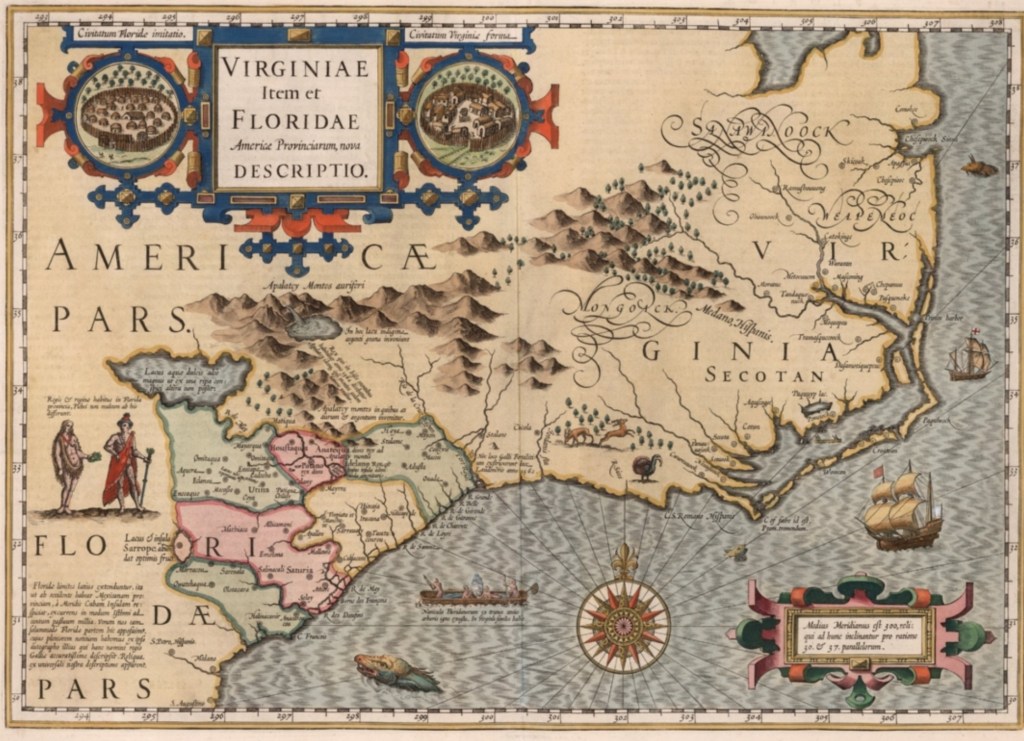
Virginiae Item et Floridae Americae Provinciarum, nova Descriptio. Map by Gerard Mercator (1512–1594), Jodocus Hondius (1563–1612), and Hendrik Hondius (1597–1651). Published in 1623 by Hendricus Hondius, Amsterdam. Image courtesy of the David Rumsey Map Collection, David Rumsey Map Center, Stanford Libraries. Licensed under Creative Commons CC BY-NC-SA 3.0.
Raised within the Romano-Byzantine tradition—formed by both the Roman and Byzantine Catholic rites—I was shaped by a confluence of liturgical beauty, theological depth, and mystical reverence. From that upbringing, there remains not merely memory, but a lasting affection for the rhythm and substance of the faith of my youth. It is not simply a cultural inheritance, but a formative lens through which the sacred, the communal, and the mysterious first revealed themselves. Yet, it would not be accurate to describe my present stance as that of a lapsed Catholic, nor as an atheist, nor as one alienated from the Church. Alienation implies disaffection or estrangement born of expectation unmet or betrayal suffered. What remains is neither rejection nor rebellion, but something quieter and more reflective—a posture of reverent detachment that neither clings nor condemns.
Any attempt to articulate my position must begin by acknowledging the futility of articulation itself—at least in matters concerning the Divine. The belief that the Divine wholly exceeds the bounds of human comprehension and articulation grows only firmer over time. All creeds, revelations, and theological systems—however earnest or inspired—are, in the end, efforts to sketch with a cramped human lexicon and limited imagination that which lies beyond even the highest powers of conception. Far from illuminating the Divine, such efforts only obscure its immensity by imposing upon it our narrow symbols and forms.
Better to liken our theological endeavors to the drawing of maps—maps sketched by explorers who had never seen the coasts they sought to chart. Just as early cartographers filled the margins with dragons, saints, and imagined cities, we adorn the unknown with creeds, cosmologies, and commandments. These are sincere efforts, yet they more often reflect our hopes and fears than reveal any transcendent truth. The more intricate the system, the more seductive the illusion that the map is the territory. But the Divine is not a line upon a page. It is the sea beneath the sea monster, the silence beyond the compass rose, the continent whose very existence remains unknown. To name the Divine is already to misname it; to describe is to distort.
Such a perspective finds its truest expression in apophatic mysticism—the via negativa, the way of negation—a tradition articulated by Pseudo-Dionysius the Areopagite, a Christian thinker of the late fifth to early sixth century whose writings permeate the Catholic tradition through the works of Thomas Aquinas, Bonaventure, and the Spanish mystics, reminding us that the path of unknowing is not a break from faith, but one of its most ancient and revered expressions. In this light, God is not wise, not good, not just, not loving—not because the Divine lacks these qualities, but because our highest notions of them remain shadows cast by a light we cannot behold. Whatever we say of the Divine, however conceived, the most faithful statement is this: our words fall short.
Even so, human beings remain kataphatic creatures as well—creatures who long to speak, to name, to worship, to relate. Thus arises a kataphatic-apophatic tension, a profound and permanent unease between the impulse to speak of the Divine and the recognition that all speech fails. Hymns, liturgies, cathedrals, and doctrines are all human responses to this tension—not to capture the Divine, but to reach toward it, however falteringly. These gestures deserve neither scorn nor uncritical assent. They should be honored, but held lightly, cherished as poems rather than mistaken for proofs.
This tension extends beyond the realm of theology into the very nature of being itself. In a moment of quiet reflection, I found myself asking: “Where is Am I?”—caught between breath and thought, a question turning circles in the hollow of my chest. Am I the echo, or the voice that trembles back? A fragment drifting through the hour, a flicker in the endless light, unsure if I was ever whole or if the pieces were ever mine to find. Such a question is not mere existential uncertainty, but a recognition that the self, like the Divine, eludes definitive capture.
No formal creed or written revelation authored by man commands my assent, however noble or inspired it may be. Faith is not placed in these constructions, though the sacred yearning from which they arise is deeply respected. They are echoes of an original voice no longer heard directly, outlines of a presence glimpsed but never grasped. Like the adornments on ancient maps, these expressions are beautiful and sincere, but they are not to be mistaken for the thing itself.
To some, this may resemble agnosticism, though that word has become burdened with meanings it was never intended to carry—meanings of indecision, skepticism, or apathy. What is expressed here is none of those. It is not a shrug of the shoulders, but a bow of the head. Not the silence of the indifferent, but of the reverent. Not ignorance, but a conscious unknowing—a sacred refusal to impose limitation upon that which exceeds all bounds. This is why I eschew agnostic labels in favor of mystical ones—for the mystic does not claim ignorance of the Divine but acknowledges that true knowledge of it transcends conventional understanding.
What remains, then, is a life lived in contemplation of the ineffable—a contemplation that finds expression through creative work. In poetry, music, and essay, I reach toward that which cannot be directly named. When I write of the “eternal now” where “yesterday, tomorrow, and today collapse,” or compose lyrics that honor Humilitatem Initium Sapientiae, I am not merely creating art but engaging in a form of contemplative practice. These creative acts serve as bridges, not only between myself and the ineffable, but also between myself and others who share this reverent space, regardless of their formal religious affiliations or φιλοσοφίαι (philosophies or wisdom traditions).
The path ahead is not marked by certainty but by awe, not by declarations but by listening. Mystery is not something to be solved, but something to be honored. Years of formal study—first in history and religious studies as an undergraduate, then as a teacher of both subjects, and later through a long career in civil rights law and public service—have only deepened the awareness that human systems, whether intellectual, doctrinal, or legal, ultimately encounter their limits at the threshold of the sacred. In this, the apophatic tradition offers a spiritual home—a dwelling place where reverence begins precisely where language ends. If there is a guiding light for such a path, it is humility—humilitatem initium sapientiae—not merely as a moral posture, but as a metaphysical necessity. That teaching, which echoes throughout Thomas à Kempis’ The Imitation of Christ, remains not only a personal motto, but a settled conviction: that wisdom begins when one ceases to pretend to possess it.
Near the staircase in my front hallway hangs an early map of the New World—an artifact I have long cherished. Its artistry is matched only by its courage, for it dares to depict what was not yet known. Near the region now recognized as Virginia and the Carolinas, a sea monster rises from the ocean’s depths, signaling peril or wonder—perhaps both. On the land itself, figures of “natives” stand, imagined by a hand that never walked those coasts. That map does not record the world; it records what the world dared to imagine. So, too, do our theologies populate the margins of metaphysical uncertainty with monsters and angels, commandments and visions. They are imaginative acts—sincere, flawed, luminous. And like that map, they are to be cherished not for their precision but for what they reveal of the human longing to reach into mystery with word and symbol, with ink and awe. In their earnest striving, they remind us: we are always sketching the edge of the unknown, even when we know we cannot cross it.