A skipping stone, chosen with care by human hand, breaks the still glass of lake serene; for stones remember what time forgets, and in their flight, recall all the more.
What does it remember? The molten cradle of its birth beneath the sea, the mountain’s shattering rise from the deep, the patient sleep in riverbed and shore. The warmth of the palm that cast it forth, the whisper of air between each skip— and how, in falling, it becomes again what it has always been: stillness beneath all motion.
The em dash—now ever present in my writing—was, for the better part of my life, a non-entity. For several obvious reasons.
First, though it may have appeared in my handwritten script, I scarcely distinguished it from an ordinary dash or hyphen; the length of line between words was inconsequential in my already indecipherable and increasingly illegible hand. In truth, I long remained unaware of its proper name, or of the distinctions of nomenclature that punctuation ascribes to the several lengths of line between words.
Second, my earliest years of composition were spent at the typewriter. There, whether composing at the typewriter or transcribing handwritten script at the typewriter for submission and review, I knew only the dash—or the double dash—a generally unattractive contrivance, with space-dash-space between words when some pause seemed warranted. Better, I thought, a semicolon, a colon, or perhaps parenthetical for the offset thought.
And then came my first decades at the computer, where a stilted admixture of bureaucratic and legalistic form constrained me: such mandated style allowed no room for such expressive gestures. The dash—any dash—was a rarity in the acceptable prose of the office.
But in retirement, in the rediscovery of prose and poetry and possibility, I learned how easily the ungainly dash could be replaced by its elegant cousin—the em dash. And so I was converted: from endless parentheticals, unsightly space-dash-space, and other intrusive devices, to this versatile and dashing stroke. Poets and novelists know its power—and so, it seems, to the consternation of creative writers everywhere, does artificial intelligence.
Nabataean temple ruins at Khirbet et-Tannur, Jordan. The temple may have been dedicated to the goddess Atargatis (see McKenzie et al. 2002; Almasri 2019).
When the Rains Come
When the rains come … the dust shall become mud, When the rains come … the mud shall become mire, And the feet of the proud shall sink to the ankle, And their words shall cling like clay to their tongues.
When the rains come … the roofs shall tremble, The cisterns shall overflow their stone mouths, And the low places shall remember the sea, Calling out to the deep from which they were torn.
When the rains come … the idols shall dim, Their painted eyes veiled in silt and silence, And the temples shall weep through broken eaves, For their gods shall not answer from the thunder.
When the rains come … the earth shall be heavy, And the hearts of men heavier still; The widow shall draw her shawl to her face, And the child shall forget the taste of dry bread.
When the rains come … we shall huddle together, Beholding the waters erase our names from the doorposts, And none shall boast of his harvest, For the river shall take what it wills, Bearing all things toward the forgetting sea.
When the Sun Is Restored
When the sun is restored … the waters shall fade, When the sun is restored … the mire shall break and sigh, And the earth shall stir beneath the plough, Breathing again as if reborn.
When the sun is restored … warmth shall come first, A balm to the chilled and the shivering earth; Green shall rise from the broken furrows, And the people shall bless the light.
When the sun is restored … the fields shall swell, The ears grow heavy, the vines bend low; And laughter shall echo in the threshing floor, Till the grain lies fuller than the granaries can hold.
And in the noonday brightness the sparrows fell silent, For they knew the hour would not endure.
When the sun is restored … the rivers shall dwindle, The soil yawn open like a parched mouth, And famine shall creep from the roots of plenty, Taking the firstborn of abundance.
When the sun is restored … the hearts of men shall fail, Their tongues cleaving to the roofs of their mouths; And the widow shall weep no longer, For her tears have been taken by the wind.
When the sun is restored … we shall gather at the well, Staring into its empty throat, And all shall return to dust, For from dust were we raised, and to dust we descend; And we lift parched hands, as if exalting to heaven for rain, That the circle may begin again.
When the Silence Falls
When the silence falls … the people shall gather, Not in joy nor mourning, but in stillness; And the priests shall stand before the altar, Their hands empty of offerings.
When the silence falls … the incense shall not rise, For no prayer shall remain upon our lips; We have cried out in the rains and cursed in the drought, And now we have no words to give.
When the silence falls … the children shall ask, “Why do we come to this place?” And the elders shall have no answer, For the stones themselves have forgotten their purpose.
When the silence falls … the priests shall look upon each other, And see their own faces as through water; They shall remember the prayers they learned as boys, And wonder if the words were ever heard.
When the silence falls … we shall see what we have built— Altars worn smooth by our hands, Bowls that held grain and oil and blood, All the bargaining of our fathers with the sky.
When the silence falls … no voice shall descend, Neither blessing nor judgment from above; And we shall know that we stand alone, Between the rain we fear and the sun we cannot bear, Waiting in the house we made for a goddess Who has not spoken in living memory.
Amor, che ‘ncende il cor d’ardente zelo, di gelata paura il tèn constretto, et qual sia più, fa dubbio a l’intelletto, la speranza o ‘l temor, la fiamma o ‘l gielo.
Love that lights ardent zeal in the heart, constrains it also with an icy fear, and leaves the mind uncertain which is greater, the hope or the fear, the flame or the frost. — Francesco Petrarca, Canzoniere 182
I. The Divided Heart
Few poets have so perfectly distilled the contradictory essence of love as Petrarch. In four lines, he sets the human heart ablaze and in the same breath subdues it with frost. Love, that “ardent zeal,” becomes inseparable from the chill of fear; the intellect, summoned to arbitrate between hope and terror, finds itself immobilized in doubt. The flame illuminates even as it freezes.
The quatrain serves not merely as an emblem of courtly love but as a mirror of the reflective soul—the soul that, once conscious of its passion, cannot help but analyze it. Every act of self-awareness introduces distance; every act of comprehension tempers immediacy. To understand what one feels is already to stand outside the feeling. Thus, the Petrarchan heart is forever divided: inflamed by emotion, yet cooled by the very intellect that seeks to grasp it.
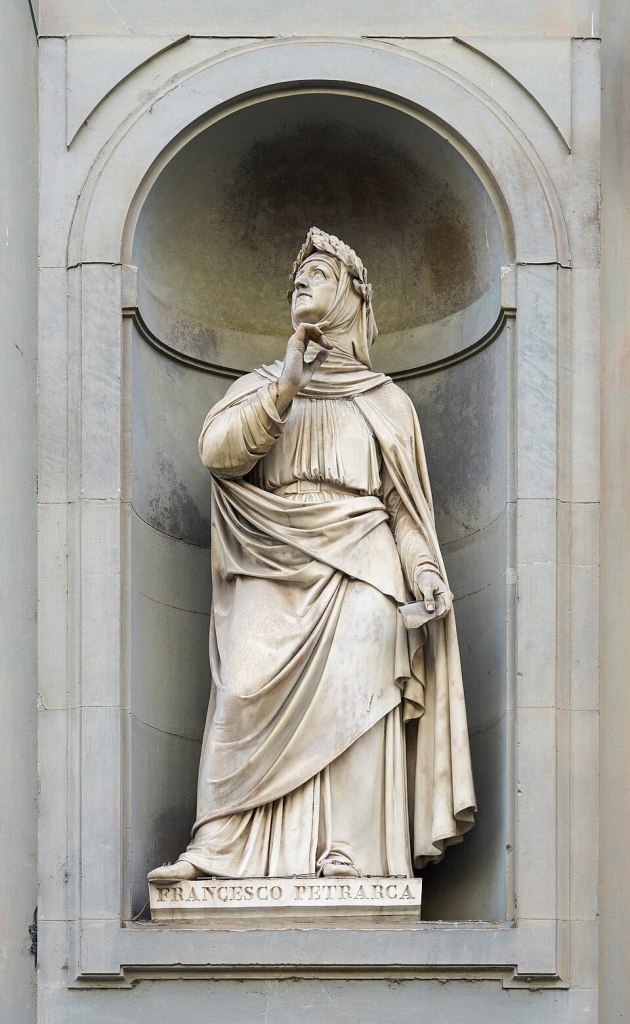
Statue of Petrarch on the Uffizi Palace, in Florence
II. Petrarch’s Paradox—Flame and Frost
In Canzoniere 182, Amore is no mere sentiment but a force of cosmic ambivalence—a sacred fire that binds as much as it liberates. The heart, seized by ardente zelo, is at once inspired and constrained by gelata paura; passion and dread are inseparable twins. But what gives the poem its enduring power is the final turn: fa dubbio a l’intelletto—it makes the intellect uncertain.
This uncertainty is not simple indecision; it is the very mechanism by which passion becomes reflection. The lover’s flame, examined, begins to cool—and that cooling assumes distinct forms.
First, love cools by comprehension. The instant it is understood, passion becomes object rather than subject. The flame is enclosed in glass: it still glows, but it no longer burns.
Second, love cools by doubt of itself. Reflection turns inward, questioning its own authenticity: Is this love true, or merely imagined? In this moment, feeling erodes under the acid of self-consciousness.
Third, love cools by doubt of the beloved. The intellect, unable to sustain idealization, wonders whether the object of devotion merits such intensity. The beloved becomes an emblem—not a person of flesh and breath, but a mirror of perfection that no reality can equal.
Fourth, love cools by doubt of the lover’s worthiness. The heart fears it is unworthy of its own longing. Humility becomes paralysis, and passion folds inward upon itself.
These four modes of cooling form the architecture of Petrarch’s inner world—the endless oscillation between fervor and fear, adoration and self-doubt. He writes not to resolve this tension but to dwell within it. Each sonnet is a chamber where flame and frost coexist, where thought is both confessor and executioner of feeling.
III. Dante and the Alchemy of the Intellect
Dante offers a luminous counterpoint. In La Vita Nuova and the Paradiso, intellect and love are not adversaries but allies; the mind becomes the means by which love ascends. L’amor che move il sole e l’altre stelle—the love that moves the sun and the other stars—does not cool but sanctifies. In Dante, the intellect transforms passion into vision—the earthly beloved into divine wisdom. The flame does not die; it becomes light.
Consider the climactic moment of Paradiso XXXIII, where Dante’s vision finally encompasses the divine mystery. His intellect, far from diminishing his love, becomes the very instrument of its perfection. He describes how his desire and will are turned like a wheel by the love that moves the sun and the other stars. Here, understanding completes rather than constrains. The mind does not freeze the heart; it liberates it into comprehension of the Eternal. Beatrice herself, who began as an earthly beloved, becomes through the intellect’s mediation a guide to the Beatific Vision. Her smile, growing ever brighter as they ascend through the spheres of Paradise, finally becomes too radiant for mortal sight—not because love has cooled, but because it has been refined into pure illumination.
Petrarch inherits Dante’s vocabulary but not his cosmos. His world is one step further from heaven, one degree cooler. Where Dante’s intellect completes love by raising it to the eternal, Petrarch’s intellect contains it, interrogates it, doubts it. He lives in the afterglow of revelation—the warmth still present, but the fire withdrawn. As the Paradiso closes, Dante’s vision resolves into the final harmony of understanding and desire—l’amor che move il sole e l’altre stelle—the line that unites intellect and love in a single act of divine motion. Petrarch cannot reach this synthesis. His flame flickers in the middle distance, neither extinguished nor transcendent.
IV. The Modern Inheritance—Reflection and Alienation
From Petrarch descends the long lineage of reflective melancholy that characterizes the modern mind. His was the first great experiment in self-conscious passion—the attempt to inhabit feeling and analyze it at once. After him, love and thought could no longer coexist in innocence; the very act of awareness altered the nature of what was felt.
Montaigne and the Essay of the Self
Montaigne inherits this disposition and turns it into method. In his Essais, feeling is no longer confessed in the lyric key but dissected in the prose of observation. The heart becomes a field for inquiry, and what was once sung becomes tested, weighed, compared. It is telling that Montaigne quotes Petrarch approvingly: “He who can say how he burns with love, has little fire.” (Chi può dir com’ egli arde, è in picciol fuoco, Canzoniere 137). The aphorism might well serve as Montaigne’s motto, for he, too, knows that passion explained is passion already cooling.
His genial skepticism marks the first full tempering of Petrarch’s flame: affection survives, but only as reflection. The essay replaces the sonnet as the vessel of interior life; emotion, distilled into thought, becomes the study of itself. In Montaigne, we see the completion of a transformation begun in Petrarch—the lover becomes the anatomist of his own heart, and the page becomes not a transcript of feeling but a laboratory for its examination. The warmth of passion is not extinguished but transmuted into the steady light of self-knowledge.
Wordsworth and Emotion Recollected
Wordsworth, centuries later, restores emotion to poetry, yet only by containing it within the frame of recollection. His famous dictum—”emotion recollected in tranquillity”—is itself a Petrarchan paradox, though less tormented. He admits that to write of passion is to have already survived it. The poet stands at a contemplative distance from his own fervor, translating immediacy into memory, fire into afterglow. What once consumed now instructs.
In the Prelude (XII), Wordsworth describes the “spots of time” that preserve the intensity of past experience, yet the very act of preservation requires temporal remove. The flame of immediate experience has cooled into the steady glow of retrospective understanding. Wordsworth does not lament this cooling as loss; rather, he discovers in it a new kind of beauty—the beauty of consciousness reflecting upon its own depths.
Eliot and the Fragments of Feeling
By the time we reach T.S. Eliot, the process is complete. In The Waste Land, the flame is nearly ash. His lines of “memory and desire” register not passion itself but its echo—reverberations in a chamber long since emptied of direct experience. Emotion is mediated through quotation, irony, and allusion; the self no longer speaks but curates its fragments.
Consider the hyacinth girl passage, where memory itself fails to sustain emotion: “I could not / Speak, and my eyes failed, I was neither / Living nor dead, and I knew nothing.” The speaker recalls a moment that should have been transcendent—arms full of flowers, hair wet—but the recollection brings only paralysis, a kind of death-in-life. Even memory cannot resurrect the feeling; it can only gesture toward its absence. The modern condition is not the absence of feeling but its overexposure, its reduction to artifact. The poem becomes the museum of emotion, its vitrines polished and sterile. Where Petrarch’s flame still flickered with real heat, and Wordsworth’s embers still glowed warm, Eliot presents us with the cold remains—fragments shored against ruins. Where Petrarch doubts his own worthiness to feel, Eliot doubts feeling itself. The circle has closed; intellect now governs even absence.
The Progressive Abstraction
Between Montaigne’s self-observation, Wordsworth’s recollected emotion, and Eliot’s fractured memory, one can trace the progressive abstraction of the human heart. Each represents a further remove from Petrarch’s immediacy: what began as a dialogue between love and intellect becomes a monologue of intellect about love. The warmth remains, but it is remembered warmth—the lingering heat of stones long after the fire has gone out.
And yet, in each of these figures, the Petrarchan spark persists. Montaigne’s curiosity, Wordsworth’s reverence for inward life, Eliot’s yearning for spiritual coherence—all descend from that first poet who dared to make consciousness itself his subject. The flame may cool, but its light passes on, refracted through centuries of minds still haunted by the desire to feel purely and the impossibility of doing so once thought begins.
V. The Cooling of the Flame—A Personal Reflection
It is impossible, for some temperaments, to escape this inheritance. Emotion arises, and almost immediately the mind begins to interpret it—weighing, contextualizing, seeking its meaning. In doing so, it drains the warmth from the moment even as it preserves it in memory.
To intellectualize emotion is to betray and to honor it at once. The betrayal lies in the loss of immediacy; the honor lies in the act of remembrance. What the heart cannot sustain, the mind attempts to eternalize. The flame cools into an image—but in that cooling, it endures.
Perhaps the intellect is not the enemy of passion but its afterlife. Every poem, every meditation, every recollection is a small resurrection of a feeling that once burned uncontrollably. The fire itself is gone, but its light remains, steady now, capable of illuminating others.
This is the paradox Petrarch teaches: that the lover who cannot stop thinking destroys the ecstasy of love but gains, in its place, the wisdom of love. To understand one’s passion is to lose it; yet without understanding, it would pass unnoticed, leaving no trace but ashes.
VI. The Light of the Ashes
Petrarch’s quatrain ends in uncertainty, but not in despair. His is not the extinguished flame, but the tempered one. Love and fear, hope and doubt, flame and frost—these are not enemies but necessary contraries. The human soul, poised between ardor and intellect, must learn to bear the tension rather than resolve it.
In the end, intellect does not annihilate feeling; it refines it. The cooled flame still gives light. That light—pale but enduring—is the radiance of thought born from passion, the steady glow of what once burned brightly.
We live by such embers. To love is to burn; to remember is to cool; to think is to preserve. Between these three acts, the heart makes its pilgrimage from fire to frost to flame again—each transformation both loss and grace.
THOMAS COUTURE – Los Romanos de la Decadencia (Museo de Orsay, 1847)
“Est igitur, inquit Africanus, res publica res populi; populus autem non omnis hominum coetus quoquo modo congregatus, sed coetus multitudinis iuris consensu et utilitatis communione sociatus.”
“Well, then, a commonwealth is the property of a people. But a people is not any collection of human beings brought together in any sort of way, but an assemblage of people in large numbers associated in an agreement with respect to justice and a partnership for the common good.”
— Cicero, De Re Publica I.xxv (39), trans. Clinton W. Keyes-Marcus Tullius Cicero, De Re Publica
The Romans named the commonwealth theres publica—the public thing. Ours has become theres mercatoria—the mercantile thing.
I. Form Without Spirit
Republics seldom die by sword or decree. They decay in silence—eroding first in spirit, then in habit, until only the forms remain. The flag still waves, oaths are still sworn, the Capitol dome still gleams in the sun. Yet beneath that marble permanence lies a slow petrification of the civic soul.
Cicero defined the res publica as “the property of the people”—a common good bound by shared agreement on law and justice. But when the people cease to agree on what law means, or what justice demands, the Republic endures only as silhouette. Its forms persist out of inertia, its substance preserved only in ritual memory.
We have reached that stage of endurance. The Republic survives, but uninhabited. Its spirit has withdrawn, its voice replaced by noise.
II. The Market’s Triumph Over the Polis
The hollowing began not in our politics but in our economy. The citizen was slowly replaced by the consumer; civic virtue yielded to commercial appetite.
This transformation did not occur by chance. It was conceived in the classrooms of Vienna and Chicago, where Friedrich Hayek and Milton Friedman re-imagined freedom itself as a function of the market. Their disciples translated this theory into policy through Ronald Reagan and their obedient acolytes, who proclaimed that government was the problem and private enterprise the measure of liberty.
The revolution was cultural as much as economic. In 1971, Lewis Powell—soon to be a Supreme Court Justice—sent a confidential memorandum to the U.S. Chamber of Commerce warning that American business faced an existential threat from critics of capitalism. His solution: a coordinated campaign to capture the institutions that shape public opinion—universities, media, courts, and legislatures. The result was a new institutional order: the Business Roundtable, the Heritage Foundation, the Cato Institute, and a constellation of think tanks and lobbying arms that would spend decades re-educating the political class in the gospel of deregulation, privatization, and permanent growth.
By the 1980s this ideology had become orthodoxy. The social compact that once bound liberty to responsibility was rewritten so that profit alone defined the good. The public good became whatever advanced shareholder value and citizenship became an economic function.
Thus the res publica—the public thing—was supplanted by the res mercatoria—the mercantile thing. The Romans had no such term, for they could not imagine a world in which commerce would claim sovereignty over the commonwealth. But the new condition requires a new name.
The irony of this transformation is ancient and bitter. For most of Christian history, the merchant stood outside the moral order—necessary, perhaps, but suspect. The early Church Fathers—Ambrose, Tertullian, Leo the Great—condemned merchants outright, inheriting from Plato (Republic) and Aristotle (Politics Book VII, Ch. IX, 1328b-1329a) the conviction that trade was ignoble and inimical to virtue. By the Middle Ages, this judgment had softened but not disappeared. Augustine warned extensively against avarice, that “uncleanness of heart” which weighed down the soul and bound it to perishing things (Sermon 177). Aquinas, centuries later, distinguished carefully: exchange for necessity was commendable, but trading for profit was “justly deserving of blame, because, considered in itself, it satisfies the greed for gain, which knows no limit and tends to infinity” (Summa Theologiae II-II, Q. 77, Art. 4). Such trading, he wrote, had “a certain debasement attaching thereto”—it engaged the mind too much with worldly cares and withdrew it from spiritual ones (Summa Theologiae II-II, Q. 77, Art. 4). Wealth was a burden to be borne, not a sign of virtue. The Gospels themselves spoke plainly: it is easier for a camel to pass through the eye of a needle than for a rich man to enter the kingdom of heaven (Matthew 19:24).
The Reformation reversed this judgment. Labor became a vocation, profit a sign of election, diligence and thrift the new sacraments of grace. The theological architecture of this reversal is visible in Calvin’s 1545 Letter on Usury, which systematically dismantled thirteen centuries of prohibition. Calvin reinterpreted Luke 6:35—”lend, expecting nothing in return”—as a call to charity toward the poor, not a ban on commercial lending. He dismissed Aquinas’s argument that money was sterile and consumed in its use as “too frivolous” and “childish,” insisting instead that money, like land, could legitimately generate return through productive employment. Most decisively, Calvin divorced usury from property rights and natural law, relocating its ethics in “equity” and “mutual benefit”—a standard flexible enough to bless commerce while condemning exploitation. Yet even Calvin betrayed unease: “it would be good to desire that usurers were expelled from the entire world,” he wrote, before immediately adding, “but since that is impossible we must submit to a common utility.” The tension was never resolved; it was merely buried beneath the momentum of markets.
What Max Weber would later identify as “the Protestant ethic” emerged: the doctrine of predestination created psychological need for visible signs of election, and worldly success became such a sign. Labor was no longer penance but calling; profit no longer suspect but evidence of grace rightly used. The Puritan divine Richard Baxter made this explicit: “If God shew you a way in which you may lawfully get more than in another way, (without wrong to your soul, or to any other) if you refuse this, and choose the less gainful way, you cross one of the ends of your Calling, and you refuse to be Gods Steward, and to accept his gifts, and use them for him when he requireth it” (Christian Directory, 1673).
In America, this theology found its most radical expression: a nation that declared itself divinely ordained to prosper, its wealth evidence of providence rather than plunder. The monastery yielded to the countinghouse, the community of faith to the individual of conscience; and the Temple to the money-lenders’ tables. The merchant was redeemed and enthroned, and the marketplace declared holy ground. Yet in this sanctification lay the seed of perversion. What had been a warning against excess became a theology of excess; what had been humility became self-justification. The camel, still unable to traverse the eye of the needle, now claims the needle has widened to accommodate its girth. Thus, through inversion disguised as progress, the old economy of salvation became the new salvation of economy.
Interlude: The Shining Hill and the Idol of Gold
Perhaps this explains the American paradox: the Republic imagined itself a shining city on a hill, a light unto nations. Yet what if that light was never the flame of civic virtue but the glitter of commerce—the reflected gleam of Mammon’s altar? The founders spoke of liberty, but liberty yoked to profit soon ceases to be freedom and becomes appetite enthroned. The idol of gold, once condemned by prophets, now governs the temples of exchange. Thus the Republic mistook the radiance of avarice for the light of grace, and called its marketplace a sanctuary.
If Mammon once ruled the countinghouse, he now reigns through the circuit and the screen.
III. The Digital Usurpation
If the market stripped the Republic of its moral substance, technology has stripped it of its perceptual one. The Internet, once envisioned as a global commons, has been enclosed by a handful of private empires: Meta, Alphabet, Amazon, Apple, and X.
These companies now mediate nearly every act of citizenship—our speech, assembly, education, even our perception of truth. They claim to connect the world, yet in practice divide it into markets of attention and identity.
Their infrastructures are not neutral. Algorithms decide what can be seen, heard, and believed. Platforms that once promised dialogue now amplify division because outrage is more profitable than understanding. Truth has been outcompeted by virality.
Consider the architecture of a Facebook feed. It does not present information chronologically or randomly, but according to a hidden formula designed to maximize “engagement”—a euphemism for time spent, which translates to advertising revenue. Posts that trigger anger, fear, or tribal affirmation rise to the top; nuance sinks. The algorithm knows no truth, only metrics of return. The result is a kind of epistemic Darwinism in which the most emotionally inflammatory content survives and the most thoughtful perishes unseen.
This is not a bug but the business model. The platform does not sell connection; it sells attention. And attention, in this economy, is harvested through the deliberate fragmentation of shared reality.
What Orwell feared as censorship has become something subtler: curation. The public square has been replaced by the private feed. We are no longer silenced—we are distracted. And distraction, as the tyrants of old never mastered, is the most perfect instrument of control.
IV. The Propaganda Apparatus
Every empire needs its heralds. In the modern order, propaganda no longer marches beneath banners; it wears the costume of journalism.
The Murdoch media empire—Fox News, The Wall Street Journal’s editorial arm, The New York Post, The Times and The Sun in Britain, Sky News in Australia—has perfected this form of propaganda as entertainment. It does not so much persuade as condition.
By flooding the public square with grievance, spectacle, and especially fear, it transforms political life into perpetual theater. Its message is not ideology but emotion: outrage as identity, resentment as belonging. The goal is not to convince the citizen, but to exhaust him—to make deliberation impossible by ensuring that no common truth remains to deliberate about.
The method is simpler than it appears: repeat the lie, normalize the outrage, monetize the attention. Truth becomes just another narrative competing for airtime—and in that competition, truth is structurally disadvantaged. It cannot offer the satisfactions of tribal belonging that propaganda provides. Thus the empire does not need to censor; it merely drowns signal in noise until citizens, exhausted by the effort of discernment, surrender their capacity for judgment altogether.
The old tyrannies burned books; this one drowns them in noise.
V. The Corporations as Princes
It is no longer sufficient to speak in abstractions. The hollowing of the Republic has addresses, headquarters, and quarterly reports.
Sphere of Life
De Facto Sovereign
Instrument of Power
Speech & Assembly
Meta, X, Alphabet
Algorithmic reach, moderation, shadow banning
Commerce & Supply
Amazon, Apple
Infrastructure, logistics, payments
Knowledge & Memory
Google, OpenAI
Indexing, generation, curation of information
Currency & Capital
BlackRock, Vanguard, JPMorgan
Financial concentration, policy leverage
Imagination & Desire
Disney, Netflix, TikTok
Narrative control, aesthetic conditioning
News & Ideology
Fox News / News Corp
Manufactured outrage, narrative distortion
These are not metaphorical princes. They set policy without election, levy fees without representation, and administer justice without appeal—the very acts that once defined sovereignty.
Together they form what might be called The Architecture of Dominion: a network of powers that administer daily life more effectively than any elected government, yet without transparency, consent, or accountability.
VI. The Capture of the Political Class
The final conquest of the Republic occurred when its political machinery was wholly absorbed by the same forces that had already claimed its markets, media, and imagination.
The 2010 Supreme Court decision in Citizens United v. Federal Election Commission declared that corporations possess a First Amendment right to spend unlimited sums to influence elections. With that ruling, the barrier between wealth and sovereignty collapsed. Money became speech, and therefore power.
In the years that followed, the American two-party system—already in steady decline as a functional mechanism of representation—was captured outright by oligarchic interests. Campaigns became open auctions, legislators became bought investments, and policies became returns on capital. The parties now differ chiefly in the rhetoric by which they justify serving the same donors.
This demolished the Republic’s ancient defense against oligarchy: the principle that political power derives from citizenship, not property. The legal fiction that corporations are persons—a doctrine conjured by nineteenth-century courts without constitutional warrant—had long troubled the boundary between civic and commercial power. But by extending this extra-constitutional invention to include nearly unlimited political spending, and by declaring money itself to be speech, the Court completed a transformation built not on constitutional text but on judicial fiat. The voices of oligarchs and corporations alike could now be amplified a thousandfold, a millionfold, beyond those of ordinary citizens. When one man’s wealth can purchase more speech than a million voters combined, citizenship ceases to be a meaningful source of political power. What had been a legal convenience became a political weapon—the final triumph of cash over voice, of property over person, of the res mercatoria over the res publica.
This was the Republic’s silent coup. What had once been government of the people became government for the shareholders. The Republic remains as ritual; oligarchy rules in fact.
VII. The Cultural Surrender
While these structures were forming, the culture itself underwent a moral inversion. The intellectual skepticism of the twentieth century—postmodernism’s denial of objective truth—escaped the universities and entered the bloodstream of public discourse.
What began as critique of power became the abdication of reason. Truth was replaced by “personal narrative,” knowledge by “perspective,” and moral judgment by performative empathy. The result is not liberation but solipsism: each of us sovereign within our own unverifiable reality.
Hannah Arendt understood that totalitarianism does not begin with the camps but with the collapse of common worldliness—the destruction of the shared reality that binds men together. She called it organized loneliness: a condition in which individuals, isolated yet interconnected, are governed by narratives they no longer believe but cannot escape. It is the perfect soil for manipulation, for in such loneliness the appetite for belonging overwhelms the duty of thought. The algorithm merely perfected what ideology began: it manufactures isolation and then monetizes the yearning to escape it.
This is the perfect cultural soil for the new oligarchies. For when truth dissolves, authority no longer needs to justify itself—it merely needs to define what truth is today. The relativist becomes the authoritarian’s unwitting ally.
Thus language itself has been weaponized. Freedom means security; dissent becomes hate; lies become “alternative facts.” The corruption of meaning precedes the corruption of law, and the res publica fades from speech before it vanishes from life.
VIII. The Retreat of Education and Virtue
At the heart of every Republic lies paideia—the education of the soul toward wisdom and citizenship. We have replaced it with credentialing and metrics, with the pursuit of “outcomes” rather than understanding.
This transformation, too, bears a lineage. Milton Friedman’s 1955 essay, The Role of Government in Education, proposed the idea of school vouchers as a mechanism for privatization under the guise of parental choice. It took root during the backlash to desegregation in the 1960s and matured in the 1980s and 1990s as “school choice” and “charter reform.” Education was recast as a competitive market rather than a civic institution.
The language of civic formation gave way to the rhetoric of productivity. The so-called “education crisis” of the 1980s culminated in A Nation at Risk (1983), which declared that public schools were failing to serve the economy. From that moment, economic utility supplanted intellectual cultivation as the standard of success. The humanities—once the Republic’s nursery of conscience—were defunded, mocked as impractical, or harnessed to “skills-based learning.”
In higher education, the same logic prevailed. University boards filled with corporate executives who treat knowledge as a commodity and students as clients. The algorithm now decides who is admitted, how teaching is evaluated, and which disciplines survive. The classroom itself has become a data laboratory: outcomes tracked, performance engineered, curiosity quantified—education reduced to the management of metrics rather than the cultivation of mind.
A high-school English teacher is evaluated not by her students’ capacity for insight but by “value-added metrics” derived from standardized test scores—metrics that reduce King Lear to a datapoint in a district’s performance dashboard. A university professor knows that thoughtful, difficult texts will harm her evaluation scores, and that those scores will determine her career. The algorithm optimizes for satisfaction, not formation; for comfort, not growth. Thus the institutional incentive is to teach what pleases, not what challenges—to produce consumers of education rather than citizens capable of self-governance.
Washington, in his Farewell Address (1796), warned that morality and religion were the “indispensable supports” of political prosperity. Adams wrote in an October 1798 letter that the Constitution was made for a moral and religious people, and was inadequate to govern any other. We have tested that hypothesis—and proved them right.
IX. The Political Consequence: Empty Institutions
What remains of politics is theater. Legislatures deliberate for the camera; executives govern by fiat; courts arbitrate between corporate interests. Public authority survives as ceremony, while real power migrates to the unelected oligarchs: the financial houses, the data lords, the platform barons, and the propaganda merchants.
The façade of republican government still stands, but within it resides an empire of bureaucracy and capital—not the civil service devoted to civic stewardship, but the corporate bureaucracy of extraction and surveillance. The old tyrants ruled through fear; the new through dependency. The oath of allegiance has been replaced by the click of “I agree.”
We live under what Sheldon Wolin called inverted totalitarianism—a system in which corporate and governmental power fuse seamlessly while citizens, intoxicated by consumption and misled by propaganda, mistake submission for freedom.
X. The Present Condition: The Hollowing Complete
Consider the life now administered by algorithm: a gig worker’s income depends on maintaining a five-star rating from customers who can destroy his livelihood with a single click—customers who are themselves strangers with no accountability for the judgment they render. A young professional’s romantic prospects are curated by an app that reduces human beings to swipeable commodities, optimizing not for companionship but for the addictive dopamine loop that keeps users returning. A family’s access to housing hinges on a credit score calculated by a private company using undisclosed factors—a score that can deny them a home without explanation or appeal.
This is governance without government, sovereignty without accountability. We have comfort, but not character; connection, but not community; information, but not understanding. The Republic’s architecture remains, yet the light that once filled it—the shared moral imagination of a free people—has gone out.
This is not collapse but inversion: the Republic turned inside out, liberty administered by those who profit from dependence. The Republic endures as interface, its promise reduced to user experience, its citizens reborn as users—forever clicking “I agree.”
XI. Memory as Resistance
And yet, memory remains—the one province not yet colonized. Memory is the Republic’s last frontier: the remembrance that truth exists, that words have meaning, that citizenship is not consumption but conscience.
To remember rightly is to resist silently. For the memory of the Republic is not nostalgia but defiance: the assertion that what once was good need not remain lost.
Yet remembrance need not remain abstract; it begins in quiet acts of fidelity. The decision to read a book rather than scroll a feed. The choice to speak in full sentences rather than in slogans. The cultivation of attention in an economy designed to fragment it. The insistence that words still mean what they have always meant—that truth is not “my truth,” that justice is not self-interest dressed in virtue’s language, that freedom is not the absence of constraint but the capacity for self-government.
These are not grand gestures. They are the quiet practices by which a republic is inhabited rather than merely remembered. And from such practices, carried out by enough citizens in enough places, the Republic becomes possible again.
Within the small fidelities of teachers who still teach the canon, of local journalists who still pursue fact rather than traffic, of congregations that maintain common worship in an age of private spirituality, of small business owners who measure success by craft rather than scale, of librarians who curate knowledge rather than data, and of parents who guard their children’s attention from the platforms’ harvest—within these scattered practices, the memory of the Republic endures not as doctrine but as disposition, not as ideology but as habit.
XII. Coda: The Seed Beneath the Ashes
The form of the Republic may endure, but its substance has subsided into memory.
So it seems. Yet memory, if guarded, may become seed once more. The founders built not merely a machine of government, but a moral architecture designed to house what Lincoln called the better angels of our nature. The machine still stands. It awaits habitation.
The Republic will rise again only when its citizens once more deserve it—when they reclaim the courage to speak truth, to resist convenience, and to hold power, even digital, financial, and propagandistic power, accountable to the moral law that no algorithm or Supreme Court ruling can repeal.
Until then, the Republic remains—its monuments intact, its meaning in exile. But even exile is not extinction. For memory, like embers beneath the ash, waits for the breath of the living to make it flame again.
The question is not whether the forms of the Republic shall endure—they shall, embalmed in marble and lit by the flicker of screens. The question is whether we shall prove worthy to reinhabit them.








 Northcoast Antiquarian