
The Flaws of AI Detection Tools

Auguste Rodin, The Thinker (conceived 1880, cast c. 1917).
Bronze. Cleveland Museum of Art. CC0 
Originally conceived as part of The Gates of Hell, Rodin’s The Thinker was not merely a passive figure lost in thought, but a representation of Dante himself, contemplating the fates of souls below. Cast in tension and muscle, he embodies the labor of intellect—the weight of reflection, the cost of authorship, and the solitary burden of making meaning in a world of mechanized shortcuts. A fitting emblem for the human writer mistaken for a machine.

Preface: A Writer Mistaken for a Machine

The main essay that follows this preface was generated wholly by ChatGPT’s “Deep Research” feature, produced at my request after a recent experience that was equal parts amusing and unsettling.

In a recent essay I had written—carefully and thoughtfully—I found myself admiring a few turns of phrase that seemed, perhaps, too polished. Seeking to determine whether I had unconsciously absorbed and repeated something from my recent reading, I turned to a site I had used before—one that aggregates reviews of AI and plagiarism detectors commonly employed by educators. From there, I selected not one, but three highly rated tools to review my essay and determine whether I had inadvertently borrowed a phrase from Blake, Eckhart, Pseudo-Dionysius, or anyone else I have recently been reading.

The results were, to put it mildly, contradictory, though not for the issue I had set out to explore. The first site was no longer operational, citing the unreliability of AI detection in view of the accelerating complexity of AI language model algorithms. The second tool confidently declared that my essay was entirely free of both plagiarism and AI-generated content. The third, by contrast, just as confidently pronounced that my essay was likely 100 percent AI-generated, both in style and content, based on the presence of twenty phrases—unhelpfully left unidentified—that appeared more frequently in AI-generated material. The site explained that those mysterious phrases had been used in training language models and thus their use in my writing rendered it suspect. It passed no judgment on whether I had plagiarized any statements, only that the content bore resemblance to machine-generated text.

My immediate reaction, I confess, was to teeter between horror and bemusement. The accusation—if one may call such pronouncements generated by AI algorithms such—felt surreal. After all, I knew the truth: I had written every word of the essay, agonized over phrasing, amended lines multiple times, and left the final version still slightly flawed in its characteristic manner—overwritten in places, a bit repetitive, and too fond of “dollar words” when “nickel words” might have sufficed. In other words, it bore the unmistakable hallmark of my own inimitable style and vocabulary—a style and vocabulary that had been mine long before AI and computers were available to assist writers.

My suspicion is that some AI detectors struggle with refined style and elevated or scholarly vocabulary, not because the language itself is artificial, but because such prose deviates from what the detectors expect. Many of these tools appear to assume that typical writing samples—particularly from Americans—will reflect a sixth- to eighth-grade reading and writing level, which is often cited as the norm in American education. As a result, writing that demonstrates syntactic complexity, lexical richness, or familiarity with classical or theological sources may be flagged as anomalous—if not by design, then by statistical accident.

But perhaps this is not so much a matter of cynicism as it is a reflection of changing cultural baselines. It may be that AI detectors are most often trained and tested on writing submitted by individuals who, through no fault of their own, have received a relatively standard education—one that is no longer grounded in the Western canon, rhetorical tradition, or literary cultivation. Meanwhile, the language models themselves were trained on vast bodies of material that included precisely such literary and scholarly writings. The result is a curious inversion: those whose writing reflects a more literary or humanistic sensibility may appear “too AI-like” because the models were trained on the very texts that once defined erudition. We have, in a sense, taught the machines what good writing looks like—and then turned around and accused anyone who writes well of being a machine.

Once the bemusement passed, I turned to curiosity. How could this happen? What is the current scholarly consensus on these tools? Are they reliable? Ethical? Legally defensible? And what risks do they pose—to students, educators, or professionals whose authentic work is misjudged by algorithm? The essay that follows is the product of those inquiries: an AI-assisted deep research essay on AI detection tools, their promises and pitfalls, their technical limits, and their unintended consequences.

To be clear, I do use AI tools—but not to draft my writing. I use them as an editor and as a very well-informed assistant. Tasks assigned to AI include reviewing essays for spelling and grammatical errors, formatting footnotes and endnotes, formatting essays for publication on my website, converting material into HTML, creating SEO-friendly titles and tags, checking poetic meter, or assisting me as a thesaurus when a word feels off. AI assists at the margins. It does not craft essays, as writing is my work.

Anyone still in doubt need only glance at my desk—or my nightstand or dining room table. There, amid scattered books, notebooks, half-drafted pages, and layers of revisions, is the reality of my writing process. It is rarely clean, often circuitous, and always human.

Writing is a laborious but enjoyable process. Many essays and poems take months to write, others take weeks, a few only days. Now and then, an essay or poem does arrive nearly whole, a rare gift, as if sprung from the brow of Zeus. But more often, it is a time-consuming process, coming line by line, revision by revision.

So, with that somewhat overwrought introduction, I offer the following AI-generated essay on AI detection tools—an essay which, in my professional and legal opinion, should dissuade any reasonable educator or institution from ever using AI detectors to determine authorship. AI plagiarism detection may still serve a purpose. But AI authorship detectors? Never. Do not be tempted.

And if I may offer some unsolicited advice in their place, grounded not in machine logic but in the lived practice of teaching and learning: when I taught history, reading, and religion to seventh and eighth graders at St. Edward Catholic School in Youngstown, Ohio, I insisted that all assignments be written in ink. “If one is to err, one should err boldly, in ink,” I told my students, and I refused to accept work written in pencil. This approach taught them not only to commit to their words but, more importantly, to reflect on them before committing anything to paper. It encouraged thought and contemplation—qualities essential to authentic writing and learning—rather than the careless drafting and endless erasing that pencils with erasers, and now mechanical tools, permit. That ethic, I believe, translates well to our current moment.

Educators should begin by becoming familiar with the voice, habits, and capabilities of the writers whose work they are assessing. Ask for drafts, notes, outlines, or written reflections that reveal the student’s thinking process. Structure assignments so that substantial components are completed in class, or are grounded in personal experience or classroom dialogue—subjects that AI cannot credibly fabricate. Make clear whether AI tools may be used, and if so, how. Explain why certain shortcuts, especially in formative stages, may undermine the very skills students are meant to acquire.

For developing writers especially, I am inclined to believe it is best to eschew AI altogether—and perhaps even computers and, dare I say, typewriters, should any still have access to them—in the early stages of learning. Write by hand, with ink. Let not an algorithm be found in the process.


Scholarly and Critical Perspectives on AI Content and Detection Tools

A CHAT GPT ESSAY

Introduction

AI content detection tools – such as Copyleaks, Turnitin’s AI-writing detector, GPTZero, and others – have emerged to help educators and publishers identify text that might have been generated by AI. These detectors typically analyze text for telltale patterns or “low perplexity” that could signal machine-written prose. However, as these tools proliferate in classrooms and journals, many academics, educators, and legal experts are raising alarms about their reliability, transparency, and potential harms. Recent studies and critiques suggest that current AI detectors often fall short of their promises and may even produce unintended negative consequences​ theguardian.com​vanderbilt.edu. This report provides an up-to-date overview of how academic, educational, and legal communities view AI content detectors, focusing on concerns over accuracy, fairness, and the risk of false accusations.

Accuracy and Reliability Issues

Detectors’ claims vs. reality: AI detector companies often tout extremely high accuracy rates – some advertise 98–99% accuracy for identifying AI-generated text​citl.news.niu.edu. For example, Copyleaks has claimed 99.12% accuracy and GPTZero about 99%​citl.news.niu.edu. In practice, independent evaluations have found such claims “misleading at best”​ theguardian.com. OpenAI’s own attempt at an AI-written text classifier was quietly discontinued in mid-2023 due to its “low rate of accuracy”​insidehighered.com​businessinsider.com. Even Turnitin, which integrated an AI-writing indicator into its plagiarism platform, acknowledged that real-world use revealed a higher false positive rate than initially estimated (more on false positives below)​insidehighered.com​insidehighered.com. In short, consensus is growing that no tool can infallibly distinguish human from AI text, especially as AI models evolve.

False negatives and AI evolution: Critics note that detectors struggle to keep up with the rapid progress of large language models. Many detectors were trained on older models (like GPT-2 or early GPT-3), making them prone to “overfitting” on those patterns while missing the more human-like writing produced by newer models such as GPT-4 ​bibek-poudel.medium.com. A recent U.K. study underscores this gap: when researchers secretly inserted AI-generated essays into real university exams, 94% of the AI-written answers went undetected by graders​ bibek-poudel.medium.com​reading.ac.uk. In fact, those AI-generated answers often received higher scores than human students’ work ​bibek-poudel.medium.com, highlighting that advanced AI can blend in undetected. This high false-negative rate suggests detectors (and even human examiners) can be easily fooled as AI-generated writing grows more sophisticated. It also reinforces that educators cannot rely on detectors alone – as one analyst put it, trying to catch AI in writing is “like trying to catch smoke with your bare hands” ​bibek-poudel.medium.com.

Transparency and Methodological Concerns

Many in academia criticize AI detection tools as “black boxes” that lack transparency. Turnitin’s AI detector, for instance, was rolled out in early 2023 with almost no public information on how it worked. Vanderbilt University – which initially enabled Turnitin’s AI checks – reported “no insight into how it [the AI detector] works” and noted that Turnitin provided “no detailed information as to how it determines if a piece of writing is AI-generated or not.” ​vanderbilt.edu Instead, instructors were told only that the tool looks for unspecified patterns common in AI writing. This opacity makes it difficult for educators and students to trust the results or to challenge them. If a student is flagged, neither the instructor nor the student can see what specific feature triggered the detector’s suspicion. Such lack of transparency runs counter to academic values of evidence and explanation, as decisions about academic integrity are being outsourced to an algorithm that operates in secrecy.

Lack of peer review or independent validation: Unlike plagiarism checkers (which match text against known sources), AI detectors use proprietary algorithms and often haven’t been rigorously peer-reviewed in public. Experts point out that “AI detectors are themselves a type of artificial intelligence” with all the attendant opaqueness and unpredictability ​citl.news.niu.edu. This raises concerns about due process: should a student face consequences from a tool whose inner workings are not open to scrutiny? Legal commentators note that relying on an unproven algorithm for high-stakes decisions is risky – any “evidence” from an AI detector is inherently probabilistic and not easily explainable in plain terms  ​cedarlawpllc.com​cedarlawpllc.com. Some universities have therefore erred on the side of caution. For example, the University of Minnesota explicitly “does not recommend instructors use AI detection software because of its known issues”  ​mprnews.org, and advises that if used at all, it be treated as an “imperfect last resort.”

Privacy concerns: Another transparency issue involves data privacy and consent. Using third-party AI detectors means student submissions (which can include personal reflections or sensitive content) are sent to an external service. Vanderbilt’s review concluded that “even if [an AI detector] claimed higher accuracy… there are real privacy concerns about taking student data and entering it into a detector managed by a separate company with unknown data usage policies.”​  vanderbilt.edu Educators worry that student work could be stored or reused by these companies without students’ knowledge. This lack of clarity about data handling adds yet another layer of concern, leading some institutions to opt out of detector services on privacy grounds alone.

False Positives and Bias Against Certain Writers

Perhaps the most pressing criticism of AI content detectors is their propensity for false positives – flagging authentic human work as AI-generated. Researchers and educators have documented numerous cases of sophisticated or even simplistic human writing being mistaken for machine output. A dramatic illustration comes from feeding well-known texts into detectors: when analysts ran the U.S. Constitution through several AI detectors, the document was flagged as likely written by AI​  senseient.com. The reason is rooted in how these tools work. Many detectors measure “perplexity,” essentially how predictably a text aligns with patterns seen in AI training data​  senseient.com​senseient.com. Paradoxically, a text like the Constitution or certain Bible verses, which use common words and structures, appears too predictable and yields a low perplexity score – causing the detector to misjudge it as AI-produced. As one expert quipped, detectors can incorrectly label even America’s most important legal document as machine-made​  senseient.com. This highlights a fundamental flaw: well-written or formulaic human prose can trip the alarms because AI models are trained on vast amounts of such text and can mimic it.

Bias against non-native English writers: A growing body of scholarship reveals that AI detectors may disproportionately flag work by certain groups of human writers. A 2023 Stanford study by Liang et al. found that over half of essays written by non-native English speakers were wrongly flagged as AI-generated by popular detectors​  theguardian.com. By contrast, the same detectors judged over 90% of essays by native English-speaking middle-schoolers to be human-written  ​theguardian.com. The disparity stems from linguistic style: non-native writers, or those with more basic vocabulary and simpler grammar, inadvertently write in a way that the detectors identify as “low perplexity” (too predictable)  ​theguardian.com. Detectors, trained on AI outputs that tend to be straightforward, end up penalizing writers who use simpler phrasing or formulaic structures, even if their work is entirely original  ​theguardian.com. The Stanford team bluntly concluded that “the design of many GPT detectors inherently discriminates against non-native authors”​  themarkup.org. This bias can have serious implications in academia and hiring: an ESL student’s college essay or a non-native job applicant’s cover letter might be unfairly flagged, potentially “marginalizing non-native English speakers on the internet” as one report warned  ​theguardian.com​theguardian.com.

Beyond language background, other kinds of “atypical” writing styles trigger false positives. People with autism or other neurodivergent conditions, who might write in a repetitive or highly structured way, have been snared by AI detectors. Bloomberg reported the case of a college student with autism who wrote in a very formal, patterned style – a detector misidentified her work, leading to a failing grade and a traumatic accusation of cheating  ​gigazine.net. She described the experience as feeling “like I was punched in the stomach” upon learning the software tagged her essay as AI-written  ​gigazine.net. Likewise, younger students or those with limited vocabulary (through no fault of their own) could be at higher risk. In tests on pre-ChatGPT student essays, researchers found detectors disproportionately flagged papers with “straightforward” sentences or repetitive word choices​  mprnews.org​gigazine.net. These examples underline a key point from critics: AI content detectors exhibit systemic biases – they are more likely to falsely accuse certain human writers (non-native English writers, neurodivergent students, etc.), raising equity and ethical red flags.

Real World Consequence: False Accusations and Student Harm

For students and educators, a false positive isn’t an abstract statistical problem – it can derail a person’s education or career. Recent incidents show the tangible harm caused by over-reliance on AI detectors. At Johns Hopkins University, lecturer Taylor Hahn discovered multiple instances where Turnitin’s AI checker flagged student papers as 90% AI-written, even though the students had written them honestly​  themarkup.org​themarkup.org. In one case, a student was able to produce drafts and notes to prove her work was her own, leading Hahn to conclude the “tool had made a mistake.”​  themarkup.org  He and others have since grown wary of trusting such software. Unfortunately, not all students get the benefit of the doubt initially. In Texas, a professor infamously failed an entire class after an AI tool (reportedly ChatGPT itself) “detected” cheating, only for it to emerge that the students hadn’t cheated – the detector was simply not a valid evidence tool  ​businessinsider.com​businessinsider.com. Incidents like this have fueled professors’ concerns that blind faith in detectors could lead to wrongful punishments of innocent students.

The psychological and academic toll of false accusations is significant. Students report experiencing stress, anxiety, and a damaged sense of trust when their authentic work is misjudged by an algorithm​  citl.news.niu.edu. For international students, the stakes can be even higher. As one Vietnamese student explained, if an AI detector wrongly flags his paper, it “represents a threat to his grades, and therefore his merit scholarship” – even raising fears about visa status if academic standing is lost  ​themarkup.org​themarkup.org. In the U.S., where academic misconduct can lead to expulsion, an unfounded cheating charge could put an international student at risk of deportation​  themarkup.org. These scenarios illustrate why students like those at the University of Minnesota say they “live in fear of AI detection software”, knowing one false flag could be “the difference between a degree and going home.”  ​mprnews.org​mprnews.org

Unsurprisingly, some students and faculty have fought back. In early 2025, a Ph.D. student at the University of Minnesota filed a lawsuit alleging he was unfairly expelled based on an AI cheating accusation​  mprnews.org​mprnews.org. He maintains he did not use AI on an exam, and objects that professors relied on unvalidated detection software as evidence  ​mprnews.org​mprnews.org. The case, which garnered national attention, underscores the legal minefield institutions enter if they treat AI detector output as proof of misconduct. Similarly, a community college student in Washington state had his failing grade and discipline overturned after lawyers demonstrated to the school’s administration how unreliable the detection program was – notably, the college vice-president admitted that even her own email reply was flagged as 66% AI-generated by the tool  ​cedarlawpllc.com  ​cedarlawpllc.com. In voiding the penalty, the college effectively acknowledged that the detector’s result was not trustworthy evidence​  cedarlawpllc.com. These cases highlight a common refrain: without corroborating evidence, an AI detector’s output alone is too flimsy to justify accusing someone of academic dishonesty​  cedarlawpllc.com.

Responses from Educators and Institutions

The educational community’s response to AI detectors has rapidly evolved from initial curiosity to growing skepticism. Many instructors, while concerned about AI-assisted cheating, have concluded that current detector tools are “a flawed solution to a nuanced challenge.” They argue that “they promise certainty in an area where certainty doesn’t exist”  ​bibek-poudel.medium.com. Instead of fostering integrity, heavy-handed use of detectors can create an adversarial classroom environment and chill student creativity  ​medium.com. For these reasons, a number of teaching and learning centers at universities have published guides essentially making the case against AI detectors. For instance, the University of Iowa’s pedagogy center bluntly advises faculty to “refrain from using AI detectors on student work due to the inherent inaccuracies” and to seek alternative ways to uphold integrity​  teach.its.uiowa.edu. Northern Illinois University’s academic technology office labeled detectors an “ethical minefield,” arguing their drawbacks (false accusations, bias, stress on students) “often outweigh any perceived benefits.”​  citl.news.niu.edu Their guidance encourages faculty to prioritize fair assessments and student trust over any quick technological fix​citl.  news.niu.edu.

Importantly, some universities have instituted policy decisions to limit or reject the use of AI detection tools. In August 2023, after internal tests and consultations, Vanderbilt University decided to disable Turnitin’s AI detector campus-wide  ​vanderbilt.edu  ​vanderbilt.edu. Vanderbilt’s announcement cited multiple concerns: uncertain reliability, lack of transparency, the risk of ~1% false positives (potentially hundreds of students falsely flagged each year), and evidence of bias against non-native English writers  ​vanderbilt.edu​vanderbilt.edu. Northwestern University likewise turned off Turnitin’s AI detection in fall 2023 and “did not recommend using it to check students’ work.”  ​businessinsider.com  The University of Texas at Austin also halted use, with a vice-provost stating that until the tools are accurate enough, “we don’t want to create a situation where students are falsely accused.”  ​businessinsider.com   Even Turnitin’s own guidance to educators now stresses caution, advising that its AI findings “should not be used as the sole basis for academic misconduct allegations” and should be combined with human judgment​  turnitin.com. In practice, many colleges have shifted focus to preventative and pedagogical strategies – designing assignments that are harder for AI to complete (personal reflections, oral exams, in-class writing), educating students about acceptable AI use, and improving assessment design  ​mprnews.org​mprnews.org. This approach seeks to address AI-related cheating without leaning on fallible detection software.

On a broader policy level, OpenAI itself has cautioned educators against over-reliance on detectors. In a back-to-school guide for fall 2023, OpenAI explicitly warned that AI content detectors are not reliable for distinguishing GPT-written text​  businessinsider.com. The company even confirmed what independent studies found: detectors tend to mislabel writing by non-English authors as AI-generated, and thus should be used, if at all, with extreme care  ​businessinsider.com. As a result, many institutions are rethinking how to maintain academic integrity in the AI era. The emerging consensus in education is that no AI detection tool today offers a magic bullet, and using them blindly can cause more harm than good. Instead, instructors are encouraged to discuss AI use openly with students, set clear policies, and consider assessments that integrate AI as a learning tool rather than treat it as a forbidden trick  ​mprnews.org​mprnews.org.

Legal and Ethical Considerations

The controversies around AI writing detectors also raise legal and ethical questions. From an ethical standpoint, deploying a tool known to produce errors that can jeopardize students’ academic standing is highly problematic. Scholars of educational ethics argue that the potential for “unfounded accusations” and damage to student well-being means the costs of using such detectors may outweigh the benefits  ​themarkup.org  ​themarkup.org. There is an implicit breach of trust when a student’s honest work is deemed guilty until proven innocent by an algorithm. This reverses the usual academic principle of assuming student honesty and has been compared to using an unreliable litmus test that forces students to “prove their innocence” after a machine accuses them​  themarkup.org. Such an approach can poison the student-teacher relationship and create a climate of suspicion in the classroom.

Legally, if a student is disciplined or loses opportunities due to a false AI detection, institutions could face challenges. Education lawyers note that students might have grounds for appeal or even litigation if they can show that an accusation rested on junk science. The defamation lawsuit at Minnesota (mentioned above) may set an important precedent on whether sole reliance on AI detectors can be considered negligent or unjust by a university  ​mprnews.org​mprnews.org. Additionally, since studies have demonstrated bias against non-native English speakers, one could argue that using these detectors in high-stakes decisions could inadvertently violate anti-discrimination policies or laws, if international or ESL students are disproportionately harmed. Universities are aware of these risks. As the Cedar Law case in Washington illustrated, once informed of the detector’s fallibility, administrators reversed the sanction to avoid unfairly tarnishing a student’s record​  cedarlawpllc.com​cedarlawpllc.com. The takeaway for many is that any evidence from an AI detector must be corroborated and cannot be treated as conclusive. As one legal commentary put it: the “lesson from these cases is that colleges must be extremely conscientious given the present lack of reliable AI-detection tools, and must evaluate all evidence carefully to reach a just result.”​  cedarlawpllc.com

Finally, there are broader implications for academic freedom and assessment. If instructors were to let fear of AI cheating drive them to use opaque tools, they might also chill legitimate student expression or push students toward homogenized writing. Some ethicists argue that the very concept of AI text detection may be a “technological dead end” – because writing is too variable and AI is explicitly designed to mimic human style, trying to perfectly separate the two may be futile​  bibek-poudel.medium.com​bibek-poudel.medium.com. A more ethical response, they suggest, is to teach students how to use AI responsibly and adapt educational practices, rather than leaning on surveillance technology that cannot guarantee fairness.

Conclusion

Current scholarly and critical perspectives converge on a clear message: today’s AI content detectors are not fully reliable or equitable tools, and their unchecked use can do more harm than good. While the idea of an “AI lie detector” is appealing in theory, in practice these programs struggle with both false negatives (missing AI-written text) and false positives (flagging innocent writing) to a degree that undermines their utility. The lack of transparency and independent validation further erodes confidence, as does evidence of bias against certain writers. Across academia, educators and researchers are warning that an over-reliance on AI detectors could lead to wrongful accusations, damaged student-teacher trust, and even legal repercussions. Instead of providing a quick fix to AI-facilitated cheating, these tools have become an object of controversy and caution.

In the educational community, a shift is underway – away from automated detection and toward pedagogy and policy solutions. Many universities have scaled back use of detectors, opting to train faculty in better assessment design, set clear guidelines for AI use, and foster open dialogue with students about the role of AI in learning  ​mprnews.org​mprnews.org. Researchers are continuing to study detection methods, but most acknowledge that as AI writing gets more advanced, the detection arms race will only intensify​  edintegrity.biomedcentral.com​edintegrity.biomedcentral.com. In the meantime, the consensus is that any use of AI content detectors must be coupled with human judgment, skepticism of the results, and a recognition of the tools’ limits  ​edintegrity.biomedcentral.com​edintegrity.biomedcentral.com. The overarching lesson from the past two years is one of caution: integrity in education is best upheld by informed teaching practices and fair processes, not by uncritically trusting in artificial intelligence to police itself​  cedarlawpllc.com​citl.news.niu.edu.

Between Noise and Silence: On the Literal, the Metaphoric, and the Space Where Meaning Resides

Rembrandt, “Philosopher in Contemplation” (1632). A quiet spiral of thought, descending into the hush between certainties.

“The soul speaks most clearly when the tongue is still.”

There are days now, more frequent than before, when I find myself recoiling—not from people, exactly, but from a certain tone, a cast of mind. It is the literalists who unsettle me. Those who cling to the concrete as though it were the last raft afloat. The older I grow, with my silvered hair, the more their certainties feel not reassuring but menacing. It is not their knowledge I fear—it is their refusal to admit the unknown, the unspoken, the not-yet-understood.

And yet, I do not mean to dismiss the literal out of hand. I was trained in it. I lived among it. I applied law to facts with the solemn responsibility of rendering findings in civil rights complaints—decisions that shaped lives, guided by precedent, statute, regulation, policy, and the weight of written word. The literal is necessary. It is the groundwork. The shared foundation upon which meaning may be built. One must know the noise, the surface of things, before any deeper hearing is possible. Literalism is not, in itself, a failing. But to dwell in it wholly, to build a temple upon it without windows or doors—that is a failure of imagination and perhaps of courage.

There is something holy, or at least essential, in the gaps. The hush between words. The pause before reply. The silence that says more than any explanation could. It may be peace. It may be sorrow. It may be nothing at all—and that nothing may yet be everything.

The paradox thickens with age. I cannot dismiss the concrete—it is how we meet one another—but I also cannot abide those who live only by its rule. The world is not built entirely of clarity, nor is it meant to be. There is a path somewhere between the clamor and the silence, and perhaps I am only now beginning to find it.

The literal is our first tongue. It is how the child learns: this is a stone; that is a tree. Language builds the world we inhabit. And in that naming, in that first apprenticeship to the visible and the graspable, we are equipped with the tools to navigate life’s surfaces. We learn to classify, to divide, to act. It is a necessary scaffolding, even beautiful in its clarity.

But what follows—what truly shapes the soul—is what one does once that scaffolding has served its purpose. It is in the gaps, the silences, the places where the scaffolding falls away, that something more begins.

The darkness between the stars, or perhaps the light that filters through cracks in ancient stone, draws us to pause. It is not the substance, but the space between the substance, that calls us to deeper thought. The hush in a conversation—not the words, but the breath that precedes or follows them—can speak more profoundly than the speech itself. The crevice between certainties is where wonder slips in.

In these spaces we do not necessarily find answers. Sometimes we find transformative questions. Sometimes only presence. And sometimes only ourselves, which may be enough.

There is a wisdom in the void that no amount of noise can manufacture. Not the nihilism of meaninglessness, but the reverent recognition that meaning, like light, often travels best through emptiness.

To live entirely in the measured and known is to dwell in a museum of certainties—tidy, lifeless, unmoved. But to discard all that for a world of formless suggestion is to risk disappearance. The task is to dwell attentively in both: to know the stone as stone, and then sit long enough beside it to feel what it is not.

There are those who seek certainty in everything—in people, in relationships, in experiences, in outcomes. They crave contracts over conversation, definitions over dialogue. To them, ambiguity is a flaw, unpredictability a failure. But in securing themselves against uncertainty, they forfeit something essential. They miss the quickening of the heart in a half-spoken promise, the richness of a glance misunderstood, the poetry of a thing only half-comprehended but wholly felt.

To insist that the world always yield its meaning—immediately, exhaustively—is to mistake life for a mechanism. To live without risk, without the possibility of being undone or remade, is to refuse the privilege of being human.

And yet, those who flee entirely into mystery—who refuse form, who reject grounding—are no better served. Obscurity for its own sake is not wisdom but evasion. To veil oneself in metaphor to avoid responsibility is no more noble than to cling to literalism out of fear.

We are not machines. Nor are we vapor. We are, maddeningly and gloriously, both. We are flesh and thought, bone and breath, anchored and floating. And it is precisely in that stretch between—the literal and the allusive, the known and the unknown—that we are most fully human.

To demand certainty is to deny the thrill of becoming. To refuse structure is to forgo the beauty of its breaking. Somewhere in that middle space, between what can be said and what must be felt, is where the soul begins to sing.

And so we return to the hush. That space which is not absence but presence unspoken. The unanswered breath, suspended between question and reply, is not a failure of speech but its fulfillment. There, in that breath, we are closest to the truth—not because we grasp it, but because we cease grasping.

It is silence that answers most deeply. Not the silence of indifference, nor of ignorance, but the silence of presence—unadorned, uninsistent, abiding. The kind of silence that rests beside you like a companion who has nothing to prove. A silence that allows space for your own self to rise up, or dissolve, or simply be.

There are things that cannot be said, and yet are spoken in the pauses between words. There are truths that cannot be held, but are felt in the stillness between certainties. And perhaps the deepest form of knowledge is not in knowing, but in listening long enough to no longer need to.

The literal gives us form, but the silence between the forms gives us meaning. The prose of the world teaches us its names, but it is the poetry of its silences that teaches us our own.

I do not know if this is wisdom, or simply age. But I have come to suspect that the truest things—love, sorrow, grace, wonder—do not arrive in declarations. They appear instead in the gaps, in the long glances, in the word left unspoken. They arrive in silence. And in that silence—between noise and silence—we are not alone.

The Shimmering Absence: A Journey into Silence

Prefatory Thoughts

Meditations on the Divine Absence are not arguments in defense of an idea, nor essays in systematic theology. They are structured instead as a triptych—three panels that open onto one another, each moving closer toward silence. Their form is intentional: poetic, theological, and contemplative in turn. The sequence begins in language, passes through tradition, and ends in surrender. This is the apophatic path not only in theme, but in structure.

Apophatic theology—also called negative or via negativa theology—is often misunderstood as merely an assertion that “God is unknowable.” But more precisely, it is a spiritual and intellectual discipline: the repeated, reverent unmaking of what is known, not to assert nothing, but to refuse to make of God something.

In this spirit, Meditation I: On the Absence that Speaks begins in the poet’s voice, naming the absence and its effect upon the speaking soul. This first movement is evocative rather than doctrinal; it explores the human impulse to name the divine and the deep intuition that such naming always falls short. The language is paradoxical, metaphorical, reaching always beyond itself. It echoes the mystical poets and desert fathers who knew that silence is not the opposite of speech, but its completion.

Meditation II: The Theological Echo of Absence turns from the personal to the historical. It gathers the voices of mystics, theologians, and philosophers who have traced the contours of this absence in Christian tradition and beyond. The figures cited—Pseudo-Dionysius, Gregory of Nyssa, Augustine, Aquinas, and Eckhart—do not merely argue for God’s unknowability; they enact it, each in their own way, by gesturing toward the divine as that which exceeds every utterance. The inclusion of resonances from Jewish, Islamic, Hindu, and Buddhist traditions is not an attempt at syncretism, but a recognition that the apophatic insight is not the possession of one creed. It arises wherever human speech meets its limit before the sacred.

Finally, Meditation III: Return to Silence abandons even these authorities. It is not a conclusion, but a relinquishment. It does not aim to instruct, but to let go. It beckons the contemplative not to grasp, but to receive. Here, the structure itself participates in the theology: movement gives way to stillness, and knowledge is overtaken by being known.

This form—poetic, theological, contemplative—is not accidental. It enacts what it describes. If the meditations succeed, they do so not by persuading, but by inviting. Not by resolving tension, but by allowing the reader to abide within it.

The apophatic tradition does not speak because it knows; it speaks in tension with what it does not know, responding to humanity’s innate compulsion to fill the pregnant void that silence presents. These meditations, too, speak—but with trembling voice, always approaching silence, always pointing beyond themselves. What is offered here is not a theology of absence, but a theological absence: a space in which the divine may be known by not being spoken.

❈ ❈ ❈

Meditations on the Divine Absence


It is at a total remove from every condition, movement, life, imagination, conjecture, name, discourse, thought, conception, being, rest, dwelling, unity, limit, infinity, the totality of existence.” — Pseudo-Dionysius the Areopagite, The Divine Names

Yet, humanity still strives, with its limited lexicon and limp imagination, to create a divinity in its own image, willing a revelation and incarnation, rather than a contemplation and dim remembrance.


Meditation I: On the Absence that Speaks

We speak because we must. Language, that trembling scaffold of sound and symbol, is all we possess. We speak even into silence. Especially into silence.

Yet there is a silence so profound that it is not absence, but plenitude—so overflowing that it undoes every category into which we might try to pour it. It is not stillness, but the void that cradles movement. Not darkness, but the blinding brightness before which the eyes of the soul must close to see. This is the silence from which Pseudo-Dionysius begins—not a silence that demands filling, but one that demands reverence.

Still, we strive. We sculpt idols from our need, chisel out theology from longing. We clothe the divine in flesh because flesh is what we know. We name it with sacred syllables, not because we have grasped it, but because we fear the void its namelessness implies. What is not spoken might vanish altogether. And so, we speak.

But the more we speak, the more the divine retreats—not in spite of our words, but because of them. Each utterance of “God” tightens the net of finitude around what is unbounded. Each metaphor, however noble, is a concession to the fear of absence. We say Father, King, Fire, Light, Love—and behind every word lingers the unspoken admission: This, too, fails.

Perhaps true reverence lies not in naming, but in un-naming. In the surrender of language. In the gradual peeling away of image and doctrine until only a single breath remains—then even that dissolves. What if the highest praise is silence? What if the only true theology is awe?

The mystic knows what the theologian forgets: that to encounter the divine is to be unmade. The intellect does not ascend the mountain; it is stripped bare upon its slopes. The soul does not grasp the flame; it is consumed by it. We do not see God—we are blinded by the sight.

And yet, paradoxically, it is in this surrender that the dim remembrance awakens. A faint echo from before thought. A memory not of doctrine, but of origin. The soul recalls—not in clarity, but in yearning—that it once knew what it now cannot speak.

This remembrance is not knowledge, nor even certainty. It is the ache of what lies just beyond the veil. It is the recognition that we are not merely ignorant of the divine, but that the divine is of a nature so wholly other that even our ignorance cannot frame it. We do not fail to reach it because it is distant, but because it is other. Not far, but utterly near in a way we cannot endure.

Let us then cease striving to form God in our image. Let us instead allow ourselves to be unformed in the presence of what cannot be named. Let the lexicon fall silent. Let imagination bend toward surrender. Let us enter not into proclamation, but into mystery.

For what is remembered dimly may be closer to the truth than what is shouted from the pulpit.

And in that quiet, perhaps we will find not answers, but presence—not revelation, but a shimmering absence that speaks more deeply than all our declarations.

Not a voice, but the space in which every voice dissolves.

Not a light, but the void from which all light bursts forth.

Not a god fashioned in our image, but the image effaced in the divine.

And yet, scripture speaks—haltingly, tremblingly—of the face of God.

Not to describe it, for none who have glimpsed it speak of its contours. Rather, they speak of what it did to them. Jacob limps away, renamed and remade (Genesis 32:22-32). Moses descends the mountain veiled, his face radiant with an unbearable light (Exodus 34:29-35). Isaiah cries woe upon himself, undone in the temple (Isaiah 6:1-5). The face is never rendered, only reflected—dimly, in the trembling of the one who beheld it.

Perhaps this is the truest vision: not seeing what God is, but undergoing what it means to see. To encounter the divine is to suffer a revelation that effaces more than it illuminates. The face of God is not a surface to be studied, but a mirror that cannot hold our image. In that gaze, the self dissolves. Identity falters. What remains is not understanding, but awe—perhaps even fear—not of punishment, but of proximity.

For this is the truth the literalists miss: that these metaphors are not evasions, but vessels of meaning. They point to a reality too radiant for our eyes, too intimate for our language. The face of God is not a face—but the boundary between presence and annihilation. It is where knowing ends, and being is remade.

So let us not strive to depict that face, nor name it, nor cage it in doctrine. Let us instead receive the wound of that encounter, the mystery that leaves us silent and changed.

There, in the shimmering absence, in the dim remembrance of what cannot be retained, may we dwell—not as those who know, but as those who have been known.

❈ ❈ ❈

Meditation II: The Theological Echo of Absence

The paradox stands at the heart of theology: to speak of that which exceeds all speech, to name the Unnameable. If the first meditation rested on the poet’s breath and the philosopher’s silence, this second seeks resonance in the historical voice—the voices that have, across centuries, affirmed that the deepest truths of the divine lie not in presence, but in absence. Not in description, but in reverent unknowing.

The Paradox of Theological Language

Scripture speaks of God walking in the garden, wrestling with Jacob, speaking from the whirlwind. And yet, it also insists: “You cannot see my face, for no one may see me and live” (Exodus 33:20). This tension—between intimacy and unknowability, between revelation and concealment—has never been resolved. Nor should it be. It is the fertile ground from which the apophatic tradition springs: the conviction that God is best approached not through affirmation, but through negation—not by saying what God is, but by peeling away all that God is not.

The tradition does not reject speech, but recognizes its limits. It affirms that the words we use—however sacred, however inspired—are at best provisional. The divine is not the sum of our highest attributes multiplied to infinity. It is not the perfection of being. It is beyond being.

Dionysius the Areopagite and the Language of Unknowing

No figure more clearly articulates this mystical approach than the one who calls himself Dionysius the Areopagite. Writing in the late fifth or early sixth century, and cloaked in the authority of the Athenian convert of Acts 17, the Pseudo-Dionysius shaped the path of Christian mysticism with profound subtlety. In The Mystical Theology and The Divine Names, he insists that God is “beyond being” and that the soul must ascend not into light, but into the “superluminous darkness” (ὑπέρφωτον γνόφον)—that paradoxical state where illumination comes through the surrender of conventional sight.[1]

His thought was deeply influential in both East and West, preserved and transmitted through Maximus the Confessor and John of Scythopolis in the East, and through John Scotus Eriugena, Albert the Great, and Thomas Aquinas in the Latin tradition.[2]

Eastern Echoes: Gregory of Nyssa and the Divine Darkness

Long before Dionysius, Gregory of Nyssa laid the groundwork for apophatic ascent. In his Life of Moses, Gregory describes a spiritual journey that moves from light, to cloud, to darkness—the very image Dionysius would echo.[3] This threefold progression is crucial: first comes the light of initial revelation (Moses and the burning bush), where God appears accessible to sensory perception. Then follows the cloud on Mount Sinai, where visibility diminishes but presence intensifies. Finally, Moses enters the “darkness where God was”—not absence, but presence so overwhelming that it transcends sight altogether. The darkness into which Moses enters is the place where God is most truly encountered—not by sight, but by an ever-deepening desire that knows it cannot comprehend.

This theology of yearning rather than seeing marks the Eastern mystical tradition and shapes Orthodox understandings of theosis, or deification, as participation in the unknowable divine mystery.[4]

Western Currents: Augustine, Aquinas, and the Limits of Reason

Augustine repeatedly affirmed that God transcends human understanding: Si comprehendis, non est Deus (“If you understand it, it is not God,” Sermon 117).[5] Aquinas, despite his systematizing impulse, echoes this humility. In Summa Theologiae, I.12.4, he asserts that we know God only through His effects, and that every name we give to God is analogical, not univocal.[6]

Meister Eckhart, building on these currents, pushed the apophatic impulse to its limits. His sermons and tracts often flirt with paradox and negation: God is “nothing” because God transcends all categories. For Eckhart, spiritual maturity requires a radical unknowing that undoes the ego and renders the soul receptive to divine birth within.[7]

The Cloud of Unknowing

In fourteenth-century England, an anonymous writer composed The Cloud of Unknowing, a guide to contemplative prayer rooted in Dionysian insight. One must abandon all images, concepts, and thoughts, and enter into a “cloud” between the soul and God. Only love, not knowledge, can penetrate this darkness.[8] It is a work of profound simplicity and depth, reminding its reader that one does not think oneself into the presence of God—one surrenders into it.

Resonances in Other Traditions

This way of unknowing is not unique to Christianity. Across diverse religious traditions, we find remarkably similar approaches to ultimate reality as that which exceeds conceptual grasp. Maimonides, in The Guide for the Perplexed, insists that “the negative attributes of God are the true attributes: they do not include any incorrect actions or any deficiency whatever in reference to God, while positive attributes imply polytheism, and are inadequate,” that is to say, in his view, the only proper theology is negative theology.[9] In Hindu Advaita Vedānta, the concept of neti neti (“not this, not this”) methodically negates all attributes when speaking of Brahman, while Mahāyāna Buddhism’s Śūnyatā (emptiness) points to a reality beyond all conceptual construction.[10] Similarly, Sufi mystics in Islam approach the divine essence (dhāt) as that which remains utterly transcendent even in the midst of intimate experience.[11]

Modern Loss and Quiet Recovery

The Enlightenment ushered in clarity, system, and the elevation of reason—but at the cost of mystery. Apophatic theology waned, but never vanished. In the twentieth century, thinkers like Simone Weil, Karl Rahner, and Jean-Luc Marion reclaimed it. Weil wrote of a God who withdraws to make room for human freedom.[12] Marion spoke of the divine as a “saturated phenomenon” that exceeds conceptual containment.[13] Denys Turner has argued that apophatic theology is not mysticism as irrationalism, but the highest form of rational humility—a rigorous acknowledgment of reason’s proper limits that represents not reason’s defeat but its most disciplined expression.[14]

To Know by Not Knowing

The apophatic path is not a renunciation of theology, but its transfiguration. It affirms that the truest knowledge of God is found not in definition, but in reverent surrender. The journey is not upward toward clarity, but inward toward mystery.

And so, we return to the face of God—not as image, but as encounter. Not as object of knowledge, but as the wound of being known. The face that blinds, that transfigures, that effaces the self who dared to see.

Let us abandon definition, and embrace mystery. Let us release certainty, and receive wonder. Let us remember, in silence, that we have been spoken into being by one who will not be spoken.

And in that shimmering absence, may we dwell.

Having traced the contours of absence through the voices of tradition, we stand now at a precipice. The theologians and mystics have led us to the edge of language, to the boundary where systematic thought dissolves into contemplation. What remains when historical survey falls silent? What emerges when the scholar’s pen is set down? We must now set aside even our carefully constructed apophatic theology, for what we seek precedes all theology—the unmediated encounter between the soul and its ineffable source. It is to this final threshold—not of further analysis, but of return to the originating silence—that we now turn.

❈ ❈ ❈

Meditation III: Return to Silence

The mystics spoke from silence and returned to it. Dionysius, from the summit of negation, advised: “Leave behind you everything perceived and understood….”[15] Eckhart dared to pray, “God, rid me of God.”[16] The Cloud counseled love—not thought, not form—love, as the only bridge through the cloud of unknowing.[17]

Now, having wandered long the corridors of theology, hearing the echo of centuries articulate and retreat, we arrive again—not at conclusion, but at the beginning.

Not a god named, but the God who names us. Not knowledge possessed, but a presence that possesses.

Here, the face of God no longer terrifies, for it no longer requires our gaze. Here, the void no longer threatens, for it holds us, cradles movement.

We speak, then we fall silent. We learn, then we forget. We know, then we are known.

So let the scaffolding fall. Let the doctrine be devoutly forgotten. Let the fire of yearning burn away the scroll.

The divine remains—not in image or language, but in the hush after. In that hush, we dwell.

At a total remove from condition, we find rest. Beyond movement, we discover true life. Outside imagination, we glimpse reality. Beyond name, discourse, and thought, we are embraced. Past being, unity, limit, and infinity, we return.[18]

Remembered. Released. Still.

❈ ❈ ❈

Endnotes

  1. The phrase superluminous darkness (Greek: ὑπέρφωτον γνόφον) appears in the opening lines of the Mystical Theology attributed to Pseudo-Dionysius the Areopagite. The Greek text used here is drawn from Patrologiae Cursus Completus, Series Graeca, ed. J.-P. Migne, vol. 3 (Paris: Imprimerie Catholique, 1857), 997–1000. This foundational paradox of apophatic theology—a darkness more radiant than light—expresses the Dionysian claim that the divine transcends all affirmation and is to be approached through reverent unknowing. For a general discussion of the development and transmission of this tradition, see Jaroslav Pelikan, The Christian Tradition: A History of the Development of Doctrine, Vol. 1, The Emergence of the Catholic Tradition (100–600) (Chicago: University of Chicago Press, 1971), 225–230; see also Vol. 2, The Spirit of Eastern Christendom (600–1700) (1974), especially 32–39 and 215–219; Vol. 3, The Growth of Medieval Theology (600–1300) (1978), 51–58; and Vol. 4, Reformation of Church and Dogma (1300–1700) (1984), 234–238.
  2. For a focused discussion of Pseudo-Dionysius’ apophatic theology in its patristic, philosophical, and reception context, see Andrew Louth, The Origins of the Christian Mystical Tradition: From Plato to Denys (Oxford: Clarendon Press, 1981), esp. pp. 113ff. For an accessible English translation of the Dionysian corpus, see Pseudo-Dionysius: The Complete Works, trans. Colm Luibhéid, ed. Paul Rorem (Mahwah, NJ: Paulist Press, 1987). The three introductory essays in that volume offer important perspectives on the historical reception of the Dionysian tradition: Jaroslav Pelikan, “The Odyssey of Dionysian Spirituality,” pp. 11ff; Jean Leclercq, “Influences and Noninfluence of Dionysius in the Western Middle Ages,” pp. 25ff; and Karlfried Froehlich, “Pseudo-Dionysius and the Reformation of the Sixteenth Century,” pp. 33ff.
  3. Gregory of Nyssa, The Life of Moses, trans. Abraham J. Malherbe and Everett Ferguson (New York: Paulist Press, 1978).
  4. On the concept of theosis in the Eastern Christian tradition and its grounding in apophatic theology—especially as developed by Pseudo-Dionysius and interpreted within Orthodox mystical thought—see Nancy J. Hudson, “Theosis in the Greek Fathers and Pseudo-Dionysius,” in Becoming God: The Doctrine of Theosis in Nicholas of Cusa (Washington, DC: Catholic University of America Press, 2007), 11–44.
  5. Augustine of Hippo, The Works of Saint Augustine: A Translation for the 21st Century, Part III, vol. 4, Sermons 94A–147A, trans. Edmund Hill, O.P., ed. John E. Rotelle, O.S.A. (Brooklyn, NY: New City Press, 1992), Sermon 117, pp. 209-223.  
  6. Thomas Aquinas, The “Summa Theologica” of St. Thomas Aquinas, trans. Fathers of the English Dominican Province, 2nd rev. ed. (London: Burns, Oates & Washbourne, 1920), I, q. 12, a. 4.
  7. On the significance of The Cloud of Unknowing as a foundational text in the English apophatic tradition, see both Evelyn Underhill’s traditional rendering in The Cloud of Unknowing (Mineola, NY: Dover Publications, 2012; originally published London: Stuart & Watkins, 1912), which preserves the texture of Middle English spirituality, and Carmen Acevedo Butcher’s modernized version, The Cloud of Unknowing (Boulder, CO: Shambhala Publications, 2009), which presents the text in accessible contemporary English. These complementary translations illustrate the dynamic between historical fidelity and modern readability in mystical literature.
  8. For a classic treatment of negative theology within the Jewish philosophical tradition, particularly the limits of language in describing God, see Moses Maimonides, The Guide for the Perplexed, trans. M. Friedländer, 2nd ed. (New York: Dover Publications, 1956), especially Part I, chapters L–LXI. This edition reprints the original 1904 translation first published in London.
  9. On the Hindu expression of apophatic insight, particularly the formulation “neti, neti” (“not this, not this”) found in Brihadaranyaka Upanishad 2.3.6, see Brihadaranyaka Upanishad: With the Commentary of Shankaracharya (Shankara Bhashya), trans. Swami Madhavananda (Kolkata: Advaita Ashrama, 1950), pp. 336–337. For the Buddhist articulation of emptiness (śūnyatā) in relation to apophatic thought, see Jay L. Garfield, The Fundamental Wisdom of the Middle Way: Nāgārjuna’s Mūlamadhyamakakārikā, trans. and comm. (New York: Oxford University Press, 1995), esp. pp. 281–282 n. 104 and p. 325 n. 126.
  10. William C. Chittick, The Sufi Path of Knowledge: Ibn al-Arabi’s Metaphysics of Imagination (Albany: State University of New York Press, 1989), Chapter I, “The Divine Presence.” On the Sufi understanding of divine unknowability and the paradox of perception, see William C. Chittick, Sufism: A Short Introduction (Oxford: Oneworld Publications, 2000; ebook 2011), p. 42. Chittick cites Abu Bakr’s famed aphorism: “Incapacity to perceive is perception,” capturing the apophatic logic at the heart of Sufi mysticism.
  11. On the notion of divine withdrawal (kenosis) and the tension between presence and absence in mystical theology, see Simone Weil, Gravity and Grace, trans. Emma Crawford and Mario von der Ruhr (London: Routledge, 2002; originally published 1947), pp. 15 and 32.
  12. On Jean-Luc Marion’s account of divine self-revelation as the paradigm of saturated phenomena, see Jean-Luc Marion, Being Given: Toward a Phenomenology of Givenness, trans. Jeffrey L. Kosky (Stanford, CA: Stanford University Press, 2002), esp. pp. 234ff.
  13. Denys Turner frames apophatic theology as a disciplined intellectual practice, emphasizing its philosophical rigor and alignment with rational humility. He challenges the notion that apophatic theology is synonymous with mystical experientialism or irrationalism—arguing instead that it is the highest form of rational thought acknowledging its own limits. His second chapter on Pseudo-Dionysius is particularly significant, exploring the tension between knowing and unknowing, and demonstrating that apophatic theology, while paradoxical, is a systematic approach to understanding divine transcendence. See Denys Turner, The Darkness of God: Negativity in Christian Mysticism (Cambridge: Cambridge University Press, 1995).
  14. Pseudo-Dionysius: The Complete Works, trans. Colm Luibhéid, ed. Paul Rorem (Mahwah, NJ: Paulist Press, 1987) Chapter 1, Section 1, 135.
  15. This prayer appears in Meister Eckhart’s German Sermon 52. Bruce Milem discusses its significance in his essay, where the line is as “Therefore I beg God that he make me empty of God,” see Suffering God: Meister Eckhart’s Sermon 52, Mystics Quarterly 22, no. 2 (1996), pp. 81ff.
  16. Anonymous, The Cloud of Unknowing, Translated by Evelyn Underhill (Mineola, NY: Dover Publications, 2012), Chapter 6: “He may well be loved, but not thought. By love may He be gotten and holden; but by thought never.”
  17. This concluding paragraph deliberately echoes the epigraph from Pseudo-Dionysius’s The Divine Names, bringing the meditation full circle.


Toward an Unsaying: Contemplation of Faith in the Shadow of the Ineffable

A meditation on the limits of theological language and the mystery of the Divine, this contemplative essay explores apophatic mysticism, the inadequacy of creeds, and the symbolic power of maps—blending poetic introspection with a life lived in scholarship, service, and creative expression.

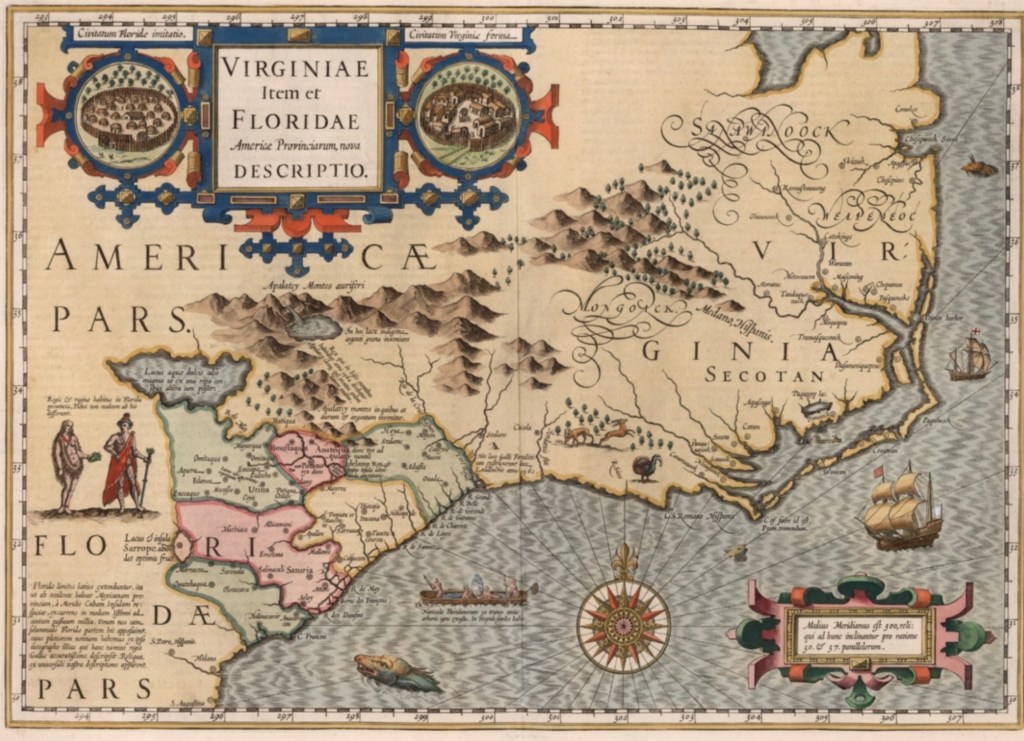
Virginiae Item et Floridae Americae Provinciarum, nova Descriptio.
Map by Gerard Mercator (1512–1594), Jodocus Hondius (1563–1612), and Hendrik Hondius (1597–1651).
Virginiae Item et Floridae Americae Provinciarum, nova Descriptio.
Map by Gerard Mercator (1512–1594), Jodocus Hondius (1563–1612), and Hendrik Hondius (1597–1651).
Published in 1623 by Hendricus Hondius, Amsterdam.
Image courtesy of the David Rumsey Map Collection, David Rumsey Map Center, Stanford Libraries.
Licensed under Creative Commons CC BY-NC-SA 3.0.

Raised within the Romano-Byzantine tradition—formed by both the Roman and Byzantine Catholic rites—I was shaped by a confluence of liturgical beauty, theological depth, and mystical reverence. From that upbringing, there remains not merely memory, but a lasting affection for the rhythm and substance of the faith of my youth. It is not simply a cultural inheritance, but a formative lens through which the sacred, the communal, and the mysterious first revealed themselves. Yet, it would not be accurate to describe my present stance as that of a lapsed Catholic, nor as an atheist, nor as one alienated from the Church. Alienation implies disaffection or estrangement born of expectation unmet or betrayal suffered. What remains is neither rejection nor rebellion, but something quieter and more reflective—a posture of reverent detachment that neither clings nor condemns.

Any attempt to articulate my position must begin by acknowledging the futility of articulation itself—at least in matters concerning the Divine. The belief that the Divine wholly exceeds the bounds of human comprehension and articulation grows only firmer over time. All creeds, revelations, and theological systems—however earnest or inspired—are, in the end, efforts to sketch with a cramped human lexicon and limited imagination that which lies beyond even the highest powers of conception. Far from illuminating the Divine, such efforts only obscure its immensity by imposing upon it our narrow symbols and forms.

Better to liken our theological endeavors to the drawing of maps—maps sketched by explorers who had never seen the coasts they sought to chart. Just as early cartographers filled the margins with dragons, saints, and imagined cities, we adorn the unknown with creeds, cosmologies, and commandments. These are sincere efforts, yet they more often reflect our hopes and fears than reveal any transcendent truth. The more intricate the system, the more seductive the illusion that the map is the territory. But the Divine is not a line upon a page. It is the sea beneath the sea monster, the silence beyond the compass rose, the continent whose very existence remains unknown. To name the Divine is already to misname it; to describe is to distort.

Such a perspective finds its truest expression in apophatic mysticism—the via negativa, the way of negation—a tradition articulated by Pseudo-Dionysius the Areopagite, a Christian thinker of the late fifth to early sixth century whose writings permeate the Catholic tradition through the works of Thomas Aquinas, Bonaventure, and the Spanish mystics, reminding us that the path of unknowing is not a break from faith, but one of its most ancient and revered expressions. In this light, God is not wise, not good, not just, not loving—not because the Divine lacks these qualities, but because our highest notions of them remain shadows cast by a light we cannot behold. Whatever we say of the Divine, however conceived, the most faithful statement is this: our words fall short.

Even so, human beings remain kataphatic creatures as well—creatures who long to speak, to name, to worship, to relate. Thus arises a kataphatic-apophatic tension, a profound and permanent unease between the impulse to speak of the Divine and the recognition that all speech fails. Hymns, liturgies, cathedrals, and doctrines are all human responses to this tension—not to capture the Divine, but to reach toward it, however falteringly. These gestures deserve neither scorn nor uncritical assent. They should be honored, but held lightly, cherished as poems rather than mistaken for proofs.

This tension extends beyond the realm of theology into the very nature of being itself. In a moment of quiet reflection, I found myself asking: “Where is Am I?”—caught between breath and thought, a question turning circles in the hollow of my chest. Am I the echo, or the voice that trembles back? A fragment drifting through the hour, a flicker in the endless light, unsure if I was ever whole or if the pieces were ever mine to find. Such a question is not mere existential uncertainty, but a recognition that the self, like the Divine, eludes definitive capture.

No formal creed or written revelation authored by man commands my assent, however noble or inspired it may be. Faith is not placed in these constructions, though the sacred yearning from which they arise is deeply respected. They are echoes of an original voice no longer heard directly, outlines of a presence glimpsed but never grasped. Like the adornments on ancient maps, these expressions are beautiful and sincere, but they are not to be mistaken for the thing itself.

To some, this may resemble agnosticism, though that word has become burdened with meanings it was never intended to carry—meanings of indecision, skepticism, or apathy. What is expressed here is none of those. It is not a shrug of the shoulders, but a bow of the head. Not the silence of the indifferent, but of the reverent. Not ignorance, but a conscious unknowing—a sacred refusal to impose limitation upon that which exceeds all bounds. This is why I eschew agnostic labels in favor of mystical ones—for the mystic does not claim ignorance of the Divine but acknowledges that true knowledge of it transcends conventional understanding.

What remains, then, is a life lived in contemplation of the ineffable—a contemplation that finds expression through creative work. In poetry, music, and essay, I reach toward that which cannot be directly named. When I write of the “eternal now” where “yesterday, tomorrow, and today collapse,” or compose lyrics that honor Humilitatem Initium Sapientiae, I am not merely creating art but engaging in a form of contemplative practice. These creative acts serve as bridges, not only between myself and the ineffable, but also between myself and others who share this reverent space, regardless of their formal religious affiliations or φιλοσοφίαι (philosophies or wisdom traditions).

The path ahead is not marked by certainty but by awe, not by declarations but by listening. Mystery is not something to be solved, but something to be honored. Years of formal study—first in history and religious studies as an undergraduate, then as a teacher of both subjects, and later through a long career in civil rights law and public service—have only deepened the awareness that human systems, whether intellectual, doctrinal, or legal, ultimately encounter their limits at the threshold of the sacred. In this, the apophatic tradition offers a spiritual home—a dwelling place where reverence begins precisely where language ends. If there is a guiding light for such a path, it is humility—humilitatem initium sapientiae—not merely as a moral posture, but as a metaphysical necessity. That teaching, which echoes throughout Thomas à Kempis’ The Imitation of Christ, remains not only a personal motto, but a settled conviction: that wisdom begins when one ceases to pretend to possess it.

Near the staircase in my front hallway hangs an early map of the New World—an artifact I have long cherished. Its artistry is matched only by its courage, for it dares to depict what was not yet known. Near the region now recognized as Virginia and the Carolinas, a sea monster rises from the ocean’s depths, signaling peril or wonder—perhaps both. On the land itself, figures of “natives” stand, imagined by a hand that never walked those coasts. That map does not record the world; it records what the world dared to imagine. So, too, do our theologies populate the margins of metaphysical uncertainty with monsters and angels, commandments and visions. They are imaginative acts—sincere, flawed, luminous. And like that map, they are to be cherished not for their precision but for what they reveal of the human longing to reach into mystery with word and symbol, with ink and awe. In their earnest striving, they remind us: we are always sketching the edge of the unknown, even when we know we cannot cross it.

Apokalypsis Teleiosis: A Vision of Fulfillment

Approaching Apokalypsis Teleiosis

The prophetic poem Apokalypsis Teleiosis contemplates the culmination of divine purpose—the moment when revelation reaches its fulfillment and silence follows.

The poem unfolds in five movements, each drawing the reader deeper into a journey from divine articulation to fulfillment. Its use of Greek and biblical language is not ornamental but intentional—forming a theological vocabulary that bridges scripture and philosophy. The capitalization of words like Word, Breath, Fire, and Light serves as a kind of “visual theology,” intensifying as the poem progresses toward unity.

This is not a vision of divine ending or abandonment, but of ineffable transformation—a passage into that which exceeds our categories of presence and absence alike. Rather than following familiar apocalyptic themes of sovereignty, judgment, or renewal, this vision moves beyond such categories entirely. The divine is not framed in terms of rule or absence but as a transformation beyond presence and absence alike. It does not end in proclamation but in ordained silence—the stillness that remains when all has been spoken.

This final movement invites contemplation rather than conclusion. The closing line, “In Light beyond light, all is whole,” is not an answer but an opening—a gesture toward the mystery that lies beyond both prophecy and language itself.

The author notes, accessible after the poem by clicking on the button, provides more information about the structure and specifics of the poem.


Apokalypsis Teleiosis (A Vision of Fulfillment)

Γέγοναν. ἐγώ εἰμι τὸ Ἄλφα καὶ τὸ Ὦ, ἡ ἀρχὴ καὶ τὸ τέλος.
(It is done. I am Alpha and Omega, the beginning and the end.) — Revelation 21:6

I. Logos Tetelestai (The Word Fulfilled)

In the beginning was the Word, and the Word was God,
And all arose from His breath—
Light from void, form from welter deep.
The Breath that shaped Adam from dust
Now settles silent in the wind.
Not lost, nor cast aside in ruin,
But drawn unto the end ordained.
No faltering step, no shadowed doubt—
All Will is met, all Purpose whole.

II. Epistrophe (The Return)

The Fire that set the stars in course
Fades not, but meets its destined Rest.
The Name that called the dawn to rise—
El Shaddai, Elohim, I AM—
Now slips beyond the grasp of time.
Not in despair, nor weary sigh,
Not in surrender, nor retreat,
But in the fullness of the Path,
As ocean answers to the shore.

III. Gnosis (Divine Knowledge)

I AM Alpha and Omega, the Spark, the Ember’s end,
The Shadow stretched across the arc.
I AM the Hand that formed the hand,
The Dust that walks, the Flame that thinks.
From Me to Me, from seed to bloom,
From silence into vaster still.
Not lost, not less, but all complete—
The Die returns unto the Forge.

IV. Eschaton Kairos (The Fulfillment of Time)

Now breathless waits the sacred Sky,
Now sound itself resigns to hush.
No temple stands, no altar burns,
For worship folds into the Vast.
The Voice that thundered from the mountain,
That split the sea and called the dead,
Lies hushed within the closing Dawn.
No fear, no cry, no wrath, no woe—
Only the quiet after all.

V. Epekeina (Beyond)

Here fulfills the prophet’s final sight,
For where He goes, none else may gaze.
Not death, nor night, nor vanquished might,
But passing into more than Being.
A hush beyond the thought of man,
A stillness more than endless void.
The First has met the final Dawn—
The circle breaks, the mirror fades,
Purpose achieved in Perfect Light.

(In Light beyond light, all is whole…)