Abandoned classroom. Photo by Pixabay on Pexels.com
The destruction of the U.S. Department of Education is not merely a bureaucratic restructuring or an attempt at governmental efficiency. It is, rather, a brutal, ideologically driven attack on public and higher education itself—an assault decades in the making. The immediate consequences, such as the callous firing of over 1,300 employees and the gutting of its Office for Civil Rights, are alarming, but they are only symptoms of a broader effort to delegitimize and dismantle the tradition of public education in America. This is no accident; it is a deliberate and malicious campaign waged by reactionary forces who have long sought to annihilate the very concept of education as a public good.
Before addressing the broader catastrophe, it is essential to recognize the dedicated public servants whose careers have been abruptly and callously ended. These were not faceless bureaucrats but individuals who dedicated their lives to ensuring access to quality education, protecting civil rights, and supporting students, parents, and teachers. They are the ones who worked tirelessly to administer federal student aid, enforce anti-discrimination laws, and uphold policies meant to ensure that education remained a pathway to opportunity rather than a privilege of the few. To see them falsely maligned and slandered while being discarded so cruelly is an injustice, not only to them but to the nation they so nobly served.
To understand the scope of this travesty, one must acknowledge that public education in the United States has been under sustained assault—not from bureaucrats, not from educators, and certainly not from the imagined “woke” enemies that conservative demagogues irrationally scream about—but from the anti-public education, anti-higher education agenda of the right-wing forces that have festered in the American political landscape since Brown v. Board of Education so deeply outraged the bigoted sensibilities of many Americans. This movement, which cloaks itself in deceptive terms like “school choice” and “parental rights,” is nothing more than a long-running campaign to dismantle public education in favor of a reactionary, privatized system that siphons resources from the many to enrich the few.
Milton Friedman, the sinister patron saint of the libertarian free-market fantasy, provided the economic blueprint for this war on public education. His advocacy for school vouchers was never about “improving education” or “empowering parents”—it was about facilitating the exodus of white children from integrated schools while redirecting public funds into private, often exclusionary institutions. The modern conservative attack on public education is a direct continuation of this shameful tradition, now infused with fresh venom as it seeks to erase any federal coordination, civil rights protections, and guarantee of equal access to education.
And now, with breathtaking ruthlessness, this agenda is reaching its culmination at the hands of pusillanimous politicians hiding behind false narratives. The elimination of nearly half the workforce of the Department of Education within the first two months of the second reign of incompetence is an unmistakable step toward the total obliteration of the department. The Office for Civil Rights, already struggling to process the nearly 25,000 complaints of discrimination it receives from the public yearly and one of the last remaining institutional bulwarks against discrimination in schools—has been slashed to the bone, ensuring that students with disabilities and others who are discriminated against, whether on sex or race or national origin, will have nowhere to turn for timely relief when their rights are trampled. This is not accidental; this is the plan.
The current Education Secretary, in the grand Orwellian tradition of this administration, has assured the public that these cuts will somehow improve “efficiency” and “accountability.” Such statements are not merely disingenuous—they are outright lies, designed to mask the true intent behind this evisceration: to dismantle any federal structure that protects education as a right rather than a privilege reserved for the wealthy and well-connected.
Adding further insult to this grievous injury, the most aggrieved one has handed the reins of this demolition project to none other than our billionaire tech overlord. This grotesque display of plutocratic interference sees our billionaire tech overlord—who has no experience in education policy but plenty of experience in exploiting workers—granted unfettered access to sensitive government data and decision-making power over federal agencies. Under the laughable guise of “efficiency,” his Technokratische Jugend has set about dismantling the very institutions that serve as the backbone of public education, further centralizing power in the hands of the ultra-rich while leaving working Americans to suffer the consequences.
But let us be clear: this is not just an attack on those in public service. It is an attack on the very principle that education should be accessible to all, that an informed citizenry is essential to democracy, that knowledge should not be hoarded by the privileged few. It is an attack on the American future, a calculated and malevolent act of national sabotage designed to entrench ignorance and subjugation. Presently, the enlightened pro-choice anti-education agenda of our political elite has delivered unto us a nation where 54 percent of adults read only at the 6th grade level—imagine a decade hence where we will be!
Public education is not a luxury; it is the foundation of an equitable society. The destruction of the U.S. Department of Education is not about “efficiency” or “streamlining” government—it is about ensuring that the levers of power remain in the hands of a select few while the masses are kept ignorant, powerless, and too overwhelmed to fight back. This is a crisis of democracy, and it will have consequences that reverberate for generations.
The wreckage of this assault will be vast and far-reaching. Higher education costs will continue to increase as many institutions shutter their doors, vocational training programs will wither, and civil rights enforcement in schools will become an afterthought, if it exists at all. Meanwhile, a handful of oligarchs and right-wing ideologues will gloat over their victory, having successfully reduced one of the last bastions promoting American progress into a smoldering ruin. And continue to pay attention to the war on institutions of higher education, our overlords are not done reducing our heirs into ignorance.
Detail highlighting the dust motes from “Støvkornenes dans i solstrålerne” (Dust Motes Dancing in the Sunbeams, 1900) By Vilhelm Hammershøi (1864-1916) Oil on canvas, 70 cm × 59 cm Ordrupgaard Museum. Photograph Public Domain.
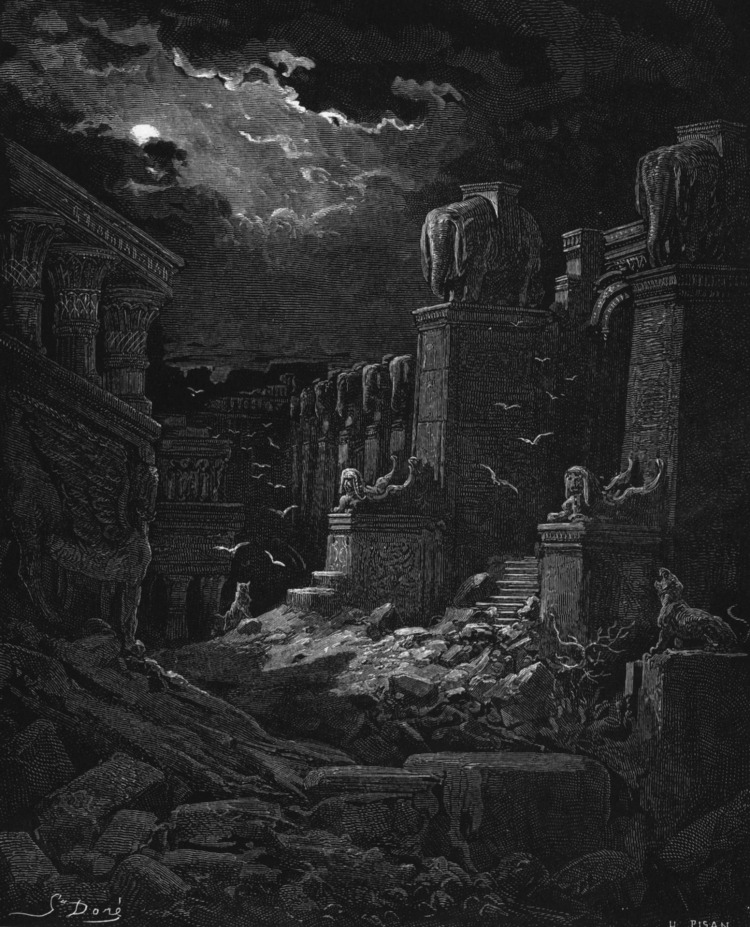
Dust lingers in the ruins of empires, in the fading footprints of the past. It clings to the forgotten, settles upon the broken. T.S. Eliot’s The Waste Land declares “I will show you fear in a handful of dust,” evoking a profound existential dread—the terror of insignificance, the finality of death in a world where nothing endures. Shelley’s Ozymandias presents the cruel irony that even the mightiest fall into dust, their ambitions erased by time. Shakespeare reinforces this democratic nature of mortality in Cymbeline, reminding us that: “Golden lads and girls all must, / As chimney-sweepers, come to dust” (Act IV, Scene 2). The biblical refrain, “For dust you are, and to dust you shall return” (Genesis 3:19) serves as a humbling reminder of human mortality—our bodies fated to mingle with soil and ruin.
This narrative of dust as dissolution has dominated our cultural consciousness for millennia. Yet beneath this interpretation lies a profound irony: the very science that revealed our cosmic insignificance also offers us a path to transcendence.
As we began to understand the origins of matter itself, a counternarrative emerged. The spectrographic analysis of stars, the discovery of nucleosynthesis, and the mapping of elemental creation within stellar lifecycles revealed an unexpected truth: the dust of our being is not merely the residue of life lost but the particulate remnants of stars long dead.
This scientific revelation transforms our relationship with dust. No longer just the symbol of our inevitable decay, it becomes evidence of our cosmic lineage. In this expanded understanding, we are made of elements forged in stellar cores—carbon, oxygen, nitrogen, iron—the ashes of ancient supernovae. As Carl Sagan elaborated: “The nitrogen in our DNA, the calcium in our teeth, the iron in our blood, the carbon in our apple pies were made in the interiors of collapsing stars.” (Cosmos, 1980)
The death of those stars gave birth to us. Thus, when our bodies return to dust, they are not returning to nothingness, but to the infinite. This is a poetic inversion of the traditional dread associated with dust. Instead of entropy as a reduction to meaninglessness, it becomes a return to something larger than the self.
Where Eliot shows us fear in dust, Carl Sagan tells us: “The cosmos is within us. We are made of star-stuff.” Lawrence M. Krauss echoes this sentiment: “Every atom in your body came from a star that exploded…. You are all stardust… the carbon, nitrogen, oxygen, iron …. They were created in the nuclear furnaces of stars.” (A Universe from Nothing, 2009)
The Paradox of Cosmic Fear
If one understands oneself as a finite being, bound to decay, dust is terrifying—it signifies loss. But if one understands oneself as an ephemeral expression of the universe, momentarily coalesced and destined to dissolve back into the great celestial flow, then there is no reason for fear. The end is not the end, but a return to origins.
So why does existential dread persist? Perhaps it is the ego’s reluctance to let go of selfhood. Perhaps it is the mind’s inability to accept that individual consciousness does not endure. Perhaps it is because dust, unlike stars, is silent. A ruined city, a forgotten name, a scattering of bones—all speak of oblivion, not grandeur.
As William Blake advised in The Proverbs of Hell, we “Drive [our] cart and [our] plow over the bones of the dead,” suggesting our instinctive fear of becoming that which is trampled and forgotten. Jorge Luis Borges captures this anxiety when he writes that “time is a river which sweeps me along, but I am the river”—we are both the eroder and the eroded, the dust-maker and the dust.
Yet, as a poem once attributed to Emily Dickinson but now considered of uncertain authorship reminds us: “Ashes denote that fire was; / Revere the grayest pile / For the departed creature’s sake / That hovered there awhile.” Dust does not truly vanish. It transforms.
Yet if the erasure of self is what we fear, we must ask: is selfhood truly lost, or merely transformed? If dust dissolves, does it vanish—or does it scatter into something greater?
From Dust to Light: The Redemption of Stardust
Yet if we understand dust not as an annihilation of self but as the very fabric of renewal, the fear dissolves. The metaphor itself must be rewritten: From dust we are made, from stardust we are formed. To dust we return, to the stars we return.
Walt Whitman intuited this cycle when he wrote: “I bequeath myself to the dirt to grow from the grass I love.” (Song of Myself, LII) His biological understanding of transformation prefigures our cosmic one—matter recycled through systems larger than ourselves.
If the metaphor itself shifts, then the meaning shifts with it. We do not fall into dust; we rise into radiance. We do not vanish into the void; we dissolve into the cosmos, as much a part of the next great supernova as we once were of the last. Even in knowing that we return to the stars, a quiet unease remains: what of the self? If I dissolve into light, is there still an “I”?
This cosmic transformation demands a new poetic language—one that recasts the traditional imagery of dust not as a symbol of loss but as a promise of renewal. If we are to truly grasp this shift in understanding, we must reimagine the very metaphors through which we comprehend our mortality. In the spirit of this reframing, I offer these verses that trace our journey from stardust to dust and back again:
From dust we are made— Not of earth, but embered light, Forged in stellar furnace bright, A whisper of stars in the cosmic shade.
To dust we return— Not to silence, not to loss, But scattered bright across the gloss Of galaxies that twist and burn.
Fear not the handful of dust— It is not death, nor mere decay, But embers cast upon the way, To rise once more in cosmic trust.
Thus, the fear in Eliot’s handful of dust dissolves when we see it not as an end, but as a beginning of something else. In the vast cosmic cycle, there is no finality—only motion, only transformation. The Rubaiyat of Omar Khayyam gestures toward this understanding when it speaks of being “Star-scatter’d on the Grass”—our elements returning to the cosmos from which they came. If all that we are, all that we love, all that we create ultimately returns to the stars, is that not immortality?
The Choice of Understanding
We return to the beginning, as dust does. The words of Genesis remind us: “For dust you are, and to dust you shall return.”
Yet now, having traced the journey of dust from earth to stars, we hear these words anew. Through the narrow human lens, we interpret them as a grim certainty—dust as ruin, silence, and the erasure of memory. We see only decay, the dissolution of self, the inevitable fading of all things into oblivion.
But through the enlightened cosmic lens, we recognize a deeper truth. Dust is not an end, but a transformation. It is not absence, but renewal. It is potential, energy, and the foundation of new worlds.
As Jorge Luis Borges reflects in We Are the Time:
“We are the time. We are the famous metaphor from Heraclitus the Obscure. We are the water, not the hard diamond, the one that is lost, not the one that stands still. We are the river and we are that Greek who looks himself in the river.”
Borges, invoking Heraclitus’ ever-flowing river, offers a vision of existence as movement, dissolution, and renewal. We are not fixed, immutable beings; we are the water, ever-changing, ever-returning to the whole. If we are dust, then we are not the dust that settles, but the dust that travels—the dust that, like the stars, finds itself scattered only to be reshaped into something new.
To understand this is to grasp something beyond the immediate and the visible. It is to move past fear into recognition: that what was once bound into form returns to the vastness, not in loss, but in continuation. That what dissolves is not diminished but remade, part of a cycle stretching beyond human time. What Yeats called “a terrible beauty” is born in this transformation—terrible in its finality, beautiful in its cosmic potential.
Perhaps it is our task, then, to choose how we understand our own dust—not as the extinguishing of life, but as its return to the great fire from which it came. In this cosmic understanding, we are not merely dust returning to dust, but light returning to light—briefly kindled, then scattered again, not into oblivion, but into reunion with the luminous whole from which we emerged.
The completion of my poem Whispers of the Waning Light left an impression lingering in my thoughts, a quiet meditation on the nature of longing, time, and the elusive quality of memory. In reflecting on that poem, I found myself drawn to the word wistful—a word that seems to stretch between the weight of longing and the lightness of a dream. The following brief essay is an exploration of that thought.
Støvkornenes dans i solstrålerne (Dust Motes Dancing in the Sunbeams, 1900) By Vilhelm Hammershøi (1864-1916) Oil on canvas, 70 cm x 59 cm. Ordrupgaard Musuem. Photograph Public Domain.
An audio recitation of the essay by the author.
The Weight of Longing and the Lightness of Dreams
Wistful is a wonderful word in our lexicon. It has slender shoulders but a muscular frame, and with each passing year, it grows, paradoxically enough, in vigor—able to inspire more ably imagination, poetry, memory, and vivid recall. The language with which we write, think, and contemplate is most remarkable indeed.
There is a paradox at the heart of wistfulness. It is a longing imbued with both the weight of the past and the lightness of the dream. Unlike simple nostalgia, which binds one to memory with a chain of sentiment, wistfulness carries a certain buoyancy, a gentle drift between what was and what might have been. It is not an emotion of mere loss, but rather one of continued yearning—an ache that does not wound but instead stirs, provokes, and enlivens.
Across centuries, wistful has carried shades of longing, attention, and awareness—never merely a passive sigh but a reaching toward what shimmers just beyond our grasp.
It is the mind’s way of grappling with the ethereal, of shaping dreams from recollections, of crafting possibilities from the echoes of what has already passed.
This duality—the weight of longing and the lightness of dream—has long been explored in poetry and literature. Keats’ Ode to a Nightingale shimmers with this very tension, the desire to dissolve into beauty while being tethered to the mortal world. Proust’s In Search of Lost Time captures it in the way a madeleine dipped in tea can summon an entire universe of memory. Even T.S. Eliot, in The Love Song of J. Alfred Prufrock, wrestles with the wistfulness of unlived potential, of questions left unanswered and paths left untaken.
Yet wistfulness is not purely literary; it is deeply personal, shaping our thoughts in quiet moments of reflection. It is the fleeting recognition of something beautiful that has passed, or the sudden awareness of an almost-forgotten dream. It is the feeling of standing at the edge of a vast, metaphorical ocean, where the horizon shimmers with the unknown, both beckoning and receding at the same time.
Perhaps this is why wistfulness endures, growing not weaker but stronger with time. It is an emotion that deepens as we collect more moments of beauty and loss, as we come to understand that our longings are not burdens but invitations—to reflect, to remember, and to dream anew.
Moonlight, Strandgade 30 (1900-1906) – Vilhelm Hammershøi (1864–1916) Oil on canvas, 41 x 51.1 cm; On view at The Met Fifth Avenue, Gallery 813. Hammershøi’s Moonlight, Strandgade 30 captures the stillness of night in his Copenhagen apartment, where light and shadow become the true subjects of the scene. Photograph courtesy The Metropolitan Museum of Art, Public Domain
A poem by D.S. Yarab, reflecting on the fleeting nature of time, the way memories persist even as moments dissolve, and how the quiet glow of moonlight can stir both longing and serenity.
Whispers of the Waning Light
The misted pane distorts the night, A wavering world in silvered hue, The lamplight bends—a trembling sight, Yet past and present shimmer true.
The clock-hands drift in softened glide, Their silent whispers feign retreat, Yet memories, steadfast at my side, Hold time within their quiet seat.
A voice long stilled, yet clear it sings, A scent unbidden lingers near, As if the years had feathered wings, And bore me back to what was dear.
Yet all dissolves in drifting haze, Elusive as the frost-bound air, What tempts the mind, what thought betrays, What hand still grasps what is not there?
So let the veils of time unwind, No rush to capture or define— For in the fleeting, we may find That all was ours, yet none was mine.
The United States was founded as a democratic republic, a nation where governance was entrusted to the people and their elected representatives. Yet, in the present age, democracy appears increasingly untenable, not because of external threats, but because the citizenry itself seems willing to surrender its role in self-governance. Rather than engaging in the messy and difficult work of democracy, Americans have increasingly deferred power to an elite class—oligarchs whose wealth, status, and influence have elevated them beyond the reach of ordinary accountability. In doing so, we have embraced a political theology that anoints the rich as our rightful rulers, sanctifying economic disparity as though it were ordained by divine providence.
A key factor in this transformation is the theological justification for inequality, particularly through the Prosperity Gospel—a strain of Christianity that equates material wealth with divine favor. If wealth is a sign of God’s blessing, then poverty must be a mark of moral or spiritual failure. This belief, deeply embedded in the American consciousness, has provided a convenient ideological foundation for the rise of oligarchy. The result is a republic in name only, where the wealthy govern without meaningful challenge, and where democracy is tolerated only to the extent that it does not threaten the interests of the ruling elite.
Alexis de Tocqueville, in Democracy in America, warned that “the aristocracy of manufacturers… are one of the most dangerous that has ever appeared in the world” because they hold power over the masses without obligation or accountability. Likewise, James Madison in The Federalist No. 10 cautioned that factions dominated by economic interests would threaten the republic, as “the most common and durable source of factions has been the various and unequal distribution of property.”
II. The Historical Cycle: Republics in Decline
America is not the first republic to slide into oligarchy. The Roman Republic offers a particularly illuminating parallel. Beginning as a relatively participatory system after the expulsion of its kings, Rome’s republic gradually concentrated power in the hands of wealthy patricians. By the late republic, a handful of families controlled vast estates worked by slaves, while formerly independent farmers were displaced into a dependent urban proletariat. The final century of the republic saw repeated attempts at reform by populist leaders like the Gracchi brothers, who were assassinated for proposing land redistribution. When Julius Caesar crossed the Rubicon in 49 BC, the republic that had stood for nearly 500 years had already been hollowed out by economic inequality.
Venice provides another instructive example. The Republic of Venice began with a relatively broad-based Great Council of citizens. However, in 1297, the Serrata (closure) of the Great Council permanently fixed membership to established families, creating a hereditary aristocracy. Over time, even within this oligarchy, power concentrated further into the hands of the Council of Ten and eventually the three State Inquisitors. What began as a merchant republic gradually calcified into rule by the few, with elaborate ceremonies maintaining the fiction of the Serenissima Respublica (Most Serene Republic) while actual democratic elements withered.
The Weimar Republic’s collapse demonstrates how economic crisis can accelerate democratic decline. The hyperinflation of 1923 and the Great Depression devastated Germany’s middle class, traditionally democracy’s strongest supporters. As economic security vanished, so did commitment to democratic processes, with many seeking salvation in authoritarian alternatives. Alarmingly, in contemporary America, we witness similar anti-democratic impulses despite experiencing nothing remotely comparable to Weimar’s catastrophic conditions—suggesting that our democratic erosion stems not from genuine economic devastation but from manufactured grievance and the deliberate exploitation of social divisions.
But what fuels this manufactured grievance? Unlike the desperate economic collapse of Weimar Germany, today’s American discontent is stoked less by material suffering and more by a carefully cultivated sense of resentment. The modern oligarchy has perfected the art of distraction, channeling public anger away from corporate excess and systemic inequality and toward cultural and ideological battles that serve no economic interest for the working and middles classes. Instead of demanding higher wages, we are encouraged to fight over identity politics. Instead of questioning why billionaires pay lower tax rates than teachers, Americans are bombarded with outrage over books in libraries. Economic anxiety is repackaged into tribal conflict, ensuring that the real architects of inequality remain unchallenged.
This strategy is not accidental—it is the logical evolution of the media landscape. As traditional journalism declines, political entertainment thrives. Once, the press served as a check on power; now, it too is absorbed into the machinery of grievance, owned by the very oligarchs it should scrutinize. The consolidation is staggering: 90% of U.S. media is now controlled by just six corporations, compared to 50 companies in the 1980s.[1] This concentration has decimated local journalism while amplifying voices that serve oligarchic interests. The electorate is not simply disengaged—it is actively misled, encouraged to see fellow citizens as enemies rather than those who rule over them. This is not the erosion of democracy through neglect, but through engineering.
The success of this model is evident in voter behavior. Discontent no longer translates into economic reform movements or policy advocacy; instead, it is absorbed into personality-driven politics, where would-be strongmen are seen as righteous warriors against manufactured threats. The shift from democracy to oligarchy is not imposed—it is sold, marketed, and ultimately, embraced.
In this light, the warnings of America’s founders appear remarkably prescient. Thomas Jefferson warned against an “aristocracy of monied corporations” and stated, “I hope we shall… crush in its birth the aristocracy of our monied corporations which dare already to challenge our government to a trial of strength, and bid defiance to the laws of our country” (Letter to George Logan, November 12, 1816). Yet today, we have embraced the very model the Founders feared, allowing economic elites to determine policy, shape culture, and control the mechanisms of governance. The people, rather than resisting this transformation, have largely accepted it—guided in part by a religious narrative that equates power with virtue and poverty with failure.
III. The New Oligarchy: Wealth as Divine Favor
The modern American oligarchy is not merely composed of the wealthy, but of those who have successfully positioned themselves as figures of admiration and near-worship. Silicon Valley billionaires, hedge fund magnates, and political dynasties have become the new aristocracy, justified not by noble birth but by financial success. What separates today’s oligarchs from the robber barons of the past is not their wealth alone, but the theological and cultural framework that has shielded them from critique.
The concentration of wealth has reached unprecedented levels. According to Federal Reserve data, the top .1 percent of Americans—just 330,000 individuals—now hold 12.5% of the wealth, a staggering 40% increase from 8.9% in 2010. Meanwhile, the bottom 50% of Americans—165 million people—now hold only 5.5%.[2] This means the richest one-thousandth of the population controls more than twice the wealth of half the entire country. This marks a historic reversal of the post-WWII economic order. Yet rather than prompting concern, this concentration is often celebrated as evidence of entrepreneurial success and innovation.
This oligarchic influence extends beyond domestic borders. Foreign billionaires and sovereign wealth funds increasingly shape American policy and economic priorities through strategic investments, lobbying efforts, and ownership of U.S. assets. The globalization of capital has created a transnational oligarchic class whose interests often align regardless of nationality, further removed from democratic accountability. While domestic oligarchs at least feign the pretense of national loyalty, foreign wealth operates with even fewer constraints, treating American democracy as simply another market to be influenced or manipulated for profit.
The Prosperity Gospel, a uniquely American theological development, has played a significant role in this transformation. This doctrine teaches that material success is evidence of God’s blessing, while poverty signals a lack of faith or effort. In this view, wealth is not merely economic—it is moral. This ideology serves as a powerful deterrent to any redistributionist impulse, as it frames economic disparity as a reflection of divine will rather than systemic injustice.
Consider concrete manifestations of this oligarchic power: Congressional studies show that policy outcomes overwhelmingly align with the preferences of the wealthy. The Princeton study by Gilens and Page (2014) concluded that “economic elites and organized groups representing business interests have substantial independent impacts on U.S. government policy, while average citizens and mass-based interest groups have little or no independent influence.”[3] This influence is maintained through campaign finance—in the 2020 election cycle alone, the top 20 billionaire donors collectively spent $2.3 billion, more than twice as much as Joe Biden’s entire campaign, with a single billionaire contributing over half that sum.[4] Our democracy has effectively been captured by a donor class whose interests dictate policy priorities.
This capture extends to the very institutions designed to safeguard democracy. The judiciary, once a bulwark against concentrated power, has been systematically reshaped through strategic appointments and massive funding of judicial campaigns. Supreme Court decisions like Citizens United have equated money with speech, unleashing unprecedented corporate (thus oligarchic) influence in elections. Meanwhile, elected officials increasingly depend on wealthy donors and corporate PACs to fund ever-more-expensive campaigns, creating a system where access and influence are directly proportional to financial contributions. The result is a government formally elected by the people but functionally beholden to monied interests.
We see this play out in specific policies. The 2017 Tax Cuts and Jobs Act delivered massive benefits to corporations and wealthy individuals while adding $1.9 trillion to the national debt. Meanwhile, proposals for universal healthcare, student debt relief, or expanded social services—policies that would benefit the broader citizenry—face insurmountable opposition despite popular support. The revolving door between Wall Street and government regulatory agencies ensures that financial regulations are written by and for the financial elite. Figures like Steven Mnuchin, who moved from Goldman Sachs to hedge fund companies to Treasury Secretary, or Gary Gensler, who went from Goldman Sachs to Assistant Treasury Secretary, Under Secretary of the Treasury, Chair of the Commodity Futures Trading Commission, Commissioner of the U.S. Securities and Exchange Commission, and Chair of the Securities and Exchange Commission, exemplify how the line between regulator and regulated has blurred beyond recognition. When financial institutions faced collapse in 2008, they received immediate bailouts, while millions of Americans lost their homes with minimal assistance.
The tax system itself has been shaped to benefit the oligarchy. In 2021, ProPublica revealed that the 25 richest Americans paid an effective tax rate of just 3.4% between 2014-2018, while the average American paid around 14%.[5] This disparity did not occur by accident but through deliberate policy choices that allow the wealthy to categorize income as capital gains, exploit loopholes, and shield assets through complex financial structures unavailable to ordinary citizens.
Yet, the same religious justifications that elevate the wealthy conveniently overlook the conduct of those at the top. The modern oligarchs are often anything but paragons of virtue. Their lifestyles, filled with excess, exploitation, and moral as well as often legal bankruptcy, are far removed from the Christian ideals of humility, charity, and service. As Jesus himself warned in Matthew 19:24, “Again I tell you, it is easier for a camel to go through the eye of a needle than for someone who is rich to enter the kingdom of God.” And yet, the rich are celebrated, while the poor—often vilified as lazy or undeserving—are left to navigate a system rigged against them.
IV. The Willing Servitude of the Electorate
This transition from democracy to oligarchy has not been solely imposed from above; it has been embraced from below. A significant portion of the American electorate has come to see governance not as a participatory duty, but as a spectacle—one in which wanna-be strongmen and billionaires are revered as saviors rather than as figures to be held accountable.
Some defend this system as a meritocracy, where wealth reflects productivity and innovation. Yet Federal Reserve data shows that, using historically typical rates of return, inherited rather than earned wealth may account for over half of total wealth, undermining the narrative that economic status is purely the result of individual effort.[6] When nearly half of all wealth comes through inheritance, the myth of pure meritocracy becomes impossible to maintain. Nevertheless, the electorate continues to defend a system that increasingly resembles the hereditary aristocracies our founders sought to abolish.
The cultural obsession with wealth, combined with religious narratives that equate prosperity with righteousness, has dulled the instinct for democratic engagement. Why question the morality of economic inequality when it is perceived as a reflection of God’s order? Proverbs 22:7 states, “The rich rule over the poor, and the borrower is slave to the lender.” Why demand accountability from the ruling class when they are seen as divinely chosen stewards of the nation’s fate?
This abdication of democratic responsibility has been significantly accelerated by the capture of media institutions by the same oligarchic interests. Independent, objective news sources have largely disappeared from citizens’ lives, replaced by conglomerates owned by the very elites whose power should be scrutinized. What passes for journalism often amounts to ideologically laden content designed to reinforce existing power structures while appearing to inform. The resulting information ecosystem leaves citizens simultaneously overwhelmed with content yet starved of the context and critical analysis necessary for meaningful democratic participation. This theological deference to wealth has allowed democracy to wither, not through violent overthrow, but through active acquiescence.
The illusion of consumer choice masks growing corporate concentration, where 75% of household items are now controlled by just ten corporations.[7] When we believe we are making free market choices, we are often simply selecting between products owned by the same conglomerate. This mirrors our increasingly limited political choices, where candidates across the spectrum rely on the same donor base and serve similar corporate interests despite superficial differences in rhetoric.
Consider Amazon’s successful opposition to unionization efforts in Bessemer, Alabama (2021-2022), where billions in corporate resources were deployed to defeat workers seeking basic protections and better wages.[8] Rather than seeing this as class conflict, many Americans defend corporate interests against their own economic self-interest, having internalized a worldview where the market is sacrosanct and labor organization is somehow un-American. This represents the culmination of decades of ideological cult conditioning that has separated Americans from their own civic and economic power.
V. The Disappearance of Ethics in Public Life
If the Prosperity Gospel were true to Christianity, it would demand that the wealthy adhere to moral obligations—generosity, humility, and justice. Yet the reality is quite the opposite. The modern oligarchy exploits faith not to guide ethical behavior, but to silence dissent.
Throughout history, faith has been a force for challenging power—from the Social Gospel movement’s advocacy for labor rights to Martin Luther King Jr.’s invocation of Christian morality in the fight for civil rights. Dr. King warned, “We must rapidly begin the shift from a ‘thing-oriented’ society to a ‘person-oriented’ society” (Beyond Vietnam: A Time to Break Silence, April 4, 1967), criticizing the worship of material success over human dignity.
Yet today, much of American Christianity has been hollowed out, transformed into a vehicle for wealth-worship rather than a challenge to injustice. The teachings of Jesus, who spoke of the poor inheriting the kingdom of God and the moral dangers of riches, have been replaced by a doctrine that tells the poor they simply need to pray harder and wait their turn.
VI. The Oligarchs’ America
The American experiment in democracy appears to be in retreat, not because of foreign invaders or external threats, but because we have abandoned the very principles that sustain it. A democracy requires engaged citizens, yet we have become a nation content to let the wealthy govern without challenge. A republic requires accountability, yet we have deified billionaires and accepted their dominion as inevitable, if not righteous.
The Prosperity Gospel and its ideological offshoots have played a crucial role in this transformation. By equating wealth with divine favor, they have given a theological foundation to inequality and sanctioned the rise of oligarchy. This ideology has not only justified the unchecked power of the rich, but has also pacified the poor, persuading them that their struggles are personal failings rather than structural injustices.
If America is to reclaim its democratic aspirations, it must first confront the myths that have enabled its decline. We the People must remember that wealth is not virtue. Power is not righteousness. And democracy is not sustainable when its people cease to believe in their own right to govern. Until these truths are recognized, the nation will remain in the hands of those who have been deemed, by wealth and by providence, our betters.
History shows that oligarchic rule is not an inevitability. From the antitrust reforms of the early 20th century to the labor movements that shaped the New Deal, democratic resurgence is possible when citizens recognize their own power. But this requires first dispelling the myths that sustain the status quo: that wealth equals virtue, that political change is impossible, and that democracy is someone else’s responsibility.
[1] Ashley Lutz, “These 6 Corporations Control 90% of the Media in America,”’ Business Insider, June 14, 2012.
[3] Martin Gilens and Benjamin I. Page. “Testing Theories of American Politics: Elites, Interest Groups, and Average Citizens.” Perspectives on Politics 12, no. 3 (2014), 565.
[6] Laura Feiveson and John Sabelhaus. “How Does Intergenerational Wealth Transmission Affect Wealth Concentration?” Federal Reserve FEDS Notes, June 1, 2018.




 Northcoast Antiquarian